Showing posts with label Cold War. Show all posts

Wednesday, May 28, 2025

Dana Andrews and Gene Tierney are trapped behind “The Iron Curtain”

The Iron Curtain (1948) is an American espionage thriller directed by William A. Wellman and starring Dana Andrews and Gene Tierney. It is based on the memoirs of Igor Gouzenko, a Russian code deciphering expert working at the Soviet embassy in Ottawa, Canada, in 1943. The supporting cast includes June Havoc, Berry Kroeger, and Edna Best. This was the first about the Cold War.

Dana Andrews plays Igor Gouzenko, an expert at deciphering codes, who arrives at the Soviet embassy in Ottawa to help set up a base of operations to spy on the Canadian government. At first, Igor is loyal to the Russian cause, but once his pregnant wife, Anna (Tierney), arrives, he begins to have second thoughts.

Is capitalism as evil as he has been taught? Does Russia deserve his loyalty?

Once it is decided that Igor is to be sent back to Moscow, he faces a difficult decision.


Gene Tierney and Dana Adrews

William A. Wellman (1896 – 1975) was an American film director. He started his directorial career in silent films. Wellman directed Wings (1927), which was the first film to win the Academy Award for Best Picture at the 1st Academy Awards ceremony. Wellman directed two classic films released in 1937: Nothing Sacred and A Star is Born. Other important films directed by Wellman include Beau Geste (1939), Roxie Hart (1942), The Story of G.I. Joe (1945), Yellow Sky (1948), Battleground (1949), and The High and the Mighty (1954).

Dana Andrews (1909 – 1992) was an American stage and film actor. During the 1940s, Andrews was a major star and leading man in Laura (1944), State Fair (1945), A Walk in the Sun (1945), The Best Years of Our Lives (1946), Canyon Passage (1946), Boomerang! (1947), and Daisy Kenyon (1947) co-starring Joan Crawford and Henry Fonda. During the 1950s, film roles were harder to come by, but he had success in Elephant Walk (1954) co-starring Elizabeth Taylor and Peter Finch, While the City Sleeps (1956), and Curse of the Demon (1957). In 1958, he replaced Henry Fonda on Broadway in Two for the Seesaw.

Gene Tierney (1920 – 1991) was an American actress. Tierney got her start on the stage where she played the ingenue lead in The Male Animal. Tierney made her movie debut in 1940 in The Return of Frank James starring Henry Fonda. She worked steadily in the early 1940s but established herself as a top box office star with Laura (1944). She starred in Leave Her to Heaven the next year, which was the biggest hit of the year and Fox’s biggest moneymaking success until The Robe (1953). Other successes for Tierney include Dragonwyck (1946), The Razor’s Edge (1946), and The Ghost and Mrs. Muir (1947).


The Iron Curtain trivia

  • The film was shot on location in Ottawa.
  • Soviet sympathizers tried to disrupt location shooting, but were unsuccessful.
  • The fourth of five movies Andrews and Tierney made together.
  • The film was the number one movie in America during its first two weeks of release and was a commercial success.
  • New York Times film critic Bosley Crowther said the film would negatively impact U.S. Soviet relations. Producer Darryl F. Zanuck responded to Crowther’s review in a much-publicized letter to the critic.
  • Twentieth Century Fox considered The Iron Curtain to be one of their biggest films of the year; the film’s score was played with the studio logo instead of the Fox fanfare.


Click HERE to watch the movie on YouTube.


Click HERE to join the online discussion on June 2, 2025, at 6:30 p.m. Central Time. Once you RSVP, you will receive an email with an invitation and a link to join the discussion on Zoom.


Discussion questions

  1. Considering this film was made at a time when the Cold War was just beginning, does it hold up as entertainment?
  2. Did the film’s documentary-style narrative appeal to you?
  3. Do you think the film was realistic in its portrayal of the Russian spies?
  4. Did the on-location filming at to the film’s realism?
  5. How do you think the film was received by audiences in 1948?
  6. Did the film remind you of other movies you’ve seen?
  7. Forgetting that the film is based on a true story, does it work as a political thriller?
  8. The film was criticized for using music from Russian composers. What did you think of the film score? Does it work?

Tuesday, March 26, 2024

James Cagney tries to sell Coke-a-Cola to the Soviets in “One, Two, Three”

One, Two, Three (1961) is an American political comedy film directed by Billy Wilder and starring James Cagney, Horst Buchholz, Lilo Pulver, Pamela Tiffin, and Arlene Francis. The screenplay was written by Wilder and frequent partner I.A.L. Diamond. The music is by Andre Previn and the cinematography is by Daniel L. Fapp who won an Academy Award for West Side Story (1961).

C.R. “Mac” MacNamara (Cagney) is an executive with the Coca-a-Cola Company, based in West Berlin during the early days of the Cold War. He was sent there after a business failure in the Middle East. Still bitter over the demotion, Mac is determined to become head of the Western European operations in London. While attempting to introduce Coke to the Soviet Union, Mac’s boss asks him to look after his seventeen-year-old daughter Scarlett (Tiffin) when she arrives in Berlin.

Looking for a “marvy” time in Berlin her trip to Europe wasn’t any fun for her. Scarlett goes out every night, unbeknownst Mac and his wife Phyllis (Francis). Every night, Scarlett would sneak over to East Berlin where she met a Russian Communist named Otto (Buchholz). She falls in love with him and they get married. Then, she declares she’s pregnant!

What will Mac do when Scarlett’s parents come to Berlin to take her home to Georgia?

Billy Wilder (1906 - 2002) was an Austrian-born American film director, screenwriter, and producer. He won six Academy Awards for his writing and direction and was nominated twenty-one times over a career that spanned five decades. Wilder started his career as a writer, penning the screenplays for Ninotchka (1939), Ball of Fire (1942), Double Indemnity (1945), The Lost Weekend (1946), Sunset Boulevard (1951)  Boulevard (1951)Sabrina (1955), Some Like it Hot (1960), and The Apartment (1961). As a director, he won Academy Awards for directing The Lost Weekend (1946) and The Apartment (1961). Wilder directed fourteen different actors in Oscar-nominated roles. He is considered one of the most versatile directors from Hollywood’s Classical period.

Billy Wilder (far left), Pamela Tiffin, James Cagney, and Horst Buchholz


James Cagney (1899 – 1986) was an American actor of stage and film. During the early 1930s, Cagney emerged as one of the biggest stars in Hollywood in films like The Public Enemy (1931), Angels with Dirty Faces (1938), Yankee Doodle Dandy (1942), and White Heat (1949). Cagney was nominated for the Academy Award for Best Actor three times, winning for Yankee Doodle Dandy. His other Best Actor nominations was for Angels with Dirty Angels, and Love Me or Leave Me with Doris Day. Cagney retired from acting in 1961 but came out of retirement 20 years later for a role in the movie Ragtime (1981).

Horst Buchholz (1933 - 2003) was a German actor who was once called “the German James Dean” was an international movie star and voice artist. In America, he starred in The Magnificent Seven (1960), One, Two Three (1961). He starred opposite Leslie Caron in Fanny (1961) and Nine Hours to Rama (1963). He’s almost as famous for the roles that got away. He was offered the roles of Tony in West Side Story (1961) and Sherif Ali in Lawrence of Arabia (1962) but scheduling conflicts prevented him from starring in those films.


Pamela Tiffin (1942 – 2020) was an American film, stage, and television actress. She was discovered by producer Hal Wallace while she was on a tour of Paramount Studios. She was given a screen test and was cast in the film version of Summer and Smoke (1961). Her next film was Billy Wilder’s One, Two, Three (1961). Wilder caller her “the biggest find since Audrey Hepburn.” She was nominated for a Golden Globe award for her first two roles. Other roles followed in State Fair (1962), Come Fly with Me (1963), The Pleasure Seekers (1963). She made two films with James Darren geared for the teen audience: For Those Who Think Young (1964) and The Lively Set (1964). In 1965 she co-starred with Burt Lancaster, Lee Remick, and Jim Hutton in The Hallelujah Trail. She also co-starred with Paul Newman in Harper (1966). In 1967, she won a Theatre World Award for her performance in Dinner at Eight on Broadway.

Arlene Francis (1907 – 2001) was an American stage, television, and film actress. Her career spanned more than five decades. Francis also gained fame as a radio personality in New York City. She made her film debut in 1932 in Murders in the Rue Morgue. Sixteen years later, she appeared with Edward G. Robinson and Burt Lancaster in the film version of All My Sons (1948). Perhaps her greatest claim to fame was as a weekly panelist on the popular game show What My Line (1950 – 1967). Francis’s last film role was in Fedora (1978) directed by Billy Wilder. She earlier worked for the director in One, Two, Three playing James Cagney’s wife.


One, Two, Three trivia

  • The film lost money due to folks thinking the Cold War wasn’t a good subject for comedy at that time.
  • Joan Crawford (then on the board of Pepsi) didn’t like the Coke-Cola connection. At the end of the film, Cagney buys four Cokes but the last one out of the machine was a Pepsi.
  • The building of the Berlin Wall impacted filming with the crew moving to Munich, building the lower half of the Brandenburg Gate.
  • James Cagney hated working with Horst Buchholz. Cagney complained that he was uncooperative and was always trying to steal scenes. It was so unpleasant for Cagney that he retired from movies until he accepted a supporting role in Ragtime.
  • In 1985, the film was rereleased in France and Germany and was a big hit.
  • There are many homages to other Wilder and Cagney films. Can you name some?


Click HERE to join the discussion on Zoom, April 1, 2024, 6:30 p.m. Once you RSVP, you will receive and invitation with a link to join the discussion on Zoom.

Click HERE to watch the film on YouTube.


Discussion questions

  1. Can you understand why the film wasn’t well received when first released? Why do you think the film is now considered a classic by many?
  2. This was Cagney’s last film before appearing Ragtime (1985). What did you think of his performance?
  3. Horst Buchholz was reportedly a thorn in Cagney and Wilder’s side. What did you think of his performance?
  4. Wilder was really high on Pamela Tiffin as Scarlett, comparing her to Audrey Hepburn. Some people might declare “blasphemy” with this comparison. What do you think?
  5. Is there anything that is still relevant between the Capitalist and Communist systems?
  6. The film is loaded with great dialogue; did you have a favorite line or scene?

Tuesday, May 10, 2022

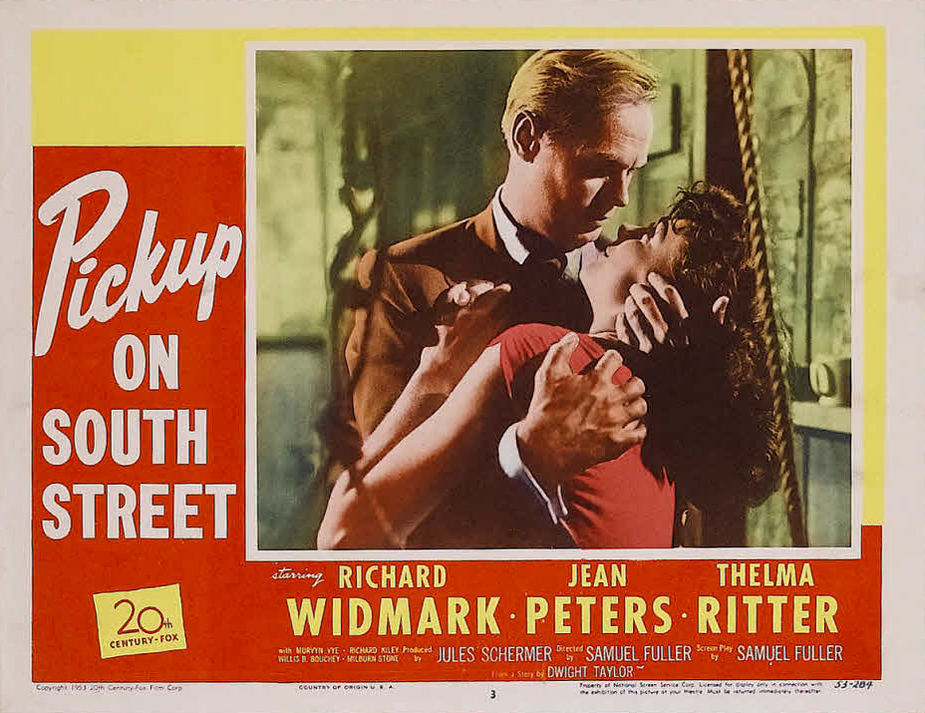
Richard Widmark, Jean Peters and Thelma Ritter in "Pickup on South Street"

Pickup on South Street (1953) is a film noir set against Cold War intrigue, directed by Samuel Fuller and starring Richard Widmark, Jean Peters, and Thelma Ritter. The supporting cast included Richard Kiley and Milburn Stone. The screenplay was by Fuller with cinematography by Joseph MacDonald.

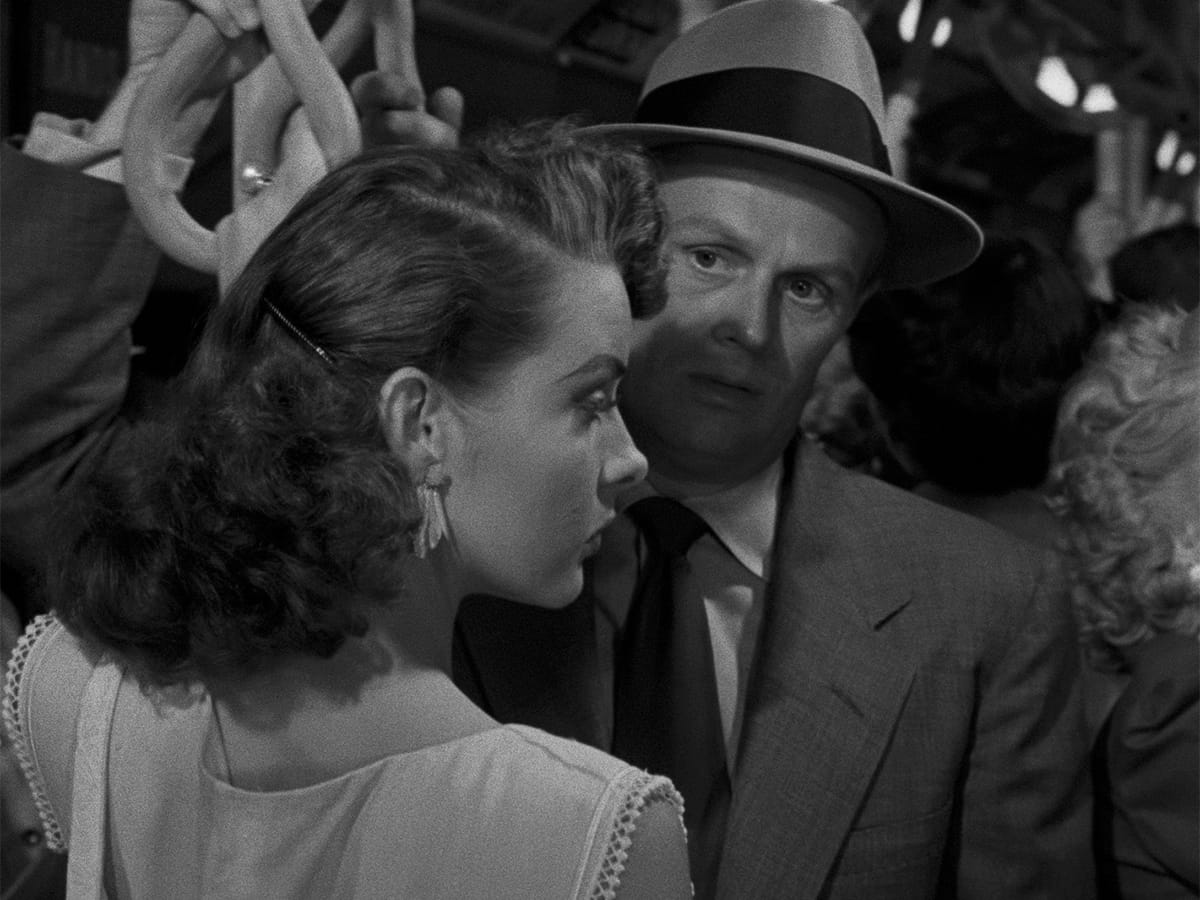
On a New York City subway, a pickpocket, Skip McCoy (Widmark) steals a wallet out of the purse of a street-smart woman named Candy (Peters). Unknown to both Candy and Skip is the fact that her wallet contained microfilm meant to be delivered to Communist spies. Candy's ex-boyfriend Joey (Richard Kiley) talked her into delivering the microfilm (in an envelope) to Joey's contacts.

Finding who has the microfilm and how to get it back becomes a top priority not only for Joey but for the U.S. government agents training Candy and Skip. Candy contacts a woman named Moe (Ritter) who helps her track down Skip. As the three of them interact and try to outsmart each other, they get into trouble that they aren't quite ready for.

Jean Peters and Richard Widmark

Samuel Fuller (1912 - 1997) was an American director, screenwriter, novelist, and journalist. Fuller got his start writing and directing B-pictures. He wrote and directed two cult films in the early 1960s: Shock Corridor (1963) and The Naked Kiss (1964). In 1957, he directed Barbara Stanwyck in the western classic Forty Guns. Later in Fuller's career, he directed the big-budget World War II film, The Big Red One starring Lee Marvin and Mark Hamill. Fuller's work influenced directors Martin Scorsese and Quentin Tarantino.

Richard Widmark (1914- 2008) had a sensational movie debut playing the crazy villain Tommy Udo in director Henry Hathaway’s Kiss of Death (1947). His performance won him a Golden Globe Award for New Star Of The Year – Actor. He was also nominated for the Academy Award for Best Supporting Actor for his performance as Udo. Widmark was under contract to Twentieth Century-Fox where he played mostly villains. Later in his career, he started playing more heroic roles in films like Slattery’s Hurricane and Down to the Sea in Ships (both 1949).

Jean Peters (1926 - 2000) was an American film actress. She was under contract with 20th Century-Fox from the late 1940s and early 1950s. Early in her career, she got a boost co-starring with Tyrone Power in The Captain from Castile (1947). She later went on to costar with Dana Andrews, Ray Milland, and Marlon Brando. She was set to play the female lead in The Robe co-starring Richard Burton but was replaced by Jean Simmons when she discovered she was pregnant. Peters married Howard Hughes in 1957 and retired from film. After her divorce from Hughes in 1971, Peters appeared on television in several mini-series. Her last acting role was in Murder, She Wrote in 1988. Today she is probably best remembered for her role as Candy in Samuel Fuller's Pickup on South Street.

Jean Peters and Thelma Ritter

Thelma Ritter (1902 - 1969) was an American actress best known for her portrayal of working-class characters. She was nominated six times in the Best Supporting Actress category, more than any other actress in the category. Ritter won the 
Best Actress in a Musical Tony Award in 1958 for New Girl in Town. She made her unbilled screen debut in Miracle on 34th Street (1947) and a character actress was born. Ritter quickly became a favorite of studio chief Daryl F. Zanuck who cast her in A Letter to Three Wives (1949), All About Eve (1950), The Model and the Marriage Broker (1951), With a Song in My Heart (1952), and Titanic (1953). Perhaps her most famous role was as James Stewart's nurse in Rear Window (1954). Ritter was a good friend of director George Seaton, who cast her first film in Miracle on 34th Street. It was only fitting that Ritter's last film What's So Bad About Feeling Good (1968), was also directed by Seaton.

Pickup on South Street trivia

  • Marilyn Monroe, Shelley Winters, Ava Gardner, and Betty Grable were all considered for the role of Candy. Fuller pulled for Peters, threatening to walk off the picture if she wasn't cast.
  • Thelma Ritter was nominated for Best Supporting Actress as Moe. This was her fourth nomination in four years.
  • It won the Bronze Lion award at the Venice Film Festival.
  • A soldier in the opening scene has a "Big Red One" 1st Infantry Division shoulder patch which was Fuller's division during World War II. He later went on to write and direct The Big Red One in 1980.


To watch the movie on YouTube click on the link below.


To join the discussion online on May 16, 2022, at 6:30 p.m. Central Time click here. Once you RSVP, you will receive an invitation with a link to the meeting on Zoom.

Discussion questions

  1. What did you think of the Cold War storylne? Did it add anything to the plot?
  2. Richard Widmark was still in his tough-guy phase at this point in his movie career. What did you think of his performance?
  3. Were you familiar with the actress Jean Peters prior to this film? What did you think of her performance?
  4. This film wasn't highly regarded when first released but has garnered a reputation as classic film noir. 
  5. Do you think director Fuller had a theme in mind with his writing and directing?
  6. The film boasts a great cast. Did you have any favorites?
  7. Did it remind you of any other films you've seen?


Related Posts Plugin for WordPress, Blogger...