This site is devoted to the love of classic movies. What qualifies as a classic film or movie is somewhat subjective. There are certain films which endure because they strike an emotional chord long after their initial release. For example, a movie like "Casablanca" (1942) would qualify as a classic under that definition.
Great Expectations
(1946) is a British drama directed by David Lean and based on the 1861 novel by
Charles Dickens and starring John Mills and Valerie Hobson. The strong
supporting cast included Jean Simmons, Finlay Currie, Martita Hunt, Torin
Thatcher, and Alec Guinness. The cinematography by Guy Green won the Academy
Award for Best Cinematography, Black-and-White.
Orphan Phillip “Pip” Pirrip (Anthony Wager) lives with his
mean older sister and her kindhearted blacksmith husband, Joe Gargery. While
visiting his parents’ graves, Pip meets Abel Magwitch, an escaped convict (Currie).
Magwitch intimidates young Pip into bringing him tools to remove his chains.
Pip brings him the tools and food too. Magwitch thanks him for his efforts but
is eventually captured and sent to jail.
An eccentric spinster named Miss Havisham (Hunt)
arranges to have Pip provide companionship for her adopted daughter Estella
(Jean Simmons). Estella treats Pip cruelly but he is entranced by her beauty
and finds himself falling in love with her.
As Pip (Mills) grows older, a secret benefactor provides him
with money and privilege in London. Pip has no idea who his benefactor is. The
lawyer Mr. Jaggers says that his benefactor wants to remain anonymous. Pip
still pines for Estella (Hobson) even though she still treats him indifferently.
Will Pip ever discover his benefactor and will he find true
love with Estella?
Alec Guinness and John Mills
Great Expectations trivia
Alec Guinness and Martita Hunt were both in the stage
production of Great Expectations.
This was Guinness’s first significant screen role. It was the
first of six movies he would make with Lean.
Jean Simmons who played young Estella would go on to play Miss
Havisham in the 1989 TV mini-series.
David Lean had never read any Dickens when it was suggested
that he direct an adaptation.
Tony Wager who played young Pip was three years younger than
Jean Simmons.
To join the discussion on August 14, 2023, at 6:30 p.m.
Central Time, click here. Once you RSVP, you will receive an invitation and a link to join
the discussion on Zoom.
Discussion questions
If you are familiar with the novel, how close do you think
the film was to the book?
This film made John Mills a major star in England. What did
you think of his performance?
Many critics thought that Valerie Hobson was miscast as
Estella. Do you agree?
The film won an Academy Award for its black-and-white
cinematography. Do you think it was well deserved?
Did you have a favorite character actor or performance?
This film is widely considered the best screen adaptation of
a Dickens novel. Do you agree?
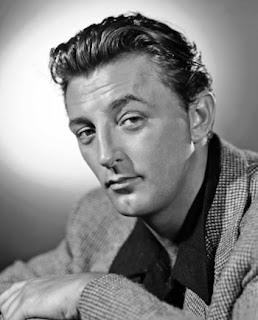
Robert Mitchum (1917 - 1997) was the original movie bad boy. When he entered the movies, his easy-going naturalistic acting style kept him starring in movies for five decades. Discover how much, or how little you know about this movie legend.
Studio portrait of Robert Mitchum
1. Mitchum's older sister, Julie, persuaded him to join her at The Players Guild of Long Beach, a local theater guild. He worked as a stagehand and bit player.
2. He worked as a machine operator for Lockheed Aircraft Corporation during World War II. He had to quick due to the damage the loud machinery did to his hearing.
3. Mitchum tried acting again and was cast in the Hopalong Cassidy (1942 - 1943) film series in various minor roles as villains and bad guys.
4. Under contract to RKO, Mitchum starred in B-Westerns based on the novels of Zane Grey. He gained prominence and fame when he was loaned out to United Artists for the film The Story of G. I. Joe (1945). For his performance in that film, he was nominated for the Academy Award for Best Supporting Actor. It would be his only Academy Award nomination.
5. In the mid-1940s, Mitchum began to make his mark in film noir, earning supporting roles in When Strangers Marry (1944), Undercurrent (1946), and The Locket (1946).
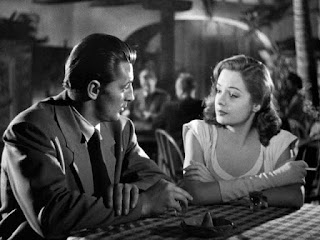
Robert Mitchum and Jane Greer in the film noir classic Out of the Past
6. His career got a boost with his co-starring role opposite Teresa Wright in Pursued (1946) directed by Raoul Walsh. The next year, he became a film noir icon with his role in Out of the Past.
7. In 1948, Mitchum was arrested with actress Lila Leeds for possession of marijuana. The arrest did not harm his career. In fact, the movies he made after his arrest were box office successes.
8. Mitchum hit his stride in the 1950s with starring roles in The River of No Return (1954), The Night of the Hunter (1955), Not as a Stranger (1955), and Heaven Knows, Mr. Allison (1956).
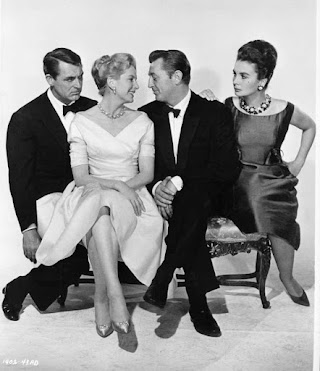
9. He made three films opposite Deborah Kerr: Heaven Knows, Mr. Allison, The Sundowners (1960), and The Grass is Greener (1960), which also starred Cary Grant and Jean Simmons, an actress who starred in three films with Mitchum.
10. The American Film Institute's 100 Years...100 Stars listed Mitchum as the 23rd-greatest male star from Hollywood's classic period.
Cary Grant, Deborah Kerr, Mitchum, and Jean Simmons in The Grass is Greener
Black Narcissus (1947) is a psychological drama directed by Michael Powell and Emeric Pressburger, and starring Deborah Kerr, Sabu, David Farrar, and Flora Robson. The film was written and produced by Powell and Pressburger. The cinematography is by Jack Cardiff (The African Queen, The Red Shoes).
The plot concerns a group of Anglican nuns who set up a school and hospital in the Himalayas. General Toda Rai invited the nuns and he has given them an old palace on a high cliff to set up their ministry. The location is a challenging one with the high altitude and the never-ceasing wind. A group of monks tried to establish their order in the palace but were unsuccessful. Sister Clodagh (Kerr) is determined to be a success in her order’s mission. The British general agent, Mr. Dean (Farrar) doubts the sisters will make it past the monsoon season.
Sister Clodagh’s job is complicated by the differing personalities of the nuns in her charge including Sister Ruth (Kathleen Byron) who is unsure of her calling and seems fixated on gaining the attention of Mr. Dean.
Michael Powell (1905 - 1990) and Emeric Pressburger (1902 - 1988) were English filmmakers who wrote, produced, and directed their films through their film production company The Archers. The two produced and directed such classics as The Life and Death of Colonel Blimp (1943), I Know Where I’m Going! (1945), A Matter of Life and Death (1946), and The Red Shoes (1948). Powell and Pressburger have influenced generations of filmmakers including Martin Scorsese and Francis Ford Coppola.
Deborah Kerr (1921 - 2007) was a British actress who had a long career in film, theatre, and television. Kerr was nominated six times for the Academy Award for Best Actress; she holds the record for the most nominations in that category without a win. Some of Kerr’s classic films include From Here to Eternity (1953), The King and I (1956), An Affair to Remember (1957), and The Night of the Iguana (1964). Although Kerr did not win a competitive Academy Award, she was awarded an Academy Honorary Award in recognition of her body of work in film.
Sabu (born Selar Sabu) (1924 - 1963) was an Indian actor who later became an American citizen. Throughout his career in film, he went by the name Sabu. He starred in films during the 1930s - 1940s in Britain and the U.S. His first important film role was in Elephant Boy (1937) which was an adaptation of the Rudyard Kipling story Toomai of the Elephants. Other films he starred in include Drum (1938), The Thief of Bagdad (1940), and Jungle Book (1942).
David Farrar (1908 - 1995) was an English stage and film actor. He starred in several Powell and Pressburger films including The Small Back Room (1949), Gone to Earth (1950), and probably his most famous role as Mr. Dean in Black Narcissus (1947), the role that made him a star. Hollywood came calling and during the 1950s, he starred alongside Ann Blyth, Tony Curtis, Janet Leigh, John Wayne, and Virginia Mayo.
Flora Robson (1902 - 1984) was an English actress who was a star on stage and in film. Robson starred on both the London and Broadway stages. In London, she starred in Desire Under the Elms (1931), and on Broadway, she starred in Ladies in Retirement (1940). Some of her famous films include Wuthering Heights (1939), Saratoga Trunk (1945), 55 Days at Peking (1963), Clash of the Titans (1981).
Jean Simmons (1929 - 2010) was a British actress film actress who had tremendous success in Hollywood. She got her start in English films like Caesar and Cleopatra (1945), Great Expectations (1946), and Black Narcissus. She became an international star with her role as Ophelia in Laurence Olivier’s production of Hamlet (1948), for which she received an Oscar nomination. In the U.S. she was under contract to Howard Hughes who refused to loan her out to Paramount to star in Roman Holiday (1953). Simmons was director William Wyler’s first choice for the role. Other films followed including Young Bess (1953) where she played a young Queen Elizabeth I, The Robe (1953), the first film released in the CinemaScope widescreen process. She co-starred with Marlon Brando in Desiree (1954) and Guys and Dolls (1955). Other important films include The Big Country (1958), Home Before Dark (1958), and Elmer Gantry (1960).
Deborah Kerr, Kathleen Byron, and David Farrar
Black Narcissus trivia
The film did not film any scenes in Asia; the entire movie was filmed on movie sound stages.
Director of Photography Jack Cardiff said his lighting palette was inspired by the Dutch painter Vermeer.
The actresses playing nuns wore flesh-colored lipstick because not wearing any lipstick showed up as if they did with the Technicolor process.
Director Michael Powell thought Deborah Kerr was too young (25 years old at the time) but Emeric Pressburger campaigned to have her cast in the film.
Kerr, Jean Simmons, and Kathleen Byron appeared together in Young Bess (1953).
Why watch this film?
It's a wonder in Technicolor. The colors are so vibrant and the photography is among the best you will ever see.
The film features Deborah Kerr’s breakout performance and features a young Jean Simmons, just a few years from being a star in her own right.
You’ll almost believe you’re in the Himalayas due to the magnificent matte paintings.
The psychological aspect of the film is hypnotic; it will instantly draw you in.
One of the finest examples of the Powell Pressburger partnership.
To watch this film on YouTube, click on the link below.
To join the discussion on August 24, 2021, at 6:30 p.m., click here. Once you RSVP, you will receive an invitation and link to join the discussion on Zoom.
Discussion questions:
What was your overall impression of the film?
Did you think that the nuns were doomed to failure?
What did you think of Deborah Kerr as Sister Clodagh? Was she believable?