Showing posts with label Joseph LaShelle. Show all posts

Tuesday, May 6, 2025

Dana Andrews and Gene Tierney find out “Where the Sidewalk Ends”

Where the Sidewalk Ends (1950) is an American film noir directed and produced by Otto Preminger and starring Dana Andrews and Gene Tierney. The screenplay was written by Ben Hecht, and the cinematography was by Joseph LaShelle.

Mark Dixon (Andrews) is a tough New York City cop who was demoted due to excessive force in the line of duty. During a routine investigation with a witness to a crime (a possible murder), things go terribly wrong. When Dixon questions Ken Paine (Craig Stevens), a drunk Paine becomes angry and starts a fight. Defending himself, Dixon punches Paine who falls and hits his head, killing him instantly. In a panic, because of his recent demotion and fearing his career would be over if he told his superiors, Dixon disposes of Paine’s body. 

Paine’s estranged wife, model Morgan Taylor (Tierney), is brought in for questioning because she too was a possible witness to the murder. Morgan’s husband used her as “bait” to lure a Texas tycoon to a floating crap game at mobster Tommy Scalise’s (Gary Merrill) apartment. The tycoon ends up dead and it looks like Scalise was trying to pin it on Paine. When circumstantial evidence gets Morgan’s father (Tom Tully) arrested for the murder of his son-in-law, Dixon finds himself with a moral dilemma, complicated by his attraction to Morgan.

Will Dixon come clean and face the consequences, or will he let Morgan’s father take the fall?


Otto Preminger (1905 -1986) was an American film director who made more than 35 feature films during a five-decade career. Born in Austro-Hungarian into a Jewish family. Preminger was drawn to acting from an early age and became the apprentice of famed stage director Max Reinhardt. In 1935, he was recruited by Twentieth Century-Fox to apprentice as a director at the studio. After a rocky start, Preminger established himself as an A-list director after Rouben Mamoulian was fired from Laura (1944). The film noir classic made major stars of Gene Tierney and Dana Andrews and is considered one of the best film noirs of all time. While under contract to Fox, Preminger directed Fallen Angel (1945), Centennial Summer (1946), Forever Amber (1947), and Daisy Kenyon (1947). After he left Fox, Preminger became a maverick, constantly clashing with members of the Production Code. He released two films without the approval of the Production Code: The Moon is Blue (1953) and The Man with the Golden Arm (1955). Both films were financial successes and helped bring an end to the Code entirely. Later successes for Preminger include Anatomy of a Murder (1959) and Exodus (1960).


Dana Andrews (1909 – 1992) was an American stage, film, and television actor. During the 1940s, Andrews was a major star and leading man, starring in Laura (1944), State Fair (1945), A Walk in the Sun (1945), The Best Years of Our Lives (1946), Canyon Passage (1946), Boomerang! (1947), and Daisy Kenyon (1947), the latter co-starring Joan Crawford and Henry Fonda. During the 1950s, film roles were harder to come by, but he had success in Elephant Walk (1954) co-starring Elizabeth Taylor and Peter Finch, While the City Sleeps (1956), and Curse of the Demon (1957). In 1958, he replaced Henry Fonda on Broadway in Two for the Seesaw. Andrews worked a lot on television, guest-starring on shows like The Twilight ZoneCheckmateThe Barbara Stanwyck ShowBen Casey, The Love BoatIronside, and Falcon Crest. He also starred in the daytime soap opera Bright Promise (1969 - 1971).


Gene Tierney (1920 – 1991) was an American actress. Tierney got her start on the stage where she played the ingenue lead in The Male Animal. She was spotted by 20th Century-Fox Studio head Darryl F. Zanuck and he offered her a movie contract. Zanuck said that Tierney was the most beautiful woman in the movies. Tierney proved that she could carry a film not completely based on her beauty in films like Laura (1944) and Leave Her To Heaven (1945) for which she was nominated for her first and only Best Actress Academy Award. Other important films include The Razor’s Edge (1946), Dragonwyck (1946), The Ghost and Mrs. Muir (1947), The Iron Curtain (1948), Whirlpool (1949), and The Mating Season (1951). In the late 1940s, she struggled with mental illness which negatively affected her career. After 1955’s The Left Hand of God, Tierney was off the screen until Advice & Consent (1962). She appeared in two films after that, but her career in film effectively ended in 1964 after a guest appearance in The Pleasure Seekers.


Where the Sidewalk Ends trivia:
  • This was the last film that director Otto Preminger directed under contract to 20th Century-Fox.
  • It reunited Dana Andrews, Gene Tierney, cinematographer Joseph LaShelle, and Preminger, who all worked on the classic film noir Laura (1944). 
  • Andrews and Tierney starred in five films together; this was their last.
  • Designer Oleg Cassini, who was married to Gene Tierney at the time, has a small role as a fashion designer in the film. While the two were married, Cassini designed many of the film costumes for Tierney.
  • Craig Stevens, who played Ken Paine went on to fame on the small screen in the television series Peter Gunn.
  • Otto Preminger made more films with Dana Andrews than any other actor; the two made five films together.

Why watch this film?
The film has a reputation as one of the first, if not the first, of the “bad cop” films. Dana Andrews delivers a great multi-layered performance as Dixon. Otto Preminger was a master of the film noir genre, and this is one of his best.
It’s the last time Andrews and Gene Tierney appeared together on film.


Click HERE to join the online discussion on May 12, 2025, at 6:30 p.m. Central Time. Once you RSVP, you will receive an invitation with a link to join the discussion on Zoom.

Click HERE to watch the movie on YouTube.


Discussion questions:
  1. What did you make of  Dixon’s character? Were you rooting for or against him?
  2. How do you think the director handled the subject matter? Was it believable?
  3. Did anything in the film surprise you?
  4. The film had some amazing character actors. Did you have a favorite?
  5. Was the chemistry between Andrews and Tierney believable?
  6. Did the film end the way you expected it to? Did you find it satisfying?

Monday, March 28, 2022

Olivia de Havilland and Richard Burton in "My Cousin Rachel"

My Cousin Rachel (1952) is an American gothic mystery directed by Henry Koster and starring Olivia de Havilland and Richard Burton in his American film debut. The cast also includes Audrey Dalton, Ronald Squire, George Dolenz, and John Sutton. The screenplay was written by Nunnally Johnson, who also produced, based on the novel of the same name by Daphne Du Maurier. The cinematography was by Joseph LaShelle and the music was by Franz Waxman.

Philip Ashley (Burton) is raised by his older and wealthy cousin Ambrose Ashley on a large estate on the coast of Cornwall. Ambrose's declining health requires him to move to a warmer climate. He ends up in Florence, Italy, where he marries his cousin Rachel Sangalletti (de Havilland). Philip begins to receive disturbing letters from Ambrose complaining that Rachel and his doctor aren't treating him well.

Philip travels to Florence only to discover that Ambrose died of a brain tumor. A man named Guido Rainaldi informs him of this fact and provides a death certificate to prove it. Rachel left before Philip's arrival and according to Rainaldi, Ambrose left his entire estate to Philip (upon his 25th birthday) and nothing to Rachel. In spite of this, Philip suspects foul play in regard to his cousin's death.

Was Rachel responsible for Ambrose's death? And if so, what were her motives?

Richard Burton and Olivia de Havilland

Henry Koster (1905 - 1988) was a German-born film director. He signed a contract with Universal Pictures in 1936. At the time, he didn't speak English but he convinced the studio to let him make Three Smart Girls (1936), which was Deanna Durbin’s first starring film role. The movie was a huge success and saved Universal from bankruptcy. Koster convinced Universal to sign Abbott and Costello to a film contract. The comedy duo was a box office sensation during the 1940s, making the studio millions. Later in Koster’s career, he directed Harvey (1950), My Cousin Rachel (1952), which was Richard Burton’s American film debut. He directed Burton again the next year in The Robe, which was the first film to be filmed in CinemaScope. Other films include Desiree (1954) with Marlon Brando and Jean Simmons, Flower Drum Song (1960) starring Nancy Kwan, and The Singing Nub (1965) starring Debbie Reynolds.

Olivia de Havilland (1916 – 2020) was a British-American actress and two-time Best Actress Academy Award winner. De Havilland’s career spanned more than five decades. She was one of the leading actresses of the 1940s and was the last major surviving star from Hollywood’s Golden Age. Some of de Havilland’s classic films include The Adventures of Robin Hood (1938), Gone with the Wind (1939), Hold Back the Dawn (1941), To Each His Own (1946), The Snake Pit (1948), and The Heiress (1949).

Richard Burton (1925 - 1984) was a Welsh actor who was a star on both stage and screen. He was nominated seven times for an Academy Award but never won an Oscar. He made his American film debut in My Cousin Rachel (1952) for which he received an Academy Award nomination for Best Supporting Actor. He didn't win but his film career took off with the blockbuster Cinemascope classic, The Robe (1953) co-starring Jean Simmons and Victor Mature. Burton's other film roles include Prince of Players (1955), Alexander the Great (1956), and Look Back in Anger (1959). He hit his stride in the 1960s, marrying Elizabeth Taylor in the process after their affair during the making of Cleopatra (1963). Other films include Beckett (1964), The V.I.P.s (1963), and The Sandpiper (1965) both co-starring Taylor. He had a box office hit with the John Huston directed The Night of the Iguana (1964). Burton continued making films up until the time of his death and is remembered as one of the greatest actors of his generation.

Oliva de Havilland, Audrey Dalton, and Richard Burton


My Cousin Rachel trivia
  • It was reported that Richard Burton and Olivia de Havilland didn't get along during filming.
  • The film was proposed as a comeback for Greta Garbo with George Cukor directing.
  • Vivien Leigh was also considered for the role of Rachel.
  • The film marked the American film debut of Richard Burton.
  • This was de Havilland's first film after her Oscar-winning The Heiress (1949).

Why watch this film
  • It's an opportunity to see Burton early in his American film career.
  • This was a prestige picture for 20th Century-Fox with de Havilland at the height of her powers.
  • The production, partially filmed in Cornwall and on the Fox soundstages is impressive.
  • The film was nominated for four Academy Awards including Burton's for Best Supporting Actor.
  • It's a gothic mystery romance based on the novel by Daphne Du Maurier like they don't make anymore.


To watch the film on YouTube, click on the link below.


To join the discussion on April 4, 2022, at 6:30 p.m. Central Time, click here. Once you RSVP, you will receive an invitation and Zoom link to the discussion.


Discussion questions
  1. Do you think Philip had good reason to be suspicious of Rachel?
  2. If Rachel was responsible for Ambrose's death, what were her motives?
  3. What did you think of Richard Burton's film debut?
  4. Did Olivia de Havilland have the right amount of mystery in her portrayal of Rachel?
  5. Were you surprised by the ending?
  6. What are your conclusions? Guilty or innocent?

Tuesday, February 15, 2022

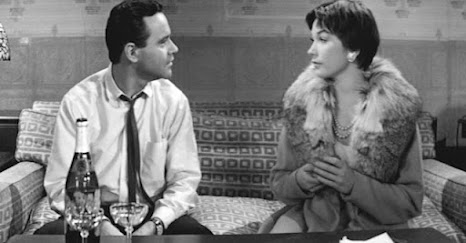
Billy Wilder's "The Apartment" starring Jack Lemmon, Shirley MacLaine, and Fred MacMurray

The Apartment (1960) is a romantic comedy directed by Billy Wilder and starring Jack Lemmon, Shirley MacLaine, and Fred MacMurray. The cast also includes Ray Walston and Edie Adams. The screenplay was written by Wilder and his long-time writing partner I. A. L. Diamond. The black and white cinematography was by Academy Award winner Joseph LaShelle (Laura). 

C C. "Bud" Baxter (Lemon) is an office drone at a large insurance company. To climb the corporate ladder, he lets several executives use his Upper West Side apartment for their extramarital affairs. With a steady stream of women coming and going from his apartment, his neighbors think he's a player.

Due to his "generosity" with his apartment, Bud starts moving up the corporate ladder. Bud develops a crush on elevator operator, Fran Kubelik. Things go a bit crazy when Bud finds out that his boss Jeff Sheldrake (MacMurray) is having an affair with Fran and using his apartment for their trysts.

Will Bud look the other way and keep moving up the ladder, or will he decide the corporate world isn't all it's cracked up to be?

Jack Lemmon and Shirley MacLaine

Billy Wilder (1906 - 2002) was an Austrian-born American film director, screenwriter, and producer. He won six Academy Awards for his writing and direction and was nominated twenty-one times over a career that spanned five decades. Wilder started his career as a writer, penning the screenplays for Ninotchka (1939), Ball of Fire (1942), Double Indemnity (1945), The Lost Weekend (1946), Sunset Boulevard (1951)  Boulevard (1951)Sabrina (1955), Some Like it Hot (1960), and The Apartment (1961). As a director, he won Academy Awards for directing The Lost Weekend (1946) and The Apartment (1961). Wilder directed fourteen different actors in Oscar-nominated roles. He is considered one of the most versatile directors from Hollywood’s Classical period.

Jack Lemmon (1925 - 2001) was an American actor who was successful in both comedic and dramatic roles. He won an Academy Award for Best Supporting Actor in Mr. Roberts (1955). He then went on to a very successful collaboration with director Billy Wilder. Some of the Wilder films that Lemmon starred in include Some Like it Hot (1959), The Apartment (1960), and Irma la Douce (1963). Lemmon won the Academy Award for Best Actor for Save the Tiger (1973). Other Lemmon films include The Odd Couple (1968), The Out-of-Towners (1970), The China Syndrome (1979), Missing (1982), and Grumpy Old Men (1993).

Shirley MacLaine (1934 - ) is an American actress who made her film debut in Alfred Hitchcock's production of The Trouble with Harry (1955) for which she won the Golden Globe award for New Star of the Year - Actress. Her movie career took off immediately and she had starring roles in Around the World in 80 Days (1956),  Hot Spell (1958), Some Came Running (1958), The Apartment (1960), The Children's Hour (1961), and Irma la Douce (1963). In 1983, she won the Academy Award for Best Actress for Terms of Endearment. MacLaine's younger brother is actor, director, and producer, Waren Beatty.

Fred MacMurray (1908 – 1991) was an American film actor who appeared in more than 100 movies and had a successful career on television as well. MacMurray signed a contract with Paramount Pictures in 1934 and was a major leading man by 1935. He co-starred with the studio's top leading actresses including Carole Lombard, Claudette Colbert, Paulette Goddard, and Madeleine Carroll. By 1943, MacMurray was the highest-paid actor in Hollywood and the fourth-highest-paid person in the United States. Probably his most famous role is as insurance agent Walter Neff in Double Indemnity (1944) co-starring Barbara Stanwyck and Edward G. Robinson. During the late 1950s and 1960s, MacMurray gained new fame as the star of films produced by Walt Disney including The Shaggy Dog (1959), The Absent-Minded Professor (1961), Son of Flubber (1963), and Charley and the Angel (1973).


The Apartment 
 trivia

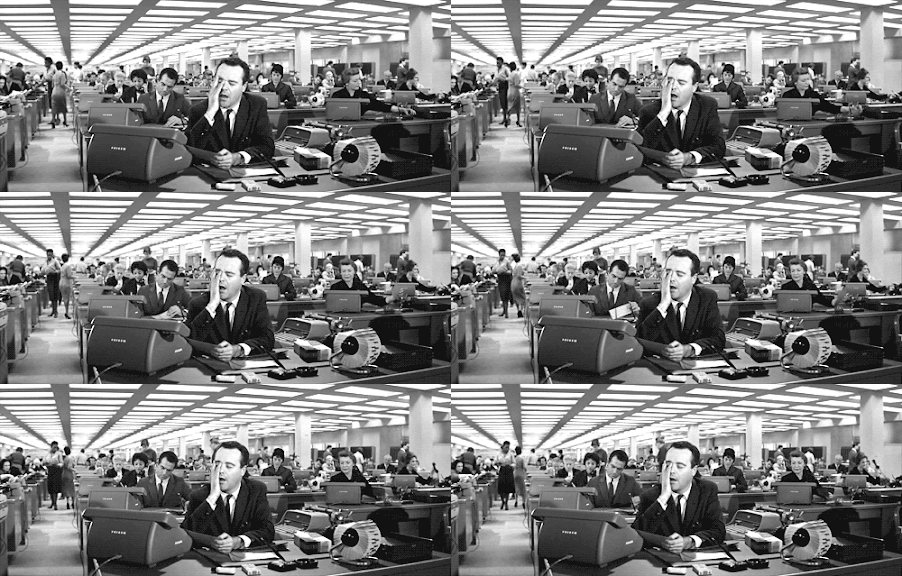
  • To make the open office space seem bigger, they put adult actors in front, and children dressed as adults in the back. The last rows were cardboard cutouts.
  • Wilder shot the Christmas office party scene on December 23, 1959, so everyone was in the holiday spirit. 
  • The Apartment was the last black and white film to win Best Picture until The Artist (2011).
  • Billy Wilder became the first person to win Academy Awards for Best Picture, Best Director, and Best Screenplay.
  • Paul Douglas was cast as Sheldrake but had a heart attack before he was to start filming. Fred MacMurray replaced him as a favor to Wilder.


To watch the movie on YouTube, click on the link below.


To join the discussion online on February 21, 2022, at 6:30 p.m Central Time, click here. Once you RSVP, you'll receive an invitation and a link to join the discussion on Zoom. 


Discussion questions

  1. How does the movie present Baxter?
  2. How does the director illustrate the alienation of office life?
  3. The film is considered a romantic comedy. Does that seem like the correct classification?
  4. What is the symbolism of the $100 bill that Sheldrake gives to Fran?
  5. Is the ending satisfying?


Related Posts Plugin for WordPress, Blogger...