Storybook Childhood
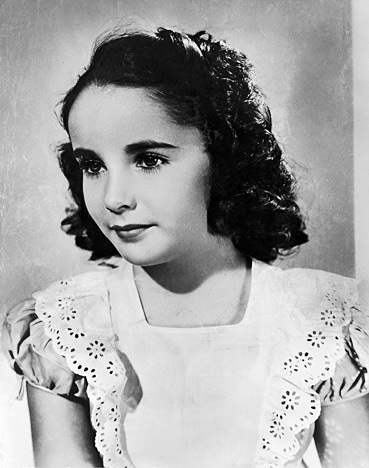
Elizabeth Taylor (1932-2011) was born to be a star. Elizabeth Rosemond Taylor was born to American parents in Hampstead Garden Suburb, just northwest of London, England. Her early life was idyllic. On the family’s farm, Taylor developed a love for animals, especially horses. Taylor’s father was a successful art dealer and had planned to remain in England, but when war clouds appeared over Europe in the late 1930s, the Taylors decided to move back to the United States, eventually settling in California.
 |
| Elizabeth Taylor had a genetic mutation that gave her a double set of eyelashes. |
Hollywood Calling
It didn’t take long for little Elizabeth to get noticed by Hollywood. Taylor signed a contract with Universal Studios and made her movie debut at nine years old alongside Carl “Alfalfa” Switzer in
There’s One Born Every Minute (1942). Taylor was a natural on screen, but Universal decided not to renew her contract. However, it didn’t take long for M-G-M to sign her up just one year later.
 |
| Taylor with Lassie; Lassie made more money than her human costar. |
Child Star
M-G-M cast Taylor opposite another child star under contract, Roddy McDowall, in
Lassie Come Home (1943). The film was enough of a box office success for the studio to groom Taylor for movie stardom. Next, M-G-M loaned her out to Twentieth Century Fox to play the doomed Helen in the 1943 production of
Jane Eyre
. She was unbilled in the Gothic classic, but she didn’t go unnoticed.
 |
| Mickey Rooney, Taylor, and Anne Revere in National Velvet |
National Velvet brings International Fame
Taylor’s career moved into high gear after she fought to secure the role of Velvet Brown in
National Velvet
. Like the title character, she loved horses and she could ride.
National Velvet opened at Radio City Hall on December 14, 1944. The Clarence Brown production was a showcase for Taylor. Bosley Crowther of
The New York Times had this to say: “Mr. Brown has also drawn some excellent performances from his cast, especially from little Elizabeth Taylor, who plays the role of the horse-loving girl. Her face is alive with youthful spirit, her voice has the softness of sweet song and her whole manner in this picture is one of refreshing grace.” And like Crowther, America fell in love with the beautiful young actress.
From Girl to Woman
Moving from child to adult roles seemed to be effortless for Taylor. Although many of her early “adult” roles were in forgettable films, the public couldn’t get enough of Taylor and M-G-M capitalized on her growing popularity. Taylor starred in two pictures meant to make her a major adult star,
Conspirator 
(1949) costarring Robert Taylor (no relation) and
The Big Hangover (1950) opposite Van Johnson. Both films were not well received and flopped at the box office. Her next film,
Father of the Bride
(1950) would prove to be a breakthrough. Spencer Tracy and
Joan Bennett played Taylor’s parents who are overwhelmed with the wedding plans of their only daughter. As the soon-to-be-married Kay Banks, Taylor was radiant. The movie was a huge hit, big enough to warrant a sequel the following year,
Father’s Little Dividend (1951).
Hollywood Wedding
In real life, Taylor, still a teenager, married hotel heir Nicky Hilton in 1950, in a wedding to rival anything Hollywood had seen before or since. But the marriage would barely last a year, with allegations that Hilton was abusive and a womanizer. Although her personal life was far from perfect, superstardom for Taylor was on the horizon.
 |
| George Stevens used extreme closeups of both Taylor and Montgomery Clift in A Place in the Sun. |
A Place in Movie History
On loan to Paramount, Taylor played Angela Vickers in the George Stevens production of
A Place in the Sun
(1951). The movie costarred Montgomery Clift and Shelley Winters. Many thought Taylor would be out of her league amongst such acting talent. But when Taylor showed up on screen wearing a form-fitting Edith Head gown to watch Clift’s character, George Eastman, shoot pool, she became a movie icon. The gown she wore in the film was copied and worn by countless young girls at senior proms across the country. Taylor’s beauty, never questioned, was now coupled with a dramatic acting technique that surprised the critics. A.H Weller in his review of the film for
The New York Times said, “Elizabeth Taylor's delineation of the rich and beauteous Angela also is the top effort of her career. It is a shaded, tender performance and one in which her passionate and genuine romance avoids the bathos common to young love as it sometimes comes to the screen.” In spite of the film’s success, Taylor’s home studio continued to put her in films that were merely showcases for her beauty.
 |
| Taylor in the Edith Head designed dress that every girl had to have for her senior prom from A Place in the Sun |
A "Giant" Role
In 1952, Taylor married for the second time to British actor, Michael Wilding. From 1952 to 1954, Taylor starred in seven movies and gave birth to two children. In 1955, director
George Stevens 
would come calling once again and cast Taylor in one of her best film roles: Leslie Benedict in
Giant
(1956).
 |
| Taylor, Rock Hudson, and James Dean in Giant |
"A Woman of Spirit and Sensitivity"
On loan to Warner Bros., Taylor was top-billed over Rock Hudson and James Dean, two of Hollywood’s most popular leading men at the time. The epic production required Taylor to age from a young woman to a middle-aged grandmother. Once again, the critics acknowledged her acting ability and once again,
The New York Times critic Bosley Crowther took notice. Crowther said, “Elizabeth Taylor as the ranchman’s lovely wife, from whose point of observation we actually view what goes on, makes a woman of spirit and sensitivity who acquires tolerance and grows old gracefully.”
Civil War Epic
After the success of
Giant, M-G-M cast Taylor as Susana Drake in the Civil War epic,
Raintree County (1957). Paired once again with Montgomery Clift, the studio pulled out all the stops thinking they had another
Gone with the Wind
on their hands. Academy Award winner Eva Marie Saint rounded out the all-star cast. Taylor’s performance would earn her the first of five Best Actress nominations, but the film failed to connect with moviegoers and was a box office failure. In spite of this, the public was fascinated by the raven-haired beauty.
Tragedy and Triumph
Taylor’s personal life continued to fascinate the public. In 1957, she divorced Michael Wilding and married producer Mike Todd. The only one of her eight marriages that did not end in divorce, Todd was killed in a plane crash while Taylor was filming
Cat on a Hot Tin Roof
(1958). In spite of her grief (there were suicide watches on the set), she pulled herself together and received another Best Actress nomination for her role as Maggie “the Cat” Pollitt. She didn’t win the award, but the movie was a critical and box office success.
More Successes
Her next film role was in
Suddenly Last Summer
(1959), directed by Joseph L. Mankiewicz, with Taylor on loan out to Columbia. Some critics thought the movie confusing, but it was another hit for Taylor and she received her third consecutive Best Actress nomination. Soon, Taylor’s personal life was about to take a turn that no one could have expected.
 |
| Taylor at her most alluring in Suddenly Last Summer |
Scandal!
After Todd’s death, his best friend, singer Eddie Fisher, consoled Taylor. Soon afterward an affair developed that created a scandal of international proportions. Fisher was married to Taylor's fellow M-G-M player, Debbie Reynolds. Reynolds and Fisher had two small children at the time, Carrie and Todd. Fisher left Reynolds to marry Taylor in 1959, which did little to quell the tabloids and the public’s outrage. Mobs picketed Fisher’s concerts and Taylor’s films. At the time of the affair, Fisher was one of the country’s most popular male vocalists. He and Reynolds were America’s sweethearts and popular subjects in fan magazines. Although the scandal was distressing for Taylor, who was labeled a “home wrecker” by the press, it all but killed Fisher’s career.
Oscar Winner
Hoping to capitalize on the scandal, M-G-M cast Taylor as Gloria Wandrous, a high-class prostitute, in
BUtterfield 8
(1960). Taylor hated the part and only after the studio agreed to cast Fisher in a supporting role did she agree to star in it. In spite of Taylor’s disdain for the film, it was a critical and popular success. Even the high-minded Crowther from
The New York Times admitted “Miss Taylor lends a certain fascination to the film.” The film fulfilled her contract with M-G-M. With her contract obligations complete, Taylor took some time off from the movies. For Taylor’s performance (one she supposedly despised) she won her first Academy Award for Best Actress of 1961.
 |
| Taylor in Cleopatra |
Queen of the Nile
In 1960, Twentieth Century Fox was preparing a new version of
Cleopatra
. The male leads were cast: Peter Finch (Taylor’s costar in 1954’s
Elephant Walk) as Julius Caesar and Stephen Boyd, fresh from his success in
Ben-Hur
as Mark Antony. The studio was searching for an actress to play the lead and the production dragged. Both Finch and Boyd dropped out. When Taylor was contacted by Fox to play the lead, she asked for $1,000,000 and a percentage of the gross, not thinking she’d be taken seriously. To Taylor’s surprise, they agreed to her terms, which made her the highest paid actress, up to that time, and she was off to England to begin shooting.
Doomed from the Start
The production was plagued from the start. Sets were built, but the weather would not cooperate, so the cast and crew relocated to Italy where the climate was closer to that of Egypt. With all these stops and starts, the costs just ballooned. The film cost so much money that Fox almost went bankrupt. But the real excitement was yet to come.
Cast Shakeup
Rex Harrison replaced Peter Finch and Richard Burton replaced Stephen Boyd. During Taylor’s scenes with Burton, it was apparent that a romance was developing. As if the director, Mankiewicz didn’t have enough problems with the out-of-control production, he now had to contend with a brewing scandal. Fisher watched his marriage to Taylor crumble before him and returned to the States. Because both Taylor and Burton were married to other people, the press had a field day. The two most famous movie actors in the world were involved in a very pubic extramarital affair, causing turmoil on the set. Amidst all the publicity, the film was finally completed and ready for its premier at New York City’s Rivoli on June 12, 1963, running just over four hours, excluding intermission.
Epic or Epic Failure?
If the film hadn’t cost a reported $40,000,000 and the running time was half as long, it might have realized a profit upon its initial release. The movie was packing in the crowds, but its length impacted the number of daily showings. The reviews were mixed, with some critics calling it a colossal mess and others declaring it a masterful epic. Crowther, obviously taken with the production had this to say in his review: “Forget the fantastic sum that
Cleopatra is reported to have cost. Forget the length of time it took to make it and all the tattle of troubles they had, including the behavior of two of its spotlighted stars. The memorable thing about this picture, which opened last night at the Rivoli, is that it is a surpassing entertainment, one of the great epic films of our day.”
 |
| George Segal and Taylor in Who's Afraid of Virginia Wolf |
Dick and Liz
In 1964 Taylor and Burton wed and became the most famous married couple in the world. Wherever they went, the press followed. They made several more films together, some more successful than others. In 1966, Taylor and Burton played combative spouses in the Mike Nichols production of
Who’s Afraid of Virginia Woolf
. For the role, Taylor gained weight and played down her looks. Both she and Burton were nominated for Oscars, but only Taylor brought home the golden statue, her second, in 1967. In spite of the Oscar, better film roles didn’t come Taylor’s way.
 |
| Richard Burton and Taylor's relationship was a tabloid publisher's dream. |
Divorce, Remarriage, Divorce
The tempestuous relationship between Taylor and Burton came to an end in 1974 when they divorced. But in 1975, they married once again, but it barely lasted a year and they divorced once again in 1976. Taylor and Burton went their separate ways, with both continuing to make films and appear on stage. In 1983 Taylor and Burton starred together in
Private Lives, but many critics thought they had become caricatures of their former selves. Still Taylor fascinated the public with her celebrity lifestyle.
Crusader and Business Woman
Two more marriages followed: John Warner (1976-1982) and Larry Fortensky (1991-1996). The latter, she met at the Betty Ford clinic. As her film career faded, Taylor became active in the battle to find a cure for HIV/AIDS, raising millions of dollars for the cause. She also kept her name in the public eye with two popular perfume fragrances, Passion and White Diamonds, bestsellers to this day.
Fragile Health
In the last years of her life, Taylor’s health, which was always fragile, kept her out of the limelight. In spite of her poor health, she was still a champion for the causes she believed in. On March 23, 2011, Taylor left this world.
 |
| Taylor at her most glamorous, as most of us will remember her |
The Last Movie Star
Often called the last movie star, Elizabeth Rosemond Taylor represented quintessential Hollywood glamour. Through her films we have a record of her extraordinary beauty and talent. With her passing, so ends our connection to Hollywood’s Golden Age. We will not see her like again in this lifetime. And she will be missed.
My Five Favorite Elizabeth Taylor Films
5.
National Velvet (1944) As Velvet Brown, a young Elizabeth Taylor burst with youthful energy and excitement.

4.
Father of the Bride
(1950) Taylor’s portrayal of Kay Banks endeared her to the public and proved that she had the potential to be a major adult movie star.
3.
A Place in the Sun (1951) This film made Taylor a certified superstar. Her portrayal of Angela Vickers amazed the public and film critics alike.
2.
Cat on a Hot Tin Roof (1958) The role of Maggie “the Cat” Pollitt was a tough role for any actress, but Taylor pulled out all the stops and earned an Academy Award nomination.
1.
Giant (1956) George Stevens’ epic film based on the Edna Ferber novel was a showcase for Taylor’s extraordinary beauty as Leslie Benedict, but also showed a dramatic range that had her age from young woman to grandmother.