Showing posts with label Shelly Winters. Show all posts

Tuesday, June 13, 2023

James Stewart searches for “Winchester ‘73”

Winchester ’73 (1950) is an American Western film directed by Anthony Mann and starring James Stewart, Shelley Winters, Dan Duryea, and Stephen McNally. Others in the cast include Millard Mitchell, Charles Drake, John McIntire, Will Geer, and Jay C. Flippen. The film also includes early screen appearances by Rock Hudson and Tony Curtis, credited as Anthony Curtis.

At the beginning of the film, Lin McAdam (Stewart) is searching for Dutch Henry Brown (McNally). The two have a score to settle.

In Dodge City, Kansas, Lin enters a shooting contest and wins a Winchester 1873 rifle. At the boarding house where Lin is packing, he is ambushed by Dutch who steals the rifle. Dutch rides away with two other men, making Lin’s anger toward Dutch burns even brighter. Lin’s quest to settle his score with Dutch becomes even more urgent than before.

James Stewart and Millard Mitchell

Anthony Mann (1906 – 1967) was an American director. Mann got his start in film working as a talent scout for David O. Selznick. He later became an assistant director, assisting Preston Sturges on Sullivan’s Travels (1941). Mann went on to direct a variety of low-budget, but successful films at Republic, RKO, and Eagle-Lion studios. The Furies was Mann’s first A picture. After The Furies, Mann went on to direct many successful westerns including Winchester ’73 (1950), Devil’s Doorway (1950), Bend of the River (1952), and The Naked Spur (1953).

James Stewart (1908 - 1997) was an American actor whose career spanned almost five decades and 80 films. Stewart often portrayed the ideal of the average American who was decent and honest. Stewart signed a seven-year contract with Metro-Goldwyn-Mayer where he appeared in a variety of supporting roles in B and A pictures. It wasn’t until he was loaned out to Columbia Pictures to costar in Frank Capra’s You Can’t Take It With You (1938) that his home studio began to take notice. Still, his best roles were on loan to other studios including Mr. Smith Goes to Washinton (1939) at Columbia again and Destry Rides Again (1939) at Universal. M-G-M eventually cast him in The Philadelphia Story (1940) where he won the Academy Award for Best Actor which cemented his reputation as a leading man and star. From there he went on to make The Shop Around the Corner (1940) and The Mortal Storm (1940). After serving in the United States Army from 1941 - 1945, Stewart returned to Hollywood where he continued as a popular leading man. During the 1950s, Steward made two films with director Alfred Hitchcock which are considered two of the director’s best films: Rear Window (1954) and Vertigo (1958). Vertigo was voted the greatest film ever made by Sight & Sound in 2012.

Shelley Winters (1920 - 2006) was an American actress whose career in film began in 1943 and continued into the 2000s. Some of Winters’s film roles include A Double Life (1947), The Great Gatsby (1948), Winchester 73 (1950), and A Place in the Sun (1951) for which she was nominated for a Best Actress Academy Award. Winters was in demand throughout the 1950s having four films in release in 1955 including Night of the Hunter. She won a Best Supporting Actress Academy Award for The Diary of Anne Frank (1959). She won her second Best Supporting Actress Oscar for her performance in A Patch of Blue (1965). Besides her film work, Winters starred on Broadway and was a frequent guest star on popular television series and made-for-TV movies.

Dan Duryea (1907 – 1968) was an American film, stage, and television actor. He is best known for his character roles as villains, but he had a long career that included a variety of lead and second lead roles. Duryea graduated from Cornell University in 1928. In his senior year, he was the president of the college drama society. Duryea went to Hollywood in 1940 to Leo Hubbard in The Little Foxes, a role he created on Broadway. He established himself in films noir costarring in classics like Scarlet Street (1945), Criss Cross (1948), and Too Late for Tears (1949).

Stephen McNally (1911 - 1994) was an American film, stage,  and television actor. He is mostly remembered for his roles in westerns. McNally often played the bad guy like his portrayal of Locky McCormick in Johnny Belinda (1948). McNally earned a law degree from Fordham University Law School. During the 1950s, he started working in television starring in popular series like Wagon TrainRiverboatRawhide77 Sunset StripThe VirginianFantasy IslandStarsky & HutchCharlies AngelsThe Rockford File, and  Police Story.


Winchester ’73 trivia

  • This film is credited with reigniting James Stewart’s career after a series of unsuccessful films after returning from World War II.
  • James Steward received a percentage of the film’s profits instead of a set salary. He’s the first actor to have negotiated this kind of deal which is now quite common.
  • This was the first pairing of director Anthony Mann and James Stewart. They went on to make seven more films together.
  • James Stewart spent a lot of time practicing a lot with the rifle so he would look like an authentic westerner.
  • As part of film’s promotion, Universal Studios conducted a contest to find rare Winchester 1873 rifles. The contest helped create an interest in antique gun collecting.


To watch the movie on YouTube, click on the link below.


To join the discussion on June 19, 2023, at 6:30 p.m. Central Time, click here. Once you RSVP, you will receive an invitation and link to join the discussion on Zoom.


Discussion questions

  1. Some people consider this film one of the best Westerns of all time. Would you agree with that assessment?
  2. In 1950, this was a James Stewart the public had never seen before. Did his performance surprise you? What do you think audiences were thinking in 1950 when they saw this film?
  3. When the relationship between Lin and Dutch was revealed were you surprised?
  4. Shelly Winters felt her character could have been left out of the movie and nobody would have noticed (or cared). Do you agree?
  5. Stewart and Mann really worked hard to capture the authenticity of the old West. Do you think they were successful?


Tuesday, May 30, 2023

Robert Mitchum, Shelly Winters, and Lillian Gish star in "The Night of the Hunter"

The Night of the Hunter (1955) is an American thriller directed by Charles Laughton and starring Robert Mitchum, Shelly Winters, and Lillian Gish.
 
The supporting cast includes James Gleason, Evelyn Varden, Billy Chapin, Sally Jane Bruce, and Peter Graves. The screenplay was written by James Agee based on the novel (1953) of the same name by Davis Grub. The cinematography was by Stanley Cortez (The Magnificent Ambersons, Since You Went Away, and The Three Faces of Eve).

The Reverend Harry Powell (Mitchum) is arrested for driving a stolen car. In jail, he shares a cell with Ben Harper (Graves) who killed two men in a bank robbery. He stole $10,000 and made his children never reveal where he hid the money. Harper is hanged for the murders and the secret dies with him.

When Powell is released from jail, he visits Harper’s hometown, where he romances Harper’s widow, Willa (Winters), and marries her, all in an attempt to find the money that Ben had hidden. John Harper (Chapin) is suspicious of Powell from the start and wants nothing to do with him, while his younger sister, Pearl (Bruce) is attracted to him as a replacement for her father.

Will Powell be successful in finding the stolen money? And what will become of the children?


Charles Laughton (1899 – 1962) had a long career on the stage and in Hollywood. He won an Academy Award for Best Actor for his portrayal of Henry VIII in The Private Life of Henry VIII (1933) and was nominated for two other Best Actor Oscars for his performances in Mutiny on the Bounty (1933) and Witness for the Prosecution (1957). His performance in The Suspect is considered one of Laughton’s most natural screen performances, which is credited to director Robert Siodmak, a close personal friend of the actor. The Night of the Hunter is the only film Laughton directed.

Robert Mitchum (1917 - 1997) was an American film actor, director, and singer. His breakthrough came in The Story of G.I. Joe (1945) for which he was nominated for a Best Supporting Actor Academy Award. He later starred in the film noir classic Out of the Past (1947) Crossfire (1947), Rachel and the Stranger (1948), River of No Return (1954) The Night of the Hunter (1955) Heaven Knows, Mr. Allison (1957), Home from the Hill (1960), Cape Fear (1962), and Ryan's Daughter (1970). Mitchum would remain busy until the late nineties. Mitchum is rated number 23 on the American Film Institute's list of the greatest male stars of classic American cinema.

Shelley Winters (1920 - 2006) was an American actress whose career in film began in 1943 and continued into the 2000s. Some of Winters’s film roles include A Double Life (1947), The Great Gatsby (1948), Winchester 73 (1950), and A Place in the Sun (1951) for which she was nominated for a Best Actress Academy Award. Winters was in demand throughout the 1950s having four films in release in 1955 including Night of the Hunter. She won a Best Supporting Actress Academy Award for The Diary of Anne Frank (1959). She won her second Best Supporting Actress Oscar for her performance in A Patch of Blue (1965). Besides her film work, Winters starred on Broadway and was a frequent guest star on popular television series and made-for-TV movies.

Lillian Gish (1893 – 1993) was an American actress; her career spanned 75 years. Gish was a major movie star during the silent film era. She was called the “First Lady of American Cinema” because she is credited with developing film acting techniques when the medium was in its infancy. She had a close professional relationship with director D.W. Griffith who directed her in some of the most famous films from the silent era including The Birth of a Nation (1915), Broken Blossoms (1915), and Orphans of the Storm (1921). With the advent of sound, Gish performed on the stage and occasionally appeared in film roles. Gish’s last film appearance was in The Whales of August (1987) co-starring Bette Davis, Vincent Price, and Ann Sothern.


The Night of the Hunter trivia

  • Later in his career, Robert Mitchum said that Charles Laughton was his favorite director.
  • The novel and film are partially based on the life of serial killer Harry Powers (1893 - 1932).
  • Elsa Lanchester suggested the casting of Lillian Gish in the role of Rachel Cooper.
  • Shelly Winters said of her performance that it was “the most thoughtful and reserved performance I ever gave.”
  • Charles Laughton’s first choices for the film’s male and female leads were Gary Cooper and Betty Grable but both turned it down.


To watch the movie on YouTube, click on the link below.


Discussion questions

  1. I categorized this film as a thriller. Do you agree with that category? How would you classify it?
  2. What did you think of the performances of the child actors? Did their performances seem natural and believable to you?
  3. Robert Mitchum’s character is one of the most diabolical in all of film. What did you think of his performance? Was it Oscar-worthy?
  4. Do you agree with Shelly Winter’s assessment of her performance?
  5. Would you recommend this film to a friend to watch?
  6. Lillian Gish is a legend among film actors. What did you think of her performance?


To join the discussion on June 5, 2023, 6:30 p.m. Central Time, click here. Once you RSVP, you will receive an invitation with a link to join the discussion on Zoom.

Sunday, November 6, 2022

Victor Mature and Richard Conte star in "Cry of the City"

Cry of the City (1948) is an American film noir directed by Robert Siodmak and starring Victor Mature and Richard Conte. Others in the cast include Fred Clark, Shelly Winters, Betty Garde, Debra Paget, and Hope Emerson.

Tough guy Martin Rome (Conte) is a criminal about to undergo surgery for leg wounds he receive in a shootout with a police officer that he killed. Police detectives Candella (Mature) and Collins (Clark) question Rome about a jewel robbery and murder. Candella and Rome were childhood friends who grew up in the same poor neighborhood. As an adult, Candella despises Rome for choosing a life of crime, disgracing his parents, and influencing his younger brother Tony (Tommy Cook) to follow in his criminal footsteps.

Rome escapes from the hospital where he tries to recover the jewels from a robbery where another man was killed. At the same time, he’s trying to run off with his girlfriend Teena Ricante (Paget).

Will Rome get the jewels, run off with Teena, and escape prosecution?

Richard Conte and Victor Mature

Robert Siodmak (1900 – 1973) had a very successful career in Hollywood and is best known for his thrillers and films noir. He signed a seven-year contract with Universal and directed The Killers (1946), the film that made Ava Gardner a star. He worked with some of the top movie stars during Hollywood’s Golden Age, including Deanna Durbin, Gene Kelly, Burt Lancaster, Dorothy McGuire, Yvonne de Carlo, Olivia de Havilland, and Barbara Stanwyck. Often compared to Hitchcock in his prime, he never got the recognition that the Master of Suspense did, but most of his films hold up remarkably well and are worth watching.


Victor Mature (1913 – 1999) was an American stage, film, and television actor who became a major movie star during the 1940s under contract to 20th Century-Fox. Before his film career took off, Mature starred in Lady in the Dark (1941) on Broadway opposite Gertrude Lawrence. Some of Mature’s notable films include I Wake Up Screaming (1941) with Betty Grable, and The Shanghai Gesture (1941) with Gene Tierney. In 1942, he starred opposite Rita Hayworth in the musical My Gal Sal. Other notable films include Samson and Delilah (1949), and The Robe (1952), the first film released in the Cinemascope widescreen process. Mature was self-deprecating when it came to his acting. He said, “I’m no actor, and I’ve got 64 pictures to prove it.”


Richard Conte (1910 – 1975) was an American actor who came to prominence in the late 1940s under contract to 20th Century-Fox. He co-starred with James Stewart in Call Northside 777 (1948) and had the lead role in Thieve’s Highway (1949) directed by Jules Dassin (Night and the City 1950), and played Gene Tierney’s husband in Otto Preminger’s Whirlpool (1949). Conte worked constantly and had major roles in Ocean’s 11 (1960) and The Godfather (1972).


To watch the film on YouTube, click on the link below.


Join the discussion on November 14, 2022, at 6:30 p.m. Central Time, clicked here. Once you RSVP, you'll receive an invitation and a link to the discussion on Zoom.


Cry of the City trivia

  • Victor Mature was originally cast as the killer and Conte was cast as the cop. The roles were reversed because Mature had played a few bad guys prior to this film.
  • Alfred Newman's "Street Scene "is used in the opening and closing credits. This music was used in more Fox films than any other. It was first used in the movie Street Scene (1931).
  • Debra Paget made her film debut at age fourteen in Cry of the City.
  • Director Robert Siodmak was borrowed from Universal to direct this film.

Victor Mature and Fred Clark


Discussion questions

  1. What did you think of Victor Mature's performance as the good cop?
  2. The film was shot on location in New York City. Did it add to the film's realistic look?
  3. The film has a very good supporting cast; did anyone supporting player stand out to you?
  4. Did anything about the film surprise you?
  5. Did this film remind you of any other films you've seen?


Wednesday, January 5, 2022

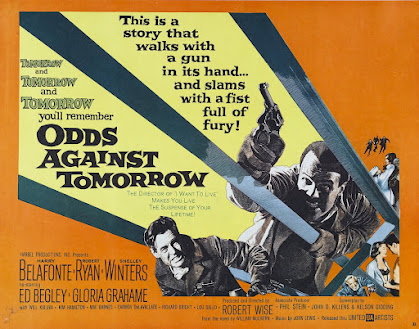
Harry Belafonte and Robert Ryan are up against the “Odds Against Tomorrow”

Odds Against Tomorrow (1959) is an American film noir, produced and directed by Robert Wise and starring Harry Belafonte, Robert Ryan, and Shelley Winters. The film features a jazz film score directed by John Lewis of the Modern Jazz Quartet. 

A former policeman (Ed Begley), an ex-con (Robert Ryan), and a nightclub entertainer (Harry Belafonte) join forces to rob a bank in upstate New York. There is tension between Earle Slater (Ryan) and Johnny Ingram (Belafonte) due to Slater's racism against Ingram who is black. David Burke (Begley), the mastermind of the robbery does his best to keep the tension between Slater and Ingram to a low boil. 

Will Burke be able to keep Slater and Ingram on task to get the job done or will it all blow up before right in front of him?


Robert Wise (1914 - 2000) was an American director, producer, and editor. Wise began his movie career at RKO as a sound and music editor. For several years, he worked with senior editor William Hamilton. Wise’s first solo film editing credits were on Bachelor Mother (1939) and My Favorite Wife (1940). He was the film editor on Citizen Kane and was nominated for an Academy Award for Film Editing. Wise got his chance to direct at RKO from Val Lewton, the producer of horror classics like Cat People (1942). The Curse of the Cat People (1944) was the first film that Wise received director credit for. He eventually directed films noir, westerns, melodramas, and science fiction. Some popular films directed by Wise include The Day the Earth Stood Still (1951), Executive Suite (1954), I Want to Live! (1958), which earned Wise his first Oscar nomination for Best Director. He went on to win Best Director Oscars for West Side Story (1961) and The Sound of Music (1965).

Harry Belafonte (1927 - ) is an American singer, songwriter, and actor. As a singer, he popularized the Caribbean music style to an international audience. He had the first million-selling album by a single artist in 1956. Belafonte made his movie debut in Bright Road (1953) co-starring Dorothy Dandridge. The next year he starred with Dandridge again in Carmen Jones (1954) directed by Otto Preminger. In 1957 Belafonte starred alongside James Mason, Joan Fontaine, and an all-star cast in Island in the Sun. He didn't like the film roles that he was offered during the late 50s and early 60s so he decided to concentrate on his singing career.

Robert Ryan (1909 - 1973) was an American film and stage actor. Ryan got his start in acting with a theater group in Chicago, where he was born, in the late-1930s. By 1939, he had a film contract with Paramount appearing in minor roles in a variety of pictures. In 1943, he signed a long-term contract with RKO based on his stage performance in Clash by Night (1941). The studio was grooming him for stardom with 1943’s Tender Comrade co-starring Ginger Rogers when he enlisted in the United States Marine Corps, serving as a drill instructor. He resumed his career after the war and was nominated for a Best Supporting Actor Academy Award for his performance in Crossfire (1947). Ryan worked on stage, TV, and in film during the next three decades. His other film roles include The Set-Up (1949), Flying Leathernecks (1951), On Dangerous Ground (1951), Clash by Night (1952), and Bad Day at Black Rock (1954).

Shelley Winters (1920 - 2006) was an American actress whose career in film began in 1943 and continued into the 2000s. Some of Winters’s film roles include A Double Life (1947), The Great Gatsby (1948), Winchester 73 (1950), and A Place in the Sun (1951) for which she was nominated for a Best Actress Academy Award. Winters was in demand throughout the 1950s having four films in release in 1955 including Night of the Hunter. She won a Best Supporting Actress Academy Award for The Diary of Anne Frank (1959). She won her second Best Supporting Actress Oscar for her performance in A Patch of Blue (1965). Besides her film work, Winters starred on Broadway and was a frequent guest star on popular television series and made-for-TV movies.

Odds Against Tomorrow trivia

  • Harry Belafonte was the first black protagonist in film noir.
  • Shelly Winters signed onto the film without seeing a script, based on the director and cast involved.
  • Richard Widmark was offered the Robert Ryan role.
  • Cicely Tyson's second film role

Shot on location in New York City, Robert Ryan lived at the Dakota and later sold his apartment to John and Yoko Lenon.

To watch the movie on YouTube, click on the link below.


To join the discussion on January 10, 2022, at 6:30 p.m. Central Time, click here. Once you RSVP, you will receive an invitation and link to the discussion on Zoom.

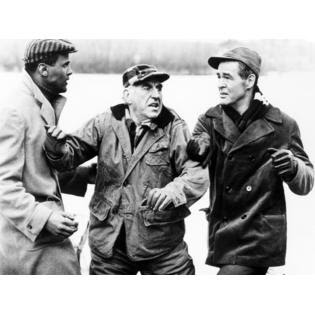
Harry Belafonte, Ed Begley, and Robert Ryan


Discussion questions:

  1. New York Times film critic Bosley Crowther wrote in his review of the film that it was “tight and strong ... sharp, hard, suspenseful melodrama,” with a "sheer dramatic build-up ... of an artistic caliber that is rarely achieved on the screen.” Do you agree with his review?
  2. What do you think the film’s overall theme is?
  3. Did you think the performances were realistic/believable? Was there a standout among the cast in your opinion?
  4. Did the characters as played by Harry Belafonte and Robert Ryan have anything in common?
  5. Did anything about this film surprise you?


Related Posts Plugin for WordPress, Blogger...