Showing posts with label Charles Brackett. Show all posts

Tuesday, January 20, 2026

Charles Boyer, Olivia de Havilland, and Paulette Goddard try to “Hold Back the Dawn”

Set against the backdrop of a dusty Mexican border town, Hold Back the Dawn (1941), directed by Mitchell Leisen, follows the story of Georges Iscovescu (Charles Boyer), a suave but desperate European dancer stranded in a crowded hotel. Having fled the turmoil of war-torn Europe, Georges is one of many refugees stuck in a bureaucratic limbo, waiting for a quota number that will allow him to legally enter the United States. When he realizes his wait could last years, he becomes disillusioned and decides to take a more cynical path to gain entry.

The plot pivots when Georges encounters an old flame and former dance partner, Anita Dixon (Paulette Goddard), who has successfully entered the U.S. by marrying an American citizen and then quickly divorcing him. Anita convinces Georges that his best chance at freedom is to find a naive American woman to marry for the sole purpose of obtaining a visa. This cold-hearted plan sets the stage for a calculated seduction, as Georges begins to scan the various tourists visiting the border for a suitable target.

His mark arrives in the form of Emmy Brown (Olivia de Havilland), a sweet, wholesome schoolteacher from California who has brought her students on a brief field trip across the border. Sensing her innocence and romantic nature, Georges turns on his considerable charm, sweeping her off her feet in a whirlwind twenty-four-hour courtship. Emmy, unaware of the legal mechanics behind his sudden affection, falls deeply in love and agrees to marry him, believing she has found a genuine soulmate amidst the chaos of the world.

The final act of the story explores the growing tension between Georges’s deceptive intentions and the unexpected emotional impact of Emmy’s unwavering kindness. As an immigration officer begins to investigate the suspicious speed of their marriage, Georges is forced to navigate a high-stakes game of pretense. The film focuses on the psychological conflict of a man caught between his desperate need for a new life and the guilt of exploiting a woman who represents the very best of the country he is so desperate to join.


Charles Boyer and Olivia de Havilland

Hold Back the Dawn trivia

1. The Movie That Made Billy Wilder a Director

The legendary Billy Wilder co-wrote the screenplay, but he was so infuriated by the filming process that he vowed never to let another director ruin” his scripts again. Specifically, lead actor Charles Boyer refused to film a scene Wilder had written where his character, in a moment of despondent isolation, has a conversation with a cockroach on his hotel wall. When director Mitchell Leisen sided with the actor and cut the scene, Wilder decided he had to become a director himself to protect his work. His very next project was his directorial debut, The Major and the Minor (1942).

2. Semi-Autobiographical Origins

The film’s focus on the grueling wait for a U.S. visa was deeply personal for Billy Wilder. As a Jewish refugee fleeing Nazi Germany, Wilder had actually spent time stranded in a Mexican border town (Mexicali) in the late 1930s, waiting for his own quota number to come up so he could legally re-enter the United States. He channeled that genuine anxiety and the limbo” of the border hotels directly into the script.

3. The Sister vs. Sister Oscar Showdown

The 1941 Academy Awards featured one of the most famous sibling rivalries in history. Olivia de Havilland was nominated for Best Actress for Hold Back the Dawn, while her sister, Joan Fontaine, was nominated in the same category for Hitchcock’s Suspicion. When Fontaine won, it notoriously cooled their relationship for years. This remains one of the few times in Oscar history that two sisters competed against each other for the same top honor.

4. A Clever “Meta” Cameo

The film uses a story-within-a-story” framing device where Charles Boyer’s character enters a movie studio to sell his life story to a director. The director he speaks to is played by none other than Mitchell Leisen, the real-life director of Hold Back the Dawn. In the scene, Leisen is shown directing a movie starring Veronica Lake and Brian Donlevy, which was actually real footage from I Wanted Wings, a film Leisen had completed just months earlier.

Click HERE to watch the movie. This is a new site for watching movies. You may have to register to watch it, but registration is free.

Click HERE to join the online discussion on January 26, 2026, at 6:30 p.m. Central Time. Once you RSVP, you will receive an invitation and link to join the discussion on Zoom.


Discussion questions

 1. The Morality of the Visa Marriage

Georges begins the film as a cynical opportunist who views Emmy merely as a passport” to the United States. Given the desperate circumstances of the European refugees in the hotel, does the film successfully make Georges a sympathetic protagonist, or does his exploitation of Emmy’s innocence make him irredeemable? At what specific point in the film—if ever—do you think his feelings for her become genuine?

2. The Portrayal of Bureaucracy and the Border

Hold Back the Dawn was released in 1941, while the real-world visa crisis for refugees was at its peak. How does the film portray the American immigration system? Does the limbo” of the Mexican border town feel like a prison, or is it presented with the lighthearted touch typical of Paramount romances of that era? Consider how the setting of the Hotel Esperanza reflects the emotional state of its residents.

3. Emmy Brown: Naivety vs. Strength

Emmy is often described as a wholesome schoolteacher,” a archetype common in 1940s cinema. However, by the end of the film, she is forced to confront a devastating betrayal. Does Emmy remain a victim throughout the story, or does her reaction to the truth show a different kind of strength? Discuss how Olivia de Havilland’s performance (which earned her an Oscar nomination) elevates a character that could have been a one-dimensional "mark."

4. The Wilder Influence and Tone

Knowing that Billy Wilder was frustrated by the direction of this film, can you spot the Wilder touch” in the dialogue or the darker, more cynical moments of the plot? Compare the sophisticated, witty banter between Georges and Anita to the earnest, romantic scenes with Emmy. How do these two different worlds”—the cynical European past and the optimistic American future—clash within the film’s narrative?


Monday, May 20, 2024

Garbo and everyone laughs in Ernst Lubitsch's "Ninotchka"

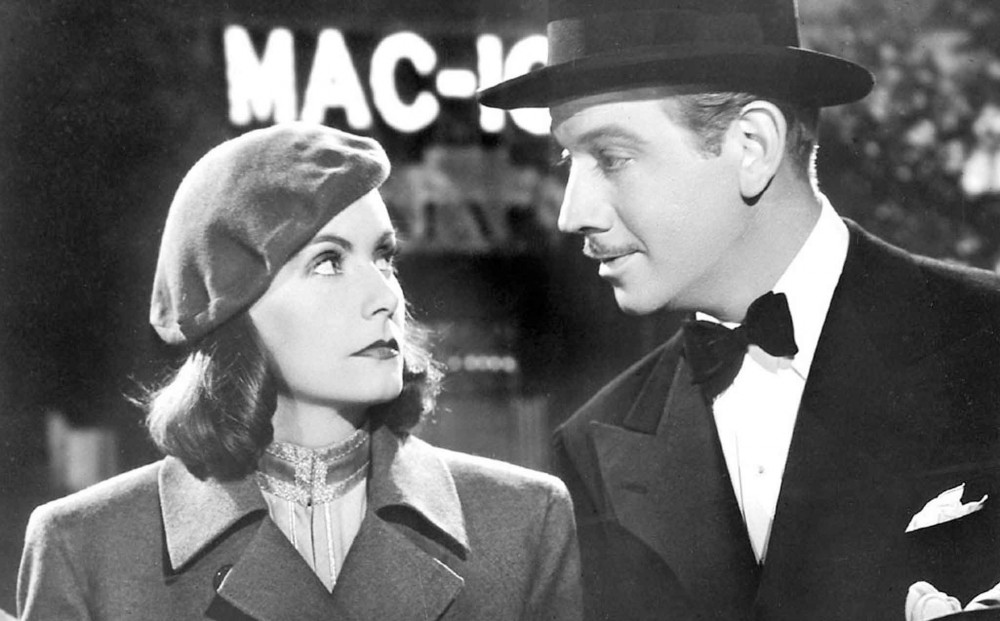
Ninotchka (1939) was the movie that proclaimed, “Garbo laughs!” The great Great Garbo is Ninotchka is a sophisticated delight. The supporting cast includes, Sig Ruman, Felix Bressart, Alexander Granach, and Bela (Dracular) Lugosi. Ninotchka, a special Russian envoy tasked with completing a deal to sell some jewelry that once belonged to an exiled member of Russian royalty (Ina Claire) now living in Paris. Ninotchka is all business and refuses to be taken in by the luxury and romance of the city of lights until she meets Count Leon d’ Algout (Melvin Douglas). Leon flirts with Ninotchka and shows her what a wonderful city Paris is and what it’s like living in a free society. Does Ninotchka hold fast to the tenets of Stalin and the Soviet Union or does she give in to the lure of democracy and capitalism? Directed by the legendary Ernst Lubitsch and written by Billy Wilder, Charles Brackett and Walter Reisch,

Greta Garbo and Melvyn Douglas


Ninotchka was a radical departure for Garbo. It was her first full-blown comedy film and it remains one of her most popular. Her performance garnered an Oscar nomination for Best Actress (she lost out, of course, to Vivian Leigh in Gone with the Wind). The film was also Oscar-nominated for Best Picture and Best Original Story, and Best Screenplay.

Backstory: By 1939, Great Garbo’s popularity was beginning to wane. Under the direction of Ernst Lubitsch, Garbo gives a wonderfully shaded performance as a woman whose life changes under the spell and romance of Paris. Garbo’s next film, Two-Faced Woman, also costarring Melvyn Douglas, was supposed to capitalize on Ninotchka’s success, but turned out to be a critical and commercial failure. It was Garbo’s last film. After the film was completed, she retired from the movies and acting altogether. Attempts to bring her out of retirement—and there were many—were unsuccessful.

The movie which pokes fun at Stalin and the Soviet Union was banned in that country, but was enormously popular in Europe.


Ernst Lubitsch (1892 – 1947) was a German-born film director who became famous for his sophisticated comedies during the pre-code era. Silent film star Mary Pickford lured Lubitsch to Hollywood in 1922. He directed Pickford in Rosita, which was a huge, hit and cemented his reputation in Hollywood. Lubitsch’s films were so unique that they were described as having the “Lubitsch touch.” Some of Lubitsch’s classic films include Trouble in Paradise (1932), Design for Living (1933), Ninotchka (1939), The Shop Around the Corner (1940), Heaven Can Wait (1943), and Cluny Brown (1946). Lubitsch was awarded an Honorary Academy Award for his work in film.

Ernst Lubitsch directs Garbo


Greta Garbo (1905 – 1990) was a Swedish-American actress. Greta Garbo was a major star during the silent and golden eras of Hollywood. She was famous for playing tragic figures in films like Mata Hari (1931), Grand Hotel (1932), Queen Christina (1933), and Anna Karenna (1935). With the beginning of World War II in Europe, Garbo’s career began to decline. Partly due to the fact that her films weren’t distributed in Europe during the war, where she was enormously popular. When she received terrible notices and poor box office with Two-Faced Woman, Garbo retired from acting and never looked back.

Melvyn Douglas (1901 – 1981) was an American actor. Douglas was a popular leading man during the 1930s working with some of Hollywood’s most famous leading ladies including Greta Garbo, Claudette Colbert, Joan Crawford, Claudette Colbert, Marlene Dietrich, Myrna Loy, and Merle Oberon. He won two Best Supporting Actor Academy Awards late in his career for Hud (1963) and Being There (1979). Douglas’s last film role was in Ghost Story (1981) co-starring Douglas Fairbanks Jr. and Fred Astair.

Click HERE to watch the movie on YouTube.


Click HERE to join the discussion online on May 27, 2024 at 6:30 p.m. Central Time. Once you RSVP, you will receive an invitation and a link to join the discussion on Zoom.


Discussion questions

  1. What did you think of Greta Garbo in a comedic role?
  2. Do you think there was some seriousness between the laughs?
  3. Did Garbo and Melvyn Douglas have good chemistry?
  4. A big part of the success of this movie is the character actors in the film. Did you have a favorite?
  5. Garbo retired from acting in 1940 after the failure of Two-Faced Woman. Do you think she made a mistake in retiring so young?


Thursday, August 26, 2021

Gary Cooper and Barbara Stanwyck are an unlikely pair in Howard Hawks’s “Ball of Fire”

Ball of Fire (1941) is an American romantic comedy directed by Howard Hawks and starring Gary Cooper and Barbara Stanwyck. The screenplay was wirtten by Charles Brackett and Billy Wilder. The cinematography was by Gregg Toland (Citizen Kane), the music by Alfred Newman.


The plot concerns a group of professors developing and writing an encyclopedia who encounter a nightclub entertainer who is an expert on American slang. Cooper plays Professor Bertram Potts who is an expert on English and grammar. Seven other professors are experts in science, geography, physiology, law, philosophy, botany, and history. All of the professors are bachelors, with the exception of Professor Oddley who is a widower. 

When Professor Potts realizes that their entry on slang is terribly out of date, he goes out into the world to do some research. He encourages nightclub singer Sugarpuss O’Shea to help him. She ignores him at first but when her boyfriend, gangster Joe Lilac (Dana Andrews) is under scrutiny for murder, she decides to hide out with the professors.


The seven professors and Mrs. Bragg


Howard Hawks (1896 - 1977) was an American director, producer, and screenwriter. He is considered one of the great directors from the classic Hollywood era. Hawks excelled in directing films in all genres. His films were famous for featuring strong women characters. These tough-talking “Hawksian women” helped to define the director’s work. Some of Hawks’ popular films include Scarface (1932) Bringing Up Baby (1938), Only Angels Have Wings (1939), His Girl Friday (1940), To Have and Have Not (1944), The Big Sleep (1946), Red River (1948), and Gentlemen Prefer Blondes (1953). Gary Cooper won a Best Actor Academy Award for his performance in Sergeant York (1941) under Hawks’ direction.

Gary Cooper (1901 - 1961) was an American film actor who was known for his down-to-earth, understated acting style. He was a major star for almost four decades until his untimely death at age 60. Cooper got his start in silent film but easily made the transition to sound. During the early 1930s, he became a major star in films like A Farewell to Arms (1932), The Lives of a Bengal Lancer (1935), and Mr. Deeds Goes to Town (1936). Other popular Cooper films include Meet John Doe (1941), Sergeant York (1941), The Pride of the Yankees (1942), and For Whom the Bell Tolls (1952). Cooper won two Best Actor Academy Awards: Sergeant York and High Noon (1952).

Barbara Stanwyck (1907 – 1990) was an American film star who got her acting start with a supporting role on Broadway in a play called The Noose (1926). The next year she had the lead in another Broadway production, Burlesque which was a huge hit. She eventually made it to Hollywood where her success was not immediate. Director Frank Capra saw something in Stanwyck and he educated her in filmmaking and film acting and the rest is history. Stanwyck was nominated four times for the Best Actress Oscar—Stella Dallas (1937), Ball of Fire (1941), Double Indemnity (1945), Sorry, Wrong Number (1948)—and remains one of the most beloved movie stars from Hollywood’s Golden Age.

Dana Andrews (1909 – 1992) was an American stage and film actor. During the 1940s, Andrews was a major star and leading man starring in Laura (1944), State Fair (1945), A Walk in the Sun (1945), The Best Years of Our Lives (1946), Canyon Passage (1946), Boomerang! (1947), and Daisy Kenyon (1947) co-starring Joan Crawford and Henry Fonda. During the 1950s, film roles were harder to come by, but he had success in Elephant Walk (1954) co-starring Elizabeth Taylor and Peter Finch, While the City Sleeps (1956), and Curse of the Demon (1957). In 1958 he replaced Henry Fonda on Broadway in Two for the Seesaw.

Dana Andrews on “the Ameche”


The amazing supporting cast includes Oscar Homolka, Henry Travers, S.Z. Sakall, Tully Marshall, Leonid Kinskey, Richard Haydn, Aubrey Mather, Allen Jenkins, Dan Duryea, Kathleen Howard, Mary Field, and Charles Lane.


Ball of Fire trivia:
  • Ginger Rogers turned down the role of Sugarpuss, something she regretted.
  • Lucille Ball was going to play Sugarpuss but once producer Samuel Goldwyn found out that Gary Cooper had suggested Stanwyck and that she was available, he gave her the part instead.
  • Leonid Kinskey (Professor Quintana) and Richard Haydn (Professor Oddley) were both under 40 years old and younger than Gary Cooper.
  • Dana Andrews based his character (Joe Lilac) on real-life gangster Bugsy Siegel. Siegel owned the Formosa, a club across the street from Goldwyn Studios.
  • Gary Cooper was paid $150,000 for his role, while Barbara Stanwyck earned the odd salary of $68,133.
  • Don’t feel too sorry for Stanwyck though. By 1944, she was the highest-paid woman in the United States.
  • Barbara Stanwyck received her second Best Actress (out of a total of four) for this film.

To watch the film on YouTube, click on the link below.


To join the discussion on August 30, 2021, at 6:30 p.m. click here. Once you RSVP, you will receive an invitation and a link for the discussion on Zoom.


Why watch this film?
  • For the terrific script by Billy Wilder and Charles Brackett.
  • The great performances and chemistry between Gary Cooper and Barbara Stanwyck.
  • The amazing group of character actors assembled for this film.
  • To see Dana Andrews as Joe Lilac, three years before his star turn in Laura.
  • This is a great example of director Howard Hawks’s versatility.
  • To hear the great American 1940s slang that your parents and grandparents spoke.

Gary Cooper shares a laugh with Robert Taylor while he visits his wife, Barbara Stanwyck on the set of Ball of Fire.


Discussion questions:
  1. What did you think of the pairing of Cooper and Stanwyck?
  2. Billy Wilder said this was a modern version of Snow White and the Seven Dwarfs. Do you agree with that comparison?
  3. Did you have a favorite professor/character actor?
  4. What do you think changed Sugarpuss’s opinion of Bertram? Do they have a chance at happiness?
  5. Did this film remind you of any other movies you have seen?
  6. Do you think this fits the category of screwball comedy?

Backstory
1941 was a great year for both Gary Cooper and Barbara Stanwyck. 

Stanwyck films released in 1941:
The Lady Eve, directed by Preston Sturges
Meet John Doe, directed by Frank Capra
You Belong to Me, directed by Wesley Ruggles
Ball of Fire, directed by Howard Hawks**

Four films, two costars. Henry Fonda starred with Stany in The Lady Eve and You Belong to Me.

Cooper films released in 1941:
Meet John Doe, directed by Frank Capra
Sergeant York, directed by Howard Hawks*
Ball of Fire, directed by Howard Hawks

**Stanwyck was nominated for the Academy Award for Best Actress; she lost to Joan Fontaine (Suspicion).
*Cooper won the Academy Award for Best Actor. 

Henry Fonda, Preston Sturges, and Barbara (Stany) Stanwyck on 
the set of The Lady Eve


Wednesday, January 18, 2017

Screening of "The Model and the Marriage Broker" at Daystar Center February 14

Classic Movie Man Favorites Series: The Model and the Marriage Broker (1951)
Where: Daystar Center, 1550 S. State Street
When: February 14, 2017
Time: 6:30 p.m.
Hosted by Stephen Reginald


The Model and the Marriage Broker (1951) features Thelma Ritter in a rare starring role as marriage broker, Mae Swasey. Her office is located in New York City’s iconic Flatiron Building where she helps her shy and awkward clients find love and companionship. When she picks up the purse of model Kitty Bennett (Jeanne Crain) by accident, she decides to secretly become her marriage broker. You see, the model found out that the man she’s been dating is married, and Mae sees no future in that relationship. Without her knowledge Mae arranges for Kitty to meet Matt Hornbeck (Scott Brady), a young radiographer. Will Mae’s matchmaking be successful? And what about Mae? Will she find a love of her own? 

Jeanne Crain and Thelma Ritter

This underrated classic has a script by Charles Brackett (Sunset Boulevard - 1950, The Lost Weekend - 1945), cinematography by Milton Kranser (The Egg and I – 1947, All About Eve – 1950, Three Coins in the Fountain – 1954, An Affair to Remember – 1957), and direction by the legendary George Cukor (My Fair Lady - 1964). 

The film also boasts a first-rate supporting cast, featuring Zero Mostel and Nancy Kulp in their first movie roles. But first and foremost, The Model and the Marriage Broker has the incomparable Ritter in one of the best roles of her career.


This film is part of the Classic Movie Man’s favorites series.


Have some Joe and Enjoy the Show!
You can bring food and beverages into the auditorium; we even have small tables set up next to some of the seats. General Admission: $5 Students and Senior Citizens: $3.

Join the Chicago Film club; join the discussion
Twice a month we screen classic films and have a brief discussion afterward. For more information, including how to join (it’s free), click here. The Venue 1550 is easily accessible by the CTA. Please visit Transit Chicago for more information on transportation options.


Stephen Reginald is a freelance writer and editor. He has worked at various positions within the publishing industry for over 25 years. Most recently he was executive editor for McGraw-Hill’s The Learning Group Division. A long-time amateur student of film, Reginald hosts “Chicago Film Club,” a monthly movie event held in the South Loop, for the past two years. Reginald has also taught several adult education film classes at Facets Film School, Chicago.

Saturday, October 24, 2009

Every Cinderella has Her "Midnight"

Midnight, directed by Mitchell Leisen, with a script by Billy Wilder and Charles Brackett, and released by Paramount Pictures, is one of the great movies of 1939. It stars Claudette Colbert as a down-on-her-luck American showgirl in Paris and Don Ameche as a Hungarian cabdriver. Colbert offers to pay Ameche double his fare if he agrees to drive her around looking for work as a blues singer. After making the rounds of dozens of Paris nightspots, Colbert gives up and decides to go back to the train station to spend the night.

A smitten Ameche buys her dinner and offers her his apartment to rest in while he drives his cab all night. Although tempted, Colbert doesn't take Ameche up on his offer. Dressed in a glamorous evening gown (the only clothes she has, of course), Colbert escapes into the night. While walking by a Parisian mansion, Colbert is mistaken for a party guest and gains entrance to a society event using a pawn ticket as her invitation. The scam works and Colbert successfully mixes with the upper classes. To keep her scam going, Colbert impersonates a Hungarian countess, aided and abetted by the aristocratic John Barrymore.

Barrymore's wife, Mary Astor, thinks she's in love with playboy and champagne heir Francis Lederer. To help win his wife back, Barrymore enlist the help of the "countess." The plan is for Colbert to get Lederer to fall in love with her, keeping him out of Astor's arms.

The action really heats up at Barrymore and Astor's country mansion. Will Colbert's cover as a countess be exposed by a jealous Ameche? Will Barrymore be able to reconcile with Astor? The answers to all these questions explodes during one of the strangest breakfast meals in film history. The pace picks up  and the stories and aliases that Colbert and Barrymore cook up become wilder and more complicated...and more and more hilarious.

At this stage in his career, Barrymore refused to memorize scripts, so he read his lines from cue cards. It's impossible to tell that he's reading his lines and he steals every scene he's in. Colbert is in top form, her comic timing impeccable. Ameche, no slouch in the comedy department, holds his own as the lovesick cabbie. Astor and Lederer are also perfect in their respective roles.

Midnight is one of Leisen's best directorial efforts. The complicated mistaken identities, double entendres are classic Wilder. A screwball comedy with elegance and charm, Midnight deserves its place as one of the great films of 1939.


Related Posts Plugin for WordPress, Blogger...