Showing posts with label Evelyn Keyes. Show all posts

Tuesday, October 22, 2024

Ida Lupino and Louis Hayward in “Ladies in Retirement”

Ladies in Retirement (1941) is an American gothic suspense film directed by Charles Vidor and starring Ida Lupino and Louis Hayward. The movie was based on the play of the same name by Reginald Denham and Edward Percy. The cinematography was by George Barnes who won an Academy Award the previous year for his work on Alfred Hitchcock’s Rebecca.


The plot involves Ellen Creed (Lupino), a middle-aged spinster forced to work as a housekeeper/companion to Miss Leonora Fiske (Isobel Elsom), a wealthy retiree and former chorus girl in her youth. Ellen gets a letter about her two sisters Emily (Elsa Lanchester) and Louisa (Edith Barrett) who are odd, to put it mildly. The letter threatens to evict the sisters and send them to an institution.

Ellen suggests to Miss Fiske that her two sisters come for a visit. The visit turns disastrous with Miss Fiske ordering the sisters and Ellen to leave her home. To complicate matters, Albert Feather (Hayward), a distant relative shows up at the most inopportune moment.

Charles Vidor (1900 – 1959) was a Hungarian film director whose career started during the early days of talking pictures. Vidor is most famous for the work he did under contract to Columbia Pictures including Ladies in Retirement (1941), Cover Girl (1944), Together Again (1944), A Song to Remember (1945), and Gilda (1946). After leaving Columbia, Vidor directed Hans Christian Andersen (1952) for Sam Goldwyn, Love Me or Leave Me (1955) for M-G-M, and The Joker is Wild (1957) for Paramount. Vidor suffered a heart attack and died three weeks into filming.

George Barnes (1892 – 1953) was an American cinematographer who began his career during the silent era and worked into the early 1950s. Barnes was competent in both black-and-white and color cinematography. He won an Academy Award for black-and-white photography in Alfred Hitchcock’s Rebecca (1940). Some other films Barnes photographed include Jesse James (1939), Meet John Doe (1941), Jane Eyre (1944), Spellbound (1945), Samson Delilah (1949), and The War of the Worlds (1953).

Lupino and Hayward at home with their dog


Ida Lupino (1918 – 1995) was an English-American actress, director, and producer. She appeared in over 50 films and was one of Warner Bros.’s biggest contract players during the 1940s starring in High Sierra (1941), The Sea Wolf (1941), and The Man I Love (1947). After she left Warner Bros., Lupino formed her own production company, producing, writing, and directing films that tackled subjects the big studios wouldn’t touch. During the 1950s, Lupino was the only female director working in Hollywood. She directed several small independent films but made a name for herself directing for television. Lupino directed episodes of The Twilight Zone (starred in one too), The RiflemanBonanzaGilligan’s IslandIt Takes a ThiefFamily Affair, and Columbo. In 1966, she directed her one-and-only big-budget studio picture, The Trouble with Angels starring Rosalind Russell and Haley Mills.

Charles Laughton visits the set of Ladies in Retirement


Louis Hayward (1909 – 1985) was a British-American actor. He worked on the London stage under the tutelage of Noel Coward. He made some films in England in the early 1930s and came to Broadway in 1935 working with Alfred Lunt and Lynn Fontanne in Noel Coward’s Point Valaine. His Broadway fame brought him to Hollywood where he was cast in some minor roles before getting starring roles in The Man in the Iron Mask (1939), My Son, My Son! (1940), and The Son of Monte Cristo (1940). Hayward was married to Ida Lupino from 1938 to 1945.


Ladies in Retirement trivia:

  • Ida Lupino and Louis Hayward were married during the filming.
  • Rosalind Russell was originally announced as the film’s lead.
  • Lupino was 23 playing a woman in her mid-40s.
  • The film was nominated for two Academy Awards: Best Art Direction-Interior Decoration, Black-and-White; Best Music, Scoring of a Dramatic Picture


Click HERE to watch the movie on YouTube.


Click HERE to join the online discussion on October 28, 2024, at 6:30 p.m. Central Time. Once you RSVP, you will receive an invitation with a link to join the discussion on Zoom.

Questions for discussion:

  1. What genre would you classify this film?
  2. Did Ida Lupino make a credible middle-aged woman?
  3. Why do you think Miss Fiske gave money to Albert?
  4. What did you make of the two “batty” sisters?
  5. Did you have any sympathy for Ellen?


Saturday, April 16, 2022

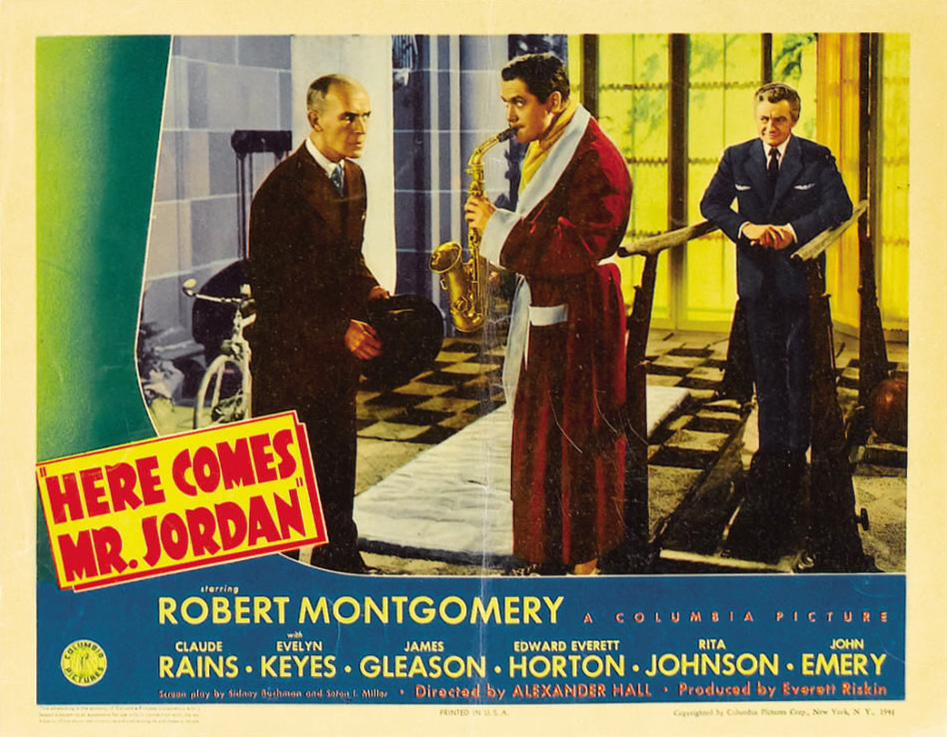
Here comes Robert Montgomery in "Here Comes Mr. Jordan"

Here Comes Mr. Jordan (1941) is an American fantasy romantic comedy directed by Alexander Hall and starring Robert Montgomery, Claude Rains, and Evelyn Keyes. The screenplay was written by Sidney Buchman and Seton I. Segall and the cinematography was by Joseph Walker (It Happened One Night, It's a Wonderful Life).

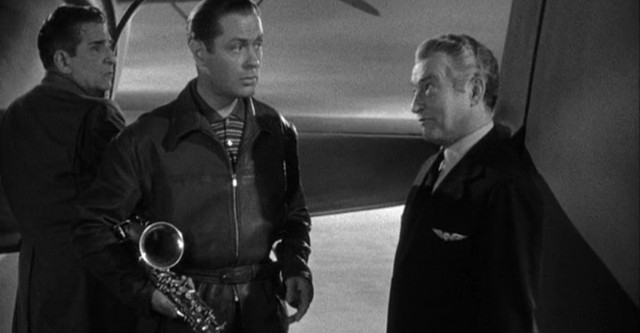
Boxer and amateur pilot Joe Pendleton (Montgomery) while flying to his next bout in New York City. A severed control cable cause him to crash his plane. An overly conscientious Angel 7013 (Edward Everett Horton) retrieves his soul concluding that he couldn't survive the crash. Upon further examination, Angel 7013's superior Mr. Jordan (Raines) determined that Joe should have lived another 50 years. 

To make amends, Mr. Jordan has Joe's soul enter the body of a crooked banker named Bruce Farnsworth who was murdered by his wife and his secretary. 

Can Joe find happiness and resume his boxing career in the body of another man?


Alexander Hall (1894 - 1968) was an American film director. He was working on the stage at age four and continued acting. As an adult, he worked in silent film before becoming interested in film production. Hall worked as a film editor and assistant director until 1932. His first directed film was Sinners in the Sun. In 1937, he signed a contract with Columbia Pictures and worked there almost exclusively. He gained a reputation for directing sophisticated comedies. Some of the films he directed include Little Miss Marker (1934), My Sister Eileen (1942), They All Kissed the Bride (1942), Down to Earth (1947), and The Great Lover (1949). 

Robert Montgomery (1904 - 1981) was an actor, director, and producer. Montgomery began his career on the stage but was soon signed by M-G-M becoming one of that studio's most popular leading men. The actor was adept at both dramas and comedies. Montgomery was twice nominated for the Best Actor Academy Award. In 1937, he was nominated for his performance as a murderous Irish handyman in Night Must Fall, and for his comedic performance in Here Comes Mr. Jordan (1942). While at M-G-M, he worked with all of the great leading ladies of the day including Norma Shearer, Joan Crawford, Ann Harding, and Greta Garbo. Before the United States entered World War II, Montgomery joined the American Field Services in London and drove ambulances in France. When the United States entered the war, he joined the Navy. He starred opposite Carole Lombard in Mr. & Mrs. Smith, They Were Expendable (1945), and two film noir classics The Lady in the Lake (1947) and Ride the Pink Horse (1947). From 1950 to 1957, he hosted the Emmy Award-winning series Robert Montgomery Presents. In 1955 he won a Tony Award for his direction of the play The Desperate Hours. He was also the father of actress Elizabeth Montgomery.

Edward Everett Horton, Robert Montgomery, and Claude Rains


Claude Rains (1889 - 1967) was a British actor whose career lasted almost seven decades. He was one of the most highly regarded character actors during Hollywood's classical period. He appeared in a number of classic films including The Adventures of Robin Hood (1938), Mr. Smith Goes to Washington (1939), The Wolf Man (1941), Casablanca (1942), and King's Row (1942). Later in his career, he starred in Lawrence of Arabia (1962), and The Greatest Story Ever Told (1965). He starred in four films with Bette Davis including Now, Voyager (1942), and Mr. Skeffington (1944). Rains was a four-time Best Supporting Actor Academy Award nominee. Many of his contemporaries consider him one of the greatest actors of the 20th century.


To watch the film on YouTube, click on the link below.


Here Comes Mr. Jordan trivia
  • The film was originally meant to be a vehicle for Cary Grant.
  • It won two Academy Awards for Best Writing, Original Story, and Best Writing Screenplay. The film was nominated for five other Academy Awards including Best Director and Best Actor and Best Supporting Actor nods for Robert Montgomery and James Gleason.
  • Columbia Pictures Studio Chief Harry Cohn was reluctant to finance the picture, thinking it wasn't the type of story that would be popular with the public.
  • Montgomery was loaned out from his home studio, M-G-M.
  • The movie was remade as Heaven Can Wait (1978) starring Warren Beatty.


To join the discussion on May 2, 2022, at 6:30 p.m. Central Time, click here. When you RSVP, you will receive an invitation and Zoom link to the discussion.


Discussion questions:
  1. Was Robert Montgomery convincing as a New York City boxer?
  2. Did this film remind you of any others you've seen?
  3. If you saw Warren Beatty in Heaven Can Wait, how does it compare to the original?
  4. The film is filled with great character actors; did one character actor stand out to you?

John Emery, Rita Johnson, Robert Montgomery, Evelyn Keyes, Claude Rains


Related Posts Plugin for WordPress, Blogger...