Showing posts with label Gone Wtih the Wind. Show all posts

Monday, July 1, 2019

Olivia de Havilland is 103 Today!

Let that sink in for a while.

There are few living legends among us these days, but de Havilland certainly qualifies. One of the truly great movie stars from Hollywood’s classical period, she was a contemporary of Bette Davis, Joan Crawford, Barbara Stanwyck, Katherine Hepburn, and of course her late younger sister, Joan Fontaine.
Olivia de Havilland (center) in The Snake Pit (1948)

A two-time Oscar winner for To Each His Own and The Heiress respectively. She also gave magical performances in The Snake Pit and The Dark Mirror. And who could forget her as Melanie Hamilton in the all-time classic Gone With The Wind. In the hands of a lesser actress Melanie would have been nothing more than a “mealy mouth ninny,” as Scarlet described her. In the hands of de Havilland, she’s a three-dimensional woman of great warmth and sincerity.

Bravo, Olivia!

Monday, July 2, 2018

Olivia de Havilland is 102!

Olivia de Havilland turned 102 on July 1. Yes, 102! De Havilland is a true living legend and one of the few movie stars still with us who came to be during Hollywood’s Golden Age.

A two-time Best Actress Oscar winner—To Each His Own 1946 and The Heiress 1949—de Havilland is probably best known to movie audiences today as Melanie Hamilton in Gone With the Wind (1939). De Havilland’s performance in that film is a marvel. In the hands of a lesser actress, Melanie could have been too sickeningly sweet, but in de Havilland’s hands, she’s a strong, compassionate, and intelligent woman. As a friend of mine noted, she understood Scarlett, Ashley, and Rhett better than they understood themselves. Her compassionate, non-judgmental approach endeared herself to all three, even the self-centered Scarlett.


De Havilland was nominated for Best Supporting Actress for her performance as Melanie, but she was bested by Hattie McDaniel who played the irrepressible Mammie. McDaniel also made film history as the first African American to win an Academy Award.

Joan Fontaine (1917 – 2013), de Havilland’s younger sister was the first in the family to win an Oscar. Both sister’s were nominated the same year (1941). Fontaine was nominated for Best Actress for her performance in Alfred Hitchcock’s Suspicion. De Havilland was nominated for Best Actress for her performance in Hold Back the Dawn. De Havilland was so convinced that the winner that year would be Barbara Stanwyck—Stanwyck was nominated for her performance in Ball of Fire, but she also had strong roles in Meet John Doe and The Lady Eve that same year—that she voted for Stanwyck instead of herself. As history would record it, Fontaine was the winner and this was the beginning of the sisters’ famous feud. Fontaine and de Havilland remain the only sisters to have both won Best Actress Oscars.

Celeste Holm and Olivia de Havilland in The Snake Pit

De Havilland has a strong body of work, most of which holds up under 21st Century scrutiny. Her acting is free from affectation and over-the-top-emoting. Her style remains amazingly contemporary.

Next year (2019) will be the 80th anniversary of the release of Gone With the Wind. Let’s hope de Havilland will be with us to celebrate this film milestone.


Some film highlights from Olivia de Havilland’s career:

Captain Blood (1935)—her first pairing with Errol Flynn
The Adventures of Robin Hood (1938)
Gone With the Wind (1939)
Dodge City (1939)
The Strawberry Blonde (1941)
Hold Back the Dawn (1941)
The Male Animal (1942)
Princess O’Rourke (1943)
To Each His Own (1946)*
The Dark Mirror (1946)
The Snake Pit (1948)
The Heiress (1949)*
My Cousin Rachel (1952)
The Proud Rebel (1958)
Light in the Piazza (1962)
Hush…Hush, Sweet Charlotte (1964)

*Best Actress winner

Saturday, July 1, 2017

Happy 101st birthday to Olivia de Havilland!

Today is Olivia de Havilland’s 101st birthday. The screen legend is the only surviving major cast member of the Civil War classic Gone With the Wind (1939). She’s also the most famous surviving actress from Hollywood’s Golden Age, outliving her younger sister, Joan Fontaine who passed away in 2013 at 96.
Olivia de Havilland in perhaps her most famous role as Melanie Hamilton
in Gone With the Wind

De Havilland is a two-time Oscar winner for To Each His Own (1946) and The Heiress (1949). Her first Oscar nomination was for Best Supporting Actress for her role as Melanie Hamilton in Gone With the Wind. She received two other Best Actress nominations for Hold Back the Dawn (1941), famously losing to her sister, and The Snake Pit (1948). For The Snake Pit she won the National Board of Review Award and New York Film Critics Circle Award for Best Actress. The Snake Pit exposed the poor conditions in state mental institutions. It had such an impact on audiences in 1948 that many states adopted new rules and regulations regarding the treatment of mental patients in state-run institutions.

De Havilland and her attorneys recently announced that they are suing FX and producer Ryan Murphy “over unauthorized use of her [de Havilland’s] identity in Feud: Bette and Joan.” De Havilland sued Warner Bros. in 1943 over the studio practice of adding the time an actor spent on suspension to his/her long-term contract. Her suit helped end the power and control of the major Hollywood studios which led to their decline.

De Havilland’s first film role was in A Midsummer Night’s Dream (1935). Her last big screen appearance was in The Fifth Musketeer (1979). In between there were some great movies and performances. Below is a list of some of the best.

Captain Blood (1935) – her first pairing with Errol Flynn
The Adventures of Robin Hood (1938) – another pairing with Flynn (their third) in glorious Technicolor

Dodge City (1939) – her fifth picture with Flynn, also starring Ann Sheridan; one of the earliest Technicolor westerns
Gone With the Wind (1939) – her first Academy Award nomination for Best Supporting Actress; she lost to costar Hattie McDaniel
Santa Fe Trail (1940)) – one of the top films of the year and another pairing with Flynn
They Died with Their Boots On (1941) – the final pairing of de Havilland with Flynn
The Strawberry Blonde (1941) – a great screen pairing with James Cagney and an up-and-coming Rita Hayworth
Hold Back the Dawn (1941) – on loan to Paramount, she was nominated for Best Actress under the direction of Mitchell Leisen; she lost to her sister Joan Fontaine for her work in Suspicion (1941)

Charles Boyer and de Havilland in Hold Back the Dawn

The Male Animal (1942) – good comedy role based on the James Thurber Broadway hit co-starring Henry Fonda
Princess O’Rourke (1943) – delightful comedy that was a forerunner to Roman Holiday (1953)
To Each His Own (1946) – her first Best Actress Oscar win, once again she was under the direction of Mitchell Leisen
The Dark Mirror (1946) – interesting dual role for de Havilland, playing identical twin sisters, one good one bad
The Snake Pit (1948) – an amazing performance of a woman suffering from mental illness


The Heiress (1949) – de Havilland goes from meak and mild to cold and ruthless in this classic based on Henry James’s Washington Square
My Cousin Rachel (1952) – notable as Richard Burton’s film debut, but it features a finely shaded performance from de Havilland as the mysterious Rachel
The Proud Rebel (1958) – one of my favorite de Havilland performances; she plays a tough woman rancher who befriends a man and his handicapped son

de Havilland with David Ladd, Alan Ladd

Light in the Piazza (1962) – beautifully photographed melodrama set in Rome
Hush…Hush, Sweet Charlotte (1964) – interesting film for the pairing of de Havilland with old friend Bette Davis

Friday, July 1, 2016

Happy Birthday, Olivia de Havilland...100 years young!

Olivia de Havilland (1916) turns 100 today. Not only is de Havilland the last surviving cast member of Gone with the Wind (1939), but she’s also one of the last links to Hollywood’s Golden Age. Her career in Hollywood started in 1934 when she signed a five-year contract with Warner Bros.

Olivia de Havilland as Maid Marion  in The Adventures of Robin Hood, directed by Michael Curtiz

As a contract player, de Havilland performed in a variety of movies from the classical, A Midsummer Night’s Dream (1935) to the adventure spectacle, The Adventures of Robin Hood (1938). A seemingly effortless performer, she excelled in both comedy and drama. In 1935 she costarred with Errol Flynn in the swashbuckler adventure Captain Blood. Flynn and de Havilland’s classic good looks plus their on-screen chemistry made them one of the movies most popular screen teams. Other collaborations included Charge of the Light Brigade (1938), Four’s a Crowd (1938), Dodge City (1939), Santa Fe Trail (1940), and They Died with Their Boots On (1941).

As Melanie Hamilton in Gone with the Wind directed by Victor Fleming

When David O. Selznick acquired the rights to Margaret Mitchell’s best-selling novel, Gone with the Wind, every actress in and out of Hollywood wanted to play Scarlett O’Hara except de Havilland. She had her sights set on playing Melanie Hamilton. Unknown to de Havilland, Selznick wanted her for the part. Jack Warner at first refused to loan her to Selznick, but de Havilland appealed to Warner’s wife and she got the role and an Oscar nomination for Best Supporting Actress (she lost to Hattie McDaniel).
With Charles Boyer in Hold Back the Dawn, directed by Mitchell Leisen

With the success of Gone with the Wind, you’d think that Warner Bros. would have given de Havilland bigger and better roles, but she found some of her best parts on loan to other studios. She made Hold Back the Dawn (1941) at Paramount and received her first Academy Award nomination for Best Actress, losing famously to her younger sister Joan Fontaine. Eventually, she would fight Warner Bros. in court over the terms of the typical Hollywood contract and their habit of putting stars on suspension for turning down roles. She won the case and in many ways it was the beginning of the end of the studio system.

With John Lund in To Each His Own, directed by Mitchell Leisen

With her court case behind her, de Havilland signed a contract with Paramount. Her first picture for them was the comedy, The Well Groomed Bride (1946) costarring Ray Milland. But it was her next picture, To Each His Own (1946) directed by Mitchell Leisen, that would be one of her greatest successes. The movie was a hit and de Havilland won the Best Actress Oscar for her performance. More great roles followed, including playing twins—one good, one evil—in The Dark Mirror (1946). She starred in the groundbreaking film about a woman suffering from mental illness in The Snake Pit (1948). For that performance she was nominated for another Best Actress Oscar. She didn’t win that year, but her performance was honored with awards from the National Board of Review, New York Film Critics Circle Award, and the Venice Film Festival Volpi Cup. With all the honors and new acclaim, de Havilland was in demand; all the major directors in Hollywood wanted to work with her.

Playing identical twins in The Dark Mirror, directed by Robert Siodmak

Another great role came her way when she starred in the William Wyler production of The Heiress (1949). De Havilland’s performance is a tour de force of emotion with her character starting out as an innocent and shy woman to one who becomes worldly-wise, hard and steely by the film’s end. The Academy honored de Havilland with another Best Actress Oscar. Once again, de Havilland was in demand from the best directors in Hollywood. Elia Kazan wanted her to star as Blanche DuBois in A Streetcar Named Desire (1951). She turned that role down, saying she wasn’t able to relate to the character being too happy after the birth of her son. Ironically, the role went to Vivian Leigh, her costar in Gone with the Wind. Leigh would go on to win her second Oscar.

With David Ladd and Alan Ladd in The Proud Rebel, directed by Michael Curtiz

Other big roles came her way including star turns in My Cousin Rachel (1952), Not as a Stranger (1955), The Ambassador’s Daughter (1956), and one of my personal favorites, The Proud Rebel (1958) costarring Alan Ladd who would become a lifelong friend. After the film Libel (1959), de Havilland’s film career began to slow down. She made occasional films like the romantic drama Light in the Piazza (1962), Lady in a Cage (1964), and to the help out old friend Bette Davis, she replaced Joan Crawford in Robert Aldrich’s Hush…Hush Sweet Charlotte (1964). During the 1970s, she appeared in supporting roles in several movies. She also starred in television movies, including Roots: The Next Generation (1979) as the wife of a former Confederate officer played by Henry Fonda. The production reunited the two stars who played husband and wife in The Male Animal (1942). In 1986 de Havilland won a Golden Globe Award for Best Supporting Actress playing the Dowager Empress Maria in the miniseries Anastasia: The Mystery of Anna.

A great beauty and a great talent, de Havilland was and is one of the true legends of classic Hollywood.


Turner Classic Movies (TCM) is honoring de Havilland as the July star of the month.

Sunday, October 5, 2014

Classic Films in Context: Gone With The Wind

I decided to write this post about Gone With The Wind after I read “When It Comes To ‘Gone With The Wind,’ Do Kids Today Give A Damn?” at the NPR Web site. The article suggests that the 1939 Best Picture Winner hasn’t aged well. The author of the piece, Neda Ulaby interviewed 13 students studying film at Georgetown University. Ulaby assures us these students are “serious about movies” to support her thesis.

Not so critical analysis
Apparently the fact that the story took place during a time when it was legal to own slaves makes the film unworthy of any respect or a full viewing according to Georgetown film student Mike Minahan. This is what Minahan has to say about Gone With The Wind: “Everything I’ve seen about it says it, like, glorifies the slave era ... and I dunno, what’s the point of that? I don’t see that as a good time in history. ... like, oh, sweet, a love story of people who own slaves.” Notice the “Everything I’ve seen about it” portion of the quote. Did Minahan watch the film in its entirety? Is he basing his opinion, one that Ulaby says most of his fellow Georgetown film students agree with, on the opinions of others? Shouldn’t a film student be more critical in his analysis? Films are like history; they need to be put into context.

It’s Scarlett's point of view
We see Gone With The Wind through Scarlett O’Hara’s (Vivien Leigh) point of view. If the film were told through Mammy’s (Hattie McDaniel) point of view, for example, we’d have an entirely different film. But it’s Scarlett’s movie and it’s her story warts and all. Is plantation life romanticized in the film? Yes, but then again, it’s pretty typical for the past to be thought of fondly in the face of some pretty stark reality (like the American Civil War); it’s human nature. What Gone With The Wind makes clear is that war is always tragic and that personal relationships (and land if you’re Gerald O’Hara) are all that really matter in life. Unfortunately for Scarlett, she learns that lesson too late.

A well-worn epic
From a technical aspect, I was amazed at how well Gone With The Wind has aged. The fact that a film released in 1939 can hold its own against contemporary epics is in itself remarkable. Ernest “Ernie” Haller’s Oscar-winning cinematography is quite compelling. Who can forget the shot of Scarlett at the Atlanta train station as she walks among the wounded and the dead. At first the camera is close on Scarlett and you only see a few men on the ground. But then the camera pulls back and the number of the wounded and dead on screen is staggering. It’s one of the greatest visuals in all of cinema. And what about the scene of people fleeing Atlanta? How they were able to choreograph the action with star Leigh, not a double, moving against the crowds and running in front of horses and carriages we’ll never know. But on the screen it’s terrific.

Life is troubling
One of the other aspects that the film students find troubling is the scene of marital rape. It is a troubling scene, but put in context it’s true to the marital conventions of the time. The relationship between Rhett Butler (Clark Gable) and Scarlett is indeed a complicated one. I wonder if the same students would refuse to watch Alfred Hitchcock’s Marnie or Clint Eastwood’s High Plains Drifter?

Award-winning performances
The performances in Gone With The Wind are solid. Leigh’s portrayal of Scarlett is fresh, lively, and contemporary. The same can be said for Gable’s portrayal of Rhett. In the hands of Olivia de Havilland (still with us at 97!), Melanie Hamilton is not quite the “mealy mouth ninny” that Scarlett accuses her of being. And who can forget Hattie McDaniel as Mammy? She goes toe-to-toe with Scarlett, always speaks her mind, and is nobody’s fool. When did a black actress get as much screen time as McDaniel did prior to 1939?

Don’t know much about history
My background in educational publishing makes me suspect that today’s film students may be the product of political correctness gone amok. When I worked in school library publishing, we routinely airbrushed cigarettes, cigars, and pipes out of the hands and mouths of historical figures like FDR and pop culture icons like James Dean. We were told that school librarians wouldn’t buy our books if we left these photos intact. This is also the case in contemporary textbook publishing. Instead of explaining that in the not so distant past people didn’t think smoking was a serious health issue and open up a dialogue on the subject, it’s ignored entirely. For many, the history they’ve been taught has been sanitized to the point where it’s not history at all, but instead someone’s fantasy of what history should be. It’s also disturbing the way we in the 21st century look down on people in the past with a superior attitude. As if we would have been any different in our thinking than Scarlett, Rhett, Ashley, and Melanie had we been born during the 19th century.

They’ve got a lot of living to do
What the NPR piece revealed is a group of film students who are unwilling to look at what might be disturbing or upsetting to their worldview. This seems contrary to the whole point of studying film, which is in many ways, studying our history. Perhaps those 13 Georgetown film students need to experience a little more of life to have an appreciation for a classic like Gone With The Wind. And frankly, I do give a damn.

Tuesday, November 22, 2011

Irene Dunne Comes of "Age" as Edith Wharton's Famous Heroine

The Queen Takes Her Throne
By the mid-1930s, Irene Dunne’s career was in an upward arch. She was one of RKO Studio’s biggest and most dependable players, starring in four pictures per year on average. After her breakout performance in Cimarron (1931), Dunne starred in the classic tearjerker, Back Street (1932), based on the popular best-selling novel by Fannie Hurst. The film was a critical and box office success. Dunne went on to star in a string of popular melodramas, earning the title “Queen of the Weepies” by the motion picture press.

Manhattan Manners
In 1934, Dunne replaced Katherine Hepburn as Countess Ellen Olenska in the first talking-picture adaptation of Edith Wharton’s novel The Age of Innocence published in 1920. The period piece also starred John Boles, Dunne’s costar from Back Street. RKO borrowed Boles from Fox Studios, hoping lighting would strike twice by pairing him once again with Dunne. The film tackles the peculiar manners and mores of upper class New York Society during the latter part of the nineteenth century. It follows Wharton’s narrative fairly closely, but according to the film’s credits, it is also partially based on a play by Margaret Ayer Barnes.

Divorced Lives
First Edition of the novel
The plot concerns Ellen and her attempts to seek a divorce from her European husband with whom she has become estranged. On a visit to see her American relatives, news of her planned divorce is received as well as her unexpected arrival in New York. Ellen’s family will do just about anything to avoid even the hint of scandal so they enlist the aid of lawyer and old family friend, Newland Archer (Boles) to convince the Countess that divorce would be a terrible mistake. Newland sympathizes with Ellen, but gives in to social and family pressures to convince her not to go through with the divorce.

Disengaged Engagement
Newland is engaged to be married to Ellen’s cousin, May Welland (Julia Haydon). Newland knew Ellen growing up, but barely remembers her. At Newland and May’s engagement party, Ellen tells Newland a story from their childhood to jar his memory. Almost at once, Newland is smitten with Ellen and finds himself conflicted in his relationship with May.

Newland encourages May and her family to move up the date of the wedding rather than face his feelings and potential scandal. He marries May, but his love for Ellen grows stronger. Ellen loves Newland, but she too, understands the code of conduct that runs New York society. She also loves her cousin and wouldn’t do anything to purposely hurt her.

John Boles between takes
Wharton’s Ambivalence
Edith Wharton was born into New York society before World War I. When she was 23, she married Edward (Teddy) Robbins Wharton, who was 12 years her senior. He was her equal in the society circles of the day, but they had little else in common. Wharton’s husband suffered from depression that eventually turned into mental illness that was considered incurable. When she divorced him in 1913, Wharton came under heavy criticism. Wharton understood the pressures put on both men and women during the 1870s. Although one may speculate the author’s true feelings about the sanctity of marriage and upper class propriety, Wharton never seems to agree with or condemn Newland or Ellen for their actions (or inaction). The film version does a good job interpreting Wharton’s ambivalence, which makes it rife for discussion.

Modest Success
Although not the blockbuster RKO had hoped for, The Age of Innocence did respectable business and garnered decent reviews. Once again, Dunne’s performance was praised and holds up well today. Film critic Leonard Malton in his review of the film said, “Dunne gives a luminous and touching performance.” Other members of the cast giving good performances are Haydon as May, Laura Hope Crews as May’s mother, Mrs. Welland, and Helen Westley as Granny Mignott.

Boles and Irene Dunne
In 1993, Martin Scorsese filmed a sumptuous interpretation of the Wharton classic starring Daniel Day-Lewis as Newland Archer, Michelle Pfeiffer As Ellen, and Winona Ryder as May.

Gone With the Wind Connection: It’s hard to compare the 1934 version of The Age of Innocence with the Civil War drama, GWTW, but if you take a look at the Age of Innocences film credits, you will see that they do share some remarkable things in common. First the cast: Laura Hope Crews would go on to screen immortality portraying Scarlett’s Aunt Pittypat. The gowns that Irene Dunne wore were designed by Walter Plunkett, the designer of all the costumes for GWTW. And last , but not least, the music was adapted by the legendary Max Steiner, who composed “Tara’s Theme.”

This post corresponds with the class Elegant and Madcap: The Incredible Versatility of Irene Dunne—Class starts November 16, 2011. Meets on Wednesdays from 7p.m. - 10 p.m. for six weeks. Classes are held at Facets Film School on Fullerton Ave. in Chicago, IL.

Sunday, February 27, 2011

Joan Bennett: Almost Scarlett O'Hara, But Always a Movie Star

Joan Bennett (1910-1990) had a long career in Hollywood. Starting out as a movie ingenue in the silent era, Bennett made the transition to sound without missing a beat. A scandal in the early 1950s put an abrupt end to her movie career, but she continued to work on the stage and on television. Bennett became something of a pop icon when she portrayed Elizabeth Collins Stoddard on the daytime TV cult classic Dark Shadows.

A studio portrait of Joan Bennett, a natural blond

Theatrical Roots
Born to a family with theatrical roots going back to 18th-century England, Joan was the youngest of three sisters born to Richard Bennett, a popular stage and silent film actor and Adrienne Morrison, an actress, and literary agent. Her eldest sister, Constance, was once the highest-paid movie actress in Hollywood. Barbara, the second Bennett sister, was an actress and dancer.

Joan (left) with older sister Constance Bennett

From Ingenue to Major Movie Star
In the early 1930s, under contract to Fox Film Corporation, she costarred with other bright newcomers like Spencer Tracy (twice). In 1932 she married movie producer Gene Markey—her first marriage to John M. Fox lasted from 1926-1928. Bennett’s marriage to Markey only lasted five years. Before her marriage to Markey ended, Joan left Fox and costarred in Little Women (1933) at RKO. As Katharine Hepburn’s self-centered younger sister Amy, Bennett was noticed by producer Walter Wanger. In 1935, Wanger had her cast as Sally McGregor, a character with mental health issues in Private Worlds. The film starred Claudette Colbert, Charles Boyer, and Joel McCrea. The picture was a hit and Bennett earned good notices; she was on her way.

Little Women was an important film for Bennett.

Winds of Change
In 1938, Bennett, a natural blond, became a brunette for her role as Kay Kerrigan in Trade Winds, co-starring Fredric March. As a brunette, Bennett took on a whole new persona and was now being compared to the dark-haired beauty Hedy Lamarr. Bennett and Lamarr had more in common than their hair color. Lamarr married Gene Markey in 1939, two years after Bennett and Markey divorced. In 1940, Bennett and Wanger married.

This film defined Bennett's movie persona for the rest of her career.

Almost Scarlett
Bennett was one of the dozens of actresses David O. Selznick tested for the role of Scarlett O’Hara in Gone With the Wind. Until Vivien Leigh showed up, the coveted role was between Paulette Goddard and Bennett, with Goddard having the edge. Bennett’s screen tests still exist and suggest she might have been an interesting choice for the role. In spite of not being cast as Scarlett, Bennett’s career was on an upward arch. In 1939, the same year Gone With the Wind was released, Bennett made a beautiful Princess Maria Theresa opposite Louis Hayward in The Man in the Iron Mask. In 1940, she starred in four films including House Across the Bay opposite George Raft and The Son of Monte Cristo, again cast opposite Hayward.

Bennett in one of her screen tests as Scarlett O'Hara; David O. Selznick called her tests "magnificent."
 
Lang's Favorite Noir Heroine
Probably Bennett’s most productive period was her work with director Fritz Lang. Under his direction, Bennett gave some of the best performances of her career. She played a prostitute in Lang’s Man Hunt (1940) opposite Walter Pigeon, Alice Reed in The Woman in the Window (1944), and the slutty Kitty March in Scarlet Street (1945), both co-starring Edward G. Robinson. The late 1940s brought continued success. She co-starred with Gregory Peck in The Macomber Affair (1947) an adaptation of Ernest Hemmingway’s The Short Happy Life of Francis Macomber. That same year Bennett worked with Jean Renoir in The Woman on the Beach. She was under Lang’s direction again for the psychological melodrama Secret Beyond the Door (1948). In 1949, she worked with Max Ophuls as blackmail victim Lucia Harper in The Reckless Moment.

Bennett and Gregory Peck in a publicity still for The Macomber Affair

From Femme Fatale to Perfect Wife and Mother
In 1950, Bennett starred in Father of the Bride with Spencer Tracy and Elizabeth Taylor. The movie was such a hit that it spawned a sequel, Father’s Little Dividend the next year. Bennett’s new image as the perfect wife and mother looked like it would continue through the rest of the 1950s, but a scandal all but destroyed her movie career.

Bennett, like Myrna Loy, became the perfect wife and mother on film.

Notes on a Scandal
On December 13, 1951, while Bennett was talking with her long-time agent Jennings Lang, Wanger shot Lang, thinking the two were having an affair. Both Lang and Bennett denied any personal involvement. The scandal put the brakes on Bennett’s film career. Supposedly, a third Father of the Bride movie had been planned but was scrapped.
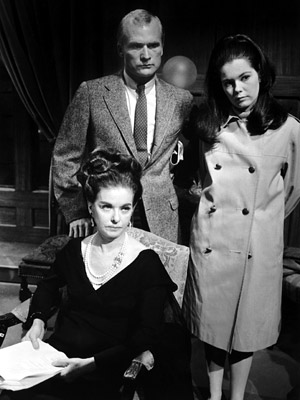
Bennett played matriarch Elizabeth Collins Stoddard on TV's Dark Shadows.

Pop Icon
Bennett managed to keep her name before the public by appearing on the legitimate stage and TV. It would be through TV that her career would take an unusual turn, making her a household name once again. In 1966, Bennett starred in the gothic daytime drama Dark Shadows, a cult hit that featured vampires, witches, warlocks, and werewolves. Bennett played family matriarch Elizabeth Collins Stoddard for the show's entire five-year run.

Bennett and Jack Albertson in an episode of Love American Style

Later Career and Death
After the end of Dark Shadows, Bennett guest-starred on popular TV shows like Love American Style, as well as starring in occasional TV movies. Bennett had another chance at screen stardom in 1985 when she was offered the role of Bess McCarthy in Ron Howard’s Cocoon. The role eventually went to Gwen Verdon but had Bennett taken the role, it would have reunited her with frequent Hollywood "Golden Age" costar Don Ameche. The story goes that David Wilde, Bennett’s fourth husband, didn’t think the role was dignified enough and talked her out of taking it. In 1990, Bennett suffered a heart attack and died. She is buried next to her parents in Lyme, Connecticut.

A beautiful and glamorous movie star, Joan Bennett left a body of work that classic film fans will be studying for generations to come.

Friday, September 10, 2010

Olivia De Havilland Awarded Legion of Honor

One More Honor for De Havilland
Two-time Oscar-winning actress, Olivia De Havilland was awarded the Legion of Honor by French President Nicolas Sarkozy on Thursday. At 94, De Havilland is the last surving major star of Gone With the Wind (1939). Also awarded the award with her was film star Jacqueline Bisset, perhaps best know in France for her role in Francois Truffaut's Day for Night (1973).

Olivia De Havilland with Legion of Honor medal

The Associated Press said De Havilland "looked radiant" during the ceremony.

French President Nicolas Sarkozy embraces De Havilland during ceremony


Related Posts Plugin for WordPress, Blogger...