Showing posts with label Joan Bennett. Show all posts

Tuesday, October 24, 2023

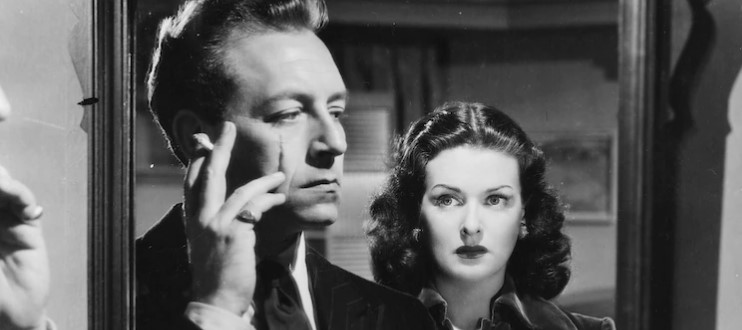
Joan Bennett is determined to discover the “Secret Beyond the Door”

Secret Beyond the Door (1947) is an American psychological thriller directed by Fritz Lang and starring Joan Bennett and Michael Redgrave. The strong supporting cast includes Anne Revere, Barbara O’Neil, Natalie Schafer, and Paul Cavanagh. The cinematography was by Stanley Cortez (The Magnificent Ambersons, The Night of the Hunter, and The Three Faces of Eve. The music was by Miklos Rozsa (Double Indemnity, Spellbound, Ben-Hur).

Celia (Bennett), a rich, young heiress meets a mysterious man, architect Mark Lamphere (Redgrave) on vacation in Mexico. The two fall in love instantly and are married. The honeymoon is happy but trouble is on the horizon when in a playful mood, Celia locks her husband out of their hotel room.

When they return to Mark’s home, Celia discovers that Mark was married before and has a teenage son David (Mark Dennis)—things Mark never told Celia. She also discovers that Mark’s sister Caroline (Revere) and Mark’s assistant Miss Robey(O’Neil) also reside in her home with Mark.

David tells Celia that Mark killed his mother. Shocked, Celia now worries that Mark may be planning to kill her as well. And then there are Mark’s rooms that recreate famous murders of women! What does it all mean and is Celia’s life in serious danger? 

Joan Bennett


Fritz Lang (1890 – 1976) was an Austrian-German-American director. Lang is the director of the silent film classic Metropolis (1927). After serving in World War I, Lang worked for a time as an actor in the theater and then worked as a writer at Decla Film in Berlin. Lang’s first talking picture was M (1931) a story about a child murderer. Due to his growing renown, Joseph Goebbels offered him the position of head of the German film studio UFA in 1933. Lang emigrated to Paris and then to the United States in 1936. Lang worked for all the major studios, making twenty-three feature films in the United States. Some of Lang’s films include Scarlet Street (1945), The Big Heat (1953), and While the City Sleeps (1956).

Joan Bennett (1910–1990) began her film career during the early sound era. A natural blonde, Bennett dyed her hair as a plot device in the film Trade Winds (1938). As a brunette, Bennett projected a sultry persona that had her compared to the brunette beauty, Hedy Lamarr. During this period she starred in two costume epics. She played Princess Maria Theresa in The Man in the Iron Mask (1939) and Grand Duchess Zona of Lichtenburg in The Son of Monte Cristo (1940). Bennett was one of two finalists for the role of Scarlett O’Hara in Gone with the Wind (1939), along with Paulette Goddard. She had a very successful collaboration with the director Fritz Lang. With Lang, she starred in the classics Man Hunt (1940), The Woman in the Window (1944), and Scarlet Street (1945). Bennett acted on stage and on television where she became a pop culture icon playing Elizabeth Collins Stoddard in the gothic soap opera Dark Shadows (1966-1971).

Michael Redgrave (1909 – 1985) was an English stage and film actor and director. He worked primarily on the British stage but had some significant film roles. He made his American film debut in Mourning Becomes Electra (1947) co-starring Rosalind Russell—he made Secret Beyond the Door first but Electra was released first. For his performance, he was nominated for the Academy Award for Best Actor. Other notable film roles include The Stars Look Down (1940), Dead of Night (1945), and The Browning Version (1951). He is the father of actresses Vanessa and Lynn Redgrave.


Secret Beyond the Door trivia

  • This was the fourth film that Bennett made with director Fritz Lang.
  • The grove of trees that Bennett runs through fleeing the house is the same grove used in the Universal horror film The Wolf Man (1941).
  • Lang thought this film would be his Rebecca (1940). Lang felt he was being eclipsed by directors like Alfred Hitchcock and was desperate to stay relevant.
  • This was Michael Redgraves first American film.
  • Bennett requested the services of cinematographer Stanley Cortez. Cortez and Lang didn’t get along on set.
  • Bennett and Redgrave did some very dangerous stunt work at the insistence of Lang. This didn’t sit well with the two stars.


To watch the film on YouTube, click on the link below.


Discussion questions

  1. Some critics consider this movie a film noir. Would you put it in that category? Why or why not?
  2. This film has been compared to earlier Alfred Hitchcock films, especially Rebecca and Spellbound. Do you see the reason for those comparisons? Does Secret Beyond the Door remind you of any other pictures?
  3. What do you think was Bennett’s motivation to marry Redgrave so quickly?
  4. What was Redgrave’s motivation?
  5. This film could fall into the damsel in distress genre. Was Bennett a convincing damsel?
  6. Was Michael Redgrave believable as the conflicted Mr. Lamphere?
  7. Did you have a favorite character or scene?
To join the discussion on October 30, 2023, at 6:30 p.m. Central Time click here. Once you RSVP, you will receive a link and an invitation to join the discussion on Zoom.

Michael Redgrave


Monday, July 25, 2022

Joan Bennett and James Mason in "The Reckless Moment"

Max Ophuls, a renowned German director who only made four films in the United States, directed The Reckless Moment (1949). It starred Joan Bennett and James Mason. It was only Mason’s third American film. The film is based on The Blank Wall (1947), a novel written by Elisabeth Sanxay Holding. The cinematography was by Burnett Guffey who won Academy Awards for From Here to Eternity (1953) and Bonnie and Clyde (1967).

The plot involves Lucia Harper (Bennett) who is trying to keep Ted Darby (Shepperd Strudwick) a low-life criminal from seeing her teenage daughter Bea (Geraldine Brooks). He tells Lucia that he’s willing to stop seeing Bea for a price. Lucia is confident that when she tells her daughter Darby’s true feelings the relationship will come to an end. This is film noir so no situation gets resolved that easily. Without giving anything away, let’s just say things go horribly wrong, exposing Lucia’s daughter and family to some pretty despicable characters. 


Max Ophuls (1931-1957) was born in Germany where his film career began. After it was clear the Nazis would take power in Germany, Ophuls, a jew, moved to France in 1933 where he became a French citizen in 1938. After the fall of France, he traveled through Switzerland and Italy, eventually ending up in the United States. In Hollywood, Ophuls directed Douglas Fairbanks Jr. in The Exile (1947), Joan Fontaine and Louis Jordan in Letter from an Unknown Woman (1948), and Caught starring James Mason, Barbara Bel Geddes, and Robert Ryan. The Reckless Moment would be his last Hollywood film before he returned to France, where he directed major successes La Ronde (1950) and The Earrings of Madame de…(1953) starring Charles Boyer and Danielle Darrieux.

James Mason (1909 – 1984) was an English actor who was a movie star in the UK before coming to Hollywood. His popular British films include The Seventh Veil (1945) and The Wicked Lady co-starring Margaret Lockwood (1945). His performance in Carol Reed’s Odd Man Out (1947) brought him international acclaim and success in Hollywood. In Hollywood he starred in four films in 1949: CaughtMadame Bovary with Jennifer Jones, The Reckless Moment with Joan Bennett, and East Side, West Side with Barbara Stanwyck. Other popular American films include The Desert Fox: The Story of Rommel (1951), The Prisoner of Zenda (1952), Julius Caesar (1953), A Star is Born (1954), 20,000 Leagues Under the SeaIsland in the Sun (1957), North by Northwest (1959), Journey to the Centre of the Earth (1959), and Lolita (1963). Mason continued to work in film and television up to the time of his death.

James Mason and Joan Bennett

Joan Bennett (1910–1990) began her film career during the early sound era. A natural blonde, Bennett dyed her hair as a plot device in the film Trade Winds (1938). As a brunette, Bennett projected a sultry persona that had her compared to the brunette beauty, Hedy Lamarr. During this period she starred in two costume epics. She played Princess Maria Theresa in The Man in the Iron Mask (1939) and Grand Duchess Zona of Lichtenburg in The Son of Monte Cristo (1940). Bennett was one of two finalists for the role of Scarlett O’Hara in Gone with the Wind (1939), along with Paulette Goddard. She had a very successful collaboration with the director Fritz Lang. With Lang, she starred in the classics Man Hunt (1940), The Woman in the Window (1944), and Scarlet Street (1945). Bennett acted on stage and on television where she became a pop culture icon playing Elizabeth Collins Stoddard on the gothic soap opera Dark Shadows (1966-1971).


To watch the film on YouTube, click on the link below.


To join the discussion on August 1, 2022, at 6:30 p.m. Central Time, click here. Once you RSVP, you will receive an invitation with a link to the discussion on Zoom.


The Reckless Moment trivia

  • This was the last American film directed by Max Ophuls.
  • This was the first film in which Bennett is the mother of an adult daughter.
  • Geraldine Brooks was 24 years old when she played Bennett's 17-year-old daughter.
  • Bennett made a career switch with this film, going from femme fatale to the "perfect" mother in films like Father of the Bride (1950) and Father's Little Dividend (1951).
  • The movie The Deep End (2001) starring Tilda Swinton is loosely based on this film.


Discussion  questions

  1. Did The Reckless Moment fit the film noir classification in your opinion?
  2. What did you make of James Mason's character? 
  3. Were the family dynamics believable? 
  4. Could you relate to Bennett's dilemma? 
  5. Filmed in Balboa, Newport Beach, and Los Angeles, California. Did the location filming give the film a more realistic feel?
  6. Did anything in the film surprise you?
  7. Did The Reckless Moment remind you of any other classic movies?


James Mason and Joan Bennett


Tuesday, June 7, 2022

Paul Henreid and Joan Bennett in "Hollow Triumph"

Hollow Triumph (1948) is an American film noir directed by Steve Sekely and starring Paul Henreid and Joan Bennett. The screenplay was by Daniel Fuchs and based on the novel Hollow Triumph (1946). The cinematography is by John Alton. Henreid also produced the film for the newly formed Eagle-Lion Films.

John Muller (Henreid) just released from prison plans a holdup at an illegal casino. Things go wrong so he takes a job in an office to hide out for a while. 

By accident, Muller runs into Dr. Swangron (John Qualen), a dentist who mistook him for Dr. Bartok. The dentist's office is in the same building as Dr. Bartok. When Muller discovers that he really does look like Dr. Bartok, except for a facial scar, he hatches a plan to impersonate him. Along the way, he falls in love with Dr. Bartok's secretary Evelyn Hahn (Bennett).

Will Muller be successful in impersonating Bartok and start a new life with Evelyn or will his past catch up with him?

Paul Henreid and Joan Bennett


Steve Sekely (1899 - 1979) was a Hungarian film director who directed films in Hungarian, German, and English. He mostly directed B movies in the United States and Europe. His most famous film is the science fiction classic The Day of the Triffids (1962) starring Howard Keel.

Paul Henreid (1909 - 1992) was an Austrian-British-American actor, producer, writer, and director. Henreid is probably best known for two films released in 1942: Casablanca and Now, Voyager. Henreid was under contract with Warner Bros. where he was a popular leading man starring opposite the studio's top actresses including Bette Davis, Ida Lupino, and Eleanor Parker. After he left Warner Bros. Henreid made a series of adventure films. He later directed films and television shows like Alfred Hitchcock Presents, Maverick, and The Big Valley.

Paul Henreid and Joan Bennett


Joan Bennett (1910–1990) began her film career during the early sound era. A natural blonde, Bennett dyed her hair as a plot device in the film Trade Winds (1938). As a brunette, Bennett projected a sultry persona that had her compared to the brunette beauty, Hedy Lamarr. During this period she starred in two costume epics. She played Princess Maria Theresa in The Man in the Iron Mask (1939) and Grand Duchess Zona of Lichtenburg in The Son of Monte Cristo (1940). Bennett was one of two finalists for the role of Scarlett O’Hara in Gone with the Wind (1939), along with Paulette Goddard. She had a very successful collaboration with the director Fritz Lang. With Lang, she starred in the classics Man Hunt (1940), The Woman in the Window (1944), and Scarlet Street (1945). Bennett acted on stage and on television where she became a pop culture icon playing Elizabeth Collins Stoddard on the gothic soap opera Dark Shadows (1966-1971).

John Qualen and Paul Henreid

Hollow Triumph trivia
  • Steve Sekely was removed as director early in production; Paul Henreid took over as director but Sekely retained director credit due to his contract.
  • Paul Henreid produced the film so he could play a bad guy.
  • Jack Webb's film debut.
  • Gasoline was 25.5 cents per gallon.

To watch the film on YouTube, click on the link below.


Discussion questions:
  1. What did you think of the film's premise?
  2. Was Paul Henreid believable in two roles?
  3. Joan Bennett wasn't a femme fatale in this film noir but was she effective in her role?
  4. Were there any character actor performances that were memorable?
  5. Did this film remind you of any other films you've seen?
  6. Was the ending a surprise? Was it what you expected?

To join the discussion on June 13, 2022, at 6:30 p.m. Central Time. To join the discussion, click here. Once you RSVP, you'll receive an invitation and link to join the discussion on Zoom.

Tuesday, August 10, 2021

Walter Pidgeon is the subject of a “Man Hunt”

Man Hunt (1941) is an American political thriller directed by Fritz Lang and starring Walter Pidgeon and Joan Bennett. The film is based on the novel Rogue Male (1939) by Geoffrey Household. The screenplay was written by Dudley Nichols and Lamar Trotti. The cinematography was by Arthur C. Miller and the music was by Alfred Newman.

The film takes place in 1939 with renowned British big-game hunter Captain Alan Thorndike (Pidgeon) attempting to assassinate Adolph Hitler close to his residence near Berchtesgaden. Thorndike is captured at brought before Major Quive-Smith (George Sanders). Thorndike tells the major he wasn’t really going to kill Hitler but just wanted to see if he could just for sport. Through a strange course of events, Thorndike escapes the Nazis and goes on the run. He meets Jerry (Bennett) a young woman who hides him in her apartment. Jerry acts as a go-between for Thorndike and his diplomat brother, Lord Risborough (Frederick Worlock).

Will Thorndike be able to allude the Nazis and return to the sporting life he once knew?


Fritz Lang (1890 – 1976) was an Austrian-German-American director. Lang is the director of the silent film classic Metropolis (1927). After serving in World War I, Lang worked for a time as an actor in the theater and then worked as a writer at Decla Film in Berlin. Lang’s first talking picture was M (1931) a story about a child murderer. Due to his growing renown, Joseph Goebbels offered him the position of head of the German film studio UFA in 1933. Lang emigrated to Paris and then to the United States in 1936. Lang worked for all the major studios, making twenty-three feature films in the United States. Some of Lang’s films include Scarlet Street (1945), The Big Heat (1953), and While the City Sleeps (1956).

Walter Pidgeon (1897 - 1984) was a Canadian-American actor. During his long career, he was nominated for two Best Actor Academy Awards—Mrs. Miniver (1942) and Madame Curie (1943). Pidgeon worked on the stage before he entered films, making his Broadway debut in 1925. When he starting working in film, he starred in musicals. Once the interest in musicals declined, he began making a name for himself in dramas and comedies during the mid-1930s. His lead role in How Green Was My Valley restored his popularity. He was first paired with Greer Garson in Blossoms in the Dust (1941). They made a total of eight films together, making them one of the screens most popular acting teams. Some of their other films include Mrs. Miniver (1942), Mrs. Parkington (1944), Julia Misbehaves (1948), and That Forsyte Woman (1949). Pidgeon has success on his own in films like Week-End at the Waldorf (1945), The Bad and the Beautiful (1952), and the science fiction classic, Forbidden Planet (1956). One of Pidgeon’s last film roles was Funny Girl (1968) where he portrayed Florenz Ziegfeld.

Joan Bennett and Walter Pidgeon

Joan Bennett (1910–1990) began her film career during the early sound era. A natural blonde, Bennett dyed her hair as a plot device in the film Trade Winds (1938). As a brunette, Bennett projected a sultry persona that had her compared to the brunette beauty, Hedy Lamarr. During this period she starred in two costume epics. She played Princess Maria Theresa in The Man in the Iron Mask (1939) and Grand Duchess Zona of Lichtenburg in The Son of Monte Cristo (1940). Bennett was one of two finalists for the role of Scarlett O’Hara in Gone with the Wind (1939), along with Paulette Goddard. She had a very successful collaboration with the director Fritz Lang. With Lang, she starred in the classics Man Hunt (1940), The Woman in the Window (1944), and Scarlet Street (1945). Bennett acted on stage and on television where she became a pop culture icon playing Elizabeth Collins Stoddard on the gothic soap opera Dark Shadows (1966-1971).

George Sanders (1906 – 1972) was a British film and stage actor who also had a fine singing voice. Hollywood was looking for a villain to star opposite a young Tyrone Power in Lloyd’s of London (1936) and Sanders more than fit the bill. His performance in that film would forever stamp him as a sophisticated bad guy. Before his acting career, he worked in the textile industry, which must have helped him with his role in The Strange Affair of Uncle Harry. In the 1960s, Sanders played Mr. Freeze in the Batman (1966) television series.


Man Hunt trivia

  • The film was made before America entered World War II. It was considered propaganda, encouraging American involvement in the war.
  • Director John Ford was approached to direct but he turned the project down.
  • 20th Century-Fox built a replica of the London tube station with the aid of actual blueprints.
  • This was Roddy McDowall’s American film debut. He would go on to work with Walter Pidgeon that same year in How Green Was My Valley.


To watch the movie on YouTube, click below.


To join the discussion on August 16, 2021, at 6:30 p.m. Central Time, click here. Once you RSVP, you’ll receive an invitation and link to join the discussion on Zoom.

Why watch this film?

  • The director Fritz Lang is considered one of the great directors who emigrated from Europe to the United States.
  • It is the first of Lang’s four anti-Nazi films, which also include Hangmen also Die! (1943), Ministry of Fear (1944), and Cloak and Dagger (1946).
  • This was Lang’s first collaboration with Joan Bennett. Other Lang-directed films that Bennett starred in include The Woman in the Window (1944), Scarlet Street (1945), and Secret Beyond the Door (1947).


Discussion questions:

What did you think of Walther Pidgeon as the hero?

Before the film was released, the studio was concerned that it was promoting U.S. involvement in World War II. Did you see that promotion in the film?

Does the film remind you of other similar films you’ve seen?

What did you think of Joan Bennett’s performance? Did you think she and Pidgeon had good chemistry on screen? Does the romance work or would the film have been better without it?

Publicity photo of Bennett for Man Hunt


Wednesday, July 1, 2020

A walk down "Scarlet Street" with Edward G. Robinson, Joan Bennett, and Dan Duryea

Scarlet Street (1945) is a film noir directed by Fritz Lang, produced by Walter Wanger, cinematography by Milton Krasner, and starring Edward G. Robinson, Joan Bennett, and Dan Duryea.

With the critical and box office success of The Woman in the Window (1944), director Lang once again directed Robinson, Bennett, and Duryea in another film noir thinking lighting would strike twice and it did.
Joan Bennett in Scarlet Street

The plot revolves around Christopher “Chris” Cross (Robinson), a shy and reserved cashier for a retail store. In his spare time, he paints to help him forget his dull life and loveless marriage with Adele (Rosalind Ivan). Walking through Greenwich Village he witnesses Kitty March (Bennett) being roughed up by Johnny Prince (Duryea) and proceeds to knock Johnny out with his umbrella. Chris is enamored with Kitty and the two go out for drinks. While together, Chris is somewhat vague about his profession and his financial situation. Based on the way Chris talks about art, Kitty suspects he’s a rich and famous artist. When Kitty tells Johnny about her encounter, Johnny cooks up a plan to swindle Chris of his “fortune.”

Edward G. Robinson paints in his bathroom in Scarlet Street.

If The Woman in the Window was all a dream, Scarlet Street is a nightmare. Much darker than its predecessor but with similar ironic twists and turns to keep you guessing till the end.

Scarlet Street was a nominee for Best Feature Film at the 1946 Venice Film Festival.

Fritz Lang (1890 – 1976) was an Austrian-German-American director. Lang is the director of the silent film classic Metropolis (1927). After serving in World War I, Lang worked for a time as an actor in the theater and then worked as a writer at Decla Film in Berlin. Lang’s first talking picture was M (1931) a story about a child murderer. Due to his growing renown, Joseph Goebbels offered him the position of head of the German film studio UFA in 1933. Lang emigrated to Paris and then to the United States in 1936. Lang worked for all the major studios, making twenty-three feature films in the United States. Some of Lang’s films include Scarlet Street (1945), The Big Heat (1953), and While the City Sleeps (1956).

Milton R. Krasner (1904 – 1988) was an American cinematographer. He is best known for his work at 20th Century-Fox where he filmed such classics as All About Eve (1950) and The Seven Year Itch (1955). Other notable films he photographed include Scarlet Street (1945), The Dark Mirror (1946), The Egg and I (1947), The Farmer’s Daughter (1947), Bus Stop (1956), An Affair to Remember (1957), Bells Are Ringing (1960), Sweet Bird of Youth (1962), How the West Was Won (1962), Love with the Proper Stranger (1963), and The Singing Nun (1966). Krasner won an Academy Award for his work on Three Coins in the Fountain (1954).

Robinson and Bennett
Edward G. Robinson (1893 – 1973) was an American actor of the stage and screen. Robinson is a true star from Hollywood’s Golden Age where he starred in the gangster classic Little Caesar (1931), Kid Galahad (1937), Confessions of a Nazi Spy (1939), The Sea Wolf (1941), Double Indemnity (1944), and Key Largo (1948). Robinson was awarded an Honorary Academy Award in 1973 but was never nominated for a competitive Oscar.

Joan Bennett (1910–1990) began her film career during the early sound era. A natural blonde, Bennett dyed her hair as a plot device in the film Trade Winds (1938). As a brunette, Bennett projected a sultry persona that had her compared to the brunette beauty, Hedy Lamarr. During this period she starred in two costume epics. She played Princess Maria Theresa in The Man in the Iron Mask (1939) and Grand Duchess Zona of Lichtenburg in The Son of Monte Cristo (1940). Bennett was one of two finalists for the role of Scarlett O’Hara in Gone with the Wind (1939), along with Paulette Goddard. She had a very successful collaboration with the director Fritz Lang. With Lang, she starred in the classics Man Hunt (1940), The Woman in the Window (1944), and Scarlet Street (1945). Bennett acted on stage and on television where she became a pop culture icon playing Elizabeth Collins Stoddard on the gothic soap opera Dark Shadows (1966-1971).

Dan Duryea (1907 – 1968) was an American film, stage, and television actor. He is best known for his character roles as villains, but he had a long career that included a variety of lead and second lead roles. Duryea graduated from Cornell University in 1928. In his senior year, he was the president of the college drama society. Duryea went to Hollywood in 1940 to Leo Hubbard in The Little Foxes, a role he created on Broadway. He established himself in films noir costarring in classics like Scarlet Street (1945), Criss Cross (1948), and Too Late for Tears (1949).

Below is the link to the movie on YouTube. Please use this link; there are several prints uploaded to the channel, but this one is the best one available.


Join us on Zoom for a discussion of this film on July 7, 2020, 2020, at 6:30 p.m. Central Time. Check below for meeting links.

Stephen Reginald is inviting you to a scheduled Zoom meeting.

Topic: Discussion of "Scarlet Street"
Time: Jul 7, 2020 06:30 PM Central Time (US and Canada)

Join Zoom Meeting

https://us04web.zoom.us/j/74072831028?pwd=REdjTU00bERyc1BMVCs2a2FnMExjUT09

Meeting ID: 740 7283 1028
Password: 9NLZi9


Questions for discussion:
1. Does Joan Bennett’s Kitty March have anything in common with Alice Reed from The Woman in the Window?
2. How similar is Edward G. Robinson’s Christopher Cross with his characterization of Richard Wanely?
3. What about Dan Duryea? Was his characterization similar to the one in The Woman in the Window?
4. What classic film noir elements, based on your understanding of the genre, did you notice?
5. Was the ending a surprise to you? Was it a satisfying ending?
6. Of the two films: The Woman in the Window and Scarlet Street, which one do you think is the better film?

Wednesday, June 24, 2020

Fritz Lang’s “The Woman in the Window” starring Edward G. Robinson and Joan Bennett

The Woman in the Window (1944) is an American film noir directed by Fritz Lang, produced by Nunnally Johnson, and starring Edward G. Robinson, Joan Bennett, Raymond Massey, and Dan Duryea.

The plot centers on a mild-mannered college professor Richard Wanley (Robinson) who meets Alice Reed, (Bennett) while staring at a painting in an art gallery window. He soon realizes that the woman was the model for the painting. What started out as an innocent night out for a few drinks turns into a night of murder and blackmail.

How will  Professor Wanley and Alice get out of the mess they’ve gotten themselves into?

Joan Bennett and Edward G. Robinson

Fritz Lang (1890 – 1976) was an Austrian-German-American director. Lang is the director of the silent film classic Metropolis (1927). After serving in World War I, Lang worked for a time as an actor in the theater and then worked as a writer at Decla Film in Berlin. Lang’s first talking picture was M (1931) a story about a child murderer. Due to his growing renown, Joseph Goebbels offered him the position of head of the German film studio UFA in 1933. Lang emigrated to Paris and then to the United States in 1936. Lang worked for all the major studios, making twenty-three feature films in the United States. Some of Lang’s films include Scarlet Street (1945), The Big Heat (1953), and While the City Sleeps (1956).

Nunnally Johnson (1897 – 1977) was a journalist, screenwriter, producer, and director. He worked for many years as a writer at 20th Century-Fox before he co-founded International Pictures in 1943 with William Goetz. Johnson was nominated for an Academy Award for Best Screenplay in 1940 for The Grapes of Wrath. Johnson wrote, produced, and directed The Man in the Gray Flannel Suit (1956) and The Three Faces of Eve (1957). As a writer-producer, he is responsible for The Gunfighter (1950), My Cousin Rachel (1952), and How to Marry a Millionaire (1953). Johnson’s last credited screenplay was for The Dirty Dozen (1967).

Milton R. Krasner (1904 – 1988) was an American cinematographer. He is best known for his work at 20th Century-Fox where he filmed such classics as All About Eve (1950) and The Seven Year Itch (1955). Other notable films he photographed include Scarlett Street (1945), The Dark Mirror (1946), The Egg and I (1947), The Farmer’s Daughter (1947), Bus Stop (1956), An Affair to Remember (1957), Bells Are Ringing (1960), Sweet Bird of Youth (1962), How the West Was Won (1962), Love with the Proper Stranger (1963), and The Singing Nun (1966). Krasner won an Academy Award for his work on Three Coins in the Fountain (1954).

Edward G. Robinson (1893 – 1973) was an American actor of the stage and screen. Robinson is a true star from Hollywood’s Golden Age where he starred in the gangster classic Little Caesar (1931), Kid Galahad (1937), Confessions of a Nazi Spy (1939), The Sea Wolf (1941), Double Indemnity (1944), and Key Largo (1948). Robinson was awarded an Honorary Academy Award in 1973 but was never nominated for a competitive Oscar.


Joan Bennett (1910–1990) began her film career during the early sound era. A natural blonde, Bennett dyed her hair as a plot device in the film Trade Winds (1938). As a brunette, Bennett projected a sultry persona that had her compared to the brunette beauty, Hedy Lamarr. During this period she starred in two costume epics. She played Princess Maria Theresa in The Man in the Iron Mask (1939) and Grand Duchess Zona of Lichtenburg in The Son of Monte Cristo (1940). Bennett was one of two finalists for the role of Scarlett O’Hara in Gone with the Wind (1939), along with Paulette Goddard. She had a very successful collaboration with the director Fritz Lang. With Lang, she starred in the classics Man Hunt (1940), The Woman in the Window (1944), and Scarlet Street (1945). Bennett acted on stage and on television where she became a pop culture icon playing Elizabeth Collins Stoddard on the gothic soap opera Dark Shadows (1966-1971).

Dan Duryea (1907 – 1968) was an American film, stage, and television actor. He is best known for his character roles as villains, but he had a long career that included a variety of lead and second lead roles. Duryea graduated from Cornell University in 1928. In his senior year, he was the president of the college drama society. Duryea went to Hollywood in 1940 to Leo Hubbard in The Little Foxes, a role he created on Broadway. He established himself in films noir costarring in classics like Scarlet Street (1945), Criss Cross (1948), and Too Late for Tears (1949).

Below is the link to the movie on YouTube. Please use this link; there are several prints uploaded to the channel, but this one is the best one available.


Join us on Zoom for a discussion of this film on June 30, 2020, 2020, at 6:30 p.m. Central Time. Check below for meeting links.

Stephen Reginald is inviting you to a scheduled Zoom meeting.

Topic: Discussion of "The Woman in the Window"
Time: Jun 30, 2020, 06:30 PM Central Time (US and Canada)

Join Zoom Meeting

https://us04web.zoom.us/j/71665496130?pwd=ZDdveDhIN1ZCcjNSSGRDNTE2SHhBQT09

Meeting ID: 716 6549 6130
Password: 7yG9D2


Questions for discussion:
1. Noir or not? Does this film fit your idea of film noir?
2. Did you notice any noir visual clues?
3. Was Edward G. Robinson credible as a middle-aged college professor?
4. Any significance to the name Wanely? Why do you think professor Wanely decided to read “The Song of Solomon.”
5. Joan Bennett wasn’t your typical film noir “dame.” What sets her apart from some other femme fatales in other films noir? Were you curious about Bennett’s profession?
6. Fritz Lang is considered one of the best directors of film noir. From what you know about Lang, do you agree? What makes his style unique?
7. Did you like the ending? Was it a surprise or expected?

Trivia: Look for Robert Blake at the beginning of the film. He plays Robinson’s young son. Blake wasn't credited in the movie.

Sunday, April 5, 2020

“The Reckless Moment”—an overlooked film noir gem

Max Ophuls, a renowned German director who only made four films in the United States, directed The Reckless Moment (1949). It starred Joan Bennett and James Mason. It was only Mason’s third American film.

The plot involves Lucia Harper (Bennett), who is trying to keep Ted Darby (Shepperd Strudwick), a low-life criminal, from seeing her teenage daughter, Bea (Geraldine Brooks). He tells Lucia that he’s willing to stop seeing Bea for a price. Lucia is confident that when she tells her daughter Darby’s true feelings, the relationship will come to an end. This is film noir, so no situation gets resolved that easily. Without giving anything away, let’s just say things go horribly wrong, exposing Lucia’s daughter and family to some pretty despicable characters.

Joan Bennett in a pivotal scene from The Reckless Moment
The Backstory
Director Ophuls (1931-1957) was born in Germany, where his film career began. After it was clear the Nazis would take power in Germany, Ophuls, a jew, moved to France in 1933, where he became a French citizen in 1938. After the fall of France, he traveled through Switzerland and Italy, eventually ending up in the United States. In Hollywood, Ophuls directed Douglas Fairbanks Jr. in The Exile (1947), Joan Fontaine and Louis Jordan in Letter from an Unknown Woman (1948), and Caught starring James Mason, Barbara Bel Geddes, and Robert Ryan. The Reckless Moment would be his last Hollywood film before he returned to France, where he directed major successes La Ronde (1950) and The Earrings of Madame de…(1953), starring Charles Boyer and Danielle Darrieux.

Joan Bennett (1910–1990) began her film career during the early sound era. A natural blonde, Bennett dyed her hair as a plot device in the film Trade Winds (1938). As a brunette, Bennett projected a sultry persona that had her compared to brunette beauty Hedy Lamarr. During this period, she starred in two costume epics. She played Princess Maria Theresa in The Man in the Iron Mask (1939) and Grand Duchess Zona of Lichtenburg in The Son of Monte Cristo (1940).

Joan Bennett in a still from one of her screen tests for Gone with the Wind. This is the famous paddock scene.

Almost Scarlett O’Hara
Bennett was one of two finalists for the role of Scarlett O’Hara in Gone with the Wind (1939), along with Paulette Goddard, who appeared to be the front-runner. There was concern that Goddard’s marriage to Charley Chaplin wasn’t legal, which made Bennett’s prospects to play Scarlett almost certain until Vivian Leigh showed up to watch the filming of the burning of Atlanta scenes on the Selznick backlot. Despite that disappointment, Bennett had a distinguished film career. She worked with many of the top directors of the period, including George Cukor, Mitchell Leisen, Tay Garnett, Henry Hathaway, and Vincente Minnelli. She had a very successful collaboration with the director Fritz Lang. With Lang, she starred in the classics Man Hunt (1940), The Woman in the Window (1944), and Scarlet Street (1945). She worked with the French director Jean Renoir in The Woman on the Beach and with director Zoltan Korda in The Macomber Affair (both 1947), co-starring Gregory Peck. In 1950, she became the perfect wife and mother in Father of the Bride (1950) and its sequel, Father’s Little Dividend (1951), both directed by Minnelli. A scandal after the release of Dividend pretty much ended Bennett’s film career. She continued to act on stage and on television, where she became a pop culture icon playing Elizabeth Collins Stoddard on the gothic soap opera Dark Shadows (1966-1971).

James Mason (1909-1984) was an English actor who was a popular film star in Great Britain before he came to Hollywood. Mason was a top box office star in the UK with hits like The Seventh Veil, The Wicked Lady (both 1945), and Odd Man Out (1947).

Barbara Stanwyck and James Mason in East Side, West Side (1949)
Hollywood Calling
Mason went to Hollywood to make Caught (1949), directed by Ophuls. He made three other films in 1949: Madame Bovary, East Side, West Side, and The Reckless Moment. In 1951, he entered into an agreement with 20th Century Fox, where they signed a seven-year contract. At Fox, he starred as General Rommel in The Desert Fox: The Story of Rommel (1951) directed by Henry Hathaway. It was a commercial and financial success. He reprised the role in The Desert Rats (1953), co-starring a young Richard Burton, with direction by Robert Wise. In 1954, he played the evil Sir Brack in Prince Valiant and Captain Nemo in Disney’s 20.000 Leagues Under the Sea. That same year, he starred in the role he is probably most identified with, Norman Maine in A Star Is Born, co-starring Judy Garland. For his performance in that film, he was nominated for the Academy Award for Best Actor. He continued to act through the fifties and sixties in a variety of films, including North by Northwest, Journey to the Center of the Earth (both 1959), The Marriage-Go-Round (1961), Lolita (1962), The Fall of the Roman Empire (1964), Georgy Girl (1966), and Mayerling (1968). During the 1970s and 1980s, Mason continued to act in film and on television. In 1982, Mason was nominated for the Academy Award for Best Supporting Actor in The Verdict, starring Paul Newman.

Joan Bennett and Elizabeth Taylor Trivia
Bennett and Elizabeth Taylor share the same birthday: February 27.
Bennett played Amy March in Little Women 1933.
Taylor played Amy in Little Women 1949.
Both Bennett and Taylor were grandmothers at 39.
Both Bennett and Taylor gave birth to one of their children on their birthdays.
Bennett and Taylor played mother and daughter, respectively, in Father of the Bride and Father’s Little Dividend.

You can read more about Joan Bennett by clicking here.


Friday, December 30, 2011

Classic Movie Man’s Top Posts of 2011

The Year in Review
As 2011 comes to a close, I thought it would be fun to revisit the top-ten posts of the year. We lost some classic movie legends, including Elizabeth Taylor and Farley Granger. This year, Classic Movie Man taught another film class at Facets Film School: Elegant and Madcap: The Incredible Versatility of Irene Dunne. It was great fun introducing this remarkable actress and movie star to folks who were not familiar with her body of work.

Below are the top-ten Classic Movie Man posts for 2011. Are any of your favorites on this list?

Number 10Classic Movie Man’s Guilty Pleasure: “Devotion” This fictionalization of the lives of the Brontë sisters was short on the facts (according to critics of the day), but is great melodrama with Ida Lupino as Emily and Olivia de Haviland as Charlotte. Paul Henried, Nancy Coleman, and Arthur Kennedy round out the talented cast. The film score by Erich Wolfgand Korngold is lush and beautiful, as is the movie’s overall production.


Number 9Jeanne Crain: More Than Just a Pretty Face. A personal favorite of mine, Crain was one of the most popular movie stars during the late-1940s to early-1950s. So popular was Crain that when she passed away in 2003, Turner Classic Movies’ Robert Osborn called her “the Julia Roberts of the day.” She appeared in some great films, including A Letter to Three Wives, Apartment for Peggy, and Pinky, the latter earning Crain her only Academy Award nomination for Best Actress.

Fred MacMurray
Number 8Farley Granger, star of Hitchcock’s “Strangers on a Train.” Granger was a product of the Hollywood dream factory. Plucked from obscurity and signed to a movie contract by Samuel Goldwyn, he was featured in some popular films during the mid-1940s like The Purple Heart and The North Star. While under contract to Goldwyn, Granger’s best roles were a result of being loaned out to other studios. Two of his most famous films, Rope and Strangers on a Train both directed by Alfred Hitchcock, were made on loan to Warner Bros.

Number 7Fred MacMurray: Nice-Guy Movie Star. Mostly remembered today for his iconic TV role as Steven Douglas in My Three Sons, MacMurray had a substantial movie career. In fact, MacMurray was the highest paid movie star in the world in 1943.

Number 6Ida Lupino: A Lasting Legacy in Hollywood. Lupino not only was a great movie star, but she was a writer, director, and producer of independent films in the late-1940s and 50s. She was one of the only women directors working in Hollywood, directing classic TV episodes of The Twilight Zone, Alfred Hitchcock Presents, and The Untouchables. In 1966, Lupino finally got a big budget production to direct: The classic comedy The Trouble With Angels starring Rosalind Russell and Halley Mills.

Number 5Classic Movie Man’s Guilty Pleasure: “Elephant Walk.” This action-adventure melodrama starred a very young Elizabeth Taylor, Dana Andrews, and Peter Finch. Released in 1954, the main action takes place on a Ceylon tea plantation run by Finch. Feeling neglected, Taylor turns to overseer Andrews. Some great color cinematography and those stampeding elephants make this a fun movie to watch.

A lovely studio portrait of the very lovely Joan Bennett
Number 4“Jane Eyre”: A Golden Age Classic. One of my favorite classic films, I thought a review was in order when a new version by director Cary Fukunaga released this past spring. Featuring beatuiful black and white cinematography and a wonderful performance from Joan Fontaine as Jane. Orson Welles is a little over-the-top as Rochester, but it doesn’t take anything away from the overall production. It also features a young unbilled Elizabeth Taylor as Jane’s doomed childhood friend Helen.

Number 3Joan Bennett: Almost Scarlet O’Hara, But Always a Star. Bennett almost snagged the role of Scarlet O’Hara, but she got over that disappointment fairly quickly. She starred in musicals, comedies, and dramas, becoming one of the screen’s great femme fatales. Bennett gave terrific performances in three films directed by Fritz Lang: Man Hunt, Scarlet Street, and The Woman in the Window. After her movie glory days were over, she became a pop-culture icon as Elizabeth Collins Stoddard in daytime TV’s Gothic soap opera Dark Shadows. She was also one of the few actresses who could realistically play mother to Elizabeth Taylor (she physically looked as beautiful). She did this twice in Father of the Bride and Father’s Little Dividend.

Elizabeth Taylor
Number 2This Island Earth: 1950s Science Fiction Classic. One of the best flying saucer flicks, the film benefits from a decent script, great special effects, and more than competent performances by the three lead performers: Rex Reason, Faith Domergue, and Jeff Morrow.

Number 1Elizabeth Taylor: Born To Be a Star. With Taylor’s passing, an era passed with her. One of the last great movie stars to come out of the studio system, she epitomized Hollywood style and glamour. Her beautiful looks notwithstanding, Taylor gave some memorable screen performances and won two Best Actress Academy Awards during her long career. As famous for her well-publicized off-screen life, she was the quintessential movie star.

Thanks for reading the Classic Movie Man blog in 2011. I hope you’ll continue to read and follow this blog into 2012 and beyond!

Sunday, February 27, 2011

Joan Bennett: Almost Scarlett O'Hara, But Always a Movie Star

Joan Bennett (1910-1990) had a long career in Hollywood. Starting out as a movie ingenue in the silent era, Bennett made the transition to sound without missing a beat. A scandal in the early 1950s put an abrupt end to her movie career, but she continued to work on the stage and on television. Bennett became something of a pop icon when she portrayed Elizabeth Collins Stoddard on the daytime TV cult classic Dark Shadows.

A studio portrait of Joan Bennett, a natural blond

Theatrical Roots
Born to a family with theatrical roots going back to 18th-century England, Joan was the youngest of three sisters born to Richard Bennett, a popular stage and silent film actor and Adrienne Morrison, an actress, and literary agent. Her eldest sister, Constance, was once the highest-paid movie actress in Hollywood. Barbara, the second Bennett sister, was an actress and dancer.

Joan (left) with older sister Constance Bennett

From Ingenue to Major Movie Star
In the early 1930s, under contract to Fox Film Corporation, she costarred with other bright newcomers like Spencer Tracy (twice). In 1932 she married movie producer Gene Markey—her first marriage to John M. Fox lasted from 1926-1928. Bennett’s marriage to Markey only lasted five years. Before her marriage to Markey ended, Joan left Fox and costarred in Little Women (1933) at RKO. As Katharine Hepburn’s self-centered younger sister Amy, Bennett was noticed by producer Walter Wanger. In 1935, Wanger had her cast as Sally McGregor, a character with mental health issues in Private Worlds. The film starred Claudette Colbert, Charles Boyer, and Joel McCrea. The picture was a hit and Bennett earned good notices; she was on her way.

Little Women was an important film for Bennett.

Winds of Change
In 1938, Bennett, a natural blond, became a brunette for her role as Kay Kerrigan in Trade Winds, co-starring Fredric March. As a brunette, Bennett took on a whole new persona and was now being compared to the dark-haired beauty Hedy Lamarr. Bennett and Lamarr had more in common than their hair color. Lamarr married Gene Markey in 1939, two years after Bennett and Markey divorced. In 1940, Bennett and Wanger married.

This film defined Bennett's movie persona for the rest of her career.

Almost Scarlett
Bennett was one of the dozens of actresses David O. Selznick tested for the role of Scarlett O’Hara in Gone With the Wind. Until Vivien Leigh showed up, the coveted role was between Paulette Goddard and Bennett, with Goddard having the edge. Bennett’s screen tests still exist and suggest she might have been an interesting choice for the role. In spite of not being cast as Scarlett, Bennett’s career was on an upward arch. In 1939, the same year Gone With the Wind was released, Bennett made a beautiful Princess Maria Theresa opposite Louis Hayward in The Man in the Iron Mask. In 1940, she starred in four films including House Across the Bay opposite George Raft and The Son of Monte Cristo, again cast opposite Hayward.

Bennett in one of her screen tests as Scarlett O'Hara; David O. Selznick called her tests "magnificent."
 
Lang's Favorite Noir Heroine
Probably Bennett’s most productive period was her work with director Fritz Lang. Under his direction, Bennett gave some of the best performances of her career. She played a prostitute in Lang’s Man Hunt (1940) opposite Walter Pigeon, Alice Reed in The Woman in the Window (1944), and the slutty Kitty March in Scarlet Street (1945), both co-starring Edward G. Robinson. The late 1940s brought continued success. She co-starred with Gregory Peck in The Macomber Affair (1947) an adaptation of Ernest Hemmingway’s The Short Happy Life of Francis Macomber. That same year Bennett worked with Jean Renoir in The Woman on the Beach. She was under Lang’s direction again for the psychological melodrama Secret Beyond the Door (1948). In 1949, she worked with Max Ophuls as blackmail victim Lucia Harper in The Reckless Moment.

Bennett and Gregory Peck in a publicity still for The Macomber Affair

From Femme Fatale to Perfect Wife and Mother
In 1950, Bennett starred in Father of the Bride with Spencer Tracy and Elizabeth Taylor. The movie was such a hit that it spawned a sequel, Father’s Little Dividend the next year. Bennett’s new image as the perfect wife and mother looked like it would continue through the rest of the 1950s, but a scandal all but destroyed her movie career.

Bennett, like Myrna Loy, became the perfect wife and mother on film.

Notes on a Scandal
On December 13, 1951, while Bennett was talking with her long-time agent Jennings Lang, Wanger shot Lang, thinking the two were having an affair. Both Lang and Bennett denied any personal involvement. The scandal put the brakes on Bennett’s film career. Supposedly, a third Father of the Bride movie had been planned but was scrapped.

Bennett played matriarch Elizabeth Collins Stoddard on TV's Dark Shadows.

Pop Icon
Bennett managed to keep her name before the public by appearing on the legitimate stage and TV. It would be through TV that her career would take an unusual turn, making her a household name once again. In 1966, Bennett starred in the gothic daytime drama Dark Shadows, a cult hit that featured vampires, witches, warlocks, and werewolves. Bennett played family matriarch Elizabeth Collins Stoddard for the show's entire five-year run.

Bennett and Jack Albertson in an episode of Love American Style

Later Career and Death
After the end of Dark Shadows, Bennett guest-starred on popular TV shows like Love American Style, as well as starring in occasional TV movies. Bennett had another chance at screen stardom in 1985 when she was offered the role of Bess McCarthy in Ron Howard’s Cocoon. The role eventually went to Gwen Verdon but had Bennett taken the role, it would have reunited her with frequent Hollywood "Golden Age" costar Don Ameche. The story goes that David Wilde, Bennett’s fourth husband, didn’t think the role was dignified enough and talked her out of taking it. In 1990, Bennett suffered a heart attack and died. She is buried next to her parents in Lyme, Connecticut.

A beautiful and glamorous movie star, Joan Bennett left a body of work that classic film fans will be studying for generations to come.


Related Posts Plugin for WordPress, Blogger...