Showing posts with label Edward G. Robinson. Show all posts

Tuesday, October 28, 2025

An all-star cast discovers the difference between “Flesh and Fantasy”

Flesh and Fantasy is a 1943 American anthology film that weaves together three distinct, supernatural-tinged stories, all framed by a philosophical conversation between two club members about the nature of destiny and the reality of fortune-telling. The movie explores the central theme of whether human lives are dictated by fate or free will, and the profound impact that predictions and dreams can have on an individual's psychology and subsequent actions. This approach blends romance, suspense, and the eerie, making it an early, atmospheric example of the episodic storytelling format in cinema.

The three segments each showcase a unique encounter with the uncanny. The first story, set during Mardi Gras in New Orleans, follows a lonely, self-conscious young woman who yearns for a better life. She receives a mysterious, beautiful mask from a strange shopkeeper and is allowed to experience the evening as someone transformed, but with a strict condition that must be met by midnight. The second segment features a skeptical, wealthy man who attends a party where a prominent palmist is making uncannily accurate predictions for the guests. When the man insists on a private reading, he receives a shocking prophecy that forces him to confront his own sense of morality and control over his future.

The final tale centers on a high-wire circus aerialist known for his dangerous, death-defying act. He becomes deeply unsettled after a terrifying dream where he falls during his performance, the scene of his doom forever imprinted with the image of a screaming, beautiful woman he's never met. This premonition begins to erode his nerve until he unexpectedly encounters the woman from his dream in real life, prompting him to try and understand the connection between his inner fears and the external world, and whether he can truly defy the fate he believes has been foretold.


The all-star cast directed by Julien Duvivier (1896 – 1967) includes Charles Boyer, Barbara Stanwyck, Edward G. Robinson, Robert Cummings, and Betty Field.

There was a fourth segment that was to star John Garfield, but he dropped out and was replaced by Alan Curtis. The segment was well received by preview audiences, but was cut from the film and expanded to a full-length feature, Destiny 1944.


Betty Field and Robert Cummings

Click HERE to watch the movie on the Internet Archive.

Click HERE to join the online discussion on Monday, November 3, 2025, at 6:30 p.m. Central Time.


Discussion questions

  1. Free Will vs. Destiny: The film repeatedly raises the question of whether a person is master of their own fate or merely a puppet of destiny. In the second story, where Marshall Tyler is told he will commit murder, does the prophecy cause him to act, or does his reaction to the prophecy reveal an inherent flaw in his character?
  2. The Nature of Reality and Perception: Both the first story (Henrietta and the mask) and the third story (Paul Gaspar and the dream woman) explore how an individual’s perception of self influences the way the world treats them. How do the masks and dreams in these segments serve as a psychological tool for transformation, and to what extent is the supernatural aspect merely a catalyst for a change that was always possible?
  3. The Role of the Anthology Format: Flesh and Fantasy is an anthology film tied together by a brief framing device. Do you feel the three distinct stories collectively strengthen the film's central philosophical theme, or do they feel too disparate? Which story best explores the balance between "flesh" (human experience/desire) and "fantasy" (the supernatural/occult)?
  4. Influence of the Occult on Psychology: The film suggests that preoccupation with predictions—whether from a palm reader or a dream—can have a paralyzing or maddening effect on the characters. Compare Marshall Tyler's reaction to the murder prophecy with Paul Gaspar's reaction to his premonition of death. How do their psychological responses to the occult drive the plot in their respective stories?


Wednesday, April 24, 2024

Book Review: “From the Moment They Met It Was Murder: Double Indemnity and the Rise of Film Noir”

Title: From the Moment They Met It Was Murder: Double Indemnity and the Rise of Film Noir

By: Alain Silver and James Ursini

Publisher: Running Press – Turner Classic Movies

ISBN: 978-07624-8493-5 (hardcover)

ISBN: 978-0-7624-8495-9 (ebook)


The new book by Alain Silver and James Ursini is a detailed account of how the classic film noir Double Indemnity came to be. The authors take a look at the real-life crime that influenced James M. Cain’s novel on which the film is based. The thesis of the book is that Double Indemnity is the definitive film noir and its influence is still felt today.

Just when you thought you knew all there was to know about Double Indemnity and film noir, the authors begin their book with the case of Ruth May Snyder and Henry Judd Gray. Snyder and Gray came up with a plot to murder her husband. They tried to make it look like robbery and murder but weren’t as slick as Phyllis Dietrichson and Walter Neff.

Once the authors start talking about the development of Double Indemnity, the book really moves along. The consensus was that Cain’s dialogue in the novel sounded stilted and phony when read aloud. That’s where Raymond Chandler came in. Chandler’s novels were known for their snappy, realistic dialogue. Chandler worked with director Billy Wilder on the script. A contentious relationship at best but somehow it all worked out in the end.

The casting was interesting. Dick Powell campaigned hard to play Neff, but this was before his dramatic turn in Murder, My Sweet (1944). Powell was a musical comedy star during the 1930s at Warner Bros. and wasn’t seriously consider by Wilder. Fred MacMurray was known for light comedy and musicals as well, but Wilder saw something. Casting MacMurray against type turned out to be a brilliant move. He’s convincing and believable as Neff. For Phyllis Dietrichson, it doesn’t look like Wilder wanted anyone but Barbara Stanwyck.

Billy Wilder (right in front of policemen) directs Stanwyck and MacMurray
in the supermarket scene.

When Ball of Fire (1941) starring Gary Cooper and Stanwyck went into production, Wilder, still a screenwriter, decided he wanted to direct so he shadowed director Howard Hawks. Wilder and Charles Brackett wrote the screenplay for Ball of Fire. He was impressed with Stanwyck’s performance and the rest is history.

There has always been a fascination with why Wilder had Stanwyck wear that cheap blonde wig. The truth is the wig was the same one worn by Marlene Dietrich in Manpower (1941). Wilder wanted Stanwyck to look cheap but he ultimately admitted it was a mistake. He decided this after a few weeks of filming but he decided he couldn’t scrap what was already printed and start from scratch so he just kept going. Paramount file executive Buddy DeSylva said, “We paid for Barbara Stanwyck, and we got George Washington.”

One bit of information that I had never heard before was that Mona Freeman was originally cast as Lola Dietrichson. When Wilder saw her on film, she looked twelve years old. She was eventually replaced with Jean Heather. Heather also had a role in Going My Way, the film that beat Double Indemnity for Best Picture. Its director Leo McCarey also beat Wilder in the Best Director category.

The gas chamber scene that was filmed but cut from the final film

Dressing Stanwyck—done by the legendary Edith Head—to look cheap was expensive. Some of Stanwyck’s outfits cost $7000 in today’s dollars. Stanwyck’s bath towel and pair of slippers cost $40 in 1943 or $700 today.

The book delves into the films Double Indemnity has influenced during the peak noir era and more contemporary or neo-noir films like Body Heat (1981).

And you can’t ignore the foreboding score by Miklos Rozsa. The feeling of dread is apparent from the opening credits and is carried through to the very last frame.

If you’re a fan of Double Indemnity and/or film noir, this book is a must.

Some quick facts:

  • Fred MacMurray worked 61 days
  • Barbara Stanwyck worked 35 days
  • Edward G. Robinson worked 37 days


Monday, January 9, 2023

Edward G. Robinson and Jean Arthur wonder why "The Whole Town’s Talking"

The Whole Town’s Talking (1935) is an American comedy film directed by John Ford and starring Edward G. Robinson and Jean Arthur. The screenplay was written by Jo Swerling and Robert Riskin and based on a story by W. R. Burnett (Little Caesar, High Sierra).

Arthur Ferguson Jones (Robinson) is a mild-mannered advertising clerk who has a crush on Wilhemina Clark (Arthur) who barely knows he’s alive.

Jones looks precisely like the notorious bank robber “Killer Mannion” and is arrested by the police. When his true identity is confirmed, they let him go with a “passport,” a letter that says he’s not Mannion.

Mannion devises a plan to use his lookalike, making Jones the fall guy for a crime he has planned.

Will Mannion get away with his crime with Jones holding the bag?

Jean Arthur and Edward G. Robinson

John Ford (1894 - 1973) was an American film director who won a record four Academy Awards, more than any other director in history. He is perhaps best known for his western films, but ironically the Academy Awards he won weren’t for classic westerns like Stagecoach (1939) and The Searchers (1956). Ford got his start in silent film, first as an actor, then as a writer-director. He directed many silent films including the epic The Iron Horse (1924). Once the sound era arrived, Ford was one of its first pioneers. He hit his stride in the 1930s with films like The Lost Patrol (1934), The Whole Town’s Talking (1935), and The Informer (1935), which brought Ford his first Academy Award for Best Director. Other popular Ford films include The Hurricane (1937), Wee Willie Winkie (1937), Young Mr. Lincoln (1939), Drums Along the Mohawk (1939), and The Grapes of Wrath (1940) the last three all starring Henry Fonda. He also had a long collaborative relationship with John Wayne. Wayne starred in many classic Ford films including She Wore a Yellow Ribbon (1949), The Quiet Man (1952), The Searchers, and The Man Who Shot Liberty Valance (1962).

Edward G. Robinson (1893 – 1973) was an American actor on the stage and screen. Robinson is a true star from Hollywood’s Golden Age where he starred in the gangster classic Little Caesar (1931), Kid Galahad (1937), Confessions of a Nazi Spy (1939), The Sea Wolf (1941), Double Indemnity (1944), and Key Largo (1948). Robinson was awarded an Honorary Academy Award in 1973 but was never nominated for a competitive Oscar.

Jean Arthur (1900 – 1991) was an American stage and film actress whose career spanned three decades. Arthur got her start in silent films but became a major star with the advent of sound. Her unique speaking voice made her a natural for comedy. She came to prominence by having major roles in a series of films directed by Frank Capra: Mr. Deeds Goes to Town (1936), You Can’t Take it With You (1938), and Mr. Smith Goes to Washington (1939). Other popular films Arthur starred in included Only Angels Have Wings (1939), The Talk of the Town (1942), and The More the Merrier (1943). For her work in The More the Merrier, she was nominated for an Academy Award for Best Actress; it was her only Academy Award nomination. Arthur’s last film role was in the classic western Shane (1953). After retiring from acting, she taught drama at Vassar College where one of her students was Meryl Streep.


The Whole Town's Talking trivia

  • The Production Code didn't allow references to drugs or drug addiction but the reference to a character in the movie being "coked up" seems to have slipped by the censors.
  • The $250.00 per week that Jones gets to write the article about Mannion translates to almost $5000.00 today.
  • Mannion is never given a first name. He's always referred to as Killer Mannion or just Mannion.
  • The movie inspired the Bollywood movie Duplicate (1998).


To watch the film on YouTube, click the link below.


To join the discussion on January 16, 2023, at 6:30 p.m. Central Time, click here. Once you RSVP, you will receive an invitation and a link to the discussion on Zoom.


Discussion questions

  1. Did you enjoy Edward G. Robinson in a comedy role?
  2. Was Robinson successful in playing two different characters?
  3. Were you surprised to know that John Ford directed this comedy?
  4. What did you think of Jean Arthur's performance? Did she and Robinson work well together?
  5. Did anything surprise you?


Tuesday, February 1, 2022

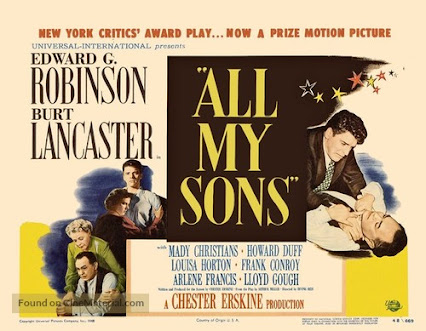
Edward G. Robinson and Burt Lancaster star in "All My Sons"

All My Sons (1948) is based on the play by Arthur Miller which ran on Broadway from January 29, 1947, closed on November 8, 1949, and ran for 328 performances. The film was directed by Irving Reis and starred Edward G. Robinson and Burt Lancaster. Other members of the cast include Louisa Horton, Mady Christians, Howard Duff, Arlene Francis, and Harry Morgan.

Joe Keller has built a manufacturing business that he hopes his son, Chris (Lancaster), will one day take over. But Chris has other plans. He wants to marry Ann Deever (Horton), who was once engaged to his brother, Larry, who was missing in action during World War II and presumed dead. Kate Keller refuses to believe her son is dead and has his room exactly as he left it, even going so far as to polish his shoes on a regular basis.

Ann's father and Joe Keller were partners in a plant that manufactured airplane parts for the military. An investigation determined that the company sold the government defective equipment. It was determined that the partners sold the parts knowing they were defective. Ann's father was convicted and sent to prison but Joe was exonerated. However, there has always been some doubt as to whether or not Joe was also responsible for the faulty airplane parts. This doubt hangs heavy over the Keller home and endangers Chris's relationship with Ann and his father.

When all the secrets are revealed, will the Keller family survive?


Irving Reis (1906 - 1953) was an American writer, producer, and director of both radio plays and motion pictures. Reis got his start as a photographer, eventually photographing publicity stills for various movie studios. He went to Hollywood and became a screenwriter at Paramount in 1938. From Paramount, he went to RKO where he directed the box office hit The Bachelor and the Bobby-Soxer (1947) starring Cary Grant, Myrna Loy, and Shirley Temple. Other films he directed include Enchantment  (1948), and The Four Poster (1952). Reis's died of cancer at the age of 47; he left a widow and three children.

Edward G. Robinson (1893 – 1973) was an American actor on the stage and screen. Robinson is a true legend from Hollywood’s Golden Age where he starred in the gangster classic Little Caesar (1931), Kid Galahad (1937), Confessions of a Nazi Spy (1939), The Sea Wolf (1941), Double Indemnity (1944), and Key Largo (1948). Robinson was awarded an Honorary Academy Award in 1973, but he was never nominated for a competitive Oscar.

Burt Lancaster (1913- 1994) was an American actor and producer. He won a Best Actor Academy Award for his performance in Elmer Gantry (1960). Lancaster made his film debut in The Killers (1946). After the release of that film, he was on his way as a leading man, starring in quick succession Desert Fury (1947), Brute Force (1947), Variety Girl (1947), I Walk Alone (1947), All My Sons (1948), and Sorry, Wrong Number (1948). Other popular films starring Lancaster include The Flame and the Arrow (1950), Jim Thorpe All-American (1951), From Here to Eternity (1953), The Rose Tattoo (1955), and Birdman of Alcatraz (1962).

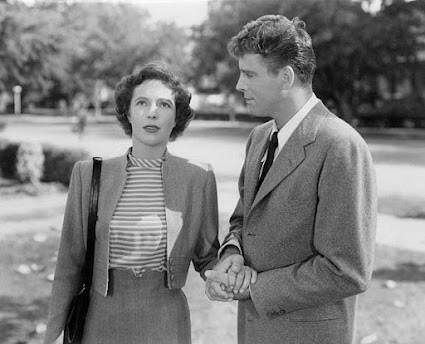
Lousia Horton and Burt Lancaster


Why watch this film?

  • It's a good film version of Arthur Miller's award-winning play.
  • Edward G. Robinson delivers a great performance.
  • Burt Lancaster put off making another film he was committed to because he wanted the role of Chris Keller.
  • This was the film debut of Louisa Horton (Ann) who was married to director George Roy Hill (The Sting).
  • The opportunity to see Arlene Francis early in her career and two years before she would become an icon on the television game show What's My Line.

To watch the film on YouTube, click on the link below.


Discussion questions:

  1. Some critics have considered this movie a film noir. What category of film would you classify it as?
  2. What did you think of Edward G. Robinson's performance in this film compared with his performance in The Red House?
  3. Burt Lancaster really wanted to play Chris Keller; what did you make of his performance?
  4. What did you think of the supporting cast? Any standouts?
  5. Did this film have a theme? If so, what is it?


To join the discussion on February 7, 2022, at 6:30 p.m. Central Time click here. Once you RSVP, you will receive an invitation with a Zoom link to the discussion online.

Wednesday, January 19, 2022

What is the mystery surrounding "The Red House?"

The Red House (1947) is a mystery written and directed by Delmer Daves and starring Edward G. Robinson, Lon McCallister, and Judith Anderson. The film score is by Miklos Rozsa. Others in the cast include Rory Calhoun, Julie London, and Allene Roberts.

The film centers around brother and sister Pete (Robinson) and Ellen Morgan, and their adopted daughter Meg (Roberts). Because of their reclusive ways, rarely leaving their farm, the Morgans are the subject of gossip. Meg and her relationship with Pete and Ellen is also a subject that is whispered about among her schoolmates. Pete warns Meg not to wander alone in the woods near their farm and he also warns her to stay away from a mysterious red house.

Meg and schoolmate Nath (McCallister), out of curiosity, go in search of the red house. What secret will the red house reveal and how will it affect Pete, Ellen, and Meg.

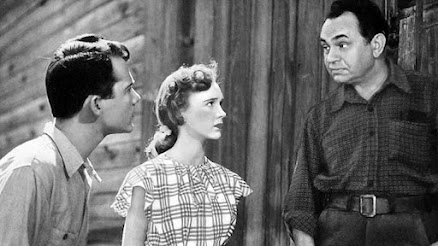
Lon McCallister, Allene Roberts, Edward G. Robinson


Delmer Daves (1904 - 1977) was an American writer, producer, and director. He worked in many genres including film noir, but he may be best remembered for his westerns. Broken Arrow (1950) starred James Stewart and Debra Paget, one of the first westerns to feature a Native American protagonist. During his career, Daves worked with many top stars from Hollywood's Golden age including Humphrey Bogart, Lauren Bacall, Glenn Ford, Gary Cooper, Clark Gable, Gene Tierney, Susan Hayward, Cary Grant, and Richard Widmark. Daves is responsible for some of the most popular movies of the 1940s and 1950s like Destination Tokyo (1943), The Pride of the Marines (1945), 3:10 to Yuma (1957), and A Summer Place (1959).

Edward G. Robinson (1893 – 1973) was an American actor on the stage and screen. Robinson is a true legend from Hollywood’s Golden Age where he starred in the gangster classic Little Caesar (1931), Kid Galahad (1937), Confessions of a Nazi Spy (1939), The Sea Wolf (1941), Double Indemnity (1944), and Key Largo (1948). Robinson was awarded an Honorary Academy Award in 1973, but he was never nominated for a competitive Oscar.

Lon McCallister (1923 - 2005) was an American film actor who was a popular star during the 1940s. McCallister was mostly cast as the youthful hero in films like Home in Indiana (1944) and Winged Victory (1944). Columnist Hedda Hopper called him "the cutest boy the movies have hauled up out of obscurity since Mickey Rooney." At only 5' 6", McCallister had difficulty finding movie roles as he grew older. He eventually worked in television but retired from acting in 1953. After his acting career ended, McCallister became a successful real estate investor.

Judith Anderson (1897 - 1992) was an Australian actress who was a star stage, film, and television. Anderson left Australia for a career in the United States. After a period of struggle, she made a name for herself on the Broadway stage in Strange Interlude (1929) replacing Lynn Fontaine. She starred in As You Desire  (1931) and The Old Maid (1935). With her success in the film Rebecca (1940), Anderson's career got a boost. She continued to work in film throughout the remainder of her career appearing in Laura (1944), Pursued (1947), The Ten Commandments (1956), A Man Called Horse (1970), and Star Trek III: The Search for Spock (1984).


The Red House trivia
  • The film was produced by Thalia Productions, a production company owned by Edward G. Robinson and producer Sol Lesser.
  • The novel on which the film is based was serialized in The Saturday Evening Post in 1945. 
  • This was the film debut of Allene Roberts (Meg).
  • The Red House was Rory Calhoun's second credited film role.

To watch the film on YouTube, click on the link below.


To join the discussion on January 24, 2022, at 6:30 p.m. Central Time click here. Once you RSVP, you will receive an invitation and link to join the discussion on Zoom.

Discussion questions:
  1. What genre do you think this film fits? Is it a mystery, horror, psychological thriller, film noir? 
  2. Do you think the film narrative is realistic?
  3. Did the film have an overall message or theme?
  4. Was there a scene that stood out to you?
  5. Is there a character and/or performance that stood out to you?

Thursday, July 9, 2020

Edward G. Robinson lives in a "House of Strangers"

House of Strangers (1949) is a film noir directed by Joseph L. Mankiewicz and starring Edward G. Robinson, Susan Hayward, and Richard Conte. The cinematography is by Milton R. Krasner (Scarlet Street 1945).


Richard Conte (sitting), Paul Valentine, Efrem Zimbalist Jr., and Luther Adler
Edward G. Robinson is Gino Monetti, an Italian-American banker whose business practices are questionable at best, against the law at worst. His four sons work with him at the bank. Gino dominates and belittles them at every opportunity, which causes deep resentments.

When Gino is put on trial for bank fraud, three of his sons take control of the bank with only Max (Richard Conte), a lawyer, taking his father’s side. Max bribes a juror in an attempt to keep his father out of jail, which leads to his disbarment and a seven-year prison term.
Richard Conte and Susan Hayward
Once out of jail, Max vows revenge on his brothers, especially older brother Joe (Luther Adler) who, like his father, controls his younger brothers Pietro (Paul Valentine) and Tony (Efrem Zimbalist Jr.).

Max’s quest for revenge threatens his relationship with Irene Bennett (Susan Hayward) a client he fell in love with. Will Max’s hatred and bitterness destroy him and his family or will he be able to create a new life with Irene.

Nineteen forty-nine was a great year for director Mankiewicz. That same year he wrote and directed A Letter to Three Wives, for which film he won two Academy Awards for directing and writing. He would win two more Oscars the following year for writing and directing All About Eve (1950). He is the only director to win back-to-back Academy Awards for writing and directing.

Edward G. Robinson (1893 – 1973) was an American actor of the stage and screen. Robinson is a true star from Hollywood’s Golden Age where he starred in the gangster classic Little Caesar (1931), Kid Galahad (1937), Confessions of a Nazi Spy (1939), The Sea Wolf (1941), Double Indemnity (1944), and Key Largo (1948). Robinson was awarded an Honorary Academy Award in 1973 but was never nominated for a competitive Oscar.

Susan Hayward (1917 – 1975) was an Academy Award-winning actress for her role as Barbara Graham in I Want to Live (1958). Hayward worked as a fashion model but traveled to Hollywood in 1937 to try out for the role of Scarlett O’Hara. She didn’t win that coveted role, but she secured a film contract. Hayward’s career took off in the late 1940s when she was nominated for Best Actress for Smash-Up, the Story of a Woman (1947). She received four more Best Actress nominations for My Foolish Heart (1949), With a Song in My Heart (1952), I’ll Cry Tomorrow (1955), and I Want to Live. Later in her career, Hayward replaced Judy Garland as Helen Lawson in Valley of the Dolls (1967).

Richard Conte (1910 – 1975) was an American actor who came to prominence in the late 1940s under contract to 20th Century-Fox. He co-starred with James Stewart in Call Northside 777 (1948) and had the lead role in Thieve’s Highway (1949) directed by Jules Dassin (Night and the City 1950), and played Gene Tierney’s husband in Otto Preminger’s Whirlpool (1949). Conte worked constantly and had major roles in Ocean’s 11 (1960) and The Godfather (1972).

Below is the YouTube link to House of Strangers. Be sure to use this link because there are several versions available on the channel. The quality of this one is terrific.


After youve watched the movie, join us on Tuesday, July 14 at 6:30 p.m. Central Time on Zoom for a discussion. The Zoom meeting link is below

Stephen Reginald is inviting you to a scheduled Zoom meeting.

Topic: Discussion of "House of Strangers"
Time: Jul 14, 2020 06:30 PM Central Time (US and Canada)

Join Zoom Meeting


Meeting ID: 722 1492 0975
Password: 9skVd3

Questions for discussion:
1. Noir or not? How does this fit in with the genre in your opinion?
2. Did Edward G. Robinson’s character remind you of another famous character from the movies?
3. Some critics thought that Susan Hayward’s role wasn’t necessary for the film narrative. Do you agree with that assessment?
4. Were you surprised by anything? Did the movie end the way you thought it would?

Wednesday, July 1, 2020

A walk down "Scarlet Street" with Edward G. Robinson, Joan Bennett, and Dan Duryea

Scarlet Street (1945) is a film noir directed by Fritz Lang, produced by Walter Wanger, cinematography by Milton Krasner, and starring Edward G. Robinson, Joan Bennett, and Dan Duryea.

With the critical and box office success of The Woman in the Window (1944), director Lang once again directed Robinson, Bennett, and Duryea in another film noir thinking lighting would strike twice and it did.
Joan Bennett in Scarlet Street

The plot revolves around Christopher “Chris” Cross (Robinson), a shy and reserved cashier for a retail store. In his spare time, he paints to help him forget his dull life and loveless marriage with Adele (Rosalind Ivan). Walking through Greenwich Village he witnesses Kitty March (Bennett) being roughed up by Johnny Prince (Duryea) and proceeds to knock Johnny out with his umbrella. Chris is enamored with Kitty and the two go out for drinks. While together, Chris is somewhat vague about his profession and his financial situation. Based on the way Chris talks about art, Kitty suspects he’s a rich and famous artist. When Kitty tells Johnny about her encounter, Johnny cooks up a plan to swindle Chris of his “fortune.”

Edward G. Robinson paints in his bathroom in Scarlet Street.

If The Woman in the Window was all a dream, Scarlet Street is a nightmare. Much darker than its predecessor but with similar ironic twists and turns to keep you guessing till the end.

Scarlet Street was a nominee for Best Feature Film at the 1946 Venice Film Festival.

Fritz Lang (1890 – 1976) was an Austrian-German-American director. Lang is the director of the silent film classic Metropolis (1927). After serving in World War I, Lang worked for a time as an actor in the theater and then worked as a writer at Decla Film in Berlin. Lang’s first talking picture was M (1931) a story about a child murderer. Due to his growing renown, Joseph Goebbels offered him the position of head of the German film studio UFA in 1933. Lang emigrated to Paris and then to the United States in 1936. Lang worked for all the major studios, making twenty-three feature films in the United States. Some of Lang’s films include Scarlet Street (1945), The Big Heat (1953), and While the City Sleeps (1956).

Milton R. Krasner (1904 – 1988) was an American cinematographer. He is best known for his work at 20th Century-Fox where he filmed such classics as All About Eve (1950) and The Seven Year Itch (1955). Other notable films he photographed include Scarlet Street (1945), The Dark Mirror (1946), The Egg and I (1947), The Farmer’s Daughter (1947), Bus Stop (1956), An Affair to Remember (1957), Bells Are Ringing (1960), Sweet Bird of Youth (1962), How the West Was Won (1962), Love with the Proper Stranger (1963), and The Singing Nun (1966). Krasner won an Academy Award for his work on Three Coins in the Fountain (1954).

Robinson and Bennett
Edward G. Robinson (1893 – 1973) was an American actor of the stage and screen. Robinson is a true star from Hollywood’s Golden Age where he starred in the gangster classic Little Caesar (1931), Kid Galahad (1937), Confessions of a Nazi Spy (1939), The Sea Wolf (1941), Double Indemnity (1944), and Key Largo (1948). Robinson was awarded an Honorary Academy Award in 1973 but was never nominated for a competitive Oscar.

Joan Bennett (1910–1990) began her film career during the early sound era. A natural blonde, Bennett dyed her hair as a plot device in the film Trade Winds (1938). As a brunette, Bennett projected a sultry persona that had her compared to the brunette beauty, Hedy Lamarr. During this period she starred in two costume epics. She played Princess Maria Theresa in The Man in the Iron Mask (1939) and Grand Duchess Zona of Lichtenburg in The Son of Monte Cristo (1940). Bennett was one of two finalists for the role of Scarlett O’Hara in Gone with the Wind (1939), along with Paulette Goddard. She had a very successful collaboration with the director Fritz Lang. With Lang, she starred in the classics Man Hunt (1940), The Woman in the Window (1944), and Scarlet Street (1945). Bennett acted on stage and on television where she became a pop culture icon playing Elizabeth Collins Stoddard on the gothic soap opera Dark Shadows (1966-1971).

Dan Duryea (1907 – 1968) was an American film, stage, and television actor. He is best known for his character roles as villains, but he had a long career that included a variety of lead and second lead roles. Duryea graduated from Cornell University in 1928. In his senior year, he was the president of the college drama society. Duryea went to Hollywood in 1940 to Leo Hubbard in The Little Foxes, a role he created on Broadway. He established himself in films noir costarring in classics like Scarlet Street (1945), Criss Cross (1948), and Too Late for Tears (1949).

Below is the link to the movie on YouTube. Please use this link; there are several prints uploaded to the channel, but this one is the best one available.


Join us on Zoom for a discussion of this film on July 7, 2020, 2020, at 6:30 p.m. Central Time. Check below for meeting links.

Stephen Reginald is inviting you to a scheduled Zoom meeting.

Topic: Discussion of "Scarlet Street"
Time: Jul 7, 2020 06:30 PM Central Time (US and Canada)

Join Zoom Meeting

https://us04web.zoom.us/j/74072831028?pwd=REdjTU00bERyc1BMVCs2a2FnMExjUT09

Meeting ID: 740 7283 1028
Password: 9NLZi9


Questions for discussion:
1. Does Joan Bennett’s Kitty March have anything in common with Alice Reed from The Woman in the Window?
2. How similar is Edward G. Robinson’s Christopher Cross with his characterization of Richard Wanely?
3. What about Dan Duryea? Was his characterization similar to the one in The Woman in the Window?
4. What classic film noir elements, based on your understanding of the genre, did you notice?
5. Was the ending a surprise to you? Was it a satisfying ending?
6. Of the two films: The Woman in the Window and Scarlet Street, which one do you think is the better film?

Wednesday, June 24, 2020

Fritz Lang’s “The Woman in the Window” starring Edward G. Robinson and Joan Bennett

The Woman in the Window (1944) is an American film noir directed by Fritz Lang, produced by Nunnally Johnson, and starring Edward G. Robinson, Joan Bennett, Raymond Massey, and Dan Duryea.

The plot centers on a mild-mannered college professor Richard Wanley (Robinson) who meets Alice Reed, (Bennett) while staring at a painting in an art gallery window. He soon realizes that the woman was the model for the painting. What started out as an innocent night out for a few drinks turns into a night of murder and blackmail.

How will  Professor Wanley and Alice get out of the mess they’ve gotten themselves into?

Joan Bennett and Edward G. Robinson

Fritz Lang (1890 – 1976) was an Austrian-German-American director. Lang is the director of the silent film classic Metropolis (1927). After serving in World War I, Lang worked for a time as an actor in the theater and then worked as a writer at Decla Film in Berlin. Lang’s first talking picture was M (1931) a story about a child murderer. Due to his growing renown, Joseph Goebbels offered him the position of head of the German film studio UFA in 1933. Lang emigrated to Paris and then to the United States in 1936. Lang worked for all the major studios, making twenty-three feature films in the United States. Some of Lang’s films include Scarlet Street (1945), The Big Heat (1953), and While the City Sleeps (1956).

Nunnally Johnson (1897 – 1977) was a journalist, screenwriter, producer, and director. He worked for many years as a writer at 20th Century-Fox before he co-founded International Pictures in 1943 with William Goetz. Johnson was nominated for an Academy Award for Best Screenplay in 1940 for The Grapes of Wrath. Johnson wrote, produced, and directed The Man in the Gray Flannel Suit (1956) and The Three Faces of Eve (1957). As a writer-producer, he is responsible for The Gunfighter (1950), My Cousin Rachel (1952), and How to Marry a Millionaire (1953). Johnson’s last credited screenplay was for The Dirty Dozen (1967).

Milton R. Krasner (1904 – 1988) was an American cinematographer. He is best known for his work at 20th Century-Fox where he filmed such classics as All About Eve (1950) and The Seven Year Itch (1955). Other notable films he photographed include Scarlett Street (1945), The Dark Mirror (1946), The Egg and I (1947), The Farmer’s Daughter (1947), Bus Stop (1956), An Affair to Remember (1957), Bells Are Ringing (1960), Sweet Bird of Youth (1962), How the West Was Won (1962), Love with the Proper Stranger (1963), and The Singing Nun (1966). Krasner won an Academy Award for his work on Three Coins in the Fountain (1954).

Edward G. Robinson (1893 – 1973) was an American actor of the stage and screen. Robinson is a true star from Hollywood’s Golden Age where he starred in the gangster classic Little Caesar (1931), Kid Galahad (1937), Confessions of a Nazi Spy (1939), The Sea Wolf (1941), Double Indemnity (1944), and Key Largo (1948). Robinson was awarded an Honorary Academy Award in 1973 but was never nominated for a competitive Oscar.


Joan Bennett (1910–1990) began her film career during the early sound era. A natural blonde, Bennett dyed her hair as a plot device in the film Trade Winds (1938). As a brunette, Bennett projected a sultry persona that had her compared to the brunette beauty, Hedy Lamarr. During this period she starred in two costume epics. She played Princess Maria Theresa in The Man in the Iron Mask (1939) and Grand Duchess Zona of Lichtenburg in The Son of Monte Cristo (1940). Bennett was one of two finalists for the role of Scarlett O’Hara in Gone with the Wind (1939), along with Paulette Goddard. She had a very successful collaboration with the director Fritz Lang. With Lang, she starred in the classics Man Hunt (1940), The Woman in the Window (1944), and Scarlet Street (1945). Bennett acted on stage and on television where she became a pop culture icon playing Elizabeth Collins Stoddard on the gothic soap opera Dark Shadows (1966-1971).

Dan Duryea (1907 – 1968) was an American film, stage, and television actor. He is best known for his character roles as villains, but he had a long career that included a variety of lead and second lead roles. Duryea graduated from Cornell University in 1928. In his senior year, he was the president of the college drama society. Duryea went to Hollywood in 1940 to Leo Hubbard in The Little Foxes, a role he created on Broadway. He established himself in films noir costarring in classics like Scarlet Street (1945), Criss Cross (1948), and Too Late for Tears (1949).

Below is the link to the movie on YouTube. Please use this link; there are several prints uploaded to the channel, but this one is the best one available.


Join us on Zoom for a discussion of this film on June 30, 2020, 2020, at 6:30 p.m. Central Time. Check below for meeting links.

Stephen Reginald is inviting you to a scheduled Zoom meeting.

Topic: Discussion of "The Woman in the Window"
Time: Jun 30, 2020, 06:30 PM Central Time (US and Canada)

Join Zoom Meeting

https://us04web.zoom.us/j/71665496130?pwd=ZDdveDhIN1ZCcjNSSGRDNTE2SHhBQT09

Meeting ID: 716 6549 6130
Password: 7yG9D2


Questions for discussion:
1. Noir or not? Does this film fit your idea of film noir?
2. Did you notice any noir visual clues?
3. Was Edward G. Robinson credible as a middle-aged college professor?
4. Any significance to the name Wanely? Why do you think professor Wanely decided to read “The Song of Solomon.”
5. Joan Bennett wasn’t your typical film noir “dame.” What sets her apart from some other femme fatales in other films noir? Were you curious about Bennett’s profession?
6. Fritz Lang is considered one of the best directors of film noir. From what you know about Lang, do you agree? What makes his style unique?
7. Did you like the ending? Was it a surprise or expected?

Trivia: Look for Robert Blake at the beginning of the film. He plays Robinson’s young son. Blake wasn't credited in the movie.

Wednesday, May 27, 2020

Edward G. Robinson Pursues Nazis in “The Stranger” directed by Orson Welles

The Stranger (1946) is a film noir directed by Orson Welles, produced by Sam Spiegel, and starring Edward G. Robinson, Loretta Young, and Orson Welles.

The film concerns Mr. Wilson (Robinson) of the United Nations War Crimes Commission and his hunt for Nazi war criminal Franz Kindler (Welles). Kindler was careful to erase all traces of evidence that would connect him to his war crimes, but it is known that he had an affinity for clocks.

Edward G. Robinson, Loretta Young, and Orson Welles
In an effort to locate Kindler, Robinson releases Meinike, a former associate of Kindler’s. Robinson hopes that Meinike will lead him to Kindler. Upon Meinike’s release, he travels to Harper, a small town in Connecticut. Kindler has created a new identity and life for himself there in the person of Charles Rankin, a teacher at a prep school. He is engaged to marry Mary Longstreet, (Young) the daughter of a Supreme Court Justice.

Will Kindler escape prosecution for his war crimes or will Wilson be successful in bringing him to justice?

The Stranger has the distinction of being the only film that Welles directed that was a commercial hit. After the back-to-back box office disasters of Citizen Kane (1941) and The Magnificent Ambersons (1942), no one wanted to hire Welles to direct. In order for Welles to direct, he had to sign an agreement that he would owe the studio a substantial sum of money if he didn’t meet his obligation to bring the picture in on time and on budget. In fact, Welles brought the picture in a day ahead of schedule and under budget!

Major cast members from The Stranger at the dinner table

Excerpts of the documentary film Nazi Concentration Camps (1945) were included when Wilson’s character is explaining the crimes of Kindler and other Nazis. Director George Stevens, along with James B. Donovan, and Ray Kellogg assembled the film from footage they took during the liberation of Europe for that documentary.

Orson Welles (1915- 1985) was an American actor, writer, director, and producer. He is considered one of the greatest filmmakers of all time, with Citizen Kane considered by many to be the greatest film of all time. Welles got his start on the stage. He formed the Mercury Theatre with John Houseman in 1937. Many of the actors from his repertory theatre starred in his first two films. Welles had a reputation for being difficult and undisciplined which contributed to his low output of films. In spite of all that, his reputation as a Hollywood genius remains untarnished.

Sam Spiegel (1901 – 1985) was an American independent film producer. Speigel won Best Picture Academy Awards for three of the most famous American films of the twentieth century: On the Waterfront (1954), The Bridge on the River Kwai (1957), and Lawrence of Arabia (1962). His three Oscar wins are a record for an independent producer.

Russell Metty (1906 – 1978) was an American cinematographer. He won an Academy Award for Best Cinematography, Color for Spartacus (1960). Starting his career at RKO, Metty photographed Bringing Up Baby (1937) and Room Service (1938). Other films he photographed include Magnificent Obsession (1954), There’s Always Tomorrow (1955), Written on the Wind (1956), and All That Heaven Allows (1956) all directed by Douglas Sirk. Some of his later films include Flower Drum Song (1961), Thoroughly Modern Millie (1967), The Omega Man (1971), and That’s Entertainment (1974).

Edward G. Robinson (1893 – 1973) was an American actor of the stage and screen. Robinson is a true legend from Hollywood’s Golden Age where he starred in the gangster classic Little Caesar (1931), Kid Galahad (1937), Confessions of a Nazi Spy (1939), The Sea Wolf (1941), Double Indemnity (1944), and Key Largo (1948). Robinson was awarded an Honorary Academy Award in 1973, but he was never nominated for a competitive Oscar.

Loretta Young (1913 – 2000) was an American actress. She entered show business as a young girl working in silent films. Silent film icon Colleen Moore gave her the name Loretta (she was born Gretchen Young). With the advent of talkies, Young became a leading lady, landing a long-term contract at 20th Century-Fox. Studio head Darryl F. Zanuck paired her with Tyrone Power and the two were a movie team for a time. Young tired of the parts she was getting at Fox and she decided to leave the studio and become a freelance actor, which was a risky proposition. After a slow start where she reduced her per film fee, she managed to get back on top, winning the Academy Award for Best Actress in 1948 for The Farmer’s Daughter. When film roles dried up, Young ventured into the new medium of television, becoming one of its earliest pioneers with the anthology series The Loretta Young Show.

To watch this film on YouTube, click on the link below. Be sure to use this link because there are several versions of this film on YouTube that are of poor quality.


After you have watched the film, join us on Zoom for a discussion. Below are the links to follow.

Stephen Reginald is inviting you to a scheduled Zoom meeting.

Topic: Discussion of "The Stranger"
Time: Jun 2, 2020 06:30 PM Central Time (US and Canada)

Join Zoom Meeting


Meeting ID: 791 0685 1740
Password: 5Wqk1Z


Questions for discussion:
1. Noir or not? Does this film fit the film noir model as you know it?
2. What did you think of Edward G. Robinson’s performance?
3. From what you know of Orson Welles, did this feel like a Welles film?
4. Was Loretta Young’s character believable?
5. Did the ending surprise you? If yes, how did you think it would end?


Thursday, August 23, 2018

Review of “All My Sons” at #NoirCityChicago


Monday night the A Film at Noir City Chicago was the film adaptation of Arthur Miller’s award-winning play, All My Sons (1948). The film starred Edward G. Robinson and Burt Lancaster as father and son respectively.


The movie was introduced by Alan K. Rode, film historian and author of Michael Curtiz: A Life in Film. He made it clear that this film didn’t fit the film noir category, but because of its dark thematic elements thought it would be appreciated by a film noir crowd. He was right. The film was dark and somber, but it was also superbly acted. Rode noted that photographer-turned-playwright-turned director Irving Reis overall did a good job directing the film, but thought the cinematography was a bit static. To be honest, I didn’t notice this (maybe I need to see it again); I found the subject matter and the performances compelling enough.

As the father, Edward G. Robinson was terrific. His characterization was multidimensional, which made Joe Keller a flesh and blood human being. Joe is flawed for sure, but not entirely unsympathetic. As Joe’s son, Chris, Burt Lancaster was solid. Physically, he doesn’t resemble Robinson at all, but his characterization was very strong without any of the screen chewing that he displayed in I Walk Alone, released the same year. The other cast members: Louisa Horton, Mady Christians, Howard Duff, and Arlene Francis were also very good.
 
A tense scene between Howard Duff, Burt Lancaster, and Louisa Horton
All My Sons was definitely not a film noir, but it was engrossing cinema nonetheless.

The #NoirCityChicago film festival, wraps up on Thursday, August 23, 2018. Looking forward to this festival coming to Chicago again in 2019.  

Tuesday, May 8, 2018

2018 Turner Classic Film Festival (#TCMFF) Day 1

It’s hard to believe that the 2018 TCM Film Festival is over. My anticipation builds as soon as the weather turns chilly here in Chicago. Dreaming about the film festival and warm days and nights in Los Angeles helps me get through the winter. Plus it’s great reconnecting with friends from all over the country and the world.


This year’s festival began for me on Thursday, April 26. Flying out of Chicago’s Midway airport in the morning and arriving in LA four hours later…in the morning! After leaving the airport and heading for the Hollywood Roosevelt Hotel where fellow classic movie fans gather in the Blossom Room—the room where the very first Academy Awards ceremony was held in 1929—to hang out and chat, celebrity watch, and watch everyone arrive. After the couple of hours of meeting and greeting, it’s check in time at the Air B & B; this year barely a block away from the Hollywood Roosevelt Hotel. Score!

After checking in, it’s back to the Hollywood Roosevelt for the hardest movie trivia game ever, “So You Think You Know Movies,” hosted by Bruce Goldstein, repertory program director of New York’s Film Forum. I think my knowledge of classic movies is pretty good, but every year, this event just crushes me. We assembled a good team, but we came up extremely short.


As usual I opted for the Classic Pass, which doesn’t include the red carpet presentation movie (this year Mel Brooks’s The Producers). The bump in price has never seemed worth it and there are plenty of movies to choose from while the celebrities mingle with ordinary folk on the red carpet at the Chinese Theater. The first movie I saw was To Have And Have Not (1944) directed by Howard Hawks. I’ve seen bits and pieces of this film over the years, but I don’t think I’ve ever seen it from beginning to end. The film that introduced Lauren Bacall to film audiences starred Humphrey Bogart who would end up marrying his 19-year-old leading lady the next year. The 35MM print provided by Warner Bros. Classics looked great on the big screen at the Egyptian Theatre and was the perfect movie to start my 2018 TCMFF.


The next movie on my agenda was The Sea Wolf (1941) directed by Michael Curtiz, starring Edward G. Robinson, Ida Lupino, and John Garfield. The supporting cast includes Gene Lockhart, Alexander Knox, and Barry Fitzgerald. Besides being a fan of all three stars, this movie went through a restoration. In 1947, Warner Brothers paired The Sea Wolf with The Sea Hawk (1940) on a double bill. In order to get more screenings in, Warners cut 14 minutes from The Sea Wolf. Those 14 minutes were thought lost forever until a 35MM nitrate print was discovered at the Museum of Modern Art. What we saw at the Chinese Multiplex House # 6 was a beautiful digital restoration that looked brand new. The performances of Robinson, Lupino, and Garfield are extraordinary. Robinson’s performance is especially good; it’s hard to believe he was never nominated for a competitive Oscar—neither was Lupio; Garfield was nominated twice: Best Supporting Actor in Four Daughters (1938) and Best Actor in Body and Soul (1947). By the time The Sea Wolf ended, it was nearly 11:30 p.m. (1:30 p.m. Chicago time!). Time to get some shuteye and plan on what movie to see Friday morning. Here are my three choices: The Merry Widow (1934), Strangers on a Train (1951), and Intruder in the Dust (1949). Which movie would you pick?

Sunday, March 20, 2016

The Ten Commandments on the big screen

I wasn’t going to see Cecil B. DeMille’s production of The Ten Commandments on the big screen presented by Turner Classic Movies, Fathom Events, and Paramount Pictures. I’d seen it a dozen times on TV and thought it might not hold up in the 21st-century. On almost a whim, I decided to go and was glad I did.

At the bus stop, I met a woman who was also going to see the movie. We talked about it on the way there and chatted about the other classic movies we saw on the big screen recently. At the theater, I met a member of my film club and a neighbor. The audience was quite diverse. There were old folks with walkers and canes, parents with small children, and single folks, like me.

During the introduction of the film by TCM’s Ben Mankiewicz, we learned that we were going to see The Ten Commandments in its original road show version—overture, intermission, entr’ act—which was the way many movies were shown back in the day when I was a kid. The lights went down and the overture played the stirring score by Elmer Bernstein and I was hooked.

Moses and Rameses, two princes of Egypt

The epic directed by the legendary DeMille was his last film; he died three years after the film’s release. Sure there are parts of the film that are stilted and a bit hokey by today’s acting conventions, but I found most of the film very powerful. I was surprised at how emotionally I reacted to the movie. The plight of a people in bondage, living under a cruel leader, eventually finding freedom and redemption, still resonate—at least it did with me. It was like Sunday school come alive. I found myself remembering Bible verses and the stories from the book of Exodus.

Anne Baxter as Nefritiri
I always used to make fun of Anne Baxter’s uttering of the line, “Oh Moses, you stubborn, splendid, adorable fool!” But for some reason, it didn’t seem so campy on the big screen. And I must say, Baxter’s performance as Nefretiri—one of the most sought after roles of the 1950s—is all in. She really brought the Egyptian queen to life. The other performances were equally strong. Charlton Heston as Moses is impressive and he has the physical stature necessary for such a role. Yul Brynner is equally impressive as the vain and power-hungry Rameses II. Both have genuine screen presence and the commanding voices to match. Edward G. Robinson is properly sinister as Dathan. Yvonne DeCarlo—years before she became a TV icon on The Munsters—as Sephora and Moses’ wife is radiant. Then there’s John Derek as Joshua and Debra Paget as Lilia. Derek seems saddled with the most stilted spiritual sounding dialogue, but again, somehow on the big screen, it worked for me.

The scenes in Egypt were impressive, especially the Exodus. The sheer number of extras involved in that scene is staggering; I can’t imagine how difficult it was to get all of that on film. Did they get it in one take? I doubt it. The film employed a lot of blue screen and matte backdrops. Sometimes these devices were noticeable and obvious, but at other times not so much. With the parting of the Red Sea scene, the blue “halo” from the rear screen process photography gave it a “miraculous” look.

Moses confronts Rameses

The restoration that Paramount did in 2010 is near perfect. The film looked brand new and I can only imagine what audiences in 1956 though. Of course, 1956 was a simpler time and scenes that we think are corny or campy today weren’t back then. But the size and sheer spectacle of the production must have been extraordinarily impressive. It was nominated for seven Academy Awards (it won one for Best Visual Effects) and was the top-grossing film of the year. It still ranks high on the list of all-time movie moneymakers, coming in at number seven when grosses are adjusted for inflation.

If you’ve never seen a movie like The Ten Commandments on the big screen, you should. It really makes a difference.

There’s another screening of this classic film this Wednesday. Click the link to see if it’s showing in your area.

Backstory: Many top actresses were considered for the role of Nefritiri, including Audrey Hepburn Ann Blyth, Rhonda Fleming, Colleen Gray, Vivian Leigh, and Jane Russell. For the role of Sephora, the stars considered were Anne Bancroft, Linda Darnell, Grace Kelly, Barbara Hale, Patricia Neal, Ruth Roman, Jean Peters, and Barbara Rush.


Related Posts Plugin for WordPress, Blogger...