Showing posts with label Yvonne DeCarlo. Show all posts

Tuesday, November 18, 2025

Burt Lancaster and Yvonne De Carlo can’t seem to catch a break in “Criss Cross”

Criss Cross (1948) is an American film noir directed by Robert Siodmak that plunges the audience into a dark, fatalistic world of obsessive love and impending disaster. The story centers on Steve Thompson (Burt Lancaster), a man who returns to Los Angeles trying to leave his past behind. He takes back his old job as a driver for an armored car company, a symbol of the honest, steady life he hopes to maintain. However, Steve can’t shake his deep, lingering obsession with his beautiful and volatile ex-wife, Anna (Yvonne De Carlo).

Despite his family’s and friends’ warnings about Anna’s manipulative nature, Steve inevitably crosses paths with her again, immediately reigniting a passionate but doomed romance. The situation is complicated by the fact that Anna is now married to Slim Dundee (Dan Duryea), a local gangster and nightclub owner. Steve’s renewed relationship with Anna forces him into a dangerous love triangle, quickly pushing him away from his attempts at a clean start and back toward the corrupting influences of the criminal underworld. This relentless attraction to a woman who is demonstrably bad for him sets the stage for the escalating tragedy.

As the plot unfolds, Steve becomes trapped in a tangled web of deceit and double-crosses, where no one—not Anna, not Slim, and certainly not Steve himself—can be completely trusted. The film masterfully builds a sense of inescapable doom as the intricate plan for the heist is set in motion. Criss Cross is a powerful, stylish examination of human weakness, desire, and betrayal, showcasing how a single, consuming obsession can irrevocably lead a man down a path to his own destruction.

Yvonne De Carlo and Burt Lancaster


Robert Siodmak (1900 – 1973) had a very successful career in Hollywood and is best known for his thrillers and films noir. He signed a seven-year contract with Universal and directed The Killers (1946), the film that made Ava Gardner a star. He worked with some of the top movie stars during Hollywood’s Golden Age, including Deanna Durbin, Gene Kelly, Burt Lancaster, Dorothy McGuire, Yvonne de Carlo, Olivia de Havilland, and Barbara Stanwyck. Often compared to Hitchcock in his prime, he never got the recognition that the Master of Suspense did, but most of his films hold up remarkably well and are worth watching.

Burt Lancaster (1913- 1994) was an American actor and producer. He won a Best Actor Academy Award for his performance in Elmer Gantry (1960). Lancaster made his film debut in The Killers (1946). After the release of that film, he was on his way as a leading man, starring in quick succession Desert Fury (1947), Brute Force (1947), Variety Girl (1947), I Walk Alone (1947), All My Sons (1948), and Sorry, Wrong Number (1948). Other popular films starring Lancaster include The Flame and the Arrow (1950), Jim Thorpe All-American (1951), From Here to Eternity (1953), The Rose Tattoo (1955), and Birdman of Alcatraz (1962).

Yvonne De Carlo (1922 – 2007) was a Canadian-American actress, dancer, and singer whose career spanned six decades across film, television, and stage. She first rose to prominence in the 1940s and 1950s as a Hollywood film star, gaining recognition in lavish Technicolor productions like Salome, Where She Danced (1945) and often being cast in exotic or adventurous roles, including her notable turn in the film noir Criss Cross (1949). Her film career peaked when she played Sephora, the wife of Moses, in Cecil B. DeMille’s epic The Ten Commandments (1956). She gained renewed fame with a new generation of fans in the 1960s for her enduring role as Lily Munster, the glamorous matriarch, in the popular CBS sitcom The Munsters (1964–1966).

Dan Duryea (1907 – 1968) was an American film, stage, and television actor. He is best known for his character roles as villains, but he had a long career that included a variety of lead and second lead roles. Duryea graduated from Cornell University in 1928. In his senior year, he was the president of the college drama society. Duryea went to Hollywood in 1940 to play Leo Hubbard in The Little Foxes, a role he created on Broadway. He established himself in films noir, costarring in classics like Scarlet Street (1945), Criss Cross (1948), and Too Late for Tears (1949).


Criss Cross trivia

  • Reunion of Noir Veterans: The film reunited director Robert Siodmak and star Burt Lancaster, along with composer Miklós Rózsa, all of whom had previously collaborated on the highly successful 1946 film noir classic, The Killers. The two movies share the thematic elements of a doomed protagonist drawn back into crime by a manipulative woman.
  • Uncredited Star Debut: A very young and uncredited Tony Curtis makes a brief appearance in the film. He can be spotted as an extra dancing with Yvonne De Carlo’s character, Anna, in the lively nightclub scene at “The Round-Up.”
  • Los Angeles Location as a Character: Criss Cross was shot extensively on location in the Bunker Hill neighborhood of downtown Los Angeles. This area, known for its steep hills, Victorian architecture, and rundown boarding houses, was a popular setting for classic film noirs, and its gritty, precarious atmosphere adds to the movie’s sense of fatalism. Much of the architecture seen in the film was later demolished in the 1950s and 60s due to redevelopment.
  • Novel Adaptation: The film is based on the 1934 novel of the same name by Don Tracy. While the novel provided the core plot, the film adaptation, scripted by Daniel Fuchs, amplified the key elements of film noir, including the complex flashback structure, the fatalistic voice-over narration, and the overwhelming sense of doom.


Click HERE to watch the movie on the Internet Archive.

Click HERE to join the online discussion on Monday, November 24, 2025, at 6:30 p. m. Central Time. Once you RSVP, you’ll receive a link with an invitation to join the discussion on Zoom.

Discussion questions

  1. The Nature of Obsession and Fate: The film utilizes a flashback structure that essentially reveals the ending in the very first scene. How does knowing Steve Thompson's ultimate fate from the beginning affect the audience's viewing experience? Does this structure amplify the fatalism and obsessive nature of his choices, or does it simply reduce the suspense?
  2. The Archetype of the Femme Fatale: How does Anna (Yvonne De Carlo) embody the classic film noir archetype of the femme fatale? Is she truly evil and manipulative, or is she also a victim of her circumstances and the limited opportunities available to women in her environment? How does her character compare to other famous film noir women?
  3. Moral Compromise and the American Dream: Steve Thompson returns to Los Angeles determined to live an honest, working-class life, but his desires quickly derail him. How does the film comment on the idea of the American Dream or the possibility of redemption? At what point does Steve cross the moral line, and is his downfall inevitable regardless of his choices?
  4. Style and Setting in Noir: The film makes extensive use of location shooting in the atmospheric, now-demolished Bunker Hill neighborhood of Los Angeles. How do the movie's visual style—specifically the use of low-key lighting (chiaroscuro), shadows, and gritty urban settings—reflect and enhance the themes of desperation, moral corruption, and entrapment in the story?
Wednesday, March 16, 2022

Burt Lancaster leads with "Brute Force"

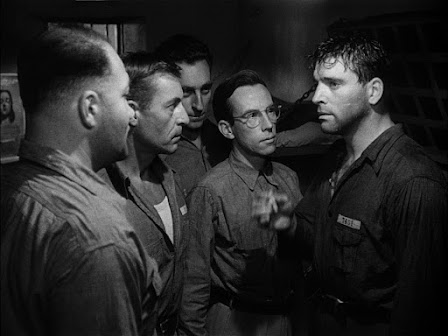
Brute Force (1947) is an American film noir directed by Jules Dassin and starring Burt Lancaster, Hume Cronyn, and Charles Bickford. The film also stars Yvonne De Carlo, Ann Blyth, and Ella Raines. The screenplay was by Richard Brooks, the cinematography was by William H. Daniels, and the music was by Miklos Rozsa.

After returning from solitary confinement, Joe Collins (Lancaster) plans his escape from Westgate Prison, along with some of his fellow prisoners. Along with his plans for escape, are his plans to get even with Captain Munsey (Cronyn) the sadistic chief of security.


Jules Dassin (1911 – 2008) was an American film director. He got work as an assistant director at RKO and then moved to M-G-M where he directed short subjects. Dassin directed the film noir classics Brute Force (1947), The Naked City (1948), and Thieves’ Highway (1949). He was blacklisted because of his once being a member of the Communist Party so he left the United States for Europe where remained for the rest of his life. He was married to Greek film actress Melina Mercouri.

Burt Lancaster (1913- 1994) was an American actor and producer. He won a Best Actor Academy Award for his performance in Elmer Gantry (1960). Lancaster made his film debut in The Killers (1946). After the release of that film, he was on his way as a leading man, starring in quick succession Desert Fury (1947), Brute Force (1947), Variety Girl (1947), I Walk Alone (1947), All My Sons (1948), and Sorry, Wrong Number (1948). Other popular films starring Lancaster include The Flame and the Arrow (1950), Jim Thorpe All-American (1951), From Here to Eternity (1953), The Rose Tattoo (1955), and Birdman of Alcatraz (1962).

Hume Cronyn (1911 - 2003) was a Canadian film and stage actor, as well as a writer. He and his wife Jessica Tandy often worked together on stage, film, and television. Cronyn's first film role was in Alfred Hitchcock's Shadow of a Doubt (1943), which began a long working relationship with the famed director. Cronyn appeared in Hitchcock's Lifeboat (1944) and worked on the screenplays of Rope (1948) and Under Capricorn (1949). In 1944 he was nominated for a Best Supporting Actor Oscar in The Seventh Cross. Other Cronyn films include The Postman Always Rings Twice (1946), Sunrise of Campobello (1960), and  Cleopatra (1963).

Charles Bickford (1891 - 1967) was an American actor who is best remembered for his supporting roles in films like The Farmer's Daughter (1947), Johnny Belinda (1948),  A Star is Born (1954), and The Big Country (1958). Bickford was nominated for three Best Supporting Actor Academy Awards between 1943 - 1948. During the 1950s and 1960s, Bickford staring appearing on television on shows like Wagon Trian, The Barbara Stanwyck Show, and The Virginian.


To watch the film on YouTube click the link below.


To join the discussion on March 21, 2022, at 6:30 p.m. Central Time, click here. Once you RSVP, you'll receive an invitation and link to join the discussion on Zoom.

Why watch this film?
  • We see a superstar in the making, Burt Lancaster in only his second film role.
  • One of director Jules Dassin's best films.
  • There are several actors who made their film debuts and went on to long careers in film and television including Howard Duff and Whit Bissell.
  • We get to see Ann Blyth play sweet and innocent after playing the daughter from hell in Mildred Pierce.

Brute Force trivia

  • Inspired by an incident at Alcatraz in 1946. A riot at the prison lasted for two days.
  • The film was considered shocking in its day due to the on-screen violence.
  • The movie the prisoners watch is The Egg and I, starring Claudette Colbert and Fred MacMurray which was released the same year as Brute Force.
  • Film debuts of Whit Bissell and Howard Duff.


Discussion questions:

  1. What was your overall impression of the film?
  2. This was Burt Lancaster's second film; what did you think of his performance?
  3. Was Hume Cronyn believable as the sadistic Captain Munsey?
  4. Did anything about the film surprise you?
  5. Did this film check most of the film noir boxes?


Sunday, March 20, 2016

The Ten Commandments on the big screen

I wasn’t going to see Cecil B. DeMille’s production of The Ten Commandments on the big screen presented by Turner Classic Movies, Fathom Events, and Paramount Pictures. I’d seen it a dozen times on TV and thought it might not hold up in the 21st-century. On almost a whim, I decided to go and was glad I did.

At the bus stop, I met a woman who was also going to see the movie. We talked about it on the way there and chatted about the other classic movies we saw on the big screen recently. At the theater, I met a member of my film club and a neighbor. The audience was quite diverse. There were old folks with walkers and canes, parents with small children, and single folks, like me.

During the introduction of the film by TCM’s Ben Mankiewicz, we learned that we were going to see The Ten Commandments in its original road show version—overture, intermission, entr’ act—which was the way many movies were shown back in the day when I was a kid. The lights went down and the overture played the stirring score by Elmer Bernstein and I was hooked.

Moses and Rameses, two princes of Egypt

The epic directed by the legendary DeMille was his last film; he died three years after the film’s release. Sure there are parts of the film that are stilted and a bit hokey by today’s acting conventions, but I found most of the film very powerful. I was surprised at how emotionally I reacted to the movie. The plight of a people in bondage, living under a cruel leader, eventually finding freedom and redemption, still resonate—at least it did with me. It was like Sunday school come alive. I found myself remembering Bible verses and the stories from the book of Exodus.

Anne Baxter as Nefritiri
I always used to make fun of Anne Baxter’s uttering of the line, “Oh Moses, you stubborn, splendid, adorable fool!” But for some reason, it didn’t seem so campy on the big screen. And I must say, Baxter’s performance as Nefretiri—one of the most sought after roles of the 1950s—is all in. She really brought the Egyptian queen to life. The other performances were equally strong. Charlton Heston as Moses is impressive and he has the physical stature necessary for such a role. Yul Brynner is equally impressive as the vain and power-hungry Rameses II. Both have genuine screen presence and the commanding voices to match. Edward G. Robinson is properly sinister as Dathan. Yvonne DeCarlo—years before she became a TV icon on The Munsters—as Sephora and Moses’ wife is radiant. Then there’s John Derek as Joshua and Debra Paget as Lilia. Derek seems saddled with the most stilted spiritual sounding dialogue, but again, somehow on the big screen, it worked for me.

The scenes in Egypt were impressive, especially the Exodus. The sheer number of extras involved in that scene is staggering; I can’t imagine how difficult it was to get all of that on film. Did they get it in one take? I doubt it. The film employed a lot of blue screen and matte backdrops. Sometimes these devices were noticeable and obvious, but at other times not so much. With the parting of the Red Sea scene, the blue “halo” from the rear screen process photography gave it a “miraculous” look.

Moses confronts Rameses

The restoration that Paramount did in 2010 is near perfect. The film looked brand new and I can only imagine what audiences in 1956 though. Of course, 1956 was a simpler time and scenes that we think are corny or campy today weren’t back then. But the size and sheer spectacle of the production must have been extraordinarily impressive. It was nominated for seven Academy Awards (it won one for Best Visual Effects) and was the top-grossing film of the year. It still ranks high on the list of all-time movie moneymakers, coming in at number seven when grosses are adjusted for inflation.

If you’ve never seen a movie like The Ten Commandments on the big screen, you should. It really makes a difference.

There’s another screening of this classic film this Wednesday. Click the link to see if it’s showing in your area.

Backstory: Many top actresses were considered for the role of Nefritiri, including Audrey Hepburn Ann Blyth, Rhonda Fleming, Colleen Gray, Vivian Leigh, and Jane Russell. For the role of Sephora, the stars considered were Anne Bancroft, Linda Darnell, Grace Kelly, Barbara Hale, Patricia Neal, Ruth Roman, Jean Peters, and Barbara Rush.


Related Posts Plugin for WordPress, Blogger...