Showing posts with label Charles Bickford. Show all posts

Monday, April 27, 2026

“Not as a Stranger”: The Clinical Arrogance and Human Fallibility of Lucas Marsh

Not as a Stranger (1955), which marked the directorial debut of Stanley Kramer, centers on Lucas Marsh, a brilliant but cold and fiercely ambitious medical student who views the profession of medicine with near-religious fervor. Lacking the funds to finish his schooling, Lucas enters into a calculated, loveless marriage with Kristina Hedvigson, an older, dedicated nurse who has saved enough money to subsidize his education. While Kristina is genuinely devoted to Lucas and his dreams, he views her primarily as a means to an end, remaining emotionally distant and intolerant of any human frailty—both in his personal life and in the medical field.

After graduation, Lucas moves with Kristina to a small town to begin his practice under the mentorship of Dr. Dave Benson. Under Kramer's direction—known for tackling heavy social and ethical themes—the film highlights Lucas's peerless technical skills alongside a non-existent bedside manner; he views his patients as clinical puzzles to be solved rather than human beings to be comforted. His rigid idealism leads to frequent clashes with his colleagues, particularly when he refuses to forgive minor mistakes of others, believing that a doctor must be an infallible figure. This arrogance creates a widening chasm between him and the local medical community, as well as his increasingly alienated wife.

The tension in Lucas’s life reaches a breaking point when he begins a reckless affair with Harriet Lang, a wealthy socialite who represents the luxury he previously lacked. As his marriage to Kristina nears collapse, his professional world begins to crumble. Kramer emphasizes the protagonist's internal struggle as Lucas is forced to confront the reality that he cannot control every variable of life and death, and his obsession with perfection starts to isolate him from the very people who have supported his rise.


Stanley Kramer (1913–2001) was a formidable American filmmaker and producer who became known as Hollywood’s Conscience for his unwavering commitment to “message films” that tackled provocative social and ethical issues. After establishing himself as a successful independent producer with hits like High Noon (1952) and The Caine Mutiny (1954), he transitioned into directing, where he utilized the screen to explore themes of racism, nuclear war, and judicial integrity. His directorial body of work includes landmark classics such as The Defiant Ones (1958), Inherit the Wind (1960), Judgment at Nuremberg (1961), and Guess Who's Coming to Dinner (1967). Over a career that spanned more than three decades, Kramer earned nine Academy Award nominations and received the prestigious Irving G. Thalberg Memorial Award in 1961, leaving behind a legacy as a visionary who prioritized intellectual substance and moral inquiry in mainstream cinema.

Olivia de Havilland (1916–2020) was a legendary Anglo-American actress whose career spanned seven decades and earned her a reputation as one of the last great stars of the Golden Age of Hollywood. Initially rising to fame as the quintessential leading lady opposite Errol Flynn in sweeping adventures like The Adventures of Robin Hood (1938), she achieved cinematic immortality as the gentle Melanie Hamilton in Gone with the Wind (1939). Beyond her on-screen grace, she became a pivotal figure in industry history by successfully challenging the restrictive studio contract system in the landmark “De Havilland Decision,” which granted actors greater professional freedom. This newfound independence allowed her to pursue complex, psychologically demanding roles that showcased her immense range, leading to two Academy Awards for Best Actress for her performances in To Each His Own (1946) and The Heiress (1949). Her legacy is defined by a rare combination of elegant poise and fierce resilience, leaving behind a body of work that remains a cornerstone of classic cinema.

Robert Mitchum (1917–1997) was a towering figure of American cinema whose laconic delivery and sleepy-eyed gaze made him the quintessential anti-hero of the film noir era. Rising to stardom with an Academy Award-nominated performance in The Story of G.I. Joe (1945), he became the definitive face of Noir through cynical, hard-boiled classics such as Out of the Past (1947) and The Night of the Hunter (1955), where he portrayed one of the screen’s most terrifying villains. Despite a rebellious public persona and a highly publicized legal brush with the law, Mitchum’s understated masculinity and effortless screen presence allowed him to transition seamlessly into Westerns and war epics, including The Enemy Below (1957) and The Longest Day (1962). Over a prolific career that spanned five decades, he remained a remarkably versatile performer, ultimately earning his place as a legendary icon whose cool, unbothered exterior masked a profound and enduring technical mastery of his craft.

Frank Sinatra (1915–1998) was an incomparable titan of American entertainment whose dual mastery of song and screen transformed him into a definitive cultural icon of the 20th century. After skyrocketing to fame as a “bobby-soxer” idol in the 1940s, he orchestrated one of the most dramatic career comebacks in Hollywood history, winning an Academy Award for his gritty performance in From Here to Eternity (1953). This resurgence ushered in a period of remarkable cinematic versatility, where he excelled in tense noir thrillers like The Manchurian Candidate (1962), hard-hitting dramas such as The Man with the Golden Arm (1955), and vibrant musicals. Beyond his “Chairman of the Board” persona and legendary status as a recording artist, Sinatra’s naturalistic acting style and magnetic presence allowed him to command the screen with both vulnerability and swagger. Throughout a storied career that spanned over sixty years, he remained a formidable force in the industry, leaving an indelible mark on the Great American Songbook and the annals of classic cinema.


Click HERE to watch the movie on the Internet Archive.

Click HERE to join the online discussion on May 11, 2026, at 6:30 p.m. Central Time. Once you RSVP, you will receive an invitation and a link to join the discussion on Zoom.


Not as a Stranger trivia

A High-Stakes Directorial Debut

Although he was already a powerhouse producer behind classics like High Noon, Not as a Stranger marked the directorial debut of Stanley Kramer. He chose a massive, best-selling medical novel for his first time behind the camera, signaling his intent to move away from purely producing and toward a hands-on role in shaping complex, character-driven narratives.

Clinical Realism and The Heart

In a pursuit of absolute authenticity, Kramer required the cast to observe actual medical procedures. During the filming of the climactic open-heart surgery, the production used footage of a real heart surgery interspersed with shots of the actors. This graphic realism was quite jarring for 1955 audiences and added a visceral intensity to the film's emotional turning point.

Star-Studded Friction

The production was famously tense due to the differing temperaments of its leads. The disciplined and classically trained Olivia de Havilland reportedly found it difficult to work with the more casual, improvisational styles of Robert Mitchum and Frank Sinatra. Sinatra, in particular, was known for his "one-take" preference, which often clashed with the meticulous needs of a first-time director and his more traditional co-stars.

Box Office Triumph

Despite the mixed critical reception regarding its length and heavy-handed tone, the film was a massive financial success. It became one of the highest-grossing films of 1955, proving that the combination of Robert Mitchum's rugged star power and the public's fascination with medical dramas was a winning formula at the domestic box office.


Discussion questions

The Ethics of Ambition

Lucas Marsh enters into a marriage with Kristina primarily to fund his medical education. Does his genuine priesthood of devotion to saving lives justify his cold exploitation of Kristina’s emotions and savings? At what point does professional dedication cross the line into moral bankruptcy?

Infallibility vs. Humanity

Lucas views doctors as god-like figures who must be perfect, leading him to hold his colleagues to impossible standards. How does the film’s climax—where Lucas finally faces his own professional failure—change his definition of what a good doctor is? Is a doctor who acknowledges their own humanity more effective than one who strives for technical perfection?

The Casting Paradox

The film features three of Hollywood’s most magnetic stars: Robert Mitchum, Olivia de Havilland, and Frank Sinatra. Given their established screen personas, how does their casting influence your perception of the characters? For instance, does Mitchum’s natural cool make Lucas more sympathetic, or does it make his clinical detachment feel more calculated?

Directorial Perspective

As Stanley Kramer’s directorial debut, the film emphasizes stark realism, including actual surgical footage. How does this clinical, almost documentary-style approach to the medical scenes contrast with the highly stylized, melodramatic elements of the Harriet Lang affair? Does this contrast help or hinder the film’s overall message?


Wednesday, March 16, 2022

Burt Lancaster leads with "Brute Force"

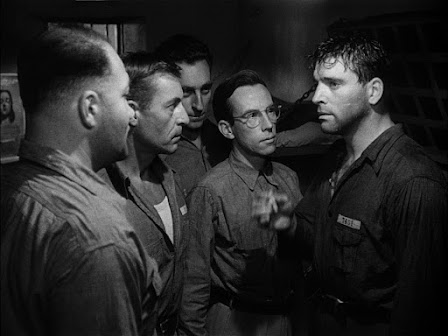
Brute Force (1947) is an American film noir directed by Jules Dassin and starring Burt Lancaster, Hume Cronyn, and Charles Bickford. The film also stars Yvonne De Carlo, Ann Blyth, and Ella Raines. The screenplay was by Richard Brooks, the cinematography was by William H. Daniels, and the music was by Miklos Rozsa.

After returning from solitary confinement, Joe Collins (Lancaster) plans his escape from Westgate Prison, along with some of his fellow prisoners. Along with his plans for escape, are his plans to get even with Captain Munsey (Cronyn) the sadistic chief of security.


Jules Dassin (1911 – 2008) was an American film director. He got work as an assistant director at RKO and then moved to M-G-M where he directed short subjects. Dassin directed the film noir classics Brute Force (1947), The Naked City (1948), and Thieves’ Highway (1949). He was blacklisted because of his once being a member of the Communist Party so he left the United States for Europe where remained for the rest of his life. He was married to Greek film actress Melina Mercouri.

Burt Lancaster (1913- 1994) was an American actor and producer. He won a Best Actor Academy Award for his performance in Elmer Gantry (1960). Lancaster made his film debut in The Killers (1946). After the release of that film, he was on his way as a leading man, starring in quick succession Desert Fury (1947), Brute Force (1947), Variety Girl (1947), I Walk Alone (1947), All My Sons (1948), and Sorry, Wrong Number (1948). Other popular films starring Lancaster include The Flame and the Arrow (1950), Jim Thorpe All-American (1951), From Here to Eternity (1953), The Rose Tattoo (1955), and Birdman of Alcatraz (1962).

Hume Cronyn (1911 - 2003) was a Canadian film and stage actor, as well as a writer. He and his wife Jessica Tandy often worked together on stage, film, and television. Cronyn's first film role was in Alfred Hitchcock's Shadow of a Doubt (1943), which began a long working relationship with the famed director. Cronyn appeared in Hitchcock's Lifeboat (1944) and worked on the screenplays of Rope (1948) and Under Capricorn (1949). In 1944 he was nominated for a Best Supporting Actor Oscar in The Seventh Cross. Other Cronyn films include The Postman Always Rings Twice (1946), Sunrise of Campobello (1960), and  Cleopatra (1963).

Charles Bickford (1891 - 1967) was an American actor who is best remembered for his supporting roles in films like The Farmer's Daughter (1947), Johnny Belinda (1948),  A Star is Born (1954), and The Big Country (1958). Bickford was nominated for three Best Supporting Actor Academy Awards between 1943 - 1948. During the 1950s and 1960s, Bickford staring appearing on television on shows like Wagon Trian, The Barbara Stanwyck Show, and The Virginian.


To watch the film on YouTube click the link below.


To join the discussion on March 21, 2022, at 6:30 p.m. Central Time, click here. Once you RSVP, you'll receive an invitation and link to join the discussion on Zoom.

Why watch this film?
  • We see a superstar in the making, Burt Lancaster in only his second film role.
  • One of director Jules Dassin's best films.
  • There are several actors who made their film debuts and went on to long careers in film and television including Howard Duff and Whit Bissell.
  • We get to see Ann Blyth play sweet and innocent after playing the daughter from hell in Mildred Pierce.

Brute Force trivia

  • Inspired by an incident at Alcatraz in 1946. A riot at the prison lasted for two days.
  • The film was considered shocking in its day due to the on-screen violence.
  • The movie the prisoners watch is The Egg and I, starring Claudette Colbert and Fred MacMurray which was released the same year as Brute Force.
  • Film debuts of Whit Bissell and Howard Duff.


Discussion questions:

  1. What was your overall impression of the film?
  2. This was Burt Lancaster's second film; what did you think of his performance?
  3. Was Hume Cronyn believable as the sadistic Captain Munsey?
  4. Did anything about the film surprise you?
  5. Did this film check most of the film noir boxes?


Saturday, June 5, 2021

Joseph Cotton falls for “The Farmer’s Daughter,” Loretta Young

The Farmer’s Daughter (1947) is an American film comedy directed by H. C. Potter and starring Loretta Young, Joseph Cotten, and Ethel Barrymore. The supporting cast includes Charles Bickford, Harry Davenport, Lex Barker, Keith Andes, Thurston Hall, and James Arness.

Katie Holstrom (Young), a Swedish-American leaves home to go to nursing school. On her way to Capitol City, she is taken advantage of by barn painter Adolph Petree (Rys Williams). He steals her money and leaves her stranded at a motel 60 miles from Capitol City. Humiliated and afraid to tell her parents about her situation, she takes a job as a maid for Agatha Morley (Barrymore) and her son, U. S. Representative Glenn Morely (Cotten). Agatha is the head of a powerful political family which is of interest to Katie.

Impressed by Katie’s work ethic and ability to charm everyone including the crusty butler Joseph Clancy (Bickford). Another bonus, her coffee is much better than Clancy’s which must be taken with alcohol to blunt its bitter taste. Glenn Morley takes notice of Katie’s good qualities and courts her much to the delight of his mother.

When Katie learns that the Morleys are backing Anders J. Finley (Art Baker) for Congress, Katie shows her disapproval by asking him pointed questions of Finley at a town hall meeting introducing him as a candidate. So impressed with Katie’s questioning, the opposition party asks Katie to run for Congress. She accepts their invitation and quits her job with the Morleys.

Will Katie be able to handle the rough and tumble ways of American politics? Will she be taken seriously as a viable candidate and will Glenn stand by her no matter what troubles lie ahead?


H. C. Potter (1904 - 1977) was an American theatrical producer and director, and a director of motion pictures. Potter graduated from Yale University in 1926 and was part of the Yale Dramatic Association. He founded a theater group, the Hampton Players based in Southampton, Long Island. He eventually made his way to Hollywood where he eventually became a film director. Some of his popular films include The Shopworn Angel (1938) starring Margaret Sullivan and James Stewart, The Story of Vernon and Irene Castle (1939) starring Fred Astaire and Ginger Rogers, Mr. Lucky (1943) starring Cary Grant and Laraine Day, and Mr. Blandings Builds His Dream House (1948) starring Cary Grant, Myrna Loy, and Melvyn Douglas.

Loretta Young (1913 - 2000) was an American actress who can trace her start to the days of silent films where she performed as a child actress. Young made the transition to talking pictures as an adult with almost immediate success. As an adult starred opposite some of Hollywood’s most popular leading men including James Cagney, Clark Gable, Tyrone Power, Gary Cooper, and Cary Grant. Young made many films during the pre-code era including Platinum Blonde (1931), Taxi! (1932), They Call It Sin (1932), Employee’s Entrance (1933), and Midnight Mary (1933). Darryl Zanuck signed Young to a contract at Twentieth Century-Fox and paired her with Tyrone Power, the studio’s top male star in several hit films including Love is News (1937), Cafe Metopole (1937), and Second Honeymoon (1937). Unsatisfied with the roles Zanuck was providing her with, Young left the studio and became a freelance artist. On her own, Young starred opposite Alan Ladd in two films, starred alongside Gary Cooper in Along Came Jones (1945), The Stranger (1946), The Bishop’s Wife (1947) with Cary Grant and David Niven, and Rachel and the Stranger (1947) top-billed over William Holden and Robert Mitchum. After her film career was winding down, Young became a huge star on television when the medium was in its early stages.

Joseph Cotten (1905 - 1994) was an American film, stage, radio, and television actor. Cotten achieved fame on Broadway in the original stage productions of The Philadelphia Story and Sabrina Fair.  He became famous worldwide after appearing in Citizen Kane (1941) and The Magnificent Ambersons (1942). As one of the most popular leading men of the 1940s, Cotten starred in Shadow of a Doubt (1943), Gaslight (1943), Duel in the Sun (1946), and The Third Man (1949). Cotten alternated between work on stage and film into the late-1950s. Cotten also appeared on television guest-starring on The Name of the Game, Cimarron Strip, and Ironside. Cotten’s last film role was in 1981.

Ethel Barrymore (1879 - 1959) was an American stage and film actress and part of the famous Barrymore family of actors. Her equally famous brothers were Lionel and John Barrymore. Barrymore got her start on the stage and she was among its brightest stars for many years. Barrymore also had a successful career on the other side of the Atlantic in London where she starred in Peter the Great. She achieved one of her biggest Broadway successes in W. Somerset Maugham’s comedy, The Constant Wife (1926). Barrymore was a popular character actress in film during the 1940s. She won the Academy Award for Best Supporting Actress for her performance in None but the Lonely Heart (1944) opposite Cary Grant who played her son. Other film roles include The Spiral Staircase (1946), The Paradine Case (1947), and Pinky (1949).

Joseph Cotten and Loretta Young
The Farmer’s Daughter trivia

  • The film was intended as a vehicle for Ingrid Bergman but she declined the role. Dorothy McGuire and Sonja Henie were possible replacements.
  • Glenn Morley’s (Joseph Cotten) political party was never mentioned.
  • Loretta Young’s Oscar win is considered one of the biggest upsets in Academy history. It was the first comedy performance to win since Claudette Colbert won for It Happened One Night (1934).
  • Rosalind Russell (one of Young’s real-life best friends) was the odds-on favorite to win the Academy Award that year for her performance in Mourning Becomes Electra (1947).
  • This was James Arness’s movie debut and Lex Barker’s first credited screen appearance.
  • Anna Q. Nilsson who played Young’s mother was a major star during the silent era.


Why watch this film?

  • It’s a delightful film featuring a winner performance from Loretta Young.
  • The production is so polished and beautiful, showing off the old studio system at its height.
  • In life and politics, nothing has really changed.
  • Interesting characterizations from Ethel Barrymore and Charles Bickford


To join the discussion on June 8, 2021, at 6:30 p.m. Central Time click here. Once you RSVP, you’ll receive an invitation with a Zoom link.


To watch this film on YouTube, click on the link below.


Discussion questions:
  1. What did you think of Young’s performance? Was it Oscar-worthy?
  2. Did Young and Cotten have good screen chemistry?
  3. What did you think of the political backdrop? Not much has changed, has it?
  4. Did you have a favorite scene, character, or piece of dialogue?
  5. Did this film remind you of any others that you may have seen?
  6. Was Young’s hairstyle the real inspiration for Princess Leia’s in Star Wars?


Related Posts Plugin for WordPress, Blogger...