Showing posts with label Miklos Rozsa. Show all posts

Tuesday, January 21, 2025

Ronald Colman struggles to avoid “A Double Life”

A Double Life (1947) is a film noir directed by George Cukor, starring Ronald Colman and Signe Hasso. The husband and wife team of Ruth Gordon and Garson Kanin wrote the screenplay. Milton R. Krasner did the cinematography and Miklos Rozsa wrote the score.

The plot concerns the famous Broadway stage actor Anthony “Tony” John (Colman) who is coming off tremendous success in a comedy entitled A Gentleman’s Gentleman. Max Lasker (Philip Loeb), a theatrical producer wants Tony’s next play to be Shakespeare’s Othello. Lasker also wants Tony’s ex-wife, Brita (Hasso) to co-star as Desdemona.


Tony and Brita star in Othello to wonderful reviews and the play runs for over a year on Broadway. As time goes by, Tony finds it difficult to distinguish between the character he is playing and reality. Will Tony be able to hold on to his sanity or will he disintegrate into madness?

George Cukor (1899 – 1983) was an American director. He was famous for directing comedies and literary adaptations of classics like Little Women (1933) and David Copperfield (1935). He was famously fired from directing Gone with the Wind (1939), but that incident didn’t mar an impressive directorial career that included The Philadelphia Story (1940), Gaslight (1944), and Born Yesterday (1950). Cukor won an Academy Award as Best Director for My Fair Lady (1964).

Ronald Colman (1891 – 1958) was an English-born actor whose career started in the theatre. In 1923, Colman appeared opposite Lillian Gish in the silent film The White Sister. He was a hit with the public and starred in over 20 silent films in America. Due to his wonderfully trained stage voice, Colman made the transition to talking pictures with ease. Some of his sound films include Clive of India (1935), A Tale of Two Cities (1935), Lost Horizon (1937), The Prisoner of Zenda (1937), The Talk of the Town (1942), and Random Harvest (1942). Colman was nominated three times for the Best Actor Academy Award. He finally won for his performance in A Double Life (1947).

Signe Hasso (1915 – 2002) was a Swedish actress who was promoted in the United States by RKO Pictures as “the next Garbo.” Although she wouldn’t live up to the promotion, Hasso had some memorable film roles in Heaven Can Wait (1943), The Seventh Cross (1944), Johnny Angel (1945), and The House on 92nd Street (1945). Hasso also acted on the Broadway stage and appeared on television making guest appearances on Route 66Starsky and HutchTrapper John, M.D., and Hart to Hart.


A Double Life trivia:
  • Laurence Olivier was originally slated for the role of Anthony John.
  • The film was nominated for four Academy Awards: Best Actor (Colman winner), Best Music, Scoring of a Dramatic or Comedy Picture (Miklos Rozsa winner), Best Director (George Cukor), and Best Writing, Original Screenplay (Garson Kanin and Ruth Gordon).
  • Colman had never performed any Shakespeare before and was uneasy about doing so on film.

Click HERE to watch the film on the YouTube. Please use this link because other versions on the channel aren’t as good.


Click HERE to join the online discussion on January 27, 2025, at 6:30 p.m. Central Time. Once you RSVP, you will receive an email invitation to join the discussion on Zoom. 

Questions for discussion:
1. Noir or not? Does this film fit in with your idea of what makes a movie qualify as a film noir?
2. Was Ronald Colman convincing as a major Broadway star?
3. Did Colman and Signe Hasso have good on-screen chemistry?
4. There are lots of double images in the film; do you recall any of them? There is the contrast between illusion and reality. Our hero seems to have trouble distinguishing between the two as the film progresses.
5. Was the ending inevitable? Does it help with its film noir credibility?

Wednesday, April 24, 2024

Book Review: “From the Moment They Met It Was Murder: Double Indemnity and the Rise of Film Noir”

Title: From the Moment They Met It Was Murder: Double Indemnity and the Rise of Film Noir

By: Alain Silver and James Ursini

Publisher: Running Press – Turner Classic Movies

ISBN: 978-07624-8493-5 (hardcover)

ISBN: 978-0-7624-8495-9 (ebook)


The new book by Alain Silver and James Ursini is a detailed account of how the classic film noir Double Indemnity came to be. The authors take a look at the real-life crime that influenced James M. Cain’s novel on which the film is based. The thesis of the book is that Double Indemnity is the definitive film noir and its influence is still felt today.

Just when you thought you knew all there was to know about Double Indemnity and film noir, the authors begin their book with the case of Ruth May Snyder and Henry Judd Gray. Snyder and Gray came up with a plot to murder her husband. They tried to make it look like robbery and murder but weren’t as slick as Phyllis Dietrichson and Walter Neff.

Once the authors start talking about the development of Double Indemnity, the book really moves along. The consensus was that Cain’s dialogue in the novel sounded stilted and phony when read aloud. That’s where Raymond Chandler came in. Chandler’s novels were known for their snappy, realistic dialogue. Chandler worked with director Billy Wilder on the script. A contentious relationship at best but somehow it all worked out in the end.

The casting was interesting. Dick Powell campaigned hard to play Neff, but this was before his dramatic turn in Murder, My Sweet (1944). Powell was a musical comedy star during the 1930s at Warner Bros. and wasn’t seriously consider by Wilder. Fred MacMurray was known for light comedy and musicals as well, but Wilder saw something. Casting MacMurray against type turned out to be a brilliant move. He’s convincing and believable as Neff. For Phyllis Dietrichson, it doesn’t look like Wilder wanted anyone but Barbara Stanwyck.

Billy Wilder (right in front of policemen) directs Stanwyck and MacMurray
in the supermarket scene.

When Ball of Fire (1941) starring Gary Cooper and Stanwyck went into production, Wilder, still a screenwriter, decided he wanted to direct so he shadowed director Howard Hawks. Wilder and Charles Brackett wrote the screenplay for Ball of Fire. He was impressed with Stanwyck’s performance and the rest is history.

There has always been a fascination with why Wilder had Stanwyck wear that cheap blonde wig. The truth is the wig was the same one worn by Marlene Dietrich in Manpower (1941). Wilder wanted Stanwyck to look cheap but he ultimately admitted it was a mistake. He decided this after a few weeks of filming but he decided he couldn’t scrap what was already printed and start from scratch so he just kept going. Paramount file executive Buddy DeSylva said, “We paid for Barbara Stanwyck, and we got George Washington.”

One bit of information that I had never heard before was that Mona Freeman was originally cast as Lola Dietrichson. When Wilder saw her on film, she looked twelve years old. She was eventually replaced with Jean Heather. Heather also had a role in Going My Way, the film that beat Double Indemnity for Best Picture. Its director Leo McCarey also beat Wilder in the Best Director category.

The gas chamber scene that was filmed but cut from the final film

Dressing Stanwyck—done by the legendary Edith Head—to look cheap was expensive. Some of Stanwyck’s outfits cost $7000 in today’s dollars. Stanwyck’s bath towel and pair of slippers cost $40 in 1943 or $700 today.

The book delves into the films Double Indemnity has influenced during the peak noir era and more contemporary or neo-noir films like Body Heat (1981).

And you can’t ignore the foreboding score by Miklos Rozsa. The feeling of dread is apparent from the opening credits and is carried through to the very last frame.

If you’re a fan of Double Indemnity and/or film noir, this book is a must.

Some quick facts:

  • Fred MacMurray worked 61 days
  • Barbara Stanwyck worked 35 days
  • Edward G. Robinson worked 37 days


Tuesday, November 21, 2023

Charles Boyer and Ann Blyth discover “A Woman’s Vengeance”

A Woman’s Vengeance (1948) is an American film noir mystery directed by Zoltan Korda and starring Charles Boyer, Ann Blyth, and Jessica Tandy. The supporting cast includes Cedric Hardwicke and Mildred Natwick. The screenplay was written by Aldous Huxley which was based on his novelette The Gioconda Smile. The cinematography was by Russel Metty and the music was by Miklos Rozsa.

Henry Maurier’s (Boyer) marriage is not a happy one. His wife Emily (Rachel Kempson) is not in good health. Henry and Emily’s marriage is in name only. Henry is carrying on an affair with Doris Mead (Ann Blyth) who is much younger than he is. Meanwhile, another woman, Janet Spence (Tandy) is in love with Henry. When Emily dies suddenly, Henry quickly marries Doris.

Henry is accused of poisoning his wife and is put on trial for murder. Will the trial reveal that Henry poisoned his wife so he could marry Doris or did someone else have a motive to murder Emily?

Charles Boyer and Ann Blyth

Zolton Korda (1895 – 1961) was a Hungarian-born motion picture screenwriter, director, and producer. Along with his brothers Alexander and Vincent, he made films in Hungary and London before moving to Hollywood where they continued to make movies. Some of the films that Korda directed include The Four Feathers (1939), The Jungle Book (1942), The Macomber Affair (1947), and Cry, the Beloved Country (1951).

Charles Boyer (1899 - 1978) was a French-American stage and film actor. Boyer was nominated for the Best Actor Academy Award four times. He became a major movie star in the late 1930s in films like The Garden of Allah (1936), Algiers (1938), and Love Affair (1939). He starred as the evil husband of Ingrid Bergman in Gaslight (1944). Boyer starred opposite most of the top female stars of the period including Claudette Colbert, Marlene Dietrich, Irene Dunne, Jean Arthur, Greta Garbo, Bette Davis, Joan Fontaine, Katharine Hepburn, and Olivia de Havilland. As he grew older, Boyer played supporting roles in film and also starred on Broadway in Kind Sir (1953 - 1954) and The Marriage-Go-Round (1958 - 1960).

Ann Blyth (1928 - ) is a retired American actress and singer. She is most famous for her role as Veda in Mildred Pierce (1945) where she played Joan Crawford’s ungrateful daughter. For her role in that film, Blyth was nominated for an Academy Award for Best Supporting Actress. Blyth’s first acting role was in Lillian Hellman’s Watch on the Rhine on Broadway. While on tour with the play, Blyth was offered a contract with Universal Studios. At Universal, Blyth starred alongside Donald O’Connor and Peggy Ann Ryan in a series of teen musicals. In 1952, Blyth was signed by M-G-M where she starred opposite Steward Granger, Robert Taylor, Howard Keel, Van Johnson, and Mario Lanza.

Jessica Tandy (1909 – 1994) was an English actress who had a long and successful career on the stage and screen. Tandy created the role of Blanche Du Bois in the original Broadway production of A Streetcar of Desire. She won a Tony Award for Best Actress for her performance in the Tennessee Williams classic. Tandy had supporting roles in films starting in 1944 supporting stars like Gregory Peck, Greer Garson, Gene Tierney, and Linda Darnell. In the 1980, her film career picked up. She won a Best Actress Academy Award for Driving Miss Daisy. At 80-years-old, Tandy became the oldest Oscar-winning actress.


To watch the film on YouTube, click here.


Click here to join the discussion on November 27, 2023, at 6:30 p.m. Central Time. Once you RSVP, you will receive an email invitation with a link to join the discussion on Zoom.


Discussion questions

  1. Would you classify this movie as a film noir? Why or why not?
  2. What did you think of the relationship between Boyer and Blyth? Was it believable? At the time of filming, Boyer was 49 and Blyth was 20.
  3. Jessica Tandy has a pivotal role in the film. What did you think of her performance?
  4. Did you suspect that someone other than Henry had a motive to kill Emily?
  5. Were you surprised by the film’s conclusion?
  6. Did this film remind you of any other film?


Tuesday, October 24, 2023

Joan Bennett is determined to discover the “Secret Beyond the Door”

Secret Beyond the Door (1947) is an American psychological thriller directed by Fritz Lang and starring Joan Bennett and Michael Redgrave. The strong supporting cast includes Anne Revere, Barbara O’Neil, Natalie Schafer, and Paul Cavanagh. The cinematography was by Stanley Cortez (The Magnificent Ambersons, The Night of the Hunter, and The Three Faces of Eve. The music was by Miklos Rozsa (Double Indemnity, Spellbound, Ben-Hur).

Celia (Bennett), a rich, young heiress meets a mysterious man, architect Mark Lamphere (Redgrave) on vacation in Mexico. The two fall in love instantly and are married. The honeymoon is happy but trouble is on the horizon when in a playful mood, Celia locks her husband out of their hotel room.

When they return to Mark’s home, Celia discovers that Mark was married before and has a teenage son David (Mark Dennis)—things Mark never told Celia. She also discovers that Mark’s sister Caroline (Revere) and Mark’s assistant Miss Robey(O’Neil) also reside in her home with Mark.

David tells Celia that Mark killed his mother. Shocked, Celia now worries that Mark may be planning to kill her as well. And then there are Mark’s rooms that recreate famous murders of women! What does it all mean and is Celia’s life in serious danger? 

Joan Bennett


Fritz Lang (1890 – 1976) was an Austrian-German-American director. Lang is the director of the silent film classic Metropolis (1927). After serving in World War I, Lang worked for a time as an actor in the theater and then worked as a writer at Decla Film in Berlin. Lang’s first talking picture was M (1931) a story about a child murderer. Due to his growing renown, Joseph Goebbels offered him the position of head of the German film studio UFA in 1933. Lang emigrated to Paris and then to the United States in 1936. Lang worked for all the major studios, making twenty-three feature films in the United States. Some of Lang’s films include Scarlet Street (1945), The Big Heat (1953), and While the City Sleeps (1956).

Joan Bennett (1910–1990) began her film career during the early sound era. A natural blonde, Bennett dyed her hair as a plot device in the film Trade Winds (1938). As a brunette, Bennett projected a sultry persona that had her compared to the brunette beauty, Hedy Lamarr. During this period she starred in two costume epics. She played Princess Maria Theresa in The Man in the Iron Mask (1939) and Grand Duchess Zona of Lichtenburg in The Son of Monte Cristo (1940). Bennett was one of two finalists for the role of Scarlett O’Hara in Gone with the Wind (1939), along with Paulette Goddard. She had a very successful collaboration with the director Fritz Lang. With Lang, she starred in the classics Man Hunt (1940), The Woman in the Window (1944), and Scarlet Street (1945). Bennett acted on stage and on television where she became a pop culture icon playing Elizabeth Collins Stoddard in the gothic soap opera Dark Shadows (1966-1971).

Michael Redgrave (1909 – 1985) was an English stage and film actor and director. He worked primarily on the British stage but had some significant film roles. He made his American film debut in Mourning Becomes Electra (1947) co-starring Rosalind Russell—he made Secret Beyond the Door first but Electra was released first. For his performance, he was nominated for the Academy Award for Best Actor. Other notable film roles include The Stars Look Down (1940), Dead of Night (1945), and The Browning Version (1951). He is the father of actresses Vanessa and Lynn Redgrave.


Secret Beyond the Door trivia

  • This was the fourth film that Bennett made with director Fritz Lang.
  • The grove of trees that Bennett runs through fleeing the house is the same grove used in the Universal horror film The Wolf Man (1941).
  • Lang thought this film would be his Rebecca (1940). Lang felt he was being eclipsed by directors like Alfred Hitchcock and was desperate to stay relevant.
  • This was Michael Redgraves first American film.
  • Bennett requested the services of cinematographer Stanley Cortez. Cortez and Lang didn’t get along on set.
  • Bennett and Redgrave did some very dangerous stunt work at the insistence of Lang. This didn’t sit well with the two stars.


To watch the film on YouTube, click on the link below.


Discussion questions

  1. Some critics consider this movie a film noir. Would you put it in that category? Why or why not?
  2. This film has been compared to earlier Alfred Hitchcock films, especially Rebecca and Spellbound. Do you see the reason for those comparisons? Does Secret Beyond the Door remind you of any other pictures?
  3. What do you think was Bennett’s motivation to marry Redgrave so quickly?
  4. What was Redgrave’s motivation?
  5. This film could fall into the damsel in distress genre. Was Bennett a convincing damsel?
  6. Was Michael Redgrave believable as the conflicted Mr. Lamphere?
  7. Did you have a favorite character or scene?
To join the discussion on October 30, 2023, at 6:30 p.m. Central Time click here. Once you RSVP, you will receive a link and an invitation to join the discussion on Zoom.

Michael Redgrave


Sunday, February 26, 2023

Jules Dassin's "The Naked City"

The Naked City (1948) is an American film noir directed by Jules Dassin and starring Barry Fitzgerald, Howard Duff, Dorothy Hart, and Don Taylor. The Academy-Award-Winning cinematography was by William H. Daniels. The music is by Miklos Rozsa and Frank Skinner.

The plot concerns the murder of a model who is knocked out by a pair of men with chloroform and then left to drown in her own bathtub. When police arrive on the scene, the medical examiner says the woman was murdered. The search is on for the killers but there are several twists and turns along the journey.

The film was praised for its realism that seems to borrow elements from the Neo Realism movement happening in Italian films.


Jules Dassin (1911 – 2008) was an American film director. He got work as an assistant director at RKO and then moved to M-G-M where he directed short subjects. Dassin directed the film noir classics Brute Force (1947), The Naked City (1948), and Thieves’ Highway (1949). He was blacklisted because of his once being a member of the Communist Party so he left the United States for Europe where remained for the rest of his life. He was married to Greek film actress Melina Mercouri.

Barry Fitzgerald (1888 – 1961) was an Irish stage, film, and television actor. He appeared in many notable films over four decades including Bringing Up  Baby (1938), How Green Was My Valley (1941), Going My Way (1944), None but the Lonely Heart (1944), and The Quiet Man (1952). He was a member of the Abbey Theatre and made his film debut in Juno and the Paycock (1930) directed by Alfred Hitchcock.


The Naked City trivia

  • Most of the scenes filmed in New York City were filmed without people knowing they were being filmed.
  • Producer Mark Hellinger narrated the film; he died of a heart attack before the film was released; he was only 44 years old.
  • After Hellinger’s death, Universal was prepared to scrap the picture. Due to a contract he had with the studio, the film had to be released. It became a big hit and won two Academy Awards.
  • Stanley Kubrick, on assignment from Look magazine, took pictures on the film’s location.
  • The film marked the film debuts of Ted de Corsia, Kathleen Freeman, James Gregory, and Nehemiah Persoff.
  • Barry Fitzgerald was 5’3” and the minimum height requirement for policemen at the time of filming was 5’9”.


To watch the film on YouTube, click on the link below.


To join the discussion on March 6, 2023, 6:30 p.m. Central Time, click here. Once you RSVP, you’ll receive and invitation with a link to join the discussion on Zoom.


Discussion questions

  1. The film was acclaimed for its realism; did the film seem realistic to you?
  2. Some have tagged The Naked City as a film noir. Would you agree with this classification?
  3. Producer Mark Hellinger narrated the film. Did you think the narration enhanced the film?
  4. What did you think of the performances? Did anyone stand out to you?
  5. Did the movie remind you of any other films you’ve seen? 

Wednesday, March 16, 2022

Burt Lancaster leads with "Brute Force"

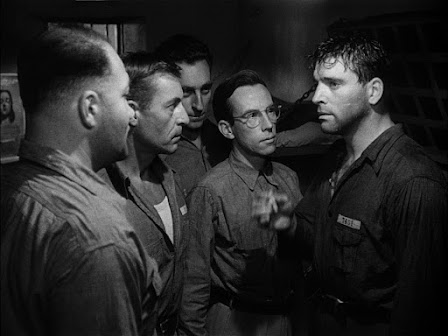
Brute Force (1947) is an American film noir directed by Jules Dassin and starring Burt Lancaster, Hume Cronyn, and Charles Bickford. The film also stars Yvonne De Carlo, Ann Blyth, and Ella Raines. The screenplay was by Richard Brooks, the cinematography was by William H. Daniels, and the music was by Miklos Rozsa.

After returning from solitary confinement, Joe Collins (Lancaster) plans his escape from Westgate Prison, along with some of his fellow prisoners. Along with his plans for escape, are his plans to get even with Captain Munsey (Cronyn) the sadistic chief of security.


Jules Dassin (1911 – 2008) was an American film director. He got work as an assistant director at RKO and then moved to M-G-M where he directed short subjects. Dassin directed the film noir classics Brute Force (1947), The Naked City (1948), and Thieves’ Highway (1949). He was blacklisted because of his once being a member of the Communist Party so he left the United States for Europe where remained for the rest of his life. He was married to Greek film actress Melina Mercouri.

Burt Lancaster (1913- 1994) was an American actor and producer. He won a Best Actor Academy Award for his performance in Elmer Gantry (1960). Lancaster made his film debut in The Killers (1946). After the release of that film, he was on his way as a leading man, starring in quick succession Desert Fury (1947), Brute Force (1947), Variety Girl (1947), I Walk Alone (1947), All My Sons (1948), and Sorry, Wrong Number (1948). Other popular films starring Lancaster include The Flame and the Arrow (1950), Jim Thorpe All-American (1951), From Here to Eternity (1953), The Rose Tattoo (1955), and Birdman of Alcatraz (1962).

Hume Cronyn (1911 - 2003) was a Canadian film and stage actor, as well as a writer. He and his wife Jessica Tandy often worked together on stage, film, and television. Cronyn's first film role was in Alfred Hitchcock's Shadow of a Doubt (1943), which began a long working relationship with the famed director. Cronyn appeared in Hitchcock's Lifeboat (1944) and worked on the screenplays of Rope (1948) and Under Capricorn (1949). In 1944 he was nominated for a Best Supporting Actor Oscar in The Seventh Cross. Other Cronyn films include The Postman Always Rings Twice (1946), Sunrise of Campobello (1960), and  Cleopatra (1963).

Charles Bickford (1891 - 1967) was an American actor who is best remembered for his supporting roles in films like The Farmer's Daughter (1947), Johnny Belinda (1948),  A Star is Born (1954), and The Big Country (1958). Bickford was nominated for three Best Supporting Actor Academy Awards between 1943 - 1948. During the 1950s and 1960s, Bickford staring appearing on television on shows like Wagon Trian, The Barbara Stanwyck Show, and The Virginian.


To watch the film on YouTube click the link below.


To join the discussion on March 21, 2022, at 6:30 p.m. Central Time, click here. Once you RSVP, you'll receive an invitation and link to join the discussion on Zoom.

Why watch this film?
  • We see a superstar in the making, Burt Lancaster in only his second film role.
  • One of director Jules Dassin's best films.
  • There are several actors who made their film debuts and went on to long careers in film and television including Howard Duff and Whit Bissell.
  • We get to see Ann Blyth play sweet and innocent after playing the daughter from hell in Mildred Pierce.

Brute Force trivia

  • Inspired by an incident at Alcatraz in 1946. A riot at the prison lasted for two days.
  • The film was considered shocking in its day due to the on-screen violence.
  • The movie the prisoners watch is The Egg and I, starring Claudette Colbert and Fred MacMurray which was released the same year as Brute Force.
  • Film debuts of Whit Bissell and Howard Duff.


Discussion questions:

  1. What was your overall impression of the film?
  2. This was Burt Lancaster's second film; what did you think of his performance?
  3. Was Hume Cronyn believable as the sadistic Captain Munsey?
  4. Did anything about the film surprise you?
  5. Did this film check most of the film noir boxes?


Related Posts Plugin for WordPress, Blogger...