This site is devoted to the love of classic movies. What qualifies as a classic film or movie is somewhat subjective. There are certain films which endure because they strike an emotional chord long after their initial release. For example, a movie like "Casablanca" (1942) would qualify as a classic under that definition.
Laura (1944) is set among New York City’s upper crust, with Detective Mark McPherson (Dana Andrews) investigating the murder of beautiful advertising executive Laura Hunt (Gene Tierney). The suspects are some of her closest friends and associates including fiancé (Vincent Price), aunt (Judith Anderson), and mentor (Clifton Webb).
When production on Laura started, no one believed that the end product would be worth seeing. From the beginning the project was problematic. Arguments between studio boss Darryl Zanuck and the original director, Rouben Mamoulian ended in Mamoulian being fired. Zanuck then assigned Otto Preminger, already the film’s producer, to be its director too. The only problem: Preminger had limited experience as a movie director.
Under Preminger’s supervision, what began as a fairly ordinary murder mystery, turned out to be a critical and box office success. Tierney in the title role became a superstar and was forever identified with the beautiful, enigmatic Laura Hunt. Andrews, as Detective Mark McPherson, established himself as a major star and popular leading man. Webb, who hadn’t made a movie since the early days of talking pictures, earned an Academy Award nomination as Best Supporting Actor for his role as Waldo Lydecker. Thomas M. Pryor, in his October 12, 1944 New York Times review called Laura “a top-drawer mystery.”
With some of the sharpest and wittiest dialogue ever recorded on film, Laura set the standard for 1940s film noir. Andrews’s portrayal of McPherson became a prototype for what would become known as the hard-boiled detective, influencing a generation of movie actors. Pryor from the Times put it this way: “Mr. Andrews is fast proving himself to be a solidly persuasive performer, a sort of younger-edition Spencer Tracy.”
The musical score by David Raksin is one of the most hauntingly beautiful movie themes ever recorded and will forever be associated with the enigmatic Tierney.
Laura trivia
Vincent Price thought this was the best movie he ever made.
David Raskin's famous film score wasn't nominated for an Academy Award.
Jennifer Jones and Hedy Lamarr were both offered the role of Laura but turned it down.
Gene Tierney, knowing that she wasn't the first choice was reluctant to take the part.
Joseph LaShelle won an Academy Award for his black and white cinematography.
Click HERE to watch the film on Internet Archive. You can play the film on your laptop or phone. If you have an HDMI cable, you can hook it up to your TV.
Click HERE to join the discussion on August 19, 2024, at 6:30 p.m. Central Time. Once you RSVP, you will receive an invitation with a link to join the discussion on Zoom.
Discussion questions
Laura is considered one of the top films noir of all time. Do you think it deserves that reputation?
Some critics upon the film's release thought that Gene Tierney was miscast. Do you agree with that assessment?
Did David Raskin's score help the movie narrative?
The film is filled with great performances; did one performance stand out to you?
Where you surprised by the plot twists?
Do you think Waldo Lydecker was in love with Laura?
Edge of Darkness (1943) is a World War II directed by Lewis Milestone and starring Errol Flynn and Ann Sheridan. Others in the impressive supporting cast include Walter Huston, Nancy Coleman, Ruth Gordon, Helmut Dantine, and Judith Anderson. The cinematography was by Sidney Hickox (Gentleman Jim, The Big Sleep, White Heat).
Gunnar Brogge (Flynn) and Karen Stensgard (Sheridan) head
the Nazi resistance in their small fishing village in Norway. Against all odds,
they push back against the Nazi control of their village.
Will their efforts help them gain their freedom?
Lewis Milestone (1895 – 1980) was a Russian-born American film director. He is a two-time Academy Award-winner for Best Director: Two Arabian Knights (1927) and All Quiet on the Western Front (1930). Other notable films directed by Milestone include The Front Page (1931), Of Mice and Men (1939), A Walk in the Sun (1945), Les Miserables (1952), and Ocean’s 11 (1960).
Errol Flynn (1909 – 1959) was an Australian-American actor
who was one of the most popular actors during Hollywood’s Golden Age. He was
famous for playing in romantic swashbuckler roles, often co-starring with
Olivia de Havilland. Flynn obtained screen immortality early in his career with
The Adventures of Robin Hood (1938).
Other major films include Captain Blood
(1935), The Charge of the Light Brigade
(1936), Dodge City (1939), and Santa Fe Trail (1940). Flynn’s
hard-drinking and wild personal life seriously affected his career. He died on
October 14, 1959, at age 50.
Ann Sheridan and Errol Flynn in an on-set publicity photo of them reading the novel.
Ann Sheridan (1915 - 1967) was an American actress and singer. Her movie career began in 1934 when she appeared in 19 films! Her roles were all small and mostly unbilled, but she appeared in another 20+ films before she was signed to Warner Bros. in 1938. She was given better roles and was groomed for major stardom. The studio dubbed her “The Oomph Girl,” a title she hated but helped contribute to her popularity. During World War II she was a popular pin-up girl. As a star, Sheridan starred in Angels Wash Their Faces (1939), Castle on the Hudson (1940), It All Came True (1940), They Drive by Night (1940), City for Conquest (1941), and The Man Who Came to Dinner (1942). During this time she starred opposite Warner’s top leading men including John Garfield, James Cagney, and George Raft. Her biggest success during this period came with Kings Row (1942), a film in which she received top billing over Robert Cummings, Ronald Reagan, and Betty Field. Sheridan made the transition to television and was starring in the weekly western series, Pistols 'n' Petticoats (1966-67) when she became sick with cancer. She died on January 21, 1967, at the age of 51.
Walter Huston (1883 - 1950) was a Canadian singer, stage, and film actor. He is also the patriarch of the Huston clan which includes his writer-director son John, and his granddaughter, actress Anjelica. Huston worked in the theater, with roles on Broadway where he made his debut in 1924. Once talking pictures began in Hollywood, Huston worked as both a leading man and also a character actor. Some of Huston’s films include The Virginian (1929), Rain (1932), Gabriel Over the White House (1933), The Devil and Daniel Webster (1941), and The Treasure of the Sierra Madre (1948) for which he won the Academy Award for Best Supporting Actor, directed by his son John. Huston’s last film was The Furies (1950) co-starring Barbara Stanwyck and Wendell Corey.
Edge of Darkness trivia
When the film was announced it was going to star Anne Sheridan and Humphrey Bogart.
Errol Flynn went on trial for rape while the film was in production.
Ann Sheridan's marriage to George Brent collapsed at the same time as production due to Sheridan's affair with Flynn.
Weather problems hinder production, keeping Ruth Gordon and Judith Anderson in Hollywood longer than they wanted due to stage commitments.
Sheridan and Flynn co-starred in Dodge City (1939) and Silver River (1948).
To watch the film on YouTube, click on the link below.
To join the discussion on October 17, 2022, at 6:30 p.m. Central Time, click here. Once you RSVP, you'll receive an invitation and link to the discussion on Zoom.
Discussion questions
How do you think this film ranks among World War II films you've seen?
Do you think the portrayals of the Norwegian freedom fighters were realistic?
What did you think of the film score by Fraz Waxman? Did it enhance or detract from the film in your opinion?
The supporting cast is exceptional. Did any one of the supporting characters stand out to you?
How do you think American audiences reacted to this film in 1943?
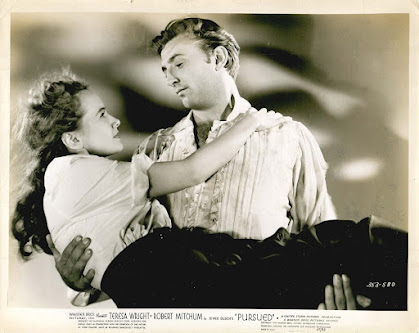
Pursued (1947) Is considered the first noir western, directed by Raoul Walsh and starring Teresa Wright and Robert Mitchum. The cinematography is by the legendary James Wong Howe and music by the equally legendary Max Steiner. Oscar-winning director Martin Scorsese counts Pursued as one of his favorite films.
Mitchum is Jeb Rand, a man haunted by traumatic events from his past that left him an orphan. Mrs. Callum (Judith Anderson) adopts him and raises him as her son with her natural children Adam (John Rodney) and Thorley (Wright). But there is tension in these relationships, and a man he doesn’t even know torments Jeb for reasons he doesn’t understand.
Others in the cast include Dean Jagger and Alan Hale.
Publicity still of Teresa Wright and Robert Mitchum
Raoul Walsh (1887 - 1980) was an American director, actor, and founding member of The Academy of Motion Picture Arts and Sciences (AMPAS). Walsh got his start acting on the stage in New York. He eventually began acting in silent films and worked as an assistant director alongside D.W. Griffith. He eventually became a director on his own working with major silent-film stars Douglas Fairbanks, Gloria Swanson, and Anna May Wong. He lost his right eye in a freak accident in 1928 and never acted again, instead of focusing exclusively on directing. Some of his notable films include The Roaring Twenties (1939) starring James Cagney and Priscilla Lane, High Sierra (1941) starring Ida Lupino and Humphrey Bogart, The Strawberry Blonde (1941) starring Cagney and Olivia de Havilland, White Heat (1949) starring Cagney and Virginia Mayo, and Captian Horatio Hornblower (1951) starring Gregory Peck and Mayo.
Teresa Wright (1918 - 2005) was an American stage, film, and television actress. She received Academy Award nominations in her first three films, a record that still holds today. In 1942, she was nominated for Best Supporting Actress for Mrs. Miniver and for Best Actress in The Pride of the Yankees. She won the Supporting Oscar for Mrs. Miniver, her co-star, Greer Garson won Best Actress. Today Wright is most famous for playing Lou Gehrig’s wife in The Pride of the Yankees, The Best Years of Our Lives, and Alfred Hitchcock’s Shadow of a Doubt (1943). Wright was a popular star throughout the 1940s starring opposite Robert Mitchum, Ray Milland, Gary Cooper, and David Niven. She starred opposite Marlon Brando in his first film role in The Men (1950). Wright continued working in film, with her last role as Miss Birdie in The Rainmaker (1997). Wright is the only non-baseball player to be honored by the New York Yankees when she passed away at age 86.
Robert Mitchum (1917 - 1997) was an American film actor, director, and singer. His breakthrough came in The Story of G.I. Joe (1945) for which he was nominated for a Best Supporting Actor Academy Award. He later starred in the film noir classic Out of the Past (1947) Crossfire (1947), Rachel and the Stranger (1948), River of No Return (1954) The Night of the Hunter (1955) Heaven Knows, Mr. Allison (1957), Home from the Hill (1960), Cape Fear (1962), and Ryan's Daughter (1970). Mitchum would remain busy until the late-nineties. Mitchum is rated number 23 on the American Film Institute's list of the greatest male stars of classic American cinema.
Pursued trivia
When the film was released, Teresa Wright was #6 at the box office.
Charles Bates who plays Adam Callum as an 11-year-old boy played Teresa Wright's younger brother in Alfred Hitchcock's Shadow of a Doubt (1943).
The film was filmed in Gallup, New Mexico.
The screenplay was written by Niven Busch who was Teresa Wright's husband.
Niven Busch also wrote the novel Duel in the Sun which was made into a hit western that was supposed to star Wright. Wright had to drop out due to pregnancy. Pursued was a consolation prize of sorts.
Producer Milton Sperling and his United States Pictures production company worked out a distribution deal with Warner Bros. It was a profitable deal for both.
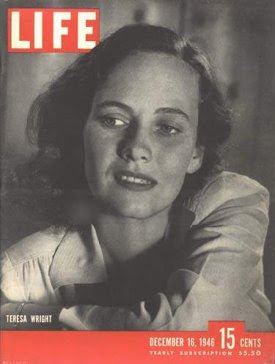
Teresa Wright was on the cover of Life magazine on December 16, 1946.
Why watch this film?
The film features beautiful black and white cinematography by James Wong Howe.
It's an opportunity to see Robert Mitchum in an early lead role.
It's considered the first film noir western, directed by a legend of the Classic Hollywood period.
The film boasts a strong cast including top-billed Teresa Wright, Judith Anderson, and Dean Jagger.
To watch the film on YouTube, click the link below.
Discussion questions:
Do you think a western could be classified as a film noir?
Freud and psychological dramas were all the rage in the 1940s. Does Pursued work as a psychological western?
What did you make of Jeb's relationship with his stepmother, stepbrother, and sister?
Do you think the family dynamics would have been different had Jeb's true origins been known from the beginning?
The scene when Jeb and Adam sing together is a pleasant one and suggests that togetherness and family love was possible or does it?
Was there a performance that stood out to you?
Did anything surprise you?
Do you think the movie had a theme? If so, what do you think it was?
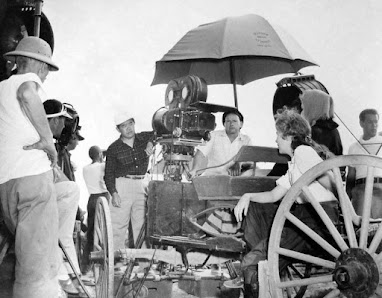
Teresa Wright on location with cinematographer James Wong Howe behind the camera
To join the discussion on January 31, 2022, at 6:30 p.m. Central Time, click here. Once you RSVP, you'll receive an invitation and a link to the discussion on Zoom.
Contemporary reviews for Pursued
Bosley Crowther in The New York Times said this about the film: "...And it is likewise hard to work up any sympathy for the hero, who seems bored by all his woes. That may be because Robert Mitchum, who plays the latter, is a very rigid gent and gives off no more animation than a Frigidaire turned to 'Defrost.'"*
Variety praised the film: "Pursued is potent frontier days Westernfilm fare. Standout in picture is suspense generated by the original script and Raoul Walsh's direction. It builds the western gunman's death walk to high moments of thrill and action. Strong casting also is a decided factor in selling the action wares. Production makes use of natural outdoor backgrounds supplied by New Mexico scenery, lending air of authenticity that is fully captured by the camera."**
*New York Times, Crowther, Bosley, review March 8, 1947
**Variety magazine, Variety staff, review December 31, 1946
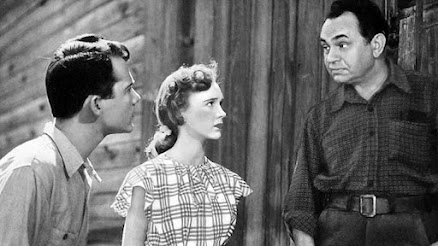
The Red House (1947) is a mystery written and directed by Delmer Daves and starring Edward G. Robinson, Lon McCallister, and Judith Anderson. The film score is by Miklos Rozsa. Others in the cast include Rory Calhoun, Julie London, and Allene Roberts.
The film centers around brother and sister Pete (Robinson) and Ellen Morgan, and their adopted daughter Meg (Roberts). Because of their reclusive ways, rarely leaving their farm, the Morgans are the subject of gossip. Meg and her relationship with Pete and Ellen is also a subject that is whispered about among her schoolmates. Pete warns Meg not to wander alone in the woods near their farm and he also warns her to stay away from a mysterious red house.
Meg and schoolmate Nath (McCallister), out of curiosity, go in search of the red house. What secret will the red house reveal and how will it affect Pete, Ellen, and Meg.
Lon McCallister, Allene Roberts, Edward G. Robinson
Delmer Daves (1904 - 1977) was an American writer, producer, and director. He worked in many genres including film noir, but he may be best remembered for his westerns. Broken Arrow (1950) starred James Stewart and Debra Paget, one of the first westerns to feature a Native American protagonist. During his career, Daves worked with many top stars from Hollywood's Golden age including Humphrey Bogart, Lauren Bacall, Glenn Ford, Gary Cooper, Clark Gable, Gene Tierney, Susan Hayward, Cary Grant, and Richard Widmark. Daves is responsible for some of the most popular movies of the 1940s and 1950s like Destination Tokyo (1943), The Pride of the Marines (1945), 3:10 to Yuma (1957), and A Summer Place (1959).
Edward G. Robinson (1893 – 1973) was an American actor on the stage and screen. Robinson is a true legend from Hollywood’s Golden Age where he starred in the gangster classic Little Caesar (1931), Kid Galahad (1937), Confessions of a Nazi Spy (1939), The Sea Wolf (1941), Double Indemnity (1944), and Key Largo (1948). Robinson was awarded an Honorary Academy Award in 1973, but he was never nominated for a competitive Oscar.
Lon McCallister (1923 - 2005) was an American film actor who was a popular star during the 1940s. McCallister was mostly cast as the youthful hero in films like Home in Indiana (1944) and Winged Victory (1944). Columnist Hedda Hopper called him "the cutest boy the movies have hauled up out of obscurity since Mickey Rooney." At only 5' 6", McCallister had difficulty finding movie roles as he grew older. He eventually worked in television but retired from acting in 1953. After his acting career ended, McCallister became a successful real estate investor.
Judith Anderson (1897 - 1992) was an Australian actress who was a star stage, film, and television. Anderson left Australia for a career in the United States. After a period of struggle, she made a name for herself on the Broadway stage in Strange Interlude (1929) replacing Lynn Fontaine. She starred in As You Desire (1931) and The Old Maid (1935). With her success in the film Rebecca (1940), Anderson's career got a boost. She continued to work in film throughout the remainder of her career appearing in Laura (1944), Pursued (1947), The Ten Commandments (1956), A Man Called Horse (1970), and Star Trek III: The Search for Spock (1984).
The Red House trivia
The film was produced by Thalia Productions, a production company owned by Edward G. Robinson and producer Sol Lesser.
The novel on which the film is based was serialized in The Saturday Evening Post in 1945.
This was the film debut of Allene Roberts (Meg).
The Red House was Rory Calhoun's second credited film role.
To watch the film on YouTube, click on the link below.
To join the discussion on January 24, 2022, at 6:30 p.m. Central Time click here. Once you RSVP, you will receive an invitation and link to join the discussion on Zoom.
Discussion questions:
What genre do you think this film fits? Is it a mystery, horror, psychological thriller, film noir?
Do you think the film narrative is realistic?
Did the film have an overall message or theme?
Was there a scene that stood out to you?
Is there a character and/or performance that stood out to you?
And Then There Were None (1945) is a mystery movie directed by Rene Clair and starring Barry Fitzgerald, Walter Huston, and Louis Hayward. The film is an adaptation of Agatha Christie's 1939 novel of the same name.
Eight strangers are invited to a small isolated island off the coast of Devon, England, by a Mr. and Mrs. Owen. Two newly-hired servants, Thomas and Ethel Rogers greet them to the secluded mansion, but their hosts are absent. As the guests sit down to dinner, they notice a centerpiece featuring figurines of ten Indians. Thomas plays a record and a man's voice accuses them all of the murder!
Are they really all guilty? Is this all a cruel game concocted by the mysterious Mr. and Mrs. Owen?
Rene Clair (1898 - 1981) was a French film director and writer. He directed silent films in his native France but was lured to Hollywood where he directed five films. His first American film was The Flame of New Orleans (1941) starring Marlene Dietrich. The film was not a success and it would be a year before he made another American film. His most popular American film was And Then There Were None (1945) based on Agatha Christie’s novel of the same name. After World War II, Clair returned to France where he was considered one of that country’s best film directors.
BarryFitzgerald (1888 – 1961) was an Irish stage, film, and television actor. He appeared in many notable films over four decades including Bringing Up Baby (1938), How Green Was My Valley (1941), Going My Way (1944), None but the Lonely Heart (1944), and The Quiet Man (1952). He was a member of the Abbey Theatre and made his film debut in Juno and the Paycock (1930) directed by Alfred Hitchcock.
Walter Huston (1883 - 1950) was a Canadian singer, stage, and film actor. He is also the patriarch of the Huston clan that includes his writer-director son John, and his granddaughter, actress Anjelica. Huston worked in the theater, with roles on Broadway where he made his debut in 1924. Once talking pictures began in Hollywood, Huston worked as both a leading man and also a character actor. Some of Huston’s films include The Virginian (1929), Rain (1932), Gabriel Over the White House (1933), The Devil and Daniel Webster (1941), and The Treasure of the Sierra Madre (1948) for which he won the Academy Award for Best Supporting Actor, directed by his son John. Huston’s last film was The Furies (1950) co-starring Barbara Stanwyck and Wendell Corey.
Louis Hayward (1909 – 1985) was a British-American actor. He worked on the London stage under the tutelage of Noel Coward. He made some films in England in the early 1930s and came to Broadway in 1935 working with Alfred Lunt and Lynn Fontanne in Noel Coward’s Point Valaine. His Broadway fame brought him to Hollywood where he was cast in some minor roles before getting starring roles in The Man in the Iron Mask (1939), My Son, My Son! (1940), and The Son of Monte Cristo (1940). Hayward was married to Ida Lupino from 1938 to 1945.
To watch the film on YouTube, click the link below.
To join the discussion on December 6, 2021, at 6:30 p.m. Central Time, click here. Once you RSVP, you will receive an invitation and link to the discussion on Zoom.
Discussion questions:
Agatha Christie's novel has been filmed over ten times, are you familiar with any of the other versions? If so, how does this version hold up?
Would you have guessed this was the same director who directed I Married a Witch and It Happened Tomorrow?
The film features many prominent character actors; did you have a favorite?
What did you think of the top-billed stars: Fitzgerald, Huston, and Hayward?
Rebecca (1940) is an American romantic thriller directed by Alfred Hitchcock—in his American directorial debut—and starring Laurence Olivier and Joan Fontaine. The screenplay was written by Robert E. Sherwood and long-time Hitchcock associate, Joan Harrison. The film score was written by Franz Waxman and the cinematography was by George Barnes who won an Academy Award for his work on this film.
The film was producer and filmmaker David O. Selznick‘s follow up to Gone with the Wind (1939). It would be impossible for Selznick to match that success in his long career, but Rebecca won Best Picture and a Best Actress Academy Award for Joan Fontaine. It was a critical and commercial success and one of the biggest hits of the year.
Laurence Olivier and Joan Fontaine
Alfred Hitchcock (1899 – 1980) was an English film director, producer, and screenwriter. He is one of the most influential filmmakers of the 20th century. Hitchcock directed over 50 feature films, many are classics that have been honored and studied for years. Some of Hitchcock’s classic films include The 39 Steps (1939), Rebecca (1940), Suspicion (1941), Shadow of a Doubt (1943), Notorious (1946), Rear Window (1954), Vertigo (1958), North by Northwest (1959), and Psycho (1960).
LaurenceOlivier (1907 - 1989) was an English actor and director who was one of the most celebrated actors of the 20th century. Olivier attended drama school in London where he learned his craft. He made his West End debut in Noel Coward‘s Private Lives (1930). More successes followed and he eventually made his way to Hollywood. He had a huge success with his role as Heathcliff in Wuthering Heights (1939) and Rebecca the next year. Olivier‘s career in films also includes lead roles in Henry V (1944), Hamlet (1948), Richard III (1955), Spartacus (1960).
Joan Fontaine (1917 – 2013) was a British-American actress who starred in more than 45 films during Hollywood’s “Golden Age.” After secondary roles in Gunga Din (1939) and The Women (1939), her fortunes turned with her starring role in Alfred Hitchcock’s first American film, Rebecca (1940). She was nominated for Best Actress for her role in that film but lost to Ginger Rogers. The next year, she worked with Hitchcock again in Suspicion and this time won the Best Actress Oscar, beating out her older sister Olivia de Havilland. She received a third and final nomination for The Constant Nymph (1943). Other popular Fontaine films include This Above All (1942), From This Day Forward (1946), Ivy (1947), Letter from an Unknown Woman (1948), The Emperor Waltz (1948), and Ivanhoe (1952). After the late-1950s, she appeared less in films and more on stage and television. Fontaine and her sister are the only siblings to have won major acting Academy Awards.
Others in the cast include Judith Anderson as Mrs. Danvers and George Sanders as Jack Favell.
Rebecca trivia:
Loretta Young, Margaret Sullavan, Anne Baxter, and Vivien Leigh were among the over 20 actresses who screen-tested for the role of Mrs. de Winter.
Hitchcock instructed Judith Anderson to rarely blink her eyes.
This is the only film directed by Hitchcock to win Best Picture.
Olivier wanted his then girl-friend, Vivien Leigh, to costar in the film which made him treat Fontaine very badly during filming.
Hitchcock shot the film in black and white to keep with the dark atmosphere of the book.
The director and cinematographer, George Barnes shot the film in deep focus, one year before Citzen Kane (1941) which is often credited with inventing the technique.
To watch the film on YouTube, click on the link below.
To Join the discussion on March 2, 2021, at 6:30 p.m. click here. Once you RSVP, you will get an invitation and link to join the discussion on Zoom.
Questions for discussion:
What genre do you think best describes this film?
Joan Fontaine‘s character has no first name; what effect does it have on the film?
How does the relationship between Max and his bride change after they arrive at Manderley?
What role does Mrs. Danvers play in the film?
What are some of the clues to Rebecca‘s true nature?
The Noirvember film series begins Saturday night with Laura (1944) at the Daystar Center, 1550 S. State Street. The movie begins at 6:45 p.m.
Set among Park Avenue society, Laura concerns the murder of Laura Hunt (Gene Tierney), a beautiful young woman who captivated every man she met. Detective Mark McPherson (Dana Andrews) investigates the murder by questioning the men in Laura’s life: literary critic Waldo Lydecker (Clifton Webb) and playboy fiancé Shelby Carpenter (Vincent Price). Did they have motives to kill Laura? Hypnotized by Laura’s portrait, as he continues the investigation, McPherson finds himself falling in love. When the case takes a strange turn, the suspense really begins. Filled with witty dialogue and one of the most famous film scores of all time, Laura is considered one of the best films noir ever produced.
The complete schedule for the Noirvember series is listed below. All films begin at 6:45 p.m.
Murder, My Sweet (1945) November 12 Gilda (1946) November 19 Road House (1948) November 26
Laura (1944) is set among New York City’s upper crust, with Detective Mark McPherson (Dana Andrews) investigating the murder of beautiful advertising executive Laura Hunt (Gene Tierney). The suspects are some of her closest friends and associates including fiancé (Vincent Price), aunt (Judith Anderson), and mentor (Clifton Webb).
When production on Laura started, no one believed that the end product would be worth seeing. From the beginning the project was problematic. Arguments between studio boss Darryl Zanuck and the original director, Rouben Mamoulian ended in Mamoulian being fired. Zanuck then assigned Otto Preminger, already the film’s producer, to be its director too. The only problem: Preminger had limited experience as a movie director.
Under Preminger’s supervision, what began as a fairly ordinary murder mystery, turned out to be a critical and box office success. Tierney in the title role became a superstar and was forever identified with the beautiful, enigmatic Laura Hunt. Andrews, as Detective Mark McPherson, established himself as a major star and popular leading man. Webb, who hadn’t made a movie since the early days of talking pictures, earned an Academy Award nomination as Best Supporting Actor for his role as Waldo Lydecker. Thomas M. Pryor, in his October 12, 1944 New York Times review called Laura “a top-drawer mystery.”
With some of the sharpest and wittiest dialogue ever recorded on film, Laura set the standard for 1940s film noir. Andrews’s portrayal of McPherson became a prototype for what would become known as the hard-boiled detective, influencing a generation of movie actors. Pryor from the Times put it this way: “Mr. Andrews is fast proving himself to be a solidly persuasive performer, a sort of younger-edition Spencer Tracy.”
The musical score by David Raksin is one of the most hauntingly beautiful movie themes ever recorded and will forever be associated with the enigmatic Tierney.




 (1944) is set among New York City’s upper crust, with Detective Mark McPherson (
 , already the film’s producer, to be its director too. The only problem: Preminger had limited experience as a movie director.