Showing posts with label Ninotchka. Show all posts

Monday, May 20, 2024

Garbo and everyone laughs in Ernst Lubitsch's "Ninotchka"

Ninotchka (1939) was the movie that proclaimed, “Garbo laughs!” The great Great Garbo is Ninotchka is a sophisticated delight. The supporting cast includes, Sig Ruman, Felix Bressart, Alexander Granach, and Bela (Dracular) Lugosi. Ninotchka, a special Russian envoy tasked with completing a deal to sell some jewelry that once belonged to an exiled member of Russian royalty (Ina Claire) now living in Paris. Ninotchka is all business and refuses to be taken in by the luxury and romance of the city of lights until she meets Count Leon d’ Algout (Melvin Douglas). Leon flirts with Ninotchka and shows her what a wonderful city Paris is and what it’s like living in a free society. Does Ninotchka hold fast to the tenets of Stalin and the Soviet Union or does she give in to the lure of democracy and capitalism? Directed by the legendary Ernst Lubitsch and written by Billy Wilder, Charles Brackett and Walter Reisch,
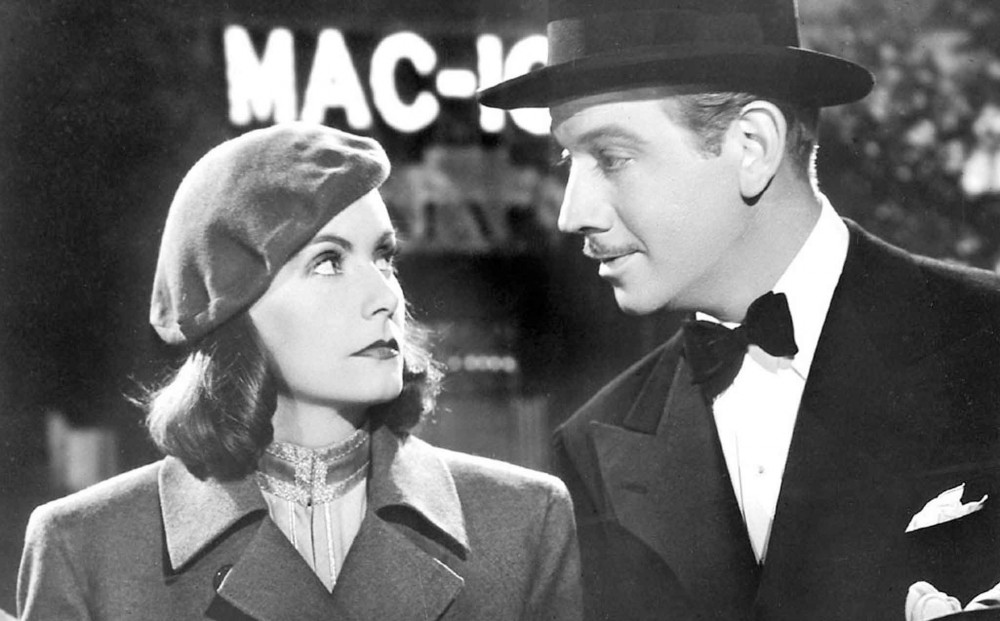
Greta Garbo and Melvyn Douglas


Ninotchka was a radical departure for Garbo. It was her first full-blown comedy film and it remains one of her most popular. Her performance garnered an Oscar nomination for Best Actress (she lost out, of course, to Vivian Leigh in Gone with the Wind). The film was also Oscar-nominated for Best Picture and Best Original Story, and Best Screenplay.

Backstory: By 1939, Great Garbo’s popularity was beginning to wane. Under the direction of Ernst Lubitsch, Garbo gives a wonderfully shaded performance as a woman whose life changes under the spell and romance of Paris. Garbo’s next film, Two-Faced Woman, also costarring Melvyn Douglas, was supposed to capitalize on Ninotchka’s success, but turned out to be a critical and commercial failure. It was Garbo’s last film. After the film was completed, she retired from the movies and acting altogether. Attempts to bring her out of retirement—and there were many—were unsuccessful.

The movie which pokes fun at Stalin and the Soviet Union was banned in that country, but was enormously popular in Europe.


Ernst Lubitsch (1892 – 1947) was a German-born film director who became famous for his sophisticated comedies during the pre-code era. Silent film star Mary Pickford lured Lubitsch to Hollywood in 1922. He directed Pickford in Rosita, which was a huge, hit and cemented his reputation in Hollywood. Lubitsch’s films were so unique that they were described as having the “Lubitsch touch.” Some of Lubitsch’s classic films include Trouble in Paradise (1932), Design for Living (1933), Ninotchka (1939), The Shop Around the Corner (1940), Heaven Can Wait (1943), and Cluny Brown (1946). Lubitsch was awarded an Honorary Academy Award for his work in film.

Ernst Lubitsch directs Garbo


Greta Garbo (1905 – 1990) was a Swedish-American actress. Greta Garbo was a major star during the silent and golden eras of Hollywood. She was famous for playing tragic figures in films like Mata Hari (1931), Grand Hotel (1932), Queen Christina (1933), and Anna Karenna (1935). With the beginning of World War II in Europe, Garbo’s career began to decline. Partly due to the fact that her films weren’t distributed in Europe during the war, where she was enormously popular. When she received terrible notices and poor box office with Two-Faced Woman, Garbo retired from acting and never looked back.

Melvyn Douglas (1901 – 1981) was an American actor. Douglas was a popular leading man during the 1930s working with some of Hollywood’s most famous leading ladies including Greta Garbo, Claudette Colbert, Joan Crawford, Claudette Colbert, Marlene Dietrich, Myrna Loy, and Merle Oberon. He won two Best Supporting Actor Academy Awards late in his career for Hud (1963) and Being There (1979). Douglas’s last film role was in Ghost Story (1981) co-starring Douglas Fairbanks Jr. and Fred Astair.

Click HERE to watch the movie on YouTube.


Click HERE to join the discussion online on May 27, 2024 at 6:30 p.m. Central Time. Once you RSVP, you will receive an invitation and a link to join the discussion on Zoom.


Discussion questions

  1. What did you think of Greta Garbo in a comedic role?
  2. Do you think there was some seriousness between the laughs?
  3. Did Garbo and Melvyn Douglas have good chemistry?
  4. A big part of the success of this movie is the character actors in the film. Did you have a favorite?
  5. Garbo retired from acting in 1940 after the failure of Two-Faced Woman. Do you think she made a mistake in retiring so young?


Friday, February 26, 2016

Great Films of 1939: “Ninotchka” March 12 at Daystar Center

Great films of 1939: Ninotchka
Where: The Venue 1550 at the Daystar Center, 1550 S. State Street, Chicago, IL
When: March 12, 2016
Time: 6:45 p.m.
Hosted by Stephen Reginald

Ninotchka (1939) was the movie that proclaimed, “Garbo laughs!” The great Great Garbo is Ninotchka is a sophisticated delight. The supporting cast includes, Sig Ruman, Felix Bressart, Alexander Granach, and Bela (Dracular) Lugosi. Ninotchka, a special Russian envoy tasked with completing a deal to sell some jewelry that once belonged to an exiled member of Russian royalty (Ina Claire) now living in Paris. Ninotchka is all business and refuses to be taken in by the luxury and romance of the city of lights until she meets Count Leon d’ Algout (Melvin Douglas). Leon flirts with Ninotchka and shows her what a wonderful city Paris is and what it’s like living in a free society. Does Ninotchka hold fast to the tenets of Stalin and the Soviet Union or does she give in to the lure of democracy and capitalism? Directed by the legendary Ernst Lubitsch and written by Billy Wilder, Charles Brackett and Walter Reisch,

Ninotchka was a radical departure for Garbo. It was her first full-blown comedy film and it remains one of her most popular. Her performance garnered an Oscar nomination for Best Actress (she lost out, of course, to Vivian Leigh in Gone with the Wind). The film was also Oscar-nominated for Best Picture and Best Original Story, and Best Screenplay.

Backstory: By 1939, Great Garbo’s popularity was beginning to wane. Under the direction of Ernst Lubitsch, Garbo gives a wonderfully shaded performance as a woman whose life changes under the spell and romance of Paris. Garbo’s next film, Two-Faced Woman, also costarring Melvyn Douglas, was supposed to capitalize on Ninotchka’s success, but turned out to be a critical and commercial failure. It was Garbo’s last film. After the film was completed, she retired from the movies and acting altogether. Attempts to bring her out of retirement—and there were many—were  unsuccessful.

The movie which pokes fun at Stalin and the Soviet Union was banned in that country, but was enormously popular in Europe.


Have some Joe and Enjoy the Show!
Before the movie, grab a cup of coffee from Overflow Coffee Bar, located within the Daystar Center. You can bring food and beverages into the auditorium; we even have small tables set up next to some of the seats. General Admission: $5 Students and Senior Citizens: $3.


Join the Chicago Film club; join the discussion
Twice a month we screen classic films and have a brief discussion afterward. For more information, including how to join (it’s free), click here. The Venue 1550 is easily accessible by the CTA. Please visit Transit Chicago for more information on transportation options.

Stephen Reginald is a freelance writer and editor. He has worked at various positions within the publishing industry for over 25 years. Most recently he was executive editor for McGraw-Hill’s The Learning Group Division. A long-time amateur student of film, Reginald hosts “Chicago Film Club,” a monthly movie event held in the South Loop, for the past two years. Reginald has also taught several adult education film classes at Facets Film School, Chicago.


Daystar Center located at 1550 S. State St. works through a grassroots network of collaborations and partnerships with individuals and other nonprofit organizations. Through this web, they’re able to provide educational, cultural, and civic activities that enrich and empower their clients, guests, and community members. To learn more about classes and events offered at the Daystar Center, please visit their Web site.

Thursday, February 13, 2014

Spend Valentine’s Day with Billy Wilder

By Kate Voss

It’s Valentine’s Day once again -- that time of year when, no matter how harsh the weather may be outside, sentimentality abounds. When it comes to classic cinema, Billy Wilder and sentimentality are practically synonymous. However, Wilder wasn’t merely a purveyor of light-hearted comedies, as his body of work includes entries in various genres. Many of the films which he either wrote or directed are typically regarded as among the best of all time.

The Austrian-born Wilder got his start in the film industry in his youth, when he began writing screenplays in Berlin in the 1920s. As the Third Reich became an increasingly menacing presence throughout Germany, Wilder, fearing religious persecution because he was Jewish, defected to Paris where he directed his first feature-length film, Mauvaise Graine (1934). Shortly thereafter, in 1933 (before his directorial debut had even hit theaters in Paris), WIlder permanently settled in Hollywood.

He first achieved notoriety in the states for co-writing the romantic comedy Ninotchka (1939), which was directed by Hollywood veteran Ernst Lubitsch. In the film, we meet three Russians who are in Paris to sell Jewelry that was confiscated from the Imperial family after the revolution. Count Leon d'Algout (Melvyn Douglas) has been sent by an heiress of the Russian family to retrieve the jewels -- that’s when the titular Ninotchka (Greta Garbo), a Russian spy, gets involved. She has been deployed by the Russian government to ensure that the jewels are sold for the monetary benefit of her country.

This was made, of course, during a time of immense political turmoil, and heightened levels of friction between competing societal ideals in the burgeoning, socialist Soviet empire, and the free-market capitalism models in the West. Ninotchka is stoic, unflinching in her pursuits, and not given to levity or frivolity, whereas Leon is the very embodiment of Western frivolity. Inevitably though, they reconcile their differences and fall madly in love. The film was a major hit, and would go on to inspire the script for the Broadway musical  Silk Stockings, which was itself adapted into the 1957 film directed by Rouben Mamoulian.

Wilder went on to bolster his reputation with the script he co-wrote alongside crime writer Raymond Chandler for the noir thriller Double Indemnity (1944), and achieved even greater fame for writing and directing the ultra-self-reflexive Sunset Boulevard (1950).

But many fans will remember Wilder best for a series of romantic comedies he did in the 1950’s, most notably, the comedic masterpiece Some Like it Hot (1959). The film features Tony Curtis and Jack Lemmon as two wayward musicians in Chicago who find themselves fleeing from the mob after they bear witness to the St. Valentine’s Day Massacre. They disguise themselves in drag, and hitch a train cross country with an all-female jazz ensemble. Both of them fall in love with the band’s singer, Sugar Kane (Marilyn Monroe). It feels dated in the very best way possible -- it’s the distillation of everything that is charming and effective about overtly-stylized romance films from Hollywood’s golden era, and the script for that film is so dense with jokes. If you only ever see one of Wilder’s films, this has got to be the one. It’s regarded by many critics, including Roger Ebert, as one of the best comedies ever made. And if you haven’t already seen it, you might consider cozying up tonight, as you can stream it in its entirety through sites like Directstartv.com and Hulu.

Wilder was a true master of his craft, and his work invokes a certain warm, fuzzy nostalgia that no other filmmaker can even come close to competing with.


Guest blogger, Kate Voss is an entertainment blogger from Chicago. A romantic at-heart, she will be delighting in the classical works of Wilder and Frank Capra this Valentine's Day. You can find her on Twitter at @Kateevoss.


Related Posts Plugin for WordPress, Blogger...