Showing posts with label Ernst Lubitsch. Show all posts

Thursday, May 14, 2026

2026 #TCMFF Wrap-Up

Another Turner Classic Film Festival (TCMFF) is in the books. This year’s festival was held from April 30 to May 3. The anticipation for the TCMFF is huge. Thinking about the film festival helps get me through the Chicago winters.

At this festival, I saw 11 movies. This total is the lowest of all my festivals, dating back to 2015. There were so many movies I wanted to see that I had to be strategic, so I passed on some films to guarantee that I’d get into the ones I really wanted to see and the ones I knew would be the most popular.


What did I see?

Thursday, April 30

Out of the Past (1947) I love this classic film noir starring Robert Mitchum and Jane Greer, co-starring Kirk Douglas and Rhonda Fleming. The movie was introduced by Eddie Muller and Dana Delany. The film we saw at the Egyptian Theatre was a 4K restoration by Warner Bros. Discovery. Not as famous as Double Indemnity (1944), but every bit as good. A must-see on any screen.


Man Hunt (1941). This World War II drama stars Walter Pidgeon and Joan Bennett. Pidgeon stars as a big-game hunter whose failure at assassinating Hitler puts him on the run. He meets up with Bennett, a Cockney streetwalker who helps to hide him from his Nazi pursuers. Directed by Fritz Lang, this is the beginning of his collaboration with Bennett that included The Woman in the Window (1944), Scarlet Street (1945), and The Secret Beyond the Door (1947). The film was screened in Chinese Multiplex #6.

Friday, May 1

Letty Lynton (1932). The movie that everyone has been dying to see for over 90 years. If you’re a classic movie fan, you’ve heard of this film. Presented in a beautiful 4K restoration by Warner Bros. Discovery. The film stars Joan Crawford and Robert Montgomery. The other star is the clothes designed for Crawford by the legendary M-G-M costume designer, Adrian. The film was introduced by Eddie Muller, George Feltenstein, and Casey LaLonde, Joan Crawford’s grandson. According to Muller and LaLonde, this was the movie that made Joan Crawford, Joan Crawford. At the screening, we learned that the film will be released on Blu-Ray in June. The film was screened in the Egyptian Theatre.

Joan Crawford in the Letty Lynton dress

Strangers on a Train (1951) As soon as Letty Lynton let out, I was back on line at the Egyptian Theatre. Strangers on a Train was the beginning of Alfred Hitchcock’s amazing string of classic movies. After a series of box-office disappointments like Rope (1948), Under Capricorn (1949), and Stage Fright (1950), many people thought Hitchcock had lost his touch. Strangers on a Train put that idea to rest. Hitchcock would produce a string of classics, including Rear Window (1954), The Man Who Knew Too Much (1956), Vertigo (1958), North by Northwest (1959), Psycho (1960), and The Birds (1963). The film was introduced by Alicia Malone with special guest Carol Burnett. She was an usher at the old Warner Bros. Theatre on Hollywood Blvd. while on summer break from college. Strangers was playing, and in the old days, movies ran continuously. You could walk into the theater during the middle of the movie, sit down, watch, and then when the movie got to the part where you came in, you’d leave. While Carol was working as an usher, an old couple came during the film’s finale and wanted to be seated. Carol tried to convince the couple that they should wait until the film started again because it would spoil their enjoyment. The manager overheard this “discussion,” and Carol was fired on the spot. When she became famous, and she was asked where she’d like her star on the Hollywood Walk of Fame, she asked for it to be right in front of the old movie theater. Years later, when Alfred Hitchcock heard about Carol’s firing, he sent her a framed copy of the movie poster. He wrote, “Dear Carol, I’m sorry. Alfred Hitchcock.”

Fred MacMurray and Carole Lombard

The Princess Comes Across (1936) is a forgotten screwball comedy/mystery starring Carole Lombard and Fred MacMurray. This was the second of four films the stars made together. Alicia Malone interviewed Kate MacMurray, the daughter of Fred MacMurray and June Haver. Kate spoke lovingly of her father and his friendship with Lombard. She said he was his favorite leading lady, although I heard her say at the screening of The Egg and I at an earlier festival that Claudette Colbert was his favorite. In any event, it was a delightful movie shown in a packed Theater #4. Kate had never seen the movie on the big screen, so she stayed and watched it with us. She was sitting right behind me.

Saturday, May 2

Phantom Lady (1944) Saturday morning was relaxing. I decided to skip all the early-morning movies and have a nice breakfast at 25 Degrees, inside the Hollywood Roosevelt Hotel. I wanted to get into see Phantom Lady in Theater #4, so that was one of the reasons I passed on the earlier films. After breakfast, I went to the Multiplex and was first in line for Phantom. The theater was totally sold out, so my strategy worked. Eddie Muller interviewed Christina Lane, the author of her 2020 biography, Phantom Lady: Hollywood Producer Joan Harrison. It was a great introduction, but the 35mm print was not the best, which was a bit disappointing. Fortunately, the film is good enough that you could get past the less-than-perfect print. I’m glad I got to see it on the big screen.

Ella Raines and Alan Curtis in the shadows

There’s Always Tomorrow (1956) is a classic Douglas Sirk melodrama starring Barbara Stanwyck, Fred MacMurray, and Joan Bennett. MacMurray is a married (to Bennett) father of three children and feels like his life is dull and meaningless. When Stanwyck surprises MacMurray with a visit while she’s in town, he begins to think that life with Stanwyck, an old colleague, would be better than the life he’s currently living. How will it all end? The movie was introduced by Dana Dalany and former child actress Gigi Perreau, who starred in the film as the older daughter of MacMurray and Bennett’s characters. Perreau had some interesting stories about the making of the film, including the fact that she felt that Stanwyck was in total control of the movie and not in a bad way. She said she, “Missy,” played cards and smoked cigarettes with the crew, which was something she would never have been allowed to do as a teenager on the set. Another packed house in Theater #4.

The Devil and Miss Jones (1941) is a delightful comedy starring Jean Arthur, Robert Cummings, Spring Byington, Edmund Gwenn, and Charles Coburn. It’s a tale of labor versus management. Charles Coburn is a rich industrialist who owns a New York City department store. He’s so rich that he didn’t even know he owned it, until he was hanged in effigy by a disgruntled department store staff that includes Arthur, Cummings, and Byington. Cummings is an organizer fighting for better treatment for employees. Coburn is convinced that he can get things under control by going undercover as a department store employee. Much to his own surprise, he becomes friendly with the “agitators” and becomes their champion. I don’t remember who introduced this film, but it attracted a good crowd in Multiplex Theater #1.

Sunday, May 3

The Best Years of Our Lives (1946) is one of my favorite movies. I’ve always wanted to see it on the big screen, and it was a great experience. What we saw was a restored version of the film that looked brand new. I was a special guest of author Alison Macor, who introduced the movie. She wrote a book, The Making of The Best Years of Our Lives: The HollywoodClassic That United a Nation. Seeing it with an audience was special. When two of the main characters got together, the audience applauded. Thanks to Alison, I got a “golden ticket,” which meant I didn’t have to wait in line and had a reserved seat! Not bad. There was a good crowd, although I think it should have been packed in Multiplex Theater #1.

Dana Andrews and Teresa Wright

From Song to Scene was an event in Club TCM with a trio of music supervisors, with Eddie Muller moderating. The job of the music supervisor is to work with the director to make sure the music used in a film matches the narrative. One of the three music supervisors, Maureen Crowe, graduated from high school with me. We both graduated from Holy Trinity High School, Hicksville, Long Island, New York. We last saw each other at our high school reunion in October and planned on seeing each other during the festival. However, she wasn’t on the TCM schedule at that time. It was great seeing her in action, and she and her colleagues were thrilled by the positive reaction.

Maureen and me

Trouble in Paradise (1932) I have to admit that I don’t think I’ve seen this pre-Code classic from beginning to end. I’ve seen parts of it over the years, so seeing it on the big screen in a beautiful 4K digital restoration was a real treat. Director Ernst Lubitsch was a master of pre-Code comedies, and Trouble may be his best film from this period. The movie was introduced by Julia Sweeney, a true Lubitsch fan. Her introduction was funny, informative, and brief. Translation: it was perfect! I think Multiplex #1 was sold out for this showing.

Kay Francis, Herbert Marshall, and Miriam Hopkins

Lady Windemere’s Fan (1925) was a silent film version of the Oscar Wilde play, directed by Ernst Lubitsch (two Lubitsch films in one day). It starred a very young Ronald Colman. The film was accompanied by the Molto Alto Motion Picture Orchestra. The film, restored by The Museum of Modern Art, was beautiful. It looked as good as it probably looked in 1925 when it first premiered. The last three festivals, I’ve ended with a silent film (last year’s silent, Beau Geste (1926), also starred Ronald Colman).  The film was introduced by TCM host Jacqueline Stewart in the Egyptian Theatre.

Another great festival is in the books.

I’m already thinking of next year!


Monday, May 20, 2024

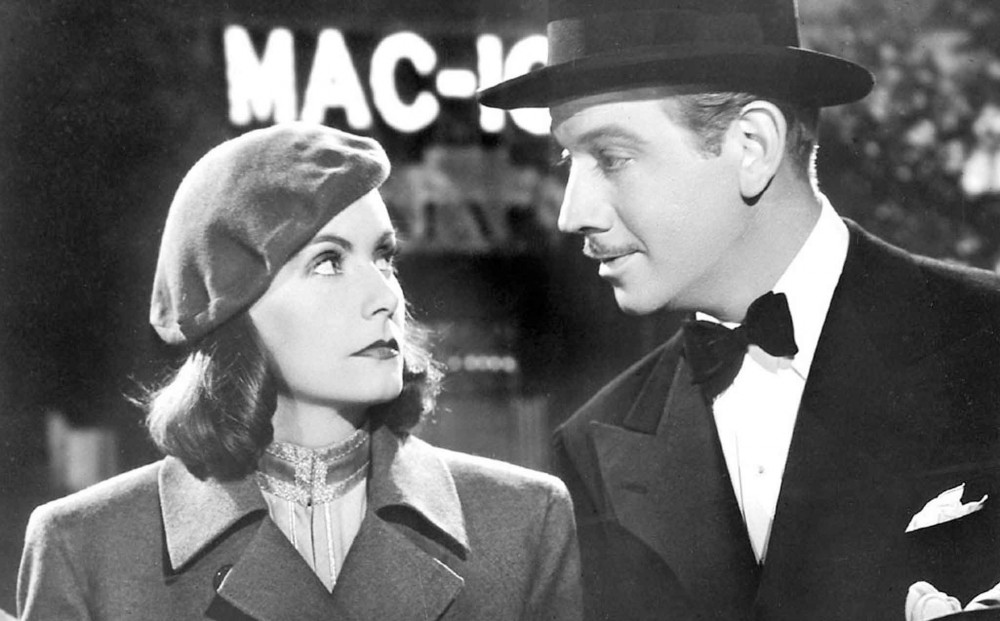
Garbo and everyone laughs in Ernst Lubitsch's "Ninotchka"

Ninotchka (1939) was the movie that proclaimed, “Garbo laughs!” The great Great Garbo is Ninotchka is a sophisticated delight. The supporting cast includes, Sig Ruman, Felix Bressart, Alexander Granach, and Bela (Dracular) Lugosi. Ninotchka, a special Russian envoy tasked with completing a deal to sell some jewelry that once belonged to an exiled member of Russian royalty (Ina Claire) now living in Paris. Ninotchka is all business and refuses to be taken in by the luxury and romance of the city of lights until she meets Count Leon d’ Algout (Melvin Douglas). Leon flirts with Ninotchka and shows her what a wonderful city Paris is and what it’s like living in a free society. Does Ninotchka hold fast to the tenets of Stalin and the Soviet Union or does she give in to the lure of democracy and capitalism? Directed by the legendary Ernst Lubitsch and written by Billy Wilder, Charles Brackett and Walter Reisch,

Greta Garbo and Melvyn Douglas


Ninotchka was a radical departure for Garbo. It was her first full-blown comedy film and it remains one of her most popular. Her performance garnered an Oscar nomination for Best Actress (she lost out, of course, to Vivian Leigh in Gone with the Wind). The film was also Oscar-nominated for Best Picture and Best Original Story, and Best Screenplay.

Backstory: By 1939, Great Garbo’s popularity was beginning to wane. Under the direction of Ernst Lubitsch, Garbo gives a wonderfully shaded performance as a woman whose life changes under the spell and romance of Paris. Garbo’s next film, Two-Faced Woman, also costarring Melvyn Douglas, was supposed to capitalize on Ninotchka’s success, but turned out to be a critical and commercial failure. It was Garbo’s last film. After the film was completed, she retired from the movies and acting altogether. Attempts to bring her out of retirement—and there were many—were unsuccessful.

The movie which pokes fun at Stalin and the Soviet Union was banned in that country, but was enormously popular in Europe.


Ernst Lubitsch (1892 – 1947) was a German-born film director who became famous for his sophisticated comedies during the pre-code era. Silent film star Mary Pickford lured Lubitsch to Hollywood in 1922. He directed Pickford in Rosita, which was a huge, hit and cemented his reputation in Hollywood. Lubitsch’s films were so unique that they were described as having the “Lubitsch touch.” Some of Lubitsch’s classic films include Trouble in Paradise (1932), Design for Living (1933), Ninotchka (1939), The Shop Around the Corner (1940), Heaven Can Wait (1943), and Cluny Brown (1946). Lubitsch was awarded an Honorary Academy Award for his work in film.

Ernst Lubitsch directs Garbo


Greta Garbo (1905 – 1990) was a Swedish-American actress. Greta Garbo was a major star during the silent and golden eras of Hollywood. She was famous for playing tragic figures in films like Mata Hari (1931), Grand Hotel (1932), Queen Christina (1933), and Anna Karenna (1935). With the beginning of World War II in Europe, Garbo’s career began to decline. Partly due to the fact that her films weren’t distributed in Europe during the war, where she was enormously popular. When she received terrible notices and poor box office with Two-Faced Woman, Garbo retired from acting and never looked back.

Melvyn Douglas (1901 – 1981) was an American actor. Douglas was a popular leading man during the 1930s working with some of Hollywood’s most famous leading ladies including Greta Garbo, Claudette Colbert, Joan Crawford, Claudette Colbert, Marlene Dietrich, Myrna Loy, and Merle Oberon. He won two Best Supporting Actor Academy Awards late in his career for Hud (1963) and Being There (1979). Douglas’s last film role was in Ghost Story (1981) co-starring Douglas Fairbanks Jr. and Fred Astair.

Click HERE to watch the movie on YouTube.


Click HERE to join the discussion online on May 27, 2024 at 6:30 p.m. Central Time. Once you RSVP, you will receive an invitation and a link to join the discussion on Zoom.


Discussion questions

  1. What did you think of Greta Garbo in a comedic role?
  2. Do you think there was some seriousness between the laughs?
  3. Did Garbo and Melvyn Douglas have good chemistry?
  4. A big part of the success of this movie is the character actors in the film. Did you have a favorite?
  5. Garbo retired from acting in 1940 after the failure of Two-Faced Woman. Do you think she made a mistake in retiring so young?


Tuesday, May 17, 2022

Charles Boyer and Jennifer Jones in Ernst Lubitsch's production of "Cluny Brown"

Cluny Brown (1946) is a romantic comedy produced and directed by Ernst Lubitsch and starring Charles Boyer and Jennifer Jones. The film is based on the novel of the same name by Margery Sharp. The cinematography was by Joseph LaShalle (Laura 1944). The supporting cast includes Peter Lawford, Helen Walker, Reginald Owen, Reginald Gardiner, Richard Haydn, C. Aubrey Smith, Sara Allgood, Florence Bates, Margaret Bannerman, and Una O'Connor.

Cluny Brown (Jones) is an orphan who lives with her uncle (Billy Bevan), a plumber. Cluny has learned all about plumbing from her uncle, but her uncle doesn't think being a plumber is good for a young woman. By coincidence, Cluny meets Adam Belinski at the London home of Mr. Ames (Gardiner). Mr. Ames is having plumbing issues and Cluny manages to fix the issue, much to the surprise of both Belinski and Ames. Cluny and Belinski hit it off and seem to make a special connection.

Unfortunately, Cluny's uncle procures a job for Cluny as a parlor maid at the country estate of Sir Henry Carmel (Owen) and Lady Carmel (Bannerman). As fate would have it, Belinski is the invited guest of Andrew Carmel where he meets Cluny once again. Their relationship continues while Belinski is a guest in the Carmel home.

Will Cluny be content with the life of a parlor maid, or will she and Belinski build a life of their own?

Charles Boyer, Reginald Gardner, and Jennifer Jones


Ernst Lubitsch (1892 – 1947) was a German-born film director who became famous for his sophisticated comedies during the pre-code era. Silent film star Mary Pickford lured Lubitsch to Hollywood in 1922. He directed Pickford in Rosita, which was a huge, hit and cemented his reputation in Hollywood. Lubitsch’s films were so unique that they were described as having the “Lubitsch touch.” Some of Lubitsch’s classic films include Trouble in Paradise (1932), Design for Living (1933), Ninotchka (1939), The Shop Around the Corner (1940), Heaven Can Wait (1943), and Cluny Brown (1946). Lubitsch was awarded an Honorary Academy Award for his work in film.

Charles Boyer (1899 - 1978) was a French-American stage and film actor. Boyer was nominated for the Best Actor Academy Award four times. He became a major movie star in the late 1930s in films like The Garden of Allah (1936), Algiers (1938), and Love Affair (1939). He starred as the evil husband of Ingrid Bergman in Gaslight (1944). Boyer starred opposite most of the top female stars of the period including Claudette Colbert, Marlene Dietrich, Irene Dunne, Jean Arthur, Greta Garbo, Bette Davis, Joan Fontaine, Katharine Hepburn, and Olivia de Havilland. As he grew older, Boyer played supporting roles in film and also starred on Broadway in Kind Sir (1953 - 1954) and The Marriage-Go-Round (1958 - 1960).

Jennifer Jones (1919 - 2009) was an American actress. She received five Academy Award nominations, including one win for her performance in The Song of Bernadette (1943). At age 25, Jones was one of the youngest Best Actress Award winners. She was a major movie star throughout the 1940s and 1950s. She starred in Duel in the Sun (1946), Portrait of Jenny (1948), Madame Bovary (1949), and Love is a Many-Splendored Thing (1955). Jones was married to producer David O. Selznick who carefully managed her career. 


Jennifer Jones takes direction from Ernst Lubitsch on the set of Cluny Brown.

Cluny Brown trivia

  • This was director Ernst Lubitsch's last completed film. He died while filming That Lady in Ermine (1948).
  • In the novel Adam Belinski is Polish. In the film, he's Czech but retains the name Belinski which is Polish.
  • Richard Haydn and C. Aubrey Smith starred together in And Then There Were None (1944).
  • Reginald Owen and Billy Bevan appeared together in National Velvet (1944).
  • Reginald Gardiner and Una O'Connor appeared together in Christmas in Connecticut (1945).


To watch the film on YouTube, click on the link below.


To join the discussion on May 23, 2022, at 6:30 p.m. Central Time, click here. Once you RSVP, you will receive an invitation and a link to the discussion on Zoom.


Discussion questions

  1. Did you think the relationship between Adam Belinski and Cluny Brown was believable?
  2. Was there chemistry between Boyer and Jones?
  3. Was there a theme or message? Do you think Ernst Lubitsch was making a statement of some kind with this comedy?
  4. The film is filled with some of the greatest character actors. Did any one of the character actors stand out to you?
  5. Did this film remind you of any other films you've seen?

Charles Boyer and Jennifer Jones in a publicity photo for Cluny Brown


Friday, December 4, 2020

Don Ameche meets “His Excellency” in “Heaven Can Wait” (1943)

Heaven Can Wait (1943) is an American comedy produced and directed by Ernst Lubitsch. It stars Gene Tierney, Don Ameche, and Charles Coburn. The film is shot in beautiful 20th Century-Fox Technicolor.


The plot begins with Henry Van Cleve (Ameche) at the end of his life speaking to “His Excellency” (Laird Cregar) the gatekeeper in Hell. Henry thinks that due to all his life’s failings, he deserves to spend eternity there away from all the people he loved on earth especially his beloved wife Martha (Tierney). 

Born in 1972 to an upper-class family in New York City, Henry has been indulged by all his family members including his mother (Spring Byington), his father (Louis Calhern), his grandmother (Clara Blandick), and his grandfather (Coburn). Will all this fawning and making excuses for Henry during his lifetime doom him to an eternity with His Excellency?

Don Ameche and Gene Tierney

Ernst Lubitsch (1892 – 1947) was a German-born American film director and producer. He is best known for his sophisticated comedies, especially those produced before the Production Code went into effect in 1934. Lubitsch was a successful director in his native Germany but was brought to Hollywood in 1922 to direct Mary Pickford in Rosita (1923). The film was a success but Pickford and Lubitsch didn’t get along very well. He signed a contract with Warner Bros. and his career in American was set. Lubitsch made the transition to sound directing hits like The Smiling Lieutenant (1931), Trouble in Paradise (1932), Design for Living (1933), and The Merry Widow (1934). For a time he was head of production at Paramount where he became close friends with Carole Lombard. Other classic Lubitsch films include Ninotchka (1939) with Greta Garbo and The Shop Around the Corner (1940) with Margaret Sullavan and James Stewart. In the mid-1940s, he moved to Fox, but his health kept him from directing some of the films he had on his slate. Lubitsch was awarded a Special Academy Award for his “25-year contribution to motion pictures” in March of 1947. On November 30, 1947, Lubitsch died of a heart attack at the age of 55.

Gene Tierney (1920 – 1991) was an American actress. Tierney got her start on the stage where she played the ingenue lead in The Male Animal. Tierney made her movie debut in 1940 in The Return of Frank James starring Henry Fonda. She worked steadily in the early 1940s but established herself as a top box office star with Laura (1944). She starred in Leave Her to Heaven the next year which was the biggest hit of the year and Fox’s biggest moneymaking success until The Robe (1953). Other successes for Tierney include Dragonwyck (1946), The Razor’s Edge (1946), and The Ghost and Mrs. Muir (1947).

Don Ameche (1908 – 1993) was an American actor on stage and in film. He was also a star on the radio during the early 1930s. He signed a contract with 20th Century-Fox in 1935 and quickly became one of the studio’s top leading men and top box office stars. He was often teamed with fellow Fox stars Alice Faye and Tyrone Power including In Old Chicago (1938) and Alexander’s Ragtime Band (1938). Ameche was so popular that in two years (1938 and 1939) he had ten films in release. In the 1950s, Ameche starred on Broadway in Silk Stockings (1955-56) and Holiday For Lovers (1957). His career in film in television continued into the 1960s and 1970s. When he was cast in Trading Places (1983) along with fellow movie veteran Ralph Bellamy, Ameche was introduced to a new generation of fans. In 1985 he starred in Cocoon (1985) which won him an Academy Award for Best Supporting Actor. Ameche continued acting until his death in 1993 at 85.

Charles Coburn (1877 – 1961) was an American character actor who had a long career on stage and in film. He won a Best Supporting Actor Academy Award for his performance in The More the Merrier (1943) co-starring Jean Arthur and Joel McCrea. Coburn’s other classic films include The Lady Eve (1941), Kings Row (1942), The Paradine Case (1947), Monkey Business (1952), and Gentlemen Prefer Blondes (1953).

The film has a dream supporting cast that includes Marjorie Main, Spring Byington, Allyn Joslyn, Eugene Pallette, Signe Hasso, Louis Calhern, and Clara Blandick.


Heaven Can Wait trivia:

  • Lubitsch was originally disappointed with the casting of Don Ameche but changed his mind and was won over by the actor’s dedication to the role and his professionalism.
  • Gene Tierney recalled that during production, “Lubitsch was a tyrant on the set, the most demanding of directors. After one scene, which took from noon until five to get, I was almost in tears from listening to Lubitsch shout at me. The next day I sought him out, looked him in the eye, and said, ‘Mr. Lubitsch, I'm willing to do my best but I just can't go on working on this picture if you're going to keep shouting at me.’ ‘I’m paid to shout at you’, he bellowed. ‘Yes’, I said, ‘and I’m paid to take it - but not enough.’ After a tense pause, Lubitsch broke out laughing. From then on we got along famously.” (From Gene Tierney’s autobiography Self-Portrait.)
  • This was Lubitsch’s only film in Technicolor,
  • Tod Andrews who played Don Ameche and Gene Tierney’s son was only six years younger than Ameche and six years older than Tierney.
  • Gene Tierney realized she was pregnant during the film’s production.
  • The film was nominated for three Academy Awards: Best Picture, Best Director, and Best Cinematography, Color.


To watch the film on YouTube, click on the link below.


To join us on Zoom for a discussion on December 8, at 6:30 p.m. Central Time, click the link for details and invitation. When you RSVP you will receive an email and link to the discussion.


Questions for discussion:

  1. Do you think Henry was actually unfaithful to Martha?
  2. The picture rests on Ameche’s shoulders; what did you think of his performance as Henry?
  3. Would the film have worked in black and white? What did the Technicolor add to the film?
  4. The film is filled with great character actors; did you have a favorite?
  5. Were there any memorable lines from the film that stuck with you?


Thursday, August 13, 2020

Carole Lombard and Jack Benny in Ernst Lubitsch’s “To Be or Not to Be”

To Be or Not to Be (1942) is a comedy directed by Ernst Lubitsch and starring Carole Lombard and Jack Benny

The film is set in Warsaw, Poland, before the 1939 Nazi invasion. Josef Tura (Jack Benny) and his stunningly beautiful wife Maria Tura (Carole Lombard) head a theater company that at the beginning of the film is rehearsing a play called Gestapo, a production making fun of the Nazis.

Table reading for To Be or Not to Be with director Ernst Lubitsch (top left), Carole Lombard, and Jack Benny. Lombard told her friends that this was the happiest film set she had ever worked on.

While Josef Tura is performing Shakespeare’s Hamlet, Poland is invaded and things change for the acting company which is now being watched closely by the Nazis. Can a troop filled with ham actors help the Polish resistance? Can they help bring down Hitler and the Nazis?

Ernst Lubitsch (1892 – 1947) was a German-born film director who became famous for his sophisticated comedies during the pre-code era. Silent film star Mary Pickford lured Lubitsch to Hollywood in 1922. He directed Pickford in Rosita, which was a huge, hit and cemented his reputation in Hollywood. Lubitsch’s films were so unique that they were described as having the “Lubitsch touch.” Some of Lubitsch’s classic films include Trouble in Paradise (1932), Design for Living (1933), Ninotchka (1939), The Shop Around the Corner (1940), Heaven Can Wait (1943), and Cluny Brown (1946). Lubitsch was awarded an Honorary Academy Award for his work in film.

Carole Lombard and Jack Benny
Carole Lombard (1908 – 1942) was an American actress, well regarded for her many screwball comedy film roles. During the late 1930s, she was the highest-paid star in Hollywood. Lombard got her start in silent films as a child and set her mind on making movie acting her career. She was one of Mack Sennett’s bathing beauties, appearing in 15 of his comedy shorts before moving on to feature films. Her breakout performance came in 1934’s Twentieth Century co-starring John Barrymore. After that film, Lombard’s career soared. She starred in many successful comedies including Hands Across the Table (1935), My Man Godfrey (1936), which brought her a Best Actress Academy Award nomination, Mr. & Mrs. Smith (1941), and To Be or Not to Be (1942), her final film.

Jack Benny (1894 – 1974) was an American comedian who was a star on radio, film, and television. He was known for his comic timing and delivery, often with long pauses and facial expressions. He had the ability to make audiences laugh without uttering a single word. When he did utter his signature “Well,” it almost always brought the house down. Benny’s film career never matched that of his radio success, but he did star in several memorable films including Broadway Melody of 1936, Charley’s Aunt (1941), and George Washington Slept Here (1942). Benny was delighted to have had the opportunity to work under Lubitsch’s direction, someone the comedian greatly admired.

Robert Stack and Carole Lombard
The supporting cast of To Be or Not to Be is very strong. In includes a young Robert Stack, Feliz Bressart, Lionel Atwill, Sig Ruman, Tom Dugan, Charles Halton, Maude Eburne, and Miles Mander.

To Be or Not to Be Trivia:

  • It was nominated for Best Music, Scoring of a Dramatic or Comedy Picture, Werner R. Heymann
  • Because Carole Lombard died in a plane crash after the film was completed, the line her character utters, “What can happen in a plane?” was cut in post-production.
  • Jack Benny’s father left the movie theater when he saw his son wearing a Nazi uniform in the film.
  • Miriam Hopkins was the original choice to play Maria Tura. She dropped out when she realized that Benny got all of the laughs.
  • Benny told his friends that he considered this to be his best and only great film role.
  • In lieu of her usual fee of $125,000, Lombard took a percentage of the film’s profits plus $75,000. Upon her death, widower, Clark Gable, received $57,307, Lombard’s share of the film’s profits.


Watch the film on YouTube by clicking the link below. Be sure to use this link because there are several versions of this film on the channel; this one is of the best quality.


After you’ve watched the film, join us for a discussion on August 18. 2020, at 6:30 p.m Central Time on Zoom. An invitation with links can be found below.

Stephen Reginald is inviting you to a scheduled Zoom meeting.

Topic: Discussion of "To Be or Not to Be"
Time: Aug 18, 2020, 06:30 PM Central Time (US and Canada)

Join Zoom Meeting

https://us04web.zoom.us/j/79809533453?pwd=RWNhM2N4RVNyVW8vQ0VKUTc2UlZWUT09

Meeting ID: 798 0953 3453
Passcode: hKy0FK


Questions for discussion:
1. What did you think of the film overall?
2. Did you find the satire of Nazis funny? Offensive?
3. What did you make of the relationship between Lombard and Benny’s characters? Were they believable as husband and wife? Actors?
4. Did anything about the film surprise you?
5. Was this a fitting film to be Lombard’s last?

Friday, March 9, 2018

Screening of "To Be or Not To Be" March 10 at Daystar Center

To Be or Not To Be (1942)
Where: Daystar Center, 1550 S. State Street
When: March 10, 2018
Time: 6:45 p.m.
Hosted by Stephen Reginald

To Be or Not to Be (1942) During the Nazi occupation of Poland, an acting troupe bands together to outwit their occupiers. Carole Lombard and Jack Benny are the Turas, the husband and wife theatrical team and two of Poland's most famous celebrities. Directed by the legendary Ernst Lubitsch who successfully combines zany comedy with poignant dramatic moments. The supporting cast includes, Robert Stack, Felix Bressart, Lionel Atwill, and Sig Ruman. This was Lombard's last film.

Carole Lombard 
Have some Joe and Enjoy the Show!
You can bring food and beverages into the auditorium; we even have small tables set up next to some of the seats. General Admission: $5 Students and Senior Citizens: $3.

Join the Chicago Film club; join the discussion
Twice a month we screen classic films and have a brief discussion afterward. For more information, including how to join (it’s free), click here. The Venue 1550 is easily accessible by the CTA. Please visit Transit Chicago for more information on transportation options.

Stephen Reginald is a freelance writer and editor. He has worked at various positions within the publishing industry for over 25 years. Most recently he was executive editor for McGraw-Hill’s The Learning Group Division. A long-time amateur student of film, Reginald hosts “Chicago Film Club,” a monthly movie event held in the South Loop, for the past two years. Reginald has also taught several adult education film classes at Facets Film School, Chicago.

Friday, February 26, 2016

Great Films of 1939: “Ninotchka” March 12 at Daystar Center

Great films of 1939: Ninotchka
Where: The Venue 1550 at the Daystar Center, 1550 S. State Street, Chicago, IL
When: March 12, 2016
Time: 6:45 p.m.
Hosted by Stephen Reginald

Ninotchka (1939) was the movie that proclaimed, “Garbo laughs!” The great Great Garbo is Ninotchka is a sophisticated delight. The supporting cast includes, Sig Ruman, Felix Bressart, Alexander Granach, and Bela (Dracular) Lugosi. Ninotchka, a special Russian envoy tasked with completing a deal to sell some jewelry that once belonged to an exiled member of Russian royalty (Ina Claire) now living in Paris. Ninotchka is all business and refuses to be taken in by the luxury and romance of the city of lights until she meets Count Leon d’ Algout (Melvin Douglas). Leon flirts with Ninotchka and shows her what a wonderful city Paris is and what it’s like living in a free society. Does Ninotchka hold fast to the tenets of Stalin and the Soviet Union or does she give in to the lure of democracy and capitalism? Directed by the legendary Ernst Lubitsch and written by Billy Wilder, Charles Brackett and Walter Reisch,

Ninotchka was a radical departure for Garbo. It was her first full-blown comedy film and it remains one of her most popular. Her performance garnered an Oscar nomination for Best Actress (she lost out, of course, to Vivian Leigh in Gone with the Wind). The film was also Oscar-nominated for Best Picture and Best Original Story, and Best Screenplay.

Backstory: By 1939, Great Garbo’s popularity was beginning to wane. Under the direction of Ernst Lubitsch, Garbo gives a wonderfully shaded performance as a woman whose life changes under the spell and romance of Paris. Garbo’s next film, Two-Faced Woman, also costarring Melvyn Douglas, was supposed to capitalize on Ninotchka’s success, but turned out to be a critical and commercial failure. It was Garbo’s last film. After the film was completed, she retired from the movies and acting altogether. Attempts to bring her out of retirement—and there were many—were  unsuccessful.

The movie which pokes fun at Stalin and the Soviet Union was banned in that country, but was enormously popular in Europe.


Have some Joe and Enjoy the Show!
Before the movie, grab a cup of coffee from Overflow Coffee Bar, located within the Daystar Center. You can bring food and beverages into the auditorium; we even have small tables set up next to some of the seats. General Admission: $5 Students and Senior Citizens: $3.


Join the Chicago Film club; join the discussion
Twice a month we screen classic films and have a brief discussion afterward. For more information, including how to join (it’s free), click here. The Venue 1550 is easily accessible by the CTA. Please visit Transit Chicago for more information on transportation options.

Stephen Reginald is a freelance writer and editor. He has worked at various positions within the publishing industry for over 25 years. Most recently he was executive editor for McGraw-Hill’s The Learning Group Division. A long-time amateur student of film, Reginald hosts “Chicago Film Club,” a monthly movie event held in the South Loop, for the past two years. Reginald has also taught several adult education film classes at Facets Film School, Chicago.


Daystar Center located at 1550 S. State St. works through a grassroots network of collaborations and partnerships with individuals and other nonprofit organizations. Through this web, they’re able to provide educational, cultural, and civic activities that enrich and empower their clients, guests, and community members. To learn more about classes and events offered at the Daystar Center, please visit their Web site.

Thursday, April 22, 2010

Down-to-Earth Sophistication: Claudette Colbert in Hollywood

Claudette Colbert’s biography could have been dreamed up by a Hollywood press agent. She was born Lily Claudette Chauchoin in Paris, France, on September 13, 1903. In 1910, Colbert’s family immigrated to America.

From an early age, Colbert wanted a career on the stage. By the late 1920s, she was a Broadway veteran, earning good notices. In 1927, Colbert tried her hand at movies. She starred in For the Love of Mike, helmed by a young director named Frank Capra. Unhappy with the results, Colbert vowed never to make another film. But when the stock market crashed, and the lights on Broadway dimmed, she gave the movies another try.

Colbert signed with Paramount Pictures in 1929, appearing in musicals, melodramas, epics, and comedies. In 1934, Colbert starred in a record three movies (It Happened One Night, Imitation of Life, and Cleopatra) that were all nominated for the Best Picture Academy Award. That same year, she won the Oscar for Best Actress, playing run-away heiress Ellie Andrews in It Happened One Night.

What made Colbert unique from other actresses, was her ability to combine class and sophistication with down-to-earth warmth and charm, a talent that endeared her to both men and women equally.

A top box office draw for over 20 years, Colbert was one of the highest paid actresses in Hollywood. She worked with the best directors in the world, including Capra, Gregory LaCava, Ernst Lubitsch, Mitchell Leisen, and Preston Sturges. Excelling at sophisticated comedy, Colbert is the only actress, from Hollywood’s golden age, to have worked with both Lubitsch and Sturges.

Few movie stars, before or since, have matched her talent. By any measure, she's one of the greatest actresses Hollywood has ever seen.

Thursday, March 25, 2010

Ernst Lubitsch, "To Be or Not To Be," and Lombard's last impression

Coming to America
Director Ernst Lubitsch left his native Germany in 1922 at the invitation of silent-screen legend Mary Pickford. He directed Pickford in two popular films, Rosita (1923) and The Marriage Circle (1924). Right from the start, his American films had a quality, polish, and sophistication that seemed fresh and new. Audiences loved the "Lubitsch touch" and his career in Hollywood prospered. When talking pictures took hold, Lubitsch adapted immediately without missing a beat.

Hollywood fights back
In 1935, Lubitsch's German citizenship was erased by the Nazis. Like many Europeans living in America, Lubitsch was horrified by the rise of Adolf Hitler and his ever-increasing stranglehold on his home continent. During the late 1930s the war in Europe was heating up and Lubitsch thought the time was right for a satire about Hitler and the Nazis. After all, The Great Dictator (1940), written and directed by Charles Chaplin was a huge hit. Surely Lubitsch with his talent for comedy would be able to be equally successful with To Be or Not To Be (1942).

Show me the money
At this point in his career, Lubitsch was working independently, without the backing of a major studio. As an independent, he had to obtain funding to make To Be or Not To Be, as well as work out a distribution agreement. From the beginning, the movie was meant to be a star vehicle for Jack Benny. Benny was a superstar on the radio, but his movie career never matched his radio success. To help secure financing, Benny actively courted Lombard to star opposite him. Lubitsch, anxious to work with Lombard didn't think the part was large enough to interest her. Surprisingly, Lombard loved the script. The fact that she would be part of an ensemble cast rather than being the "star" didn't seem to matter. Additionally, Lombard thought that with the rumors of a World War on everyone's mind, a satire like To Be or Not To Be would help in the fight against the Axis powers.

Together again: Lubitsch and Lombard
With Lombard onboard, the financing was guaranteed and production started in October 1941. From all accounts, the filming was a pleasant experience for Lombard and all of the cast. Benny loved working with Lombard and she helped him get past his anxiety about working with a director of Lubitsch's stature. Once again, Lubitsch allowed Lombard to act as uncredited producer, just like he did during the filming of Hands Across the Table, when he was in charge of production at Paramount six years earlier.

Remember Pearl Harbor
During the filming of To Be or Not To Be, Pearl Harbor was attacked and the United States entered World War II. The mood of the country was somber with American casualties mounting on a daily basis. Americans feared invasion from Japan, especially those on the west coast, which included Hollywood. Ever the patriot, Lombard wrote President Roosevelt to ask what she and her husband, Clark Gable, could do? His response: keep making movies to keep people's spirits up.

War bond tour
Not one to sit by the sidelines, Lombard went on a war bond rally on January 12, including a huge drive in her native state, Indiana. The goal was to sell $500,000 worth of bonds, but Lombard's enthusiasm and star power brought that total above $2 million! After a hectic bond-selling schedule (so hectic in fact that a January 14, 1942 stop in Chicago generated an article in the Chicago Tribune entitled "A Whirlwind! It Was Carole on Chicago Visit"), Lombard wanted to fly back to California, instead of taking the train as originally planned. She was anxious to see her husband and didn't want to waste the time on the train. Traveling with her mother, Elizabeth Peters and MGM press agent Otto Winkler, Lombard tried to convince her traveling companions that flying home was their best option. Peters and Winkler were against flying, but Lombard prevailed.

California bound
After a brief refueling stop in Las Vegas, the DC-3 plane that Lombard and 21 others occupied, took off for the west coast on January 16. They never made it home. The plane, flying too low, slammed into a mountain not far from the Las Vegas airport. Everyone on board was killed instantly.

Farewell to the screwball girl
On January 21 at 4 p.m., funeral services were held for Lombard and her mother at the Hilltop Church of the Recessional in Forest Lawn cemetery, Glendale, CA. According to Lombard's wishes, her funeral was simple with mostly family and friends in attendance. As reported in the January 22 edition of the Chicago Tribune, those present included "...Mr.and Mrs. Spencer Tracy, Jack Benny, Mr. and Mrs. Ernst Lubitsch, ... the William Powells, Louis B. Mayer, ...and the Fred MacMurrays."

To Be or Not To Be released
Lombard's last movie was met with generally good reviews, but audiences weren't flocking to see it. It's hard to know why, since today, To Be or Not To Be is considered a classic. More than sixty years after its release, the American Film Institute in it's list of the one hundred funniest films of all time, ranked it at forty-nine. Some people thought the black humor was too much for wartime audiences. New York Times critic, Bosley Crowther wrote in his March 7, 1942 review, "To say it is callous and macabre is understating the case." Other period reviews were positive: "It's an acting triumph for Lombard, who delivers an effortless and highly effective performance..." (Variety).

Lasting legacy
It's sad that a talent like Carole Lombard was taken from us at the height of her career. The plans to make another movie with Lubitsch, Preston Sturges, and Billy Wilder would never be realized. But fortunately for us, she left a body of work that still brings us joy, laughter, and tears.

"A loud cheer for the screwball girl!"


Related Posts Plugin for WordPress, Blogger...