Showing posts with label Stephen McNally. Show all posts

Tuesday, June 13, 2023

James Stewart searches for “Winchester ‘73”

Winchester ’73 (1950) is an American Western film directed by Anthony Mann and starring James Stewart, Shelley Winters, Dan Duryea, and Stephen McNally. Others in the cast include Millard Mitchell, Charles Drake, John McIntire, Will Geer, and Jay C. Flippen. The film also includes early screen appearances by Rock Hudson and Tony Curtis, credited as Anthony Curtis.

At the beginning of the film, Lin McAdam (Stewart) is searching for Dutch Henry Brown (McNally). The two have a score to settle.

In Dodge City, Kansas, Lin enters a shooting contest and wins a Winchester 1873 rifle. At the boarding house where Lin is packing, he is ambushed by Dutch who steals the rifle. Dutch rides away with two other men, making Lin’s anger toward Dutch burns even brighter. Lin’s quest to settle his score with Dutch becomes even more urgent than before.

James Stewart and Millard Mitchell

Anthony Mann (1906 – 1967) was an American director. Mann got his start in film working as a talent scout for David O. Selznick. He later became an assistant director, assisting Preston Sturges on Sullivan’s Travels (1941). Mann went on to direct a variety of low-budget, but successful films at Republic, RKO, and Eagle-Lion studios. The Furies was Mann’s first A picture. After The Furies, Mann went on to direct many successful westerns including Winchester ’73 (1950), Devil’s Doorway (1950), Bend of the River (1952), and The Naked Spur (1953).

James Stewart (1908 - 1997) was an American actor whose career spanned almost five decades and 80 films. Stewart often portrayed the ideal of the average American who was decent and honest. Stewart signed a seven-year contract with Metro-Goldwyn-Mayer where he appeared in a variety of supporting roles in B and A pictures. It wasn’t until he was loaned out to Columbia Pictures to costar in Frank Capra’s You Can’t Take It With You (1938) that his home studio began to take notice. Still, his best roles were on loan to other studios including Mr. Smith Goes to Washinton (1939) at Columbia again and Destry Rides Again (1939) at Universal. M-G-M eventually cast him in The Philadelphia Story (1940) where he won the Academy Award for Best Actor which cemented his reputation as a leading man and star. From there he went on to make The Shop Around the Corner (1940) and The Mortal Storm (1940). After serving in the United States Army from 1941 - 1945, Stewart returned to Hollywood where he continued as a popular leading man. During the 1950s, Steward made two films with director Alfred Hitchcock which are considered two of the director’s best films: Rear Window (1954) and Vertigo (1958). Vertigo was voted the greatest film ever made by Sight & Sound in 2012.

Shelley Winters (1920 - 2006) was an American actress whose career in film began in 1943 and continued into the 2000s. Some of Winters’s film roles include A Double Life (1947), The Great Gatsby (1948), Winchester 73 (1950), and A Place in the Sun (1951) for which she was nominated for a Best Actress Academy Award. Winters was in demand throughout the 1950s having four films in release in 1955 including Night of the Hunter. She won a Best Supporting Actress Academy Award for The Diary of Anne Frank (1959). She won her second Best Supporting Actress Oscar for her performance in A Patch of Blue (1965). Besides her film work, Winters starred on Broadway and was a frequent guest star on popular television series and made-for-TV movies.

Dan Duryea (1907 – 1968) was an American film, stage, and television actor. He is best known for his character roles as villains, but he had a long career that included a variety of lead and second lead roles. Duryea graduated from Cornell University in 1928. In his senior year, he was the president of the college drama society. Duryea went to Hollywood in 1940 to Leo Hubbard in The Little Foxes, a role he created on Broadway. He established himself in films noir costarring in classics like Scarlet Street (1945), Criss Cross (1948), and Too Late for Tears (1949).

Stephen McNally (1911 - 1994) was an American film, stage,  and television actor. He is mostly remembered for his roles in westerns. McNally often played the bad guy like his portrayal of Locky McCormick in Johnny Belinda (1948). McNally earned a law degree from Fordham University Law School. During the 1950s, he started working in television starring in popular series like Wagon TrainRiverboatRawhide77 Sunset StripThe VirginianFantasy IslandStarsky & HutchCharlies AngelsThe Rockford File, and  Police Story.


Winchester ’73 trivia

  • This film is credited with reigniting James Stewart’s career after a series of unsuccessful films after returning from World War II.
  • James Steward received a percentage of the film’s profits instead of a set salary. He’s the first actor to have negotiated this kind of deal which is now quite common.
  • This was the first pairing of director Anthony Mann and James Stewart. They went on to make seven more films together.
  • James Stewart spent a lot of time practicing a lot with the rifle so he would look like an authentic westerner.
  • As part of film’s promotion, Universal Studios conducted a contest to find rare Winchester 1873 rifles. The contest helped create an interest in antique gun collecting.


To watch the movie on YouTube, click on the link below.


To join the discussion on June 19, 2023, at 6:30 p.m. Central Time, click here. Once you RSVP, you will receive an invitation and link to join the discussion on Zoom.


Discussion questions

  1. Some people consider this film one of the best Westerns of all time. Would you agree with that assessment?
  2. In 1950, this was a James Stewart the public had never seen before. Did his performance surprise you? What do you think audiences were thinking in 1950 when they saw this film?
  3. When the relationship between Lin and Dutch was revealed were you surprised?
  4. Shelly Winters felt her character could have been left out of the movie and nobody would have noticed (or cared). Do you agree?
  5. Stewart and Mann really worked hard to capture the authenticity of the old West. Do you think they were successful?

Tuesday, January 11, 2022

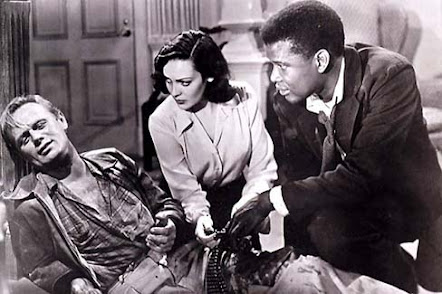
Widmark, Darnell, and Poitier wonder if there is "No Way Out"

No Way Out (1950) is an American film noir directed by Joseph Mankiewicz and starring Richard Widmark, Linda Darnell, Stephen McNally, and in his film debut, Sidney Poitier. The movie was produced by Darryl F. Zanuck with music by Alfred Newman.

The plot concerns Dr. Luther Brooks (Poitier) as the first black doctor to be employed at the urban hospital where he trained. While working at the hospital's prison ward, brothers Johnny and Ray (Widmark) Biddle are brought in to be treated for gunshot wounds they received while attempting a robbery. 

Johnnys symptoms worry Luther, suspecting he may have a brain tumor. While he is trying to tend to Johnny, Ray hurls insults and racial epitaphs at Luther. Still believing that Johnny may be suffering from a brain tumor, Luther performs a spinal tap, but Johnny dies during the procedure. Ray accuses Luther of murdering his brother and vows revenge.

Will Luther be able to survive the suspicion that he may have misdiagnosed Johnny? Will Ray make good on his vendetta against Luther?

Richard Widmark Linda Darnell, and Sidney Poitier


Joseph L. Mankiewicz (1929 – 1972) was an American film director, screenwriter, and producer. Mankiewicz won Academy Awards for directing and writing A Letter to Three Wives (1949), and All About Eve (1950). He is the only director to win back-to-back Academy Awards for writing and directing. Other films directed by Mankiewicz include Dragonwyck (1946), The Ghost and Mrs. Muir (1947), Julius Caesar (1953), The Barefoot Contessa (1954), and Guys and Dolls (1955). He directed the 1963 crisis-plagued production of Cleopatra which negatively affected his career as a director. 


Richard Widmark (1914- 2008) had a sensational movie debut playing the crazy villain Tommy Udo in director Henry Hathaway’s Kiss of Death (1947). His performance won him a Golden Globe Award for New Star Of The Year – Actor. He was also nominated for the Academy Award for Best Supporting Actor for his performance as Udo. Widmark was under contract to Twentieth Century-Fox where he played mostly villains. Later in his career, he started playing more heroic roles in films like Slattery’s Hurricane and Down to the Sea in Ships (both 1949).

Linda Darnell (1923 – 1965) was an American film actress. She signed a contract with 20th Century-Fox at age 15 and became a star almost overnight. She was immediately cast opposite Tyrone Power in Day-Time Wife (1939). She made two films with Power in 1940: Brigham Young and The Mark of Zorro. In 1941, she was again paired with Power in Blood and Sand, which also starred an up-and-coming Rita Hayworth. Darnell’s most famous role was that of Amber St. Clair in Forever Amber (1946), which turned out the be the biggest hit of the year. The role of Amber was the most sought-after female role since the casting of Scarlett O’Hara in Gone with the Wind (1939). Other important films she starred in include Unfaithfully Yours (1948), A Letter to Three Wives (1949), and No Way Out (1950). She died tragically at age 41 in a fire while visiting friends in Glenview, Illinois.

Stephen McNally (1911 - 1994) was an American film, stage,  and television actor. He is mostly remembered for his roles in westerns. McNally often played the bad guys like his portrayal of Locky McCormick in Johnny Belinda (1948). McNally earned a law degree from Fordham University Law School. During the 1950s, he started working in television starring in popular series like Wagon Train, Riverboat, Rawhide, 77 Sunset Strip, The Virginian, Fantasy Island, Starsky & Hutch, Charlies Angels, The Rockford File, and  Police Story.

Sidney Poitier (1927 - 2022) was an American actor and director. He was the first black man to win the Academy Award for Best Actor for his role in Lilies of the Field (1963). Poitier made his film debut in No Way Out which launched him on a path to movie stardom. Other early films include Cry, The Beloved Country  (1951), Blackboard Jungle (1955), and Edge of the City (1957). Another breakthrough came with The Defiant Ones (1958) where he co-starred with Tony Curtis. Both actors were nominated for the Best Actor Academy Award, with Poitier’s nomination the first for a black man. In 1959, he starred in the first production of A Raisin in the Sun on Broadway. He starred in the film version in 1961. That same year he starred with Paul Newman and Joanne Woodward in Paris Blues. Other film roles include The Bedford Incident (1965), A Patch of Blue (1965) co-starring Elizabeth Hartman and Shelley Winters. Poitier’s big year was 1967. He had three hits with To Sir, with Love, In the Heat of the Night, and Guess Who’s Coming to Dinner. The popularity of these three films made him the top box office draw of the year. Later in his career, Poitier started directing films like Uptown Saturday Night (1974) and Stir Crazy (1980). Poitier was a recipient of an Honorary Academy Award for his contribution to the motion picture industry.


No Way Out trivia

  • Sidney Poitier lied to director Joseph Mankiewicz, telling him he was 27 years old when he was only 22.
  • James Edwards, another pioneering black actor, was the first choice to play Luther.
  • The film was initially banned by the Chicago Police Department until the scene where the two gangs arm themselves was deleted.
  • Linda Darnell was in a serious car accident during filming that almost burned her to death.
  • Of the main cast, Linda Darnell was the veteran having starred in her first film in 1939 when she was still in her teens. She was only 27 when No Way Out was released.


Why watch this film?

  • To see star-in-the-making Sidney Poitier.
  • It’s an early film dealing with the issue of prejudice and racism.
  • It’s a chance to see Richard Widmark when he was still playing criminals and low-lives.
  • Linda Darnell is featured in a non-glamorous role.


To watch the film on YouTube, click the link below.


Discussion questions:
  1. How would you compare this film to Odds Against Tomorrow?
  2. Did you think the situations in this film were realistic?
  3. What did you think of Sidney Poitier’s big-screen debut?
  4. Did you have a favorite scene, piece of dialogue, or performance?
  5. Was Linda Darnell’s character arch believable?

To join the discussion on January 17, 2022, at 6 p.m. Central Time, click here. Once you RSVP, you’ll receive an invitation with a link to the discussion on Zoom.


Related Posts Plugin for WordPress, Blogger...