Showing posts with label Sidney Poitier. Show all posts

Tuesday, January 13, 2026

Rock Hudson and Sidney Poitier search for “Something of Value”

Directed by Richard Brooks and based on Robert Ruark’s best-selling novel, Something of Value (1957) is a stark, challenging drama set against the backdrop of the Mau Mau Uprising in colonial Kenya. The story centers on two young men, Peter McKenzie (Rock Hudson), the son of a white rancher, and Kimani (Sidney Poitier), the son of a Kikuyu tribal leader. Raised together as brothers on the same farm, their childhood bond transcends race, but as they reach adulthood, the rigid social structures of British-ruled East Africa begin to pull them apart, forcing them into the roles of master and servant.

The narrative shifts from personal friendship to political tragedy when Kimani’s father is imprisoned for adhering to tribal customs that conflict with colonial law. Feeling humiliated and betrayed by the system his friend represents, Kimani flees the farm and eventually joins the Mau Mau, a militant movement seeking to reclaim land and drive out European settlers. While Kimani is initially drawn to the cause by a desire for dignity and freedom, he becomes increasingly tormented by the brutal, indiscriminate violence demanded by the movement's leaders.

As the uprising turns into a bloody guerrilla war, the McKenzie farm becomes a target, and the lifelong friendship between Peter and Kimani is put to the ultimate test. Peter, who initially resists the harsh methods of the colonial militia, finds himself forced to take up arms to protect his family and his home. The film vividly portrays the “eye-for-an-eye” cycle of violence, illustrating how prejudice and the sudden dismantling of traditional cultures leave a vacuum that is often filled by hatred and chaos.

Sidney Poitier and Rock Hudson

Rock Hudson (1925–1985), born Roy Harold Scherer Jr. in Winnetka, Illinois, was a quintessential leading man of Hollywood’s Golden Age. After serving as a Navy airplane mechanic in World War II, he moved to Los Angeles and was eventually discovered by talent scout Henry Willson, who gave him his rugged stage name. Though his career began with minor roles, he skyrocketed to stardom in the 1954 drama Magnificent Obsession. Hudson’s versatile talent allowed him to excel in sweeping dramas like Giant (1956), which earned him an Academy Award nomination, and in a series of beloved romantic comedies alongside Doris Day, such as Pillow Talk (1959). In the 1970s, he successfully transitioned to television with the popular series McMillan & Wife.

Dana Wynter (1931–2011) was a German-born British actress celebrated for her elegance and sophisticated screen presence. Born Dagmar Winter in Berlin and raised in the United Kingdom and Southern Africa, she initially pursued a degree in medicine at Rhodes University before shifting her focus to the theater. After honing her craft in British films and New York television, she moved to Hollywood and signed a contract with 20th Century Fox, quickly winning a Golden Globe for Most Promising Newcomer in 1956. She is best remembered for her iconic role as Becky Driscoll in the science fiction classic Invasion of the Body Snatchers (1956), and for her performances in major dramas such as Something of Value (1957) and Sink the Bismarck! (1960). In her later years, Wynter transitioned successfully to television with roles in series like The Man Who Never Was and McMillan & Wife, and she eventually became an occasional columnist for several prestigious publications.

Sidney Poitier (1927 - 2022) was an American actor and director. He was the first black man to win the Academy Award for Best Actor for his role in Lilies of the Field (1963). Poitier made his film debut in No Way Out, which launched him on a path to movie stardom. Other early films include Cry, The Beloved Country (1951), Blackboard Jungle (1955), and Edge of the City (1957). Another breakthrough came with The Defiant Ones (1958) where he co-starred with Tony Curtis. Both actors were nominated for the Best Actor Academy Award, with Poitier’s nomination the first for a black man. In 1959, he starred in the first production of A Raisin in the Sun on Broadway. He starred in the film version in 1961. That same year, he starred with Paul Newman and Joanne Woodward in Paris Blues. Other film roles include The Bedford Incident (1965) and A Patch of Blue (1965), co-starring Elizabeth Hartman and Shelley Winters. Poitier’s big year was 1967. He had three hits: To Sir, with LoveIn the Heat of the Night, and Guess Who’s Coming to Dinner. The popularity of these three films made him the top box office draw of the year. Later in his career, Poitier started directing films like Uptown Saturday Night (1974) and Stir Crazy (1980). Poitier was a recipient of an Honorary Academy Award for his contribution to the motion picture industry.

Something of Value trivia

  • Real-Life Segregation on Set: Despite the film’s message of racial equality, the production faced the harsh reality of segregation while filming on location in Africa. Sidney Poitier was initially barred from "white-only" restaurants, and the production team had to exert significant pressure on the local hotel to allow him to stay as a guest alongside his white co-stars.
  • Alternate Titles: While the film is famously known by the title of Robert Ruark's bestseller, it was originally released in some regions under the more sensational title Africa Ablaze.
  • A Controversial Reception: Because the film depicted the Mau Mau Uprising—a conflict that was still very fresh and politically sensitive in the late 1950s—it was banned in several countries upon its release. Additionally, some theaters in the American South refused to screen the movie due to its portrayal of an interracial friendship and the tense racial themes.
  • Directorial Dedication: To ensure the film was as authentic as possible, director Richard Brooks traveled to Kenya for an extensive research trip before filming began. He even integrated a prologue into the film featuring Winston Churchill (voiced by an actor), which emphasized the historical gravity of the "Something of Value" proverb.


Dana Wynter and Rock Hudson


Click HERE to watch the movie on the Internet Archive.

Click HERE to join the online discussion on January 19, 2025, at 6:30 p.m. Central Time. Once you RSVP, you will receive an invitation with a link to join the discussion on Zoom.


Discussion questions

  1. The "Something of Value" Philosophy: The film’s title comes from a proverb stating that if you take away a people's traditions, you must replace them with "something of value." In the context of the film, did the British colonial system provide an adequate replacement for the Kikuyu customs they suppressed? Why or why not?
  2. The Evolution of Friendship: Peter (Rock Hudson) and Kimani (Sidney Poitier) begin the film as "brothers," but their relationship is shattered by a single act of humiliation and the weight of systemic inequality. Was their eventual conflict inevitable given the social structure of 1950s Kenya, or was there a specific turning point where their friendship could have been saved?
  3. The Ethics of Resistance vs. Order: The film portrays the Mau Mau Uprising not just as a political struggle, but as a moral crisis for both sides. How does the movie balance the portrayal of Kimani’s legitimate grievances against the brutal methods used by the Mau Mau? Similarly, does the film successfully critique the colonial government's response, or does it ultimately favor the preservation of the "status quo"?
  4. Symbolism of the Next Generation: The film ends with a powerful image involving the children of the two opposing sides. Based on the cycle of violence depicted throughout the movie, do you find the ending to be genuinely hopeful, or is it a bittersweet acknowledgment that the "healing" process will take generations to achieve?

Monday, March 11, 2024

Sidney Poitier stars in “To Sir, With Love”

To Sir, With Love (1967) is a British drama directed by James Clavell who also wrote the screenplay based on the autobiographical novel (1959) by the same name by E. R. Braithwaite. Sidney Poitier stars as a teacher in an inner-city school. The all-British supporting cast includes Christian Roberts, Judy Geeson, Suzy Kendall, Patricia Routledge, and Lulu.

Mark Thackery (Poitier) has had no success obtaining an engineering position after a long 18-month job search. He accepts a teaching position for Class 12 at North Quay Secondary School in the East End of London. He took the position as a stop-gap, still hoping to get an engineering position, even though he has no previous teaching experience.

The students Thackery has to teach are a tough bunch. He does his best to reach them despite their negative attitudes toward him and the school in general. 

Will Thackery be able to connect to his students or will he leave teaching for the engineering job that finally comes?


James Clavell (1921 – 1994) was an Australian-born British writer (later an American citizen), screenwriter, and director. Clavell is best known for his novels, especially his Asian Saga novels. He wrote the screenplays for The Fly (1958), The Great Escape (1963), and The Satan Bug (1965). Clavell’s novel Shogun (1965) was made into a TV miniseries starring Richard Chamberlain. The series achieved huge ratings.


Sidney Poitier (1927 - 2022) was an American actor and director. He was the first black man to win the Academy Award for Best Actor for his role in Lilies of the Field (1963). Poitier made his film debut in No Way Out which launched him on a path to movie stardom. Other early films include Cry, The Beloved Country  (1951), Blackboard Jungle (1955), and Edge of the City (1957). Another breakthrough came with The Defiant Ones (1958) where he co-starred with Tony Curtis. Both actors were nominated for the Best Actor Academy Award, with Poitier’s nomination the first for a black man. In 1959, he starred in the first production of A Raisin in the Sun on Broadway. He starred in the film version in 1961. That same year he starred with Paul Newman and Joanne Woodward in Paris Blues. Other film roles include The Bedford Incident (1965) and A Patch of Blue (1965) co-starring Elizabeth Hartman and Shelley Winters. Poitier’s big year was 1967. He had three hits: To Sir, with LoveIn the Heat of the Night, and Guess Who’s Coming to Dinner. The popularity of these three films made him the top box office draw of the year. Later in his career, Poitier started directing films like Uptown Saturday Night (1974) and Stir Crazy (1980). Poitier was a recipient of an Honorary Academy Award for his contribution to the motion picture industry.


Sidney Poitier and Judy Geeson


To Sir, With Love trivia

  • The British Museum wouldn’t let the producers film inside. They did allow still photography which resulted in the montage that appears in the film.
  • Lulu performed the title song which was a number-one single in the U.S.
  • Sidney Poitier earned a flat fee of $30,000 plus 10% of the gross. Due to the film’s huge success, he earned the equivalent of $45M in today’s dollars.


Click HERE to watch the film on YouTube.


Click HERE to join the discussion on March 18, 2024, at 6:30 p.m. Central Time. Once you RSVP, you will receive an invitation via email with a link to the discussion on Zoom.


Discussion questions

  1. The film was set in the late-1960s. Do you think this was a realistic portrayal of what it was really like?
  2. Sidney Poiter was surrounded by an all-British cast. How do you think his performance holds up?
  3. Did you have a favorite student in Thackery’s class?
  4. The movie was a huge and unexpected hit. Did this surprise you?
  5. Does the film remind you of any other films you’ve seen?
  6. Did you have a favorite scene or piece of dialogue?


Tuesday, January 11, 2022

Widmark, Darnell, and Poitier wonder if there is "No Way Out"

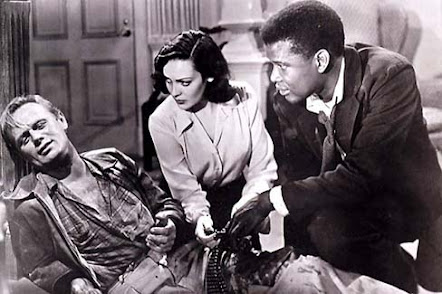
No Way Out (1950) is an American film noir directed by Joseph Mankiewicz and starring Richard Widmark, Linda Darnell, Stephen McNally, and in his film debut, Sidney Poitier. The movie was produced by Darryl F. Zanuck with music by Alfred Newman.

The plot concerns Dr. Luther Brooks (Poitier) as the first black doctor to be employed at the urban hospital where he trained. While working at the hospital's prison ward, brothers Johnny and Ray (Widmark) Biddle are brought in to be treated for gunshot wounds they received while attempting a robbery. 

Johnnys symptoms worry Luther, suspecting he may have a brain tumor. While he is trying to tend to Johnny, Ray hurls insults and racial epitaphs at Luther. Still believing that Johnny may be suffering from a brain tumor, Luther performs a spinal tap, but Johnny dies during the procedure. Ray accuses Luther of murdering his brother and vows revenge.

Will Luther be able to survive the suspicion that he may have misdiagnosed Johnny? Will Ray make good on his vendetta against Luther?

Richard Widmark Linda Darnell, and Sidney Poitier


Joseph L. Mankiewicz (1929 – 1972) was an American film director, screenwriter, and producer. Mankiewicz won Academy Awards for directing and writing A Letter to Three Wives (1949), and All About Eve (1950). He is the only director to win back-to-back Academy Awards for writing and directing. Other films directed by Mankiewicz include Dragonwyck (1946), The Ghost and Mrs. Muir (1947), Julius Caesar (1953), The Barefoot Contessa (1954), and Guys and Dolls (1955). He directed the 1963 crisis-plagued production of Cleopatra which negatively affected his career as a director. 


Richard Widmark (1914- 2008) had a sensational movie debut playing the crazy villain Tommy Udo in director Henry Hathaway’s Kiss of Death (1947). His performance won him a Golden Globe Award for New Star Of The Year – Actor. He was also nominated for the Academy Award for Best Supporting Actor for his performance as Udo. Widmark was under contract to Twentieth Century-Fox where he played mostly villains. Later in his career, he started playing more heroic roles in films like Slattery’s Hurricane and Down to the Sea in Ships (both 1949).

Linda Darnell (1923 – 1965) was an American film actress. She signed a contract with 20th Century-Fox at age 15 and became a star almost overnight. She was immediately cast opposite Tyrone Power in Day-Time Wife (1939). She made two films with Power in 1940: Brigham Young and The Mark of Zorro. In 1941, she was again paired with Power in Blood and Sand, which also starred an up-and-coming Rita Hayworth. Darnell’s most famous role was that of Amber St. Clair in Forever Amber (1946), which turned out the be the biggest hit of the year. The role of Amber was the most sought-after female role since the casting of Scarlett O’Hara in Gone with the Wind (1939). Other important films she starred in include Unfaithfully Yours (1948), A Letter to Three Wives (1949), and No Way Out (1950). She died tragically at age 41 in a fire while visiting friends in Glenview, Illinois.

Stephen McNally (1911 - 1994) was an American film, stage,  and television actor. He is mostly remembered for his roles in westerns. McNally often played the bad guys like his portrayal of Locky McCormick in Johnny Belinda (1948). McNally earned a law degree from Fordham University Law School. During the 1950s, he started working in television starring in popular series like Wagon Train, Riverboat, Rawhide, 77 Sunset Strip, The Virginian, Fantasy Island, Starsky & Hutch, Charlies Angels, The Rockford File, and  Police Story.

Sidney Poitier (1927 - 2022) was an American actor and director. He was the first black man to win the Academy Award for Best Actor for his role in Lilies of the Field (1963). Poitier made his film debut in No Way Out which launched him on a path to movie stardom. Other early films include Cry, The Beloved Country  (1951), Blackboard Jungle (1955), and Edge of the City (1957). Another breakthrough came with The Defiant Ones (1958) where he co-starred with Tony Curtis. Both actors were nominated for the Best Actor Academy Award, with Poitier’s nomination the first for a black man. In 1959, he starred in the first production of A Raisin in the Sun on Broadway. He starred in the film version in 1961. That same year he starred with Paul Newman and Joanne Woodward in Paris Blues. Other film roles include The Bedford Incident (1965), A Patch of Blue (1965) co-starring Elizabeth Hartman and Shelley Winters. Poitier’s big year was 1967. He had three hits with To Sir, with Love, In the Heat of the Night, and Guess Who’s Coming to Dinner. The popularity of these three films made him the top box office draw of the year. Later in his career, Poitier started directing films like Uptown Saturday Night (1974) and Stir Crazy (1980). Poitier was a recipient of an Honorary Academy Award for his contribution to the motion picture industry.


No Way Out trivia

  • Sidney Poitier lied to director Joseph Mankiewicz, telling him he was 27 years old when he was only 22.
  • James Edwards, another pioneering black actor, was the first choice to play Luther.
  • The film was initially banned by the Chicago Police Department until the scene where the two gangs arm themselves was deleted.
  • Linda Darnell was in a serious car accident during filming that almost burned her to death.
  • Of the main cast, Linda Darnell was the veteran having starred in her first film in 1939 when she was still in her teens. She was only 27 when No Way Out was released.


Why watch this film?

  • To see star-in-the-making Sidney Poitier.
  • It’s an early film dealing with the issue of prejudice and racism.
  • It’s a chance to see Richard Widmark when he was still playing criminals and low-lives.
  • Linda Darnell is featured in a non-glamorous role.


To watch the film on YouTube, click the link below.


Discussion questions:
  1. How would you compare this film to Odds Against Tomorrow?
  2. Did you think the situations in this film were realistic?
  3. What did you think of Sidney Poitier’s big-screen debut?
  4. Did you have a favorite scene, piece of dialogue, or performance?
  5. Was Linda Darnell’s character arch believable?

To join the discussion on January 17, 2022, at 6 p.m. Central Time, click here. Once you RSVP, you’ll receive an invitation with a link to the discussion on Zoom.


Related Posts Plugin for WordPress, Blogger...