Directed by John Brahm, The Locket (1946) is a psychologically dense film noir that unpeels its narrative mystery through a uniquely complex structure of nested flashbacks. The story begins on the wedding day of the wealthy John Willis, played by Gene Raymond, who is preparing to marry the beautiful and seemingly serene Nancy, portrayed by Laraine Day. The celebratory atmosphere is shattered when an uninvited guest, a psychiatrist named Dr. Blair, played by Brian Aherne, arrives with a shocking warning. Blair claims to be Nancy’s former husband and insists that her elegant facade conceals a deeply fractured, highly dangerous psychological state.
To prove his unsettling allegations, Dr. Blair guides
John—and the audience—into the past, recounting how his own marriage to Nancy
unraveled. This memory gives way to an even deeper layer of the past when Blair
recalls his confrontation with an artist named Norman Clyde, played by Robert
Mitchum. Norman, who was Nancy’s passionate lover before Blair, introduces yet
another flashback, tracing the roots of Nancy’s behavior all the way back to
her childhood. Through this intricate chain of recollections, the film explores
how a traumatic childhood accusation involving a priceless diamond locket
sparked an obsessive undercurrent of kleptomania and deception.
As the layers of memory converge back onto the wedding day,
the film creates a brilliant atmosphere of psychological suspense. The central
tension rests on whether Nancy is a genuinely malicious femme fatale
orchestrating the ruin of the men around her, or a tragic victim of a deeply
buried childhood trauma beyond her control. John Brahm masterfully employs
expressionistic shadows and a shifting subjective perspective to keep the
audience guessing about the true nature of Nancy’s mind right up until the
wedding march begins to play.
 |
| Laraine Day and Robert Mitchum |
John Brahm (1893–1982), Born Hans Brahm in Hamburg, Germany,
director John Brahm established himself as a master of moody, atmospheric
psychological thrillers during the classic Hollywood era. Coming from a
prominent theatrical family, he directed stage productions across Europe before
fleeing the rise of the Nazi regime in the 1930s. After a brief filmmaking
stint in England, Brahm arrived in Hollywood, where his sharp eye for
expressionistic lighting and tense, claustrophobic pacing found a perfect home
at 20th Century-Fox and RKO. He is celebrated for directing a trio of stylish,
macabre melodramas in the mid-1940s—The Lodger (1944), Hangover
Square (1945), and The Locket (1946)—before successfully
transitioning to television in the 1950s and 1960s, where he directed
memorable, atmospheric episodes of The Twilight Zone and Alfred
Hitchcock Presents.
Laraine Day (1920 – 2007), born LaRaine Johnson in
Roosevelt, Utah, was a versatile leading lady whose wholesome beauty and sharp
acting instincts made her a major contract star at MGM and RKO. She first
achieved widespread popularity as the dedicated Nurse Mary Lamont in MGM's beloved,
long-running Dr. Kildare film series opposite Lew Ayres. Eager to break
out of purely ingenue roles, Day delivered standout dramatic performances in
Alfred Hitchcock’s Foreign Correspondent (1940) and the psychological
noir The Locket (1946), where she brilliantly played against type as a
complex, deceptive kleptomaniac. Off-screen, she was famously dubbed the “First
Lady of Baseball” during her high-profile marriage to prominent New York Giants
manager Leo Durocher, and she remained a beloved Hollywood figure through her
extensive television appearances and humanitarian work.
Brian Aherne (1902 – 1986) born William Brian de Lacy Aherne in King's Norton, Worcestershire, England, Brian Aherne brought a dashing, aristocratic charm and impeccable stage diction to classical Hollywood cinema. After establishing himself as a formidable stage actor on the West End and Broadway—frequently starring opposite Katharine Cornell—Aherne transitioned effortlessly into American talkies, often playing refined, honorable gentlemen, romantic leads, and intellectual figures. He earned an Academy Award nomination for Best Supporting Actor for his regal portrayal of Emperor Maximilian in Juarez (1939) and showcased his sophisticated dramatic range as the concerned, analytical psychiatrist Dr. Blair in The Locket (1946). Aherne divided his later career between elegant character roles in Hollywood and a return to the theatrical stage, notably touring extensively in My Fair Lady as Professor Henry Higgins.
Robert Mitchum (1917 – 1997), born in Bridgeport, Connecticut, rose from a rugged, nomadic youth during the Great Depression to become one of Hollywood's most enduring icons and the definitive face of film noir. With his distinctively heavy-lidded eyes, casual swagger, and laconic, deadpan delivery, Mitchum projected a unique brand of cynical, effortless masculinity. He earned his sole Academy Award nomination for The Story of G.I. Joe (1945), which catapulted him into top-tier stardom just before he filmed his vulnerable role as the tragic artist Norman Clyde in The Locket (1946). Mitchum went on to cement his legendary status in timeless noir masterpieces like Out of the Past (1947) and delivered chilling, unforgettable performances as terrifying villains in The Night of the Hunter (1955) and Cape Fear (1962), sustaining a prolific acting career that spanned over five decades.
Gene Raymond (1908 – 1998), born Raymond Guion in New York City, was a charismatic, platinum-blonde actor, director, and producer who enjoyed a multifaceted career across stage, screen, and military service. A prolific child actor on Broadway, Raymond transitioned to Hollywood in the early 1930s, where his athletic build and sunny charm made him a popular romantic lead in glossy musicals and light comedies, famously starring alongside Dolores del Río in Flying Down to Rio (1933). During World War II, he paused his thriving entertainment career to serve as a decorated bomber pilot in the U.S. Army Air Forces, later returning to Hollywood to take on more mature, dramatic roles, such as the wealthy, unsuspecting bridegroom John Willis in The Locket (1946). Raymond, who was married to Hollywood superstar Jeanette MacDonald for nearly three decades, spent his later years directing for television, producing theater, and rising to the rank of Colonel in the Air Force Reserve.

Click HERE to watch the movie online.
Click HERE to join the online discussion on July 1, 2026, at 6:30 p.m. Central Time. Once you RSVP, you will receive an invitation with a link to join the discussion on Zoom.
The Locket Trivia
- Screenwriter Sheridan Gibney originally structured the script’s intricate, four-layer-deep flashback sequence as a bold narrative experiment. Still, RKO studio executives initially panicked and feared that mainstream theater audiences in 1946 would find the story completely impossible to follow.
- Cinematographer Nicholas Musuraca utilized heavily diffused lighting and delicate compositions for Laraine Day’s close-ups to emphasize her character’s outward innocence, deliberately contrasting her angelic appearance with the dark, moody shadows cast over her male co-stars.
- This film marked one of Robert Mitchum’s final performances before his definitive breakthrough into elite Hollywood stardom later that same year, showcasing an atypical, sensitive vulnerability as the tortured artist Norman Clyde just prior to cementing his cynical, tough-guy noir persona.
- The striking psychological paintings featured in Norman Clyde’s art studio were actually created by prominent real-life artists hired by RKO to give the production an authentic, sophisticated bohemian aesthetic that reflected the avant-garde art scene of the post-war era.
Discussion Questions
- How does the film’s highly unusual nesting-doll flashback structure affect our perception of narrative truth, considering that we are viewing Nancy’s life entirely through a chain of subjective memories recounted by the men who loved her?
- In what ways does the film challenge the traditional definition of a film noir femme fatale by framing Nancy’s destructive behavior as a compulsory psychological illness rooted in childhood trauma rather than pure, calculated malice?
- Consider the symbolic weight of the locket itself, exploring how a single physical object functions simultaneously as a token of romantic affection, a trigger for childhood shame, and a manifestation of social class envy.
- Does the film imply that the men in Nancy’s life are genuinely trying to save her, or are they trapped by their own obsessions with controlling, diagnosing, and capturing her elusive image on canvas and in marriage?


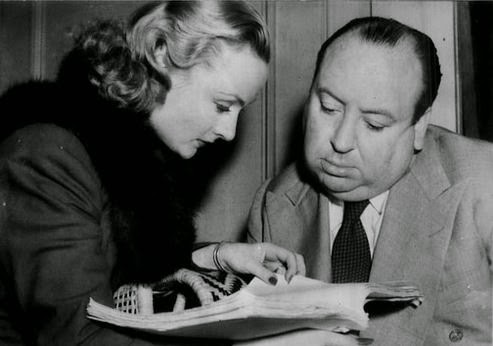


 (1941) starring Carole Lombard and Robert Montgomery and directed by Alfred Hitchcock was a flop. Nothing could be further from the truth, but for some unknown reason, this "untruth" seems to crop up whenever the film is discussed or written about.
  or
or  , but in its day, audiences voted it one of the best films of the year, along with Hitchcock's classics
  and
and  !
!

 on January 20, 1941, it played to sold-old
 audiences. In fact the first nine days were booked solid and the film was held over (it was something of a big deal to be held over at the Music Hall, back in the day). The reviews were almost unanamously good with Look magazine saying that "Hitchcock has employed the same strategy that marks his blood-chilling melodramas," utilizing the "same casual approach, the same pell-mell finish, the same corner-of-the eye viewpoint.... The net effect is the same, too: another Alfred Hitchcock hit." The New York World-Telegram said that "Portly Alfred Hitchcock abandons melodrama, but not entertainment, in the frisky, scampish, gleeful comedy called Mr. and Mrs. Smith." Other reviews positively noted that for an Englishman, Hitchcock seems to know exactly how American couples think (New York Herald Tribune). The New York Post compared Hitchcock's first comedy to those of Ernst Lubitsch!