Showing posts with label Harry Morgan. Show all posts

Tuesday, July 8, 2025

Ray Milland and Charles Laughton head the cast in “The Big Clock”

The Big Clock (1948) is an American film noir directed by John Farrow and starring Ray Milland and Charles Laughton. The supporting cast included Maureen O’Sullivan (Mrs. John Farrow), George Macready, Rita Johnson, Harry Morgan, and Elsa Lancaster (Mrs. Charles Laughton).

When George Stroud, editor-in-chief of Crimeways magazine, refuses to follow up on a missing person story because he wants to go on a long-postponed honeymoon with his wife, Georgette (O’Sullivan), and young son, he is fired by his boss, Earl Janoth (Laughton).

George drowns his sorrows at a bar where he meets Janoth’s mistress Pauline York (Johnson). George loses track of time and misses his train for his honeymoon. Disgusted, Georgette leaves without him. George spends more time with Pauline and he buys a painting and a sundial.

George eventually goes to Pauline’s apartment. He has no idea how this one action will change his life forever.


John Farrow (1904 – 1963) was an Australian film director, producer, and screenwriter. He did most of his film work in the United States. He won an Academy Award for Best Adapted Screenplay for Around the World in Eighty Days and was nominated for an Academy Award for Best Director for Wake Island (1942). Farrow’s best success came as a contract director at Paramount Pictures. At Paramount he directed China (1943) starring Alan Ladd and Loretta Young, Two Years Before the Mast made in 1944, but released in 1946, Calcutta (1947), California (1947), and The Big Clock (1948). After he left Paramount, his directorial career was diminished and he never again had a major film success.

Ray Milland (1907 – 1986) was a Welsh-American movie star and film director. He won a Best Actor Oscar for portraying an alcoholic writer in Billy Wilder’s The Lost Weekend (1945). Milland played bit parts at M-G-M and Paramount. While at Paramount, he was loaned to Universal to for a lead in the Deanna Durbin movie Three Smart Girls (1936). The success of the film led to him being cast in leading roles. He became one of Paramount’s biggest stars, remaining there for almost 20 years. Other films starring Milland include The Major and the Minor (1942), Reap the Wild Wind (1942), where he had top billing over John Wayne, the horror classic The Uninvited (1944), The Big Clock (1948), and Dial M for Murder (1954). Later in his career, he starred as Ryan O’Neal’s father in Love Story (1970).

Charles Laughton (1899 – 1962) had a long career on the stage and in Hollywood. He won an Academy Award for Best Actor for his portrayal of Henry VIII in The Private Life of Henry VIII (1933) and was nominated for two other Best Actor Oscars for his performances in Mutiny on the Bounty (1933) and Witness for the Prosecution (1957). His performance in The Suspect is considered one of Laughton’s most natural screen performances, which is credited to director Siodmak, a close personal friend of the actor.


Ray Milland and Charles Laughton in a publicity still

The Big Clock trivia

  • Earl Janoth (Charles Laughton) is based on Henry Luce, the author of the novel on which the movie is based, who worked for.
  • Paramount insisted that Maureen O’Sullivan audition for the role of Georgette Stroud.
  • George Stroud’s $30,000 a-year salary is equivalent to over $388,000 a year today.
  • Noel Neill, played the uncredited elevator operator before she played Lois Lane on the Superman television show.
  • Ray Milland, Charles Laughton, and Maureen O’Sullivan previously co-starred in Payment Deferred in 1932.

Click HERE to watch the movie on the Internet Archive.

Click HERE to join the online discussion on July 14, 2025, at 6:30 p.m. Central Time. Once you RSVP, you will receive an email invitation with a link to join the discussion on Zoom.


Rita Johnson and Ray Milland

Discussion questions

  1. The Big Clock has a reputation as one of the top films noir from the 1940s. What do you think?
  2. Some critics don’t consider The Big Clock a film noir. What do you think? If not a film noir, what genre would you classify it as?
  3. Does the screwball humor with Elsa Lancaster add to the movie’s plot? Do you think it’s overdone or appropriate?
  4. What did you think of Ray Milland’s performance? How does it compare to his performance in The Lost Weekend?
  5. Were Milland and Maureen O’Sullivan believable as a married couple?
  6. What about Charles Laughton's performance? Was he believable as the boss from hell? Did Meryl Streep’s character seem human compared to Earl Janoth?
  7. Did John Seitz’s (Double Indemnity, Sunset Boulevard) cinematography add to the suspense of the film?
  8. Was there a piece of dialogue or a particular scene that stuck out to you?
Tuesday, February 1, 2022

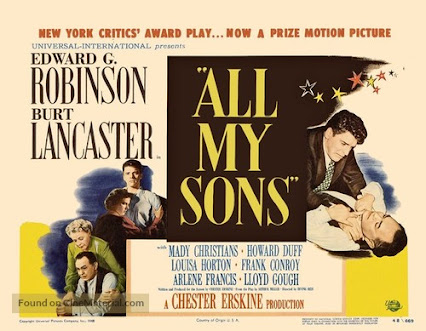
Edward G. Robinson and Burt Lancaster star in "All My Sons"

All My Sons (1948) is based on the play by Arthur Miller which ran on Broadway from January 29, 1947, closed on November 8, 1949, and ran for 328 performances. The film was directed by Irving Reis and starred Edward G. Robinson and Burt Lancaster. Other members of the cast include Louisa Horton, Mady Christians, Howard Duff, Arlene Francis, and Harry Morgan.

Joe Keller has built a manufacturing business that he hopes his son, Chris (Lancaster), will one day take over. But Chris has other plans. He wants to marry Ann Deever (Horton), who was once engaged to his brother, Larry, who was missing in action during World War II and presumed dead. Kate Keller refuses to believe her son is dead and has his room exactly as he left it, even going so far as to polish his shoes on a regular basis.

Ann's father and Joe Keller were partners in a plant that manufactured airplane parts for the military. An investigation determined that the company sold the government defective equipment. It was determined that the partners sold the parts knowing they were defective. Ann's father was convicted and sent to prison but Joe was exonerated. However, there has always been some doubt as to whether or not Joe was also responsible for the faulty airplane parts. This doubt hangs heavy over the Keller home and endangers Chris's relationship with Ann and his father.

When all the secrets are revealed, will the Keller family survive?


Irving Reis (1906 - 1953) was an American writer, producer, and director of both radio plays and motion pictures. Reis got his start as a photographer, eventually photographing publicity stills for various movie studios. He went to Hollywood and became a screenwriter at Paramount in 1938. From Paramount, he went to RKO where he directed the box office hit The Bachelor and the Bobby-Soxer (1947) starring Cary Grant, Myrna Loy, and Shirley Temple. Other films he directed include Enchantment  (1948), and The Four Poster (1952). Reis's died of cancer at the age of 47; he left a widow and three children.

Edward G. Robinson (1893 – 1973) was an American actor on the stage and screen. Robinson is a true legend from Hollywood’s Golden Age where he starred in the gangster classic Little Caesar (1931), Kid Galahad (1937), Confessions of a Nazi Spy (1939), The Sea Wolf (1941), Double Indemnity (1944), and Key Largo (1948). Robinson was awarded an Honorary Academy Award in 1973, but he was never nominated for a competitive Oscar.

Burt Lancaster (1913- 1994) was an American actor and producer. He won a Best Actor Academy Award for his performance in Elmer Gantry (1960). Lancaster made his film debut in The Killers (1946). After the release of that film, he was on his way as a leading man, starring in quick succession Desert Fury (1947), Brute Force (1947), Variety Girl (1947), I Walk Alone (1947), All My Sons (1948), and Sorry, Wrong Number (1948). Other popular films starring Lancaster include The Flame and the Arrow (1950), Jim Thorpe All-American (1951), From Here to Eternity (1953), The Rose Tattoo (1955), and Birdman of Alcatraz (1962).

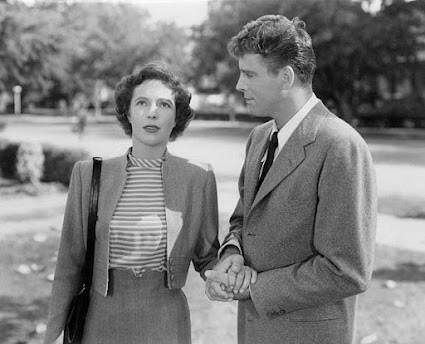
Lousia Horton and Burt Lancaster


Why watch this film?

  • It's a good film version of Arthur Miller's award-winning play.
  • Edward G. Robinson delivers a great performance.
  • Burt Lancaster put off making another film he was committed to because he wanted the role of Chris Keller.
  • This was the film debut of Louisa Horton (Ann) who was married to director George Roy Hill (The Sting).
  • The opportunity to see Arlene Francis early in her career and two years before she would become an icon on the television game show What's My Line.

To watch the film on YouTube, click on the link below.


Discussion questions:

  1. Some critics have considered this movie a film noir. What category of film would you classify it as?
  2. What did you think of Edward G. Robinson's performance in this film compared with his performance in The Red House?
  3. Burt Lancaster really wanted to play Chris Keller; what did you make of his performance?
  4. What did you think of the supporting cast? Any standouts?
  5. Did this film have a theme? If so, what is it?


To join the discussion on February 7, 2022, at 6:30 p.m. Central Time click here. Once you RSVP, you will receive an invitation with a Zoom link to the discussion online.


Related Posts Plugin for WordPress, Blogger...