Showing posts with label Linda Darnell. Show all posts

Tuesday, September 10, 2024

Jeanne Crain, Linda Darnell, and Ann Sothern receive “A Letter to Three Wives”

A Letter to Three Wives (1949) is an American romantic comedy-drama film directed by Joseph L. Mankiewicz and starring Jeanne Crain, Linda Darnell, and Ann Sothern. The supporting cast includes Kirk Douglas, Paul Douglas, Jeffrey Lynn, Connie Gilchrist, Barbara Lawrence, and Thelma Ritter.

The film is based on the novel A Letter to Five Wives (1945) by John Klempner. Mankiewicz wrote the screenplay based on an adaptation by Vera Caspary (Laura). The cinematography was by Arthur C. Miller, with music by Alfred Newman. A Letter to Three Wives was one of Twentieth Century-Fox’s most important productions of the year.

The movie tells the story of a woman (Addie Ross) who sends a letter to three of her “dearest friends” (Crain, Darnell, and Sothern) informing them that she has run off with one of their husbands but not revealing which one. The letter is delivered while the women board a riverboat to chaperone a group of underprivileged children. While they cruise up the river and spend the day picnicking with the children, each wife reflects on her marriage and wonders if their husband has run off with Ross.

Linda Darnell, Anne Sothern, and Jeanne Crain

Joseph L. Mankiewicz (1929 – 1972) was an American film director, screenwriter, and producer. Mankiewicz won Academy Awards for directing and writing A Letter to Three Wives (1949), and All About Eve (1950). He is the only director to win back-to-back Academy Awards for writing and directing. Other films directed by Mankiewicz include Dragonwyck (1946), The Ghost and Mrs. Muir (1947), Julius Caesar (1953), The Barefoot Contessa (1954), and Guys and Dolls (1955). He directed the 1963 crisis-plagued production of Cleopatra which negatively affected his career as a director.

Jeanne Crain (1925 – 2003) was an American actress whose career spanned more than three decades. While still a teenager, she was asked to take a screen test with Orson Welles. He was testing for the part of Lucy Morgan in his production of The Magnificent Ambersons (1942). She didn’t get the part (Anne Baxter did), but she was on her way. She had a bit part in The Gang’s All Here (1943) but had a leading role in Home in Indiana (1944). The film was a box office hit and Crain became a favorite of film fans everywhere. She had another hit with Winged Victory (1944) and co-starred with Dana Andrews in the musical State Fair (1945). That same year, she was the “good girl” opposite Gene Tierney’s “bad girl” in Leave Her to Heaven. More good roles came her way including leads in A Letter to Three Wives (1949), The Fan (1949), and Pinky (1949). The latter won her a Best Actress Oscar nomination. She lost that year to Olivia de Havilland. Crain’s popularity continued into the 1950s but suffered when she was released from her exclusive contract with 20th Century-Fox. She continued to work in films and on television until 1975.

Paul Douglas and Linda Darnell

Linda Darnell (1923 – 1965) was an American film actress. She signed a contract with 20th Century-Fox at age 15 and became a star almost overnight. She was immediately cast opposite Tyrone Power in Day-Time Wife (1939). She made two films with Power in 1940: Brigham Young and The Mark of Zorro. In 1941, she was again paired with Power in Blood and Sand, which also starred an up-and-coming Rita Hayworth. Darnell’s most famous role was that of Amber St. Clair in Forever Amber (1946), which turned out to be the biggest hit of the year. The role of Amber was the most sought-after female role since the casting of Scarlett O’Hara in Gone with the Wind (1939). Other important films she starred in include Unfaithfully Yours (1948), A Letter to Three Wives (1949), and No Way Out (1950). She died tragically at age 41 in a fire while visiting friends in Glenview, Illinois.

Ann Sothern (1909 - 2001) was an American actress who worked on the stage, radio, film, and television. Sothern’s most commercially successful film role was as Maisie Ravier in a series of films while she was at M-G-M. Maisie, a Brooklyn showgirl was based on the short stories by Nell Martin. Films in the series include Congo Maisie (1940), Gold Rush Maisie (1940), and Up Goes Maisie (1946). The character was so popular that Sothern played the character on the radio in The Adventure of Maisie (1939 - 1947) series. At M-G-M, Sothern starred in the film version of Panama Hattie (1942) opposite Red Skelton, which was a box-office success. In 1949, she starred in A Letter to Three Wives which brought her great reviews but did little to advance her career. In 1953, Sothern starred as Susie MacNamara in the television series Private Secretary, (1953 - 1957), and the next year starred in The Ann Sothern Show (1958 - 1961). Sothern continued working on stage, screen, and television. Her last film role was in The Whales of August (1987). For her role she earned her only Best Supporting Academy Award nomination.

Jeanne Crain, Jeffrey Lynn, Kirk Douglas, and Ann Sothern

A Letter to Three Wives trivia

  • Originally, the film was going to be called A Letter to Four Wives with the fourth wife being Anne Baxter, but her character wasn’t considered as strong as the other three so her segment was cut.
  • Joseph L. Mankiewicz won the Best Director and Best Screenplay Academy Awards for his work on this film and would repeat the wins the next year with All About Eve. No one has ever achieved this feat.
  • One of Thelma Ritter’s early roles, so early in fact she doesn't even receive on-screen billing.
  • Tyrone Power, Joan Crawford, Gene Tierney, Dorothy McGuire, Maureen O’Hara, and Ida Lupino were all considered for roles.
  • Linda Darnell and Mankiewicz were involved in an affair during the production.
  • Darnell and Barbara Lawrence played sisters the year before in Unfaithfully Yours.
  • Silent film star Mae Marsh has a small role as the women’s washroom attendant at the country club.


Click HERE to watch the movie on YouTube, or click on the link below.


Why watch this movie?

  • Another great example of what the studio system could produce at its peak.
  • One of writer-director Joseph L. Mankiewicz’s best films.
  • It’s a showcase for the talents of Jeanne Crain, Linda Darnell, and Ann Sothern.
  • It boasts early performances from Kirk and Paul Douglas and Thelma Ritter.

To join us for a discussion on Zoom, June 1, 2021, at 6:30 p.m. Central Time, click on the link here. Once you RSVP, you’ll receive an email with a link to the discussion on Zoom.

Discussion Questions

  1. What did you think of the ensemble cast?
  2. Do you think this film is still relevant in the 21st Century?
  3. Did you have a favorite wife?
  4. A favorite scene or piece of dialogue?
  5. How does this film compare with All About Eve released the next year?

Sunday, May 14, 2023

George Sanders and Linda Darnell in Douglas Sirk's "Summer Storm"

Summer Storm (1944) is a romance melodrama directed by Douglas Sirk, starring George Sanders and Linda Darnell. The supporting cast includes Edward Everett Horton, Hugo Haas, and Anna Lee. The film is based on the novel The Hunting Party (1884) written by Anton Chekhov.

The film, told in flashback, tells the story of Judge Fedor Petroff (Saunders) and his infatuation with the beautiful Olga Kuzminichna Urbenin, (Darnell) in early-19th century Russia.

Before Petroff became acquainted with Olga, he was engaged to Nadena Kalenin (Lee), the daughter of a Russian book publisher. One day, Nadena discovers Petroff kissing Olga, and Nadena calls the wedding off, reluctantly because she still loves Petroff.

Petroff’s affair with Olga continues but things do not go well. Olga has her own ideas and she plots to improve her station in life and Petroff isn’t necessarily at the center.

Will Petroff be able to work out his feeling for Olga? Will Olga set her sights on another man who can give her financial security and social position?


Summer Storm trivia

  • This was director Douglas Sirk’s second American movie.
  • Sirk wrote the screenplay with “Michael O’Hara.” O’Hara is a pseudonym for Sirk.
  • Sirk had planned to film Anton Chekhov’s The Shooting Party before he fled Germany in 1937.
  • George Sanders was born in Russia in 1906; he left with his family in 1917 during the Russian Revolution.
  • Sanders did his own singing in the tavern scene.
  • Linda Darnell campaigned hard to get the role of Olga. This role changed the arch of her career; she went from a sweet, virginal girl next door to a major Hollywood sex symbol.

To watch the movie on YouTube, click on the link below.


To join the discussion on May 22, 2023, at 6:30 p.m. Central Time, click here. Once you RSVP, you’ll receive an invitation and a link to join the discussion on Zoom


Discussion questions

  1. Douglas Sirk is famous today for his Technicolor melodramas like Written on the Wind and All That Heaven Allows. Do you see any hints in Summer Storm that foreshadows Sirk’s later work in the 1950s?
  2. What did you think of George Sanders’s performance? Did it remind you of any of his other performances?
  3. What did you think of Linda Darnell’s performance? Darnell was only 21 when this film was released.
  4. Were there any performances that you thought were particularly good?
  5. Did the ending surprise you or was it what you expected?


George Sanders and Linda Darnell


Tuesday, March 8, 2022

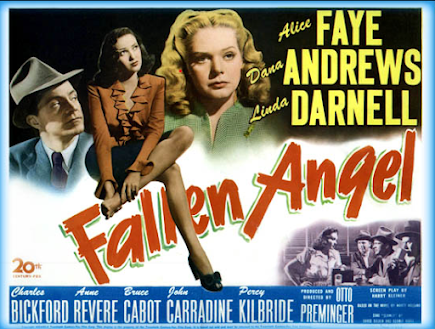
Alice Faye, Dana Andrews, and Linda Darnell star in "Fallen Angel"

Fallen Angel (1945) is an American film noir directed by Otto Preminger and starring Alice Faye, Dana Andrews, and Linda Darnell.

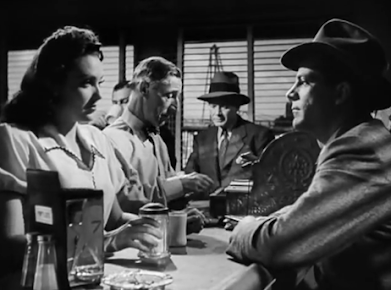
Andrews stars as a grifter hoping to swindle two rich sisters (Faye and Anne Revere) while romancing Stella (Darnell) a diner waitress.


This was director Otto Preminger’s follow-up to Laura released the year before. The cinematography was by Joseph La Shalle, who won an Academy Award for his work on Laura. Also on board for Fallen Angel was David Raksin, who wrote the film score. He composed the music for Laura, one of the most famous film scores in movie history. Last, but not least, Andrews who played Mark McPherson opposite Gene Tierney in Laura, has the male lead in Fallen Angel. Andrews made five films with Preminger, more than any other leading man.

Faye, the musical queen on the Fox lot, was looking to move into dramatic roles. She loved Laura and wanted to star in a similar mystery. As already noted, she got a lot of the same talent that was involved with that film noir classic. When Faye saw the finished film, she felt that the movie emphasized Darnell’s role to the detriment of her own. She was so distressed that she walked out on her contract. Studio boss Darryl Zanuck begged her to come back, promising her roles in prestige films in the planning stages like The Razor’s Edge, but Faye was done. She didn’t return to the big screen until 1962’s State Fair.

Darnell was signed to a contract at 20th Century Fox at age 15. Because she looked older than her age, she worked as a leading lady from the outset, with the studio claiming she was 19. Her role in Fallen Angel helped turn her into a popular pin-up during World War II. In 1944, Look magazine named her one of the four most beautiful women in Hollywood, along with Hedy Lamarr, Ingrid Bergman, and Fox colleague, Gene Tierney.

Interested in classic film? Consider joining the Chicago Film Club. It’s free to join and you’ll be made aware of future discussions and classic movie screenings in Chicago.

To watch the movie on YouTube, click the link below.


To join the discussion on March 14, 2022, at 6:30 p.m. Central Time click here. Once you RSVP, you'll receive an invitation and a link to the discussion on Zoom.

Linda Darnell, Percy Kilbride, Charles Bickford, and Dana Andrews


Fallen Angel trivia

  • Linda Darnell spent a week at the Fox commissary to prepare for her role as a waitress.
  • Alice Faye rejected over 30 scripts before choosing the one for Fallen Angel. She hoped it would be another Laura. After seeing a rough cut of the film, Faye felt that her best scenes were cut and Darnell's role was promoted above hers. She was so upset by this that she walked out on her contract and supposedly tossed her dressing room keys to the guard at the studio gate as she drove off the lot.
  • This was the second of five films Dana Andrews made with director Otto Preminger. Preminger worked with Andrews more than any other leading man.
  • Preminger assembled most of the same crew as the ones that worked on Laura the year before.

Discussion questions

  1. Alice Faye was disappointed with how her performance came off in this film. Do you think she was rash in her judgment?
  2. Would you consider this film a classic example of film noir?
  3. Did you have any sympathy for the Dana Andrews character?
  4. What about Lind Darnell? Was her character all bad or did you find yourself sympathizing with her?
  5. Do you think the film had a theme? If so, what was it?


Tuesday, March 1, 2022

Rex Harrison and Linda Darnell in Preston Sturges's "Unfaithfully Yours"

Unfaithfully Yours (1948) is a black comedy written and directed by Preston Sturges and starring Rex Harrison and Linda Darnell. Rudy Vallee and Barbara Lawrence costar.

Sir Alfred de Carter (Harrison) is a famous conductor who is suspicious that his beautiful, young wife, Daphne (Darnell) has been unfaithful while he was away on tour. So obsessed is he about the possibility that she might be unfaithful that he fantasizes about how he might possibly avenge her betrayal.

Is Sir Alfred correct in his suspicions or has Daphne been faithful all along?

Linda Darnell and Rex Harrison


Preston Sturges (1898 - 1959) was an American playwright, screenwriter, and film director. Sturges was one of the first film directors to direct his own screenplays, opening up the door for Billy Wilder and Joseph L. Mankiewicz to do the same. Sturges was a successful playwright and Hollywood screenwriter and script doctor. As a writer-director, Sturges had an amazing output of films in a period of five years, all considered classics today. These films include The Great McGinty (1940), Christmas in July (1940), The Lady Eve (1941), Sullivan's Travels (1941), The Palm Beach Story (1942), Hail the Conquering Hero (1944), and The Miracle of Morgan's Creek (1944). After leaving Paramount Pictures in a dispute with upper management, Sturges's career declined and he never produced anything close to the quality of his earlier successes. In spite of this decline, Sturges is considered one of the greatest talents to come out of Hollywood.

Rex Harrison (1908 - 1990) was an English stage and screen actor. He won a Best Actor Academy Award for his role as Professor Henry Higgins in My Fair Lady (1964). He created the role of Higgins on Broadway in 1957. Harrison established himself as a film star in England in the 1930s but he also found success in Hollywood in films like Anna and the King of Siam (1946), The Ghost and Mrs. Muir (1947), Cleopatra (1963), Doctor Dolittle (1967). He was knighted by Queen Elizabeth II in 1989.

Linda Darnell (1923 – 1965) was an American film actress. She signed a contract with 20th Century-Fox at age 15 and became a star almost overnight. She was immediately cast opposite Tyrone Power in Day-Time Wife (1939). She made two films with Power in 1940: Brigham Young and The Mark of Zorro. In 1941, she was again paired with Power in Blood and Sand, which also starred an up-and-coming Rita Hayworth. Darnell’s most famous role was that of Amber St. Clair in Forever Amber (1946), which turned out the be the biggest hit of the year. The role of Amber was the most sought-after female role since the casting of Scarlett O’Hara in Gone with the Wind (1939). Other important films she starred in include Unfaithfully Yours (1948), A Letter to Three Wives (1949), and No Way Out (1950). She died tragically at age 41 in a fire while visiting friends in Glenview, Illinois


Unfaithfully Yours trivia
  • Linda Darnell was so excited at the prospect of working with Preston Sturges that she accepted the role of Daphne without seeing a script.
  • Darnell and Barbara Lawrence played sisters again in A Letter to Three Wives (1949).
  • Darnell played one of Harrison's many wives in Anna and the King of Siam (1946).
  • The film is considered a classic today but was a bit of a box office disappointment when released.
  • Harrison was having an affair with actress Carole Landis who committed suicide supposedly because he would not divorce his wife to marry her. This may have contributed to the film's performance at the box office.
Why watch this movie?
  • Any film written and directed by Preston Sturges is worth watching.
  • This was one of Rex Harrison's early Hollywood films.
  • Linda Darnell gets to show off her versatility as an actress and not just a great beauty.
  • Like all Sturges films, it is populated with a great supporting cast and bit players.
  • Unfaithfully Yours is often overlooked when reviewing the films of Preston Sturges.


To watch the film on YouTube, click on the link below.


To join the discussion on March 7, 2022, at 6:30 p.m. Central Time, click here. Once you RSVP, you'll receive an invitation with a link to the discussion on Zoom.

Discussion questions
  1. What genre would you categorize this film?
  2. What do you think motivated Harrison's character to think his wife is unfaithful?
  3. Was Harrison believable as a symphony conductor?
  4. What did you think of Darnell? 
  5. Did this film remind you of other films you've seen?

Tuesday, February 22, 2022

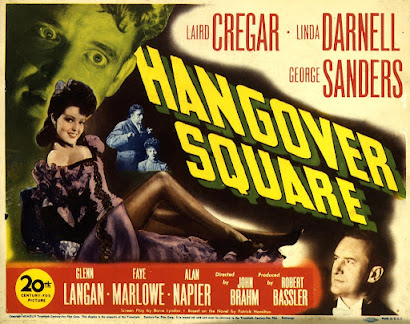
Laird Cregar, Linda Darnell, and George Sanders find themselves in "Hangover Square"

Hangover Square (1945) is an American period film noir directed by John Brahm and starring Laird Cregar, Linda Darnell, and George Sanders. Others in the cast include Glenn Langan, Faye Marlowe, and Alan Napier. The cinematography was by Joseph LaShelle (Laura, The Apartment) and the film score was by Bernard Herrmann (Citizen Kane, Psycho).

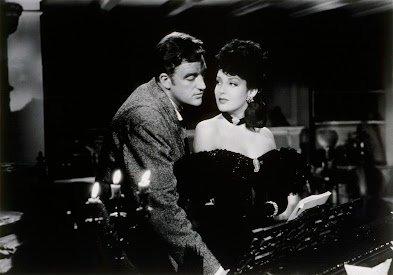
Composer George Harvey Bone (Cregar) has no memory of killing a shop owner and then setting his business on fire. It seems George goes into a trance when hears discordant sounds and loses all sense of time. He meets a music hall singer named Netta (Darnell) who uses George to write her songs for her act. When George finds out that Netta is engaged to Eddie Carstairs, he goes into a jealous rage, beating Carstairs and destroying any chance he had with Netta. With this rage and disappointment drive him to kill again?


John Brahm (1893 - 1982) was a German film director who immigrated to the United States in 1937. Brahm found work as a director, first employed by Columbia Pictures and then 20th Century-Fox. Brahm's most famous films include The Lodger (1944), Hangover Square, and The Lockett (1946). Brahm also directed a lot of television shows including Alfred Hitchcock Presents, and The Twilight Zone.

Laird Cregar (1913 - 1944) was an American film and stage actor. Cregar came to Hollywood due to his success with the play Oscar Wilde in Los Angeles in 1940. Cregar signed a contract with 20th Century-Fox and quickly became a popular character actor. Due to his large size (he weighed 300 pounds), he was often cast as the bad guy. In an effort to become a leading man in the movies, Cregar went on a crash diet during the productions of The Lodger and Hangover Square. To aid in his dieting, Cregar was prescribed amphetamines which had a negative effect on his system, causing abdominal problems. These problems lead to surgery and eventually a heart attack. He died shortly after at age 31.

Linda Darnell (1923 – 1965) was an American film actress. She signed a contract with 20th Century-Fox at age 15 and became a star almost overnight. She was immediately cast opposite Tyrone Power in Day-Time Wife (1939). She made two films with Power in 1940: Brigham Young and The Mark of Zorro. In 1941, she was again paired with Power in Blood and Sand, which also starred an up-and-coming Rita Hayworth. Darnell’s most famous role was that of Amber St. Clair in Forever Amber (1946), which turned out the be the biggest hit of the year. The role of Amber was the most sought-after female role since the casting of Scarlett O’Hara in Gone with the Wind (1939). Other important films she starred in include Unfaithfully Yours (1948), A Letter to Three Wives (1949), and No Way Out (1950). She died tragically at age 41 in a fire while visiting friends in Glenview, Illinois.

George Sanders (1906 – 1972) was a British film and stage actor who also had a fine singing voice. Hollywood was looking for a villain to star opposite a young Tyrone Power in Lloyd’s of London (1936) and Sanders more than fit the bill. His performance in that film would forever stamp him as a sophisticated bad guy. Before his acting career, he worked in the textile industry, which must have helped him with his role in The Strange Affair of Uncle Harry. In the 1960s, Sanders played Mr. Freeze in the Batman (1966) television series.

Laird Gregar and Linda Darnell


Hangover Square trivia

  • Stephen Sondheim saw the film as a 16-year-old and said that the film was the inspiration for his musical Sweeney Todd.
  • You can hear many musical cues in Herrmman's film score from other works including The Ghost and Mrs. Muir, Vertigo, and North by Northwest.
  • The film was released two months after Laird Cregar's death.
  • Cregar had originally rejected the role of Bone but changed his mind when fellow contract player Glenn Langan was announced as the lead.


To watch the film on YouTube, click on the link below.


To join the discussion on February 28, 2022, at 6:30 p.m. Central Time click here. Once you RSVP, you will receive an invitation and a link to the discussion on Zoom.

Discussion questions:

  1. What film genre would you categorize Hangover Square?
  2. Was Laird Cregar believable as a psychopath? Did you have any sympathy for his character?
  3. Would you consider Linda Darnell a turn-of-the-century femme fatale? Was she believable in her role?
  4. Did this film remind you of any other films you've seen?
  5. Were you surprised by anything in the film?


Tuesday, January 11, 2022

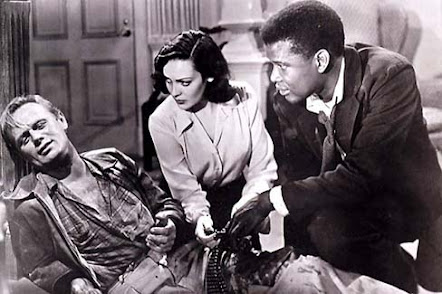
Widmark, Darnell, and Poitier wonder if there is "No Way Out"

No Way Out (1950) is an American film noir directed by Joseph Mankiewicz and starring Richard Widmark, Linda Darnell, Stephen McNally, and in his film debut, Sidney Poitier. The movie was produced by Darryl F. Zanuck with music by Alfred Newman.

The plot concerns Dr. Luther Brooks (Poitier) as the first black doctor to be employed at the urban hospital where he trained. While working at the hospital's prison ward, brothers Johnny and Ray (Widmark) Biddle are brought in to be treated for gunshot wounds they received while attempting a robbery. 

Johnnys symptoms worry Luther, suspecting he may have a brain tumor. While he is trying to tend to Johnny, Ray hurls insults and racial epitaphs at Luther. Still believing that Johnny may be suffering from a brain tumor, Luther performs a spinal tap, but Johnny dies during the procedure. Ray accuses Luther of murdering his brother and vows revenge.

Will Luther be able to survive the suspicion that he may have misdiagnosed Johnny? Will Ray make good on his vendetta against Luther?

Richard Widmark Linda Darnell, and Sidney Poitier


Joseph L. Mankiewicz (1929 – 1972) was an American film director, screenwriter, and producer. Mankiewicz won Academy Awards for directing and writing A Letter to Three Wives (1949), and All About Eve (1950). He is the only director to win back-to-back Academy Awards for writing and directing. Other films directed by Mankiewicz include Dragonwyck (1946), The Ghost and Mrs. Muir (1947), Julius Caesar (1953), The Barefoot Contessa (1954), and Guys and Dolls (1955). He directed the 1963 crisis-plagued production of Cleopatra which negatively affected his career as a director. 


Richard Widmark (1914- 2008) had a sensational movie debut playing the crazy villain Tommy Udo in director Henry Hathaway’s Kiss of Death (1947). His performance won him a Golden Globe Award for New Star Of The Year – Actor. He was also nominated for the Academy Award for Best Supporting Actor for his performance as Udo. Widmark was under contract to Twentieth Century-Fox where he played mostly villains. Later in his career, he started playing more heroic roles in films like Slattery’s Hurricane and Down to the Sea in Ships (both 1949).

Linda Darnell (1923 – 1965) was an American film actress. She signed a contract with 20th Century-Fox at age 15 and became a star almost overnight. She was immediately cast opposite Tyrone Power in Day-Time Wife (1939). She made two films with Power in 1940: Brigham Young and The Mark of Zorro. In 1941, she was again paired with Power in Blood and Sand, which also starred an up-and-coming Rita Hayworth. Darnell’s most famous role was that of Amber St. Clair in Forever Amber (1946), which turned out the be the biggest hit of the year. The role of Amber was the most sought-after female role since the casting of Scarlett O’Hara in Gone with the Wind (1939). Other important films she starred in include Unfaithfully Yours (1948), A Letter to Three Wives (1949), and No Way Out (1950). She died tragically at age 41 in a fire while visiting friends in Glenview, Illinois.

Stephen McNally (1911 - 1994) was an American film, stage,  and television actor. He is mostly remembered for his roles in westerns. McNally often played the bad guys like his portrayal of Locky McCormick in Johnny Belinda (1948). McNally earned a law degree from Fordham University Law School. During the 1950s, he started working in television starring in popular series like Wagon Train, Riverboat, Rawhide, 77 Sunset Strip, The Virginian, Fantasy Island, Starsky & Hutch, Charlies Angels, The Rockford File, and  Police Story.

Sidney Poitier (1927 - 2022) was an American actor and director. He was the first black man to win the Academy Award for Best Actor for his role in Lilies of the Field (1963). Poitier made his film debut in No Way Out which launched him on a path to movie stardom. Other early films include Cry, The Beloved Country  (1951), Blackboard Jungle (1955), and Edge of the City (1957). Another breakthrough came with The Defiant Ones (1958) where he co-starred with Tony Curtis. Both actors were nominated for the Best Actor Academy Award, with Poitier’s nomination the first for a black man. In 1959, he starred in the first production of A Raisin in the Sun on Broadway. He starred in the film version in 1961. That same year he starred with Paul Newman and Joanne Woodward in Paris Blues. Other film roles include The Bedford Incident (1965), A Patch of Blue (1965) co-starring Elizabeth Hartman and Shelley Winters. Poitier’s big year was 1967. He had three hits with To Sir, with Love, In the Heat of the Night, and Guess Who’s Coming to Dinner. The popularity of these three films made him the top box office draw of the year. Later in his career, Poitier started directing films like Uptown Saturday Night (1974) and Stir Crazy (1980). Poitier was a recipient of an Honorary Academy Award for his contribution to the motion picture industry.


No Way Out trivia

  • Sidney Poitier lied to director Joseph Mankiewicz, telling him he was 27 years old when he was only 22.
  • James Edwards, another pioneering black actor, was the first choice to play Luther.
  • The film was initially banned by the Chicago Police Department until the scene where the two gangs arm themselves was deleted.
  • Linda Darnell was in a serious car accident during filming that almost burned her to death.
  • Of the main cast, Linda Darnell was the veteran having starred in her first film in 1939 when she was still in her teens. She was only 27 when No Way Out was released.


Why watch this film?

  • To see star-in-the-making Sidney Poitier.
  • It’s an early film dealing with the issue of prejudice and racism.
  • It’s a chance to see Richard Widmark when he was still playing criminals and low-lives.
  • Linda Darnell is featured in a non-glamorous role.


To watch the film on YouTube, click the link below.


Discussion questions:
  1. How would you compare this film to Odds Against Tomorrow?
  2. Did you think the situations in this film were realistic?
  3. What did you think of Sidney Poitier’s big-screen debut?
  4. Did you have a favorite scene, piece of dialogue, or performance?
  5. Was Linda Darnell’s character arch believable?

To join the discussion on January 17, 2022, at 6 p.m. Central Time, click here. Once you RSVP, you’ll receive an invitation with a link to the discussion on Zoom.

Wednesday, October 27, 2021

Dick Powell and Linda Darnell in “It Happened Tomorrow”

It Happened Tomorrow (1944) is an American fantasy film directed by Rene Clair, starring Dick Powell, Linda Darnell, and Jack Oakie. This was Clair’s fourth of five films he made in Hollywood.

Lawrence Stevens (Powell) writes obituaries for the local paper but he dreams of writing important, hard news stories. An old newspaperman named Pop Bensen (John Philliber) gives Stevens a newspaper with tomorrow’s news. This unusual event allows Stevens to write stories, scooping the other reporters and newspapers. Along the way, he meets Oscar Smith (Oakie) and Sylvia Smith (Darnell) an uncle and niece clairvoyant act.

At first, knowing future events is exciting and helps move Stevens along in his career. But as time goes by, he discovers knowing the future isn’t what’s cracked up to be.

Dick Powell and Linda Darnell

Rene Clair (1898 - 1981) was a French film director and writer. He directed silent films in his native France but was lured to Hollywood where he directed five films. His first American film was The Flame of New Orleans (1941) starring Marlene Dietrich. The film was not a success and it would be a year before he made another American film. His most popular American film was And Then There Were None (1945) based on Agatha Christie’s novel of the same name. After World War II, Clair returned to France where he was considered one of that country’s best film directors.

Dick Powell (1904 - 1963) was an American actor, singer, producer, and director. He began his movie career in musicals and comedies but eventually toughened up his image in the mid-1940s where he became a popular star of films noir. He was the first actor to portray Philip Marlowe in Murder, My Sweet (1944). After appearing in his last film, Susan Slept Here, Powell started directing. In the 1950s he was one of the founders of Four Star Television along with Charles Boyer, David Niven, and Ida Lupino. Some popular films starring Powell include 42nd Street (1933), A Midsummer's Night Dream (1935), Christmas in July (1940), Pitfall (1948), and The Bad and the Beautiful (1952).

Linda Darnell (1923 – 1965) was an American film actress. She signed a contract with 20th Century-Fox at age 15 and became a star almost overnight. She was immediately cast opposite Tyrone Power in Day-Time Wife (1939). She made two films with Power in 1940: Brigham Young and The Mark of Zorro. In 1941, she was again paired with Power in Blood and Sand, which also starred an up-and-coming Rita Hayworth. Darnell’s most famous role was that of Amber St. Clair in Forever Amber (1946), which turned out the be the biggest hit of the year. The role of Amber was the most sought-after female role since the casting of Scarlett O’Hara in Gone with the Wind (1939). Other important films she starred in include Unfaithfully Yours (1948), A Letter to Three Wives (1949), and No Way Out (1950). She died tragically at age 41 in a fire while visiting friends in Glenview, Illinois.

Jack Oakie (1903 - 1978) was an American film actor who also appeared on the stage and radio. He is probably most famous for portraying Napaloni in Charlie Chaplin’s The Great Dictator (1940). Oakie began his film career during the silent era but had no problem when sound was introduced. After fulfilling his seven-year contract with Paramount Pictures in 1934, Oakie decided to freelance, not being attached to any one studio. He was very successful as a freelancer appearing in popular films like The Call of the Wild (1935), The Toast of New York (1937), Tin Pan Alley (1940), Hello Frisco, Hello (1943), Thieves Highway (1949), and Around the World in 80 Days (1959).


It Happened Tomorrow trivia

  • Frank Capra owned the rights to the film but sold them to producer Arnold Pressburger when he entered the U.S. Army during World War II.
  • Jack Oakie reworked his dialogue throughout the film which didn’t bother director Clair at all.
  • Cary Grant was originally considered for the role of Lawrence Stevens.
  • The opera singer alluded to in the film is most likely Nellie Melba; Peach Melba and Melba toast are named for her.
  • Inspiration for the television show Early Edition.


To watch the film on YouTube, click the link below.


Why watch this film?

  • It features Dick Powell in a non-singing role before he turned “touch guy” as Philip Marlow in Murder, My Sweet the same year.
  • We have another fantasy film from Clair, two years after I Married a Witch (1942).
  • The film features the popular and busy character actors working in Hollywood Jack Oakie and Edgar Kennedy.
  • Linda Darnell has a fairly good role as Sylvia Smith on loan out from her home studio, 20th Century-Fox.


To join the discussion on Monday, November 1, 2021, at 7:30 p.m. Central Time, click here. Once you RSVP, you will get an invitation and link to the discussion on Zoom.


Discussion questions:

  1. Do you think this lighthearted film has a serious message? If so, what is it?
  2. What did you think of Dick Powell’s performance in the lead? Do you think his casting was a good choice?
  3. How do you think this film compares to Clair’s I Married a Witch?
  4. Did you have a favorite character and/or scene from the movie?
  5. Did you have a problem with Oakie’s portrayal as “The Great Gigolini”


Thursday, May 27, 2021

Jeanne Crain, Linda Darnell, and Ann Sothern receive “A Letter to Three Wives”

A Letter to Three Wives (1949) is an American romantic comedy-drama film directed by Joseph L. Mankiewicz and starring Jeanne Crain, Linda Darnell, and Ann Sothern. The supporting cast includes Kirk Douglas, Paul Douglas, Jeffrey Lynn, Connie Gilchrist, Barbara Lawrence, and Thelma Ritter.

The film is based on the novel A Letter to Five Wives (1945) by John Klempner. Mankiewicz wrote the screenplay based on an adaptation by Vera Caspary (Laura). The cinematography was by Arthur C. Miller, with music by Alfred Newman. A Letter to Three Wives was one of Twentieth Century-Fox’s most important productions of the year.

The movie tells the story of a woman (Addie Ross) who sends a letter to three of her “dearest friends” (Crain, Darnell, and Sothern) informing them that she has run off with one of their husbands but not revealing which one. The letter is delivered while the women are getting on board a riverboat to chaperone a group of underprivileged children. While they cruise up the river and spend the day picnicking with the children, each wife reflects on her marriage and wonders if it’s their husband who has run off with Ross.

Linda Darnell, Anne Sothern, and Jeanne Crain

Joseph L. Mankiewicz (1929 – 1972) was an American film director, screenwriter, and producer. Mankiewicz won Academy Awards for directing and writing A Letter to Three Wives (1949), and All About Eve (1950). He is the only director to win back-to-back Academy Awards for writing and directing. Other films directed by Mankiewicz include Dragonwyck (1946), The Ghost and Mrs. Muir (1947), Julius Caesar (1953), The Barefoot Contessa (1954), and Guys and Dolls (1955). He directed the 1963 crisis-plagued production of Cleopatra which negatively affected his career as a director.

Jeanne Crain (1925 – 2003) was an American actress whose career spanned more than three decades. While still a teenager, she was asked to take a screen test with Orson Welles. He was testing for the part of Lucy Morgan in his production of The Magnificent Ambersons (1942). She didn’t get the part (Anne Baxter did), but she was on her way. She had a bit part in The Gang’s All Here (1943) but had a leading role in Home in Indiana (1944). The film was a box office hit and Crain became a favorite of film fans everywhere. She had another hit with Winged Victory (1944) and co-starred with Dana Andrews in the musical State Fair (1945). That same year, she was the “good girl” opposite Gene Tierney’s “bad girl” in Leave Her to Heaven. More good roles came her way including leads in A Letter to Three Wives (1949), The Fan (1949), and Pinky (1949). The latter won her a Best Actress Oscar nomination. She lost that year to Olivia de Havilland. Crain’s popularity continued into the 1950s but suffered when she was released from her exclusive contract with 20th Century-Fox. She continued to work in films and on television until 1975.

Paul Douglas and Linda Darnell

Linda Darnell (1923 – 1965) was an American film actress. She signed a contract with 20th Century-Fox at age 15 and became a star almost overnight. She was immediately cast opposite Tyrone Power in Day-Time Wife (1939). She made two films with Power in 1940: Brigham Young and The Mark of Zorro. In 1941, she was again paired with Power in Blood and Sand, which also starred an up-and-coming Rita Hayworth. Darnell’s most famous role was that of Amber St. Clair in Forever Amber (1946), which turned out the be the biggest hit of the year. The role of Amber was the most sought-after female role since the casting of Scarlett O’Hara in Gone with the Wind (1939). Other important films she starred in include Unfaithfully Yours (1948), A Letter to Three Wives (1949), and No Way Out (1950). She died tragically at age 41 in a fire while visiting friends in Glenview, Illinois.

Ann Sothern (1909 - 2001) was an American actress who worked on the stage, radio, film, and television. Sothern’s most commercially successful film role was as Maisie Ravier in a series of films while she was at M-G-M. Maisie, a Brooklyn showgirl was based on the short stories by Nell Martin. Films in the series include Congo Maisie (1940), Gold Rush Maisie (1940), and Up Goes Maisie (1946). The character was so popular that Sothern played the character on the radio in The Adventure of Maisie (1939 - 1947) series. At M-G-M, Sothern starred in the film version of Panama Hattie (1942) opposite Red Skelton, which was a box office success. In 1949, she starred in A Letter to Three Wives which brought her great reviews but did little to advance her career. In 1953, Sothern starred as Susie MacNamara in the television series Private Secretary, (1953 - 1957) and the next year starred in The Ann Sothern Show (1958 - 1961). Sothern continued working on stage, screen, and television. Her last film role was in The Whales of August (1987). For her role in that film, she earned her only Best Supporting Academy Award nomination.

Jeanne Crain, Jeffrey Lynn, Kirk Douglas, and Ann Sothern

A Letter to Three Wives trivia

  • Originally, the film was going to be called A Letter to Four Wives with the fourth wife being Anne Baxter, but her character wasn’t considered as strong as the other three so her segment was cut.
  • Joseph L. Mankiewicz won the Best Director and Best Screenplay Academy Awards for his work on this film and would repeat the wins the next year with All About Eve. No one has ever achieved this feat.
  • One of Thelma Ritter’s early roles, so early in fact she doesn't even receive on-screen billing.
  • Tyrone Power, Joan Crawford, Gene Tierney, Dorothy McGuire, Maureen O’Hara, and Ida Lupino were all considered for roles.
  • Linda Darnell and Mankiewicz were involved in an affair during the production.
  • Darnell and Barbara Lawrence played sisters the year before in Unfaithfully Yours.
  • Silent film star Mae Marsh has a small role as the womens’ washroom attendant at the country club.


To watch the movie on YouTube, click on the link below.


Why watch this movie?

  • Another great example of what the studio system could produce at its peak.
  • One of writer-director Joseph L. Mankiewicz’s best films.
  • It’s a showcase for the talents of Jeanne Crain, Linda Darnell, and Ann Sothern.
  • It boasts early performances from Kirk and Paul Douglas and Thelma Ritter.

To join us for a discussion on Zoom, June 1, 2021, at 6:30 p.m. Central Time, click on the link here. Once you RSVP, you’ll receive an email with a link to the discussion on Zoom.

Discussion Questions

  1. What did you think of the ensemble cast?
  2. Do you think this film is still relevant in the 21st Century?
  3. Did you have a favorite wife?
  4. A favorite scene or piece of dialogue?


Friday, July 17, 2020

John Ford’s “My Darling Clementine” and myth of the American West

My Darling Clementine (1946) is an American western film directed by John Ford, starring Henry Fonda, Linda Darnell, and Victor Mature. Many critics consider it one of the best westerns ever made.

The movie takes place in 1882, with the Earp brothers Wyatt (Fonda), Morgan (Ward Bond), Virgil (Tim Holt), and James (Don Garner) on a cattle drive to California. On the way, they meet Old Man Clanton (Walter Brennan). Clanton wants to buy the Wyatt cattle, but they refuse to sell. When they learn of the nearby town of Tombstone, the three older brothers ride in, leaving their younger brother James to watch over the herd. When Wyatt, Morgan, and Virgil return to camp, they discover that their cattle have been rustled and James has been murdered.

This is the setup for the famous gunfight at the O.K. Corral.

Some Clementine Trivia
My Darling Clementine was Fonda’s first film role upon returning from service in World War II. Mature had one of his best roles as Doc Holiday, even winning praise from director Ford, which was no easy task. Darnell who was emerging as 20th Century-Fox’s top bombshell is the fiery Chihuahua. Jeanne Crain was originally considered for the role of Clementine Carter, but studio head Darryl F. Zanuck had bigger plans for her. He thought the supporting role was too small for Crain who was being groomed for major stardom. Brennan disliked Ford so much that he never work with him again. Jane Darwell who plays dance hall owner Kate Nelson won a Best Supporting Actress Oscar in Ford’s The Grapes of Wrath (1940) which starred Fonda as Tom Joad.

Linda Darnell and Henry Fonda in an iconic scene from the film

John Ford (1894 – 1946) was an American film director. Best known for his classic westerns. Ironically he won four Best Director Oscars for non-western films, a record that has yet to be equaled. Ford directed more than 140 films going back to the silent era. Orson Welles and Ingmar Bergman are among the many who consider Ford the greatest director of all time.

Henry Fonda (1905 - 1982) was an American stage and film actor. Fonda became a star in his first film role as Dan Harrow in The Farmer Takes a Wife (1935) co-starring established star Janet Gaynor. In 1938, he co-starred in Jezebel with Bette Davis. In 1939 he starred as Frank James along with Tyrone Power in Jesse James (the second biggest hit of the year), Young Mr. Lincoln, and Drums Along the Mohawk, the latter two directed by John Ford. Fonda worked steadily on the stage and on film until a year before his death. He won his one and only Oscar for On Golden Pond (1981).

Linda Darnell (1923 – 1965) was an American film actress. She signed a contract with 20th Century-Fox at age 15 and became a star almost overnight. She was immediately cast opposite Tyrone Power in Day-Time Wife (1939). She made two films with Power in 1940: Brigham Young and The Mark of Zorro. In 1941, she was again paired with Power in Blood and Sand, which also starred an up and coming Rita Hayworth. Darnell’s most famous role was that of Amber St. Clair in Forever Amber (1947), which turned out the be the biggest hit of the year. The role of Amber was the most sought after female role since the casting of Scarlett O’Hara in Gone with the Wind (1939). Other important films she starred in include Unfaithfully Yours (1948), A Letter to Three Wives (1949), and No Way Out (1950). She died tragically at age 41 in a fire while visiting friends in Glenview, Illinois.

Victor Mature (1913 – 1999) was an American stage, film, and television who became a major movie star during the 1940s under contract to 20th Century-Fox. Before his film career took off, Mature starred in Lady in the Dark (1941) on Broadway opposite Gertrude Lawrence. Some of Mature’s notable films include I Wake Up Screaming (1941) with Betty Grable, The Shanghai Gesture (1941) with Gene Tierney. In 1942, he starred opposite Rita Hayworth in the musical My Gal Sal. Other notable films include Kiss of Death (1947), Samson and Delilah (1949), and The Robe (1952), the first film released in the Cinemascope widescreen process.


To watch this film on YouTube, click on the link below. Be sure to use this link because there are several prints of this film on the channel, but this one is the best by far.


After you’ve watched the film, join us for a discussion on Zoom, July 21, 2020. Click on the link below to join the discussion.

Stephen Reginald is inviting you to a scheduled Zoom meeting.

Topic: Discussion of "My Darling Clementine"
Time: Jul 21, 2020, 06:30 PM Central Time (US and Canada)

Join Zoom Meeting

https://us04web.zoom.us/j/75170417977?pwd=eUF5VFdKRmEzK1JWbisxNy9yV3pkZz09

Meeting ID: 751 7041 7977
Passcode: Z5pkxp


Discussion questions:
1. This film is considered one of the great American westerns. How does it rate in your estimation?
2. Henry Fonda was Ford’s first and only choice to play Wyatt Earp. What did you think of Fonda’s performance? Can you see another actor in the role?
3. John Ford was at first unhappy about the casting of Victor Mature (he had wanted James Stewart), but after interviewing the actor, he was convinced he was right for the part. What do you think?
4. Many critics think that Linda Darnell was miscast as Chihuahua. Do you agree with the critics and why or why not?


Related Posts Plugin for WordPress, Blogger...