The Apartment (1960) is a romantic comedy directed by Billy Wilder and starring Jack Lemmon, Shirley MacLaine, and Fred MacMurray. The cast also includes Ray Walston and Edie Adams. The screenplay was written by Wilder and his long-time writing partner I. A. L. Diamond. The black and white cinematography was by Academy Award winner Joseph LaShelle (Laura).
C C. "Bud" Baxter (Lemon) is an office drone at a large insurance company. To climb the corporate ladder, he lets several executives use his Upper West Side apartment for their extramarital affairs. With a steady stream of women coming and going from his apartment, his neighbors think he's a player.
Due to his "generosity" with his apartment, Bud starts moving up the corporate ladder. Bud develops a crush on elevator operator, Fran Kubelik. Things go a bit crazy when Bud finds out that his boss Jeff Sheldrake (MacMurray) is having an affair with Fran and using his apartment for their trysts.
Will Bud look the other way and keep moving up the ladder, or will he decide the corporate world isn't all it's cracked up to be?
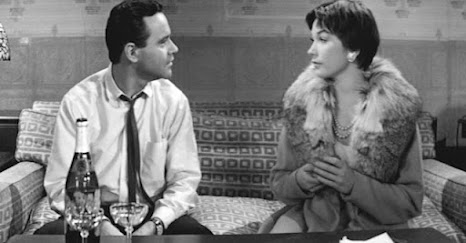 |
| Jack Lemmon and Shirley MacLaine |
Billy Wilder (1906 - 2002) was an Austrian-born American film director, screenwriter, and producer. He won six Academy Awards for his writing and direction and was nominated twenty-one times over a career that spanned five decades. Wilder started his career as a writer, penning the screenplays for Ninotchka (1939), Ball of Fire (1942), Double Indemnity (1945), The Lost Weekend (1946), Sunset Boulevard (1951) Boulevard (1951), Sabrina (1955), Some Like it Hot (1960), and The Apartment (1961). As a director, he won Academy Awards for directing The Lost Weekend (1946) and The Apartment (1961). Wilder directed fourteen different actors in Oscar-nominated roles. He is considered one of the most versatile directors from Hollywood’s Classical period.
Jack Lemmon (1925 - 2001) was an American actor who was successful in both comedic and dramatic roles. He won an Academy Award for Best Supporting Actor in Mr. Roberts (1955). He then went on to a very successful collaboration with director Billy Wilder. Some of the Wilder films that Lemmon starred in include Some Like it Hot (1959), The Apartment (1960), and Irma la Douce (1963). Lemmon won the Academy Award for Best Actor for Save the Tiger (1973). Other Lemmon films include The Odd Couple (1968), The Out-of-Towners (1970), The China Syndrome (1979), Missing (1982), and Grumpy Old Men (1993).
Shirley MacLaine (1934 - ) is an American actress who made her film debut in Alfred Hitchcock's production of The Trouble with Harry (1955) for which she won the Golden Globe award for New Star of the Year - Actress. Her movie career took off immediately and she had starring roles in Around the World in 80 Days (1956), Hot Spell (1958), Some Came Running (1958), The Apartment (1960), The Children's Hour (1961), and Irma la Douce (1963). In 1983, she won the Academy Award for Best Actress for Terms of Endearment. MacLaine's younger brother is actor, director, and producer, Waren Beatty.
Fred MacMurray (1908 – 1991) was an American film actor who appeared in more than 100 movies and had a successful career on television as well. MacMurray signed a contract with Paramount Pictures in 1934 and was a major leading man by 1935. He co-starred with the studio's top leading actresses including Carole Lombard, Claudette Colbert, Paulette Goddard, and Madeleine Carroll. By 1943, MacMurray was the highest-paid actor in Hollywood and the fourth-highest-paid person in the United States. Probably his most famous role is as insurance agent Walter Neff in Double Indemnity (1944) co-starring Barbara Stanwyck and Edward G. Robinson. During the late 1950s and 1960s, MacMurray gained new fame as the star of films produced by Walt Disney including The Shaggy Dog (1959), The Absent-Minded Professor (1961), Son of Flubber (1963), and Charley and the Angel (1973).
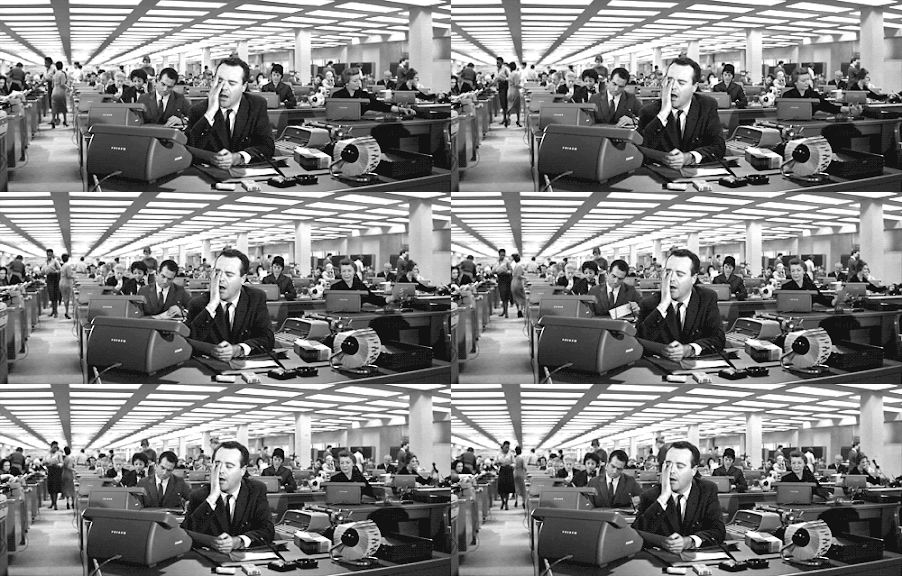
- To make the open office space seem bigger, they put adult actors in front, and children dressed as adults in the back. The last rows were cardboard cutouts.
- Wilder shot the Christmas office party scene on December 23, 1959, so everyone was in the holiday spirit.
- The Apartment was the last black and white film to win Best Picture until The Artist (2011).
- Billy Wilder became the first person to win Academy Awards for Best Picture, Best Director, and Best Screenplay.
- Paul Douglas was cast as Sheldrake but had a heart attack before he was to start filming. Fred MacMurray replaced him as a favor to Wilder.
To watch the movie on YouTube, click on the link below.
To join the discussion online on February 21, 2022, at 6:30 p.m Central Time, click here. Once you RSVP, you'll receive an invitation and a link to join the discussion on Zoom.
Discussion questions
- How does the movie present Baxter?
- How does the director illustrate the alienation of office life?
- The film is considered a romantic comedy. Does that seem like the correct classification?
- What is the symbolism of the $100 bill that Sheldrake gives to Fran?
- Is the ending satisfying?

 (1954) and
  (1955).
  (1956) was one of the biggest box office hits of the year.

 . It was too British in its black humor, according to Hitchcock (although apparently the British didn't like it much either). To Hitchcock fans, it's a fun film for a number of reasons. It features the film debut of Shirley MacLaine for one and a pre-Leave it to Beaver Jerry Mathers for another. It also has some beautiful cinematography and a pounding score by composer Bernard Herrmann. This was the beginning of a long professional relationship between Hitchcock and Herrmann, that lasted until
 (1957),
  (1964), and
  (1966). Still, his most enduring work remains the films he wrote for the master of suspense.
 (1994) starring Kevin Spacey. Hayes died in November 2008 at the age of 89.