Showing posts with label Fred MacMurray. Show all posts

Wednesday, May 21, 2025

Carole Lombard, Fred MacMurray, and John Barrymore star in “True Confession”

True Confession (1937) is an American screwball comedy directed by Wesley Ruggles and starring Carole Lombard, Fred MacMurray, and John Barrymore. The supporting cast included Una Merkel, Porter Hall, Edgar Kennedy, Fritz Feld, and Hattie McDaniel.

Carole Lombard plays Helen Bartlett, a housewife and aspiring fiction writer. Helen is a habitual storyteller; she is often fast and loose with the truth. Helen bangs out short stories on her portable typewriter at home while her husband, Ken (MacMurray), tries to establish his fledgling law practice. He has a problem: he’s only interested in taking on clients who are truthful and innocent. He is the complete opposite of Helen. Ken’s refusal to take on “guilty” clients causes friction between the young couple struggling to make ends meet. Helen writes stories in an attempt to help with the family finances, which Ken resents. When Helen is conjuring up a lie, her tongue is planted firmly in her cheek, and you can see the wheels turning in her head.

When Helen applies for a private secretary position at an incredibly generous salary, her best friend, Daisy (Una Merkel), smells a rat. Helen’s boss, Otto Krayler (John T. Murray), really doesn’t want a secretary, but rather a playmate. On her very first day on the job, Krayler makes a pass at Helen and she quits in a huff. Later, she realizes that she left her hat and coat at Krayler’s lavish apartment. When she and Daisy go to retrieve them, the two discover that Krayler has been murdered and that, according to Detective Darsey (Edgar Kennedy), Helen is the prime suspect!

How is Helen going to get out of this mess?


Fred MacMurray, Carole Lombard, and John Barrymore

True Confession trivia

  • Lombard lobbied to get John Barrymore hired to play Charlie Jasper. She also insisted that he get star billing.
  • This was the fourth and final film that Lombard and Fred MacMurray made together. All four of their films were box office successes.
  • True Confession was released within weeks of the more famous Lombard film Nothing Sacred. Ironically, True Confession was the bigger box office hit.
  • The film was remade in 1946 as Cross My Heart starring Betty Hutton.
  • This blogger thinks this film was a template for the I Love Lucy television situation comedy.


Click HERE to watch the movie on the Internet Movie Archive.

Click HERE to join the online discussion on May 26, 2025, at 6:30 p.m. Central Time. Once you RSVP, you will receive an email with a link to join the discussion on Zoom.


Una Merkel, Carol Lombard

Discussion questions

  1. Why do you think Lombard fans preferred this film over Nothing Sacred, released the same year?
  2. Was Lombard believable as a congenital liar?
  3. What did you think of the girlfriend chemistry between Lombard and Una Merkel? Did their friendship remind you of another famous girlfriend team?
  4. As noted in the trivia section, this was the fourth and last film that MacMurray and Lombard made. Did you think they had good on-screen chemistry?
  5. What did you think of John Barrymore’s performance? Was Lombard right in insisting he be cast in the role of Charlie Jasper?
  6. Did the film remind you of any other films you’ve seen?

Wednesday, April 24, 2024

Book Review: “From the Moment They Met It Was Murder: Double Indemnity and the Rise of Film Noir”

Title: From the Moment They Met It Was Murder: Double Indemnity and the Rise of Film Noir

By: Alain Silver and James Ursini

Publisher: Running Press – Turner Classic Movies

ISBN: 978-07624-8493-5 (hardcover)

ISBN: 978-0-7624-8495-9 (ebook)


The new book by Alain Silver and James Ursini is a detailed account of how the classic film noir Double Indemnity came to be. The authors take a look at the real-life crime that influenced James M. Cain’s novel on which the film is based. The thesis of the book is that Double Indemnity is the definitive film noir and its influence is still felt today.

Just when you thought you knew all there was to know about Double Indemnity and film noir, the authors begin their book with the case of Ruth May Snyder and Henry Judd Gray. Snyder and Gray came up with a plot to murder her husband. They tried to make it look like robbery and murder but weren’t as slick as Phyllis Dietrichson and Walter Neff.

Once the authors start talking about the development of Double Indemnity, the book really moves along. The consensus was that Cain’s dialogue in the novel sounded stilted and phony when read aloud. That’s where Raymond Chandler came in. Chandler’s novels were known for their snappy, realistic dialogue. Chandler worked with director Billy Wilder on the script. A contentious relationship at best but somehow it all worked out in the end.

The casting was interesting. Dick Powell campaigned hard to play Neff, but this was before his dramatic turn in Murder, My Sweet (1944). Powell was a musical comedy star during the 1930s at Warner Bros. and wasn’t seriously consider by Wilder. Fred MacMurray was known for light comedy and musicals as well, but Wilder saw something. Casting MacMurray against type turned out to be a brilliant move. He’s convincing and believable as Neff. For Phyllis Dietrichson, it doesn’t look like Wilder wanted anyone but Barbara Stanwyck.

Billy Wilder (right in front of policemen) directs Stanwyck and MacMurray
in the supermarket scene.

When Ball of Fire (1941) starring Gary Cooper and Stanwyck went into production, Wilder, still a screenwriter, decided he wanted to direct so he shadowed director Howard Hawks. Wilder and Charles Brackett wrote the screenplay for Ball of Fire. He was impressed with Stanwyck’s performance and the rest is history.

There has always been a fascination with why Wilder had Stanwyck wear that cheap blonde wig. The truth is the wig was the same one worn by Marlene Dietrich in Manpower (1941). Wilder wanted Stanwyck to look cheap but he ultimately admitted it was a mistake. He decided this after a few weeks of filming but he decided he couldn’t scrap what was already printed and start from scratch so he just kept going. Paramount file executive Buddy DeSylva said, “We paid for Barbara Stanwyck, and we got George Washington.”

One bit of information that I had never heard before was that Mona Freeman was originally cast as Lola Dietrichson. When Wilder saw her on film, she looked twelve years old. She was eventually replaced with Jean Heather. Heather also had a role in Going My Way, the film that beat Double Indemnity for Best Picture. Its director Leo McCarey also beat Wilder in the Best Director category.

The gas chamber scene that was filmed but cut from the final film

Dressing Stanwyck—done by the legendary Edith Head—to look cheap was expensive. Some of Stanwyck’s outfits cost $7000 in today’s dollars. Stanwyck’s bath towel and pair of slippers cost $40 in 1943 or $700 today.

The book delves into the films Double Indemnity has influenced during the peak noir era and more contemporary or neo-noir films like Body Heat (1981).

And you can’t ignore the foreboding score by Miklos Rozsa. The feeling of dread is apparent from the opening credits and is carried through to the very last frame.

If you’re a fan of Double Indemnity and/or film noir, this book is a must.

Some quick facts:

  • Fred MacMurray worked 61 days
  • Barbara Stanwyck worked 35 days
  • Edward G. Robinson worked 37 days


Tuesday, February 15, 2022

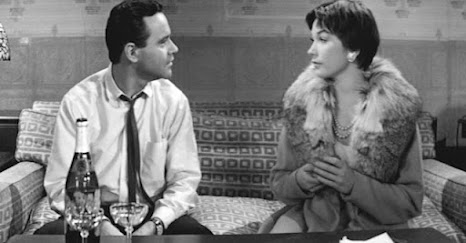
Billy Wilder's "The Apartment" starring Jack Lemmon, Shirley MacLaine, and Fred MacMurray

The Apartment (1960) is a romantic comedy directed by Billy Wilder and starring Jack Lemmon, Shirley MacLaine, and Fred MacMurray. The cast also includes Ray Walston and Edie Adams. The screenplay was written by Wilder and his long-time writing partner I. A. L. Diamond. The black and white cinematography was by Academy Award winner Joseph LaShelle (Laura). 

C C. "Bud" Baxter (Lemon) is an office drone at a large insurance company. To climb the corporate ladder, he lets several executives use his Upper West Side apartment for their extramarital affairs. With a steady stream of women coming and going from his apartment, his neighbors think he's a player.

Due to his "generosity" with his apartment, Bud starts moving up the corporate ladder. Bud develops a crush on elevator operator, Fran Kubelik. Things go a bit crazy when Bud finds out that his boss Jeff Sheldrake (MacMurray) is having an affair with Fran and using his apartment for their trysts.

Will Bud look the other way and keep moving up the ladder, or will he decide the corporate world isn't all it's cracked up to be?

Jack Lemmon and Shirley MacLaine

Billy Wilder (1906 - 2002) was an Austrian-born American film director, screenwriter, and producer. He won six Academy Awards for his writing and direction and was nominated twenty-one times over a career that spanned five decades. Wilder started his career as a writer, penning the screenplays for Ninotchka (1939), Ball of Fire (1942), Double Indemnity (1945), The Lost Weekend (1946), Sunset Boulevard (1951)  Boulevard (1951)Sabrina (1955), Some Like it Hot (1960), and The Apartment (1961). As a director, he won Academy Awards for directing The Lost Weekend (1946) and The Apartment (1961). Wilder directed fourteen different actors in Oscar-nominated roles. He is considered one of the most versatile directors from Hollywood’s Classical period.

Jack Lemmon (1925 - 2001) was an American actor who was successful in both comedic and dramatic roles. He won an Academy Award for Best Supporting Actor in Mr. Roberts (1955). He then went on to a very successful collaboration with director Billy Wilder. Some of the Wilder films that Lemmon starred in include Some Like it Hot (1959), The Apartment (1960), and Irma la Douce (1963). Lemmon won the Academy Award for Best Actor for Save the Tiger (1973). Other Lemmon films include The Odd Couple (1968), The Out-of-Towners (1970), The China Syndrome (1979), Missing (1982), and Grumpy Old Men (1993).

Shirley MacLaine (1934 - ) is an American actress who made her film debut in Alfred Hitchcock's production of The Trouble with Harry (1955) for which she won the Golden Globe award for New Star of the Year - Actress. Her movie career took off immediately and she had starring roles in Around the World in 80 Days (1956),  Hot Spell (1958), Some Came Running (1958), The Apartment (1960), The Children's Hour (1961), and Irma la Douce (1963). In 1983, she won the Academy Award for Best Actress for Terms of Endearment. MacLaine's younger brother is actor, director, and producer, Waren Beatty.

Fred MacMurray (1908 – 1991) was an American film actor who appeared in more than 100 movies and had a successful career on television as well. MacMurray signed a contract with Paramount Pictures in 1934 and was a major leading man by 1935. He co-starred with the studio's top leading actresses including Carole Lombard, Claudette Colbert, Paulette Goddard, and Madeleine Carroll. By 1943, MacMurray was the highest-paid actor in Hollywood and the fourth-highest-paid person in the United States. Probably his most famous role is as insurance agent Walter Neff in Double Indemnity (1944) co-starring Barbara Stanwyck and Edward G. Robinson. During the late 1950s and 1960s, MacMurray gained new fame as the star of films produced by Walt Disney including The Shaggy Dog (1959), The Absent-Minded Professor (1961), Son of Flubber (1963), and Charley and the Angel (1973).


The Apartment 
 trivia

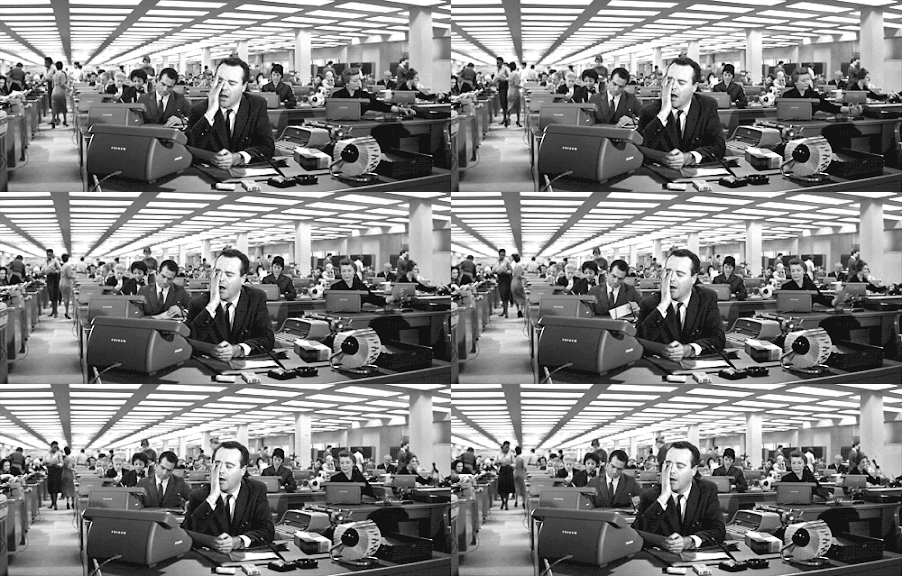
  • To make the open office space seem bigger, they put adult actors in front, and children dressed as adults in the back. The last rows were cardboard cutouts.
  • Wilder shot the Christmas office party scene on December 23, 1959, so everyone was in the holiday spirit. 
  • The Apartment was the last black and white film to win Best Picture until The Artist (2011).
  • Billy Wilder became the first person to win Academy Awards for Best Picture, Best Director, and Best Screenplay.
  • Paul Douglas was cast as Sheldrake but had a heart attack before he was to start filming. Fred MacMurray replaced him as a favor to Wilder.


To watch the movie on YouTube, click on the link below.


To join the discussion online on February 21, 2022, at 6:30 p.m Central Time, click here. Once you RSVP, you'll receive an invitation and a link to join the discussion on Zoom. 


Discussion questions

  1. How does the movie present Baxter?
  2. How does the director illustrate the alienation of office life?
  3. The film is considered a romantic comedy. Does that seem like the correct classification?
  4. What is the symbolism of the $100 bill that Sheldrake gives to Fran?
  5. Is the ending satisfying?


Saturday, December 26, 2020

Jean Arthur has “Too Many Husbands”

Too Many Husbands (1940) is a screwball comedy directed by Wesley Ruggles and starring Jean Arthur, Fred MacMurray, and Melvyn Douglas. The screenplay was written by Claude Binyon (True Confession 1938), based on a play by W. Somerset Maugham.

Melvyn Douglas, Jean Arthur, and Fred MacMurray

Vicky Lowndes’s (Arthur) first husband, Bill Cardew (MacMurray) went missing in a boating accident and is presumed dead. During her bereavement, Bill’s best friend and business partner Henry Lowndes (Douglas) comforts Vicky. Within six months of Bill’s death, Vicky and Henry marry. Six months later, Bill shows up, after being rescued from an uninhabited island where he had survived after his accident at sea. Vicky has a tough choice to make; which husband does she want to spend the rest of her life with?

Cimarron (1931) was the only western to win the Best Picture Oscar until Dances with Wolves (1990)

Wesley Ruggles (1889 – 1972) was an American film director. He directed over 50 films including Cimarron (1931), No Man of Her Own (1932)—the only film to star Clark Gable and Carole Lombard, I’m No Angel (1933). The Gilded Lily (1935), I Met Him in Paris (1937), and You Belong to Me (1941). Ruggles got his start as an actor in 1915 where he appeared in several silent films. Two years later, his interests turned to directing. He was a top producer and director at Paramount throughout the 1930s and early 1940s. His career declined after directing and producing London Town (1946), considered one of the biggest flops in the history of British cinema. It was the last motion picture he directed. He was the younger brother of actor Charlie Ruggles.


Jean Arthur (1900 – 1991) was an American stage and film actress whose career spanned three decades. Arthur got her start in silent films but became a major star with the advent of sound. Her unique speaking voice made her a natural for comedy. She came to prominence having major roles in a series of films directed by Frank Capra: Mr. Deeds Goes to Town (1936), You Can’t Take it With You (1938), and Mr. Smith Goes to Washington (1939). Other popular films Arthur starred in included Only Angels Have Wings (1939), The Talk of the Town (1942), The More the Merrier (1943). Arthur’s last film role was in the western classic Shane (1953). After retiring from acting, she taught drama at Vassar College where one of her students was Meryl Streep.

Fred MacMurray (1908 – 1991) was an American film actor who appeared in more than 100 movies and had a successful career on television as well. MacMurray signed a contract with Paramount Pictures in 1934 and was a major leading man by 1935. He co-starred with the studio's top leading actresses including Carole Lombard, Claudette Colbert, Paulette Goddard, and Madeleine Carroll. By 1943, MacMurray was the highest-paid actor in Hollywood and the fourth-highest-paid person in the United States. Probably his most famous role is as insurance agent Walter Neff in Double Indemnity (1944) co-starring Barbara Stanwyck and Edward G. Robinson. During the late 1950s and 1960s, MacMurray gained new fame as the star of films produced by Walt Disney including The Shaggy Dog (1959), The Absent-Minded Professor (1961), Son of Flubber (1963), and Charley and the Angel (1973).

Melvyn Douglas (1901 – 1981) was an American actor. Douglas was a popular leading man during the 1930s working with some of Hollywood’s most famous leading ladies including Greta Garbo, Claudette Colbert, Joan Crawford, Claudette Colbert, Marlene Dietrich, Myrna Loy, and Merle Oberon. He won two Best Supporting Actor Academy Awards late in his career for Hud (1963) and Being There (1979). Douglas’s last film role was in Ghost Story (1981) co-starring Douglas Fairbanks Jr. and Fred Astair.


Too Many Husbands trivia:

  • Two endings were filmed, one having her end up with her first husband and the other having her stay with the second.
  • The film was screened with both endings and sent out questionnaires to see which ending audiences preferred.
  • Released just months before My Favorite Wife, both films were popular with audiences and critics.
  • The film was remade as “Three for the Show (1955) starring Betty Grable, Jack Lemmon, and Gower Champion.


To watch the movie on YouTube, click on the link below.


To join our discussion of this film on Zoom, December 29, 2020, at 6:30 p.m. click here. Once you RSVP to the Meetup, you’ll receive an email with Zoom login information.


Questions for discussion:

  1. What was your overall impression of the movie?
  2. Did anything surprise you?
  3. If you’ve seen My Favorite Wife, how are the movies similar and how are they different?
  4. Did you have a favorite husband? Who do you think Vicky would be happiest with and why?
  5. Was the film’s ending satisfying or a letdown?


Wednesday, April 25, 2018

Screening of “Hands Across the Table” at the Daystar Center May 12

Hands Across the Table (1935)
Where: Daystar Center, 1550 S. State Street
When: May 12, 2018
Time: 6:45 p.m.
Hosted by Stephen Reginald

Hands Across the Table (1935) is a classic screwball comedy starring Carole Lombard and Fred MacMurray in their first movie together (The two starred together in a total of four films).

Lombard is Regi Allen, a gold-digging manicurist and MacMurray is Theodore “Ted” Drew III, a handsome playboy engaged to Vivian Snowden (Astrid Allwyn), a rich New York City debutante.


Directed with a steady hand by Mitchell Leisen, Hands Across the Table did wonders for the careers of both Lombard and MacMurray. Lombard was already a top star, but her performance in this film was a huge hit with both critics and the public. MacMurray appeared in seven movies in 1935, but his performance in Hands Across the Table elevated his status to that of a popular and sought after leading man.

This movie was so popular that Lombard and MacMurray went on to star in three other films. The film also features a top-notch supporting cast, including Ruth Donnelly, Marie Prevost, and Ralph Bellamy.

Have some Joe and Enjoy the Show!
You can bring food and beverages into the auditorium; we even have small tables set up next to some of the seats. General Admission: $5 Students and Senior Citizens: $3.

Join the Chicago Film club; join the discussion
Twice a month we screen classic films and have a brief discussion afterward. For more information, including how to join (it’s free), click here. The Venue 1550 is easily accessible by the CTA. Please visit Transit Chicago for more information on transportation options.

Stephen Reginald is a freelance writer and editor. He has worked at various positions within the publishing industry for over 25 years. Most recently he was executive editor for McGraw-Hill’s The Learning Group Division. A long-time amateur student of film, Reginald hosts “Chicago Film Club,” a monthly movie event held in the South Loop, for the past two years. Reginald has also taught several adult education film classes at Facets Film School, Chicago.

Saturday, December 9, 2017

Screening of Billy Wilder's "The Apartment" at the Daystar Center December 9

“Holiday” Series: The Apartment (1960)
Where: Daystar Center, 1550 S. State Street
When: December 9, 2017
Time: 6:30 p.m.
Hosted by Stephen Reginald


The Apartment (1960) features Bud Baxter (Jack Lemmon) as a lonely office worker in a corporate insurance company in New York City. In an effort to climb the corporate ladder, he lends his Upper West Side apartment to some influential company managers who use if for their extramarital affairs.

The company personnel director, Jeff D. Sheldrake (Fred MacMurray) discovers what Baxter is doing, but instead of punishing him, he insists on using his apartment too. Enter elevator operator Fran Kubelik (Shirley MacLaine) who Bud has had his eye on for weeks. Bud is disappointed to discover that Fran is Sheldrake’s latest fling when she stands him up on a date. What happens next is nothing short of amazing.


Directed by Billy Wilder and written by Wilder and I.A.L. Diamond, The Apartment won the Best Picture Oscar for 1960 as well as awards for Best Director and Writing.


Have some Joe and Enjoy the Show!
You can bring food and beverages into the auditorium; we even have small tables set up next to some of the seats. General Admission: $5 Students and Senior Citizens: $3.

Join the Chicago Film club; join the discussion
Twice a month we screen classic films and have a brief discussion afterward. For more information, including how to join (it’s free), click here. The Venue 1550 is easily accessible by the CTA. Please visit Transit Chicago for more information on transportation options.

Stephen Reginald is a freelance writer and editor. He has worked at various positions within the publishing industry for over 25 years. Most recently he was executive editor for McGraw-Hill’s The Learning Group Division. A long-time amateur student of film, Reginald hosts “Chicago Film Club,” a monthly movie event held in the South Loop, for the past two years. Reginald has also taught several adult education film classes at Facets Film School, Chicago.

Friday, December 1, 2017

Screening of "Remember the Night" December 5 at the Daystar Center

“Holiday” Series: Remember the Night (1940)
Where: Daystar Center, 1550 S. State Street
When: December 5, 2017
Time: 6:30 p.m.
Hosted by Stephen Reginald


Remember the Night (1940) is a rarely seen holiday classic features the first screen pairing of Barbara Stanwyck and Fred MacMurray.

Stanwyck is Lee Leander, a shoplifter on trial for stealing an expensive bracelet from a jewelry store during the Christmas holidays. The judge decides to postpone her trial till after the New Year, which means Stanwyck would be spending Christmas in jail. Lawyer, John Sargent (MacMurray) takes pity on Lee and pays her bail so she doesn’t have to spend the holidays locked up. John invites Lee to his mother’s home, where he grew up, which makes a big impression on her. The warmth of Sargent’s family and the magic of the Christmas holiday make Lee take stock of her life.

Directed by the too-often-neglected Mitchell Leisen, with a script by Preston Sturges, Remember the Night features a dream of a supporting cast that includes Beulah Bondi, Elizabeth Patterson, and Sterling Holloway.


Have some Joe and Enjoy the Show!
You can bring food and beverages into the auditorium; we even have small tables set up next to some of the seats. General Admission: $5 Students and Senior Citizens: $3.

Join the Chicago Film club; join the discussion
Twice a month we screen classic films and have a brief discussion afterward. For more information, including how to join (it’s free), click here. The Venue 1550 is easily accessible by the CTA. Please visit Transit Chicago for more information on transportation options.

Stephen Reginald is a freelance writer and editor. He has worked at various positions within the publishing industry for over 25 years. Most recently he was executive editor for McGraw-Hill’s The Learning Group Division. A long-time amateur student of film, Reginald hosts “Chicago Film Club,” a monthly movie event held in the South Loop, for the past two years. Reginald has also taught several adult education film classes at Facets Film School, Chicago.

Wednesday, January 6, 2016

Carole Lombard and Una Merkel in "True Confession": Inspiration for "I Love Lucy?"

I Love Lucy was a landmark in television history. The original series ran for six years on CBS and for four of those years was the top-rated TV show in the country. One of the dynamics that made the show work so well was the relationship between Lucy Ricardo (Lucille Ball) and her neighbor and best friend Ethel Mertz (Vivian Vance). Lucy was always getting into trouble and Ethel, trying to help her friend, always seemed to get caught up in Lucy’s crazy schemes. These schemes usually centered on Lucy’s attempts to break into show business and trying to establish a career of her own, much to the dismay of her husband Ricky.

Similar sitcom scenarios are played out today, but it was all new during TV’s Golden Age. Did you ever wonder where Ball got her major inspiration? It’s no secret that Ball adored Carole Lombard. Lombard was sort of a mentor to Ball when both were working at the RKO studio. Lombard was one of the few truly beautiful movie stars who wasn’t afraid to be silly on screen. She also wasn’t concerned about making faces, which took away from her glamour. Lombard was adored by the public and was glamorous enough to snag the “King” of Hollywood, Clark Gable.

Publicity shot of Carole Lombard
During the mid-to-late 1930s, Lombard was America’s “screwball girl.” She made her mark with classic comedies like Hands Across the Table (1935), My Man Godfrey (1936), and Nothing Sacred (1937). One comedy that was a huge hit in 1937, but isn’t well remember today is True Confession. The film, directed by Welsley Ruggles also stars Fred MacMurray, Una Merkel, and John Barrymore. Lombard plays Helen Bartlett a housewife and aspiring fiction writer. Helen is a habitual storyteller; she is often fast and loose with the truth—just like Lucy. Helen bangs out short stories on her portable typewriter at home while her husband Ken (MacMurray) tries to establish his fledgling law practice. He has a problem: he’s only interested in taking on clients that are truthful and innocent. He is the complete opposite of Helen. Ken’s refusal to take on “guilty” clients causes friction between the young couple struggling to make ends meet. Helen writes stories in an attempt to help with the family finances, which Ken resents.When Helen is conjuring up a lie, her tongue is planted firmly in her cheek and you can see the wheels turning in her head—shades of Lucy.

Lombard and Una Merkel in a jam
Helen’s best friend, Daisy McClure (Merkel) knows Helen is a liar, but she still manages to get tangled up in whatever crazy caper Helen finds herself in the midst of. When Lombard and Merkel’s characters interact with each other, it’s hard not to think of Lucy and Ethel. The dynamic is amazingly similar and their on-screen chemistry is genuinely appealing—just like Ball’s and Vance’s. And just like Ball and Vance, both women are attractive, but Lombard is the more glamorous of the two with Merkel never outshining her costar.

When Helen applies for a private secretary position at an incredibly generous salary, the wiser Daisy, smells a rat. Helen’s boss Otto Krayler (John T. Murray) really doesn’t want a secretary, but rather a playmate. On her very fist day on the job, Krayler makes a pass at Helen and she quits in a huff. Later she realizes that she left her hat and coat at Krayler’s lavish apartment. When she and Daisy go to retrieve them, the two discover that Krayler has been murdered and that according to detective Darsey (Edgar Kennedy) Helen is the prime suspect.

Vivian Vance and Lucille Ball in trouble
As goofy as Helen’s character is, she has some genuine qualities. She truly loves her husband, even if her lying ways often work against their relationship. As a way to get her husband some favorable publicity as a lawyer and to avoid telling him that she took a job behind his back, Helen confesses to killing Krayler in self-defense, which isn’t true. Helen believes that if her husband successfully defends her, his career will be set—sounds like a plan Lucy might dream up.

Helen has lied so many times to Ken that at this point it’s harder for her to tell the truth. In jail, Lombard is dressed in a simple black outfit. With the blouse’s large white collar and her hair combed back, she looks like Greta Garbo in Queen Christina. Lombard did a beautifully funny imitation of a Garbo-like character a year earlier in The Princess Comes Across.

Daisy, always the loyal friend—Ethel all the way—goes to Helen’s trial that is also attended by an odd man named Charley Jasper (Barrymore) who thinks Helen is innocent, but keeps this to himself. He is generally obnoxious, resorting to blowing up balloons then letting the air out slowly, disrupting the court proceedings.

Coming up with another scheme
Ken manages to successfully defend Helen—with some hysterical courtroom acting—and she is a free woman. With all the publicity generated at the trial, Helen is now a celebrity on the lecture circuit and has a best-selling autobiography (My Life, My Struggle). Daisy now works with Helen as private secretary and story collaborator. Ken has a thriving law career and the two seem to have everything, but the truth stands in the way of their happiness. Because of Helen’s habitual lying—with the ultimate lie pretending to be a murderer—their marriage isn’t what it should be.


Ball wasn't afraid to look silly.
Just when you think things couldn’t get any more complicated, Charley Jasper shows up with Krayler’s wallet and blackmail on his mind. Ken comes to the rescue, but the “truth” about Helen is revealed and Ken has had enough. At their new lake house, where Ken and Helen now have a maid, (Hattie McDaniel), Helen and Daisy walk along the lake in the late afternoon. Helen reflects on the mess she’s made of her life, even though she has the money and success she’s always craved. Afraid she’s going to lose her husband, Helen comes up with one more lie that seems to keep the marriage together. The movie ends with Ken throwing Helen over his shoulder and you’re left wondering what new caper (lie) she’ll dream up next—just like Lucy!

True Confession was popular with the critics of the day and a huge box office hit. It was the fourth and final collaboration between Lombard and MacMurray who had earlier starred together in Hands Across The Table (1935), The Princess Comes Across, (1936) and Swing High, Swing Low, Paramount’s top grossing film of 1937. Nothing Sacred, released the same year as True Confession, and considered a classic today wasn’t nearly as commercially successful. Both films were released on Thanksgiving Day, 1937.

Fred MacMurray, Lombard, and John Barrymore in publicity photo for True Confession

Backstory: Lombard was responsible for casting John Barrymore in the supporting role of Charley Jasper. At this point in his career, producers were reluctant to hire him due to his alcoholism and his refusal to memorize his lines (he read them from cue cards). But Lombard never forgot her big break in Twentieth Century, a film in which Barrymore was the top-billed star. She learned a lot from Barrymore during that production and she was forever grateful. She even gave him star billing alongside herself and MacMurray. Lombard was a true and faithful friend.

Tuesday, February 19, 2013

Double Indemnity: 2nd Film in “High Heels and Fedoras” series at Daystar Center March 12, 2013

Tuesday, March 12, 2013
6:30 p.m.
The Venue 1550 at the Daystar Center
1550 S. State Street


Double Indemnity based on the short novel by James M. Cain, is considered the ultimate film noir by many. In fact, some critics think the whole genre began with this classic. If it hadn’t been for director Billy Wilder’s persistence, Double Indemnity may never have made it to the screen. Just about every actor in Hollywood turned down the male lead and Barbara Stanwyck, Wilder’s first choice to play Phyllis Dietrichson, had to be talked into playing a cold, calculated killer. Fred MacMurray, who up to this time had played likeable leads in romantic comedies, was afraid playing Walter Neff might be a career-killing move.

Before directing, Wilder had established himself as one of the best writers in Hollywood. He wrote or cowrote the screenplays for classic films like Ninotchka, Midnight, Ball of Fire, and Hold Back the Dawn, to name a few. In 1944, Wilder was still considered a novice, having only directed two films prior to Double Indemnity. Wilder’s first two films, Five Graves to Cairo and The Major and the Minor were well received by both the public and critics, but they were considered conventional films and didn’t do much to burnish his image as a director to watch. That was all about to change.

In 1943, Barbara Stanwyck was the
highest paid woman in America.
For many, Double Indemnity is the prototype for film noir. For sure, some of characteristics that we identify with the genre are in Wilder’s masterpiece. We have the manipulative femme fatale, the all-to-willing male protagonist, and murder, of course. We also have fast snappy dialogue filled with enough double-entendres to confound the censors of the day and delight 1940s audiences. The dialogue, written by Wilder and co-scriptwriter Raymond Chandler is masterful. Both loved language and it shows.

Stanwyck, already noted as Wilder’s first choice, is the ultimate femme fatale. She not only manipulates MacMurray’s Walter, but us as well. We’re never quite sure what she’s thinking. MacMurray’s nice-guy image also works to his advantage. He seems like your typical, but harmless, wise-guy, not someone who would plan a murder for money and a “dame.” In a supporting role, Edward G. Robinson shines as Neff’s coworker and friend Barton Keyes. Keyes can spot a phoney insurance claim a mile away and he’s certain there’s something fishy about the Dietrichson case. Mix it all together with John Seitz’s incredible black and white cinematography and you’ve got a stylized thriller on your hands.

Double Indemnity was nominated for seven Academy Awards including Best Picture, Best Director, and Best Actress. It was shut-out in all categories. The Leo McCarey hit, Going My Way was the big winner that year, capturing the award for Best Picture, Director, Actor, and Best Supporting Actor.

Publicity shot of Fred MacMurray
Time has been kind to Double Indemnity. It was entered into the U.S. Library of Congress in 1992, selected for preservation in the National Film Registry. It was ranked #38 on the American Film Institute's list of the 100 best American films of the 20th century in 1998, and it was 29th on the AFI’s 10th Anniversary list in 2007.

To purchase tickets for the March 12 screening, click here. Tickets are $5 per person general admission and $3 for students and seniors. Tickets may be purchased at the door. To stay on top of classic movie screenings in Chicago, join the Chicago Film Club by clicking here.

Backstory: Barbara Stanwyck and Fred MacMurray were both at high-points in their careers. Stanwyck was not only highest paid female movie star in 1943, but also the highest paid woman in America. MacMurray was the highest paid male movie star and the fourth highest-paid American. With things going so well, you can understand why they may have been reluctant to star in a movie like Double Indemnity.

Friday, December 30, 2011

Classic Movie Man’s Top Posts of 2011

The Year in Review
As 2011 comes to a close, I thought it would be fun to revisit the top-ten posts of the year. We lost some classic movie legends, including Elizabeth Taylor and Farley Granger. This year, Classic Movie Man taught another film class at Facets Film School: Elegant and Madcap: The Incredible Versatility of Irene Dunne. It was great fun introducing this remarkable actress and movie star to folks who were not familiar with her body of work.

Below are the top-ten Classic Movie Man posts for 2011. Are any of your favorites on this list?

Number 10Classic Movie Man’s Guilty Pleasure: “Devotion” This fictionalization of the lives of the Brontë sisters was short on the facts (according to critics of the day), but is great melodrama with Ida Lupino as Emily and Olivia de Haviland as Charlotte. Paul Henried, Nancy Coleman, and Arthur Kennedy round out the talented cast. The film score by Erich Wolfgand Korngold is lush and beautiful, as is the movie’s overall production.


Number 9Jeanne Crain: More Than Just a Pretty Face. A personal favorite of mine, Crain was one of the most popular movie stars during the late-1940s to early-1950s. So popular was Crain that when she passed away in 2003, Turner Classic Movies’ Robert Osborn called her “the Julia Roberts of the day.” She appeared in some great films, including A Letter to Three Wives, Apartment for Peggy, and Pinky, the latter earning Crain her only Academy Award nomination for Best Actress.

Fred MacMurray
Number 8Farley Granger, star of Hitchcock’s “Strangers on a Train.” Granger was a product of the Hollywood dream factory. Plucked from obscurity and signed to a movie contract by Samuel Goldwyn, he was featured in some popular films during the mid-1940s like The Purple Heart and The North Star. While under contract to Goldwyn, Granger’s best roles were a result of being loaned out to other studios. Two of his most famous films, Rope and Strangers on a Train both directed by Alfred Hitchcock, were made on loan to Warner Bros.

Number 7Fred MacMurray: Nice-Guy Movie Star. Mostly remembered today for his iconic TV role as Steven Douglas in My Three Sons, MacMurray had a substantial movie career. In fact, MacMurray was the highest paid movie star in the world in 1943.

Number 6Ida Lupino: A Lasting Legacy in Hollywood. Lupino not only was a great movie star, but she was a writer, director, and producer of independent films in the late-1940s and 50s. She was one of the only women directors working in Hollywood, directing classic TV episodes of The Twilight Zone, Alfred Hitchcock Presents, and The Untouchables. In 1966, Lupino finally got a big budget production to direct: The classic comedy The Trouble With Angels starring Rosalind Russell and Halley Mills.

Number 5Classic Movie Man’s Guilty Pleasure: “Elephant Walk.” This action-adventure melodrama starred a very young Elizabeth Taylor, Dana Andrews, and Peter Finch. Released in 1954, the main action takes place on a Ceylon tea plantation run by Finch. Feeling neglected, Taylor turns to overseer Andrews. Some great color cinematography and those stampeding elephants make this a fun movie to watch.

A lovely studio portrait of the very lovely Joan Bennett
Number 4“Jane Eyre”: A Golden Age Classic. One of my favorite classic films, I thought a review was in order when a new version by director Cary Fukunaga released this past spring. Featuring beatuiful black and white cinematography and a wonderful performance from Joan Fontaine as Jane. Orson Welles is a little over-the-top as Rochester, but it doesn’t take anything away from the overall production. It also features a young unbilled Elizabeth Taylor as Jane’s doomed childhood friend Helen.

Number 3Joan Bennett: Almost Scarlet O’Hara, But Always a Star. Bennett almost snagged the role of Scarlet O’Hara, but she got over that disappointment fairly quickly. She starred in musicals, comedies, and dramas, becoming one of the screen’s great femme fatales. Bennett gave terrific performances in three films directed by Fritz Lang: Man Hunt, Scarlet Street, and The Woman in the Window. After her movie glory days were over, she became a pop-culture icon as Elizabeth Collins Stoddard in daytime TV’s Gothic soap opera Dark Shadows. She was also one of the few actresses who could realistically play mother to Elizabeth Taylor (she physically looked as beautiful). She did this twice in Father of the Bride and Father’s Little Dividend.

Elizabeth Taylor
Number 2This Island Earth: 1950s Science Fiction Classic. One of the best flying saucer flicks, the film benefits from a decent script, great special effects, and more than competent performances by the three lead performers: Rex Reason, Faith Domergue, and Jeff Morrow.

Number 1Elizabeth Taylor: Born To Be a Star. With Taylor’s passing, an era passed with her. One of the last great movie stars to come out of the studio system, she epitomized Hollywood style and glamour. Her beautiful looks notwithstanding, Taylor gave some memorable screen performances and won two Best Actress Academy Awards during her long career. As famous for her well-publicized off-screen life, she was the quintessential movie star.

Thanks for reading the Classic Movie Man blog in 2011. I hope you’ll continue to read and follow this blog into 2012 and beyond!

Wednesday, April 20, 2011

Fred MacMurray: Nice-Guy Movie Star

Fred MacMurray (1908-1991) was a popular movie star during Hollywood’s Golden Age. He was so popular, that in 1943, MacMurray was the highest paid movie star in the world. For most of his career, MacMurray played likeable characters in comedies, musicals, and dramas. The few times MacMurray played heavies or “bad” guys, he surprised audiences and impressed the critics. In the 1960s and 1970s, MacMurray was America’s favorite dad on TV’s My Three Sons.

Illinois Born
Born Frederick Martin MacMurray in Kankakee, Illinois. His parents, Frederick MacMurray and Maleta Martin, eventually settled in Beaver Dam, Wisconsin, where Martin was born.

Music Scholar and Broadway Star
MacMurray studied music in school and was talented enough to win a full scholarship to Carroll College in Waukesha, Wisconsin. In the early 1930s, he was part of an orchestra. He eventually ended up on Broadway working alongside the likes of Sydney Greenstreet and Bob Hope. In 1934, he signed with Paramount where he was groomed for movie stardom. In 1935, MacMurray appeared in seven movies, starring opposite some of the most popular leading actresses of the day, including Claudette Colbert and Katharine Hepburn. But it was his star turn opposite Carole Lombard in Michell Leisen’s Hands Across the Table that made him a bonafide movie star.

Box Office Success
Hands Across the Table was a breakthrough for both Lombard and MacMurray. The Lombard-MacMurray on-screen chemistry was a big hit with movie audiences. Paramount was quick to capitalize on their popularity by costarring them in three more films over the next two years. Lombard and MacMurray starred in two majors successes in 1937, Swing High, Swing Low (Paramount’s biggest success that year) and True Confession. Had it not been for Lombard’s untimely death in 1942, there might have been more pairings.

A "Paramount" Leading Man
During the late 1930s and 1940s, Paramount cast MacMurray opposite all of it’s top female stars, including Marlene Dietrich, Paulette Goddard, and Barbara Stanwyck. MacMurray starred with Stanwyck in the Preston Sturges scripted, Leisen directed classic, Remember the Night (1940), but it would be 1944’s Double Indemnity that would forever link the two together.

Icon Status
Cast against type as insurance salesman Walter Neff by director Billy Wilder, MacMurray showed a darker side the public had not seen before. Playing opposite Stanwyck as Phyllis Dietrichson and Edward G. Robinson as Barton Keyes, MacMurray, who was topped billed, more than held his own. The film was a hit with the public and most critics of the day. Over the years, the film’s reputation has grown. In 2007, the American Film Institute ranked Double Indemnity 29 on its list of the 100 best American Films, which was nine spots higher than when the poll was taken in 1998.

Fred MacMurray and Barbara Stanwyck in the Billy Wilder classic Double Indemnity
Popular Costars
MacMurray continued his winning streak throughout the 1940s. He developed a reputation around Paramount as the perfect leading man. Never overpowering the leading lady, MacMurray costarred in seven films with Colbert, four with Stanwyck as well as starring in several films with Goddard and Madeleine Carroll. MacMurray could carry a film on his own as evidenced by the successful Murder, He Says (1945), directed by George Marshall.

MacMurray and Claudette Colbert starred together in seven movies.

A Turn in the Road
In 1953, his wife of 17 years passed away, leaving him with two children: 13-year old Susan and seven-year-old Robert. The following year, he married June Haver; they adopted twin daughters Katherine and Laurie in 1956. During the mid-1950s, MacMurray, like James Stewart, stayed busy starring in mostly western movies. As the 1950s came to an end, MacMurray’s career took yet another turn.

MacMurray in The Absent-Minded Professor

Disney Legend
In 1959, Walt Disney tapped MacMurray for a starring role in The Shaggy Dog. The low-budget film was a monster hit for the studio, which led to the title role in The Absent-Minded Professor in 1961 and its sequel, Son of Flubber in 1963. Disney’s top director, Robert Stevenson (Jane Eyre, Marry Poppins), turned both films into box office gold.

MacMurray caused a stir by playing a philandering husband in The Apartment.

Wilder Called Again
Director Billy Wilder called on MacMurray once again to play against type in 1960’s The Apartment. Starring alongside Jack Lemmon and Shirley MacLaine, MacMurray played wife-cheating executive Jeff D. Sheldrake. His performance was jarring to many filmgoers, who were now used to his persona as a Disney star. The Apartment would be the last film in which he would play a heel.

The first season of My Three Sons featured William Frawley as Bub.

 TV Star
Along with his new career at Disney, MacMurray entered series television in 1960 starring as widowed father Steve Douglas on My Three Sons. One of the most popular TV series of all time, it ran for 12 years and cemented MacMurray’s place in American popular culture. MacMurray, always the shrewd businessman, arranged his TV filming schedule so he could continue making films. Between 1959-1973, MacMurray starred in seven movies for Disney, with Charley and the Angel (1973) being his last.

Well Remembered
MacMurray's star is at 6421 Hollywood Blvd.
MacMurray had a natural, comfortable acting style that was often overlooked. His comedic timing was as good as anyone’s and his dramatic performances gain new respect and appreciation with each passing year. In 1987, MacMurray was the first person honored as a Disney Legend.

A true movie legend, MacMurray earned his star on the Hollywood Walk of Fame.


Trivia: MacMurray worked with two of his My Three Sons co-stars long before the series debuted. William Frawley, who played grandfather Bub, co-starred alongside MacMurray in The Princess Comes Across (1936). And William Demarest, who replaced the ailing Frawley as Uncle Charley, was one of Carole Lombard's prospective boyfriends in Hands Across the Table (1935).


Related Posts Plugin for WordPress, Blogger...