Showing posts with label Remember the Night. Show all posts

Monday, December 19, 2022

Barbara Stanwyck Sleighs Christmas

Barbara Stanwyck is one of the icons of Hollywood’s Golden Age. She was believable as a hard-boiled film noir dame as she was a madcap heiress in screwball comedy. She had a way of mixing toughness and vulnerability like no other actress in film history. These qualities would contribute to Stanwyck’s longevity in a career that spanned over 60 years.

Stanwyck is so closely identified with film noir due to her Oscar-nominated performance in Double Indemnity (1944) that she is almost forgotten for some of the best Christmas-themed movies ever made.

The four Christmas movies Stanwyck starred in have stood the test of time and all are worth watching, even in the jaded 21st century. So here we go!

Lee Leander (Barbara Stanwyck) and John Sargent (Fred MacMurray) take a break on their way to Indiana.

Remember the Night (1940) is directed by the underrated Michell Leisen with a screenplay by Preston Sturges. It’s a wonderful Christmas movie that has been rediscovered in the last several years. It’s also the first pairing of Stanwyck and Fred MacMurray, four years before Double Indemnity cemented their status as film noir icons.

Lee Leander (Stanwyck) is arrested for shoplifting a bracelet from a jewelry store in New York City. Her trial is set to start right before Christmas. John “Jack” Sargeant (MacMurray), the lawyer set to prosecute her, gets the trial postponed until after Christmas. He fears that the jurors will be filled with compassion during the Christmas holiday and declare her not guilty. But when he hears Lee complain to her lawyer that she’ll be spending Christmas in jail, Sargeant arranges for her bail.

Through a misunderstanding, the bail bondsman delivers Lee to Jack’s apartment, thinking he wants to take advantage of the situation by seducing her. When Jack realizes that Leander is a fellow Hoosier, he volunteers to drive her home for Christmas. When Lee arrives at her mother’s home, she finds a mean spirited woman who wants nothing to do with her daughter. Lee is devastated by her mother’s rejection. Seeing how hurt she is, Jack invites her to come home with him for Christmas.

Lee is embraced by Jack’s family including his mother (Beulah Bondi), Aunt Emma (Elizabeth Patterson), and Cousin Willie (Stanley Holloway). Perhaps for the first time in her life, Lee feels loved and accepted. Jack’s mother and aunt treat Lee like family and it has a profound effect on her.

Lee and Mrs. Sargent (Beulah Bondi) have a serious conversation. 

When Jack and Lee start falling in love, things begin to change. As much as Jack’s mother feels for Lee’s predicament, she’s concerned for her son’s career, a career that took a lot of hard work and sacrifice.

Will Jack and Lee be able to overcome the obstacles in their way and find happiness? I hope you get the chance to see this classic for yourself; I think you’ll be surprised by the ending. 


Meet John Doe (1941) is a comedy-drama directed by Frank Capra. Stanwyck’s co-star is Gary Cooper who has the title role. Stanwyck stars as Ann Mitchell, a newspaper reporter who is fired when a new owner takes over The Bulletin a paper with a sagging readership. As she exits, Ann creates a column featuring a man she calls John Doe who plans on committing suicide to protest the ills of the world on Christmas Eve.

John Willoughby (Gary Cooper) and Ann Mitchell (Barbara Stanwyck)

The column gets such a big response from the public that the new editor of the paper hires Ann back. Once she’s back on the paper, Ann sets about finding a “real” John Doe to promote her column and to keep her employed. When she sees Long John Willoughby (Cooper), a former baseball player and tramp, she thinks she’s found the perfect man to play the part. With coaching from Ann, John develops into a competent speaker and leader. John Doe clubs pop up all over the country due to John’s appearances on the radio and Ann’s columns.

Ann convinced newspaper editor Henry Connell (James Gleason) that she should get her job back.


When the owner of the paper D. B. Norton realizes that the John Doe clubs could help him with his political ambitions, as long as he can convince Ann and John to go along. Things get complicated when Ann finds herself falling in love with John but is blinded by the money and position Norton offers her.

John refuses to go along with Norton which also alienates him from Ann who he thinks has betrayed him. At an outdoor rally where John is set to speak, Norton has the microphones turned off and agitators in the crowd hired to turn the rallygoers against him. Ann, now being held by Norton is desperate to explain herself to John but he won’t listen. Frustrated and upset, Ann makes herself sick when she realizes that John thinks she played him for a fool.

Hurt and disillusioned, John decides to jump off of the top of City Hall on Christmas Eve just as Ann had said he would in her first column. D. B. Morton and his associates fear that John may actually try to jump to his death and go to the top of City Hall. They’re afraid he’ll turn himself into a martyr and thwart their political ambitions.

Ann Mitchell begs John not to jump

Ann, leaving her sickbed goes to City Hall in an attempt to keep John from jumping. She confronts John and begs him not to jump. She also proclaims her love for him and that together they can continue the John Doe movement. Exhausted from her climb to the top of City Hall and her illness, Ann collapses in John’s arms. At that moment, some members of the John Doe clubs have gone to the top of city hall to tell him the movement isn’t dead and that they still believe in him.

What does John do? Is there hope for John and Ann and the John Doe movement? Watch this classic (it’s free on YouTube) to find out.


Christmas in Connecticut (1945) is a wonderful screwball comedy directed by Peter Godfrey. Stanwyck plays Elizabeth Lane, a popular food writer for Smart Housekeeping magazine owned by publisher Alexander Yardley (Sydney Greenstreet). Her stories about her married life on a farm in Connecticut with her husband and baby have helped boost circulation, making it one of the top magazines in the country. The only problem is Elizabeth Lane’s life is one big lie. She can’t cook, she’s not married, has no baby or a farm in Connecticut. All her recipes come from her friend Felix Bassenak (S.Z. Sakall) a restaurateur in her neighborhood.

Jefferson Jones (Dennis Morgan) and Elizabeth Lane (Barbara Stanwyck) out for a sleigh ride

As a publicity stunt, Yardley invites a Navy veteran who was adrift at sea for several weeks before his rescue to Elizabeth’s “farm” for Christmas. Yardley believes that if Elizabeth Lane entertains a war hero in her home, readers will buy and subscribe to Smart Housekeeping.

This development puts Elizabeth on the spot. How will she be able to entertain a war hero when she lives in a small New York City apartment? Enter John Sloan, an architect, who is in love with Elizabeth and has asked her to marry him on several occasions but has always been turned down…until now! John has a farm in Connecticut, the farm she has based her stories on, and he’s anxious to make her his bride. Sloan even has worked out a plan where they can “rent” a baby!

Felix (S.Z. Sakall) teaches Elizabeth how to flip pancakes

When returning war hero Jefferson Jones (Dennis Morgan) arrives at the Connecticut farm, he is immediately smitten with Elizabeth Lane, and she is with him. Elizabeth and Sloan try numerous times to get married at the farm but are always interrupted by someone or something. Felix, who doesn’t think Sloan is the right man for Elizabeth, finds ways to disrupt their wedding plans on several occasions. On the other hand, he does all he can to bring Elizabeth and Jefferson together since Felix sees the war veteran as a better match for his friend.

Like many screwball comedies, the action is fast and furious with lots of witty dialogue and improbable situations. You know that Elizabeth and Jefferson are destined to be together, but it’s the crazy path they take to get there that makes this movie so much fun.


My Reputation (1946) is a wonderful romantic drama directed by Curtis Bernhardt. Stanwyck stars as Jessica Drummond a widow who is trying to get on with her life while raising two young boys. She gets a lot of advice from her friends and family on how she should act now that she’s a widow. Her mother (Lucile Watson) especially feels that her daughter should mourn her husband perpetually. Jessica’s mother still wears black in memory of her dead husband. Jessica wants no part of her mother’s view of widowhood. Some of the film’s major events take place during the Christmas and New Year’s Eve holidays.
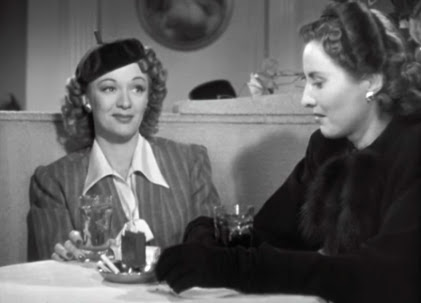
Ginna Abbott (Eve Arden) and Jessica Drummond (Barbara Stanwyck)

Jessica’s best friend Ginna Abbott (Eve Arden) and her husband Cary (John Ridgely) invite her on a ski vacation in Lake Tahoe. Jessica has a skiing mishap and is assisted by Major Scott Landis (George Brent). Jessica is wary of Scott’s attention but she needs his help to get back to her friends' cabin. After a little back and forth between the two, Jessica asks him to leave.

Back home in Lake Forest, Illinois, Jessica learns that Scott is stationed in Chicago. In the meantime, Jessica’s social circle starts spreading rumors about her and Scott. Not understanding why, when she’s unattached, a platonic relationship should garner so much attention and ruin her reputation. One of Jessica’s chief critics is Riette Van Orman (Leona Maricle) whose husband tried to force himself on Jessica.

Jessica and Major Scott Landis (George Brent) on the slopes


During the Christmas holiday, Jessica spends time with her mother her boys, and the family lawyer and friend Frank Everett (Warner Anderson). Jessica’s mother thinks Frank is a suitable man for Jessica to consider dating. Jessica is having none of it; she doesn’t want to be pushed into a relationship with someone she doesn’t love.

After being subjected to her “friends” talking behind her back for months, Jessica confronts Riette at Van Orman’s New Year’s Eve party. Riette expresses her disapproval of Jessica’s behavior in a most unkind way. Jessica protests saying she’s done nothing wrong and resents Riette’s judgment.

It’s about this time that Jessica realizes that she’s in love with Scott and wants to build a life together with him in spite of the gossip and judgment she may encounter going forward. Scott has orders to go overseas which complicates their relationship. It is especially difficult for her two boys who wonder if Jessica has forgotten their father. She tells them that she loved their father but has it in her to love another

My Reputation had its premiere at a U.S. Army base.

Scott is on his way to New York by train and Jessica goes to meet him. She originally planned on going to New York with him but after speaking with her boys decided not to. Jessica meets Scott at the train but tells him she can’t go with him because her boys are too young to understand. Scott asks her to wait for him. Jessica says she will as she watches the train leave the station.

Friday, December 1, 2017

Screening of "Remember the Night" December 5 at the Daystar Center

“Holiday” Series: Remember the Night (1940)
Where: Daystar Center, 1550 S. State Street
When: December 5, 2017
Time: 6:30 p.m.
Hosted by Stephen Reginald


Remember the Night (1940) is a rarely seen holiday classic features the first screen pairing of Barbara Stanwyck and Fred MacMurray.

Stanwyck is Lee Leander, a shoplifter on trial for stealing an expensive bracelet from a jewelry store during the Christmas holidays. The judge decides to postpone her trial till after the New Year, which means Stanwyck would be spending Christmas in jail. Lawyer, John Sargent (MacMurray) takes pity on Lee and pays her bail so she doesn’t have to spend the holidays locked up. John invites Lee to his mother’s home, where he grew up, which makes a big impression on her. The warmth of Sargent’s family and the magic of the Christmas holiday make Lee take stock of her life.

Directed by the too-often-neglected Mitchell Leisen, with a script by Preston Sturges, Remember the Night features a dream of a supporting cast that includes Beulah Bondi, Elizabeth Patterson, and Sterling Holloway.


Have some Joe and Enjoy the Show!
You can bring food and beverages into the auditorium; we even have small tables set up next to some of the seats. General Admission: $5 Students and Senior Citizens: $3.

Join the Chicago Film club; join the discussion
Twice a month we screen classic films and have a brief discussion afterward. For more information, including how to join (it’s free), click here. The Venue 1550 is easily accessible by the CTA. Please visit Transit Chicago for more information on transportation options.

Stephen Reginald is a freelance writer and editor. He has worked at various positions within the publishing industry for over 25 years. Most recently he was executive editor for McGraw-Hill’s The Learning Group Division. A long-time amateur student of film, Reginald hosts “Chicago Film Club,” a monthly movie event held in the South Loop, for the past two years. Reginald has also taught several adult education film classes at Facets Film School, Chicago.

Tuesday, December 20, 2011

Classic Movie Man’s Favorite Christmas Movies: 2011 Edition

Last year I put together a short list of Christmas movie favorites (see Classic Movie Man’s Favorite Christmas Movies). So I decided to put together another list for 2011. This year’s list includes some movies that you may not identify as Christmas movies, but they all include pivotal climatic holiday scenes and often show up during this time of year. The movies are listed below in order of their respective release dates.

Babes in Toyland—1934 This Laurel and Hardy classic also known as March of the Wooden Soldiers, was a favorite of mine as a kid. The “boys” are at their comic best in this interpretation of the Victor Herbert operetta. All the Mother Goose characters are here, including Bo-Peep, Tom-Tom, The Old Lady Who Lived in a Shoe, and Mother Goose herself. Santa Claus makes an appearance, checking up on an order with the toy maker. Due to a misunderstanding the soldiers Santa ordered were mistakenly made life-size and too big for children to play with, which forces the jolly old man to cancel his order. But it’s these giant toy soldiers that save the day at the end.

Heidi—1937 This Shirley Temple classic includes a climatic scene toward the end of the film that takes place during Christmas. Loosely based on the Swiss literature classic by Johanna Spyri, Heidi was originally released on October 15, 1937. One of Temple’s best and most popular films, it has a wonderful message about redemptive love and reconciliation. Jean Hersholt’s characterization as The Grandfather is perfect. He makes the transition from a gruff and bitter man into Heidi’s kind and gentle protector most touching. The film also includes Temple movie mainstays Mary Nash as the evil Fräulein Rottenmeier, Marcia Mae Joes as Klara, and Arthur Treacher as Andrews, the butler, of course.

Margaret Sullivan and James Stewart
The Shop Around The Corner—1940 Legendary film director Ernst Lubitsch’s classic stars Margaret Sullivan and James Stewart as battling coworkers in a Budapest shop. They fall in love when they start corresponding through letters, after answering ads in the newspaper’s lonelyhearts section. Of course Sullivan and Stewart don’t know the true identities of their loves, which makes for some wonderful situations. Never mind that everyone in Budapest sounds like they’re from California, this movie has a warmth and charm that neither remakes, In The Good Old Summertime and You’ve Got Mail, came even close to capturing. For good measure we have the irrepressible Frank Morgan as shopkeeper Mr. Matuschek.

Remember the Night—1940 Tough girl Barbara Stanwyck gets caught shoplifting a bracelet during the Christmas holiday season and is arrested. Fred MacMurray, the prosecuting attorney, postpones the trial until after Christmas and bails Stanwyck out, rather than have her spend the holiday in jail. MacMurray then volunteers to drive Stanwyck to her mother’s house. When Stanwyck’s mother gives her the cold shoulder, MacMurray brings her to his mother’s home to spend the holiday, where she is warmly received. A wonderful romantic melodrama, Remember the Night was written by Preston Sturges (The Lady Eve) and directed by the underrated Mitchell Leisen (Hands Across the Table). An edearing film that demonstrates the power of love and its ability to redeem and transform. 

Meet John Doe—1941 This lesser-known Frank Capra classic stars Barbara Stanwyck as Ann Mitchell a crafty newspaper columnist who creates an everyman character, John Doe. Doe pledges to jump off of the roof of city hall on Christmas Eve, to protest all the injustice in the world. Gary Cooper plays John Doe, handpicked by Mitchell to perpetuate her newspaper column and her job. The column, and the sentiment expressed in it is such a hit with the public that John Doe clubs start forming, making Doe a national figure. Double-crossed by a corrupt newspaper tycoon (Edward Arnold), Doe is disgraced and makes his way to the roof of city hall on Christmas Eve. Will he jump? You’ll have to find out for yourself. Cooper and Stanwyck had a great 1941. They costarred again in the Howard Hawks classic Ball of Fire and Stanwyck starred in the Preston Sturges classic, The Lady Eve. Cooper won the first of his two Oscars for Sergent York. Available in a 70th Anniversary two-disc DVD, Meet John Doe never looked better.

Penny Serenade—1941 The third and last pairing of screen legends Irene Dunne and Cary Grant is a tear-jerking melodrama, which was a change of pace from the rollicking comedies they made together in 1937 and 1940. The movie told in flashback, begins with Julie Adams (Dunne)  packing up her belongings, in preparation to leave her husband, while listening to old recordings on the phonograph. With each familiar tune, she thinks back to the early years of her marriage and happier times. After it is revealed that Julie cannot have children, she and her husband Roger (Grant) adopt a little girl. Tragedy strikes right before Christmas and it tears the couple apart. Directed by Academy Award winner George Stevens, the movie still packs an emotional punch. Grant’s performance earned him his first Best Actor Academy Award nomination. The film also costars the great character actors Beulah Bondi (wonderful as a sympathetic social worker) and Edgar Buchanan. If you’re not crying by the end of this film, you’re dead!

Holiday Inn—1942 Another favorite from my childhood, the movie revolves around friends and entertainers Jim Hardy (Bing Crosby) and Ted Hanover (Fred Astaire) and their professional and romantic entanglements. After Jim’s girlfriend Lila Dixon (Virginia Dale) throws him over for Ted, Jim decides to retire to a Connecticut inn open only during public holidays. Jim hires Linda Mason (Marjorie Reynolds) to work as an entertainer at the inn and a romance quickly develops. This is the movie that launched the song “White Christmas,” which became the biggest selling Christmas song of all time. This film isn’t shown on TCM because it contains a minstrel number, “Abraham” where Crosby and Reynolds appear in blackface. It’s uncomfortable to watch today, but it’s a unfortunate part of our history. The future holiday classic, White Christmas (1954) was a loose remake of this film.

Since You Went Away—1944 Another film not necessarily associated with Christmas, this war-time classic boast an all-star cast featuring Claudette Colbert, Jennifer Jones, Joseph Cotton, Shirley Temple, Lionel Barrymore, Montey Wooley, Robert Walker, and Hattie McDaniel. The film begins in early January and ends in late December 1943. Concentrating on the Hilton family as they keep the home fires burning while its matriarch’s (Colbert) husband is fighting overseas. The film is at times sentimental, but at others is brutally honest about the emotional toll of war, separation, and loneliness. The film has a very moving scene between Ann Hilton (Colbert) and fellow factory worker Zofia Koslowska, a Europen émigré, played by silent-screen legend Alla Nazimova. Zofia details her emigration to the United States and how in spite of the tragedy of war, her life is still so much better than it was in the war-torn land of her birth. The film ends on an inspirational note during Christmas to encourage wartime moviegoers, but the message of courage and hope still resonates—maybe even more so—today.

It Happened On 5th Avenue—1947 This minor classic hasn’t benefited from annual showings on TV to build its reputation, but it is an interesting and engaging film. Frank Capra had intended to film this story, but decided he couldn’t make two movies centered around Christmas in the same year, so he opted to make just one, It’s A Wonderful Life. It Happened On 5th Avenue is about a hobo named Aloyisius T. McKeever (Victor Moore) who lives in a boarded up Manhattan mansion during the winter while the owner, Michael J. O’Connor (Charles Ruggles), the second richest man in the world, moves down south for the season. McKeever meets a homeless World War II veteran, Jim Bullock (Don DeFore), recently kicked out of his apartment. Aloyisius feels sorry for Jim and decides to take him “home.” O’Connor’s daughter, Trudy (Gale Storm) unhappy at finishing school, runs away and returns to the boarded up New York City mansion. Both Aloyisius and Jim think she’s a crook out to steal a mink coat. Not wanting to get her father involved and possibly sent back to school, Trudy confesses to being a girl down on her luck and in need of some nice clothes for a job interview. The three become fast friends and decide to invite two homeless families with children to live with them. Before you know it, Trudy’s mother, Mary O’Connor (Ann Harding) is living in the mansion too, disguised as a cook, along with her estranged husband, Michael, now pretending to be another hobo. The plot is incredible, but the cast of pros make it all work somehow. Don Defore and Gale Storm would go on to TV immortality as Mr. Baxter in Hazel and Margie Albright in My Little Margie respectively.

Holiday Affair—1949 Not a big hit when first released, it’s become something of a classic today, due in part to the curiosity surrounding the change-of-pace role for tough-guy Robert Mitchum and repeated showings on TCM. Fresh-faced Janet Leigh costars as war widow, Connie Ennis, with a young son (Gordon Gebert) to support. Connie, a comparative shopper, buys an electric train set from salesman and army veteran, Steve Mason (Mitchum). Connie returns it the next day for a refund, which results in Steve being fired. Connie’s long-term relationship with lawyer Carl Davis (Wendell Corey) is complicated when she finds herself attracted to Steve. Similar to Miracle on 34th Street in some ways, the film benefits from the good chemistry between Leigh and Gebert as mother and son.

Of course there are more Christmas movies, but that’s what the 2012 list is for! Please feel free to share your favorites here and Merry Christmas!

Classic Movie Man's Favorite Christmas Movies: 2010 Edition

Wednesday, April 20, 2011

Fred MacMurray: Nice-Guy Movie Star

Fred MacMurray (1908-1991) was a popular movie star during Hollywood’s Golden Age. He was so popular, that in 1943, MacMurray was the highest paid movie star in the world. For most of his career, MacMurray played likeable characters in comedies, musicals, and dramas. The few times MacMurray played heavies or “bad” guys, he surprised audiences and impressed the critics. In the 1960s and 1970s, MacMurray was America’s favorite dad on TV’s My Three Sons.

Illinois Born
Born Frederick Martin MacMurray in Kankakee, Illinois. His parents, Frederick MacMurray and Maleta Martin, eventually settled in Beaver Dam, Wisconsin, where Martin was born.

Music Scholar and Broadway Star
MacMurray studied music in school and was talented enough to win a full scholarship to Carroll College in Waukesha, Wisconsin. In the early 1930s, he was part of an orchestra. He eventually ended up on Broadway working alongside the likes of Sydney Greenstreet and Bob Hope. In 1934, he signed with Paramount where he was groomed for movie stardom. In 1935, MacMurray appeared in seven movies, starring opposite some of the most popular leading actresses of the day, including Claudette Colbert and Katharine Hepburn. But it was his star turn opposite Carole Lombard in Michell Leisen’s Hands Across the Table that made him a bonafide movie star.

Box Office Success
Hands Across the Table was a breakthrough for both Lombard and MacMurray. The Lombard-MacMurray on-screen chemistry was a big hit with movie audiences. Paramount was quick to capitalize on their popularity by costarring them in three more films over the next two years. Lombard and MacMurray starred in two majors successes in 1937, Swing High, Swing Low (Paramount’s biggest success that year) and True Confession. Had it not been for Lombard’s untimely death in 1942, there might have been more pairings.

A "Paramount" Leading Man
During the late 1930s and 1940s, Paramount cast MacMurray opposite all of it’s top female stars, including Marlene Dietrich, Paulette Goddard, and Barbara Stanwyck. MacMurray starred with Stanwyck in the Preston Sturges scripted, Leisen directed classic, Remember the Night (1940), but it would be 1944’s Double Indemnity that would forever link the two together.

Icon Status
Cast against type as insurance salesman Walter Neff by director Billy Wilder, MacMurray showed a darker side the public had not seen before. Playing opposite Stanwyck as Phyllis Dietrichson and Edward G. Robinson as Barton Keyes, MacMurray, who was topped billed, more than held his own. The film was a hit with the public and most critics of the day. Over the years, the film’s reputation has grown. In 2007, the American Film Institute ranked Double Indemnity 29 on its list of the 100 best American Films, which was nine spots higher than when the poll was taken in 1998.

Fred MacMurray and Barbara Stanwyck in the Billy Wilder classic Double Indemnity
Popular Costars
MacMurray continued his winning streak throughout the 1940s. He developed a reputation around Paramount as the perfect leading man. Never overpowering the leading lady, MacMurray costarred in seven films with Colbert, four with Stanwyck as well as starring in several films with Goddard and Madeleine Carroll. MacMurray could carry a film on his own as evidenced by the successful Murder, He Says (1945), directed by George Marshall.

MacMurray and Claudette Colbert starred together in seven movies.

A Turn in the Road
In 1953, his wife of 17 years passed away, leaving him with two children: 13-year old Susan and seven-year-old Robert. The following year, he married June Haver; they adopted twin daughters Katherine and Laurie in 1956. During the mid-1950s, MacMurray, like James Stewart, stayed busy starring in mostly western movies. As the 1950s came to an end, MacMurray’s career took yet another turn.

MacMurray in The Absent-Minded Professor

Disney Legend
In 1959, Walt Disney tapped MacMurray for a starring role in The Shaggy Dog. The low-budget film was a monster hit for the studio, which led to the title role in The Absent-Minded Professor in 1961 and its sequel, Son of Flubber in 1963. Disney’s top director, Robert Stevenson (Jane Eyre, Marry Poppins), turned both films into box office gold.

MacMurray caused a stir by playing a philandering husband in The Apartment.

Wilder Called Again
Director Billy Wilder called on MacMurray once again to play against type in 1960’s The Apartment. Starring alongside Jack Lemmon and Shirley MacLaine, MacMurray played wife-cheating executive Jeff D. Sheldrake. His performance was jarring to many filmgoers, who were now used to his persona as a Disney star. The Apartment would be the last film in which he would play a heel.

The first season of My Three Sons featured William Frawley as Bub.

 TV Star
Along with his new career at Disney, MacMurray entered series television in 1960 starring as widowed father Steve Douglas on My Three Sons. One of the most popular TV series of all time, it ran for 12 years and cemented MacMurray’s place in American popular culture. MacMurray, always the shrewd businessman, arranged his TV filming schedule so he could continue making films. Between 1959-1973, MacMurray starred in seven movies for Disney, with Charley and the Angel (1973) being his last.

Well Remembered
MacMurray's star is at 6421 Hollywood Blvd.
MacMurray had a natural, comfortable acting style that was often overlooked. His comedic timing was as good as anyone’s and his dramatic performances gain new respect and appreciation with each passing year. In 1987, MacMurray was the first person honored as a Disney Legend.

A true movie legend, MacMurray earned his star on the Hollywood Walk of Fame.


Trivia: MacMurray worked with two of his My Three Sons co-stars long before the series debuted. William Frawley, who played grandfather Bub, co-starred alongside MacMurray in The Princess Comes Across (1936). And William Demarest, who replaced the ailing Frawley as Uncle Charley, was one of Carole Lombard's prospective boyfriends in Hands Across the Table (1935).


Related Posts Plugin for WordPress, Blogger...