Showing posts with label Christmas movies. Show all posts

Monday, December 19, 2022

Barbara Stanwyck Sleighs Christmas

Barbara Stanwyck is one of the icons of Hollywood’s Golden Age. She was believable as a hard-boiled film noir dame as she was a madcap heiress in screwball comedy. She had a way of mixing toughness and vulnerability like no other actress in film history. These qualities would contribute to Stanwyck’s longevity in a career that spanned over 60 years.

Stanwyck is so closely identified with film noir due to her Oscar-nominated performance in Double Indemnity (1944) that she is almost forgotten for some of the best Christmas-themed movies ever made.

The four Christmas movies Stanwyck starred in have stood the test of time and all are worth watching, even in the jaded 21st century. So here we go!

Lee Leander (Barbara Stanwyck) and John Sargent (Fred MacMurray) take a break on their way to Indiana.

Remember the Night (1940) is directed by the underrated Michell Leisen with a screenplay by Preston Sturges. It’s a wonderful Christmas movie that has been rediscovered in the last several years. It’s also the first pairing of Stanwyck and Fred MacMurray, four years before Double Indemnity cemented their status as film noir icons.

Lee Leander (Stanwyck) is arrested for shoplifting a bracelet from a jewelry store in New York City. Her trial is set to start right before Christmas. John “Jack” Sargeant (MacMurray), the lawyer set to prosecute her, gets the trial postponed until after Christmas. He fears that the jurors will be filled with compassion during the Christmas holiday and declare her not guilty. But when he hears Lee complain to her lawyer that she’ll be spending Christmas in jail, Sargeant arranges for her bail.

Through a misunderstanding, the bail bondsman delivers Lee to Jack’s apartment, thinking he wants to take advantage of the situation by seducing her. When Jack realizes that Leander is a fellow Hoosier, he volunteers to drive her home for Christmas. When Lee arrives at her mother’s home, she finds a mean spirited woman who wants nothing to do with her daughter. Lee is devastated by her mother’s rejection. Seeing how hurt she is, Jack invites her to come home with him for Christmas.

Lee is embraced by Jack’s family including his mother (Beulah Bondi), Aunt Emma (Elizabeth Patterson), and Cousin Willie (Stanley Holloway). Perhaps for the first time in her life, Lee feels loved and accepted. Jack’s mother and aunt treat Lee like family and it has a profound effect on her.

Lee and Mrs. Sargent (Beulah Bondi) have a serious conversation. 

When Jack and Lee start falling in love, things begin to change. As much as Jack’s mother feels for Lee’s predicament, she’s concerned for her son’s career, a career that took a lot of hard work and sacrifice.

Will Jack and Lee be able to overcome the obstacles in their way and find happiness? I hope you get the chance to see this classic for yourself; I think you’ll be surprised by the ending. 


Meet John Doe (1941) is a comedy-drama directed by Frank Capra. Stanwyck’s co-star is Gary Cooper who has the title role. Stanwyck stars as Ann Mitchell, a newspaper reporter who is fired when a new owner takes over The Bulletin a paper with a sagging readership. As she exits, Ann creates a column featuring a man she calls John Doe who plans on committing suicide to protest the ills of the world on Christmas Eve.

John Willoughby (Gary Cooper) and Ann Mitchell (Barbara Stanwyck)

The column gets such a big response from the public that the new editor of the paper hires Ann back. Once she’s back on the paper, Ann sets about finding a “real” John Doe to promote her column and to keep her employed. When she sees Long John Willoughby (Cooper), a former baseball player and tramp, she thinks she’s found the perfect man to play the part. With coaching from Ann, John develops into a competent speaker and leader. John Doe clubs pop up all over the country due to John’s appearances on the radio and Ann’s columns.

Ann convinced newspaper editor Henry Connell (James Gleason) that she should get her job back.


When the owner of the paper D. B. Norton realizes that the John Doe clubs could help him with his political ambitions, as long as he can convince Ann and John to go along. Things get complicated when Ann finds herself falling in love with John but is blinded by the money and position Norton offers her.

John refuses to go along with Norton which also alienates him from Ann who he thinks has betrayed him. At an outdoor rally where John is set to speak, Norton has the microphones turned off and agitators in the crowd hired to turn the rallygoers against him. Ann, now being held by Norton is desperate to explain herself to John but he won’t listen. Frustrated and upset, Ann makes herself sick when she realizes that John thinks she played him for a fool.

Hurt and disillusioned, John decides to jump off of the top of City Hall on Christmas Eve just as Ann had said he would in her first column. D. B. Morton and his associates fear that John may actually try to jump to his death and go to the top of City Hall. They’re afraid he’ll turn himself into a martyr and thwart their political ambitions.

Ann Mitchell begs John not to jump

Ann, leaving her sickbed goes to City Hall in an attempt to keep John from jumping. She confronts John and begs him not to jump. She also proclaims her love for him and that together they can continue the John Doe movement. Exhausted from her climb to the top of City Hall and her illness, Ann collapses in John’s arms. At that moment, some members of the John Doe clubs have gone to the top of city hall to tell him the movement isn’t dead and that they still believe in him.

What does John do? Is there hope for John and Ann and the John Doe movement? Watch this classic (it’s free on YouTube) to find out.


Christmas in Connecticut (1945) is a wonderful screwball comedy directed by Peter Godfrey. Stanwyck plays Elizabeth Lane, a popular food writer for Smart Housekeeping magazine owned by publisher Alexander Yardley (Sydney Greenstreet). Her stories about her married life on a farm in Connecticut with her husband and baby have helped boost circulation, making it one of the top magazines in the country. The only problem is Elizabeth Lane’s life is one big lie. She can’t cook, she’s not married, has no baby or a farm in Connecticut. All her recipes come from her friend Felix Bassenak (S.Z. Sakall) a restaurateur in her neighborhood.

Jefferson Jones (Dennis Morgan) and Elizabeth Lane (Barbara Stanwyck) out for a sleigh ride

As a publicity stunt, Yardley invites a Navy veteran who was adrift at sea for several weeks before his rescue to Elizabeth’s “farm” for Christmas. Yardley believes that if Elizabeth Lane entertains a war hero in her home, readers will buy and subscribe to Smart Housekeeping.

This development puts Elizabeth on the spot. How will she be able to entertain a war hero when she lives in a small New York City apartment? Enter John Sloan, an architect, who is in love with Elizabeth and has asked her to marry him on several occasions but has always been turned down…until now! John has a farm in Connecticut, the farm she has based her stories on, and he’s anxious to make her his bride. Sloan even has worked out a plan where they can “rent” a baby!

Felix (S.Z. Sakall) teaches Elizabeth how to flip pancakes

When returning war hero Jefferson Jones (Dennis Morgan) arrives at the Connecticut farm, he is immediately smitten with Elizabeth Lane, and she is with him. Elizabeth and Sloan try numerous times to get married at the farm but are always interrupted by someone or something. Felix, who doesn’t think Sloan is the right man for Elizabeth, finds ways to disrupt their wedding plans on several occasions. On the other hand, he does all he can to bring Elizabeth and Jefferson together since Felix sees the war veteran as a better match for his friend.

Like many screwball comedies, the action is fast and furious with lots of witty dialogue and improbable situations. You know that Elizabeth and Jefferson are destined to be together, but it’s the crazy path they take to get there that makes this movie so much fun.


My Reputation (1946) is a wonderful romantic drama directed by Curtis Bernhardt. Stanwyck stars as Jessica Drummond a widow who is trying to get on with her life while raising two young boys. She gets a lot of advice from her friends and family on how she should act now that she’s a widow. Her mother (Lucile Watson) especially feels that her daughter should mourn her husband perpetually. Jessica’s mother still wears black in memory of her dead husband. Jessica wants no part of her mother’s view of widowhood. Some of the film’s major events take place during the Christmas and New Year’s Eve holidays.
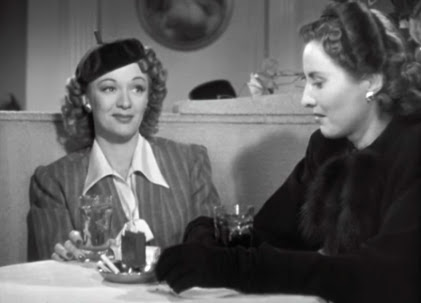
Ginna Abbott (Eve Arden) and Jessica Drummond (Barbara Stanwyck)

Jessica’s best friend Ginna Abbott (Eve Arden) and her husband Cary (John Ridgely) invite her on a ski vacation in Lake Tahoe. Jessica has a skiing mishap and is assisted by Major Scott Landis (George Brent). Jessica is wary of Scott’s attention but she needs his help to get back to her friends' cabin. After a little back and forth between the two, Jessica asks him to leave.

Back home in Lake Forest, Illinois, Jessica learns that Scott is stationed in Chicago. In the meantime, Jessica’s social circle starts spreading rumors about her and Scott. Not understanding why, when she’s unattached, a platonic relationship should garner so much attention and ruin her reputation. One of Jessica’s chief critics is Riette Van Orman (Leona Maricle) whose husband tried to force himself on Jessica.

Jessica and Major Scott Landis (George Brent) on the slopes


During the Christmas holiday, Jessica spends time with her mother her boys, and the family lawyer and friend Frank Everett (Warner Anderson). Jessica’s mother thinks Frank is a suitable man for Jessica to consider dating. Jessica is having none of it; she doesn’t want to be pushed into a relationship with someone she doesn’t love.

After being subjected to her “friends” talking behind her back for months, Jessica confronts Riette at Van Orman’s New Year’s Eve party. Riette expresses her disapproval of Jessica’s behavior in a most unkind way. Jessica protests saying she’s done nothing wrong and resents Riette’s judgment.

It’s about this time that Jessica realizes that she’s in love with Scott and wants to build a life together with him in spite of the gossip and judgment she may encounter going forward. Scott has orders to go overseas which complicates their relationship. It is especially difficult for her two boys who wonder if Jessica has forgotten their father. She tells them that she loved their father but has it in her to love another

My Reputation had its premiere at a U.S. Army base.

Scott is on his way to New York by train and Jessica goes to meet him. She originally planned on going to New York with him but after speaking with her boys decided not to. Jessica meets Scott at the train but tells him she can’t go with him because her boys are too young to understand. Scott asks her to wait for him. Jessica says she will as she watches the train leave the station.

Monday, December 10, 2018

ArcLight Cinemas Shares The Holiday Spirit With New ArcLight Presents… Let It Snow


Curated series brings feel-good, romantic and classic holiday film favorites to the big screen as the season kicks into full swing! 

CHICAGO (November 15, 2018) – ArcLight Cinemas – Chicago, the premier moviegoing destination in Lincoln Park (1500 N. Clybourn Ave.) announces a special, seasonal film series featuring six nights of holiday movies. From nostalgic to romantic – hilarious to action-packed, ArcLight Cinemas has carefully curated a selection of timeless stories for film lovers to enjoy this season. ArcLight Presents… Let it Snow begins on Monday, November 19 at 7:30 p.m. and runs through Monday, December 17. The schedule of the beloved films includes special screenings of A Christmas Story, Love Actually, Planes, Trains and Automobiles, Home Alone, Tokyo Godfathers, and Die Hard.

“When curating films for the ArcLight Presents… Let It Snow series, we looked at movies for everyone; movies that transcend individual traditions and holidays, connecting people together to share the joy of the season,” said Kevin Holloway, VP of Film Marketing and Operations, ArcLight Cinemas. “Everybody has their own tradition and their own favorite holiday movies, and we hope to evoke special memories of the season through these film selections.”

ArcLight Cinemas, the premier moviegoing experience with an unparalleled commitment to bringing a variety of rich cinematic content, offers more than just a place to watch a movie. With a focus on undistracted viewing and state of the art sight and sound technology, guests experience classic movies the way they were meant to be seen.

The upcoming ArcLight Presents… Let it Snow schedule is:


Home Alone

Monday, December 10 at 7:30 p.m.

An eight-year-old troublemaker must protect his home from burglars when he is accidentally left home alone during Christmas vacation. Directed by Chris Columbus, the 1990 family-favorite, Home Alone, stars Macaulay Culkin Joe Pesci, and Daniel Stern.

Tokyo Godfathers

Tuesday, December 11 at 7:30 p.m.

A trio of homeless people living on the streets of Tokyo set out to find the parents of a newborn baby they found among the trash on Christmas Eve. The 2003 animated Japanese film, Tokyo Godfathers, was co-directed by Satoshi Kon and Shôgo Furuya and features the voices of Tôru Emori, Yoshiaki Umegaki, and Aya Okamoto.

Die Hard

Monday, December 17 at 7:30 p.m.

An NYPD officer, John McClane, tries to save his wife Holly Genaro and others after a German terrorist takes them hostage during a Christmas party at Nakatomi Plaza in Los Angeles. Directed by John McTiernan, Die Hard stars Bruce Willis, Alan Rickman, and Bonnie Bedelia. This untraditional 1988 Christmas movie celebrates its 30th anniversary this year.

Tickets for the ArcLight Presents… Let it Snow series are $12.50 (adults). ArcLight Members can use their two free ArcLight Presents… tickets for this series. Not a member? Sign up at arclightcinemas.com/membership. For more information and to reserve your seats now, please visit https://www.arclightcinemas.com/en/movies/arclight-presents.

About ArcLight Cinemas:

ArcLight Cinemas, a privately owned, Los Angeles based company with 60 years of theatrical exhibition history throughout California, Hawaii, and Washington is a premier moviegoing experience with an unparalleled commitment to bringing a variety of rich cinematic content to moviegoers in all markets. ArcLight Cinemas operates seven theaters in California including Hollywood, Pasadena, Sherman Oaks, El Segundo, Santa Monica, Culver City and La Jolla, as well as theaters in Bethesda, MD, Chicago and Glenview, IL, with a new location in Boston for 2019. ArcLight also owns and operates the historic Cinerama Dome and programs the TCL Chinese Theatre and IMAX in Hollywood. Pacific Theatres currently operates theaters in Los Angeles that include The Grove and The Americana at Brand in Glendale, CA. Additional information about ArcLight Cinemas is available at www.arclightcinemas.com.

Connect with ArcLight:

Facebook: facebook.com/ArclightCinemas #ArcLightChicago
Twitter: twitter.com/ArcLightCinemas #ArcLightChicago
Instagram: instagram.com/arclightcinemas #ArcLightChicago

Editor’s note: Received information on this series late, so I’ve just printed the dates and times for films that have yet to be screened.

Saturday, December 20, 2014

Classic Movie Man’s Favorite Christmas Movies: 2014 Edition

It’s Christmastime again. And it’s time for some more classic Christmas films to enjoy during the holidays. Some of these films you might not associate with Christmas, but all feature the holiday prominently. Make some hot chocolate, light up the fireplace and get cozy on the couch or your favorite chair to watch some great classic movies!


Lady for a Day—1933 This early Frank Capra classic (released a year before It Happened One Night) is about Apple Annie (May Robson), a poor woman who sells fruit on the streets of New York City to support her daughter’s education in a Spanish convent school. Her daughter is coming to visit her mother, who she thinks is a society lady. Annie needs a Christmas miracle to keep up the charade when her daughter arrives with her fiancé Carlos and his father, Count Romero. Will Annie’s street friends and gambler Dave the Dude (Warren William) come to her aid? What do you think? It’s great classic entertainment from one of Hollywood’s great masters.

Backstory: Capra wanted Robert Montgomery (it was written with Montgomery in mind), James Cagney or William Powell to star as Dave the Dude and Marie Dressler to star as Annie, but their respective studios wouldn’t loan them out.

The Thin Man—1934 The first of the classic films featuring Nick and Nora Charles (William Powell and Myrna Loy) includes several scenes during the Christmas holiday. Nick, a former detective and Nora, his rich wife, solve murders for the fun of it. The film combines comedy, mystery, and slapstick (check out Myrna Loy’s terrific pratfall at the beginning of the movie). The Thin Man basically invented the comedy murder-mystery genre. It’s fast and furious, featuring some of the best dialogue of all time. Nora utters my favorite: “Waiter, will you serve the nuts? I mean, will you serve the guests the nuts?”

Backstory: The very efficient W. S. Van Dyke reportedly shot the film in only two weeks. The Thin Man was the first of six movies featuring the sleuthing Nick and Nora Charles, all starring Powell and Loy.

Bright Eyes—1934 This was the first film developed for Shirley Temple. Temple is Shirley Blake who lives with her mother Mary, (Lois Wilson) a maid in the house of the Smythe family. When she becomes an orphan on Christmas morning, Shirley’s future is uncertain. Her bachelor godfather and pilot, James “Loop” Merritt (James Dunn) would like to adopt the orphan, but wheelchair-bound Uncle Ned Smythe (Charles Sellon) wants Shirley to live with him. His snooty relatives, Anita and J. Wellington Smythe and their obnoxious daughter Joy (Jane Withers) reluctantly agree to his wishes, hoping to stay in his good graces financially. This is the film that features the song “On The Good Ship Lollipop,” a tune forever identified with Temple. Bright Eyes established Temple as a top box office star. Temple would continue to be a major fan favorite throughout the 1930s.

Backstory: Temple won a special juvenile Academy Award in 1935, the first year it was presented, for her work in Bright Eyes and Little Miss Marker. Shirley’s dog, Rags (Terry) was the same dog that played Totto in The Wizard of Oz.

Love Affair—1939 One of the great films from that amazing year stars Irene Dunne as singer Terry McKay and Charles Boyer as painter and playboy Michel Marnet. The two, both engaged to other people, meet on a trans-Atlantic liner and fall in love. Terry and Michel decide to meet at the top of the Empire State Building (the closest place to heaven) six months later. When the date arrives, Terry is hit by a car crossing the street and is badly injured. It is uncertain if she will ever be able to walk. Not wanting to gain Michel’s sympathy or be a burden, Terry refuses to contact him and tell him the reason she didn’t’ show up. The two accidentally meet at a theater, but it isn’t obvious to Michel that Terry cannot walk. Michel visits Terry on Christmas, gifting her with his mother’s shawl, something Terry had admired when she met the old woman who is now deceased. Michel finds out about Terry’s injury, but decides it doesn’t matter; they will be together whatever the diagnosis.

Backstory: Love Affair was nominated for six Academy Awards, including Best Picture and Best Actress (Dunne). The film was remade twice: An Affair to Remember (1957) starring Cary Grant and Deborah Kerr and Love Affair (1994), starring Warren Beatty and Annette Benning.


My Reputation—1946 Barbara Stanwyck plays Jessica Drummond, a young widow and mother of two sons from Chicago’s North Shore. Jess is mourning the loss of her husband as well as attempting to navigate the demands of being an upper class society woman. Her mother, Mary (Lucille Watson) is no help at all. She’s shocked when her daughter refuses to dress in black and makes Jess feel guilty for not following her example—Mary, a widow herself has been wearing black for decades. Fortunately for Jess, she has a great friend in Gina Abbott (Eve Arden) whom she confides in. Gina invites Jess to spend a week at Lake Tahoe with her husband. While skiing she meets Major Scott Landis (George Brent) who takes an immediate interest in her. Jess likes Scott and enjoys his company, but is reluctant to get too involved. The plot thickens when a friend of Jess’s mother sees her enter Scott’s apartment. It doesn’t take long for the society gang to spread rumors about Jess and her reputation, now seemingly tarnished. When Jess’s boys Kim (Scotty Beckett) and Keith (Bobby Cooper) come home from a Christmas party after hearing the gossip about their mother, things take an interesting turn. Stanwyck gives a subtle and sensitive performance as Jess and is ably supported by Brent and the rest of the cast. My Reputation is so well done and it’s a wonderful film to watch during the holidays.

Backstory: Made in 1944, the movie wasn’t released until 1946. The movie premiered in England to the Armed Forces. My Reputation was the first movie since the production code—enforced in 1934—to feature a double bed in a married couple’s bedroom.


In the Good Old Summertime—1949 Don’t let the title fool you! This musical remake of the Ernst Lubitsch classic, The Shop Around the Corner has several critical scenes that take place during the Christmas holidays and features the song “Merry Christmas.” Veronica Fisher (Judy Garland) and Andrew Larking (Van Johnson) are battling coworkers in a music store owned by Otto Oberkugen (S.Z. Sakall). Unbeknownst to Veronica and Andrew is the fact that they are each other’s secret pen pal. Garland is absolutely charming as Veronica and Johnson is perfect as Andrew. The supporting cast is a film buff’s delight that features the talents of Sakall, Spring Byington, Clinton Sundberg, and Buster Keaton, making his first film at M-G-M since being fired from the studio in 1933.

Backstory: Judy Garland replaced June Alyson who had to drop out of the movie due to pregnancy. Liza Minnelli made her film debut as the child of Veronica and Andrew in the closing shot.

Room for One More—1952 This heartwarming family film was a favorite of my family, especially around Christmastime. The movie stars Cary Grant and Betsy Drake (who were married at the time) as George “Poppy” and Anna Rose, a middle-class family who foster children who eventually become permanent members of their family. Anna is the softy of the two, or so it seems. The Roses have three children of their own, but after visiting an orphanage, Anna feels compelled to help at least one child. Poppy who is reluctant and grumpy about his wife’s willingness to bring strange children into their home, eventually warms up to the idea. Room for One More is a wonderfully entertaining film that demonstrates the importance of family, love, forgiveness, and reconciliation.

Backstory: The words “under God” are missing from the Pledge of Allegiance the schoolchildren recite because they weren’t added until 1954.

What do you think these of these choices? I would love to hear from you. Merry Christmas!

There are so many great classic movies to watch during the holidays. The above are just a small sampling. For a list of some other classic Christmas movies, click on the links below.

Classic Movie Man's Favorite Christmas Movies: 2010 Edition
Classic Movie Man's Favorite Christmas Movies: 2011 Edition

Tuesday, December 24, 2013

Classic Movie Man's Favorite Christmas Movies: 2013 Edition

It’s become an annual feature on this blog to write about my favorite classic Christmas movies. In the movies, the Christmas season can be portrayed as incredibly sentimental, sad or tragic. Here are a few classics that use the holiday as a backdrop to the overall narrative. This list includes some of my favorite movies, featuring some of Hollywood’s legendary stars—like they don’t make any more. Enjoy!


Little Women—1933 The definitive version of the Louisa May Alcott novel stars Katharine Hepburn and
Joan Bennett as Jo and Amy March respectively. Set during and after the American Civil War, the story centers around the March sisters and their mother, Marmee. Their lives are turned upside down while Mr. March is away from home, fighting for the Union Army. Surviving without Mr. March is a challenge for Marmee and the girls who are beholden to their rich Aunt March, played by the always enjoyable, Edna May Oliver. During the Christmas season, the girls don’t receive much in the way of gifts, but they share a love and bond that make the spirit of the holiday rich and meaningful. A wonderful film to watch any time of the year, but it really glows around Christmas time. Little Women also features one of Hepburn’s best performances. Other standouts in the cast include, Bennett, Frances Dee as Meg, Jean Parker as the doomed Beth, Spring Byington as Marmee, and Paul Lukas as Professor Bhaer.

Backstory: Little Women has been remade several times for television and for theatrical release. After the 1933 version, the 1949 Little Women with June Allyson, Peter Lawford, Margaret O’Brien, Elizabeth Taylor, and Janet Leigh is worth watching too. Filmed in glorious M-G-M Technicolor, it looks like a Christmas postcard.


Ching-Ching on Christmas morning 
Stowaway—1936 This popular Shirley Temple vehicle was considered one of her best when released. Temple plays Barbara “Ching-Ching” Stewart, an orphan living in China. While in Shanghai, Ching-Ching becomes a stowaway on the same ship as Tommy Randall (Robert Young), a rich playboy traveling around the world by luxury liner. Also on board is Susan Parker (Alice Faye), the traveling companion to Mrs. Hope, the mother of Susan’s ex-fiance. Of course Tommy and Susan fall in love and adopt little Ching-Ching. Along the way there are some nice tunes for Temple and Fay to sing, including “Goodnight My Love” and “That’s What I Want for Christmas.” The latter is sung during the last few minutes of the movie as the new family celebrates the Christmas holiday together for the very first time. The song, along with the film, was enormously popular. As Temple movies go, this is one of my favorites. Young and Faye have a warm and realistic chemistry on screen and the film includes the wonderful Arthur Treacher, part of the “Shirley Temple Stock Company.” If you’ve never seen a Temple film before, this is a good one to watch as a primer.

Backstory: The New York Times reviewer thought Stowaway was Temple’s best film since Little Miss Marker (1934). Temple followed up this hit with two blockbusters in 1937:  Wee Willie Winkie directed by John Ford and Heidi directed by Allan Dwan.


Carole Lombard, Cary Grant, and Kay Francis make up
the triangle In Name Only.
In Name Only—1939 This movie melodramatic stars popular screwball comedy icons Carole Lombard and Cary Grant. Kay Francis also stars as Grant’s wife, more interested in money and position than love. Grant plays Alec Walker, a rich businessman from a well-respected family. Discouraged and despondent over his loveless marriage to Maida (Francis), Alec’s spirits are temporarily lifted when he runs into Julie Eden (Lombard) and her young daughter, Ellen (an unbilled Peggy Ann Garner). Julie is a widow and a commercial artist in New York City. Alec and Julie meet by accident, and develop a friendship that quickly turns into love. Julie realizing there is no future with a married man tries to break things off, but Alec is persistent. Maida has so manipulated Alec’s parents that they cannot see her deception. They take her side against their own son and look down their noses at Julie. When Maida refuses to give Alec a divorce, all seems lost. On Christmas Eve, Alec gets himself good and drunk and he ends up sick with pneumonia (thanks to sitting in front of an open window all night). In the hospital, Alec asks for Julie. Julie goes to be by his side, but is shunned by Alec’s parents and their family doctor. At the hospital, Julie confronts Maida. Maida reveals to Julie that she never loved Alec and that she’s holding out for the old man’s money, just as Mr. and Mrs. Walker enter the hospital room and hear their duplicitous daughter-in-law’s scheme. Alec’s parents finally wise to Maida declare that she won’t get a penny of their money. This event frees Alec and Julie to be together, enabling them to share a very Merry Christmas, even if it’s in a hospital room.

Backstory: Kay Francis was one of the biggest movie stars in the world in the early and mid 1930s. At the time this film was released, her career was on a downward spiral. Lombard who knew Francis from her Paramount contract days, offered Francis the plum role of Maida and gave her equal billing with herself and Cary Grant. The New York Times called the film “soap opera par excellence, blessed with a peerless cast.”


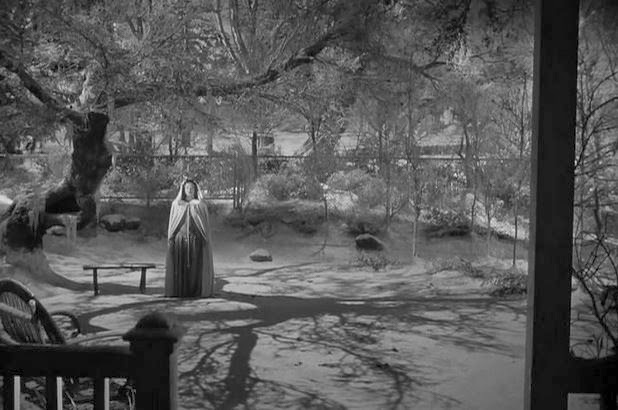
Irena (Simone Simon) sings carols in the snow.
The Curse of the Cat People—1944 A Christmas movie you say? Yes, indeed! As a sequel to Cat People, it stands on its own merits as an original work of movie storytelling. The film concerns the story of Amy (Ann Carter), an introverted little girl who spends all her time daydreaming. She conjures up an imaginary friend Irena (Simone Simon), the late first wife of her father (Kent Smith), something that baffles her parents, since Irena’s name has never been mentioned in their house. Amy also befriends Mrs. Farren, (Julia Dean) an elderly woman who is estranged from her own daughter, Barbara (Elizabeth Russell) who is desperate for some emotional connection to her mother. During the Christmas holiday, Amy sees Irena in her backyard in a beautiful gown. As party guests inside Amy’s house are singing carols, Irena sings a carol to Amy in French. Shortly after this event, Irena tells Amy that she is leaving her and she won’t be visiting her again. Distraught by this news and her parents growing frustration with what to do, Amy runs away from home during a snowstorm. She ends up at the home of Mrs. Farren, hoping to find some comfort. She does for a moment until Mrs. Farren drops dead before her. Barbara approaches Amy with murder in her eyes, but suddenly melts when Amy, imagines that Barbara is Irena—calling her “my friend.” Instead of straggling the child, which is what we think is about to happen, Barbara returns the embrace that Amy gives her, her features and body language softening. The Curse of the Cat People is an interesting look at the imaginary life of a child and the parent-child relationship.

Backstory: This was the first film to be directed by Robert Wise (West Side Story, The Sound of Music) who took over for the original director, Gunther von Fritsch. The New York Time’s Bosley Crowther called the film “a rare departure from the ordinary run of horror films [which] emerges as an oddly touching study of the working of a sensitive child’s mind.”


The poster gives you an idea that all is not too, too serious!
Lady on a Train—1945 This interesting mix of film noir and screwball comedy stars a very blond Deanna Durbin as a young women on her way to New York during the Christmas holiday. Traveling to Grand Central Station, debutante Nikki Collins (Durbin) witnesses a murder from her train car window. When the police ignore her story as the tale of someone with an overactive imagination, Nikki solicits the help of mystery novelist Wayne Morgan (David Bruce). Nikki tries to figure out who killed Josiah Waring and why? She suspects Arnold Waring (Dan Duryea), but there’s something odd about Arnold’s cousin, Jonathan Waring (Ralph Bellamy). Of course Deanna gets to sing several songs, including “Give Me a Little Kiss,” and “Night and Day,” while she’s sleuthing. She sings the Christmas hymn “Silent Night” to her father (who is never seen) over the telephone. Durbin sings the carol, reclining on her hotel bed bathed in the most becoming movie star lighting imaginable. As the plot thickens and Nikki gets closer to the truth her own life is in peril. The movie features a supporting cast of film noir and screwball comedy pros, including the aforementioned Duryea and Bellamy, Edward Everett Horton, Elizabeth Patterson, and William Frawley. The film moves along at a clip and balances the serious with the comedy well. A treat for Durbin fans for sure, but it should also please fans of film noir and screwball comedies as well.

Backstory: Deanna Durbin married the French director, Charles David (her third husband). She abandoned her Hollywood career in 1948, married David in 1950 and together they relocated to France where she remained until her death in 2013.

There are so many great classic movies to watch during the holidays. The above are just a small sampling. For a list of some other classic Christmas movies, click on the links below.

Classic Movie Man's Favorite Christmas Movies
Classic Movie Man’s Favorite Christmas Movies: 2011 Edition
Classic Movie Man’s Favorite Christmas Movies: 2012 Edition

Saturday, December 22, 2012

Classic Movie Man’s Favorite Christmas Movies: 2012 Edition

For the past two years, I’ve posted my personal favorite Christmas movies. This year is no different, although it is getting more challenging to pick new classic films that I haven’t mentioned before. This year’s post includes some new classic films, plus a list of all-time favorites. Movies listed below are in order of their initial release. Okay, here we go!

Bachelor Mother—1939 Ginger Rogers plays Polly Parrish a department store clerk at Merlin’s Department Store who finds out that her job is being eliminated as the Christmas holiday season is winding down. While passing by an orphanage, Polly sees a baby left outside on the steps. Fearing the baby will topple over, she picks up the basket, just as the orphanage door opens. Polly tries to explain to everyone that the baby isn’t hers, but no one believes her. Enter David Merlin (David Niven) as the department store owner’s (Charles Coburn) playboy son. David feels sorry for Polly and arranges for her to get her old job back. After all, how is she supposed to support herself and a baby too? Another classic from that magical Hollywood year: 1939. With a screenplay by the legendary Norman Krasna, based on a story by Felix Jackson, and with direction by Garson Kanin, how could you go wrong? Fortunately, for us, everything goes right. Rogers does her best street smart, but vulnerable working girl act and Niven is perfect as the somewhat stuffy, at first, playboy who falls for both Polly and the baby. Throw in the irascible Coburn as J.B. Merlin, the owner of Merlin’s and you’ve got the perfect holiday movie to enjoy with the whole family.

Backstory: Nominated for a Best Writing, Original Story Academy Award.


The Man Who Came To Dinner—1942 Radio personality Sheridan Whiteside (Monty Woolley) slips on the ice-covered steps of the home of Ernest and Daisy Stanley (Grant Mitchell and Billie Burke), a prominent Ohio family. Temporarily incapacitated, he’s forced to recuperate at the Stanleys’s home during Christmas. The cast is perfect: Woolley recreates the role he played on Broadway, a subdued Bette Davis plays Whiteside’s secretary Maggie Cutler, and Ann Sheridan, in a scene-stealing performance, is vain Broadway actress Lorraine Sheldon. The self-centered and egotistical Whiteside makes everyone’s life miserable, with his impossible demands to make his stay more comfortable. The rest of the supporting cast is memorable, including the wonderful Mary Wickes (also recreating her Broadway role) as Nurse Preen, Reginald Gardiner as playwright Beverly Carlton, and Jimmy Durante as Banjo. The beginning of the film is a little slow, but once the situation and the characters are established, it’s fast and furious all the way.

Backstory: Charles Laughton and Orson Welles campaigned hard for the role of Whiteside.


I’ll Be Seeing You—1944 Another movie set during the Christmas holidays concerns Mary Marshall (Ginger Rogers), a young woman convicted of manslaughter, on holiday furlough from prison, who meets a shell-shocked war veteran Sgt. Zachary Morgan (Joseph Cotten) on a train. Attracted to each other from the start, Mary and Zach lie to each about their respective pasts. The two exchange names when the train pulls into the Pine Hill train station. Zach contacts Mary and she invites him to dinner where he reveals something about himself that sets the rest of the narrative in motion. Mary, disillusioned with how her life has turned out is not as forthcoming. An interesting and touching movie, I’ll Be Seeing You may require at least two hankies during viewing.

Backstory: The film introduced the song “I’ll Be Seeing You” which became a big hit and is played throughout the film.


Never Say Goodbye—1946 Somehow this movie escaped me until this year. A favorite of a writer-friend of mine, I finally caught it on Turner Classic Movies. This fun, romantic comedy stars Errol Flynn and the ravishing Eleanor Parker. The plot is like an early version of The Parent Trap, but without the twin. Flynn and Parker play the divorced parents of eight-year-old Phillipa “Flip” who is tiring of spending six months out of the year with each parent. Desperate to get her parents back together, Flip enlists the help of Cpl. Fenwick “Wickie” Lonkowski (Forrest Tucker), a World War II vet who Flip has been writing to for months. The major action takes place during the Christmas holidays. In a rare comedy role, Flynn gets to make fun of his swashbuckler image, playing a Vargas Girl-type commercial artist. The supporting cast is perfect. There’s Lucille Watson as Parker’s mother, doing her best pain-in-the-neck mother-in-law routine, S.Z. Sakall as Luigi (you have to see the movie to figure out how he ended up with a name like that), and Hattie McDaniel as Flip’s nurse Cozy. As Flip, child actress Patty Brady is appealing and believable. Never Say Goodbye is a lighthearted, fun, feel good holiday movie.

Backstory: Flip calls her father Robin Hood, one of Flynn’s most famous film roles. Flynn does a physical impersonation of Humphrey Bogart, but Bogart’s voice is dubbed for Flynn’s.

Alastair Sim as Ebenezer Scrooge

A Christmas Carol—1951 This is the definitive version of the Charles Dickens classic. Alastair Sim, the great British character actor makes a wonderful Ebenezer Scrooge. Even though most critics consider this one of the best versions of the Dickens novela, it does take some liberties with the original text. However, the film manages to capture the soul of the story, making Scrooge’s transformation both believable and touching. If you’ve never seen this version, you’re in for a treat.

Backstory: Released as Scrooge in the U.K. it was set to debut in the U.S. at Radio City Music Hall, but considered too downbeat for family viewing by theatre management.


White Christmas—1954 This perennial Christmas favorite is really an excuse for Bing Crosby and Rosemary Clooney to sing some great tunes, Danny Kaye to mug for the camera, and Vera-Ellen to dance up a storm. The plot revolves around old army buddies, Crosby and Kaye and their attempts to help out their old commanding officer who is down on his luck. Major General Thomas F. Waverly’s (Dean Jagger) Pine Tree Ski log in Vermont is on the skids. So Crosby and Kaye, along with sisters Clooney and Vera-Ellen, bring Broadway to the lodge in an attempt to save it and honor their beloved comrade. The plot is corny, but the cast of pros make it all work. And it’s hard to resist those great Irving Berlin tunes.

Backstory: White Christmas is a loose remake of Holiday Inn (1942), which introduced the number one selling Christmas song of all time, “White Christmas.”

For a list of some other Christmas favorites check out the lists from 2010 and 2011.


Related Posts Plugin for WordPress, Blogger...