Showing posts with label Thelma Ritter. Show all posts

Tuesday, August 11, 2026

Class Collisions and Culinary Cover-Ups: “The Mating Season”

Directed by Mitchell Leisen and released by Paramount Pictures in 1951, The Mating Season is a satirical screwball comedy starring Gene Tierney, John Lund, Miriam Hopkins, and Thelma Ritter. The story opens in Jersey City, where working-class hamburger stand owner Ellen McNulty (Thelma Ritter) loses her modest business due to financial misfortune. Undeterred, she travels to Ohio to visit her ambitious son, Val McNulty (John Lund), who has recently married Maggie Carleton (Gene Tierney), a gracious, high-society woman. Val, self-conscious about his humble origins, has kept his mother’s working-class background a secret from his new bride and her aristocratic mother, Fran (Miriam Hopkins).

When Ellen arrives unannounced at the newlyweds’upscale apartment while Val is away, she is mistaken by the snobbish Fran for a newly hired maid and cook. Rather than causing an embarrassing scene that might damage her son's social standing or new marriage, Ellen plays along and accepts the job, deciding to keep her true identity hidden. Val returns home shocked to find his mother cooking and cleaning for his wife and mother-in-law, but Ellen insists on maintaining the masquerade, using her practical wisdom and sharp wit to navigate high-society dinner parties, fix domestic disasters, and quietly mentor the well-meaning Maggie.

Complications multiply as social tensions mount, a snooty corporate rival threatens Val’s career, and Fran continually belittles the “hired help.”  Through her quiet dignity, maternal devotion, and unvarnished common sense, Ellen ultimately wins the genuine affection of Maggie and helps heal the artificial class divides surrounding her son. When the truth of Ellen’s identity is finally revealed, the pretenses of high society crumble, forcing the family to confront their biases and celebrate the enduring, unifying bond of selfless motherly love.


Click HERE to watch the movie on the Internet.

Click HERE to join the online discussion on Tuesday, August 18, 2026, at 6:30 p.m. Central Time. Once you RSVP, you will receive an invitation with a link to join the discussion on Zoom.

Mitchell Leisen (1898 – 1972) was an American film director, art director, and costume designer known for his sophisticated visual style and elegant handling of romantic comedies and dramas during Hollywood’s studio era. Beginning his career in the 1920s as a set designer and costume maker for Cecil B. DeMille, Leisen transitioned to directing at Paramount Pictures in 1933. He became one of the studio's premier comedy directors, helming classics such as Easy Living (1937), Midnight (1939), and Remember the Night (1940), often working from screenplays written by Billy Wilder, Charles Brackett, and Preston Sturges. Leisen earned acclaim for his strong direction of female performers, securing an Academy Award nomination for Best Director for Hold Back the Dawn (1941) and directing Olivia de Havilland to her first Oscar win in To Each His Own (1946).

Gene Tierney (1920 – 1991) was an acclaimed American film and stage actress celebrated for her striking beauty and compelling dramatic performances during the 1940s and 1950s. After achieving success on Broadway, she signed with 20th Century Fox and achieved movie stardom as the mysterious title character in Otto Preminger's classic film noir Laura (1944). Tierney earned an Academy Award nomination for Best Actress for her chilling performance in Leave Her to Heaven (1945) and starred in acclaimed classics including The Razors Edge (1946), The Ghost and Mrs. Muir (1947), and Whirlpool (1949). Despite enduring severe personal tragedies and mental health struggles throughout her life, she maintained a memorable career in both dramatic and comedic roles before retiring from screen acting in the late 1960s.

John Lund (1911 – 1992) was an American actor who worked extensively across theater, radio, film, and television. After building a successful stage career as an actor and writer—including starring on Broadway in The Hasty Heart (1945)—Lund was signed by Paramount Pictures, making his screen debut in To Each His Own (1946). He became a reliable leading man for Paramount throughout the late 1940s and 1950s, frequently starring in romantic comedies and dramas such as Billy Wilder's A Foreign Affair (1948), My Friend Irma (1949), and High Society (1956). Lund served as a vice president of the Screen Actors Guild during his Hollywood tenure before retiring from acting in the early 1960s to pursue business ventures.

Miriam Hopkins (1902 – 1972) was a versatile, high-energy American actress who excelled on the Broadway stage and in classic Hollywood cinema. Emerging as a top leading lady in the 1930s, Hopkins starred in several landmark films, including Ernst Lubitsch's Trouble in Paradise (1932) and Design for Living (1933), Rouben Mamoulian’s Dr. Jekyll and Mr. Hyde (1931), and Becky Sharp (1935), for which she earned an Academy Award nomination for Best Actress. Renowned for her sharp intellect, intense dramatic style, and famous off-screen rivalries with fellow stars like Bette Davis, Hopkins successfully transitioned into character roles later in her career, earning critical praise in pictures such as The Heiress (1949), The Mating Season (1951), and The Children’s Hour (1961).

Thelma Ritter (February 14, 1902 – February 5, 1969) was an iconic American character actress renowned for her distinctive Brooklyn accent, razor-sharp comic timing, and dry, working-class cynicism. After working in theater for decades and raising a family, Ritter launched a legendary Hollywood screen career in her late 40s following a minor, scene-stealing role in Miracle on 34th Street (1947). She became one of the most respected character performers in cinema history, earning six Academy Award nominations for Best Supporting Actress for her roles in All About Eve (1950), The Mating Season (1951), With a Song in My Heart (1952), Pickup on South Street (1953), Pillow Talk (1959), and Birdman of Alcatraz (1962). Ritter also won a Tony Award in 1958 for her performance in the Broadway musical New Girl in Town.

Gene Tierney and John Lund

The Mating Season trivia
  • Academy Award Recognition: Thelma Ritter earned an Academy Award nomination for Best Supporting Actress for her portrayal of Ellen McNulty, marking the second of her six record-setting supporting actress nominations.

  • Berlin International Film Festival Win: The Mating Season was recognized internationally at the 1st Berlin International Film Festival in 1951, where it won the Bronze Bear for Best Comedy.

  • Brackett Production and Script: The film was produced and co-written by Charles Brackett, marking one of his major comedy projects after his legendary writing and producing partnership with Billy Wilder ended following Sunset Boulevard (1950).

  • Oleg Cassini Wardrobe: Gene Tierney’s elegant wardrobe for the film was designed by her husband, high-fashion designer Oleg Cassini, who frequently crafted her screen costumes during their marriage.

Discussion Questions

  • How does The Mating Season use the classic comedy trope of mistaken identity to satirize postwar American social mobility and class anxiety?

  • In what ways does Thelma Ritter’s character, Ellen McNulty, challenge the traditional portrayals of working-class mothers and household servants in 1950s Hollywood cinema?

  • How do the contrasting performance styles of Miriam Hopkins (as the snobbish matriarch) and Thelma Ritter (as the grounded mother) enhance the films comedic and thematic conflicts?

  • Comparing Mitchell Leisen's direction in The Mating Season to his earlier 1930s screwball comedies, how does the film reflect changing societal attitudes toward marriage, status, and family dynamics in early 1950s America?

Tuesday, September 3, 2024

Bette Davis learns "All About Eve" in Joseph L. Mankiewicz’s classic film

 All About Eve (1950) is an American drama written and directed by Joseph L. Mankiewicz and starring Bette Davis, Anne Baxter, George Sanders, and Celeste Holm. Other cast members include Gary Merrill, Hugh Marlow, Thelma Ritter, and Marilyn Monroe.

Broadway star Margo Channing (Davis) has recently turned 40 and is wondering how long she can sustain her career. Then one evening after Margo’s latest performance, her best friend Karen Richards (Holm) brings a seemingly helpless superfan named Eve Harrington (Baxter). Eve followed Margo’s career when she was on tour in San Francisco and now in New York City.

Karen introduces Eve to Margo’s friends, including Karen’s husband playwright Lloyd Richards (Marlowe). Slowly, Eve becomes part of Margo’s inner circle making Margo’s personal assistant Birdie (Ritter) suspicious. So cunning is Eve, that she replaces Birdie as Margo’s new assistant.

Other complications arise from Margo’s relationship with the director of her current play Bill Sampson (Merrill), 8 years her junior. Margo is insecure in their relationship due to their age difference and unbeknownst to her, Eve attempts to replace Margo in Bill’s affections.

How does this all end? Will Margo overcome her insecurities about her age, career, and relationship with Bill or will Eve stand in her way?

Anne Baxter and Bette Davis square off

Joseph L. Mankiewicz (1929 – 1972) was an American film director, screenwriter, and producer. Mankiewicz won Academy Awards for directing and writing A Letter to Three Wives (1949), and All About Eve (1950). He is the only director to win back-to-back Academy Awards for writing and directing. Other films directed by Mankiewicz include Dragonwyck (1946), The Ghost and Mrs. Muir (1947), Julius Caesar (1953), The Barefoot Contessa (1954), and Guys and Dolls (1955). He directed the 1963 crisis-plagued production of Cleopatra which negatively affected his career as a director.

Bette Davis (1908 – 1989) was an American actress whose stage and screen career spanned more than 50 years. Davis came to Hollywood in 1930 and within four years of her arrival, she was one of its biggest stars winning her first Best Actress Academy Award for her role in Dangerous (1935). Her starring role in Jezebel (1938) won her a second Best Actress Oscar. Davis would go on to star in many popular films during the 1940s including Dark Victory (1939), The Letter (1940), The Little Foxes (1941), and Now, Voyager (1942). In 1950 she starred as Margo Channing in All About Eve (1950), a role she is probably most identified with today. Other popular films include The Old Maid (1939), All This and Heaven Too (1940), Mr. Skeffington (1944), and The Corn is Green (1945).

Anne Baxter (1923 – 1985) won a Best Supporting Actress Oscar for her role as Sophie MacDonald in The Razor’s Edge (1946). She was signed to a contract with Twentieth Century-Fox in 1940. In 1948, Baxter starred in four movies, with Yellow Sky being her most prominent role to date. She went on to have a prolific career in film, television, and theater. She is probably best known for her Oscar-nominated performance as Eve Harrington in All About Eve. Frank Lloyd Wright was Baxter’s grandfather.

George Sanders (1906 – 1972) was a British film and stage actor who also had a fine singing voice. Hollywood was looking for a villain to star opposite a young Tyrone Power in Lloyd’s of London (1936) and Sanders more than fit the bill. His performance in that film would forever stamp him as a sophisticated bad guy. Before his acting career, he worked in the textile industry, which must have helped him with his role in The Strange Affair of Uncle Harry. In the 1960s, Sanders played Mr. Freeze in the Batman (1966) television series.

Celeste Holm (1917 – 2012) was an American stage, film, and television actress. She won a Best Supporting Actress award for her role in Gentleman’s Agreement (1947) and was nominated for her roles in Come to the Stable (1949) and All About Eve (1950). She originated the role of Ado Annie in the landmark stage musical Oklahoma! (1943).


All About Eve trivia

  • Claudette Colbert was the director’s first choice to play Margo Channing. In fact, Colbert was contracted to play the part but had to drop out due to a back injury she suffered during the filming of Three Came Home (1950).
  • Bette Davis and Gary Merrill fell in love during filming and were married a few weeks after the production wrapped.
  • The film holds the record for the most female Oscar-nominated performances: Anne Baxter and Bette Davis for Best Actress and Celeste Holm and Thelma Ritter for Best Supporting Actress.
  • Davis said this film saved her career after a series of unsuccessful films. She said Mankiewicz “…resurrected me from the dead.”
  • Producer Darryl F. Zanuck changed the working title Best Performance to All About Eve after reading one of Addison DeWitt’s lines in the opening narration of the script.
  • Zanuck wanted Jeanne Crain to play Eve, but she became pregnant and Anne Baxter was offered the role.


Click HERE to watch the film at the Internet Archive.


Click HERE to join the online discussion on September 9, 2024, at 6:30 p.m. Central Time. Once you RSVP, you will receive an invitation and a link to join the discussion on Zoom.


Discussion questions

  1. All About Eve’s reputation over the years has achieved legendary status. Do you think its reputation as a great film is well deserved?
  2. The film is filled with wonderful performances by a great cast. Did one performance stand out to you or were all of equal weight in your estimation?
  3. What do you think will become of Eve as she goes forward with her career? Will she always be under the thumb of Addison?
  4. Do you think that Margo and Bill will have a successful marriage? Why or why not?
  5. How well does the film hold up in the 21st century?
  6. Was there anything in the film that surprised you?
  7. If this movie were remade, who would you cast as Margo and Eve?


Tuesday, December 5, 2023

James Stewart, Grace Kelly, and Thelma Ritter debate “Rear Window” ethics

Rear Window (1954) is an American mystery thriller directed by Alfred Hitchcock and starring James Stewart, Grace Kelly, Wendell Corey, and Thelma Ritter. The script was by John Michael Hayes, the cinematography was by Robert Burks, and the music was by Franz Waxman.

A favorite with both the public and critics, Rear Window’s reputation only seems to grow with each passing year. 

L.B. “Jeff” Jefferies (James Stewart) is confined to a wheelchair after breaking his leg while photographing a racetrack accident. While recuperating in his Greenwich Village apartment, Jeff suspects that his neighbor across the courtyard, Lars Thorwald (Raymond Burr) murdered his invalid wife. At first, his girlfriend Lisa Freemont (Kelly) and home-care nurse Stella (Ritter) think he’s imagining things, but soon both begin suspecting there may be some truth to his suspicions.

Alfred Hitchcock’s Rear Window is a master class in filmmaking; its technique and storytelling are timeless.

Grace Kelly

Alfred Hitchcock (1899 – 1980) was an English film director, producer, and screenwriter. He is one of the most influential filmmakers of the 20th century. Hitchcock directed over 50 feature films, many of which are classics that have been honored and studied for years. Some of Hitchcock’s classic films include The 39 Steps (1939), Rebecca (1940), Suspicion (1941), Shadow of a Doubt (1943), Notorious (1946), Rear Window (1954), Vertigo (1958), North by Northwest (1959), and Psycho (1960).

James Stewart (1908 - 1997) was an American actor whose career spanned almost five decades and 80 films. Stewart often portrayed the ideal of the average American who was decent and honest. Stewart signed a seven-year contract with Metro-Goldwyn-Mayer where he appeared in a variety of supporting roles in B and A pictures. It wasn’t until he was loaned out to Columbia Pictures to costar in Frank Capra’s You Can’t Take It With You (1938) that his home studio began to notice. Still, his best roles were on loan to other studios including Mr. Smith Goes to Washinton (1939) at Columbia again and Destry Rides Again (1939) at Universal. M-G-M eventually cast him in The Philadelphia Story (1940) where he won the Academy Award for Best Actor which cemented his reputation as a leading man and star. From there he went on to make The Shop Around the Corner (1940) and The Mortal Storm (1940). After serving in the United States Army from 1941 to 1945, Stewart returned to Hollywood where he continued as a popular leading man. During the 1950s, Steward made two films with director Alfred Hitchcock, considered two of the director’s best films: Rear Window (1954) and Vertigo (1958). Vertigo was voted the greatest film ever made by Sight & Sound in 2012.

Grace Kelly (1929 – 1982) was an American film actress who after a fairly brief Hollywood career became the Princess of Monaco by marrying Prince Rainier III in 1956. Kelly appeared in theater productions in New York City and on live television during the early 1950s. For her role in Mogambo (1953), Kelly was nominated for a Best Supporting Actress Oscar. She lost the Oscar but became a major star with lead roles in five films released in 1954: Dial M for MurderRear WindowThe Country GirlGreen Fire, and The Bridges of Toko-Ri. She would make only three more movies—To Catch a ThiefThe Swan (1955), and High Society (1956)—before retiring from films.

James Stewart (1908 - 1997) was an American actor whose career spanned almost five decades and 80 films. Stewart often portrayed the ideal of the average American who was decent and honest. Stewart signed a seven-year contract with Metro-Goldwyn-Mayer where he appeared in various supporting roles in B and A pictures. It wasn’t until he was loaned out to Columbia Pictures to costar in Frank Capra’s You Can’t Take It With You (1938) that his home studio began to notice. Still, his best roles were on loan to other studios including Mr. Smith Goes to Washinton (1939) at Columbia again and Destry Rides Again (1939) at Universal. M-G-M eventually cast him in The Philadelphia Story (1940) where he won the Academy Award for Best Actor which cemented his reputation as a leading man and star. From there he went on to make The Shop Around the Corner (1940) and The Mortal Storm (1940). After serving in the United States Army from 1941 to 1945, Stewart returned to Hollywood where he continued as a popular leading man. During the 1950s, Steward made two films with director Alfred Hitchcock, considered two of the director’s best films: Rear Window (1954) and Vertigo (1958). Vertigo was voted the greatest film ever made by Sight & Sound in 2012.

Wendell Corey (1914 – 1968) was an American film and stage actor. After appearing in the hit Broadway play Dream Girl (1945), Corey was spotted by producer Wallis who put him under contract at Paramount. He started out in supporting roles, but he was elevated to leading man with The File on Thelma Jordon. As film roles diminished, Corey turned to television where he made guest appearances on Alfred Hitchcock PresentsThe UntouchablesPerry Mason, and The Wild Wild West.

Thelma Ritter (1902 - 1969) was an American actress best known for her portrayal of working-class characters. She was nominated six times in the Best Supporting Actress category, more than any other actress in the category. Ritter won the Best Actress in a Musical Tony Award in 1958 for New Girl in Town. She made her unbilled screen debut in Miracle on 34th Street (1947) and a character actress was born. Ritter quickly became a favorite of studio chief Daryl F. Zanuck who cast her in A Letter to Three Wives (1949), All About Eve (1950), The Model and the Marriage Broker (1951), With a Song in My Heart (1952), and Titanic (1953). Perhaps her most famous role was as James Stewart's nurse in Rear Window (1954). Ritter was a good friend of director George Seaton, who cast her in her first film role in Miracle on 34th Street. It was only fitting that Ritter's last film What's So Bad About Feeling Good (1968), was also directed by Seaton.

Thelma Ritter and James Stewart

Rear Window trivia

  • The entire movie was shot on one set. It was the largest set piece built on the Paramount lot up to that time.
  • The actors in the apartments other than Jeff’s (Stewart’s) all wore earpieces so Hitchcock could direct them remotely.
  • All of the apartments in Thorwald’s building had electricity and running water and could be lived in.
  • Of the four films Steward made with Hitchcock, Rear Window was his personal favorite.


Click HERE to watch the movie on YouTube.


Rear Window trivia

  • The entire movie was shot on one set. It was the largest set piece built on the Paramount lot up to that time.
  • The actors in the apartments other than Jeff’s (Stewart’s) all wore earpieces so Hitchcock could direct them remotely.
  • All of the apartments in Thorwald’s building had electricity and running water and could be lived in.
  • Of the four films Stewart made with Hitchcock, Rear Window was his personal favorite.


Click HERE to join the discussion on December 11, 2023, at 6:30 p.m. Central Time. Once you RSVP, you’ll receive an invitation and a link to join the discussion on Zoom.


Discussion questions

  1. Do you think that Lisa and Jeff’s relationship was believable?
  2. Have you ever “observed” your neighbors the way Jeff’s character did?
  3. Do you think Hitchcock was commenting on our voyeuristic society?
  4. What do you think Hitchcock would have thought of today’s reality TV?
  5. Hitchcock tells so much of the story with the camera; do you have a favorite scene or visual image?
  6. What did you think of the performances?
  7. Of all of Hitchcock’s films, Read Window’s reputation seems to get better with age. Why do you think that is?


Tuesday, April 4, 2023

Jeanne Crain, Scott Brady, and Thelma Ritter star in "The Model and the Marriage Broker"

The Model and the Marriage Broker (1951 was directed by George Cukor and stars Jeanne Crain, Scott Brady, and Thelma Ritter.

Ritter has a rare starring role as marriage broker Mae Swasey. Her office is located in New York City’s iconic Flatiron Building where she helps her shy and awkward clients find love and companionship. When she picks up the purse of model Kitty Bennett (Crain) by accident, she decides to secretly become her marriage broker. You see, the model found out that the man she’s been dating is married, and Mae sees no future in that relationship. Without her knowledge, Mae arranges for Kitty to meet Matt Hornbeck (Brady), a young radiographer. Will Mae’s matchmaking be successful? And what about Mae? Will she find a love of her own? 

This underrated classic has a script by Charles Brackett (Sunset Boulevard - 1950, The Lost Weekend - 1945), cinematography by Milton Kranser (The Egg and I – 1947, All About Eve – 1950, Three Coins in the Fountain – 1954, An Affair to Remember – 1957), and direction by the legendary George Cukor (My Fair Lady - 1964). 

The film also boasts a first-rate supporting cast, featuring Zero Mostel and Nancy Kulp (in her film debut). But first and foremost, The Model and the Marriage Broker has the incomparable Ritter in one of the best roles of her career.

Jeanne Crain and Thelma Ritter


Jeanne Crain
 (1925 – 2003) was an American actress whose career spanned more than three decades. While still a teenager, she was asked to take a screen test with Orson Welles. He was testing for the part of Lucy Morgan in his production of The Magnificent Ambersons (1942). She didn’t get the part (Anne Baxter did), but she was on her way. She had a bit part in The Gang’s All Here (1943), but had a leading role in Home in Indiana (1944). The film was a box office hit and Crain became a favorite of film fans everywhere. She had another hit with Winged Victory (1944) and co-starred with Dana Andrews in the musical State Fair (1945). That same year, she was the “good girl” opposite Gene Tierney’s “bad girl” in Leave Her to Heaven. More good roles came her way including leads in A Letter to Three Wives (1949), The Fan (1949), and Pinky (1949). The latter won her a Best Actress Oscar nomination. She lost that year to Olivia de Havilland. Crain’s popularity continued into the 1950s but suffered when she was released from her exclusive contract with 20th Century-Fox. She continued to work in films and on television until 1975.

Scott Brady (1924 – 1985) was an American film and television actor who achieved fame in a series of movie westerns. Brady followed his older brother Lawrence Tierney to Hollywood. He studied acting at The Beverly Hills Dramatic School under the G.I. Bill of Rights. Brady made his movie debut in 1948 and worked steadily in film until his death. His last film role was in Gremlins (1984). Other films featuring Brady include Johnny Guitar opposite Joan Crawford and Sterling Hayden, Gentlemen Marry Brunettes (1955), co-starring Jeanne Crain and Jane Russell, Marooned (1969), Doctor’s Wives (1971), and The China Syndrome (1979). Brady guest starred on many television shows starting in the 1950s to the mid-80s. He was offered the role of Archie Bunker in All in the Family but turned it down! He appeared on the show as Joe Foley for four episodes. He also guest starred on Laverne & Shirley as Shirley Feeney’s father.

Thelma Ritter (1902 - 1969) was an American actress best known for her portrayal of working-class characters. She was nominated six times in the Best Supporting Actress category, more than any other actress in the category. Ritter won the Best Actress in a Musical Tony Award in 1958 for New Girl in Town. She made her unbilled screen debut in Miracle on 34th Street (1947) and a character actress was born. Ritter quickly became a favorite of studio chief Daryl F. Zanuck who cast her in A Letter to Three Wives (1949), All About Eve (1950), The Model and the Marriage Broker (1951), With a Song in My Heart (1952), and Titanic (1953). Perhaps her most famous role was as James Stewart's nurse in Rear Window (1954). Ritter was a good friend of director George Seaton, who cast her in her first film role in Miracle on 34th Street. It was only fitting that Ritter's last film What's So Bad About Feeling Good (1968), was also directed by Seaton.

Dennie Moore, Jeanne Crain, and Nancy Kulp


The Model and the Marriage Broker trivia

  • Thelma Ritter was third billed but has more screen time than Jeanne Crain and Scott Brady.
  • This was Ritter's only true starring role where she's in almost every scene.
  • Jeanne Crain and Scott Brady would co-star four years later in Gentlemen Marry Brunettes.
  • This was the last film of Dennie Moore (Mrs. Bea Gingras).


To watch the movie on YouTube, click on the link below.


To join the discussion online on April 10, 2023, at 6:30 p.m. Central Time, click here. Once you RSVP, you will receive an invitation with a link to the discussion on Zoom.


Discussion questions:

  1. Should Mae have read the letter in Kitty's purse? Would you have read it?
  2. Do you think this romantic comedy had a serious theme running through it? If yes, what was it?
  3. Would you have gone to Mae Swasey to help you find a mate?
  4. Did you have a favorite supporting character?
  5. Was the romance between Crain and Brady believable?
  6. What did you think of the relationship between Kitty (Crain) and Mae (Ritter)? Do you think they'll stay in touch?


Tuesday, December 13, 2022

Maureen O'Hara and John Payne experience the "Miracle on 34th Street"

Miracle on 34th Street (1947) is a comedy-drama directed by George Seaton and starring Maureen O'Hara, John Payne, and Edmund Gwenn. Others in the cast include Natalie Wood, Gene Lockhart, Porter Hall, Jerome Cowan, William Frawley, Theresa Harris, Jack Albertson, and in her screen debut, Thelma Ritter.

Doris Walker (O’Hara) is an executive with Macy’s Department Store in New York City. She’s also a divorced single mom raising her daughter Susan (Wood). Due to her disappointment with marriage, she’s raised Susan not to believe in fairy tales and Santa Claus.

When Doris hires a man named Kris Kringle to play Santa Claus in the annual Macy’s Thanksgiving Day Parade, things get interesting. Kris doesn’t just play Santa Claus, he believes he is Santa Claus!

Fred Gailey, a lawyer who lives in the same apartment building as Doris and Susan. He befriended Susan in an effort to meet Doris. His plan works and he and Doris begin a relationship. Things get complicated when the two clash on whether or not Susan should be exposed to the “myth” of Santa Claus.

Kris Kringle suspects that Susan doesn’t believe in Santa Claus and he makes it his mission to make her think otherwise.

Wilk Kris be successful? And is there really a Santa Claus and is his name Kris Kringle?

Edmund Gwenn and Natalie Wood

George Seaton (1911 - 1979) was an American director, screenwriter, and producer. Seaton started out as an actor and played the Lone Ranger o the radio. He got a job as a contract writer at M-G-M in 1933. His first credited script was for the Marx Brothers' comedy A Day at the Races (1937). Unhappy with only working on comedies, Seaton moved to Columbia in 1940. In the early 1940s, he went to 20th Century-Fox where he achieved his greatest success as a writer and director. At Fox, he wrote the scripts for That Night in Rio (1941), Moon Over Miami (1941), and The Song of Bernadette (1943). He made his directorial debut with Diamond Horseshoe (1945) starring Betty Grable. He wrote and directed Junior Miss (1945) starring Peggy Ann Garner. Seaton wrote and directed the classic Miracle on 34th Street. He won an Academy Award for his screenplay. Other films directed by Seaton include Apartment for Peggy (1948), The Country Girl (1954), Teacher’s Pet (1958), The Counterfeit Traitor (1962), 36 Hours (1964), What’s So Bad About Feeling Good (1968), and Airport (1970), the biggest hit of Seaton’s career.

Maureen O’Hara (1920 - 2015) was an Irish-American actress and singer. In her native Ireland, O’Hara trained with the Abbey Theatre at age 14. She screen-tested for the role of Mary Yellan in Jamaica Inn at age 19. Director Hitchcock wasn't impressed with O’Hara’s test but Laughton persuaded him to cast her. After finishing the film, O’Hara moved to Hollywood where she was signed to a contract at RKO. In 1941 she starred in How Green Was My Valley, her first collaboration with director John Ford. She starred alongside Tyrone Power in The Black Swan (1942), The Spanish Main (1945) with Paul Henreid, and Sinbad the Sailor (1947) with Douglas Fairbanks Jr. That same year she starred in the Christmas classic Miracle on 34th Street with John Payne, Edmund Gwenn, and a young Natalie Wood. Other popular films include The Quiet Man (1952), The Parent Trap (1961), and McLintock! (1963). 

John Payne (1912 – 1989) was an American film actor. He made his film debut in Dodsworth (1936). He had roles are various studios but found stardom at 20th Century-Fox. At Fox, he had major roles in Tin Pan Ally (1940), Sun Valley Serenade (1941), The Dolly Sisters (1945), The Razor’s Edge (1946), and perhaps his most famous role as Fred Gayley in Miracle on 34th Street (1947). Payne wasn’t happy with the roles he was being offered at Fox so he broke his contract which had four more years to go. As an independent freelance actor, Payne then specialized in westerns and films noir. During this period, he starred in Kansas City Confidential (1952), 99 River Street (1953), and Santa Fe Passage (1955). From 1957 to 1959, he starred as Vint Bonner in the western TV series, The Restless Gun. Payne’s final role was in an episode of Columbo in 1975.

Edmund Gwenn (1877 – 1959) was an English stage and film actor. He is best remembered for his role as Kris Kringle in Miracle on 34th Street (1947) for which he won the Academy Award for Best Supporting Actor. Gwenn made his Hollywood film debut in Sylvia Scarlett (1935) and went on to have a long career in that town. He was a member of what was known as the British Colony—British ex-pats who were working in Hollywood. So of his other films include Pride and Prejudice (1940), Foreign Correspondent (1940), Lassie Come Home (1943), The Keys of the Kingdom (1944), Undercurrent (1946), Apartment for Peggy (1948), and Mister 880 (1950). The actor Cecil Kellaway was Gwenn’s cousin.

Maureen O'Hara, John Payne, and Edmund Gwenn

Miracle on 34th Street trivia

  • The team at Twentieth-Century Fox filmed the actual Macy's Thanksgiving Day Parade in 1946.
  • Edmund Gwenn actually played Santa Claus in that 1946 parade!
  • Both Macy's and Gimbel's gave their permission to have their names used in the movie...after they saw the completed film!
  • Gwenn gained 30 pounds to play Kris.
  • This as Thelma Ritter's film debut; she was soon under contract with Fox and was nominated six times for Best Supporting Actress Oscars. She never won.
  • The marketers at Fox didn't promote the film as a Christmas movie and came up with a crazy trailer that doesn't mention Christmas at all. (see trailer below)
  • Miracle on 34th Street was released in theaters on June 11, 1947.
  • The movie grossed four times its production cost.


To watch the film on YouTube, click the link below.


To join the discussion on December 19, 2022, at 6:30 p.m. Central Time, click here. Once you RSVP, you will receive an invitation and a link to join the discussion on Zoom.


Discussion questions

  1. The film is an acknowledged holiday classic. Is it one of your favorites?
  2. Does this film hold up in the 21st century?
  3. What did you think of the relationship between Maureen O'Hara and John Payne? Did they have screen chemistry?
  4. This movie put a young Natalie Wood on the map. After this performance, every studio in Hollywood wanted her in one of their movies. What did you think of her performance?
  5. If you saw Edmund Gwenn, would you believe he was Santa Claus?
  6. Do you have a favorite scene or piece of dialogue?


The original trailer for Miracle on 34th Street, featuring several movie stars on the Fox lot

Tuesday, May 10, 2022

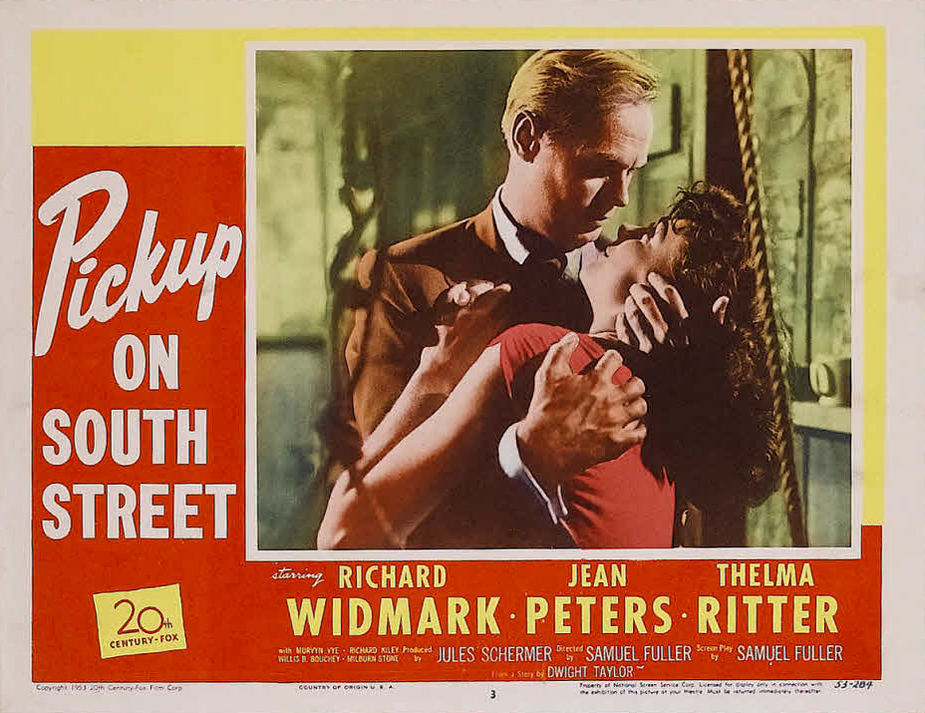
Richard Widmark, Jean Peters and Thelma Ritter in "Pickup on South Street"

Pickup on South Street (1953) is a film noir set against Cold War intrigue, directed by Samuel Fuller and starring Richard Widmark, Jean Peters, and Thelma Ritter. The supporting cast included Richard Kiley and Milburn Stone. The screenplay was by Fuller with cinematography by Joseph MacDonald.

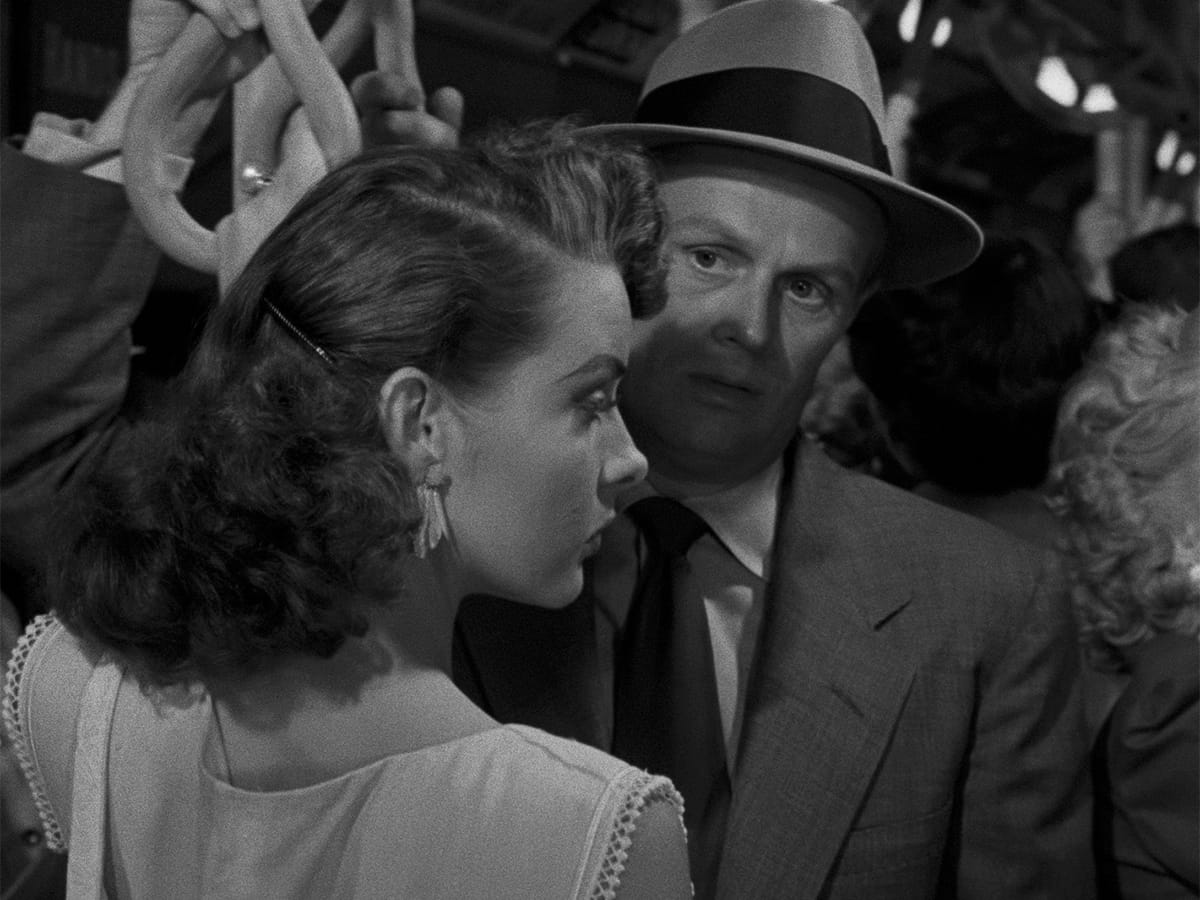
On a New York City subway, a pickpocket, Skip McCoy (Widmark) steals a wallet out of the purse of a street-smart woman named Candy (Peters). Unknown to both Candy and Skip is the fact that her wallet contained microfilm meant to be delivered to Communist spies. Candy's ex-boyfriend Joey (Richard Kiley) talked her into delivering the microfilm (in an envelope) to Joey's contacts.

Finding who has the microfilm and how to get it back becomes a top priority not only for Joey but for the U.S. government agents training Candy and Skip. Candy contacts a woman named Moe (Ritter) who helps her track down Skip. As the three of them interact and try to outsmart each other, they get into trouble that they aren't quite ready for.

Jean Peters and Richard Widmark

Samuel Fuller (1912 - 1997) was an American director, screenwriter, novelist, and journalist. Fuller got his start writing and directing B-pictures. He wrote and directed two cult films in the early 1960s: Shock Corridor (1963) and The Naked Kiss (1964). In 1957, he directed Barbara Stanwyck in the western classic Forty Guns. Later in Fuller's career, he directed the big-budget World War II film, The Big Red One starring Lee Marvin and Mark Hamill. Fuller's work influenced directors Martin Scorsese and Quentin Tarantino.

Richard Widmark (1914- 2008) had a sensational movie debut playing the crazy villain Tommy Udo in director Henry Hathaway’s Kiss of Death (1947). His performance won him a Golden Globe Award for New Star Of The Year – Actor. He was also nominated for the Academy Award for Best Supporting Actor for his performance as Udo. Widmark was under contract to Twentieth Century-Fox where he played mostly villains. Later in his career, he started playing more heroic roles in films like Slattery’s Hurricane and Down to the Sea in Ships (both 1949).

Jean Peters (1926 - 2000) was an American film actress. She was under contract with 20th Century-Fox from the late 1940s and early 1950s. Early in her career, she got a boost co-starring with Tyrone Power in The Captain from Castile (1947). She later went on to costar with Dana Andrews, Ray Milland, and Marlon Brando. She was set to play the female lead in The Robe co-starring Richard Burton but was replaced by Jean Simmons when she discovered she was pregnant. Peters married Howard Hughes in 1957 and retired from film. After her divorce from Hughes in 1971, Peters appeared on television in several mini-series. Her last acting role was in Murder, She Wrote in 1988. Today she is probably best remembered for her role as Candy in Samuel Fuller's Pickup on South Street.

Jean Peters and Thelma Ritter

Thelma Ritter (1902 - 1969) was an American actress best known for her portrayal of working-class characters. She was nominated six times in the Best Supporting Actress category, more than any other actress in the category. Ritter won the 
Best Actress in a Musical Tony Award in 1958 for New Girl in Town. She made her unbilled screen debut in Miracle on 34th Street (1947) and a character actress was born. Ritter quickly became a favorite of studio chief Daryl F. Zanuck who cast her in A Letter to Three Wives (1949), All About Eve (1950), The Model and the Marriage Broker (1951), With a Song in My Heart (1952), and Titanic (1953). Perhaps her most famous role was as James Stewart's nurse in Rear Window (1954). Ritter was a good friend of director George Seaton, who cast her first film in Miracle on 34th Street. It was only fitting that Ritter's last film What's So Bad About Feeling Good (1968), was also directed by Seaton.

Pickup on South Street trivia

  • Marilyn Monroe, Shelley Winters, Ava Gardner, and Betty Grable were all considered for the role of Candy. Fuller pulled for Peters, threatening to walk off the picture if she wasn't cast.
  • Thelma Ritter was nominated for Best Supporting Actress as Moe. This was her fourth nomination in four years.
  • It won the Bronze Lion award at the Venice Film Festival.
  • A soldier in the opening scene has a "Big Red One" 1st Infantry Division shoulder patch which was Fuller's division during World War II. He later went on to write and direct The Big Red One in 1980.


To watch the movie on YouTube click on the link below.


To join the discussion online on May 16, 2022, at 6:30 p.m. Central Time click here. Once you RSVP, you will receive an invitation with a link to the meeting on Zoom.

Discussion questions

  1. What did you think of the Cold War storylne? Did it add anything to the plot?
  2. Richard Widmark was still in his tough-guy phase at this point in his movie career. What did you think of his performance?
  3. Were you familiar with the actress Jean Peters prior to this film? What did you think of her performance?
  4. This film wasn't highly regarded when first released but has garnered a reputation as classic film noir. 
  5. Do you think director Fuller had a theme in mind with his writing and directing?
  6. The film boasts a great cast. Did you have any favorites?
  7. Did it remind you of any other films you've seen?


Thursday, May 27, 2021

Jeanne Crain, Linda Darnell, and Ann Sothern receive “A Letter to Three Wives”

A Letter to Three Wives (1949) is an American romantic comedy-drama film directed by Joseph L. Mankiewicz and starring Jeanne Crain, Linda Darnell, and Ann Sothern. The supporting cast includes Kirk Douglas, Paul Douglas, Jeffrey Lynn, Connie Gilchrist, Barbara Lawrence, and Thelma Ritter.

The film is based on the novel A Letter to Five Wives (1945) by John Klempner. Mankiewicz wrote the screenplay based on an adaptation by Vera Caspary (Laura). The cinematography was by Arthur C. Miller, with music by Alfred Newman. A Letter to Three Wives was one of Twentieth Century-Fox’s most important productions of the year.

The movie tells the story of a woman (Addie Ross) who sends a letter to three of her “dearest friends” (Crain, Darnell, and Sothern) informing them that she has run off with one of their husbands but not revealing which one. The letter is delivered while the women are getting on board a riverboat to chaperone a group of underprivileged children. While they cruise up the river and spend the day picnicking with the children, each wife reflects on her marriage and wonders if it’s their husband who has run off with Ross.

Linda Darnell, Anne Sothern, and Jeanne Crain

Joseph L. Mankiewicz (1929 – 1972) was an American film director, screenwriter, and producer. Mankiewicz won Academy Awards for directing and writing A Letter to Three Wives (1949), and All About Eve (1950). He is the only director to win back-to-back Academy Awards for writing and directing. Other films directed by Mankiewicz include Dragonwyck (1946), The Ghost and Mrs. Muir (1947), Julius Caesar (1953), The Barefoot Contessa (1954), and Guys and Dolls (1955). He directed the 1963 crisis-plagued production of Cleopatra which negatively affected his career as a director.

Jeanne Crain (1925 – 2003) was an American actress whose career spanned more than three decades. While still a teenager, she was asked to take a screen test with Orson Welles. He was testing for the part of Lucy Morgan in his production of The Magnificent Ambersons (1942). She didn’t get the part (Anne Baxter did), but she was on her way. She had a bit part in The Gang’s All Here (1943) but had a leading role in Home in Indiana (1944). The film was a box office hit and Crain became a favorite of film fans everywhere. She had another hit with Winged Victory (1944) and co-starred with Dana Andrews in the musical State Fair (1945). That same year, she was the “good girl” opposite Gene Tierney’s “bad girl” in Leave Her to Heaven. More good roles came her way including leads in A Letter to Three Wives (1949), The Fan (1949), and Pinky (1949). The latter won her a Best Actress Oscar nomination. She lost that year to Olivia de Havilland. Crain’s popularity continued into the 1950s but suffered when she was released from her exclusive contract with 20th Century-Fox. She continued to work in films and on television until 1975.

Paul Douglas and Linda Darnell

Linda Darnell (1923 – 1965) was an American film actress. She signed a contract with 20th Century-Fox at age 15 and became a star almost overnight. She was immediately cast opposite Tyrone Power in Day-Time Wife (1939). She made two films with Power in 1940: Brigham Young and The Mark of Zorro. In 1941, she was again paired with Power in Blood and Sand, which also starred an up-and-coming Rita Hayworth. Darnell’s most famous role was that of Amber St. Clair in Forever Amber (1946), which turned out the be the biggest hit of the year. The role of Amber was the most sought-after female role since the casting of Scarlett O’Hara in Gone with the Wind (1939). Other important films she starred in include Unfaithfully Yours (1948), A Letter to Three Wives (1949), and No Way Out (1950). She died tragically at age 41 in a fire while visiting friends in Glenview, Illinois.

Ann Sothern (1909 - 2001) was an American actress who worked on the stage, radio, film, and television. Sothern’s most commercially successful film role was as Maisie Ravier in a series of films while she was at M-G-M. Maisie, a Brooklyn showgirl was based on the short stories by Nell Martin. Films in the series include Congo Maisie (1940), Gold Rush Maisie (1940), and Up Goes Maisie (1946). The character was so popular that Sothern played the character on the radio in The Adventure of Maisie (1939 - 1947) series. At M-G-M, Sothern starred in the film version of Panama Hattie (1942) opposite Red Skelton, which was a box office success. In 1949, she starred in A Letter to Three Wives which brought her great reviews but did little to advance her career. In 1953, Sothern starred as Susie MacNamara in the television series Private Secretary, (1953 - 1957) and the next year starred in The Ann Sothern Show (1958 - 1961). Sothern continued working on stage, screen, and television. Her last film role was in The Whales of August (1987). For her role in that film, she earned her only Best Supporting Academy Award nomination.

Jeanne Crain, Jeffrey Lynn, Kirk Douglas, and Ann Sothern

A Letter to Three Wives trivia

  • Originally, the film was going to be called A Letter to Four Wives with the fourth wife being Anne Baxter, but her character wasn’t considered as strong as the other three so her segment was cut.
  • Joseph L. Mankiewicz won the Best Director and Best Screenplay Academy Awards for his work on this film and would repeat the wins the next year with All About Eve. No one has ever achieved this feat.
  • One of Thelma Ritter’s early roles, so early in fact she doesn't even receive on-screen billing.
  • Tyrone Power, Joan Crawford, Gene Tierney, Dorothy McGuire, Maureen O’Hara, and Ida Lupino were all considered for roles.
  • Linda Darnell and Mankiewicz were involved in an affair during the production.
  • Darnell and Barbara Lawrence played sisters the year before in Unfaithfully Yours.
  • Silent film star Mae Marsh has a small role as the womens’ washroom attendant at the country club.


To watch the movie on YouTube, click on the link below.


Why watch this movie?

  • Another great example of what the studio system could produce at its peak.
  • One of writer-director Joseph L. Mankiewicz’s best films.
  • It’s a showcase for the talents of Jeanne Crain, Linda Darnell, and Ann Sothern.
  • It boasts early performances from Kirk and Paul Douglas and Thelma Ritter.

To join us for a discussion on Zoom, June 1, 2021, at 6:30 p.m. Central Time, click on the link here. Once you RSVP, you’ll receive an email with a link to the discussion on Zoom.

Discussion Questions

  1. What did you think of the ensemble cast?
  2. Do you think this film is still relevant in the 21st Century?
  3. Did you have a favorite wife?
  4. A favorite scene or piece of dialogue?


Friday, November 1, 2019

Doris Day gets her due at The Music Box Theatre

For several weekends now, The Music Box Theatre, 3733 N. Southport Ave., Chicago, has been screening classic Doris Day movies. The series is titled “The Inimitable Doris Day” and the films have been screened, for the most part on Saturday mornings at 11:30 a.m.


Saturday, November 2, they’ll be screening one of Day’s most famous roles as Jan Morrow in Pillow Talk (1959). The film costarring Rock Hudson, was a tremendous box office hit, earning Day her only Academy Award Best Actress nomination. The picture did wonders for both Day and Hudson’s careers and they made two more successful comedies together: Lover Come Back (1961) and Send Me No Flowers (1964). The film also stars Tony Randall and Thelma Ritter. Randall also costars in Lover Come Back and Send Me No Flowers.

Pillow Talk demonstrates Day’s ability to tackle any movie genre with ease. She’s a natural comic actress and she’s a knockout in the clothes designed for her by Jean Louis.

Lover Come Back will be screened on November 23 and 24 at 11:30 a.m. For more details, please visit the Music Box Web site.

Thursday, February 23, 2017

Chicago Film Club field trip: “All About Eve” March March 5 at ShowPlace ICON at Roosevelt Road

Where: ShowPlace ICON, 150 W. Roosevelt Road, Chicago, IL 60605
When: March 5, 2017
Time: 2:00 p.m.
Hosted by Stephen Reginald
Run Time: 2 hours 30 minutes

From the moment she glimpses her idol on Broadway, Eve Harrington (Anne Baxter) strives to upstage Margo Channing (Bette Davis). After cunningly stealing Margo’s role, Eve disrupts the lives of anyone close to the actress in this timeless cinematic masterpiece. With its witty dialogue and knockout performances, the film earned a record 14 Oscar® nominations* and also features Marilyn Monroe in an early supporting role.


*1950: Best Picture (won), Supporting Actor (George Sanders, won), Costume Design (B&W, won), Directing (won), Sound Recording (won), Screenplay (won), Actress (Anne Baxter), Actress (Bette Davis), Supporting Actress (Celeste Holm), Supporting Actress (Thelma Ritter), Art Direction (B&W), Cinematography (B&W), Film Editing, Music (Score).

You can buy your ticket in advance by clicking here or purchase at your local theatre.

First-timers, look for me holding a Meetup sign below.


Related Posts Plugin for WordPress, Blogger...