Showing posts with label Celeste Holm. Show all posts

Tuesday, May 26, 2026

A “Gentleman’s Agreement” Exposed: Unmasking the Polite Facade of American Anti-Semitism

Gentleman’s Agreement (1947) is a groundbreaking social drama that follows Philip Schuyler Green (Gregory Peck), a distinguished, widowed journalist who relocates to New York City with his young son and mother after accepting a high-profile assignment from a prestigious magazine. The publication’s liberal editor tasks Green with writing an in-depth, undercover exposé on anti-Semitism in America. Initially struggling to find a fresh, impactful angle on a subject many citizens comfortably ignore, Green realizes that the only way to truly understand the depth of this prejudice is to experience it firsthand. He decides to adopt a Jewish identity, telling the world that his real name is Phil Greenberg.

The core of the film explores the swift and jarring shift in how society treats him. Almost immediately, Green is subjected to a spectrum of bigotry that ranges from overt, hostile discrimination to subtle, insidious social snubbing. He is abruptly turned away from exclusive resorts, condescended to by doctors, and frozen out of elite social circles. More painfully, his social experiment strains his burgeoning romance with Kathy Lacey (Dorothy McGuire), the progressive woman who originally suggested the magazine article, as her own deeply ingrained, passive prejudices and fear of societal disapproval begin to surface. Through these tense interactions, Green uncovers the quiet hypocrisy of affluent, polite society.

Directed by Elia Kazan and adapted by Moss Hart from Laura Z. Hobson’s bestselling novel, the film acts as a powerful psychological study of institutionalized bigotry and the complicity of silence. The narrative shines a sharp light on the casual, everyday biases of ordinary people who look the other way to maintain their social standing. Gentleman's Agreement remains a definitive masterpiece of Golden Age cinema, brilliantly illustrating how unspoken societal contracts—the gentleman's agreements of the title—can perpetuate discrimination just as effectively as formal laws.


Elia Kazan (1909 – 2003) was an American director, producer, writer, and actor. He is one of the co-founders of the Actors Studio in 1947 with Robert Lewis and Cheryl Crawford. Kazan is also one of the most celebrated directors in theater and film. Kazan won two Best Director Academy Awards, in 1947 for Gentleman’s Agreement and 1954 for On the Waterfront, and a Lifetime Achievement Academy Award in 1998. A Tree Grows in Brooklyn (1945) was Kazan’s feature film debut as a director.

Gregory Peck and Dean Stockwell


Gregory Peck (1916 – 2003) was a towering icon of Golden Age Hollywood, universally revered for his deep, resonant voice, commanding presence, and on-screen embodiment of moral integrity. After studying at UC Berkeley and honing his craft under Sanford Meisner in New York, Peck burst onto the cinematic scene, earning a Best Actor Academy Award nomination for his second film, The Keys of the Kingdom (1944). Fiercely independent, he bucked the studio system by refusing exclusive contracts, allowing him to seamlessly traverse genres in masterpieces like Alfred Hitchcock’s Spellbound (1945), Elia Kazan’s Gentleman’s Agreement (1947), and the romantic classic Roman Holiday (1953). His career reached its zenith with his Oscar-winning portrayal of the principled Southern lawyer Atticus Finch in To Kill a Mockingbird (1962)—a performance that came to define his legacy as Hollywood’s ultimate archetype of honor and decency. Beyond his acting, Peck was a passionate humanitarian and industry leader, serving as President of the Academy of Motion Picture Arts and Sciences and receiving the Presidential Medal of Freedom in 1969 before passing away peacefully at his Los Angeles home at the age of 87.

Dorothy McGuire (1916–2001) was a distinguished American actress who brought a rare, luminous sincerity and quiet intelligence to the screen during Hollywood’s Golden Age. Born in Omaha, Nebraska, where she cut her teeth acting alongside a young Henry Fonda at the local community playhouse, McGuire rocketed to stardom after winning the titular role in the 1941 Broadway smash Claudia—a performance so captivating that producer David O. Selznick brought her to Hollywood to recreate it for her 1943 film debut. Eschewing the traditional glamour-girl studio mold, she consistently chose deeply felt, complex roles, delivering back-to-back masterpieces in 1945 as the resilient mother in Elia Kazan’s A Tree Grows in Brooklyn and a mute domestic servant in the thriller The Spiral Staircase. Her artistic high point came with the groundbreaking social drama Gentleman’s Agreement (1947), in which her nuanced portrayal of a progressive woman confronting her own passive biases earned her an Academy Award nomination for Best Actress. In the 1950s and '60s, McGuire seamlessly transitioned into one of cinema's most beloved maternal figures, anchoring timeless Disney classics like Old Yeller (1957) and Swiss Family Robinson (1960), and portraying the Virgin Mary in the epic The Greatest Story Ever Told (1965). She continued to grace the stage and television in her later years, earning an Emmy nomination for Rich Man, Poor Man (1976), before passing away in 2001 at the age of 85, leaving a legacy defined by profound dignity and understated grace.

Dorothy McGuire and Gregory Peck


John Garfield (1913–1952), born Jacob Julius Garfinkle, was a fiercely talented American actor who revolutionized Hollywood screen acting by pioneering the gritty, raw, and rebellious working-class antihero. Raised in the rough neighborhoods of New York’s Lower East Side, he found his footing in the theater, eventually becoming a leading light of the politically conscious Group Theatre, where he mastered the immersive “Method” style of acting. He exploded into Hollywood with Warner Bros.’ Four Daughters (1938), earning an Academy Award nomination for Best Supporting Actor and instantly establishing his trademark persona: the cynical, streetwise outsider with a hidden vulnerability. Garfield became a definitive star of 1940s film noir, delivering electrifying performances as the doomed lover in The Postman Always Rings Twice (1946) and an uncompromising boxer in Body and Soul (1947), which earned him a Best Actor Oscar nomination. His intense, naturalistic style left an indelible blueprint for future legends like Marlon Brando, James Dean, and Montgomery Clift.

Gentleman’s Agreement trivia

  • The production of Gentleman's Agreement faced immense resistance long before a single frame was shot, as several powerful, high-ranking Jewish studio executives in Hollywood actively pressured twentieth Century-Fox studio head Darryl F. Zanuck to shelve the project entirely out of fear that confronting anti-Semitism so directly on screen would provoke a public backlash and increase hostility.
  • Director Elia Kazan deliberately weaponized the film's casting to make a point about the subtle nature of prejudice, specifically choosing the elegantly poised, patrician Dorothy McGuire to play Kathy Lacey so audiences could see that passive bias wasn't just held by loud extremists, but also by cultured, polite, and well-meaning members of high society.
  • To capture the genuine, unvarnished reactions of regular citizens for the undercover sequence, Gregory Peck and the crew utilized a hidden camera setup across the street from a real, highly exclusive resort in Connecticut, allowing them to capture authentic footage of the actor being turned away by a clerk who believed he was actually Jewish.
  • Despite her character’s name and background being synonymous with the affluent, old-money elite of Connecticut, actress Dorothy McGuire was actually heavily pregnant during the final weeks of filming, forcing director Elia Kazan and the cinematography team to utilize creative camera angles, oversized coats, and carefully placed foreground props to completely hide her growing maternity from the audience.

Click HERE to watch the movie on the Internet Archive.

Click HERE to join the online discussion on Monday, June 1, 2026, at 6:30 p.m. Central Time. Once you RSVP, you will receive an invitation with a link to join the discussion on Zoom.


Discussion questions

  1. How does Phil Green’s decision to mask his own identity to uncover prejudice highlight the difference between intellectual empathy and lived experience? Think about whether a reporter can ever truly capture the systemic weight of bigotry if they have an escape hatch that allows them to return to privilege at any moment.
  2. The film sharply critiques “polite” society and passive bystanders who claim they aren’t prejudiced but remain silent to maintain social harmony. Looking at characters like Kathy, what does the movie suggest about the moral responsibility of liberals who oppose bigotry in theory but tolerate it in their everyday social circles?
  3. Dave Goldman serves as a crucial point of contrast to Phil because his experience with antisemitism isn't a temporary assignment—it is his reality. How does Dave’s perspective challenge or deepen Phil’s idealistic, almost naive approach to fighting discrimination, especially regarding the psychological toll it takes?
  4. When we look at the ending, does the film offer a truly hopeful resolution, or does it leave us with a sense that the systemic and structural roots of prejudice remain largely untouched? Consider how the story balances individual moral awakening with the institutional barriers—like restricted housing and exclusive clubs—that defined the era.


Tuesday, September 3, 2024

Bette Davis learns "All About Eve" in Joseph L. Mankiewicz’s classic film

 All About Eve (1950) is an American drama written and directed by Joseph L. Mankiewicz and starring Bette Davis, Anne Baxter, George Sanders, and Celeste Holm. Other cast members include Gary Merrill, Hugh Marlow, Thelma Ritter, and Marilyn Monroe.

Broadway star Margo Channing (Davis) has recently turned 40 and is wondering how long she can sustain her career. Then one evening after Margo’s latest performance, her best friend Karen Richards (Holm) brings a seemingly helpless superfan named Eve Harrington (Baxter). Eve followed Margo’s career when she was on tour in San Francisco and now in New York City.

Karen introduces Eve to Margo’s friends, including Karen’s husband playwright Lloyd Richards (Marlowe). Slowly, Eve becomes part of Margo’s inner circle making Margo’s personal assistant Birdie (Ritter) suspicious. So cunning is Eve, that she replaces Birdie as Margo’s new assistant.

Other complications arise from Margo’s relationship with the director of her current play Bill Sampson (Merrill), 8 years her junior. Margo is insecure in their relationship due to their age difference and unbeknownst to her, Eve attempts to replace Margo in Bill’s affections.

How does this all end? Will Margo overcome her insecurities about her age, career, and relationship with Bill or will Eve stand in her way?

Anne Baxter and Bette Davis square off

Joseph L. Mankiewicz (1929 – 1972) was an American film director, screenwriter, and producer. Mankiewicz won Academy Awards for directing and writing A Letter to Three Wives (1949), and All About Eve (1950). He is the only director to win back-to-back Academy Awards for writing and directing. Other films directed by Mankiewicz include Dragonwyck (1946), The Ghost and Mrs. Muir (1947), Julius Caesar (1953), The Barefoot Contessa (1954), and Guys and Dolls (1955). He directed the 1963 crisis-plagued production of Cleopatra which negatively affected his career as a director.

Bette Davis (1908 – 1989) was an American actress whose stage and screen career spanned more than 50 years. Davis came to Hollywood in 1930 and within four years of her arrival, she was one of its biggest stars winning her first Best Actress Academy Award for her role in Dangerous (1935). Her starring role in Jezebel (1938) won her a second Best Actress Oscar. Davis would go on to star in many popular films during the 1940s including Dark Victory (1939), The Letter (1940), The Little Foxes (1941), and Now, Voyager (1942). In 1950 she starred as Margo Channing in All About Eve (1950), a role she is probably most identified with today. Other popular films include The Old Maid (1939), All This and Heaven Too (1940), Mr. Skeffington (1944), and The Corn is Green (1945).

Anne Baxter (1923 – 1985) won a Best Supporting Actress Oscar for her role as Sophie MacDonald in The Razor’s Edge (1946). She was signed to a contract with Twentieth Century-Fox in 1940. In 1948, Baxter starred in four movies, with Yellow Sky being her most prominent role to date. She went on to have a prolific career in film, television, and theater. She is probably best known for her Oscar-nominated performance as Eve Harrington in All About Eve. Frank Lloyd Wright was Baxter’s grandfather.

George Sanders (1906 – 1972) was a British film and stage actor who also had a fine singing voice. Hollywood was looking for a villain to star opposite a young Tyrone Power in Lloyd’s of London (1936) and Sanders more than fit the bill. His performance in that film would forever stamp him as a sophisticated bad guy. Before his acting career, he worked in the textile industry, which must have helped him with his role in The Strange Affair of Uncle Harry. In the 1960s, Sanders played Mr. Freeze in the Batman (1966) television series.

Celeste Holm (1917 – 2012) was an American stage, film, and television actress. She won a Best Supporting Actress award for her role in Gentleman’s Agreement (1947) and was nominated for her roles in Come to the Stable (1949) and All About Eve (1950). She originated the role of Ado Annie in the landmark stage musical Oklahoma! (1943).


All About Eve trivia

  • Claudette Colbert was the director’s first choice to play Margo Channing. In fact, Colbert was contracted to play the part but had to drop out due to a back injury she suffered during the filming of Three Came Home (1950).
  • Bette Davis and Gary Merrill fell in love during filming and were married a few weeks after the production wrapped.
  • The film holds the record for the most female Oscar-nominated performances: Anne Baxter and Bette Davis for Best Actress and Celeste Holm and Thelma Ritter for Best Supporting Actress.
  • Davis said this film saved her career after a series of unsuccessful films. She said Mankiewicz “…resurrected me from the dead.”
  • Producer Darryl F. Zanuck changed the working title Best Performance to All About Eve after reading one of Addison DeWitt’s lines in the opening narration of the script.
  • Zanuck wanted Jeanne Crain to play Eve, but she became pregnant and Anne Baxter was offered the role.


Click HERE to watch the film at the Internet Archive.


Click HERE to join the online discussion on September 9, 2024, at 6:30 p.m. Central Time. Once you RSVP, you will receive an invitation and a link to join the discussion on Zoom.


Discussion questions

  1. All About Eve’s reputation over the years has achieved legendary status. Do you think its reputation as a great film is well deserved?
  2. The film is filled with wonderful performances by a great cast. Did one performance stand out to you or were all of equal weight in your estimation?
  3. What do you think will become of Eve as she goes forward with her career? Will she always be under the thumb of Addison?
  4. Do you think that Margo and Bill will have a successful marriage? Why or why not?
  5. How well does the film hold up in the 21st century?
  6. Was there anything in the film that surprised you?
  7. If this movie were remade, who would you cast as Margo and Eve?


Friday, November 6, 2020

Ida Lupino performs at the “Road House”

Road House (1948) is a film noir directed by Jean Negulesco and starring Ida Lupino, Cornell Wilde, Celeste Holm, and Richard Widmark. The black and white cinematography was by Joseph LaShelle (Laura) and the film contains two songs: Johnny Mercer’s “One for my Baby (and One More for the Road)” and “Again” by Dorcas Cochran (words) and Lionel Newman (music). The latter was written specifically for this film.


Set at a roadhouse with a bowling alley, the movie revolves around Lily Stevens (Lupino), a singer that Jefty Robbins (Widmark) hires as new entertainment for his roadhouse. Pete Morgan (Wilde), Jefty’s childhood friend, and business manager is suspicious of the new singer and Jefty’s motivations for hiring her. Lily sees the gig as just a job, but Jefty quickly develops romantic feelings for her.

Things get complicated when Lily and Pete, who at the beginning were at odds, begin to have feelings for each other. Will Jefty congratulate the couple on their love or make life miserable for them both? It’s a film noir so what do you think?

Director Jean Negulesco fusses with Ida Lupino on the set of Deep Valley


Jean Negulesco (1900 – 1993) was a Romanian-American film director. Negulesco studied art in Bucharest with plans on becoming a painter. He visited the United States to become a portraitist, but while in California became interested in the movie business. He got his start at Paramount during the early 1930s where he worked as assistant producer and second unit director. In 1940, he went to Warner Bros. where he directed Humoresque (1946) starring Joan Crawford and John Garfield and Deep Valley (1947) starring Ida Lupino and Dane Clark. His greatest success at Warner’s came with Johnny Belinda (1948) starring Jane Wyman. The film was nominated for 12 Academy Awards, including a nod to Negulesco’s direction, and was a huge critical and commercial success. For some unknown reason, Warners didn’t renew his contract and he moved over to 20th Century-Fox where he became a master of the new Cinemascope wide-screen process, directing How to Marry a Millionaire (1953) and Three Coins in the Fountain (1954). Other films include Three Came Home (1950), Titanic (1953), Daddy Long Legs (1955), and The Best of Everything (1959).


Joseph LaShalle (1900 – 1989) was an American film cinematographer. He won an Academy Award for his black and white work on the film Laura (1944) and was nominated for eight additional Oscars. LaShalle got his start at Paramount where the famous cinematographer Arthur C. Miller took him under his wing. When Miller moved from Paramount to Fox Films, LaShalle went with him. Other major films LaShalled photographed include Cluny Brown (1946), Come to the Stable (1949), My Cousin Rachel (1952), Marty (1955), The Long, Hot Summer (1958), and The Apartment (1960). LaShalle worked closely with directors Otto Preminger and Billy Wilder.

Cornel Wilde, Richard Widmark, and Ida Lupino

Ida Lupino (1918 – 1995) was an English-American actress, director, and producer. She appeared in over 50 films and was one of Warner Bros. biggest contract players during the 1940s starring in High Sierra (1941), The Sea Wolf (1941), and The Man I Love (1947). After she left Warner Bros., Lupino formed her own production company, producing, writing, and directing films that tackled subjects the big studios wouldn’t touch. During the 1950s, Lupino was the only female director working in Hollywood. She directed several small independent films but really made a name for herself directing for television. Lupino directed episodes of The Twilight Zone (starred in one too), The Rifleman, Bonanza, Gilligan’s Island, It Takes a Thief, Family Affair, and Columbo. In 1966, she directed her one-and-only big-budget studio picture, The Trouble with Angels starring Rosalind Russell and Haley Mills.

Wilde and Lupino 

Cornel Wilde (1912 – 1989) was a Hungrian-born American actor and film director. Wilde had small roles in films like High Sierra (1941) until he was signed by 20th Century Fox. He was loaned out to Columbia to play the role of Frederic Chopin in A Song to Remember (1945) for which he earned an Academy Award for Best Actor. At Fox, he was a popular leading man. For that studio, he starred in Centennial Summer (1946), Forever Amber (1947), and Road House (1948). With the decline of his acting career, Wilde produced and directed several independent productions including Beach Red (1967) and No Blade of Grass (1970).


Celeste Holm (1917 – 2012) was an American stage, film, and television actress. She won a Best Supporting Actress award for her role in Gentleman’s Agreement (1947) and was nominated for her roles in Come to the Stable (1949) and All About Eve (1950). She originated the role of Ado Annie in the landmark stage musical Oklahoma! (1943).

Widmark, Celeste Holm, Wilde

Richard Widmark (1914- 2008) had a sensational movie debut playing the crazy villain Tommy Udo in director Henry Hathaway’s Kiss of Death (1947). His performance won him a Golden Globe Award for New Star Of The Year – Actor. He was also nominated for the Academy Award for Best Supporting Actor for his performance as Udo. Widmark was under contract to Twentieth Century-Fox where he played mostly villains. Later in his career, he started playing more heroic roles in films like Slattery’s Hurricane and Down to the Sea in Ships (both 1949).


Road House trivia:

  • This was the third film that Lupino and Wilde appeared in together. The other two are High Sierra (1941) and Life Begins at Eight-Thirty (1942).
  • Studio head Darryl F. Zanuck, director Negulesco, and star Lupio had all worked at Warner Bros.
  • Lupino’s and Negulesco’s first film after leaving Warner Bros.
  • The bowling alley scenes were shot at a real alley located near the studio.
  • Lupino was paid $95,000 ($1 million today).


To watch the film, click on the YouTube link below.


To join un on November 10, 2020, at 6:30 p.m. Central Time for a discussion on Zoom, visit the Chicago Film Club Meetup page for information and links.


Questions for discussion:

  1. Noir of not?
  2. Is there a femme fatale in this film? 
  3. Is there a homme fatale?
  4. What did you make of Lupino’s whiskey and gravel singing? Were you surprised they let her sing in her own voice?


Friday, September 1, 2017

Screening of “The Snake Pit” at Daystar Center September 12

“Classic Movie Man Favorites” Series: The Snake Pit (1948)
Where: Daystar Center, 1550 S. State Street
When: September 12, 2017
Time: 6:30 p.m.
Hosted by Stephen Reginald

The Snake Pit (1948) stars two-time Best Actress winner Olivia de Havilland, who turned 101 on July 1st!

De Havilland is Virginia Cunningham, an aspiring writer and newlywed. Early in their marriage, she begins to wonder about her husband’s love for her. She becomes confused and disorientated, necessitating her commitment to a state mental institution. Her experiences in the institution are harrowing. The movie had such an impact on the public that many states reevaluated and changed their treatment of mental patients.

De Havilland heads an impressive cast that also includes Leo Genn as a sympathetic psychiatrist and Mark Stevens as her long-suffering husband. The cast is populated by some of the best-known character actresses of the era, including Beulah Bondi, Ruth Donnelly, and Natalie Schafer. The Snake Pit was nominated for six Academy Awards, including Best Picture, Best Actress (de Havilland), and Best Director (Anatole Litvak).

The movie is based on the semi-autobiographical novel of the same name by Mary Jane Ward. Ward had a nervous breakdown and spent eight months at Rockland State Hospital in Orangeburg, New York. During her care, she was subjected to scalding baths and electroshock therapy, similar to what the Virginia Cunningham character experiences in the film.

Backstory
Director Litvak made sure that all the character actresses in the film were seasoned professionals. He wanted to make sure that they could stand up to a talent like de Havilland. There are dozens of recognizable faces in The Snake Pit, making it a classic movie buff’s delight.

This is part of the “Classic Movie Man Favorites” series.

Celeste Holm and Olivia de Havilland in The Snake Pit
Have some Joe and Enjoy the Show!
You can bring food and beverages into the auditorium; we even have small tables set up next to some of the seats. General Admission: $5 Students and Senior Citizens: $3.

Join the Chicago Film club; join the discussion
Twice a month we screen classic films and have a brief discussion afterward. For more information, including how to join (it’s free), click here. The Venue 1550 is easily accessible by the CTA. Please visit Transit Chicago for more information on transportation options.


Stephen Reginald is a freelance writer and editor. He has worked at various positions within the publishing industry for over 25 years. Most recently he was executive editor for McGraw-Hill’s The Learning Group Division. A long-time amateur student of film, Reginald hosts “Chicago Film Club,” a monthly movie event held in the South Loop, for the past two years. Reginald has also taught several adult education film classes at Facets Film School, Chicago.

Tuesday, April 25, 2017

Richard Widmark "kills it" in Road House (1948) #Villains2017

Richard Widmark made a dazzling debut in Howard Hawk’s Kiss of Death in 1947. His characterization of Tommy Udo caused a sensation. For the early part of his career, Widmark played bad guys and lunatics. One of his best bad guy roles was as Jefferson T. “Jefty” Robbins in Jean Negulesco’s Road House (1948).

You can have a drink or two while bowling at Jefty’s Road House!
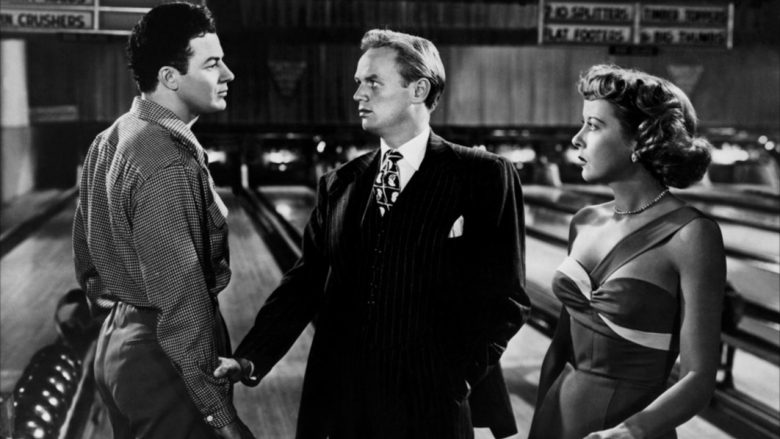
Set at a roadhouse with a bowling alley, the movie revolves around Lily Stevens (Ida Lupino), a singer that Widmark’s character Jefty hires as new entertainment for his roadhouse. Pete Morgan (Cornel Wilde), Jefty’s childhood friend, and business manager, is suspicious of the new singer and Jefty’s motivations for hiring her. Lily sees the gig as just a job, but Jefty quickly develops romantic feelings for her.

Jefty (Richard Widmark at right)  is infatuated with Lily (Ida Lupino).
Lily’s singing is a success, which softens Pete’s attitude toward her. All seems like smooth sailing ahead, with Pete and Jefty, working well together and enjoying each other’s friendship just as they always have. But slowly things begin to change and Jefty’s attachment to Lily grows obsessive. With this obsession comes a change in Jefty’s personality that is unsettling. When Jefty asks Pete to teach Lily to bowl, Pete originally declines, but Jefty insists. His demeanor and voice changes; he looks and acts like a entirely different person. The abrupt change scares Lily, but all is smoothed over, it seems, once Pete changes his mind and agrees to teach Lily.

Things get hot between Pete (Cornel Wilde) and Jefty when it comes to Lily.
Pete and Lily’s once antagonistic relationship quickly changes to romance, unbeknownst to Jefty. Jefty keeps pursuing Lily even though she’s given him no reason to believe that their relationship is anything more than that of boss and employee. As Pete and Lily’s relationship becomes more serious, Pete decides to tell Jefty. Jefty becomes enraged and throws Pete out of his house.

Lily isn’t buying what Jefty is selling.
Realizing that Jefty has become irrational, Pete and Lily decide to run off together. Pete takes $600 owed to him and a note explaining that he and Lily are leaving the roadhouse. While Lily and Pete are waiting at the train station, the police show up to take Pete into custody for stealing the roadhouse’s week’s receipts totaling $2600. Pete tells the police he only took the $600 owed him. It becomes obvious to Pete and Lily that Jefty has set Pete up. Jefty puts on quite an act for the police, pretending to be hurt and worried about Pete.

Jefty has Pete arrested for stealing; Lily and Susie (Celeste Holm) know he is innocent.
Pete is tried and found guilty of grand larceny. Jefty convinces the judge to parole Pete to his custody, therefore making him Jefty’s prisoner. Pete gets to keep his job, but he has to pay back the money he “stole.”
Jefty enjoys tormenting Pete and Lily and he descends into madness.
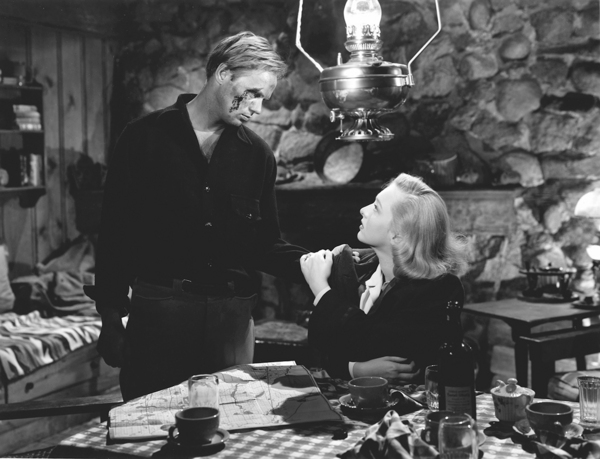
Jefty plans a trip to his hunting cabin, insisting that Pete, Lily, and Susie, (Celeste Holm) who works as the roadhouse cashier, come along. While at the cabin, a drunk Jefty taunts Pete and Lily. He becomes more maniacal, while messing around with a rifle. Lily accuses Jefty of taking the money. He smacks her and Pete knocks him out. Pete and Lily decide to make a run for the Canadian border, leaving Susie behind to keep an eye on Jefty.

Lily takes aim, but unfortunately, the gun is not loaded.
After a while Jefty comes to. Just before that, Susie discovers the deposit envelope and the cashier’s receipts in Jefty’s jacket. While Jefty is still a bit wobbly, Susie runs out of the cabin and tries to follow Pete and Lily. Jefty quickly pursues her into the woods. Susie catches up to Pete and Lily, but is shot in the arm by Jefty.

Susie confronts Jefty about the cashier receipt and deposit slip she found in his jacket
Pete sends an empty motorboat into the fog-covered lakeside as a decoy. Jefty shoots at the boat, thinking that he’s foiled Pete and Lily’s escape. Pete fights Jefty to get his gun, In their struggle the gun falls and Lily grabs it and points it at Jefty. Lily tells Jefty to stay away, but he doesn’t listen. She shoots, killing him, when he is about to throw a large rock at her. Pete, Susie and Lily leave the woods heading back to the roadhouse and we assume vindication from Jefty’s treachery.

Lobby card for Road House
Widmark’s performance in Road House is brilliant because it isn’t immediately obvious that he’s crazy. Through little incidents in the beginning of the film, we see his character slowly change. He begins to become unhinged that he almost seems drunk, even though we know he’s not. By the end of the movie he is absolutely crazy. He’s got the nuthouse laugh going full tilt and he’s mesmerizing; you can’t keep your eyes off of him.

Widmark made a spectacular movie debut playing the maniacal Tommy Udo in Kiss of Death (1947).
It’s a tribute to his talent that Widmark was able to avoid being typecast as a crazy person or bad guy, which happened in the early part of his career. During the 1950s, he was able to get more traditional leading man roles as well as playing a variety of character roles, most of which were fairly normal. But, oh, did Widmark make a great villain—and Jefty Robbins in Road House is one of his best.


This post is part of The Great Villain Blogathon for 2017. It is hosted by Ruth of Silver Screenings, Karen of Shadows & Satin, and Kristina of Speakeasy. Visit these blogs during the blogathon for some great entertaining and educational reads.

Thursday, February 23, 2017

Chicago Film Club field trip: “All About Eve” March March 5 at ShowPlace ICON at Roosevelt Road

Where: ShowPlace ICON, 150 W. Roosevelt Road, Chicago, IL 60605
When: March 5, 2017
Time: 2:00 p.m.
Hosted by Stephen Reginald
Run Time: 2 hours 30 minutes

From the moment she glimpses her idol on Broadway, Eve Harrington (Anne Baxter) strives to upstage Margo Channing (Bette Davis). After cunningly stealing Margo’s role, Eve disrupts the lives of anyone close to the actress in this timeless cinematic masterpiece. With its witty dialogue and knockout performances, the film earned a record 14 Oscar® nominations* and also features Marilyn Monroe in an early supporting role.


*1950: Best Picture (won), Supporting Actor (George Sanders, won), Costume Design (B&W, won), Directing (won), Sound Recording (won), Screenplay (won), Actress (Anne Baxter), Actress (Bette Davis), Supporting Actress (Celeste Holm), Supporting Actress (Thelma Ritter), Art Direction (B&W), Cinematography (B&W), Film Editing, Music (Score).

You can buy your ticket in advance by clicking here or purchase at your local theatre.

First-timers, look for me holding a Meetup sign below.


Monday, November 21, 2016

Noirvember film finale: “Road House” November 26, 2016 at Daystar Center

Noirvember Film Series: Road House
Where: The Venue 1550 at the Daystar Center, 1550 S. State Street, Chicago, IL
When: November 26, 2016
Time: 6:45 p.m.
Hosted by Stephen Reginald


Road House is one of my favorite melodramas from the late 1940s. It stars Ida Lupino in her first role as a “freelance” movie star. After her contract with Warner Bros. ended, Twentieth Century Fox mogul, Darryl F. Zanuck hired Lupino for the lead role of Lily Stevens.

In the film, Lily is hired by Jefty Robbins (Richard Widmark) to sing at his road house near the Canadian border. Little does she know that Jefty has more on his mind than hiring a new singer. Enter Pete Morgan (Cornel Wilde), Jefty’s friend and road house manager. At first, Pete and Lily are at odds, but soon a romance develops between them, enraging Jefty. Jefty is so crazy with jealousy over Pete and Lily’s romance that he sets Pete up and has him arrested and tried for burglary. In a perverted twist, Jefty asks the judge to remand Pete to his custody so he can break him and Lily. Road House coworker Susie Smith (Celeste Holm) acts as a buffer between the two lovers and Jefty.

Lupino’s characterization as the hard-edged lounge singer is a hoot. She smokes, drinks, and plays the piano all at the same time, making it seem natural and easy. Not too many actresses could make this work, but Lupino does so with great skill, including giving Lily a voice that sounds like whiskey and gravel. The heat generated between Lupino and Wilde is pretty hot, even by today’s standards. Director Jean Negulesco keeps the action moving, building things toward the dramatic conclusion.

Road House may not be a classic in the truest sense of the word, but it’s a ton of fun and not to be missed. 

Cornel Wilde, Richard Widmark, Ida Lupino in Road House
Have some Joe and Enjoy the Show!
You can bring food and beverages into the auditorium; we even have small tables set up next to some of the seats. General Admission: $5 Students and Senior Citizens: $3.

Join the Chicago Film club; join the discussion
Twice a month we screen classic films and have a brief discussion afterward. For more information, including how to join (it’s free), click here. The Venue 1550 is easily accessible by the CTA. Please visit Transit Chicago for more information on transportation options.


Stephen Reginald is a freelance writer and editor. He has worked at various positions within the publishing industry for over 25 years. Most recently he was executive editor for McGraw-Hill’s The Learning Group Division. A long-time amateur student of film, Reginald hosts “Chicago Film Club,” a monthly movie event held in the South Loop, for the past two years. Reginald has also taught several adult education film classes at Facets Film School, Chicago.

Thursday, September 3, 2009

Classic film of the week: "Road House" (1948)

Maybe it's not exaclty a classic, but it is great fun and one of my favorite melodrama's from the late 1940s. Road Housestars Ida Lupino in her first role as a "freelance" movie star. After her contract with Warner Bros. ended, Twentieth Century Fox mogul, Darryl F. Zanuck hired Lupino for the lead role of Lily Stevens.

In the film, Lily is hired by Jefty Robbins (Richard Widmark at his looney best) to sing at his road house near the Canadian border. Little does she know that Jefty has more on his mind than hiring a new singer. Enter Pete Morgan (Cornel Wilde), Jefty's friend and road house manager. At first, Pete and Lily are at odds, but soon a romance develops between them, enraging Jefty. Jefty is so crazy with jealousy over Pete and Lily's romance that he sets Pete up and has him arrested and tried for burglary. In a perverted twist, Jefty asks the judge to remand Pete to his custody so he can break him and Lily. Lily and Pete are befriended by coworker Susie Smith (Celeste Holm in a thankless role) who tries to act as a buffer between the two lovers and Jefty.

Lupino's characterization as the hard-edged lounge singer is a hoot. She smokes, drinks, and plays the piano all at the same time, making it seem natural and easy. Not too many actresses could make this work, but Lupino does with great skill, including giving Lily a voice that sounds like whiskey and gravel. The heat generated between Lupino and Wilde is pretty hot, even by today's standards. Director Jean Negulesco keeps the action moving, building things toward the dramatic conclusion.

Cornel Wilde, Richard Widmark, and Ida Lupino
Road House may not be a classic in the truest sense of the word, but it's a ton of fun and not to be missed. The DVD, part of the Fox Film Noir series, is crisp and sharp with commentary by film historians Kim Morgan and Eddie Muller, who may have had a few drinks at Jefty's before they started talking. A short featurette, Killer Instincts: Richard Widmark and Ida Lupino at Twentieth Century Fox is worth watching.


Related Posts Plugin for WordPress, Blogger...