Showing posts with label Jack Carson. Show all posts

Tuesday, July 14, 2026

The Price of Devotion: Sacrificial Motherhood and Fatal Ambition in Michael Curtiz’s “Mildred Pierce”

Directed by Michael Curtiz, Mildred Pierce (1945) seamlessly blends classic melodrama with the dark, shadows-and-murder aesthetic of film noir. The story kicks off in classic noir fashion with the late-night murder of playboy Monte Beragon (played by Zachary Scott) at a beach house. The police interrogate Monte’s wife, Mildred (Joan Crawford), which triggers a sprawling series of flashbacks that unspool her life over the previous several years. We learn that Mildred begins as an ordinary, devoted housewife who separates from her well-meaning but unemployed husband, Bert (Bruce Bennett), leaving her to support her two daughters entirely on her own.

Driven by an intense desire to provide everything for her materialistic, status-obsessed eldest daughter, Veda (Ann Blyth), Mildred takes a humbling job as a waitress. With the clever assistance of her cynical, wise-cracking friend and coworker Ida Corwin (Eve Arden) and the smooth-talking real estate agent Wally Fay (Jack Carson), Mildred successfully opens her own restaurant. The business quickly blossoms into a highly profitable Southern California restaurant chain. However, tragedy strikes early in her entrepreneurial journey when her younger daughter, Kay, dies of pneumonia, cementing Mildred’s singular, obsessive emotional fixation on fulfilling Veda’s endless demands for wealth and high social status.

As Veda grows older, her cruelty and entitlement only deepen, leading her to secret marriages, extortion schemes, and a deep contempt for her mother’s working-class roots. In a desperate, final bid to buy her daughter’s love and respect, Mildred marries the aristocratic but functionally broke Monte Beragon, using her restaurant fortune to fund his lavish lifestyle and appease Veda. The Mildred gives in to Veda, the more Veda demands.

Will Mildred realize that the only one Veda loves is Veda?


Joan Crawford and Ann Blyth

Michael Curtiz (1886 -1962) was a Hungarian-American film director who worked during Hollywood’s Golden age, directing some of the best-loved classics from that era including The Adventures of Robin Hood (1938), Casablanca (1942), and Mildred Pierce (1945). He directed James Cagney and Joan Crawford to Best Actor/Actress Oscar wins; he put Doris Day and John Garfield on the screen for the first time, making them major movie stars in the process. He’s also responsible for the pairing of Errol Flynn and Olivia de Havilland, one of Hollywood’s most famous screen teams. Other films directed by Curtiz include Angels with Dirty Faces (1938), The Sea Wolf (1941), Yankee Doodle Dandy (1942), Life with Father (1947), and White Christmas (1954).

Born Lucille LeSueur, Joan Crawford (1904–1977) rose from a hardscrabble childhood to become one of the most enduring and fiercely determined superstars of classical Hollywood. She initially gained fame at MGM in the late 1920s and 1930s as a vibrant flapper and the quintessential working-girl heroine, before orchestrating a spectacular mid-career comeback at Warner Bros. that earned her a Best Actress Oscar for the definitive film noir melodrama Mildred Pierce (1945). Renowned for her striking, expressive eyes, razor-sharp cheekbones, and intense dedication to her craft, Crawford successfully reinvented herself across five decades, effortlessly transitioning into mature, volatile dramatic roles in classics like Humoresque (1946) and late-career cult horror films like What Ever Happened to Baby Jane? (1962).

Born John Elmer Carson in Manitoba, Canada, Jack Carson (1910 – 1963) grew up in Milwaukee and established himself as one of Hollywood’s most versatile and dependable character actors and comedians during the Golden Age. Standing over six feet tall with a rugged, burly build, he specialized in playing loudmouthed, brassy, or slightly cynical regular guys, often serving as the perfect comic foil in Warner Bros. musicals and comedies alongside partners like Dennis Morgan. His role as the opportunistic, conniving Wally Fay in Mildred Pierce offered a rare, brilliant showcase for his dramatic range, allowing him to infuse his standard fast-talking persona with a darker, sleazier undercurrent. Carson worked tirelessly across film, radio, and early television until his untimely death from stomach cancer at the age of 52.

Zachary Scott (1914 – 1965) was born in Austin, Texas, and brought a distinct brand of urbane, aristocratic villainy to mid-century Hollywood. With his slicked-back hair, prominent mustache, and elegant, suave delivery, he was effortlessly cast as charming scoundrels, treacherous playboys, and smooth-talking heel figures. His definitive breakthrough came when Jack Warner saw him on Broadway and cast him as the fatalistic, gold-digging Monte Beragon in Mildred Pierce, a role that forever stamped him as a quintessential film noir antagonist. Though he occasionally played sympathetic leads, such as in Jean Renoir's The Southerner, Scott remained most memorable as Hollywood’s most sophisticated, menacing cad before dying of a brain tumor at age 51.

Click HERE to watch the film online.

Click HERE to join the online discussion on July 20, 2026, at 6:30 p.m. Central Time. Once you RSVP, you will receive an invitation and a link to join the discussion on Zoom.


Mildred Pierce trivia

  • Director Michael Curtiz initially fought hard against casting Joan Crawford, famously calling her a has-been and demanding she take a screen test to prove she could handle the gritty, unglamorous early scenes of the movie.
  • To achieve the realistic look of a weary, working-class mother, Curtiz reportedly became frustrated with Crawford’s meticulously applied shoulder pads and makeup on set, once lunging forward to rip a glamorous scarf from her neck to make her look more authentic.
  • Bette Davis, Warner Bros.’ top female star at the time, was originally offered the title role of Mildred Pierce but turned it down, inadvertently paving the way for Crawford to secure the part and win her sole Academy Award for Best Actress.
  • The author of the original hard-boiled novel, James M. Cain, was so deeply impressed by Joan's definitive performance that he personally gifted her a bound copy of the book inscribed with a note thanking her for bringing his heroine to life so beautifully.


Discussion questions

  1. How does the structural choice of framing the narrative as a film noir murder mystery alter the emotional impact of Mildred’s domestic struggles compared to how the story might feel if told in simple chronological order?
  2. In what ways does the film critique or subvert the traditional concept of the American Dream, particularly through Mildred’s rise to immense business success failing to secure her personal or familial happiness?
  3. To what extent is Mildred herself responsible for Veda’s monstrous behavior, and where should a viewer draw the line between a mother’s tragic devotion and destructive enabling?
  4. How do the supporting characters of Ida Corwin and Wally Fay represent contrasting survival strategies for navigating the cynical, transactional world of wartime Southern California?


Tuesday, February 24, 2026

Ambition’s Dark Shadow: Ida Lupino’s Ruthless Rise in “The Hard Way”

Set in the gritty landscape of a Pennsylvania coal town, The Hard Way (1943), directed by Vincent Sherman, follows Helen Chernen (Ida Lupino), a woman driven by a fierce, uncompromising desire to escape a life of industrial squalor. Helen sees her younger sister, Katie (Joan Leslie), as her ticket out of poverty, recognizing the girl’s raw talent as a performer. When a traveling vaudeville duo, Albert Runkel (Jack Carson) and Paul Collins (Dennis Morgan), arrives in town, Helen seizes the opportunity to tether Katie’s future to theirs, initiating a calculated ascent into the world of show business.

As the narrative progresses, the story shifts from a struggle for survival into a psychological study of Helen’s obsessive ambition. She becomes a ruthless stage mother and manager, manipulating Katie’s career and personal life to ensure her sister reaches the pinnacle of stardom. While Katie finds success on the Broadway stage, Helen’s machinations create a rift between them and the people who helped them rise, revealing the high moral price of her “success at any cost” philosophy.

The film is a dark, cynical take on the backstage musical genre, trading upbeat rehearsals for shadows and internal conflict. It explores themes of codependency and the corrupting nature of vicarious living, as Helen attempts to fulfill her own thwarted dreams through her sister. Without giving away the climax, the story serves as a cautionary tale about the emotional wreckage left behind when human relationships are treated as stepping stones to fame.

Vincent Sherman (1906–2006) was a prolific American film director who became a mainstay at Warner Bros. during the 1940s, earning a reputation as a woman’s director for his ability to elicit nuanced, powerful performances from the era's leading ladies. Originally an actor and playwright, Sherman brought a keen sense of dramatic structure and character psychology to his work, helming notable films such as Mr. Skeffington and The Hard Way. His career was marked by a sophisticated grasp of melodrama and noir aesthetics, though it faced a significant hurdle when he was grey-listed during the McCarthy era. Despite these political challenges, Sherman successfully transitioned into television in his later years, directing episodes for popular series like 77 Sunset Strip and The Waltons, ultimately enjoying a remarkably long life that spanned a full century of Hollywood history.


Gladys George and Ida Lupino

Ida Lupino (1918–1995) was a trailblazing English-American actress and filmmaker who became one of the most prominent women to work behind the camera during the Hollywood studio system. Born into a celebrated theatrical dynasty, she initially achieved stardom as a dramatic actress at Warner Bros., delivering powerhouse performances in films like High Sierra and The Hard Way, for which she won the New York Film Critics Circle Award for Best Actress. Seeking more creative control, she co-founded her own independent production company, "The Filmmakers," where she wrote, produced, and directed grittily realistic films that tackled provocative social issues often ignored by major studios. Her work on titles such as The Hitch-Hiker established her as the first woman to direct a major film noir, and she later became a prolific director for television, helming episodes for iconic series like The Twilight Zone and Alfred Hitchcock Presents. Today, she is remembered not only for her tough-as-nails screen persona but as a pioneering artist who paved the way for independent and female filmmakers in a male-dominated industry.

Dennis Morgan (1908–1994) was a charismatic American actor and singer who became one of Warner Bros.’ most reliable leading men during the Golden Age of Hollywood. Born Earl Stanley Morner, he performed under various pseudonyms before finding his greatest success as Dennis Morgan, a name synonymous with the studio's popular musicals and dramas of the 1940s. Known for his easygoing charm and clear tenor voice, he often starred in lighthearted musical comedies—frequently paired with actor Jack Carson—but also proved his range in dramatic roles such as Paul Collins in The Hard Way (1943) and Peter Kingsmill in In This Our Life (1942). Throughout the decade, he headlined major hits like Kitty Foyle, The Desert Song, and the holiday classic Christmas in Connecticut, solidifying his status as a top box-office draw. Though he shifted toward television and business interests in the late 1950s, Morgan remains a celebrated figure of the era for his versatile ability to balance sophisticated romance with musical talent.

Dennis Morgan, Jack Carson, and Ida Lupino

Joan Leslie (1925–2015) was a vivacious American actress and dancer who became one of the most beloved girl-next-door figures of the 1940s. Born Joan Agnes Theresa Sadie Brodel, she began her career as a child in a family vaudeville act, “The Three Brodels,” before signing with Warner Bros. at age 15. She rose to immediate stardom by portraying sincere, wholesome characters opposite Hollywood’s biggest legends, appearing as Humphrey Bogart’s unrequited love in High Sierra (1941), Gary Cooper’s fiancĂ©e in Sergeant York (1941), and James Cagney’s devoted wife in Yankee Doodle Dandy (1942). In The Hard Way (1943), she displayed her versatility as the talented Katie Blaine, balancing musical numbers with the emotional weight of a sister trapped by sibling ambition. Her career took a definitive turn in 1946 when she sued to be released from her studio contract to pursue more mature roles—a bold move that led to her being blacklisted by major studios for several years. Though she continued to work in independent films and television throughout the 1950s, she eventually transitioned away from the limelight to focus on her family and charitable work, leaving behind a legacy as a performer who possessed a rare, radiant authenticity that perfectly captured the spirit of wartime America.

Jack Carson (1910–1963) was a versatile Canadian-American actor who became one of the most beloved and hard-working performers of Hollywood’s Golden Age, known for his unique ability to transition seamlessly between boisterous comedy and heavy drama. Born John Elmer Carson, he honed his comedic timing on the vaudeville circuit before signing with Warner Bros., where he often played the lovable lug, the brash best friend, or the self-important blowhard who never quite gets the girl. While he is fondly remembered for his comedic partnership with Dennis Morgan in films like Two Guys from Milwaukee, Carson proved his dramatic mettle with powerhouse performances as Albert Runkel in The Hard Way (1943) and the conniving Wally Fay in Mildred Pierce (1945). His career was characterized by an incredible work ethic, spanning over 90 films and a successful transition into radio and early television, including hosting his own variety show. Though his life was cut short by stomach cancer at the age of 52, Carson remains celebrated as a consummate professional who could steal a scene from the biggest stars of his era with a single double-take or a flash of genuine vulnerability.

 Click HERE to watch the movie on the Internet.

Click HERE to join the online discussion on Monday, March 2, 2026, 6:30 p.m. Central Time. Once you RSVP, you will receive an invitation with a link to join the discussion on Zoom.

Joan Leslie and Ida Lupino


The Hard Way trivia

  • Inspired by a Legend: The story was famously rumored to be based on the real-life relationship between screen icon Ginger Rogers and her formidable stage mother, Lela Rogers. In fact, the role of Helen was originally offered to Ginger Rogers herself, but she reportedly turned it down due to the unflattering parallels to her own life.
  • Ida Lupino’s Personal Toll: During production, Ida Lupino was under immense personal strain as her father, the celebrated British performer Stanley Lupino, was terminally ill. He passed away while the film was still being shot. Despite her grief and a brief hospitalization for exhaustion, Lupino delivered what many critics consider the performance of her career.
  • Award-Winning Realism: While the Academy overlooked the film, Ida Lupino’s performance was so powerful that she won the New York Film Critics Circle Award for Best Actress. Critics specifically praised her ability to bring humanity to a character that was otherwise cold and manipulative.
  • The “Two Guys” Origin: The film served as the first-ever onscreen pairing of Dennis Morgan and Jack Carson. While they played serious roles here—with Carson in a particularly tragic turn—their natural chemistry was so evident to the studio that Warner Bros. went on to cast them as a popular comedic duo in five more films, including the "Two Guys" series.

Discussion questions

  1. The Nature of Vicarious Living: Helen Chernen justifies her ruthless behavior by claiming she only wants a better life for her sister, Katie. To what extent is Helen actually motivated by sisterly love, and to what extent is she using Katie to settle her own personal grudge against her impoverished upbringing?
  2. The Cost of Stardom: The film presents a very cynical view of the entertainment industry, contrasting the bright lights of Broadway with the shabby reality of the vaudeville circuit. Does the movie suggest that success in show business inherently requires the loss of one’s integrity, or is that loss unique to the way Helen manages Katie’s career?
  3. A Study in Gender and Power: In 1943, women had limited avenues for social mobility. Does Helen’s hard and manipulative personality stem from a genuine villainous nature, or is it a survival mechanism for a woman who refuses to be trapped in a mining town? How does her behavior compare to that of the male power players or agents often seen in Hollywood films?
  4. The Tragic Arc of Albert Runkel: Jack Carson’s character, Albert, provides the film’s most significant emotional turning point. How does his downward spiral serve as a critique of Helen’s success-at-any-cost philosophy? Is he a victim of the industry, or a victim of his own misplaced trust in the Chernen sisters?

Tuesday, December 9, 2025

Leslie Howard and Joan Blondell star in “Stand-In”

Stand-In (1937) is a screwball comedy directed by Tay Garnett and starring Lesley Howard and Joan Blondell that offers a satirical glimpse into the workings of the Hollywood studio system during the Great Depression. The story centers on Atterbury Dodd (Howard), a reserved and highly mathematical financial efficiency expert from a Wall Street bank. Dodd is sent to Tinseltown to investigate the failing finances of a fictional motion picture company, Colossal Pictures. Armed only with his ledgers and logic, he is tasked with determining if the studio is worth saving or if it should be sold off.

Upon arrival, the analytical Dodd finds himself completely unprepared for the chaotic, extravagant, and often nonsensical reality of filmmaking. He quickly meets Lester Plum (Blondell), a cheerful, street-smart former child star who now works as a stand-in for the studio’s temperamental lead actress. Lester, having a wealth of practical Hollywood experience, takes the bewildered accountant under her wing. She attempts to teach him about the unpredictable nature of the movie business—a world where human emotion and creative whims often outweigh balance sheets and sound economic principles.

As Dodd digs into the studio’s books, he begins to suspect that the financial troubles are not due to incompetence alone, but are the result of deliberate sabotage orchestrated by key personnel conspiring with an outside buyer. With Lester’s guidance, Dodd must transition from a detached man of numbers to a man of action to expose the scheme, save the jobs of the studio's hard-working employees, and prevent the entire company from falling into the wrong hands. The film thus transforms into a high-stakes battle pitting strict logic against the colorful, chaotic spirit of Hollywood.


Leslie Howard and Joan Blondell

Tay Garnett (1894–1977) was an American film director, writer, and producer whose career spanned over four decades in Hollywood, working in a wide array of genres. Born in Los Angeles, he served as a naval aviator in World War I before entering the film industry in 1920 as a gag writer for silent comedy legends like Mack Sennett and Hal Roach. Garnett began directing feature films in 1928 and quickly became known as a highly competent craftsman, helming box-office hits and critically acclaimed movies alike, including the pre-Code romance One Way Passage (1932), the adventure classic China Seas (1935), the Hollywood satire Stand-In (1937), the war drama Bataan (1943), and his most noted film, the definitive film-noir thriller The Postman Always Rings Twice (1946). In his later career, Garnett worked extensively in television, directing episodes of popular Westerns and other series like Bonanza and Rawhide.

Leslie Howard (1893–1943) was an acclaimed English actor, director, and producer, known for roles that often conveyed a quiet, sophisticated, and sensitive English charm. Born Leslie Howard Steiner in London to a Hungarian-Jewish father and a British mother, he began his professional career after serving in World War I and receiving a medical discharge for shell shock, which he was advised to treat by taking up acting. Howard found significant success on the Broadway stage before transitioning to Hollywood in the sound era, earning two Academy Award nominations for Best Actor for his roles in Berkeley Square (1933) and Pygmalion (1938), which he also co-directed. He is most widely remembered for his role as the melancholy, honorable Ashley Wilkes in the epic film Gone with the Wind (1939). In the years leading up to and during World War II, Howard returned to England, becoming heavily involved in anti-Nazi propaganda efforts through filmmaking, directing, and starring in films like Pimpernel Smith (1941) and The First of the Few (1942). His life was tragically cut short in June 1943 when the civilian plane he was aboard, traveling from Lisbon to London, was shot down by German aircraft over the Atlantic Ocean.

Joan Blondell (1906–1979) was a prolific American actress who rose to prominence as the quintessential “working girl” of the 1930s, known for her sassy charm, distinctive blonde looks, and ability to deliver witty, fast-paced dialogue. Born into a vaudeville family, she leveraged a successful Broadway run opposite James Cagney to launch a Hollywood career with Warner Bros. She starred in over 100 films, often playing resourceful chorus girls and secretaries in classic pre-Code movies and Busby Berkeley musicals like Footlight Parade and Gold Diggers of 1933, where she sang the iconic, socially-conscious number “Remember My Forgotten Man.” As she matured, Blondell successfully transitioned into a respected character actress, earning an Academy Award nomination for The Blue Veil (1951) and critical acclaim for roles in A Tree Grows in Brooklyn and The Cincinnati Kid. Her career spanned nearly five decades across film, stage, and television, ending with a final film appearance in Grease (1978).


Stand-In trivia

  • Source Material: The film is based on a novel of the same name by Alva Johnston, a writer for The New Yorker. Johnston was known for his profiles of eccentric and notable figures, and his book satirized the chaotic, high-stakes environment of the Hollywood studio system during its Golden Age.
  • Director Switch: Director Tay Garnett was originally scheduled to film A Star Is Born (1937) for Selznick International Pictures, but he traded projects with William A. Wellman, who took over A Star Is Born. This allowed Garnett to direct Stand-In, which offered him a chance to satirize the very industry he worked in.
  • Leslie Howard’s Rare Genre: While star Leslie Howard was best known for playing romantic leads and sensitive, tragic figures (like in Pygmalion and Gone with the Wind), Stand-In is one of the few pure screwball comedies he ever made. The role of the highly analytical and socially awkward banker, Atterbury Dodd, allowed him to showcase an unusual, dry comedic talent.
  • Cameo of the Author: Author Alva Johnston makes a brief uncredited cameo in the film, playing a court clerk in the final courtroom scene. This subtle appearance serves as an insider nod to the book’s creator, who was providing a commentary on Hollywood itself.


Click HERE to watch the movie on the Internet Archive.

Click HERE to join the online discussion on December 15, 2025, at 6:30 p.m. Central Time. Once you RSVP, you will receive an invitation with a link to join the discussion on Zoom.


Discussion questions

  1. Logic vs. Emotion in Hollywood: Atterbury Dodd, the efficiency expert, approaches Hollywood as a purely mathematical problem, while Lester Plum navigates it through practical experience and emotional understanding. How does the film use these two characters to satirize the clash between Wall Street’s logic and the movie industry's creative chaos? Which approach does the film ultimately suggest is more necessary for the studio's survival?
  2. The Role of the “Stand-In”: The title refers to Lester Plum's profession. Beyond her technical job (standing in for the star), how does Lester function as a “stand-in" for the audience or for the true, hard-working people of Hollywood? What does she represent about the industry that the famous stars (like Thelma Cheri) do not?
  3. Satire of the Studio System: Stand In was released at the height of the studio system’s power. Identify three specific ways the film satirizes the business (e.g., the power of the stars, the erratic directors, the financial waste, or the pressure to churn out films). Do these elements of the satire still feel relevant to the entertainment industry today?
  4. Leslie Howard’s Performance: Leslie Howard typically played romantic, sensitive leading men. Discuss how his portrayal of the stiff, humorless Atterbury Dodd uses the screwball comedy format to facilitate his character’s transformation. What key scenes illustrate the shift in Dodd from a cold analyst to someone capable of passion and action?


Monday, May 1, 2023

Carole Lombard and Robert Montgomery are "Mr and Mrs. Smith"

In 1940, Alfred Hitchcock’s third American film, Mr. and Mrs. Smith (released in 1941), was a screwball comedy. Yes, that’s right a screwball comedy. And it starred Carole Lombard, who had recently been proclaimed the “Screwball Girl” in a Life magazine profile. Few classic movie fans are familiar with this Hitchcock comedy, even though it was a critical and commercial hit, making its debut at New York’s Radio City Music Hall.

The plot is typical for a screwball comedy. Ann (Lombard) and David (Robert Montgomery) Smith, discover that through a technicality their marriage isn’t legal. After David admits to his wife that if he had it to do all over again, he wouldn’t get married, Ann decides that she doesn’t want to be married either. What follows is a series of events in which each spouse tries to make the other jealous. Ann starts dating David’s law partner Jeff Custer (Gene Raymond) and David takes a room at his club and starts to hang out with a philandering Chuck Bensen (Jack Carson), which leads to some of the film’s funniest moments.

Carole Lombard and Robert Montgomery


Alfred Hitchcock loved Carole Lombard. She was his type of actress: beautiful, smart, earthy, and blonde. The Hitchcock family rented Lombard’s house after she and Clark Gable were married in 1939. The Hitchcock’s and the Gable’s became fast friends and it was inevitable that the director and actress would work together. Unfortunately, Lombard would make one movie after Mr. and Mrs. Smith, dying tragically in a plane crash the next year, after a successful war bond drive during World War II.

The script written by Oscar winner, Norman Krasna (Hands Across the TableBachelor MotherIt Started with EvePrincess O’Rourke) is quite good and Lombard and Montgomery have great on-screen chemistry and deliver good performances. Raymond is perfect as Montgomery’s strait-laced college chum and partner. The film is peppered with some great character actors like Carson, Lucile Watson, Charles Halton, Esther Dale, and Betty Compson.

Mr. and Mrs. Smith proved that Hitchcock, the master of suspense, could be successful in any genre he put his mind to.

Carole Lombard directs Hitchcock's cameo.


Mr. and Mrs. Smith trivia

  • Carole Lombard directed Hitchcock's cameo and had him do multiply takes.
  • This was the first movie to feature a pizzeria.
  • Cary Grant was the first choice for the role of David which went to Montgomery.
  • Of Hitchcock's first four American films, this was the first one to take place in America.
  • Montgomery was on loan from M-G-M and Hitchcock was on loan from David O. Selznick.
  • The film was held over for several weeks at Radio City Music Hall.


To watch the film on YouTube, click onthe link below.


To join the discussion on May 8, 2023, at 6:30 p.m., click here. Once you RSVP, you will receive an invitation and a link to join the discussion on Zoom.


Discussion questions

  1. Did this feel like a Hitchcock movie? Did you see any Hitchcock touches?
  2. Was this a good screwball comedy in your estimation? How does it compare to others you’ve seen.
  3. Did you think that Lombard and Montgomery had good screen chemistry?
  4. Was there a supporting character that you liked?
  5. Were you surprised by anything?

Monday, October 24, 2022

Cary Grant and Priscilla Lane in "Arsenic and Old Lace"

Arsenic and Old Lace is an American black comedy directed by Frank Capra and starring Cary Grant and Priscilla Lane. The excellent supporting cast includes Raymond Massey, Peter Lorre, Jack Carson, James Gleason, and Edward Everett Horton. Jean Adair, Josephine Hull, and John Alexander reprised their roles from the Broadway production.

The screenplay was written by Julius J. Epstein and Philip G. Epstein and based on the play of the same name by Joseph Kesselring. The film score was by Max Steiner and the cinematography was by Sol Polito.

Mortimer Brewster (Grant), a writer who has written extensively on how marriage is “an old-fashioned superstition,” falls in love with Elaine Harper (Lane), the minister’s daughter next door to his family home. Mortimer and Elaine get married on Halloween day. Elaine returns to her father’s house and Mortimer goes to his childhood home where his Aunts Abby and Martha raised him and still live. Along with his aunts, his older brother Teddy, who believes he is Theodore Roosevelt, lives there too.

While looking for the manuscript notes for his next book, Mortimer discovers a body in the window seat. He immediately thinks it's Teddy who must have been the murderer. But to Mortimer’s horror, he discovers that it’s his two aunts who are responsible. Not only are they responsible for the man in the window seat, but they are serial killers who “minister” to old bachelors by putting them out of their misery. And all these “gentlemen” are buried in the basement!

Besides his serial-killer aunts, Mortimer's brother Jonathan (Massey) is also a serial killer who is on the lamb and hiding out in his childhood home.

How in the world will Mortimer be able to save his aunts from going to prison and protecting them from the menacing Jonathan?


Frank Capra (1897 - 1991) was an American film director, producer, and writer. During the 1930s and 1940s, Capra’s films were among the most popular and awarded films. By 1938, Capra has won three Best Director Academy Awards. Born in Italy, Capra immigrated to the United States with his family when he was five years old. By sheer determination and his self-described cockiness, Capra talked his way into the movie business. He found a great home at “Poverty Row” studio, Columbia Pictures. At Columbia he had a major success with It Happened One Night (1934), which swept all the major categories at the Academy Awards that year. This helped turn Columbia Pictures from a Poverty Row studio into a major one. Other Capra successes include You Can’t Take It with You (1938), Mr. Smith Goes to Washington (1939), and It’s a Wonderful Life (1946).

Cary Grant (1904 – 1986) was an English-born American actor who became one of the most popular leading men in film history. Grant started his career in vaudeville before heading to Hollywood. He became a superstar in the late 1930s in a series of screwball comedies including The Awful Truth (1937) with Irene Dunne. He was a memorable C. K. Dexter Haven in The Philadelphia Story (1940) opposite Katharine Hepburn and James Stewart. He received two Best Actor nominations for Penny Serenade (1941) and None but the Lonely Hearts (1944). Other classic Grant films include Gunga Din (1939), Only Angels Have Wings (1939), and Arsenic and Old Lace (1944). He made four popular films with Alfred Hitchcock: Suspicion (1941), Notorious (1946), To Catch a Thief (1955), and North by Northwest (1959). He was presented with an Honorary Oscar at the 42nd Academy Awards in 1970.

Priscilla Lane (1915 – 1995) was an American actress and singer. She is best remembered for her film roles in The Roaring Twenties (1939) co-starring James Cagney, Alfred Hitchcock’s Saboteur (1942), and Arsenic and Old Lace (1944) co-starring Cary Grant. Before she became a star, she had a screen test at age 16 at MGM offices in New York City. Other actresses being tested that day included Katharine Hepburn and Margaret Sullavan. All three flunked their MGM auditions. Not to be dismayed, Priscilla and her older sister Rosemary were signed to a radio contract with Waring’s orchestra. In 1938, she and her sister Rosemary were signed to seven-year contracts with Warner Bros. Priscilla starred in Four Daughters (1938), the film that introduced John Garfield to moviegoers. Other popular films starring Lane include Brother Rat (1938), Dust Be My Destiny (1939), again co-starring with Garfield, Three Cheers for the Irish (1940), and Blues in the Night (1941). Disillusioned with the roles Warners was offering her, she left the studio in 1942. She made five more movies, the last one in 1948, and then retired from films to raise a family.

Priscilla Lane and Cary Grant in a publicity still


Arsenic and Old Lace trivia
  • Bob Hope was the first choice for Mortimer Brewster but his home studio wouldn't release him so he couldn't accept the role. Jack Benny was considered but when Frank Capra found out that Cary Grant was interested, he was offered the role.
  • Frank Capra requested Priscilla Lane for the role of Elaine.
  • Archie Leach (Grant's real name) is on one of the tombstones near the Brewster home.
  • Cary Grant considered this the least favorite of all his films.
  • Capra had to pay $25,000 each for the services of Jean Adair and Josephine Hull to the producers of the Broadway play. Adair and Hull were paid $10,000 each for their film roles.
  • The film was completed in eight weeks under budget.
  • Filmed in 1941, but released in 1944.


To watch the film on YouTube, click the link below.


To join the discussion on October 31, 2022, at 6:30 p.m. Central Time, click here. Once you RSVP, you will receive an invitation to join the discussion along with the Zoom link.


Discussion questions
  1. Grant hated his performance in this film. Why do you think he was unhappy with the final cut?
  2. The supporting cast is pretty amazing. Do you have any favorites? Did you have a favorite aunt?
  3. Did you have a favorite scene or piece of dialogue?
  4. If the movie was remade today, would you set it in the 1940s? Who would you cast as Mortimer, Jonathan, and the aunts?
  5. In spite of Grant's opinion of his performance and the film, it's often sighted as a favorite among film fans. What's your opinion? Do you consider this one of Grant's best performances?

Frank Capra (hat), Cary Grant, and Priscila Lane on the set


Thursday, July 3, 2014

Hitchcock’s Mr. and Mrs. Smith to screen July 8, 2014 at Daystar Center

When: Tuesday, July 8, 2014 6:30 p.m.
Where: The Venue 1550 at the Daystar Center, 1550 S. State Street

Yes, a Hitchcock Screwball Comedy
In 1940, Alfred Hitchcock’s third American film, Mr. and Mrs. Smith, was a screwball comedy. Yes, that’s right a screwball comedy. And it starred Carole Lombard, who had recently been proclaimed the “Screwball Girl” in a Life magazine profile. Few classic movie fans are familiar with this Hitchcock comedy, even though it was a critical and commercial hit, making its debut at New York’s Radio City Music Hall.

Typically screwball
The plot is typical for a screwball comedy. Ann (Lombard) and David (Robert Montgomery) Smith, discover that through a technicality their marriage isn’t legal. After David admits to his wife that if he had it to do all over again, he wouldn’t get married, Ann decides that she doesn’t want to be married either. What follows is a series of events in which each spouse tries to make the other jealous. Ann starts dating David’s law partner Jeff Custer (Gene Raymond) and David takes a room at his club and starts to hang out with a philandering Chuck Bensen (Jack Carson), which leads to some of the film’s funniest moments.

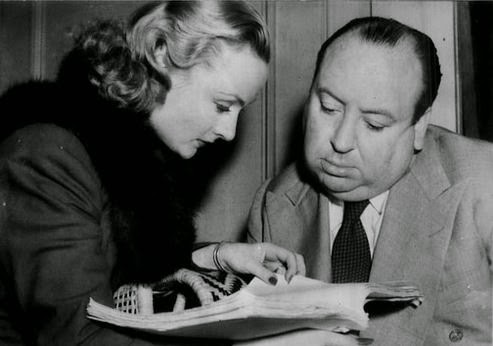
Carole Lombard and Alfred Hitchcock look at the script
His kind of actress
Alfred Hitchcock loved Carole Lombard. She was his type of actress: beautiful, smart, earthy, and blonde. The Hitchcock family rented Lombard’s house after she and Clark Gable were married in 1939. The Hitchcock’s and the Gable’s became fast friends and it was inevitable that the director and actress would work together. Unfortunately, Lombard would make one movie after Mr. and Mrs. Smith, dying tragically in a plane crash the next year, after a successful war bond drive during World War II.


Award-winning script writer
The script written by Oscar winner, Norman Krasna (Hands Across the Table, Bachelor Mother, It Started with Eve, Princess O’Rourke) is quite good and Lombard and Montgomery have great on-screen chemistry and deliver good performances. Raymond is perfect as Montgomery’s strait-laced college chum and partner. The film is peppered with some great character actors like Carson, Lucile Watson, Charles Halton, Esther Dale, and Betty Compson.

Mr. and Mrs. Smith proved that Hitchcock, the master of suspense, could be successful in any genre he put his mind to.

Have some Joe and Enjoy the Show!
Before the movie, grab a cup of coffee from Overflow Coffee Bar, located within the Daystar Center. You can bring food and beverages into the auditorium; we even have small tables set up next to some of the seats.

Join the Chicago Film club, join the discussion
The Chicago Film Club is for classic movie fans. Once a month we screen a classic film and have a brief discussion afterward. For more information, including how to join (it’s free), click here. To purchase your ticket in advance, click here. The Venue 1550 is easily accessible by the CTA. Please visit Transit Chicago for more information on transportation options.

Lombard and Anne Shirley in Vigil in the Night

Backstory: Mr. and Mrs. Smith opened on February 20, 1941 at New York’s Radio City Music Hall. Hitchcock and Lombard had hoped to get Cary Grant to costar, but he was not available. Some Hitchcock critics say that Mr. and Mrs. Smith was a critical and financial flop. This is not true. Audiences were delighted to see Lombard in a comedy after starring in two heavy dramas (Vigil in Night and They Knew What They Wanted). Hitchcock’s first three American films were all solid commercial successes.


Related Posts Plugin for WordPress, Blogger...