Showing posts with label Laura. Show all posts

Tuesday, August 13, 2024

Dana Andrews and Gene Tierney lead the cast in "Laura"

Laura (1944) is set among New York City’s upper crust, with Detective Mark McPherson (Dana Andrews) investigating the murder of beautiful advertising executive Laura Hunt (Gene Tierney). The suspects are some of her closest friends and associates including fiancĂ© (Vincent Price), aunt (Judith Anderson), and mentor (Clifton Webb).


When production on Laura  started, no one believed that the end product would be worth seeing. From the beginning the project was problematic. Arguments between studio boss Darryl Zanuck and the original director, Rouben Mamoulian ended in Mamoulian being fired. Zanuck then assigned Otto Preminger, already the film’s producer, to be its director too. The only problem: Preminger had limited experience as a movie director. 


Under Preminger’s supervision, what began as a fairly ordinary murder mystery, turned out to be a critical and box office success. Tierney in the title role became a superstar and was forever identified with the beautiful, enigmatic Laura Hunt. Andrews, as Detective Mark McPherson, established himself as a major star and popular leading man. Webb, who hadn’t made a movie since the early days of talking pictures, earned an Academy Award nomination as Best Supporting Actor for his role as Waldo Lydecker. Thomas M. Pryor, in his October 12, 1944 New York Times review called Laura “a top-drawer mystery.”

With some of the sharpest and wittiest dialogue ever recorded on film, Laura set the standard for 1940s film noir. Andrews’s portrayal of McPherson became a prototype for what would become known as the hard-boiled detective, influencing a generation of movie actors. Pryor from the Times put it this way: “Mr. Andrews is fast proving himself to be a solidly persuasive performer, a sort of younger-edition Spencer Tracy.”

The musical score by David Raksin is one of the most hauntingly beautiful movie themes ever recorded and will forever be associated with the enigmatic Tierney.


Laura trivia

  • Vincent Price thought this was the best movie he ever made.
  • David Raskin's famous film score wasn't nominated for an Academy Award.
  • Jennifer Jones and Hedy Lamarr were both offered the role of Laura but turned it down.
  • Gene Tierney, knowing that she wasn't the first choice was reluctant to take the part.
  • Dorothy Adams, memorable as Laura's maid Bessie didn't receive screen credit.
  • Joseph LaShelle won an Academy Award for his black and white cinematography.


Click HERE to watch the film on Internet Archive. You can play the film on your laptop or phone. If you have an HDMI cable, you can hook it up to your TV.

Click HERE to join the discussion on August 19, 2024, at 6:30 p.m. Central Time. Once you RSVP, you will receive an invitation with a link to join the discussion on Zoom.

Discussion questions
  1. Laura is considered one of the top films noir of all time. Do you think it deserves that reputation?
  2. Some critics upon the film's release thought that Gene Tierney was miscast. Do you agree with that assessment?
  3. Did David Raskin's score help the movie narrative?
  4. The film is filled with great performances; did one performance stand out to you?
  5. Where you surprised by the plot twists?
  6. Do you think Waldo Lydecker was in love with Laura?


Thursday, January 23, 2020

“Fallen Angel” to screen at PianoForte February 3

Fallen Angel (1945) starring Alice Faye, Dana Andrews, and Linda Darnell will screen on February 3 at PianoForte, 1335 S. Michigan Ave. 2nd Floor. Admission is $5.

Andrews stars as a grifter hoping to swindle two rich sisters (Faye and Anne Revere) while romancing Stella (Darnell) a diner waitress.

Anne Revere and Alice Faye
This was director Otto Preminger’s follow-up to Laura released the year before. The cinematography was by Joseph LaShalle, who won an Academy Award for his work on Laura. Also on board for Fallen Angel was David Raksin, who wrote the film score. He composed the music for Laura, one of the most famous film scores in movie history. Last, but not least, Andrews who played Mark McPherson opposite Gene Tierney in Laura, has the male lead in Fallen Angel. Andrews made five films with Preminger, more than any other leading man.

Faye, the musical queen on the Fox lot, was looking to move into dramatic roles. She loved Laura and wanted to star in a similar mystery. As already noted, she got a lot of the same talent that was involved with that film noir classic. When Faye saw the finished film, she felt that the movie emphasized Darnell’s role to the detriment of her own. She was so distressed that she walked out on her contract. Studio boss Darryl Zanuck begged her to come back, promising her roles in prestige films in the planning stages like The Razor’s Edge, but Faye was done. She didn’t return to the big screen until 1962’s State Fair.

Dana Andrews, Percy Kilbride, and Linda Darnell
Darnell was signed to a contract at 20th Century Fox at age 15. Because she looked older than her age, she worked as a leading lady from the outset, with the studio claiming she was 19. Her role in Fallen Angel helped turn her into a popular pin-up during World War II. In 1944, Look magazine named her one of the four most beautiful women in Hollywood, along with Hedy Lamarr, Ingrid Bergman, and Fox colleague, Gene Tierney.

Interested in classic film? Consider joining the Chicago Film Club. It’s free to join and you’ll be made aware of classic movies screened in Chicago.

For a complete schedule of films and information on PianoForte, click the link here.

Tuesday, August 21, 2018

Summer Under the Stars with Dana Andrews—August 22, 2018


I’m always a little depressed in August because I know the summer is nearing an end. But TCM helps make it better with their annual “Summer Under the Stars” tributes.

My favorite movie actor from the Golden Age of Hollywood is Dana Andrews. I’ve always felt that his style was so natural and contemporary. He created some film characters that will live on forever. Like Donald Martin in The Ox-Bow Incident (1943), Detective Mark McPherson in Laura (1944), Eric Stanton in Fallen Angel. Pat Gilbert in State Fair, Logan Stuart in A Walk in the Sun (all 1945), and perhaps his most well know, Fred Derry in The Best Years of Our Lives. Other memorable roles include, State’s Attorney Henry L. Harvey in Boomerang!, Walt Dreiser in My Foolish Heart (1949), and Detective Mark Dixon in Where the Sidewalk Ends (1950).
 
Dana Andrews
Unfortunately, not all of the films mentioned above are included in Dana’s day. One picture that I wish was on the schedule is Daisy Kenyon (1947). Considered a vehicle for Joan Crawford, Andrews gives a tour-de-force performance as the conflicted lawyer Dan O’Mara. It’s a multilayered characterization that has been overlooked, in my opinion.

Of the Andrew films they’re screening tomorrow, here are my picks, in broadcast order.

Curse of the Demon (1958)—Andrews plays scientist out to prove that the occult and witchcraft is all superstition and hysteria. While taking part in a seminar in England, he begins to have doubts about his earlier conclusions.

The Best Years of Our Lives (1946)—This is perhaps Andrews’s finest screen performance. Returning veteran Fred Derry comes face-to-face with the reality of being a civilian in post-World War II America. I can’t believe the Academy overlooked his performance in this classic film.

The Ox-Bow Incident (1943)—Andrews plays doomed rancher Donald Martin in this film adaptation of Walter Van Tilburg Clark’s classic novel. This was a real breakout performance, again no nod from the Academy.

Where the Sidewalk Ends (1950)—As Mark Dixon, a compromised city cop, Andrews is pitch perfect. This film features his last screen pairing with Gene Tierney.


Fallen Angel ( 1945)—As a conman out to swindle Alice Faye of her family fortune, Andrews’s characterization of Eric Stanton is tinged with sadness, which makes his character all too human and surprisingly sympathetic.

A Walk in the Sun (1946)—Another overlooked performance in a film that today is credited with having a direct influence on Steven Spielberg’s Saving Private Ryan. (1998).

For the complete schedule of the films of Dana Andrews, click here.

Friday, April 14, 2017

2017 Turner Classic Movies Film Festival (#TCMFF) Recap: The Second Day

Hollywood, Friday April 7
Friday was the first full day of the festival. Screenings start as early as 9 a.m. and there are usually several good movies to choose from. My early morning choices were, Rafter Romance (1933), The Maltese Falcon (1941), Cry, The Beloved Country (1951), Beyond the Mouse the 1930s Cartoons of UB Iwerks, and It’s a Mad, Mad, Mad, Mad World (1963). It wasn’t that long ago that I saw The Maltese Falcon on the big screen at a Fathom/TCM event. I didn’t want to commit to It’s a Mad, Mad, Mad, Mad World, a long, long, long, long movie, but I did want to keep with the comedy theme of the festival, so it was Rafter Romance over Cry, The Beloved Country.

Norman Foster, Ginger Rogers, George Sidney, and Laura Hope Crews
I never saw Rafter Romance before so I thought I’d give this pre-Code comedy a try. It starred Ginger Rogers and Norman Foster, who was married to Claudette Colbert (1928 –1935). The plot revolved around two people sharing the same apartment, but never actually meeting because one works during the day and one works during the evening. This improbable premise worked remarkably well and I was happy to go along for the ride. Rogers and Foster were very appealing as the leads and the supporting cast was terrific. Laura Hope Crews was hilarious as a rich patron who wanted to be Foster’s mistress. Foster, an artist, wants nothing to do with Crews. Crews, whose character is fond of alcohol, steals every scene she’s in. The cast also includes a young (ish) Robert Benchley as Rogers’s boss who is constantly asking her out on dates, only to have her refuse his advances. I found the movie absolutely delightful and was glad I choose it as my first movie of the day. Before the film, there was a brief discussion on how Rafter Romance was out of circulation for decades due to licensing and rights issues. TCM acquired the rights to the film in 2006 and “created restored prints with the help of the Library of Congress and Brigham Young University.”


Rafter Romance was screened in the Egyptian Theatre and so was my next choice, One Hour with You (1932). It was competing with Born Yesterday (1950), Lady Sings the Blues (1972), and Beat the Devil (1953). One Hour with You was another movie I had never seen before. This pre-Code musical starred Maurice Chevalier, Jeanette MacDonald, and Genevieve Tobin. The Ernst Lubitsch musical comedy centers around Chevalier and MacDonald as a happily married couple whose bliss is compromised when Chevalier is seduced by MacDonald’s best friend (Tobin). The film follows Chevalier as he struggles with his love for his wife and his attraction to Tobin. In the hands of Lubitsch and Chevalier, these struggles are incredibly comical. Chevalier breaks the fourth wall, as he constantly speaks (and sings) directly to the audience. Adding to the comedy mix are Roland Young and Charles Ruggles, but it’s Chevalier that makes this musical farce work. He’s charming, naive, sophisticated, and hysterical all at the same time. One Hour with You was another enjoyable movie experience for me. “But oh that Mitzie!”

Ben Mankiewicz and Peter Bogdanovich
After those two comedies, I took a break from the movies to go to Club TCM for “A Conversation with Peter Bogdanovich.” Like Martin Scorsese, Bogdanovich is a director and film historian in his own right. He’s interviewed some of the greatest directors from Hollywood’s Golden Age, including John Ford and Howard Hawks. He’s a terrific storyteller and does great impersonations of Cary Grant, Jimmy Stewart, and Orson Welles. He was at his best when he was recounting stories of those Hollywood legends. He also discussed his film career and spoke about how he got started as a director. Bogdanovich wrote an article on film for Esquire magazine that caught the attention of producer/director Roger Corman. He ended up working with Corman on the film Targets (1968) starring Boris Karloff. He also spoke about his early directorial successes: The Last Picture Show (1971), What’s Up Doc? (1972), and Paper Moon (1973). I think I could listened to his stories for days on end; he was that entertaining.


Next up was a movie epic that I had never seen from beginning to end: The Bridge on the River Kwai (1957). It was shown at the Chinese Theatre in a restored digital presentation. The movie did not disappoint. The production was impressive, as were the performances of William Holden, Jack Hawkins, and Alec Guinness who won a Best Actor Oscar for his performance as the by-the-book British colonel in a Japanese POW camp. This was director David Lean’s first big budget movie. It was a critical as well as an international box office success. I’m glad I finally got to see this film in its entirety. It more than lived up to its reputation. Alex Trebek introduced the film with some interesting trivia about the director and casts alleged womanizing!? Not sure how that added to the film’s enjoyment, but it was an interesting aside.

Dana Andrews and Gene Tierney in Laura
I was back at the Egyptian for the nitrate screening of Laura (1944). Laura is one of my favorite movies and Dana Andrews is my favorite movie star, so I was excited to see this classic on the big screen. After all the hype surrounding the nitrate screenings, I found this print lacking. It was dirty in spots, the focus was in and out, and worst of all, the film skipped and important dialogue was missed. If you’ve seen Laura, you know that the film is filled with great, witty dialogue. You don’t want to miss any of it. Parts of the film looked good, but overall, I was disappointed. Still, it was great to see Andrews, Gene Tierney (another favorite), Clifton Webb, Vincent Price, and Judith Anderson on the big screen. I wish we had been prepared for what to expect from this screening. If we were given a heads up as to its deficiencies and if they had pointed out the scenes that were sharp and worth noticing, I would have felt better about the overall experience. When you have a theatre like the Egyptian packed with films noir fans, you can expect some snipping—and there was quite a bit of it—about what we saw on the screen.

Even though I ended the evening on a bit of a sour note with Laura, I would have to declare the entire day a successful one. I got to see all the films I wanted to see and had a great time experiencing them with a live audience in true movie palaces.

Saturday brought more tough choices. Decisions, decisions!

Thursday, January 26, 2017

10 Things You May Not Know About Dana Andrews

Dana Andrews (1909 – 1992) was a major movie star during the 1940s and 1950s. He had major roles in several classic films, including Laura, State Fair, A Walk in the Sun, and The Best Years of Our Lives. He starred on Broadway in Two for the Seesaw, replacing Henry Fonda. He guest starred on numerous television shows and headlined the daytime soap opera Bright Promise (1969 – 1971). For many years he struggled with alcoholism, which damaged his career during the 1950s. He eventually got sober and was active with the National Council on Alcoholism and Drug Dependence.

1. He was born Carver Dana Andrews in Mississippi, the third of 13 children.

2. He was a popular actor at the famed Pasadena Playhouse where he once carried a spear in a     production of Julius Caesar.

3.     He was under contract to both Samuel Goldwyn and Twentieth Century-Fox, an unusual arrangement during the days of the major Hollywood studios.

4.    Andrews appeared in five films with Gene Tierney: Tobacco Road, Belle Starr (both 1941), Laura (1944), The Iron Curtain (1948), and Where the Sidewalk Ends (1950).

Dana Andrews and Gene Tierney kiss in Laura.

5.     A trained opera singer, Andrews had his singing voice dubbed in the musical State Fair (1945), costarring Jeanne Crain.

6.    Speaking of Jeanne Crain, she and Andrews starred in four movies together: State Fair, Duel in the Jungle (1954), Madison Avenue (1961), and the cult classic Hot Rods to Hell (1967).

7.    He was director Otto Preminger’s favorite leading man. He made more films with Andrews than with any other actor: Laura, Fallen Angel (1945), Daisy Kenyon (1947), Where the Sidewalk Ends (1950), and In Harm’s Way (1965).

8.    The disaster movie parody Airplane! (1980) got most of its material from Zero Hour! (1957) Starring Andrews and Linda Darnell.

Linda Darnell (far left) and Dana Andrews (far right) try to land a commercial airliner in Zero Hour!

9.     Actor Steve Forrest, best know for his role as Lt. Hondo Harrelson in the television series S.W.A.T., is Andrews’s younger brother.

10.   He was never nominated for an Academy Award.


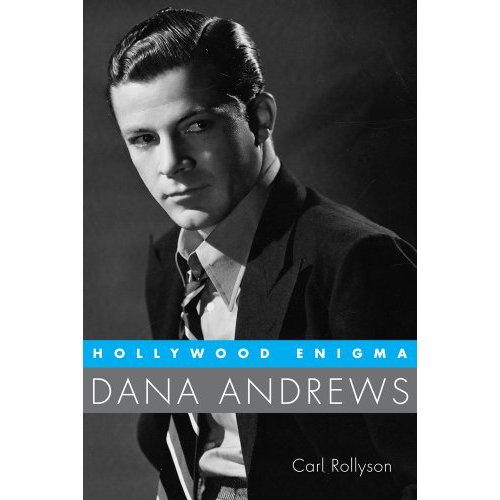
If you’re interested in learning more about Dana Andrews, I recommend you check out the biography Hollywood Enigma: Dana Andrews by Carl Rollyson.

Friday, November 4, 2016

Noirvember starts with “Laura” at the Daystar Center, November 5

The Noirvember film series begins Saturday night with Laura (1944) at the Daystar Center, 1550 S. State Street. The movie begins at 6:45 p.m.

Set among Park Avenue society, Laura concerns the murder of Laura Hunt (Gene Tierney), a beautiful young woman who captivated every man she met. Detective Mark McPherson (Dana Andrews) investigates the murder  by questioning the men in Laura’s life: literary critic Waldo Lydecker (Clifton Webb) and playboy fiancĂ© Shelby Carpenter (Vincent Price). Did they have motives to kill Laura? Hypnotized by Laura’s portrait, as he continues the investigation, McPherson finds himself falling in love. When the case takes a strange turn, the suspense really begins. Filled with witty dialogue and one of the most famous film scores of all time, Laura is considered one of the best films noir ever produced.


The complete schedule for the Noirvember series is listed below. All films begin at 6:45 p.m.

Murder, My Sweet (1945) November 12
Gilda (1946) November 19
Road House (1948) November 26

Tuesday, September 6, 2016

Book Review: "LIFE Film Noir: 75 Years of the Greatest Crime Films"

When someone tweeted the cover of LIFE Film Noir: 75 Years of the Greatest Crime Films, I had to go out and buy it. After all it had Dana Andrews and Gene Tierney on the cover! What it is is a 96-page glorified magazine with neat images from some of the most famous films noir. Author/journalist J. I. Baker is credited on the masthead as editor and writer. The brief introduction is credited to him, but the essays that accompany the films don’t include bylines. The film profiles are short and the entire book can be read in under an hour.

Of the 20 films profiled—starting with The Maltese Falcon (1941) and ending with L.A. Confidential (1997)—film noir fans are bound to criticize some of the choices. I for one was surprised to see Hitchcock’s Shadow of a Doubt (1943) on the list. Shadow of a Doubt is one of my all-time favorite movies and although there are noir elements to it, I don’t generally associate it with noir. The writer acknowledges this by stating, “Though Hitchcock isn’t generally associated with noir, he had worked in Berlin early in his career and was deeply influenced by German expressionism, which helped define the genre’s look.”

Some of the other film choices are obvious: Double Indemnity (1944), Laura (1944), Mildred Pierce (1945), and Out of the Past (1947). The book also looks at more modern films (Neo Noir) like Bonnie and Clyde (1967), Dirty Harry (1971), Chinatown (1974) and Taxi Driver (1976).

Designed to sell on the newsstand along with magazines like People and Us, 75 Years of the Greatest Crime Films is worth a look, but at $13.99 retail, it may be a bit steep for what it offers. You can pick up your copy wherever magazine are sold and from Amazon. But a trip to your local library may be the most economical option.

Monday, February 4, 2013

Dana Andrews gets his due

The title for my class comes from
Carl Rollyson’s recent biography of Andrews.
As any reader of this blog knows, I love classic movies. I have many favorite actors and actresses from Hollywood’s Golden Age, but my favorite actor from this time period is Dana Andrews. As a kid growing up, I used to watch a lot of old movies on TV (before cable and TCM). When I discovered the films of Andrews (Laura, Fallen Angel, The Best Years of Our Lives), I was fascinated by his naturalistic acting style, one without artifice or exaggerated emotions and mannerisms.

Through my blog, I became acquainted with Andrews biographer, Carl Rollyson. Rollyson wrote the first comprehensive biography of the actor, receiving cooperation from the Andrews family. The book inspired me to organize a Dana Andrews blogathon with my fellow classic movie bloggers. It was a huge success. So successful was the blogathon that I decided to propose a class on Andrews. This spring I’ll be teaching Dana Andrews: Hollywood Enigma at Facets Film School, 1517 W. Fullerton Ave, Chicago, IL. If you’re in Chicago and you love classic movies, I encourage you to take this class.

DANA ANDREWS: HOLLYWOOD ENIGMA

Wednesdays, March 20-April 24, 7-10 pm

Dana Andrews (1909-1992) was one of Hollywood’s most popular movie stars during its golden age. He worked with many legendary, accomplished directors including John Ford, Lewis Milestone, Otto Preminger, Fritz Lang, and William Wyler to name just a few. Andrews’s career is a true American rags-to-riches story as he was the third of 13 children born to a Baptist minister and his wife, yet rose to become a movie star. His minimalist acting style personified ‘the male’ mask of the 1940s, in such classic films as Laura, Fallen Angel, and Where the Sidewalk Ends, in which he played the ‘masculine ideal of sang froid impassivity. These singular films, all directed by Preminger, recognized this distinguishing characteristic of Andrews’s acting ability and perhaps exploited it best. Although Andrews fulfilled his dreams, he did not live the typical celebrity lifestyle. A family man at heart, Andrews avoided the limelight that many of his contemporaries fully embraced. A complicated man, he had a problem with alcohol for most of his adult life, but despite his personal conflicts, he was admired and well liked by his colleagues, leaving us with an extraordinary body of work that will be studied for generations to come.

To register for this film class, click here.

FILMS SCREENED AND DISCUSSED:

Laura (Otto Preminger, 1944)

Fallen Angel (Otto Preminger, 1945)

A Walk in The Sun (Lewis Milestone, 1945)

Canyon Passage (Jacques Tourneur, 1946)

Boomerang! (Elia Kazan, 1947)

Daisy Kenyon (Otto Preminger, 1947)


Friday, August 24, 2012

Book Review: Hollywood Enigma: Dana Andrews


Hollywood Enigma: Dana Andrews by Carl Rollyson
The University Press of Mississippi, 2012

Dana Andrews was one of Hollywood’s biggest stars during the mid-1940s to early 1950s. A basically decent man, Andrews struggled with alcoholism for decades. His addiction affected his film career; other stars got roles that should have gone to him.

Carl Rollyson’s biography is comprehensive and fascinating. Rollyson obviously respects his subject, however, he is objective when it comes to some of the unattractive and disturbing incidents in Andrews’s life.

Andrews was born in Collins, Mississippi in 1904. His father, a Baptist minister, moved the family to Huntsville, Texas to accept a pastorate there. Somewhat rebellious, Andrews’s pursuit of an acting career was shunned by his strict parents. A talented singer, Andrews also studied opera. As soon as he was able, he moved to California to pursue his dream of acting success. He eventually became a regular performer at the famed Pasadena Playhouse where he met second wife, Mary Todd.

Andrews as Fred Derry in The Best Years of Our Lives,
perhaps his finest screen performance
Hollywood eventually came calling and Andrews was signed by legendary independent filmmaker Samuel Goldwyn in 1938. After some small and supporting roles in films like the Ox-Box Incident, Andrews hit pay dirt as Lieutenant Mark McPherson in Laura, playing opposite Gene Tierney. A critical and financial success, Dana Andrews was now a full-fledged movie star. Success, and all the trappings that came with it, was tough for Andrews to handle. His drinking started to get in the way of his career and personal life. Amazingly, for the years he was a major star, his drinking rarely affected his on-screen work.

Andrews worked with major directors like John Ford, Otto Preminger, Fritz Lang, William Wyler, and Lewis Milestone. If it weren’t for his drinking, Andrews may have starred in the classic films Gentlemen’s Agreement and Twelve O’Clock High, both going to Gregory Peck. He finally conquered his demons late in life and was able to enjoy acting on the stage with his wife. A family man at heart, Andrews loved his wife and family passionately, if not perfectly. Apart from learning a lot about Andrews the man and actor, the reader comes away with an understanding of what the life of a movie star was like under the studio system. As you might imagine, it wasn’t as glamorous as we were led to believe. Rollyson’s work is respectful and objective, painting a rich portrait of one of Hollywood’s most beloved  movie stars.

Hollywood Enigma: Dana Andrews is available at Amazon.com and bookstores everywhere.

Rollyson is a professor of journalism at Baruch College, CUNY. He is the author of more than thirty books, including the forthcoming American Isis: The Life and Death of Sylvia Plath and biographies of Marilyn Monroe, Lillian Hellman, Martha Gelhorn, Norman Mailer, Rebecca West, and Susan Sontag. He is the advisory editor of the Hollywood Legends Series.


Take a look at the Dana Andrews blogathon posts to learn more about the actor and his most famous movie roles by clicking here.

Thursday, June 28, 2012

Dana Andrews Blogathon coming July 28, 2012!

Feel free to copy and post image
 to your own blog
Film Noir Favorite
Get ready for the Dana Andrews blogathon! Andrews, the subject of a new biography coming out in September 2012, was a major movie star during Hollywood’s Golden Age. A favorite of film noir fans, Andrews made his mark playing seriously conflicted heroes in films like Laura, Fallen Angel, and Where The Sidewalk Ends. He also excelled as a romantic leading man in films like My Foolish Heart and Night Song. He even starred in a musical (State Fair), but let someone else dub his singing, even though he was a trained opera singer (did you know that?), fearing he would be typecast.

The Rules of the Blogathon
Here are the rules (you knew there’d be rules): Pick a Dana Andrews movie that you’d like to blog about or pick an aspect or quality about the actor and blog your heart out. Since there can be many takes on the same film, duplicate posts will be allowed, but feel free to ask what’s been taken (so far The Best Years of Our LivesBoomerang!, Fallen Angel, The North Star, Swamp Water, Where the Sidewalk Ends, and Daisy Kenyon are definites). In the body of your blog post, please mention the blogathon with a link to my site. E-mail me at sreggie@sbcglobal.net to let me know which movie you want to do. When corresponding, please include “blogathon” in the subject line of your e-mail.

Lights, Camera, Action!
When your post is complete, send me the link by end of day July 25, 2012 (Central Time, US). Links to posts will go live on July 28, 2012. I will compile the links and post to my Classic Movie Man blog. The combined posts will include the titles of your blog posts with their respective links to your blog.

Any questions, please contact me.


Blogathon logo created by and courtesy of Paula Guthat.

Saturday, June 9, 2012

Dana Andrews biography due September 2012


The Enigma of Dana Andrews
The first definitive biography of Dana Andrews is set for publication in September. Hollywood Enigma: Dana Andrews was written by Carl Rollyson who has biographies of Marilyn Monroe and poet Sylvia Plath (February 2013), among others, to his credit.

Understated and Underrated
Like many of Andrews’s fans know, the actor was terribly underrated even when he was at his peak in the late 1940s to early 1950s. For this new biography, Rollyson had access to journals, home movies, the Andrews family, and studio records.

Noir Legend
According to the author a study of film noir would not be complete without a review of Andrews’s work. The films Laura, Fallen Angel, and Where the Sidewalk Ends immediately come to mind when one considers some of Andrews’s best noir films.

The Man Under the Fedora 
As well as Andrews wore a fedora, he was incredibly versatile and could hold his own when cast alongside other major stars like Joan Crawford and Henry Fonda in Daisy Kenyon. It’s this critic’s opinion that Andrews gives the best performance in that film. Under Otto Preminger’s tight direction, Andrews’s Dan O’Mara is a multidimensional character who is neither hero nor villain.

Dana Andrews Blogathon Coming Soon
In July I’ll be hosting a Dana Andrews blogathon. More information about that event will be forthcoming. In the meantime, you may preorder Hollywood Enigma: Dana Andrews from Amazon.com.

Sunday, December 5, 2010

Maverick in the Making: Otto Preminger at Twentieth Century-Fox

Otto Preminger at work
Otto Preminger (1905-1986) was born and educated in Vienna, Austria. He earned a law degree, but only tried one case. Instead of pursuing a career in law, Preminger became the assistant to Max Reinhardt, the famous European stage producer/director. In the mid-thirties, Preminger made his way to Broadway where he caught the attention of movie executive Joseph M. Schenck. Schenck offered Preminger an unusual apprenticeship at the newly formed Twentieth Century-Fox film studio.

At Fox, Preminger directed a few B-films before a dispute with Darryl F. Zanuck found Preminger back on Broadway alternating between acting and directing. During this time, Preminger also established himself as a capable actor in films. With his severe looks and Viennese accent, Preminger made a successful career for himself on stage and in film playing Nazis. Preminger leveraged this success to get back into film directing.

Preminger's most famous film during his association with Fox

With Zanuck overseas during World War II, Preminger was asked to take over the producer-director roles for the film Laura since the original director, Rouben Mamoulian, had been fired. Preminger not only rescued the film from disaster, but turned it into one of the top films of the 1940s.
"Daisy Kenyon," considered a "woman's picture" dealt with racism and child abuse, among other things.

At Fox Preminger directed many film genres: light comedies, melodramas, musicals, and costume epics. Often neglected, Preminger’s work at Fox holds up remarkably well. The themes explored during his Fox tenure (adultery, child abuse, racism, police corruption) foreshadowed his later foray as an independent producer-director, often pushing the envelope and going against the oftentimes prudish conventions and film censorship of the day.

Like Alfred Hitchcock, Preminger was a celebrity, which sometimes worked against his considerable talent as an important director in the history of American film.

Friday, November 12, 2010

Tierney is Tops!

A radiant Tierney in "The Return of Frank James"
Darryl F. Zanuck, the head of Twentieth Century Fox, thought Gene Tierney was the most beautiful woman in movie history. During the 1940s, Tierney’s face was on the covers of countless magazines; women copied her look and wore clothes and accessories inspired by her movie roles.

From the moment she first appeared on the big screen, Tierney was a star. The critics weren’t always taken with her performances, but audiences loved her mix of exotic and girl-next-door beauty. She had a slight overbite, which Tierney refused to correct, when she came to Hollywood. In fact, she had it written into her contract that she had “control” of her teeth and hair. A clause like that may seem odd to us today, but during the reign of the major Hollywood studios it was unusual for an actor or actress to have those kinds of exceptions written into their contracts.

Tierney was far from a diva or prima donna when it came to performing on the set. Known for her professionalism and kindness with both cast and crew, her first husband, Oleg Cassini said Tierney wanted everyone around her to “be happy.”
Tierney helped sell a lot of hats in the 1940s.

Gene Eliza Tierney was born in Brooklyn, NY, on November 19, 1920. Tierney’s father, Howard Sherwood was a successful insurance broker. Her mother, Belle Lavina Taylor was a former physical education instructor. Gene had an older brother, Howard Sherwood Jr. and a younger sister, Patricia.

The Tierney family eventually settled in Connecticut where all seemed ideal. Gene attended the best private schools in the state. At the age of 15, she spent two years attending the Brillantmont school in Lausanne, Switzerland. At Brillantmont, she learned to speak fluent French, a skill she would display in several future film roles.

Tierney’s film career might have started earlier had it not been for her father. In 1938, Gene and her family took a trip to Hollywood. On a tour of the Warner Brothers studio, she was “discovered” by Anatole Litvak. The studio wanted to give the seventeen-year-old a contract, but her father didn’t think the salary was very good and that ended that, or so it seemed.

Tierney is a Technicolor dream in "Heaven Can Wait."
Instead of going to Hollywood, Tierney struck a deal with her father. She would pursue an acting career on the legitimate stage. It was Howard Tierney’s belief (and hope) that his daughter would soon tire of a career, marry well and settle down. But that was not to be.

On the cover of "Life" in 1941
Tierney’s stage debut was inauspicious at best: she carried a pail of water across the stage in What a Life! (1938). Larger roles soon followed and influential critics like Brooks Atkinson from The New York Times took notice. Her real break came when she played Patricia Stanley in the Male Animal (1940). Her reviews were terrific and all of Broadway was at her feet.

One evening, Darryl F. Zanuck, head of Twentieth Century Fox studios, attended a performance of The Male Animal. He thought Tierney had movie star potential and soon she was on her way to Hollywood.

Tierney’s first movie was The Return of Frank James starring Henry Fonda and directed by Fritz Lang. The movie was a hit, but Tierney’s performance was panned. The Harvard Lampoon went so far as to call  her “The Worst Female Discovery” of 1940. Tierney took that slight in stride, but she didn’t like the way her voice sounded. She said she sounded like an “angry Minnie Mouse.” Someone suggested she take up smoking cigarettes to lower the register of her voice. Smoking did lower her voice, but it would also contribute to health problems later in life.

Tierney in "Tobacco Road"
Tierney may not have impressed the critics with her acting ability, but the public was enthralled with her beauty. As the new Hollywood “it girl,” Tierney made five movies in 1941, including Tobacco Road directed by John Ford, Sundown directed by Henry Hathaway, and The Shanghai Gesture directed by Joseph von Sternberg. Nineteen forty-one was also the year Tierney defied her family and studio by marrying a young fashion designer named Oleg Cassini. She and Cassini eloped against the advice of her parents and the brass at Fox.

The next year, Tierney starred in four movies, including Son of Fury: The Story of Benjamin Blake opposite Tyrone Power, Fox’s top male box office draw.

In 1943, Tierney starred in Heaven Can Wait with Don Ameche, directed by the legendary Ernst Lubitsch. The classic comedy filmed in Technicolor showcased Tierney’s radiant beauty. In the movie, her character aged from a young teenage girl to a middle-aged woman and mother. It was her performance as Martha Strabel Van Cleve that convinced Otto Preminger that Tierney had the right qualities to play the title character in the new movie he was producing.

A studio portrait
During the filming of Heaven Can Wait, Tierney discovered she was pregnant. On October 15, 1943, Tierney gave birth to a baby girl, Antoinette Daria Cassini. Born premature, Daria had several handicaps: she was deaf, partially blind, and severely retarded. This devastated Tierney and may have been the beginning of her struggles with mental illness.

After the birth of her daughter, it wasn’t a surprise that Tierney was reluctant to get back to the studio for the next assignment they had lined up for her. The role of Laura Hunt did not appeal to Tierney. Originally conceived as a vehicle for Jennifer Jones, producer Otto Preminger wanted Tierney and lobbied Zanuck hard for her services.

Hired as the producer, Preminger constantly clashed with Rouben Mamoulian, (The Mark of Zoro ,1940) the studio-assigned director. After viewing early footage that Mamoulian directed, Zanuck fired him and hired Preminger to both produce and direct. Preminger had directed several films before, but none had brought him any great success or acclaim. Laura was based on a novel by Vera Caspary, a popular novelist and screenwriter ( A Letter to Three Wives,1949).

Tierney, as Laura Hunt, surrounded by Dana Andrews, Vincent Price, and Clifton Webb
Set among New York’s Park Ave. set, the movie is populated with society’s “upper crust,” if you will, a group that fascinated Preminger. Casting Tierney as the mysterious Laura was a risk. The audience had to believe that she was able to captivate all three of the male protagonists. The director was sure he had made the right choice and felt the same about casting Dana Andrews as detective Mark McPherson. At this point in his career, Andrews was still playing second leads. Zanuck’s first choice for the role was John Hodiak. Laura gave Andrews his first big role and it made him a star.

When the film was released in late 1944, it was an instant hit. Tierney was more famous than ever. And she would be forever identified with the film and its haunting musical score penned by David Raksin.

Laura was nominated for five Academy Awards, including one for Best Director (Preminger) and Best Supporting Actor (Clifton Webb). Preminger and Webb lost that year, but cinematographer Joseph LaShelle won for his masterful black and white photography.

Tierney’s performance, as well as Andrews’s, was neglected at Oscar time. Today Tierney’s performance is appreciated as one of the best of the actress’s career. The American Film Institute named Laura the fourth best film in the mystery genre in 2008.


Related Posts Plugin for WordPress, Blogger...