Dodsworth (1936) is an American drama film directed by William Wyler, and starring Walter Huston, Ruth Chatterton, Paul Lukas, Mary Astor, and David Niven. The screenplay by Sidney Howard is based on the stage adaptation of the 1929 novel by Sinclair Lewis. Houston starred in the stage version and recreated his role on film.
The film centers on the marriage of retired auto magnate Samuel Dodsworth (Huston) and his wife Fran (Chatterton). While on a trip to Europe, the couple discovers they want different things. On the RMS Queen Mary, Sam meets divorcee Edith Cortright (Astor). Edith and Sam hit it off but their relationship is one of friendship. As Sam and Fran arrive in Europe, their marriage is strained, partly due to Fran’s dissatisfaction with what she considers their dull social life. Fran decides to stay in Europe while Sam returns to America.
While in America, Sam is confronted with the “gossip” about
Fran and playboy Arnold Iselin (Lukas). Same returns to Europe to see if he and
Fran have a future together.

William Wyler (1902 - 1981) was an American (born in
Mulhouse, Alsace, then part of Germany) film director and producer. He won the
Academy Award for Best Direction three times: Mrs. Miniver (1942), The Best Years of Our Lives (1946), and Ben-Hur (1959). Wyler was nominated 12 times for Best
Director, an Academy Awards history record. Wyler started working in the movie
business during the silent era, eventually making a name for himself as a
director in the early 1930s. He would go on to direct Wuthering Heights (1939), The Westerner (1940), and The Little Foxes (1941). Actress Bette Davis received three
Oscar nominations under Wyler’s direction, winning her second Oscar for her
performance in Jezebel (1938). Other popular films directed by Wyler include The Heiress (1949), Roman Holiday (1954), Friendly Persuasion (1956), The Big Country (1958), and Funny Girl 1968).
Walter Huston (1883 - 1950) was a Canadian singer,
stage, and film actor. He is also the patriarch of the Huston clan which
includes his writer-director son John, and his granddaughter, actress Anjelica.
Huston worked in the theater, with roles on Broadway where he debuted in 1924.
Once talking pictures began in Hollywood, Huston worked as both a leading man
and also a character actor. Some of Huston’s films include The Virginian (1929), Rain (1932), Gabriel
Over the White House (1933), The Devil and Daniel Webster (1941),
and The Treasure of the Sierra Madre (1948) for which he won
the Academy Award for Best Supporting Actor, directed by his son John. Huston’s
last film was The Furies (1950) co-starring Barbara Stanwyck
and Wendell Corey.
Ruth Chatterton (1892 – 1961) was an American stage, film, and
television actress. She was also an aviator and novelist. She was one of the
few female pilots in the 1930s and was a close friend of Amelia Earhart.
Chatterton started her film career in 1929 and established herself as a major
movie star with her role in Madame X.
For her work in that film, she received her first Best Actress Academy Award
nomination. In 1930, Chatterton was voted as the second favorite star of the
year behind Norma Shearer, in a poll of West Coast film exhibitors. Chatterton’s
film career was at its height during the mid-1930s. By the end of the decade,
she basically retired from film. She continued to work on the stage and was an
early performer on television in the late 1940s.
Paul Lukas (1894 – 1971) was a
Hungarian actor. He won the Academy Award for Best Actor for his performance in
the film Watch on the Rhine (1943),
reprising the role he created on Broadway stage. Before coming to American,
Lukas had a successful stage and movie career in Europe. Some of the movies
Lukas starred in include Little Women (1933), Ladies in Love (1936), The Lady Vanishes
(1938), The Ghost Breakers
(1940), Berlin Express (1948), and Fun in Acapulco (1963) with Elvis
Presley.
Mary Astor (1906 – 1987) was an American actress. She won a Best Supporting Actress
Academy Award for her role in The Great
Lie (1941) but is perhaps best remembered for her performance as Brigid O’Shaughnessy
in The Maltese Falcon (1941) opposite
Humphrey Bogart. Astor was a silent film star—she starred in over 40 silent
films—in her teens but when talkies arrived, her voice was considered too
masculine. After a successful stage performance, film roles started coming her
way. A divorce and child custody scandal involving Astor and playwright George
S. Kaufman almost destroyed her career. During the 1940s, Astor, under contract
to M-G-M, specialized in character roles. Other film roles include Red Dust (1932), The Kennel Murder Case (1933), The
Prisoner of Zenda (1937), Midnight
(1939), The Palm Beach Story (1942), Meet Me in St. Louis (1944), Little Women (1949), and Hush…Hush, Sweet Charlotte (1964).
David Niven (1910 - 1983) was a British actor. He won
the Academy Award for Best Actor for his performance in Separate Tables (1958).
Niven’s film career started in the 1930s with small
roles in films like Mutiny on the Bounty (1935). He soon signed a contract with
Samuel Goldwyn and his career took off. He had a supporting role in Wuthering
Heights (1939). The film was a major success and increased his profile as an
actor. He next co-starred with Ginger Rogers in Bachelor Mother (1939), another big hit. He played a safe-cracker
in Raffles (1939) co-starring Olivia de Havilland.
Niven worked constantly in film throughout the next four decades. Other films
he starred in include Enchantment (1948), Soldiers Three (1951), Around the World in 80 Days (1956). Bonjour Tristesse (1958), Please Don’t Eat the Daisies (1960), and The Pink Panther (1963).
 |
| Walter Huston and Mary Astor |
Dodsworth trivia
- During the filming, Mary Astor was involved in a very public child custody case. Ruth Chatterton was a character witness for Astor.
- David Niven didn’t like working with William Wyler. He acknowledged that Wyler could be “kind, fun, and cozy” off set, but when he sat in that director’s chair he became a bit of a tyrant.
- Mary Astor said that Edith Cortright was her favorite film role.
- William Wyler, Ruth Chatterton, and Walter Huston fought over Chatterton’s performance. Chatterton felt that she should be portrayed as a villainess; Wyler and Huston thought she should be portrayed more sympathetically.
Click HERE to watch the film on
YouTube.
Click
HERE to join the discussion on February 5, 2024, at 6:30 p.m. Central Time. Once
you RSVP, you will receive an invitation and a link to join the discussion on
Zoom.
 |
| Ruth Chatterton and Walter Huston |
Discussion
questions
- Ruth Chatterton thought that there should be little sympathy for Fran. Did you think she deserved any?
- Do you think the marriage conflict between Fran and Sam was realistic?
- Do you think that Sam and Fran were ever in love with each other?
- What did you think of the performances of Huston, Chatterton, and Astor?
- Where you surprised by the film’s ending or did you expect it? Do you think Sam and Edith will eventually get married? Sam is still married to Fran at the film’s end.


 and
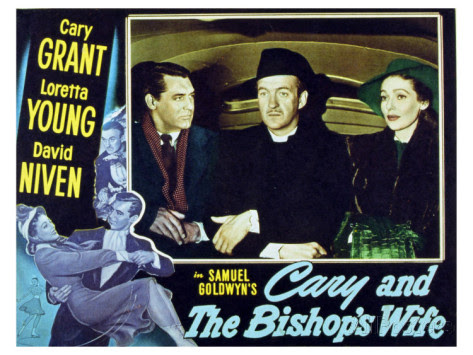
and  were known as much for their classic movie star looks as their acting abilities. Young, a star since the days of silent films, is considered one of the screen’s great beauties. Her big expressive eyes and lovely cheekbones made her a photographer’s dream. Grant’s was the face that the top female stars of the 1930s wanted next to theirs on the big screen.
 (1947), audiences were faced with two of the most beautiful and most photographed faces in the movies. With those two great faces on the screen side by side, the question comes up; who is the most beautiful of all?
 (1946). He’s as dapper as, well, Cary Grant. Young on the other hand, plays Julia Brougham, the wife of a Bishop (
 ). Throughout the movie, Young is dressed modestly, but beautifully. Likewise, her hairstyle is pulled back, simply styled, but framing that beautiful, luminous face.
 blocked out a two-shot between Young and Grant, both protested that the blocking did not exploit the best sides of their faces. To appease the two stars, Koster had them look out a window in the same direction. This shot satisfied Young and Grant because their best sides (the left sides of their faces) were photographed.
 saw the dailies (film shot that day), he was critical of Koster’s decision to shoot the scene in such a manner. When Koster asked Young and Grant to explain why the shot was set up and filmed this way, Goldywn let go with one of his famous “Goldwynisms.” He said to both stars “Look, if I'm only getting half a face, you're only getting half a salary!” Young and Grant, both being freelance movie stars and not contracted to a major movie studio were also conscious of workplace politics.

