Showing posts with label Loretta Young. Show all posts

Thursday, December 16, 2021

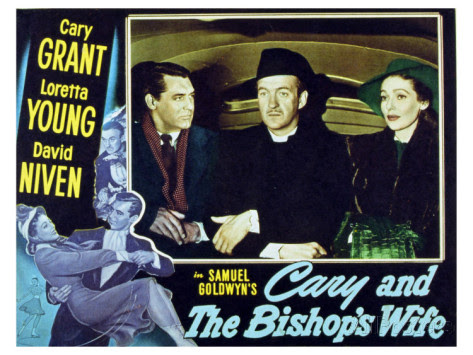
Cary Grant, Loretta Young, and David Niven star in “The Bishop’s Wife”

The Bishop’s Wife (1947) is a fantasy romantic comedy directed by Henry Koster and starring Cary Grant, Loretta Young, and David Niven. The film was produced by Samuel Goldwyn with cinematography by Gregg Toland and music by Hugo Friedhofer.

Bishop Henry Brougham (Niven) is preoccupied with the construction of a new cathedral for his congregation that it overwhelms his entire life and alienates him from his wife Julia (Young) and young daughter (Karolyn Grimes). In a desperate moment, the Bishop asks God for help and guidance. Enter an angel named Dudley (Grant) who helps the Bishop organize his life to better serve his church and family. When Dudley begins cheering up a disillusioned Julia, he finds himself falling in love with her. Will his mission to help rekindle the love the Bishop and Julia have for one another be a success or failure?


Henry Koster (1905 - 1988) was a German-born film director. He signed a contract with Universal Pictures in 1936. At the time, he didn't speak English but he convinced the studio to let him make Three Smart Girls (1936), which was Deanna Durbin’s first starring film role. The movie was a huge success and saved Universal from bankruptcy. Koster convinced Universal to sign Abbott and Costello to a film contract. The comedy duo was a box office sensation during the 1940s, making the studio millions. Later in Koster’s career, he directed Harvey (1950), My Cousin Rachel (1952), which was Richard Burton’s American film debut. He directed Burton again the next year in The Robe, which was the first film to be filmed in CinemaScope. Other films include Desiree (1954) with Marlon Brando and Jean Simmons, Flower Drum Song (1960) starring Nancy Kwan, and The Singing Nub (1965) starring Debbie Reynolds.

Cary Grant (1904 – 1986) was an English-born American actor who became one of the most popular leading men in film history. Grant started his career in vaudeville before heading to Hollywood. He became a superstar in the late 1930s in a series of screwball comedies including The Awful Truth (1937) with Irene Dunne. He was a memorable C. K. Dexter Haven in The Philadelphia Story (1940) opposite Katharine Hepburn and James Stewart. He received two Best Actor nominations: Penny Serenade (1941) and None but the Lonely Hearts (1944). Other classic Grant films include Gunga Din (1939), Only Angels Have Wings (1939), and Arsenic and Old Lace (1944). He made four popular films with Alfred Hitchcock: Suspicion (1941), Notorious (1946), To Catch a Thief (1955), and North by Northwest (1959). He was presented with an Honorary Oscar at the 42nd Academy Awards in 1970.

Loretta Young (1913 - 2000) was an American actress who can trace her start to the days of silent films where she performed as a child actress. Young made the transition to talking pictures as an adult with almost immediate success. As an adult starred opposite some of Hollywood’s most popular leading men including James Cagney, Clark Gable, Tyrone Power, Gary Cooper, and Cary Grant. Young made many films during the pre-code era including Platinum Blonde (1931), Taxi! (1932), They Call It Sin (1932), Employee’s Entrance (1933), and Midnight Mary (1933). Darryl Zanuck signed Young to a contract at Twentieth Century-Fox and paired her with Tyrone Power, the studio’s top male star in several hit films including Love is News (1937), Cafe Metopole (1937), and Second Honeymoon (1937). Unsatisfied with the roles Zanuck was providing her with, Young left the studio and became a freelance artist. On her own, Young starred opposite Alan Ladd in two films, starred alongside Gary Cooper in Along Came Jones (1945), The Stranger (1946), The Bishop’s Wife (1947) with Cary Grant and David Niven, and Rachel and the Stranger (1947) top-billed over William Holden and Robert Mitchum. After her film career was winding down, Young became a huge star on television when the medium was in its early stages.

David Niven (1910 - 1983) was a British actor. He won the Academy Award for Best Actor for his performance in Separate Tables (1958). Niven’s film career started in the 1930s with small roles in films like Mutiny on the Bounty  (1935). He soon signed a contract with Samuel Goldwyn and his career took off. He had a supporting role in Wuthering Heights (1939). The film was a major success and increased his profile as an actor. He next co-starred with Ginger Rogers in Bachelor Mother (1939), another big hit. He played a safe-cracker in Raffles (1939) co-starring Olivia de Havilland. Niven worked constantly in film throughout the next four decades. Other films he starred in include Enchantment (1948), Soldiers Three (1951), Around the World in 80 Days (1956). Bonjour Tristesse (1958), Please Don’t Eat the Daisies (1960), and The Pink Panther (1963).


The Bishop’s Wife trivia
  • When the film was in the development stages, Dana Andrews was set to play the bishop, Teresa Wright was set to play Julia, and David Niven was set to play Dudley.
  • Teresa Wright had to drop out due to pregnancy, but Andrews was still attached to the project when Loretta Young was being considered.
  • Child actor Karolyn Grimes, who plays Debby, played Zuzu in It’s a Wonderful Life the same year.
  • James Gleason, who played Sylvester the cab driver, played a cab driver in Arsenic and Old Lace also starring Cary Grant.
  • The film was remade as The Preacher’s Wife with Denzel Washington, Whitney Houston, and Courtney B. Vance some 50 years later.

To watch the film on YouTube, click the link below.


Why watch this film?
It’s one of the great Christmas classics.
It features three great stars: Grant, Young, and Niven
The film has excellent production values, including cinematography by Greg Toland (Citizen Kane, The Best Years of Our Lives)
The supporting cast features Monty Wooley, Elsa Lancaster, and Gladys Cooper.


To join the discussion on December 20, 2021, at 6:30 p.m. Central Time, click here. Once you RSVP, you will receive an invitation and a link to the discussion on Zoom.

Discussion questions:
Where would you rank this film as far as Christmas movies go? Top-ten? A personal favorite?
Do you think David Niven and Loretta Young made a credible couple?
Do you think Dudley really fell in love with Julia?
What do you think is the film’s main theme?
Did the film end the way you wanted it to? Was it satisfying?

Saturday, June 5, 2021

Joseph Cotton falls for “The Farmer’s Daughter,” Loretta Young

The Farmer’s Daughter (1947) is an American film comedy directed by H. C. Potter and starring Loretta Young, Joseph Cotten, and Ethel Barrymore. The supporting cast includes Charles Bickford, Harry Davenport, Lex Barker, Keith Andes, Thurston Hall, and James Arness.

Katie Holstrom (Young), a Swedish-American leaves home to go to nursing school. On her way to Capitol City, she is taken advantage of by barn painter Adolph Petree (Rys Williams). He steals her money and leaves her stranded at a motel 60 miles from Capitol City. Humiliated and afraid to tell her parents about her situation, she takes a job as a maid for Agatha Morley (Barrymore) and her son, U. S. Representative Glenn Morely (Cotten). Agatha is the head of a powerful political family which is of interest to Katie.

Impressed by Katie’s work ethic and ability to charm everyone including the crusty butler Joseph Clancy (Bickford). Another bonus, her coffee is much better than Clancy’s which must be taken with alcohol to blunt its bitter taste. Glenn Morley takes notice of Katie’s good qualities and courts her much to the delight of his mother.

When Katie learns that the Morleys are backing Anders J. Finley (Art Baker) for Congress, Katie shows her disapproval by asking him pointed questions of Finley at a town hall meeting introducing him as a candidate. So impressed with Katie’s questioning, the opposition party asks Katie to run for Congress. She accepts their invitation and quits her job with the Morleys.

Will Katie be able to handle the rough and tumble ways of American politics? Will she be taken seriously as a viable candidate and will Glenn stand by her no matter what troubles lie ahead?


H. C. Potter (1904 - 1977) was an American theatrical producer and director, and a director of motion pictures. Potter graduated from Yale University in 1926 and was part of the Yale Dramatic Association. He founded a theater group, the Hampton Players based in Southampton, Long Island. He eventually made his way to Hollywood where he eventually became a film director. Some of his popular films include The Shopworn Angel (1938) starring Margaret Sullivan and James Stewart, The Story of Vernon and Irene Castle (1939) starring Fred Astaire and Ginger Rogers, Mr. Lucky (1943) starring Cary Grant and Laraine Day, and Mr. Blandings Builds His Dream House (1948) starring Cary Grant, Myrna Loy, and Melvyn Douglas.

Loretta Young (1913 - 2000) was an American actress who can trace her start to the days of silent films where she performed as a child actress. Young made the transition to talking pictures as an adult with almost immediate success. As an adult starred opposite some of Hollywood’s most popular leading men including James Cagney, Clark Gable, Tyrone Power, Gary Cooper, and Cary Grant. Young made many films during the pre-code era including Platinum Blonde (1931), Taxi! (1932), They Call It Sin (1932), Employee’s Entrance (1933), and Midnight Mary (1933). Darryl Zanuck signed Young to a contract at Twentieth Century-Fox and paired her with Tyrone Power, the studio’s top male star in several hit films including Love is News (1937), Cafe Metopole (1937), and Second Honeymoon (1937). Unsatisfied with the roles Zanuck was providing her with, Young left the studio and became a freelance artist. On her own, Young starred opposite Alan Ladd in two films, starred alongside Gary Cooper in Along Came Jones (1945), The Stranger (1946), The Bishop’s Wife (1947) with Cary Grant and David Niven, and Rachel and the Stranger (1947) top-billed over William Holden and Robert Mitchum. After her film career was winding down, Young became a huge star on television when the medium was in its early stages.

Joseph Cotten (1905 - 1994) was an American film, stage, radio, and television actor. Cotten achieved fame on Broadway in the original stage productions of The Philadelphia Story and Sabrina Fair.  He became famous worldwide after appearing in Citizen Kane (1941) and The Magnificent Ambersons (1942). As one of the most popular leading men of the 1940s, Cotten starred in Shadow of a Doubt (1943), Gaslight (1943), Duel in the Sun (1946), and The Third Man (1949). Cotten alternated between work on stage and film into the late-1950s. Cotten also appeared on television guest-starring on The Name of the Game, Cimarron Strip, and Ironside. Cotten’s last film role was in 1981.

Ethel Barrymore (1879 - 1959) was an American stage and film actress and part of the famous Barrymore family of actors. Her equally famous brothers were Lionel and John Barrymore. Barrymore got her start on the stage and she was among its brightest stars for many years. Barrymore also had a successful career on the other side of the Atlantic in London where she starred in Peter the Great. She achieved one of her biggest Broadway successes in W. Somerset Maugham’s comedy, The Constant Wife (1926). Barrymore was a popular character actress in film during the 1940s. She won the Academy Award for Best Supporting Actress for her performance in None but the Lonely Heart (1944) opposite Cary Grant who played her son. Other film roles include The Spiral Staircase (1946), The Paradine Case (1947), and Pinky (1949).

Joseph Cotten and Loretta Young
The Farmer’s Daughter trivia

  • The film was intended as a vehicle for Ingrid Bergman but she declined the role. Dorothy McGuire and Sonja Henie were possible replacements.
  • Glenn Morley’s (Joseph Cotten) political party was never mentioned.
  • Loretta Young’s Oscar win is considered one of the biggest upsets in Academy history. It was the first comedy performance to win since Claudette Colbert won for It Happened One Night (1934).
  • Rosalind Russell (one of Young’s real-life best friends) was the odds-on favorite to win the Academy Award that year for her performance in Mourning Becomes Electra (1947).
  • This was James Arness’s movie debut and Lex Barker’s first credited screen appearance.
  • Anna Q. Nilsson who played Young’s mother was a major star during the silent era.


Why watch this film?

  • It’s a delightful film featuring a winner performance from Loretta Young.
  • The production is so polished and beautiful, showing off the old studio system at its height.
  • In life and politics, nothing has really changed.
  • Interesting characterizations from Ethel Barrymore and Charles Bickford


To join the discussion on June 8, 2021, at 6:30 p.m. Central Time click here. Once you RSVP, you’ll receive an invitation with a Zoom link.


To watch this film on YouTube, click on the link below.


Discussion questions:
  1. What did you think of Young’s performance? Was it Oscar-worthy?
  2. Did Young and Cotten have good screen chemistry?
  3. What did you think of the political backdrop? Not much has changed, has it?
  4. Did you have a favorite scene, character, or piece of dialogue?
  5. Did this film remind you of any others that you may have seen?
  6. Was Young’s hairstyle the real inspiration for Princess Leia’s in Star Wars?

Wednesday, May 27, 2020

Edward G. Robinson Pursues Nazis in “The Stranger” directed by Orson Welles

The Stranger (1946) is a film noir directed by Orson Welles, produced by Sam Spiegel, and starring Edward G. Robinson, Loretta Young, and Orson Welles.

The film concerns Mr. Wilson (Robinson) of the United Nations War Crimes Commission and his hunt for Nazi war criminal Franz Kindler (Welles). Kindler was careful to erase all traces of evidence that would connect him to his war crimes, but it is known that he had an affinity for clocks.

Edward G. Robinson, Loretta Young, and Orson Welles
In an effort to locate Kindler, Robinson releases Meinike, a former associate of Kindler’s. Robinson hopes that Meinike will lead him to Kindler. Upon Meinike’s release, he travels to Harper, a small town in Connecticut. Kindler has created a new identity and life for himself there in the person of Charles Rankin, a teacher at a prep school. He is engaged to marry Mary Longstreet, (Young) the daughter of a Supreme Court Justice.

Will Kindler escape prosecution for his war crimes or will Wilson be successful in bringing him to justice?

The Stranger has the distinction of being the only film that Welles directed that was a commercial hit. After the back-to-back box office disasters of Citizen Kane (1941) and The Magnificent Ambersons (1942), no one wanted to hire Welles to direct. In order for Welles to direct, he had to sign an agreement that he would owe the studio a substantial sum of money if he didn’t meet his obligation to bring the picture in on time and on budget. In fact, Welles brought the picture in a day ahead of schedule and under budget!

Major cast members from The Stranger at the dinner table

Excerpts of the documentary film Nazi Concentration Camps (1945) were included when Wilson’s character is explaining the crimes of Kindler and other Nazis. Director George Stevens, along with James B. Donovan, and Ray Kellogg assembled the film from footage they took during the liberation of Europe for that documentary.

Orson Welles (1915- 1985) was an American actor, writer, director, and producer. He is considered one of the greatest filmmakers of all time, with Citizen Kane considered by many to be the greatest film of all time. Welles got his start on the stage. He formed the Mercury Theatre with John Houseman in 1937. Many of the actors from his repertory theatre starred in his first two films. Welles had a reputation for being difficult and undisciplined which contributed to his low output of films. In spite of all that, his reputation as a Hollywood genius remains untarnished.

Sam Spiegel (1901 – 1985) was an American independent film producer. Speigel won Best Picture Academy Awards for three of the most famous American films of the twentieth century: On the Waterfront (1954), The Bridge on the River Kwai (1957), and Lawrence of Arabia (1962). His three Oscar wins are a record for an independent producer.

Russell Metty (1906 – 1978) was an American cinematographer. He won an Academy Award for Best Cinematography, Color for Spartacus (1960). Starting his career at RKO, Metty photographed Bringing Up Baby (1937) and Room Service (1938). Other films he photographed include Magnificent Obsession (1954), There’s Always Tomorrow (1955), Written on the Wind (1956), and All That Heaven Allows (1956) all directed by Douglas Sirk. Some of his later films include Flower Drum Song (1961), Thoroughly Modern Millie (1967), The Omega Man (1971), and That’s Entertainment (1974).

Edward G. Robinson (1893 – 1973) was an American actor of the stage and screen. Robinson is a true legend from Hollywood’s Golden Age where he starred in the gangster classic Little Caesar (1931), Kid Galahad (1937), Confessions of a Nazi Spy (1939), The Sea Wolf (1941), Double Indemnity (1944), and Key Largo (1948). Robinson was awarded an Honorary Academy Award in 1973, but he was never nominated for a competitive Oscar.

Loretta Young (1913 – 2000) was an American actress. She entered show business as a young girl working in silent films. Silent film icon Colleen Moore gave her the name Loretta (she was born Gretchen Young). With the advent of talkies, Young became a leading lady, landing a long-term contract at 20th Century-Fox. Studio head Darryl F. Zanuck paired her with Tyrone Power and the two were a movie team for a time. Young tired of the parts she was getting at Fox and she decided to leave the studio and become a freelance actor, which was a risky proposition. After a slow start where she reduced her per film fee, she managed to get back on top, winning the Academy Award for Best Actress in 1948 for The Farmer’s Daughter. When film roles dried up, Young ventured into the new medium of television, becoming one of its earliest pioneers with the anthology series The Loretta Young Show.

To watch this film on YouTube, click on the link below. Be sure to use this link because there are several versions of this film on YouTube that are of poor quality.


After you have watched the film, join us on Zoom for a discussion. Below are the links to follow.

Stephen Reginald is inviting you to a scheduled Zoom meeting.

Topic: Discussion of "The Stranger"
Time: Jun 2, 2020 06:30 PM Central Time (US and Canada)

Join Zoom Meeting


Meeting ID: 791 0685 1740
Password: 5Wqk1Z


Questions for discussion:
1. Noir or not? Does this film fit the film noir model as you know it?
2. What did you think of Edward G. Robinson’s performance?
3. From what you know of Orson Welles, did this feel like a Welles film?
4. Was Loretta Young’s character believable?
5. Did the ending surprise you? If yes, how did you think it would end?


Thursday, December 25, 2014

Saturday, November 27, 2010

Loretta or Cary: Who Is more Beautiful?

Loretta Young: a photographer's dream
The Faces of Beauty
Both Loretta Young and Cary Grant were known as much for their classic movie star looks as their acting abilities. Young, a star since the days of silent films, is considered one of the screen’s great beauties. Her big expressive eyes and lovely cheekbones made her a photographer’s dream. Grant’s was the face that the top female stars of the 1930s wanted next to theirs on the big screen.

Mirror, Mirror on the Wall...
When Young and Grant costarred together in The Bishop’s Wife (1947), audiences were faced with two of the most beautiful and most photographed faces in the movies. With those two great faces on the screen side by side, the question comes up; who is the most beautiful of all?

Publicity photograph of Cary Grant
Dressed to Impress
In the film, Grant plays a very dashing angel named Dudley. Dressed by five-time Oscar-winner Irene Sharaff, Grant looked as if he just walked off the set of Hitchcock’s Notorious (1946). He’s as dapper as, well, Cary Grant. Young on the other hand, plays Julia Brougham, the wife of a Bishop (David Niven). Throughout the movie, Young is dressed modestly, but beautifully. Likewise, her hairstyle is pulled back, simply styled, but framing that beautiful, luminous face.

Vanity, Vanity
Like the public that adored them, Young and Grant were aware of their respective good looks and did all they could to present themselves on screen in the best way possible. The story goes that when director Henry Koster blocked out a two-shot between Young and Grant, both protested that the blocking did not exploit the best sides of their faces. To appease the two stars, Koster had them look out a window in the same direction. This shot satisfied Young and Grant because their best sides (the left sides of their faces) were photographed.

I'm not Paying for Half a Face
 Tyrone Power and Young
When producer Samuel Goldwyn saw the dailies (film shot that day), he was critical of Koster’s decision to shoot the scene in such a manner. When Koster asked Young and Grant to explain why the shot was set up and filmed this way, Goldywn let go with one of his famous “Goldwynisms.” He said to both stars “Look, if I'm only getting half a face, you're only getting half a salary!” Young and Grant, both being freelance movie stars and not contracted to a major movie studio were also conscious of workplace politics.

After that confrontation with the boss, the subject of what side of their faces looked better on film never came up again.

Saturday, November 20, 2010

“The Bishop's Wife”: A True Holiday Classic


Losing His Religion and His Wife
Bishop Henry Brougham (David Niven) is consumed with the construction of a new cathedral. His wife, Julia (Loretta Young), feels she is losing her husband’s affection as he attempts to raise the funds to build it by flattering a rich, old widow (Gladys Cooper). Has he forgotten the reason he became a clergyman in the first place?

A Christmas Tale for Grownups
Enter an angel named Dudley (Cary Grant). On a mission from on high, Dudley attempts to show the bishop that the things that really matter aren’t made of bricks and mortar. One of the most spiritual of all the Christmas movies, The Bishop’s Wife is like A Charlie Brown Christmas for grownups.

Grant as the Bishop?
The film was originally going to star Dana Andrews as the bishop, Teresa Wright as Julia, and David Niven as Dudley, the angel. As was often the case in Hollywood, the original stars became unavailable and the film was recast with Grant replacing Andrews as the bishop and Young replacing Wright (Wright was pregnant) as his wife. Niven was still on board as Dudley. After Grant read the script, he decided he wanted to play Dudley, not the bishop, much to Niven’s chagrin. It should have been obvious to everyone that Dudley was the perfect part for Grant; he would have made a rather bland Bishop. But as the bland bishop, Niven is perfect! All the cast reshuffling worked out wonderfully and it’s hard to imagine any other actors playing the three leads.

Cary Grant, Loretta Young, and David Niven
A popular holiday classic, The Bishop’s Wife stars screen favorites Cary Grant, Loretta Young, and David Niven.


Thursday, October 21, 2010

The "Wright" Stuff: Teresa Wright Makes Her Mark

Studio portrait of Teresa Wright
"I only ever wanted to be an actress, not a star."
During the early 1940s, few movie actresses made the impact that Teresa Wright did. Wright was Oscar-nominated for the first three movies she appeared in, a record that no other actor or actress has accomplished. Embraced by the public and critics as well, Wright never wanted to be a movie star.

Muriel Teresa Wright was born in 1919 in New York City. After seeing Helen Hayes on the stage, Wright decided she wanted to be an actress. After gaining experience in regional theater, she decided to try her luck on Broadway during the late 1930s.

Early Broadway Success
Almost immediately, Wright found herself playing a small role in Thorton Wilder’s Our Town. During the play’s run, she understudied for Martha Scott, who had the lead role of Emily. When Martha Scott left for Hollywood, Wright stepped into the lead. After her success in Our Town, she was cast as Mary Skinner in an even bigger success, Life With Father. During one performance, a talent scout from the Samuel Goldwyn studios noticed something special about Wright.

Goldwyn was looking for someone to play Bette Davis’s daughter in his production of The Little Foxes, someone who would be able to stand up to the formidable Miss Davis on the big screen. The talent scout thought Wright was up to the task. Before long, she was brought to Hollywood and signed a long-term contract with Goldwyn.

When The Little Foxes was released in 1941, Wright was nominated for Best Supporting Actress, alongside Bette Davis who was nominated for Best Actress. The Goldwyn talent scout’s faith in Wright was validated.

Hot Property
Samuel Goldwyn immediately arranged for Wright to costar in William Wyler’s production of Mrs. Miniver at MGM starring Greer Garson and Walter Pigeon. After she completed that film, she was costarring opposite Gary Cooper in The Pride of the Yankees, directed by Sam Wood. Both Mrs. Miniver and The Pride of the Yankees were released in 1942 and Wright was showered with critical accolades once again.

During that eventful 1942, Wright found herself nominated for both Best Supporting Actress for Mrs. Miniver and Best Actress for The Pride of the Yankees! She lost the Best Actress award to Greer Garson, but won the Best Supporting Actress award for her role as Garson’s daughter-in-law in Mrs. Miniver.

Hitchcock Comes a Calling
When director Alfred Hitchcock was casting Shadow of a Doubt, he considered  Wright for the lead role of Charlotte (Charlie) Newton. He wanted her for her obvious talent, but Hitchcock also wanted her because she was considered a hot property and her appeal would add to the box office. He was correct on both counts. From the start Hitchcock was impressed not only with Wright’s talent, but her professionalism on the set. Wright’s characterization is a tour-de-force. She begins the film as a naive, innocent girl and ends it as a mature worldly-wise young woman.

Wright is top billed in the Hitchcock classic
During its initial release, Shadow of a Doubt  was a critical and popular success. Today it is considered Hitchcock’s first great American film. Unlike his earlier U.S. movies, Shadow of a Doubt was set in a small American town populated with average people living seemingly average lives. The notion that innocence and evil live side by side would become a popular theme that Hitchcock would continue to explore in later films.

Wright starred alongside some of the biggest male stars of the 1940s.
A Major Star
After working with Hitchcock, Wright became a major star, appearing opposite some of Hollywood’s most famous leading men, including Dana Andrews, Robert Mitchum, Ray Milland, and Gary Cooper (after Pride of the Yankees, they starred together again in Casanova Brown). During the late 1940s, Wright lost out on two important film roles that hurt her career.
  
Pursued is considered the first psychological western.

The Roles That Got Away
Wright’s husband, Niven Busch was a screenwriter and popular novelist. He wrote the best-selling novel Duel in the Sun and adapted the screenplay for producer David O. Selznick. Wright was set to star as the half-breed Pearl Chavez. The role was to be a change of pace for the actress. During production, Wright became pregnant and had to drop out. Jennifer Jones, another actress with a girl-next-door image picked up the role and a Best Actress nomination to boot.

The role of Pearl Chavez was written for Wright.

The next role that Teresa Wright lost, again due to pregnancy, was the portrayal of Julia Broughan in The Bishop’s Wife. The role eventually went to Loretta Young, and again, another box office hit slipped through Wright’s fingers.

You're Fired!
In 1948, Wright made a movie for Goldwyn called Enchantment. Goldwyn had high hopes for the film and Wright had one of the key roles. When production wrapped, Wright didn’t particularly like the result. Scheduled to travel to publicize the film, Wright said she was ill and couldn’t participate. Goldwyn didn’t believe Wright and he fired her. Overnight, Wright was a star without a studio. Used to making $5000 a week and $200,000 per picture, Wright was now a freelance artist during a turbulent time in Hollywood. The major studios were losing money because they were forced to give up their theater ownership, which reaped them huge profits.

Wright was Marlon Brando's first leading lady.
In 1950, Wright agreed to star opposite a Hollywood newcomer named Marlon Brando in what would be his very first film, The Men. The film was an independent low-budget production for which Wright accepted a salary of $25,000. Wright said that after she made that film for that low fee, she was rarely given A-list material again. She still had starring roles in movies, but none matched the quality of her early successes.

Wright Finds Work During Television's "Golden Age"
Instead of giving up on acting, Wright started working in TV during its golden age. She was Emmy-nominated for playing Annie Sullivan in a TV production of The Miracle Worker five years before the film version was made. Later she portrayed famed photographer Margaret Bourke-White in a 1960 TV production. In addition to her TV work, Wright went back to Broadway starring in The Country Girl, Bell, Book and Candle, The Heiress, and Death of a Salesman opposite George C. Scott.

During the 1970s, Wright occasionally worked in films and television. During this period she had roles in Roseland and Somewhere in Time. Her last major role was playing Miss Birdie, Matt Damon’s landlady, in John Grisham’s The Rainmaker in 1977.

Teresa Wright died of a heart attack on March 6, 2005. She was 86 years old.


Related Posts Plugin for WordPress, Blogger...