Showing posts with label Herbert Marshall. Show all posts

Tuesday, September 15, 2026

“Trouble in Paradise” (1932): A Masterclass in Pre-Code Elegance and High-Stakes Deception

Directed by legendary filmmaker Ernst Lubitsch, Trouble in Paradise (1932) is a quintessential pre-Code romantic comedy starring Herbert Marshall, Kay Francis, and Miriam Hopkins. Set against a lavish European backdrop, the film opens in Venice, where debonair master thief Gaston Monescu (Marshall) meets a charming fellow pickpocket, Lily (Hopkins). Realizing they are kindred spirits in crime and sophistication, the two fall head-over-heels in love and join forces as partners in high-society theft.

Seeking their next big payday, the duo moves to Paris and targets Madame Mariette Colet (Francis), the glamorous, immensely wealthy head of a famous perfume house. Gaston manages to return a diamond-encrusted handbag he previously stole from Mariette, earning her immense gratitude, a hefty cash reward, and a position as her personal secretary. Lily joins the household as his typist, positioning the pair to orchestrate a massive embezzlement scheme from within Madame Colet’s opulent estate.

Complications arise as Gaston spends more time with his employer. Mariette’s effortless charm and undeniable elegance begin to captivate Gaston, leading to a passionate mutual attraction that threatens to derail the heist. With jealous suitors snooping around, Lily suspecting her lover’s shifting loyalties, and a high-stakes robbery hanging in the balance, Gaston finds himself caught in a delicate, witty game of love and deception.


Kay Francis, Herbert Marshall, and Miriam Hopkins

Ernst Lubitsch (1892 – 1947) was an influential German-born director, producer, and actor who became one of Hollywood’s most revered filmmakers. Beginning his career in Germany's silent film industry, he moved to Hollywood in the 1920s and developed a celebrated directorial style known as “the Lubitsch Touch”—characterized by visual wit, urbanity, and subtle double entendres. His acclaimed works include Trouble in Paradise (1932), Ninotchka (1939), The Shop Around the Corner (1940), and To Be or Not to Be (1942).

Miriam Hopkins (1902 – 1972) was an American actress who became one of early sound cinema’s leading stars, known for her sharp intelligence, screen intensity, and comic timing. She frequently collaborated with director Ernst Lubitsch, delivering memorable performances in The Smiling Lieutenant (1931), Trouble in Paradise (1932), and Design for Living (1933). She was also nominated for an Academy Award for her title role in Becky Sharp (1935), the first feature-length Technicolor film.

Kay Francis (1905–1968), born Katharine Edwina Gibbs in Oklahoma City, rose to prominence on Broadway before transitioning to Hollywood in the late 1920s, quickly becoming Warner Bros.’ highest-paid actress during the mid-1930s. Renowned for her striking dark hair, sophisticated glamour, and distinct minor lisp (often substituting ‘r’ sounds with ‘w’), she excelled in high-fashion melodramas and romantic comedies, including Trouble in Paradise and One Way Passage (1932). After serving extensively with the USO during World War II, Francis retired from acting in the late 1940s and lived a quiet, private life until her death from breast cancer at age 63.

English actor Herbert Marshall (1890–1966) was born in London and began a promising stage career before serving in World War I, where he suffered a severe leg injury that resulted in a prosthetic limb—a condition he masked so gracefully on screen that few audiences ever noticed. With his velvet-smooth baritone voice, impeccable dignity, and suave charm, Marshall became a major Hollywood leading man in the 1930s and 1940s, starring in masterpieces like Trouble in Paradise, The Letter (1940), and The Razor’s Edge (1946). He remained a sought-after character actor in film, radio, and television until his death from heart failure at age 75.


Click HERE to watch the movie on the Internet Archive.

Click HERE to join the online discussion on Monday, September 21, 2026, at 6:30 p.m. Central Time. Once you RSVP, you will receive an invitation and a link to join the discussion on Zoom.


Trouble in Paradise trivia

Banned by the Production Code: Because the film portrays crime as romantic and financially rewarding without moral punishment, it was withdrawn from circulation in 1935 after the Hays Code began strict enforcement, remaining unshown for decades.

Director’s Favorite: Director Ernst Lubitsch frequently cited Trouble in Paradise as his personal favorite among all his films, praising its visual fluidity and tone.

On-Set Rivalry: Co-stars Miriam Hopkins and Kay Francis reportedly had a tense relationship off-camera, competing over billing, wardrobe, and screen time throughout production.

Prosthetic Triumph: Despite Herbert Marshall having a wooden leg from his wartime injury, Lubitsch directed him to walk long distances and climb stairs seamlessly, keeping the actor's physical limitation invisible to audiences.


Discussion questions

How does Trouble in Paradise embody the unique freedom of pre-Code Hollywood cinema compared to films made just a few years later?

In what ways does Ernst Lubitsch use visual touches—such as doors, shadows, and subtle props—to convey romantic and sexual subtext without explicit dialogue?

Between Lily and Mariette, how do the female leads represent different ideals of femininity, independence, and social class in 1930s cinema?

Does the film present a sympathetic view of Gaston’s criminality, or does it serve as a subtle commentary on wealth inequality during the Great Depression?


Monday, March 9, 2026

A Whimsical Experiment in Altruism: Margaret Sullavan as “The Good Fairy”

Directed by William Wyler and released in 1935, this sparkling screwball comedy features a screenplay by the legendary Preston Sturges. The story follows Luisa Ginglebusher (Margaret Sullavan), a naive and wide-eyed orphan released from her sheltered upbringing into the bustling streets of Budapest. Armed with an unwavering belief in human goodness and a self-appointed mission to act as a “good fairy” to those she encounters, Luisa quickly finds that her innocent meddling has complicated consequences after she lands a job as a movie theater usherette.

The plot thickens when Luisa catches the eye of Konrad (Frank Morgan), a wealthy and predatory meat-packing tycoon. To deflect his aggressive romantic advances while still hoping to use his resources for a charitable cause, Luisa fabricates a story that she is already married. When Konrad insists on rewarding her “husband” with a lucrative business contract to prove his supposed high-mindedness, Luisa realizes she must quickly find a real person to inhabit the role before her web of white lies collapses.

Luisa decides to pick a name at random from the telephone book, landing on Dr. Max Sporum (Herbert Marshall), a struggling, ethically upright lawyer living in near-poverty. Without Max’s knowledge, Luisa maneuvers Konrad into bestowing a sudden windfall of legal work and wealth upon the unsuspecting attorney. As Max’s life transforms overnight, he becomes convinced that his own merit is finally being recognized, while Luisa—aided by her cynical but protective waiter friend Detlaff (Reginald Owen)—struggles to maintain the charade.

As the “good fairy” finds herself increasingly entangled in the lives of these two very different men, the film explores the comedic friction between cynical ambition and pure-hearted idealism. Under Wyler’s sophisticated direction, Luisa must navigate a series of misunderstandings and narrow escapes to ensure her quest to do good doesn’t end in disaster. The result is a witty exploration of whether one can truly change the lives of others without causing a little bit of delightful chaos along the way.


William Wyler (1902 - 1981) was a titan of Hollywood’s Golden Age, renowned for his meticulous craftsmanship and an uncompromising perfectionism that earned him the nickname “40-Take Wyler.” Born in Alsace, Germany (now France), he moved to the United States in the early 1920s and rose through the studio system to become one of the most decorated directors in history, garnering a record twelve Academy Award nominations for Best Director. Wyler was a master of diverse genres, helming timeless classics such as the sweeping epic Ben-Hur (1959), the poignant post-war drama The Best Years of Our Lives (1946), and the sophisticated romance Roman Holiday (1953). His legacy is defined by his innovative use of deep focus cinematography and his uncanny ability to guide actors—including Margaret Sullavan, Bette Davis, and Audrey Hepburn—to career-defining performances.

Margaret Sullavan (1909 - 1960) was a luminous and fiercely independent star of the 1930s and 40s, celebrated for her husky, tremulous voice and a naturalistic acting style that set her apart from the stylized glamour of her contemporaries. Born in Norfolk, Virginia, she initially balked at the Hollywood studio system, preferring the discipline of the Broadway stage, yet she eventually became one of the screen's most poignant leading ladies. Sullavan is best remembered for her heart-wrenching performances in dramas like Three Comrades (1938), for which she received an Academy Award nomination, and her quintessential turn as the feisty Klara Novak in the holiday classic The Shop Around the Corner (1940). Despite a relatively brief filmography and a tumultuous personal life, her ability to blend fragile vulnerability with a sharp, intelligent wit ensured her legacy as one of the most respected performers of her generation.

Herbert Marshall (1890 - 1966) was the quintessence of the urbane British gentleman, beloved by audiences for his resonant, velvet voice and a quiet dignity that became his cinematic trademark. Born in London, he initially pursued a career in accounting before finding his true calling on the stage, a path briefly interrupted by his service in World War I, where he suffered a combat injury that resulted in the amputation of his leg. Despite this, his seamless grace and charm allowed him to transition effortlessly to Hollywood, where he became one of the most sought-after leading men of the 1930s. Marshall is perhaps best remembered for his sophisticated turn as the gentleman thief Gaston Monescu in Ernst Lubitsch’s Trouble in Paradise (1932) and for his poignant performances as the steady, often-betrayed husband in classic dramas like The Letter (1940) and The Little Foxes (1941). A versatile performer who navigated both sparkling comedies and somber melodramas with equal poise, he remained a distinguished presence on screen for over three decades, leaving an indelible mark as a symbol of resilience and refined elegance.

Frank Morgan (1890 - 1949) was a master of the flustered, well-meaning eccentric, a quintessential character actor whose stammering delivery and bewildered charm made him a beloved fixture of Hollywood’s Golden Age. Born Francis Phillip Wuppermann in New York City, he followed his brother Ralph into the acting profession, honing his craft on the Broadway stage before transitioning to a prolific film career spanning over thirty years. Though he was a versatile performer capable of dramatic depth—earning Academy Award nominations for his work in the 1934 version of The Affairs of Cellini and the 1942 drama Tortilla Flat—Morgan is eternally immortalized for his multifaceted performance in the 1939 masterpiece The Wizard of Oz. As the titular Wizard, along with several other colorful roles in the Land of Oz, he perfectly balanced humbug bluster with a deeply touching sense of humanity. A mainstay at MGM, his presence in classics like The Shop Around the Corner (1940) and The Three Musketeers (1948) cemented his reputation as a performer who could steal a scene with a single befuddled glance, leaving behind a legacy as one of cinema's most endearing and recognizable figures.


The Good Fairy trivia

  • A Turbulent Romance: Director William Wyler and star Margaret Sullavan were notorious for clashing on set, with Sullavan frequently walking off in a temper. However, in a surprising twist, Wyler realized her acting improved on the days they didn’t fight; he began treating her with more patience, the two fell in love, and they actually eloped to Yuma, Arizona, in the middle of production.
  • A “Sanitized” Script: The film was one of the first major productions to be heavily affected by the strict Hays Code censorship rules implemented in 1934. Writer Preston Sturges had to rewrite the original Ferenc Molnár play extensively to remove “objectionable” material, including a scene where the orphanage head explains the “facts of life” and the removal of a sofa from a bachelor's apartment to avoid risqué implications.
  • The “Wizard” Connection: Four years before he became world-famous as the titular character in The Wizard of Oz (1939), Frank Morgan played the wealthy Konrad in this film. In a prophetic bit of dialogue, his character actually refers to himself as a “wizard” while offering to use his checkbook to perform “magic” for Luisa.
  • Sturges’ Creative Frustration: Preston Sturges was kept under immense pressure during filming, often finishing script pages only a day before they were shot. His frustration with how directors (including Wyler) handled his dialogue in this and later films eventually led him to become a director himself, culminating in his legendary run of 1940s comedies.


Click HERE to watch the movie online.

Click HERE to join the online discussion on March 16, 2025, at 6:30 p.m. Central Time. Once you RSVP, you will receive an invitation with a link to join the discussion on Zoom.


Discussion questions

  1. The Ethics of Deception: Luisa Ginglebusher begins her journey with a vow to be a “good fairy,” yet her primary method of doing good is through a complex web of lies. Does the film suggest that white lies are a necessary tool for survival in a cynical world, or does the resulting chaos prove that her naive meddling is actually irresponsible?
  2. The Power of the “Self-Made” Myth: When Dr. Max Sporum receives his sudden windfall, he immediately attributes his success to his own unrecognized merit rather than luck or outside intervention. What does this say about the human ego, and how does his transformation from a humble, starving lawyer to a wealthy man change his character?
  3. A “Hays Code” Heroine: Given that the film was produced under the strict moral guidelines of the 1934 Production Code, how does the script balance Luisa’s perceived “innocence” with the predatory nature of the men around her? Does the film’s humor effectively subvert the censors, or does it feel restrained by them?
  4. Wyler vs. Sturges: The film features a unique collision of styles: the sophisticated, visual storytelling of director William Wyler and the fast-talking, cynical wit of writer Preston Sturges. Can you identify moments where these two styles clash or complement each other? For instance, does the romance feel sincere (Wyler) or purely satirical (Sturges)?

Tuesday, November 12, 2024

Pat O’Brien, Claire Trevor, and Herbert Marshall are involved in a “Crack-Up”

Crack-Up (1946) is an American film noir directed by Irving Reis and starring Pat O’Brien, Claire Trevor, and Herbert Marshall. The supporting cast includes Ray Collins and Wallace Ford.

Art critic George Steele (O'Brien) remembers surviving a train wreck that never took place; it's just the first incident in a growing web of intrigue and murder.

Film critic Leonard Maltin described the film as a “Tense, fast-paced Hitchcockian thriller with many imaginative touches.


Irving Reis (1906 – 1953) was a radio program producer and director and a film director. Reis directed several notable and popular films including Hitler’s Children (1943) The Bachelor and the Bobby-Soxer (1947) All My Sons (1948).

Pat O’Brien (1899 – 1983) was an American film actor. O’Brien appeared in more than 100 films, often playing characters of Irish descent. He played cops, priests, and reporters. He was often paired with friend and movie star James Cagney. O’Brien is probably best known for his roles in Angels with Dirty Faces (1938), Knute Rockne, All American (1940), and Some Like it Hot (1959).

Claire Trevor (1910 - 2000) was an American actress who appeared in over 60 movies. She received nominations for the Academy Award for Best Supporting Actress for Dead End (1937), and The High and the Mighty (1954). She won the award for her performance in Key Largo (1948). Trevor got her start on the New York stage and made her film debut in 1933. She also appeared on radio with Edward G. Robinson in the popular radio program Big Town. Trevor’s most famous role is probably Dallas in Stagecoach, but she had other memorable roles in Murder, My Sweet (1944), and Born to Kill (1947). Her last film role was in Kiss Me Goodbye (1982) where she played Sally Field’s mother.

Herbert Marshall (1890 – 1966) was an English actor of stage, screen, and radio. Marshall was a popular leading man during the 1930s and 1940s. He starred opposite Barbara Stanwyck, Greta Garbo, Joan Crawford, and Bette Davis. Some of his films include Trouble in Paradise (1932), The Good Fairy (1935), Foreign Correspondence (1940), The Little Foxes (1941), and The Razor’s Edge (1946).


Pat O'Brien, Claire Trevor, and Herbert Marshall

Crack-Up trivia

  • Crack-Up was the only film noir from director Irving Reis.
  • Laura (1944) and Scarlet Street (1945) also make use of painting and art.
  • The film was set in New York City, but several scenes were filmed in Los Angeles harbor.
  • Reis directed many of the “Falcon” movies during the early 1940s.


Click HERE to watch the film on YouTube.


Click HERE to join the online discussion on November 18, 2024, at 6:30 p.m. Central Time. Once you RSVP, you will receive an invitation and a link to join the discussion on Zoom.

Discussion questions

  1. Did you like the background of the art world?
  2. Was the story believable? Were you able to just enjoy the ride?
  3. What did you think of the performances?
  4. Did O’Brien and Trevor have good on-screen chemistry?
  5. Were you surprised by anything?

Tuesday, April 9, 2024

Joel McCrea and Laraine Day in Alfred Hitchcock’s “Foreign Correspondent”

Foreign Correspondent (1940) is an American spy thriller directed by Alfred Hitchcock and starring Joel McCrea, Laraine Day, Herbert Marshall, and George Sanders. The screenplay was written by Charles Bennett and Joan Harrison. The music was by Alfred Newman and the cinematography was by Rudolph Mate.

Before the outbreak of World War II, Mr. Powers (Harry Davenport), editor of the New York Morning Globe, sends crime reporter John Jones (McCrea) to report on the situation there.

While in the Netherlands, Jones attends an event sponsored by the Universal Peace Party led by Stephen Fisher (Marshall). When the keynote speaker Van Meer (Albert Basserman) becomes ill, he is replaced by Carol Fisher (Day), Stephen Fisher’s daughter. Earlier, Jones had insulted Carol but now finds her irresistible.

As Jones continues to delve into European politics, he becomes suspicious of the Universal Peace Party and Carol’s father.

Does the Universal Peace Party really stand for peace or do they have another agenda?


Alfred Hitchcock (1899 – 1980) was an English film director, producer, and screenwriter. He is one of the most influential filmmakers of the 20th century. Hitchcock directed over 50 feature films, many are classics that have been honored and studied for years. Some of Hitchcock’s classic films include The 39 Steps (1939), Rebecca (1940), Suspicion (1941), Shadow of a Doubt (1943), Notorious (1946), Rear Window (1954), Vertigo (1958), North by Northwest (1959), and Psycho (1960).

Joel McCrea (1905 – 1990) was an American movie star who appeared in over 100 films. During his almost-five-decades career, McCrea worked with some of the top directors in Hollywood including Alfred Hitchcock (Foreign Correspondent 1940), Preston Sturges (Sullivan’s Travels 1941, The Palm Beach Story 1942), and George Stevens (The More the Merrier 1943). McCrea worked opposite some of the top leading actresses of the day including Miriam Hopkins, Irene Dunne, Veronica Lake, Claudette Colbert, and Barbara Stanwyck with whom he made six films. He was the first actor to play Dr. Kildare in the film Internes Can’t Take Money (1937) costarring Stanwyck. McCrea married actress Frances Dee in 1933. The two were married until Joel died in 1990.

Laraine Day (1920 – 2007) was an American actress. Day appeared in films, stage, radio, and television. In 1939, she signed with M-G-M and starred as Nurse Mary Lamont in the popular film series Dr. Kildare. She made seven Dr. Kildare movies with Lew Ayres in the title role. In 1946, she signed a contract with RKO. Her contract stipulated that she would make one movie per year at $100,000. During the late 1940s, Day co-starred with John Wayne, Kirk Douglas, and Robert Mitchum. Some of Day’s films include Those Endearing Young Charms (1945), The Locket (1946), and Tycoon (1947) with John Wayne.


Foreign Correspondent trivia

  • Gary Cooper was offered the John Jones role but turned it down. He regretted it once he saw the film.
  • Alfred Hitchcock had two films up for Best Picture of 1940. This film and Rebecca.
  • Hitchcock had wanted Barbara Stanwyck or Joan Fontaine for the female lead.
  • The film was made before the U.S. had entered the war. The closing scenes of the movie were added when it became clear that the bombing of London was imminent.
  • An entire square was built on a ten-acre site for $200,000 (over $4M today).
  • A flight on the Clipper 314 cost $675.00 round trip which is roughly $12,000 in today’s dollars.
  • Laraine Day was 19 years old during production.
  • The film was a box-office hit but the film’s budget was so high that it didn’t make a profit for the filmmakers.


Joel McCrea, Laraine Day, and George Sanders

Click HERE to join the discussion on April 15, 2024, at 6:30 p.m. Central Time. Once you RSVP, you will receive an invitation and a link to join the discussion on Zoom.

Click HERE to watch the movie on YouTube.


Discussion questions

  1. Where do you think this film ranks with other Hitchcock movies?
  2. The film is famous for its elaborate set pieces. Were you impressed with the film’s recreation of Amsterdam?
  3. Joel McCrea was Hitchcock’s second choice for the lead. What did you think of his performance?
  4. Laraine Day was only 19 years old when she took on the role of Carol Fisher. What did you think of her performance?
  5. Were there any other performances that you enjoyed?


Monday, July 23, 2018

Screening of "The Little Foxes" at Daystar Center July 24

The Little Foxes (1941)
Where: Daystar Center, 1550 S. State Street, Room 102
When: July 24, 2018
Time: 6:30 p.m.
Hosted by Stephen Reginald


During the turn of the 20th century in the Deep South, the Hubbard family is fighting for control of a cotton mill predicted to earn them millions. Bette Davis stars as Regina who is more calculating and crafty than her brothers. Directed by the legendary William Wyler, The Little Foxes was nominated for 9 Academy Awards, including Best Picture.


General Admission is $5. $3 for Students and Seniors.

Have some Joe and Enjoy the Show!
You can bring food and beverages into the auditorium; we even have small tables set up next to some of the seats. General Admission: $5 Students and Senior Citizens: $3.


Join the Chicago Film club; join the discussion
Twice a month we screen classic films and have a brief discussion afterward. For more information, including how to join (it’s free), click here. The Venue 1550 is easily accessible by the CTA. Please visit Transit Chicago for more information on transportation options.

Stephen Reginald is a freelance writer and editor. He has worked at various positions within the publishing industry for over 25 years. Most recently he was executive editor for McGraw-Hill’s The Learning Group Division. A long-time amateur student of film, Reginald hosts “Chicago Film Club,” a monthly movie event held in the South Loop, for the past two years. Reginald has also taught several adult education film classes at Facets Film School, Chicago.

Monday, February 1, 2016

Mad About Deanna Durbin in "Mad About Music"

This post is part of the 2016 O Canada blogathon hosted by Ruth of Silver Screenings and Kristina of Speakeasy.

Anyone who has visited my blog or follows me on Twitter or read my entry in last year’s O Canada Blogathon, is aware that my love for Deanna Durbin knows no bounds. Besides her beautiful voice, Winnipeg’s Golden Girl had a natural screen presence that made her appealing to just about everyone attending the movies in the late 1930s. Mad About Music (1938) was Durbin’s third feature film. It’s also one of her most enjoyable vehicles, featuring many familiar faces in supporting roles.

Sid Grauman, Gail Patrick, and William Frawley
In Mad About Music, Durbin plays Gloria Harkison a student at a girls-only boarding school in Switzerland. Gloria’s mother is the famous movie actress Gwen Taylor (Gail Patrick). On the advice of her manager Dusty Turner (William Frawley), Gwen keeps the fact that she’s a widow with a teenage daughter a secret. Because Gloria can’t reveal her mother’s true identity, she invents a globetrotting explorer father who writes her letters and sends her photographs of his exploits. Of course Gloria writes the letters herself. She reads them out loud to her schoolgirl friends, much to their delight, except for the leader of the mean girls, Felice (Helen Parrish). Felice thinks that Gloria is a fake and that she’s been lying about having a father. Felice makes it her goal to expose Gloria as a liar. Gloria, on the other hand, is desperate to keep the tales of her “father” alive. Her desperation turns to inspiration as she enlists the help of an unsuspecting traveler.

Deanna Durbin reads a letter from her “father.”
Richard Todd (Herbert Marshall) is a composer on vacation in Europe who has planned a five-day stay in Switzerland, traveling with his private secretary and valet (Arthur Treacher). Richard has no idea the turn his life is about to take when he runs into Gloria at the train station. Gloria tells her roommate and best friend Olga (Marsha Mae Jones) that her father is arriving for a visit by train. Gloria asks Olga not to tell anyone, but Olga lets the cat out of the bag and not only is Gloria at the train station meeting her “father,” but all the girls from her school are there, including arch nemesis, Felice. With a bouquet in her arms, Gloria picks Richard out of the train passengers. She tells Richard, that “it’s an old Swiss custom to greet the most distinguished looking visitor on every train.” To keep the ruse alive, while her schoolmates are watching, Gloria insists on taking Richard to his hotel. By escorting Richard into the hotel, right up to the elevator, Gloria convinces her friends that Richard is her father.

Durbin and Jackie Moran
In the midst of Gloria’s subterfuge, she has a puppy-love romance with Tommy, a cadet from a nearby boys academy. While she’s pretending to be Richard’s daughter at the train station, Tommy is waiting for Gloria at a local sweet shop where he asked her out on a date. Gloria arrives late for their date due to meeting Richard at the train station and transporting him to the hotel. Tommy gives Gloria a huge box of chocolates which she brings back to school, telling her pals they’re a gift from her father.

Universal Studios version of a Swiss village on the back lot
When Annette Fusenot (Elisabeth Risdon), one of the instructors/administrators at the boarding school, hears that Gloria’s father is visiting, she and her sister and colleague at the school, Louise (Nana Bryant), invite him to luncheon. When Richard arrives at the school, he is determined to set the record straight and expose Gloria’ big lie. As he enters the school and sees the lineup of Gloria’s classmates to greet him, he changes his mind. Being the sophisticated and debonair man that he is, the girls are enthralled with “Mr. Harkinson’s” tales of adventure. Felice even seems to be coming around due to Richard’s graciousness and charm.

Herbert Marshall and Durbin entertain her schoolmates.

Gloria’s happiness comes to an end when Richard leaves for Paris. After losing her “father,” Gloria is longing to see her mother, who is currently in Paris on a publicity tour. Determined to visit her, Gloria runs away from school, boarding the same Paris-board train that Richard is on. Without a ticket, the train’s conductor locks Gloria in a small room. She tells the conductor that her father is on the train, but he doesn’t believe her. To get Richard’s attention, Gloria starts singing, which draws a crowd and eventually Richard who tells the conductor that she is indeed his daughter. Dusty Taylor tries to keep Gloria away from her mother fearing it will be the end of her career as a movie “glamour girl.” Richard is determined that Gloria gets to visit her mother by barging into the press conference she is having at her hotel. Upon seeing Gloria with Richard, Gwen tells the crowd of reporters that she has a 14-year-old daughter. At first, Gloria doesn’t want to acknowledge this fact, but when she sees that her mother wants it this way, she breaks down in tears and the two embrace.

Patrick, Durbin, and Marshall together as a family
Through all the confusion, it now appears as though the family has been reunited and that includes Richard! So of course, Gwen and Richard become a couple and Gloria not only has her mother back in her life, but a father too.

Summing Up
Mad About Music is an example of the Hollywood studio system at its best. Even with Durbin’s obvious talents, it took the geniuses at Universal to package just the right vehicles for her. Her first producer and mentor, Joeseph Pasternak (he produced 10 of her films, all at Universal) realized that Durbin was a true star and helped develop her God-given talent. It’s no secret that Durbin was unhappy toward the end of her film career, complaining that her roles were awful, even though she was still popular with moviegoers and was one of Hollywood’s highest paid actresses. After retiring, she resisted every attempt to lure her back into the spotlight. When Pasternak moved to MGM, he practically begged Durbin to come with him. She surely would have benefited from the strong musical units at that studio, but she would not be tempted. Instead she lived the rest of her days in relative obscurity in a small town outside of Paris, France.

In their review of Mad About Music, Variety said this about Durbin, “She has acquired more varied technique before the camera, without losing her ingenuous charm nor her luminous screen personality.”

Durbin’s impact on film audiences around the world cannot be understated. She was a favorite of Anne Frank. Durbin’s picture from a movie fan magazine still hangs in her bedroom at the Anne Frank Museum in Amsterdam. Indian filmmaker Satyajit Ray admitted during his Special Oscar acceptance speech: “As a small schoolboy I was terribly interested in the cinema, became a film fan, wrote a letter to Deanna Durbin, got a reply, was delighted: wrote to Ginger Rogers, ah, didn’t get a reply. Then, of course, I got interested in cinema as an art form, and I wrote a twelve-page letter to Billy Wilder after seeing Double Indemnity. He didn’t reply either…Well, there you are.”

Way to go Deanna!

Backstory
Deanna Durbin is known for having a beautiful voice, but her movies aren’t typical musicals, but rather movies with music. Mad About Music is no exception. In between escapades, Durbin sings three new songs: “I Love To Whistle,” “Chapel Bells,” and “A Serenade to the Stars.” She also sings “Ave Maria” with the Vienna Boys Choir, although the boys seen singing on screen were members of Saint Luke’s Church choir of Long Beach, California.

Helen Parrish, Durbin, and Marcia Mae Jones ride (and sing) through the Swiss countryside.

Some of Mad About Music’s Familiar Faces
Herbert Marshall was still considered a leading man in Hollywood at the time of Mad About Music’s release. Ironically, he played the “husband” of Margaret Sullavan in The Good Fairy in 1935. Sullavan’s character picks his name out of the phone book at random and tells a lecherous meat packer, played by Frank Morgan, that Marshall’s character is her husband to avoid his advances.

Durbin celebrates her sweet 16 birthday with Arthur Treacher, Marshall, director Norman Taurog, and producer Joe Pasternak.
Marcia Mae Jones who plays Durbin’s best friend would be the head of the mean girls in the Shirley Temple feature, The Little Princess, the next year.

 Jones and  Durbin
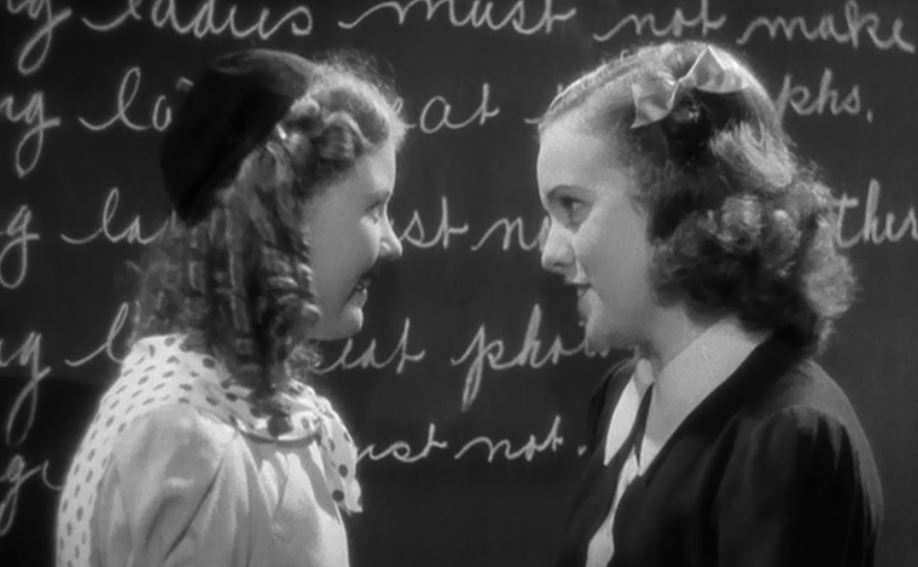
Helen Parrish was to Durbin what Jane Withers was to Shirley Temple. Parrish also played Durbin’s rich, stuck-up cousin in First Love. Parrish could also be a good girl, playing one of Durbin’s older sisters in Three Smart Girls Grow Up. In reality, Durbin and Parrish were the best of friends.

Durbin and Helen Parrish, finally friends in Mad About Music

Arthur Treacher made a career playing butlers in the movies, including this one and several he made with Shirley Temple.

Durbin, Marshall, and Treacher
Jackie Moran, who played Durbin’s romantic interest in Mad About Music was discovered by Mary Pickford. After appearing in Mad About Music, Moran had a small part in Gone With The Wind, playing Doctor and Mrs. Meade’s younger son who wanted to join the Confederate Army so he could “kill all the Yankees” to avenge the death of his older brother. He and Marcia Mae Jones starred in several films for Poverty Row studio Monogram Pictures. In 1944, he exchanged flirtatious glances with Shirley Temple in Since You Went Away.

Jackie Moran and Durbin

William Frawley had a long show business career, that includes classic films like Lady on a Train and Miracle on 34th Street, but is best known today as Fred Mertz in the TV classic I Love Lucy.

Elisabeth Risdon and Nana Bryant who play sisters and teachers Annette and Louise Fusenot, respectively, were in the screwball comedy classic Theodora Goes Wild two years earlier. Risdon played Irene Dunne’s Aunt Mary. Bryant played Ethel Stevenson, the wife of Dunne’s publisher, .

Gail Patrick had played mean women in movies like My Man Godfrey and Stage Door, but gets to play a loving, if conflicted mother in Mad About Music. Rarely a sympathetic character in her early film roles, Patrick shows her versatility with her brief, but warm portrayal.

Mother and child reunion: Patrick and Durbin
Sid Grauman appears as himself in Mad About Music. In the film he says he’s saved a space for Gwen Taylor’s (Gail Patrick) hand and footprints at the Chinese Theater. In reality, it was Durbin who would have her hand and footprints memorialized in cement at the famous theater for Mad About Music’s premier.

Durbin with Grauman getting her footprints in cement at the Chinese Theatre

Sunday, January 17, 2016

Preston Sturges series: Screening of "The Good Fairy" January 26 at Daystar Center

Preston Sturges series: The Good Fairy
Where: The Venue 1550 at the Daystar Center, 1550 S. State Street, Chicago, IL
When: January 26, 2016
Time: 6:30 p.m.
Hosted by Stephen Reginald

The Good Fairy (1935) has a gem of a screenplay by Preston Sturges, steady direction by William Wyler (Roman Holiday, Ben-Hur), and a dream cast to match. Margaret Sullavan plays Luisa, an innocent young woman who leaves the orphanage where she was raised for a job in the big city of Budapest.

Out in the world, Luisa finds herself pursued by two men: Konrad (Frank Morgan) a rich, older man and Detlaff (Reginald Owen), a grumpy waiter. Konrad wants to make Luisa his mistresss so he can shower her with jewels and furs. To escape Konrad’s clutches, Luisa pretends to be married to Max Sporum (Herbert Marshall), a name she randomly picked from the telephone book. Sporum is a struggling lawyer who has no knowledge of Luisa’s scheme. Undaunted, Konrad strikes a deal with Luisa. If he makes her husband rich by giving him an important position in his company, she will have all the material things she desires—and he desires for her—and they can carry on their affair. Konrad gives Max a big starting bonus, which enables him to furnish his law office in style. Of course things get out of hand, but not before a series of hilarious situations and complications take place.


Sullavan shines as Luisa, the wide-eyed innocent in the big city. You really believe that she’s clueless as to the ways of the world and the consequences her actions cause. Morgan almost steals the picture as Konrad, the amorous meatpacker—not to be confused with a butcher. Owen is appropriately stuffy and crabby as Luisa’s kind of big brother wannabe boyfriend. Marshall is appropriately proud and distinguished as Sporum who believes his newfound success is due to his own sterling reputation, but is in for a rude awakening.

The Good Fairy also features the talents of Beulah Bondi, Cesar Romero, Alan Hale, Eric Blore . . . plus an early screen appearance by Jane Withers as one of the orphans.


Have some Joe and Enjoy the Show!
Before the movie, grab a cup of coffee from Overflow Coffee Bar, located within the Daystar Center. You can bring food and beverages into the auditorium; we even have small tables set up next to some of the seats. General Admission: $5 Students and Senior Citizens: $3.

Join the Chicago Film club; join the discussion
Twice a month we screen classic films and have a brief discussion afterward. For more information, including how to join (it’s free), click here. The Venue 1550 is easily accessible by the CTA. Please visit Transit Chicago for more information on transportation options.

Stephen Reginald is a freelance writer and editor. He has worked at various positions within the publishing industry for over 25 years. Most recently he was executive editor for McGraw-Hill’s The Learning Group Division. A long-time amateur student of film, Reginald hosts “Chicago Film Club,” a monthly movie event held in the South Loop, for the past two years. Reginald has also taught several adult education film classes at Facets Film School, Chicago.


Daystar Center located at 1550 S. State St. works through a grassroots network of collaborations and partnerships with individuals and other nonprofit organizations. Through this web, they’re able to provide educational, cultural, and civic activities that enrich and empower their clients, guests, and community members. To learn more about classes and events offered at the Daystar Center, please visit their Web site.


Related Posts Plugin for WordPress, Blogger...