Showing posts with label Humphrey Bogart. Show all posts

Tuesday, December 9, 2025

Leslie Howard and Joan Blondell star in “Stand-In”

Stand-In (1937) is a screwball comedy directed by Tay Garnett and starring Lesley Howard and Joan Blondell that offers a satirical glimpse into the workings of the Hollywood studio system during the Great Depression. The story centers on Atterbury Dodd (Howard), a reserved and highly mathematical financial efficiency expert from a Wall Street bank. Dodd is sent to Tinseltown to investigate the failing finances of a fictional motion picture company, Colossal Pictures. Armed only with his ledgers and logic, he is tasked with determining if the studio is worth saving or if it should be sold off.

Upon arrival, the analytical Dodd finds himself completely unprepared for the chaotic, extravagant, and often nonsensical reality of filmmaking. He quickly meets Lester Plum (Blondell), a cheerful, street-smart former child star who now works as a stand-in for the studio’s temperamental lead actress. Lester, having a wealth of practical Hollywood experience, takes the bewildered accountant under her wing. She attempts to teach him about the unpredictable nature of the movie business—a world where human emotion and creative whims often outweigh balance sheets and sound economic principles.

As Dodd digs into the studio’s books, he begins to suspect that the financial troubles are not due to incompetence alone, but are the result of deliberate sabotage orchestrated by key personnel conspiring with an outside buyer. With Lester’s guidance, Dodd must transition from a detached man of numbers to a man of action to expose the scheme, save the jobs of the studio's hard-working employees, and prevent the entire company from falling into the wrong hands. The film thus transforms into a high-stakes battle pitting strict logic against the colorful, chaotic spirit of Hollywood.


Leslie Howard and Joan Blondell

Tay Garnett (1894–1977) was an American film director, writer, and producer whose career spanned over four decades in Hollywood, working in a wide array of genres. Born in Los Angeles, he served as a naval aviator in World War I before entering the film industry in 1920 as a gag writer for silent comedy legends like Mack Sennett and Hal Roach. Garnett began directing feature films in 1928 and quickly became known as a highly competent craftsman, helming box-office hits and critically acclaimed movies alike, including the pre-Code romance One Way Passage (1932), the adventure classic China Seas (1935), the Hollywood satire Stand-In (1937), the war drama Bataan (1943), and his most noted film, the definitive film-noir thriller The Postman Always Rings Twice (1946). In his later career, Garnett worked extensively in television, directing episodes of popular Westerns and other series like Bonanza and Rawhide.

Leslie Howard (1893–1943) was an acclaimed English actor, director, and producer, known for roles that often conveyed a quiet, sophisticated, and sensitive English charm. Born Leslie Howard Steiner in London to a Hungarian-Jewish father and a British mother, he began his professional career after serving in World War I and receiving a medical discharge for shell shock, which he was advised to treat by taking up acting. Howard found significant success on the Broadway stage before transitioning to Hollywood in the sound era, earning two Academy Award nominations for Best Actor for his roles in Berkeley Square (1933) and Pygmalion (1938), which he also co-directed. He is most widely remembered for his role as the melancholy, honorable Ashley Wilkes in the epic film Gone with the Wind (1939). In the years leading up to and during World War II, Howard returned to England, becoming heavily involved in anti-Nazi propaganda efforts through filmmaking, directing, and starring in films like Pimpernel Smith (1941) and The First of the Few (1942). His life was tragically cut short in June 1943 when the civilian plane he was aboard, traveling from Lisbon to London, was shot down by German aircraft over the Atlantic Ocean.

Joan Blondell (1906–1979) was a prolific American actress who rose to prominence as the quintessential “working girl” of the 1930s, known for her sassy charm, distinctive blonde looks, and ability to deliver witty, fast-paced dialogue. Born into a vaudeville family, she leveraged a successful Broadway run opposite James Cagney to launch a Hollywood career with Warner Bros. She starred in over 100 films, often playing resourceful chorus girls and secretaries in classic pre-Code movies and Busby Berkeley musicals like Footlight Parade and Gold Diggers of 1933, where she sang the iconic, socially-conscious number “Remember My Forgotten Man.” As she matured, Blondell successfully transitioned into a respected character actress, earning an Academy Award nomination for The Blue Veil (1951) and critical acclaim for roles in A Tree Grows in Brooklyn and The Cincinnati Kid. Her career spanned nearly five decades across film, stage, and television, ending with a final film appearance in Grease (1978).


Stand-In trivia

  • Source Material: The film is based on a novel of the same name by Alva Johnston, a writer for The New Yorker. Johnston was known for his profiles of eccentric and notable figures, and his book satirized the chaotic, high-stakes environment of the Hollywood studio system during its Golden Age.
  • Director Switch: Director Tay Garnett was originally scheduled to film A Star Is Born (1937) for Selznick International Pictures, but he traded projects with William A. Wellman, who took over A Star Is Born. This allowed Garnett to direct Stand-In, which offered him a chance to satirize the very industry he worked in.
  • Leslie Howard’s Rare Genre: While star Leslie Howard was best known for playing romantic leads and sensitive, tragic figures (like in Pygmalion and Gone with the Wind), Stand-In is one of the few pure screwball comedies he ever made. The role of the highly analytical and socially awkward banker, Atterbury Dodd, allowed him to showcase an unusual, dry comedic talent.
  • Cameo of the Author: Author Alva Johnston makes a brief uncredited cameo in the film, playing a court clerk in the final courtroom scene. This subtle appearance serves as an insider nod to the book’s creator, who was providing a commentary on Hollywood itself.


Click HERE to watch the movie on the Internet Archive.

Click HERE to join the online discussion on December 15, 2025, at 6:30 p.m. Central Time. Once you RSVP, you will receive an invitation with a link to join the discussion on Zoom.


Discussion questions

  1. Logic vs. Emotion in Hollywood: Atterbury Dodd, the efficiency expert, approaches Hollywood as a purely mathematical problem, while Lester Plum navigates it through practical experience and emotional understanding. How does the film use these two characters to satirize the clash between Wall Street’s logic and the movie industry's creative chaos? Which approach does the film ultimately suggest is more necessary for the studio's survival?
  2. The Role of the “Stand-In”: The title refers to Lester Plum's profession. Beyond her technical job (standing in for the star), how does Lester function as a “stand-in" for the audience or for the true, hard-working people of Hollywood? What does she represent about the industry that the famous stars (like Thelma Cheri) do not?
  3. Satire of the Studio System: Stand In was released at the height of the studio system’s power. Identify three specific ways the film satirizes the business (e.g., the power of the stars, the erratic directors, the financial waste, or the pressure to churn out films). Do these elements of the satire still feel relevant to the entertainment industry today?
  4. Leslie Howard’s Performance: Leslie Howard typically played romantic, sensitive leading men. Discuss how his portrayal of the stiff, humorless Atterbury Dodd uses the screwball comedy format to facilitate his character’s transformation. What key scenes illustrate the shift in Dodd from a cold analyst to someone capable of passion and action?


Wednesday, April 17, 2024

Humphrey Bogart and Lizabeth Scott face a “Dead Reckoning”

Dead Reckoning (1947) is an American film noir directed by John Cromwell and starring Humphrey Bogart and Lizabeth Scott.

Bogart plays Capt. Warren “Rip” Murdock who is trying to unlock the mystery surrounding the disappearance and death of his WW II buddy Sergeant Johnny Drake. During his search he meets Drake’s girlfriend Coral (Scott). During his search, Rip falls in love with Coral but is she worthy of his trust.

Humphrey Bogart and Lizabeth Scott

John Cromwell (1886 – 1979) was an American film and stage director. Cromwell started his career as an actor on the stage and in the early days of talking pictures. He was under contract to Paramount where he directed many pre-Code films. Some of the stars he directed during this time included Kay Francis, William Powell, and Jean Arthur. In 1933, he moved to RKO and directed Irene Dunne in Ann Vickers (1933), Spitfire (1934) with Katharine Hepburn, and Of Human Bondage (1934) with Leslie Howard and Bette Davis. Of Human Bondage was a tremendous box office success and made Cromwell a top director in Hollywood. Other films he directed include Little Lord Fauntleroy (1936) The Prisoner of Zenda (1937), Since You Went Away (1944), Anna and the Kind of Siam (1946), and Dead Reckoning. He is the father of actor James Cromwell.

Lizabeth Scott (1922 – 2015) was an American actress dubbed “The Threat” because she had a similar husky voice and screen persona as Lauren Bacall. Scott was understudy to Tallulah Bankhead in The Skin of Our Teeth but never got the opportunity to replace Bankhead’s run of the play. When Bankhead was replaced by Miriam Hopkins, Scott did go on for one night and received good reviews. It wasn’t long for Hollywood to take notice and producer Wallis signed her to a contract. She made her film debut as Ivy Hotchkiss in You Came Along (1945) with Robert Cummings. The Strange Love of Martha Ivers (1946) was Scott’s second feature. She went on to star in Dead Reckoning (1947) with Humphrey Bogart, I Walk Alone (1947) with Burt Lancaster, and Dark City (1950) with Charlton Heston in his film debut. She had a falling out with producer Wallis after starring in Loving You (1957) with Elvis Presley and another Wallis contract player, Wendell Corey. She basically retired from film after Loving You but appeared on television sporadically during the 1950s and 1960s.


Dead Reckoning trivia

  • Rita Hayworth was the original choice to play Coral but she was committed to The Lady from Shanghai with her estranged husband, Orson Welles.
  • Lizabeth Scott was on loan from Paramount to play Coral and Bogart was on loan from Warner Bros. to play Rip.
  • Bogart was miffed about the terms of his loan out from Warner Bros. because Columbia paid Warner Bros. more than his salary.
  • Coral’s car is a 1941 Lincoln Continental convertible. Only 400 were made.
  • Lizabeth Scott was billed as “The Threat.” Lauren Bacall was tagged as “The Look” and Scott was often compared to Bacall.
  • Lauren Bacall supposedly thought Scott did a good job in the picture.


Click HERE to join the discussion on May 6, 2024, 6:30 p.m. Central Time. Once you RSVP, you will receive an invitation and a link to join the discussion on Zoom.

Click HERE to watch the film on YouTube.


Discussion questions

  1. Does this film fit all the film noir tropes?
  2. What did you think of the pairing of Bogart and Scott?
  3. Like many film noirs, the plot has many twists and turns. Were you able to follow it?
  4. What did you think of the film’s production? Does it fit your idea of a “film noir style?”
  5. Do you think the film would have been different had Rita Hayworth played Cora?

Wednesday, April 3, 2024

Rick's Cafe and the Moral Maze: Love, War, and Choices in “Casablanca”

Guest blog post written by Stephen Galen Estevan


We all know the lines, we've probably seen the tearful goodbye a hundred times, but what truly sets this 1942 classic apart? It's not just the trench coat drama or the Bogie-Berman magic. Casablanca's secret sauce is its unique ability to cook up a storm of moral complexity in a wartime setting. Buckle up, cinephiles, because we're diving into the heart of what makes this movie so darn special.

Ingrid Bergman and Humphrey Bogart

First off, Casablanca throws you right into the grimy underbelly of a war-torn Europe. Rick's Cafe Americain, our Casablanca hotspot, isn't some swanky Hollywood hangout. It's a pressure cooker of refugees, gamblers, and desperation. Everyone's got a story, everyone's running from something. This backdrop instantly throws out a challenge: how do you define "good" and "bad" in a world gone sideways?

Here's where Rick Blaine, the cynical nightclub owner with a heart of gold (or maybe tarnished silver), takes center stage. Humphrey Bogart doesn't play Rick as a superhero. He's a guy who's seen the worst humanity has to offer, and it's hardened him. He prioritizes self-preservation, neutrality above all else.  But then Ilsa Lund walks in, a blast from his romantic past, and suddenly Rick's carefully constructed moral gray area starts to crack.

Dooley Wilson, Bogart, and Bergman

Ilsa, played by the stunning Ingrid Bergman, is another wrinkle in this moral tapestry. She's torn between her love for Rick and her duty to her husband, Victor Laszlo, a Czech resistance leader.  Laszlo embodies the fight against tyranny, the clear-cut "good" in this conflict.  Yet, Ilsa's love for Rick is real, and it forces us to confront the fact that good guys don't always get the girl, and love can be a powerful motivator, even if it complicates the fight against evil.

Casablanca doesn't shy away from the messy bits of human decision-making. We see characters wrestle with their conscience. Renault, the cynical police captain who seems to be in cahoots with the Nazis, throws a wrench into the works with his own moral dilemma.  Even Sam, the piano-playing confidante, wrestles with the line between loyalty and doing the right thing. There are no easy answers, and the film doesn't try to spoon-feed them to us.

This ambiguity is what makes Casablanca's climax so powerful. The iconic scene where Rick lets Laszlo escape with Ilsa is a masterclass in emotional storytelling. Rick sacrifices his own happiness for a cause he initially wanted nothing to do with. It's a selfless act born out of love, a love that transcends personal desires.  In that moment, Rick sheds his cynicism and chooses a side, a decision that resonates because it feels real, not forced.

Paul Henreid, Bergman, and Bogart

Casablanca's moral complexity extends beyond the central love triangle. The film doesn't shy away from the horrors of war. We see refugees desperate to escape, the cruelty of the Vichy regime collaborating with the Nazis.  It reminds us that war isn't just fought on battlefields; it's a fight for the soul in every corner of the world.

This brings us to the final ingredient in Casablanca's recipe for moral complexity: cynicism versus hope. Rick's initial cynicism reflects the disillusionment of a world at war.  But as the film progresses, a flicker of hope emerges.  Laszlo's unwavering belief in the fight against fascism becomes a spark that ignites Rick's sense of purpose.  The ending, while bittersweet, leaves us with a sense of optimism.  Even in the darkest of times, good can prevail, and individuals can make a difference.

Casablanca isn't a film that gives easy answers. It forces us to confront the complexities of human nature, the sacrifices we make for love and for what we believe in. It's a film that stays with you long after the credits roll, prompting you to ponder the murky waters between right and wrong.  That's why, even after all these years, Casablanca remains a cinematic masterpiece, a timeless reminder that the lines between good and bad can be as blurry as the smoke hanging over Rick's Cafe Americain.


Stephen Galen Estevan is the founder and operator of FrameTrek.

Tuesday, February 27, 2024

Humphrey Bogart and Gloria Grahame find themselves “In a Lonely Place”

In a Lonely Place (1950) is an American film noir directed by Nicholas Ray and starring Humphrey Bogart and Gloria Graham. The movie is based on the novel of the same name by Dorothy B. Hughes published in 1947. The cinematography was by Burnett Guffefy who won Academy Awards for From Here to Eternity (1953) and Bonnie and Clyde (1967)

Bogart stars as Dixon Steele a down-on-his-luck Hollywood screenwriter. He’s prone to violence and his troubled past behavior makes him a prime suspect in the murder of Mildred Atkinson, a young hat-check girl. Dix is considering adapting a novel into a screenplay but rather than read the novel, he let Mildred read it at his home and give him a plot summary. After that, Dix escorts Mildred out of his apartment and is witnessed by new neighbor Laurel Gray (Graham) and she gives this information to the police investigating the crime. Dix and Laurel are attracted to each other and begin a relationship. 

As the investigation into Mildred’s murder intensifies, Dix’s behavior becomes erratic, and Laurel begins to suspect that he might not be as innocent as he claims.  


Gloria Grahame and Humphrey Bogart

Nicholas Ray (1911 – 1979) was an American film director. Some of his best-known films include They Live By Night (1948), In A Lonely Place (1950), Johnny Guitar (1954), and Rebel Without a Cause (1955). His films influenced directors Joseph H. Lewis, Arthur Penn, Terrence Malick, and Robert Altman. Later in his career, he directed the big screen epics King of Kings (1961) and 55 Days at Peking (1963) starring Charlton Heston, Ava Gardner, and David Niven.  

Humphrey Bogart (1899 – 1957) was an American film and stage actor. He is one of the most famous and popular movie stars of Hollywood’s Golden Age. Nicknamed Bogie, the actor toiled in supporting roles in both A and B pictures for a decade before his breakout role as Roy Earle in High Sierra (1941). Many more film roles followed including The Maltese Falcon (1941), Casablanca (1942), Key Largo (1948), and The Treasure of the Sierra Madre (1948). His career continued with good roles in films like In a Lonely Place (1950), The Caine Mutiny (1954), and Sabrina (1954) co-starring William Holden and Audrey Hepburn. Bogart died from cancer in 1957.  

Gloria Grahame (1923 – 1981) was an American actress. She began her career on the stage and then went to Hollywood in 1944 where she was under contract to M-G-M. At M-G-M, they didn’t seem to know what to do with Grahame. She was loaned out to play Violet Bick in It’s a Wonderful Life, earning good notices but M-G-M decided to sell her contract to RKO. She played minor and secondary roles in several film noirs, but her career didn’t gain any traction at that studio as well. She had good roles in Sudden Fear (1952) and won an Academy Award for Best Supporting Actress for her performance in The Bad and the Beautiful (1952). Grahame’s performance in that film lasted just over nine minutes. She was the Elephant Girl, performing her own stunts, in Cecil B. De Mille’s The Greatest Show on Earth (1952). Other films include Not as a Stranger (1955) and Oklahoma! where she played Ado Annie, a change of pace from her typical femme fatale roles. Grahame died of cancer at the age of 57.


In a Lonely Place trivia

  • Gloria Grahame and Nicholas Ray were going through a divorce during filming.
  • Lauren Bacall and Ginger Rogers were considered for the role of Laurel Gray. Warner Bros. wouldn’t load Bacall to Columbia. The producer wanted Rogers but Ray thought his then-wife would be ideal in the part.
  • Not a big commercial success at the time of its release, the film’s reputation has grown over the years.
  • Many consider this one of Bogart’s best performances.


Click HERE to watch the film on YouTube.


Click HERE to join the discussion on March 4, 2024, at 6:30 p.m. Central Time. Once you RSVP, you will receive an invitation via email with a link to the discussion on Zoom.


Discussion questions

  1. The film is supposed to be a cynical take on Hollywood. What are some of the cynical or negative aspects of the film?
  2. How did the lighting and cinematography add to the film? Did it enhance the film’s narrative?
  3. Does In a Lonely Place qualify as a film noir? How?
  4. Both Bogart and Grahame were praised for their performances. Would you add your praise to the critics?
  5. Does the film remind you of any other films released in 1950?


Tuesday, December 12, 2023

Humphrey Bogart, Ingrid Bergman, and Paul Henreid have a date with fate in “Casablanca”

Casablanca, the 1942 classic directed by Michael Curtiz and starring Humphrey Bogart, Ingrid Bergman, and Paul Henreid is the third film to be shown in this continuing monthly series. Winner of three Academy Awards, including Best Picture, Casablanca has become part of the American consciousness, its dialogue (“Here's looking at you kid.”) part of our lexicon.


Just another movie?

What started as just another movie during Hollywood’s golden age became an instant classic. It made  Bogart a credible leading man and pushed him out of the shadows of fellow contract players James Cagney, George Raft, and Edward G. Robinson. In only her fourth American film, Bergman became a superstar and one of the most popular movie actresses of the 1940s. For Hungarian-born director Curtiz, Casablanca was his only Best Director win in a career that spanned more than four decades.


Michael Curtiz (1886 -1962) was a Hungarian-American film director who worked during Hollywood’s Golden age, directing some of the best loved classics from that era including The Adventures of Robin Hood (1938) Casablanca (1942), and Mildred Pierce (1945). He directed James Cagney and Joan Crawford to Best Actor/Actress Oscar wins; he put Doris Day and John Garfield on the screen for the first time, making them major movie stars in the process. He’s also responsible for the pairing of Errol Flynn and Olivia de Havilland, one of Hollywood’s most famous screen teams. Other films directed by Curtiz include Angels with Dirty Faces (1938), The Sea Wolf (1941), Yankee Doodle Dandy (1942),  Life with Father (1947), and White Christmas (1954).

Humphrey Bogart (1899 – 1957) was an American film and stage actor. He is one of the most famous and popular movie stars of Hollywood’s Golden Age. Nicknamed Bogie, the actor toiled in supporting roles in both A and B pictures for a decade before his breakout role as Roy Earle in High Sierra (1941). Many more film roles followed including The Maltese Falcon (1941), Casablanca (1942), Key Largo (1948), and The Treasure of the Sierra Madre (1948). His career continued with good roles in films like In a Lonely Place (1950), The Caine Mutiny (1954), and Sabrina (1954) co-starring William Holden and Audrey Hepburn. Bogart died from cancer in 1957.

Ingrid Bergman (1915 – 1982) was a Swedish actress who became an international star upon her Hollywood debut in Intermezzo (1939). Few actresses were as popular as Bergman during the 1940s. In fact, she was the number two box office draw (after Bing Crosby) in 1946. She starred opposite Humphrey Bogart in Casablanca (1942), For Whom the Bell Tolls (1943) opposite Gary Cooper, Gaslight (1944) for which she won the Best Actress Academy Award. She starred opposite newcomer Gregory Peck in Spellbound (1945) which was her first collaboration with director Alfred Hitchcock. Bergman would go on to win another Best Actress Academy Award for Anastasia (1956) and a Best Supporting Actress Academy Award for Murder on the Orient Express (1974).

Paul Henreid (1909 - 1992) was an Austrian-British-American actor, producer, writer, and director. Henreid is probably best known for two films released in 1942: Casablanca and Now, Voyager. Henreid was under contract with Warner Bros. where he was a popular leading man starring opposite the studio's top actresses including Bette Davis, Ida Lupino, and Eleanor Parker. After he left Warner Bros. Henreid made a series of adventure films. He later directed films and television shows like Alfred Hitchcock PresentsMaverick, and The Big Valley.


Casablanca trivia

  • Many of the actors playing Nazis were German Jews who escaped Nazi Germany.
  • The tears in the eyes of the extras singing “La Marseillaise” were real; many of them had escaped Nazi occupied Europe.
  • Stars Humphrey Bogart, Ingrid Bergman, and Paul Henreid didn’t want to make Casablanca. Bogart and Bergman were unhappy with a script that wasn’t completed before filming, and Henreid who had a big success starring opposite Bette Davis in Now, Voyager (1942) didn’t want to be the second male lead.
  • Bergman was desperate to play Maria in For Whom the Bell Tolls (1943). Bergman got the role and a Best Actress nod. Bergman thought this would be the role that moviegoers would remember her for. Even though the film was a bigger box office hit than Casablanca, it hasn’t the reputation of that classic.
  • The movie was filmed entirely on the Warner Bros. sound stages and backlot.

Click HERE to watch the film on YouTube.


Click HERE to join the discussion on December 18, 2023, 6:30 p.m. Central Time. Once you RSVP, you will receive an invitation and a link to join the discussion on Zoom.


Discussion questions

  1. What is the basic plot of Casablanca? What is the central conflict? How is this conflict established?
  2. What is the tone of the film? How is that tone established? What are some of the major themes of this film?
  3. What role does music play? How do the attitudes of jazz fit into Rick’s club, and what we know about his character?
  4. How are the characters framed in the film? What “tricks” does the director use to introduce characters, reveal their motives, or present their conflicts? How is this explored through lighting and camera angles?
  5. What make this film timeless?


Monday, November 14, 2022

Bogart, Hepburn, and Holden star in Billy Wilder's "Sabrina"

Sabrina (1954) is an American romantic comedy directed by Billy Wilder and starring Humphrey Bogart, Audrey Hepburn, and William Holden. The screenplay was by Wilder, Ernest Lehman, and Samuel A. Taylor. The supporting cast includes John Williams, Martha Hyer, Francis X. Bushman, Ellen Corby, and Nancy Kulp.

Sabrina Fairchild (Hepburn), the daughter of the Larrabee family’s chauffeur (Williams) has been in love with David Larrabee for as long as she can remember. David has been married three times and is the handsome, non-working playboy younger brother of the hard-working Linus (Bogart). Sabrina has lived at the Larrabee estate on Long Island her entire life. To David, she is still a little girl.

As a way to help her forget David, her father has arranged for her to attend the Le Cordon Bleu culinary school in Paris. Before she is supposed to leave, she leaves her father a suicide note and proceeds to start all the cars in the garage in an effort to kill herself. Linus, who happens to walk by the garage and hearing all the car engines running, finds Sabrina about the pass out from the fumes. Linus saves Sabrina and brings her to her family’s apartment above the garage.

Sabrina goes to Paris and after completing her cooking course, she comes back to Long Island a sophisticated young woman who David doesn’t even recognize. David finds Sabrina enchanting but there’s one problem; he’s engaged to be married to socialite Elizabeth Tyson (Hyer).

What will happen to Sabrina? Will she find happiness with her childhood crush, David, or is there someone else who is a better match?


Billy Wilder (1906 - 2002) was an Austrian-born American film director, screenwriter, and producer. He won six Academy Awards for his writing and direction and was nominated twenty-one times over a career that spanned five decades. Wilder started his career as a writer, penning the screenplays for Ninotchka (1939), Ball of Fire (1942), Double Indemnity (1945), The Lost Weekend (1946), Sunset Boulevard (1951)  Boulevard (1951)Sabrina (1955), Some Like it Hot (1960), and The Apartment (1961). As a director, he won Academy Awards for directing The Lost Weekend (1946) and The Apartment (1961). Wilder directed fourteen different actors in Oscar-nominated roles. He is considered one of the most versatile directors from Hollywood’s Classical period.

Humphrey Bogart (1899 – 1957) was an American film and stage actor. He is one of the most famous and popular movie stars of Hollywood’s Golden Age. Nicknamed Bogie, the actor toiled in supporting roles in both A and B pictures for a decade before his breakout role as Roy Earle in High Sierra (1941). Many more film roles followed including The Maltese Falcon (1941), Casablanca (1942), Key Largo (1948), and The Treasure of the Sierra Madre (1948). His career continued with good roles in films like In a Lonely Place (1950), The Caine Mutiny (1954), and Sabrina (1954) co-starring William Holden and Audrey Hepburn. Bogart died from cancer in 1957.

Audrey Hepburn and William Holden

Audrey Hepburn (1929 – 1993) was a British actress. Hepburn won an Academy Award for Best Actress for her first starring role in Roman Holiday (1953), co-starring Gregory Peck. Peck predicted that Hepburn would be a big star during production and insisted that she receive equal screen building with him. Hepburn also starred on Broadway in Gigi and Ondine. Other film roles include Sabrina (1954), War and Peace (1955), Breakfast at Tiffany’s (1961), My Fair Lady (1964), How to Steal a Million (1966), Wait Until Dark (1966), Two for the Road (1967). Besides her acting career, Hepburn was a fashion icon and a humanitarian working as Goodwill Ambassador with UNICEF.

William Holden (1918 - 1981) was an American actor and major movie star. He was one of the most bankable stars of the 1950s. Holden starred in some of the most popular and beloved films of all time including Sunset BoulevardSabrina, Picnic (1955), The Bridge on the River Kwai (1957), and Stalag 17 for which he won the Academy Award for Best Actor. Holden became a star with his very first role in Golden Boy (1939). He had lead roles in other popular films like Our Town (1940), and  I Wanted Wings (1941). World War II interrupted his career. Holden was a first lieutenant in the United States Army Air Force. After the war, he made some popular but forgettable films. It wasn’t after he collaborated with director Wilder on Sunset Boulevard that Holden’s popularity and stature in Hollywood grew to superstar status.


Sabina trivia

  • Cary Grant was Wyler's first choice to play Linus. 
  • Humphrey Bogart wanted his wife (Lauren Bacall) to play Sabrina.
  • Bogart did not enjoy working with Hepburn and Holden. Bogart thought Hepburn was inexperienced.
  • The script was being worked on as they filmed. Reportedly, one scene was written in the morning and shot that afternoon. Writer Ernest Lehman had a nervous breakdown during production.
  • Hepburn was 24, Holden was 35, and Bogart was 53 during the film's production.
  • Bogart was paid $300,000, Holden $150,000, and Hepburn $15,00.


To watch the film on YouTube, click on the link below.


To join the discussion on November 21, 2022, at 6:30 p.m. Central Time, click here. Once you RSVP, you will receive an invitation and a link to the discussion on Zoom.

Bogart, Hepburn, and Holden


Discussion questions

  1. Would you have rather seen Cary Grant in the role of Linus or did you think Humphrey Bogart was just right for the role? Joseph Cotten played Linus in Sabrina Fair, the play on which the movie is based. Can you see Cotten in the Bogart role?
  2. Some critics think that William Holden was miscast as David; do you agree with the critics?
  3. This was only Hepburn's second major film role. What did you make of her performance?
  4. Do you think Lauren Bacall would have made a good Sabrina?
  5. Did this film remind you of any other romantic comedies you've seen?

Monday, August 8, 2022

Sylvia Sidney and Joel McCrea star in “Dead End”

Dead End (1937) is a crime melodrama directed by William Wyler and starring Sylvia Sidney and Joel McCrea. The supporting cast includes Humphrey Bogart, Wendy Barie, Claire Trevor, and Allen Jenkins. The screenplay was written by Lillian Hellman, and based on the play Dead End (1935) by Sidney Kingsley. The cinematography was by Greg Toland (Citizen Kane, Wuthering Heights, The Best Years of Our Lives) and the music was by Alfred Newman.

Tommy Gordon (Billy Halop) is the leader of a gang of poor kids on their way to being more than petty criminals, is being raised by his older sister Drina (Sydney). Drina works hard to provide for Tommy and to keep him from the criminal element that he seems to admire.

Mobster Hugh “Baby Face” Martin (Bogart) returns to the neighborhood to visit his mother and girlfriend (Trevor), causing commotion and excitement among the young gang members. Dave Connell (McCrea) recognized Martin who was raised on the same street as he, warns him to stay away. Martin ignores Dave.

Dave is a trained architect, but hasn’t been able to gain employment in his chosen field, works odd jobs to make ends meet. He is involved with a rich debutante Kay Burton (Barrie). The relationship is doomed due to the fact that Dave is poor and Kay is used to a life of comfort and ease. Eventually, Dave finds himself drawn to Drina, someone he has known from his childhood.

Will Dave, Drina, and Tommy escape the dead end of their current existence?

Joel McCrea, Sylvia Sidney, and Billy Halop

William Wyler (1902 - 1981) was an American (born in Mulhouse, Alsace, then part of Germany) film director and producer. He won the Academy Award for Best Direction three times: Mrs. Miniver (1942), The Best Years of Our Lives (1946), and Ben-Hur (1959). Wyler was nominated 12 times for Best Director, an Academy record. Wyler started working in the movie business during the silent era, eventually making a name for himself as a director in the early 1930s. He would go on to direct Wuthering Heights (1939), The Westerner (1940), and The Little Foxes (1941). Actress Bette Davis received three Oscar nominations under Wyler’s direction, winning her second Oscar for her performance in Jezebel (1938). Other popular films directed by Wyler include The Heiress (1949), Roman Holiday (1954), Friendly Persuasion (1956), The Big Country (1958), and Funny Girl 1968).

Sylvia Sydney (1910 – 1999) was an American stage and film actress. Sydney was a major movie star during the depression with starring roles in An American Tragedy (1931), Fury (1936), Dead End (1937). In 1936, she starred in The Trail of the Lonesome Pine, an early three-strip Technicolor film. When Sydney made Sabotage, she was the highest-paid actress in movies, earning $10,000 per week. She made a total of $80,000 for that film. Later in her career, she appeared in supporting roles in Summer Wishes, Winter Dreams (1973), Beetlejuice (1998), Used People (1992), and Mars Attacks! (1996) which was her final film role.

Joel McCrea (1905 – 1990) was an American movie star who appeared in over 100 films. During his almost-five-decades career, McCrea worked with some of the top directors in Hollywood including Alfred Hitchcock (Foreign Correspondent 1940), Preston Sturges (Sullivan’s Travels 1941, The Palm Beach Story 1942), and George Stevens (The More the Merrier 1943). McCrea worked opposite some of the top leading actresses of the day including Miriam Hopkins, Irene Dunne, Veronica Lake, Claudette Colbert, and Barbara Stanwyck with whom he made six films. He was the first actor to play Dr. Kildare in the film Internes Can’t Take Money (1937) costarring Stanwyck. McCrea married actress Frances Dee in 1933. The two were married until McCrea’s death in 1990.

Joel McCrea, Allan Jenkins, and Humphrey Bogart

Humphrey Bogart (1899 – 1957) was an American film and stage actor. He is one of the most famous and popular movie stars of Hollywood’s Golden Age. Nicknamed Bogie, the actor toiled in supporting roles in both A and B pictures for a decade before his breakout role as Roy Earle in High Sierra (1941). Many more film roles followed including The Maltese Falcon (1941), Casablanca (1942), Key Largo (1948), and The Treasure of the Sierra Madre (1948). His career continued with good roles in films like In a Lonely Place (1950), The Caine Mutiny (1954), and Sabrina (1954) co-starring William Holden and Audrey Hepburn. Bogart died from cancer in 1957.


To watch the film on YouTube, click on the link below.


To join the discussion on August 15, at 6:30 p.m. Central Time, click here. Once you RSVP, you will receive an invitation with a link to join the discussion on Zoom.

Dead End trivia
  • The was the first appearance of The Dead End Kids who went on to make movies under various names until 1958.
  • Sylvia Sydney was borrowed from Walter Wanger and Humphrey Bogart was borrowed from Warner Bros. for their roles.
  • The set for Dead End was one of the most elaborate and realistic sets ever created.
  • Samuel Goldwyn supposedly said of the Dead End set, "Why do directors always want these slums to be so dirty? Clean it up!" Director Wyler convinced Goldwyn that most slums weren't clean. 


Discussion questions
  1. The movie was based on a very successful stage play. Does the film feel like a filmed stage play?
  2. Sylvia Sidney was a huge star when the film was released. What did you think of her performance as Drina?
  3. Bogart was still playing gangsters and second leads at this point in his career. Was he convincing as mobster Hugh "Baby Face" Martin?
  4. This film was released at the height of the depression. What do you think audiences thought about when the film premiered?
  5. Claire Trevor was barely on screen for five minutes but she was still nominated for Best Supporting Actress. Do you think she deserved the nomination?

Monday, August 1, 2022

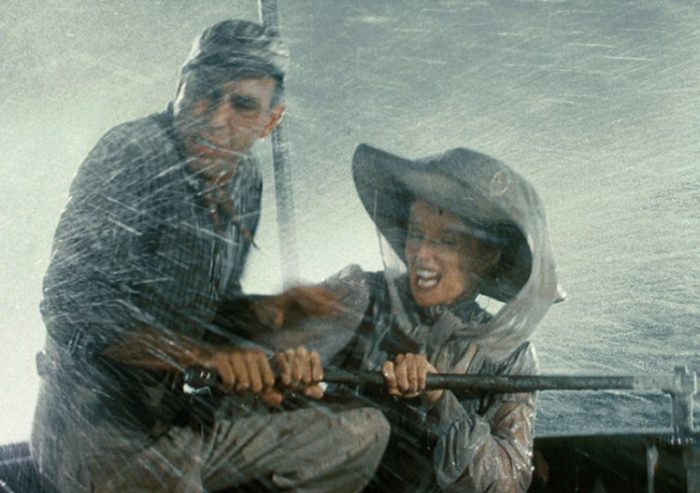
Humphrey Bogart and Katharine Hepburn take a journey on "The African Queen"

The African Queen (1951) is a British-American adventure film directed by John Huston and starring Humphrey Bogard, Katharine Hepburn, and Robert Morley. The film is based on the novel of the same name by C. S. Forester. The color cinematography is by Jack Cardiff (Black Narcissus (1947), The Red Shoes (1948)).

Rose Sayer (Hepburn) and her brother Reverend Samuel Sayer (Morley) are British missionaries in German East Africa in 1914. When war breaks out between Britain and Germany, the mission is threatened, as are the lives of the villagers. Charlie Allnut (Bogart), a gruff Canadian mechanic who delivers the mail and supplies to the mission warns Rose and Samuel that they aren’t safe and need to abandon the mission to save their lives.

When Samuel dies and the village is burned to the ground, Rose escapes with Charlie on his small steamboat named the African Queen. The two opposites form an unlikely partnership to save their lives and attack the Germans.


John Huston (1906 – 1987) was an American actor, director, and screenwriter. Huston made a name for himself as a writer and director. He directed and wrote the screenplays for most of his movies. Some of his famous films include The Maltese Falcon (1941), The Treasure of the Sierra Madre (1948), The Asphalt Jungle (1950), and The Man Who Would Be King (1975). John Huston is the son of the stage and screen actor Walter Huston and the father of actress Anjelica Huston. He won two Academy Awards during his long career and directed his father and daughter to Oscar-winning performances.

Katharine Hepburn (1907 - 2002) was an American actress on stage, screen, and television. She is the Oscar champ, winning four competitive Best Actress Awards. She received her first in 1933 for Morning Glory and her fourth for On Golden Pond (1981). Other Hepburn films include Little Women (1933), Alice Adams (1935), Stage Door (1937), Holiday (1938), The Philadelphia Story (1940), Woman of the Year (1942), Adams Ribs 1949), and The African Queen (1951). Hepburn continued acting as late as 1994, concentrating on television acting in The Man Upstairs (1992) with Ryan O’ Neal and This Can’t Be Love with Anthony Quinn.

Humphrey Bogart (1899 – 1957) was an American film and stage actor. He is one of the most famous and popular movie stars of Hollywood’s Golden Age. Nicknamed Bogie, the actor toiled in supporting roles in both A and B pictures for a decade before his breakout role as Roy Earle in High Sierra (1941). Many more film roles followed including The Maltese Falcon (1941), Casablanca (1942), Key Largo (1948), and The Treasure of the Sierra Madre (1948). His career continued with good roles in films like In a Lonely Place (1950), The Caine Mutiny (1954), and Sabrina (1954) co-starring William Holden and Audrey Hepburn. Bogart died from cancer in 1957.


The African Queen trivia

  • Supposedly, Bogart and Huston were the only members of the cast and clue who didn't come down with dysentery. They attributed this to the fact that they drank Scotch Whiskey during production.
  • Bogart hated Africa but Hepburn loved it.
  • Lauren Bacall went to Africa with her husband and played den mother to the cast and crew. It was during this time that she developed her lifelong friendship with Katharine Hepburn.
  • The African Queen was Katharine Hepburn's first color film.
  • Bogart couldn't perfect a cockney accent so his character was changed from British to Canadian.


To watch the film on YouTube, click on the link below.


To join the discussion on August 8, 2022, at 6:30 p.m. Central Time, click here. Once you RSVP, you will receive an invitation with a link to the discussion on Zoom.


Discussion questions

  1. Do you think the relationship between Charlie and Rose was realistic? Do you think Rose would have fallen in love with Charlie if she had more experience with men?
  2. Did Charlie and Rose have to risk their lives to torpedo the German warship? Why do you think they took the risk?
  3. Is there a message/theme that the director wanted to convey?
  4. Was there anything about the movie that disturbed you?


Related Posts Plugin for WordPress, Blogger...