Showing posts with label Burt Lancaster. Show all posts

Tuesday, November 18, 2025

Burt Lancaster and Yvonne De Carlo can’t seem to catch a break in “Criss Cross”

Criss Cross (1948) is an American film noir directed by Robert Siodmak that plunges the audience into a dark, fatalistic world of obsessive love and impending disaster. The story centers on Steve Thompson (Burt Lancaster), a man who returns to Los Angeles trying to leave his past behind. He takes back his old job as a driver for an armored car company, a symbol of the honest, steady life he hopes to maintain. However, Steve can’t shake his deep, lingering obsession with his beautiful and volatile ex-wife, Anna (Yvonne De Carlo).

Despite his family’s and friends’ warnings about Anna’s manipulative nature, Steve inevitably crosses paths with her again, immediately reigniting a passionate but doomed romance. The situation is complicated by the fact that Anna is now married to Slim Dundee (Dan Duryea), a local gangster and nightclub owner. Steve’s renewed relationship with Anna forces him into a dangerous love triangle, quickly pushing him away from his attempts at a clean start and back toward the corrupting influences of the criminal underworld. This relentless attraction to a woman who is demonstrably bad for him sets the stage for the escalating tragedy.

As the plot unfolds, Steve becomes trapped in a tangled web of deceit and double-crosses, where no one—not Anna, not Slim, and certainly not Steve himself—can be completely trusted. The film masterfully builds a sense of inescapable doom as the intricate plan for the heist is set in motion. Criss Cross is a powerful, stylish examination of human weakness, desire, and betrayal, showcasing how a single, consuming obsession can irrevocably lead a man down a path to his own destruction.

Yvonne De Carlo and Burt Lancaster


Robert Siodmak (1900 – 1973) had a very successful career in Hollywood and is best known for his thrillers and films noir. He signed a seven-year contract with Universal and directed The Killers (1946), the film that made Ava Gardner a star. He worked with some of the top movie stars during Hollywood’s Golden Age, including Deanna Durbin, Gene Kelly, Burt Lancaster, Dorothy McGuire, Yvonne de Carlo, Olivia de Havilland, and Barbara Stanwyck. Often compared to Hitchcock in his prime, he never got the recognition that the Master of Suspense did, but most of his films hold up remarkably well and are worth watching.

Burt Lancaster (1913- 1994) was an American actor and producer. He won a Best Actor Academy Award for his performance in Elmer Gantry (1960). Lancaster made his film debut in The Killers (1946). After the release of that film, he was on his way as a leading man, starring in quick succession Desert Fury (1947), Brute Force (1947), Variety Girl (1947), I Walk Alone (1947), All My Sons (1948), and Sorry, Wrong Number (1948). Other popular films starring Lancaster include The Flame and the Arrow (1950), Jim Thorpe All-American (1951), From Here to Eternity (1953), The Rose Tattoo (1955), and Birdman of Alcatraz (1962).

Yvonne De Carlo (1922 – 2007) was a Canadian-American actress, dancer, and singer whose career spanned six decades across film, television, and stage. She first rose to prominence in the 1940s and 1950s as a Hollywood film star, gaining recognition in lavish Technicolor productions like Salome, Where She Danced (1945) and often being cast in exotic or adventurous roles, including her notable turn in the film noir Criss Cross (1949). Her film career peaked when she played Sephora, the wife of Moses, in Cecil B. DeMille’s epic The Ten Commandments (1956). She gained renewed fame with a new generation of fans in the 1960s for her enduring role as Lily Munster, the glamorous matriarch, in the popular CBS sitcom The Munsters (1964–1966).

Dan Duryea (1907 – 1968) was an American film, stage, and television actor. He is best known for his character roles as villains, but he had a long career that included a variety of lead and second lead roles. Duryea graduated from Cornell University in 1928. In his senior year, he was the president of the college drama society. Duryea went to Hollywood in 1940 to play Leo Hubbard in The Little Foxes, a role he created on Broadway. He established himself in films noir, costarring in classics like Scarlet Street (1945), Criss Cross (1948), and Too Late for Tears (1949).


Criss Cross trivia

  • Reunion of Noir Veterans: The film reunited director Robert Siodmak and star Burt Lancaster, along with composer Miklós Rózsa, all of whom had previously collaborated on the highly successful 1946 film noir classic, The Killers. The two movies share the thematic elements of a doomed protagonist drawn back into crime by a manipulative woman.
  • Uncredited Star Debut: A very young and uncredited Tony Curtis makes a brief appearance in the film. He can be spotted as an extra dancing with Yvonne De Carlo’s character, Anna, in the lively nightclub scene at “The Round-Up.”
  • Los Angeles Location as a Character: Criss Cross was shot extensively on location in the Bunker Hill neighborhood of downtown Los Angeles. This area, known for its steep hills, Victorian architecture, and rundown boarding houses, was a popular setting for classic film noirs, and its gritty, precarious atmosphere adds to the movie’s sense of fatalism. Much of the architecture seen in the film was later demolished in the 1950s and 60s due to redevelopment.
  • Novel Adaptation: The film is based on the 1934 novel of the same name by Don Tracy. While the novel provided the core plot, the film adaptation, scripted by Daniel Fuchs, amplified the key elements of film noir, including the complex flashback structure, the fatalistic voice-over narration, and the overwhelming sense of doom.


Click HERE to watch the movie on the Internet Archive.

Click HERE to join the online discussion on Monday, November 24, 2025, at 6:30 p. m. Central Time. Once you RSVP, you’ll receive a link with an invitation to join the discussion on Zoom.

Discussion questions

  1. The Nature of Obsession and Fate: The film utilizes a flashback structure that essentially reveals the ending in the very first scene. How does knowing Steve Thompson's ultimate fate from the beginning affect the audience's viewing experience? Does this structure amplify the fatalism and obsessive nature of his choices, or does it simply reduce the suspense?
  2. The Archetype of the Femme Fatale: How does Anna (Yvonne De Carlo) embody the classic film noir archetype of the femme fatale? Is she truly evil and manipulative, or is she also a victim of her circumstances and the limited opportunities available to women in her environment? How does her character compare to other famous film noir women?
  3. Moral Compromise and the American Dream: Steve Thompson returns to Los Angeles determined to live an honest, working-class life, but his desires quickly derail him. How does the film comment on the idea of the American Dream or the possibility of redemption? At what point does Steve cross the moral line, and is his downfall inevitable regardless of his choices?
  4. Style and Setting in Noir: The film makes extensive use of location shooting in the atmospheric, now-demolished Bunker Hill neighborhood of Los Angeles. How do the movie's visual style—specifically the use of low-key lighting (chiaroscuro), shadows, and gritty urban settings—reflect and enhance the themes of desperation, moral corruption, and entrapment in the story?
Tuesday, August 16, 2022

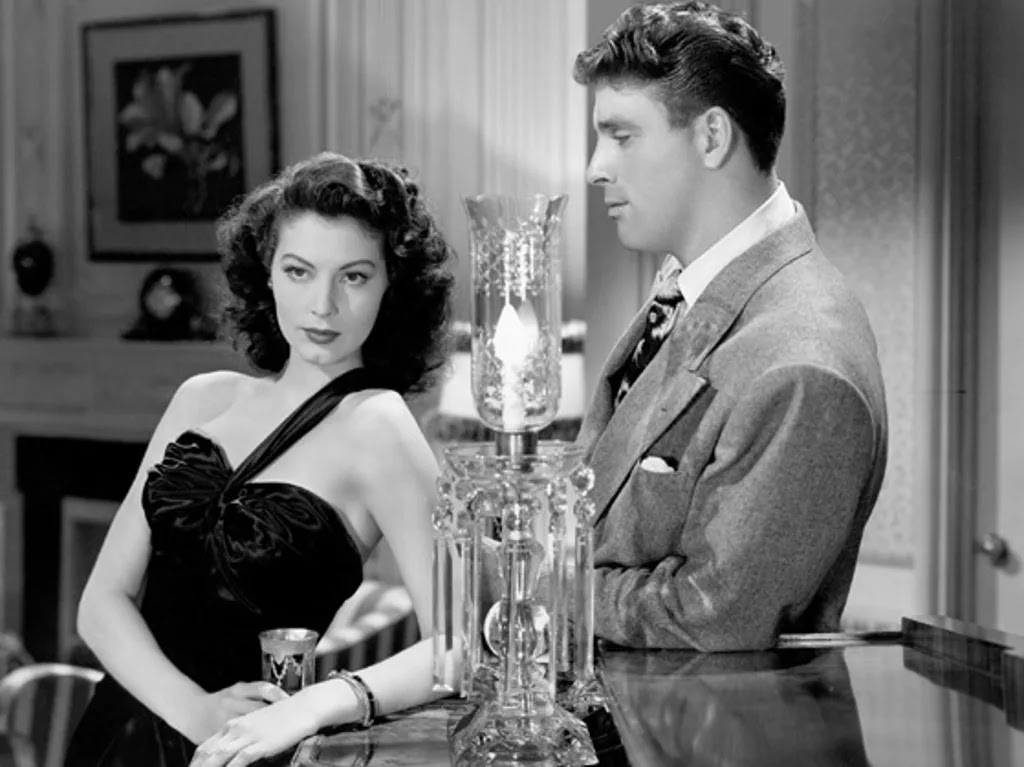
Burt Lancaster and Ava Gardner in director Robert Siodmak's "The Killers"

The Killers (1946) is an American film noir directed by Robert Siodmak and starring Burt Lancaster in his movie debut and Ava Gardner. The film co-stars Edmond O'Brien, Sam Levine, and Charles McGraw. The film is based on The Killers, a short story by Ernest Hemingway. The cinematography is by Elwood Bredell (The Phantom Lady 1944).

A former boxer known as "The Swede" (Lancaster) is murdered by some criminal associates from his past. Insurance agent Jim Reardon (O'Brien) is assigned to find the beneficiary of the Swede's $2,500 insurance policy. By interviewing people who knew the Swede, Reardon pieces together the tragic events that led to his death. 

What Reardon discovers is that no one's life is as it seems on the surface.

Ava Gardner and Burt Lancaster


Robert Siodmak (1900 – 1973) had a very successful career in Hollywood and is best known for his thrillers and films noir. He signed a seven-year contract with Universal and directed The Killers (1946), the film that made Ava Gardner a star. He worked with some of the top movie stars during Hollywood’s Golden Age, including Deanna Durbin, Gene Kelly, Burt Lancaster, Dorothy McGuire, Yvonne de Carlo, Olivia de Havilland, and Barbara Stanwyck. Often compared to Hitchcock in his prime, he never got the recognition that the Master of Suspense did, but most of his films hold up remarkably well and are worth watching.

Burt Lancaster (1913- 1994) was an American actor and producer. He won a Best Actor Academy Award for his performance in Elmer Gantry (1960). Lancaster made his film debut in The Killers (1946). After the release of that film, he was on his way as a leading man, starring in quick succession Desert Fury (1947), Brute Force (1947), Variety Girl (1947), I Walk Alone (1947), All My Sons (1948), and Sorry, Wrong Number (1948). Other popular films starring Lancaster include The Flame and the Arrow (1950), Jim Thorpe All-American (1951), From Here to Eternity (1953), The Rose Tattoo (1955), and Birdman of Alcatraz (1962).

Ava Gardner (1922 - 1990) was an American actress who signed a film contract with M-G-M in 1941. She played minor roles in a variety of films until her breakout performance in The Killers (1946) on loan to Universal. She hit her stride in the 1950s with films like Mogambo (1953), The Knights of the Round Table (1953), Bhowani Junction (1956), The Sun Also Rises (1957), On the Beach (1959), and 55 Days in Peking (1963). Later in her career, she had a recurring role on the television series Knots Landing (1985). During her prime, Garnder was considered one of the world’s most beautiful women.


The Killers trivia
  • Burt Lancaster was the third choice to play the Swede. Wayne Morris and Sonny Tufts were first and second choices but were unavailable.
  • Ava Gardner was the producer's only choice to play Kitty Collins.
  • The movie ran 24 hours in New York City to accommodate the crowds, breaking previous box office records.
  • Ernest Hemingway was a fan of the film adaptation of his short story.


To watch the film on YouTube, click on the link below.


To join the conversation on August 22, 2022, at 6:30 p.m. Central Time, click here. Once you RSVP, you will receive an invitation with a link to the discussion on Zoom.


Discussion questions
  1. The Killers made Lancaster a movie star overnight. What did you think of his performance?
  2. Ava Gardner was under contract with MGM since 1941. On loan to Universal, the role of Kitty Collins elevated her to leading-lady status. Was she a convincing femme fatale?
  3. Did you think there was any significance to Kitty's name?
  4. What did you think of the narrative style? Did it remind you of any other movies?
  5. Did anything in this film surprise you?
  6. Would you have waited in line to have seen this film in 1946? Why do you think this movie was such a hit in its day?


Wednesday, March 16, 2022

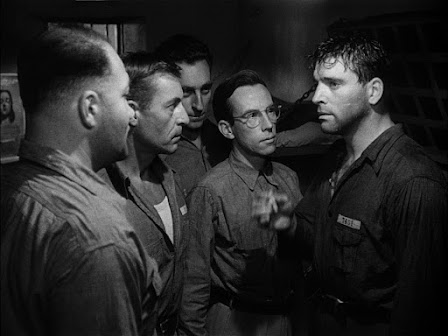
Burt Lancaster leads with "Brute Force"

Brute Force (1947) is an American film noir directed by Jules Dassin and starring Burt Lancaster, Hume Cronyn, and Charles Bickford. The film also stars Yvonne De Carlo, Ann Blyth, and Ella Raines. The screenplay was by Richard Brooks, the cinematography was by William H. Daniels, and the music was by Miklos Rozsa.

After returning from solitary confinement, Joe Collins (Lancaster) plans his escape from Westgate Prison, along with some of his fellow prisoners. Along with his plans for escape, are his plans to get even with Captain Munsey (Cronyn) the sadistic chief of security.


Jules Dassin (1911 – 2008) was an American film director. He got work as an assistant director at RKO and then moved to M-G-M where he directed short subjects. Dassin directed the film noir classics Brute Force (1947), The Naked City (1948), and Thieves’ Highway (1949). He was blacklisted because of his once being a member of the Communist Party so he left the United States for Europe where remained for the rest of his life. He was married to Greek film actress Melina Mercouri.

Burt Lancaster (1913- 1994) was an American actor and producer. He won a Best Actor Academy Award for his performance in Elmer Gantry (1960). Lancaster made his film debut in The Killers (1946). After the release of that film, he was on his way as a leading man, starring in quick succession Desert Fury (1947), Brute Force (1947), Variety Girl (1947), I Walk Alone (1947), All My Sons (1948), and Sorry, Wrong Number (1948). Other popular films starring Lancaster include The Flame and the Arrow (1950), Jim Thorpe All-American (1951), From Here to Eternity (1953), The Rose Tattoo (1955), and Birdman of Alcatraz (1962).

Hume Cronyn (1911 - 2003) was a Canadian film and stage actor, as well as a writer. He and his wife Jessica Tandy often worked together on stage, film, and television. Cronyn's first film role was in Alfred Hitchcock's Shadow of a Doubt (1943), which began a long working relationship with the famed director. Cronyn appeared in Hitchcock's Lifeboat (1944) and worked on the screenplays of Rope (1948) and Under Capricorn (1949). In 1944 he was nominated for a Best Supporting Actor Oscar in The Seventh Cross. Other Cronyn films include The Postman Always Rings Twice (1946), Sunrise of Campobello (1960), and  Cleopatra (1963).

Charles Bickford (1891 - 1967) was an American actor who is best remembered for his supporting roles in films like The Farmer's Daughter (1947), Johnny Belinda (1948),  A Star is Born (1954), and The Big Country (1958). Bickford was nominated for three Best Supporting Actor Academy Awards between 1943 - 1948. During the 1950s and 1960s, Bickford staring appearing on television on shows like Wagon Trian, The Barbara Stanwyck Show, and The Virginian.


To watch the film on YouTube click the link below.


To join the discussion on March 21, 2022, at 6:30 p.m. Central Time, click here. Once you RSVP, you'll receive an invitation and link to join the discussion on Zoom.

Why watch this film?
  • We see a superstar in the making, Burt Lancaster in only his second film role.
  • One of director Jules Dassin's best films.
  • There are several actors who made their film debuts and went on to long careers in film and television including Howard Duff and Whit Bissell.
  • We get to see Ann Blyth play sweet and innocent after playing the daughter from hell in Mildred Pierce.

Brute Force trivia

  • Inspired by an incident at Alcatraz in 1946. A riot at the prison lasted for two days.
  • The film was considered shocking in its day due to the on-screen violence.
  • The movie the prisoners watch is The Egg and I, starring Claudette Colbert and Fred MacMurray which was released the same year as Brute Force.
  • Film debuts of Whit Bissell and Howard Duff.


Discussion questions:

  1. What was your overall impression of the film?
  2. This was Burt Lancaster's second film; what did you think of his performance?
  3. Was Hume Cronyn believable as the sadistic Captain Munsey?
  4. Did anything about the film surprise you?
  5. Did this film check most of the film noir boxes?


Tuesday, February 1, 2022

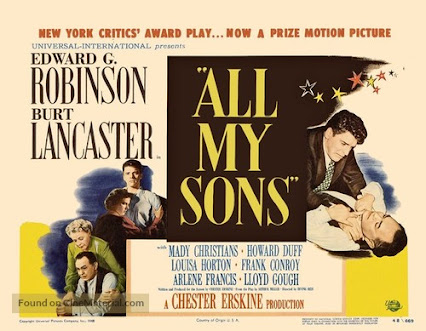
Edward G. Robinson and Burt Lancaster star in "All My Sons"

All My Sons (1948) is based on the play by Arthur Miller which ran on Broadway from January 29, 1947, closed on November 8, 1949, and ran for 328 performances. The film was directed by Irving Reis and starred Edward G. Robinson and Burt Lancaster. Other members of the cast include Louisa Horton, Mady Christians, Howard Duff, Arlene Francis, and Harry Morgan.

Joe Keller has built a manufacturing business that he hopes his son, Chris (Lancaster), will one day take over. But Chris has other plans. He wants to marry Ann Deever (Horton), who was once engaged to his brother, Larry, who was missing in action during World War II and presumed dead. Kate Keller refuses to believe her son is dead and has his room exactly as he left it, even going so far as to polish his shoes on a regular basis.

Ann's father and Joe Keller were partners in a plant that manufactured airplane parts for the military. An investigation determined that the company sold the government defective equipment. It was determined that the partners sold the parts knowing they were defective. Ann's father was convicted and sent to prison but Joe was exonerated. However, there has always been some doubt as to whether or not Joe was also responsible for the faulty airplane parts. This doubt hangs heavy over the Keller home and endangers Chris's relationship with Ann and his father.

When all the secrets are revealed, will the Keller family survive?


Irving Reis (1906 - 1953) was an American writer, producer, and director of both radio plays and motion pictures. Reis got his start as a photographer, eventually photographing publicity stills for various movie studios. He went to Hollywood and became a screenwriter at Paramount in 1938. From Paramount, he went to RKO where he directed the box office hit The Bachelor and the Bobby-Soxer (1947) starring Cary Grant, Myrna Loy, and Shirley Temple. Other films he directed include Enchantment  (1948), and The Four Poster (1952). Reis's died of cancer at the age of 47; he left a widow and three children.

Edward G. Robinson (1893 – 1973) was an American actor on the stage and screen. Robinson is a true legend from Hollywood’s Golden Age where he starred in the gangster classic Little Caesar (1931), Kid Galahad (1937), Confessions of a Nazi Spy (1939), The Sea Wolf (1941), Double Indemnity (1944), and Key Largo (1948). Robinson was awarded an Honorary Academy Award in 1973, but he was never nominated for a competitive Oscar.

Burt Lancaster (1913- 1994) was an American actor and producer. He won a Best Actor Academy Award for his performance in Elmer Gantry (1960). Lancaster made his film debut in The Killers (1946). After the release of that film, he was on his way as a leading man, starring in quick succession Desert Fury (1947), Brute Force (1947), Variety Girl (1947), I Walk Alone (1947), All My Sons (1948), and Sorry, Wrong Number (1948). Other popular films starring Lancaster include The Flame and the Arrow (1950), Jim Thorpe All-American (1951), From Here to Eternity (1953), The Rose Tattoo (1955), and Birdman of Alcatraz (1962).

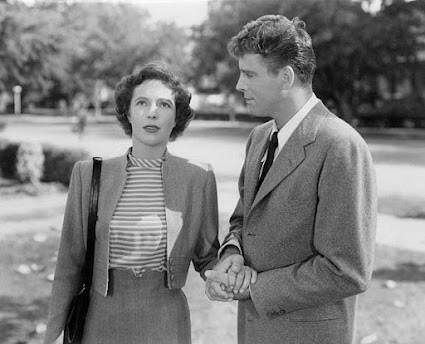
Lousia Horton and Burt Lancaster


Why watch this film?

  • It's a good film version of Arthur Miller's award-winning play.
  • Edward G. Robinson delivers a great performance.
  • Burt Lancaster put off making another film he was committed to because he wanted the role of Chris Keller.
  • This was the film debut of Louisa Horton (Ann) who was married to director George Roy Hill (The Sting).
  • The opportunity to see Arlene Francis early in her career and two years before she would become an icon on the television game show What's My Line.

To watch the film on YouTube, click on the link below.


Discussion questions:

  1. Some critics have considered this movie a film noir. What category of film would you classify it as?
  2. What did you think of Edward G. Robinson's performance in this film compared with his performance in The Red House?
  3. Burt Lancaster really wanted to play Chris Keller; what did you make of his performance?
  4. What did you think of the supporting cast? Any standouts?
  5. Did this film have a theme? If so, what is it?


To join the discussion on February 7, 2022, at 6:30 p.m. Central Time click here. Once you RSVP, you will receive an invitation with a Zoom link to the discussion online.

Thursday, December 27, 2018

Screening of "Sorry, Wrong Number" January 19 at Daystar Center

Sorry, Wrong Number (1948)
Where: Daystar Center, 1550 S. State Street, Room 102
When: January 19, 2018
Time: 6:45 p.m
Hosted by Stephen Reginald

Sorry, Wrong Number (1948) is based on a popular radio play—one of the most popular radio plays of all time—that stars Barbara Stanwyck as Leona Stevenson, a spoiled, rich, bedridden woman who accidentally overhears a plot to murder an unidentified woman. In her attempt to report the incident to the police, Stanwyck begins to suspect that it is her husband (Burt Lancaster) who wants her murdered. The role of Leona was a tour-de-force for Stanwyck, earning her an Academy Award nomination—her fourth—for Best Actress.

General Admission: $5, Students and Senior Citizens: $3


Have some Joe and Enjoy the Show!
Before the movie, grab a cup of coffee from Overflow Coffee Bar, located within the Daystar Center. You can bring food and beverages into room 102.

Join the Chicago Film club; join the discussion
Twice a month we screen classic films and have a brief discussion afterward. For more information, including how to join (it’s free), click here. The Venue 1550 is easily accessible by the CTA. Please visit Transit Chicago for more information on transportation options.

Stephen Reginald is a freelance writer and editor. He has worked at various positions within the publishing industry for over 25 years. Most recently he was executive editor for McGraw-Hill’s The Learning Group Division. A long-time amateur student of film, Reginald hosts “Chicago Film Club,” a monthly movie event held in the South Loop, for the past two years. Reginald has also taught several adult education film classes at Facets Film School, Chicago.

Thursday, August 23, 2018

Review of “All My Sons” at #NoirCityChicago


Monday night the A Film at Noir City Chicago was the film adaptation of Arthur Miller’s award-winning play, All My Sons (1948). The film starred Edward G. Robinson and Burt Lancaster as father and son respectively.


The movie was introduced by Alan K. Rode, film historian and author of Michael Curtiz: A Life in Film. He made it clear that this film didn’t fit the film noir category, but because of its dark thematic elements thought it would be appreciated by a film noir crowd. He was right. The film was dark and somber, but it was also superbly acted. Rode noted that photographer-turned-playwright-turned director Irving Reis overall did a good job directing the film, but thought the cinematography was a bit static. To be honest, I didn’t notice this (maybe I need to see it again); I found the subject matter and the performances compelling enough.

As the father, Edward G. Robinson was terrific. His characterization was multidimensional, which made Joe Keller a flesh and blood human being. Joe is flawed for sure, but not entirely unsympathetic. As Joe’s son, Chris, Burt Lancaster was solid. Physically, he doesn’t resemble Robinson at all, but his characterization was very strong without any of the screen chewing that he displayed in I Walk Alone, released the same year. The other cast members: Louisa Horton, Mady Christians, Howard Duff, and Arlene Francis were also very good.
 
A tense scene between Howard Duff, Burt Lancaster, and Louisa Horton
All My Sons was definitely not a film noir, but it was engrossing cinema nonetheless.

The #NoirCityChicago film festival, wraps up on Thursday, August 23, 2018. Looking forward to this festival coming to Chicago again in 2019.  

Monday, August 20, 2018

Review of “I Walk Alone” at #NoirCityChicago


I spent Sunday evening taking in a screening of I Walk Alone at Noir City Chicago at the Music Box Theatre, 3733 N. Southport Ave., Chicago. I hadn’t seen this film before so it was a real treat. Another treat was the restored digital transfer, which was virtually flawless.

Introduced by Eddie Muller, Film Noir Foundation Founder and President, and host of Noir Alley on Turner Classic Movies, Muller said that this Hal Wallis independent production (released through Paramount) was a way to showcase the stars—Burt Lancaster, Lizabeth Scott, Wendell Corey, and Kirk Douglas—he had under contract.
 
Burt Lancaster, Lizabeth Scott, and Kirk Douglas
The plot is a simple one: Lancaster and Douglas were partners selling booze during prohibition. During a run, the two were followed by the police so they decide to split up, thinking one of them would be able to make it to safety, but vowing that they would help the other if caught and profits would be split 50/50.

Well, 14 years later, Lancaster is out of prison and anxious to get his share of the profits from the business. Douglas who now runs a successful, but shady, nightclub, dissolved their old partnership and claims that Lancaster’s share amounts to less than $3000. This news sends Lancaster into a rage threatening to kill Wendell Corey, who set up the new corporation and does the books for the club.

In the middle of all this is Lizabeth Scott, a singer at the nightclub. Douglas has been stringing her along, all the while romancing a rich socialite. He plans on marrying her because he thinks she can help bring a higher class clientele to the club. Once this is revealed to Scott, her sympathies end up with Lancaster. She wants to help him, but doesn’t want him to resort to anything that would send him back to jail.


Like all classic films noir, the dialogue is sharp and snappy and delivered by a cast of pros. As the club singer, Scott wears a variety of fashions designed by the legendary Edith Head, and she wears them very well, I might add. Additionally, I don’t think one hair on Scott’s head was out of place through the entire movie, which is remarkable since she gets pushed around a bit.

It was fun to see Lancaster, Scott, and Douglas (Douglas is the only one still with us at 101!) so young. Muller said it looked like there was a bit of a competition between Lancaster and Douglas as to who could chew more scenery! And chew they do, and that’s what makes the movie so enjoyable.

I Walk Alone is now available on DVD in a restored version produced by the Paramount Pictures Archive.

The Chicago Noir City film festival continues through Thursday, August 23. For the remaining films scheduled, click here.     

Sunday, February 8, 2015

Lizabeth Scott the quintessential “noir dame” dead at 92

Lizabeth Scott who became a star playing the femme fatale in many popular noir films from the mid-1940s to the early-1950s, passed away on January 31, 2015. She was 92 years old. In her prime, Scott starred opposite Burt Lancaster, Dick Powell, Robert Mitchum, and Humphrey Bogart. Scott was often compared, sometimes unfavorably, to Lauren Bacall because of her striking blond good looks and her husky voice.

Scott started out pursuing a career in the theater. In 1938 at 18, she found herself touring in Hellzapoppin. Her role in this production required her to do sketch comedy. Her next big break came as understudy to Tallulah Bankhead in the original Broadway production of Thornton Wilder’s The Skin of Our Teeth. Bankhead never missed a performance. After Bankhead left, she was replaced by Miriam Hopkins. During Hopkins’s run, Scott went on for one night with great success. After Hopkins, Gladys George took over. George had no understudy, but Scott was called in to replace George during a brief illness. Scott’s performance was noted by Hollywood, but she wasn’t interested in a career in film, so she continued her theater studies and earned a living by modeling.


Producer Hal Wallis, who had just left Warner Brothers for Paramount, persuaded Scott to sign a film contract. Her first picture was the comedy-drama You Came Along (1945) costarring Robert Cummings. With a script by Ayn Rand, the plot centered on an Army Air Force officer (Cummings) hiding his leukemia from a US Treasury PR woman (Scott) traveling with him on a bond tour. Scott’s next role in The Strange Love of Martha Ivers (1946) would define her movie persona for the rest of her film career. The legendary Lewis Milestone directed the popular film noir starring the top-billed Barbara Stanwyck and Van Heflin. Though her role wasn’t all that big, she received good notices. Her blond good looks and husky low voice fascinated moviegoers.

Scott’s breakout performance came in Dead Reckoning (1947) where she shared equal billing with Humphrey Bogart. As Bogart’s duplicitous girlfriend and torch singer Coral “Dusty” Chandler, Scott is both mysterious and beguiling. Next up was the Hal Wallis production of Desert Fury (1947). One of the few noir films shot in Technicolor, Scott was billed under John Hodiak, but above Burt Lancaster. Panned by the critics when first released, today it is considered a classic by many noir aficionados. Scott had a brief reprieve from heavy drama with a comedy sketch in Paramount’s all-star Variety Girl (1947). The next year would see Scott back in another noir, I Walk Alone (1948) once again costarring Burt Lancaster. More roles followed, Pitfall (1948) costarring Dick Powell, Too Late For Tears (1948) costarring Don Defore, Dan Duryea, and Aruthur Kennedy, Easy Living (1949) costarring Victor Mature and Lucille Ball.

By the early 1950s, with the movie business changing, film roles were harder to come by. Scott, like many movie stars, worked on television during its golden age. A trained singer, Scott recorded an album in 1957 titled Lizabeth. That same year, Scott starred opposite Elvis Presley in Loving You where she played the manager of a country band who discovers Deke Rivers (Presley) and makes him a star. After Loving You, Scott pretty much vanished, pursuing personal interests in education and charity work. Her last film was Pulp (1972), a comedy that poked fun at the noir genre.

Scott will go down in history as someone who appeared in more noir films than any other actress. She will also be remembered for her iconic look and sensual low voice. To film fans, she will be remembered as the perfect “noir dame” who could hold her own against any tough guy that crossed her path.


Related Posts Plugin for WordPress, Blogger...