Showing posts with label MGM. Show all posts

Tuesday, September 24, 2024

Book Review – MOGULS: The Lives and Times of Hollywood Film Pioneers Nicholas and Joseph Schenck

Title: MOGULS: The Lives and Times of Hollywood FilmPioneers Nicholas and Joseph Schenck

By: Michael Benson and Craig Singer

Publisher: Citadel Press

ISBN 978-0-8065-4308-6 (hardcover)

ISBN: 978-0-8065-4310-9 (ebook)

When you think about movie moguls from Hollywood’s Golden Age, who comes to mind? You’ve probably heard or know something about Louis B. Mayer, Darryl F. Zanuck, Samuel Goldwyn, and maybe Harry Cohn. All of these men were the public faces of powerful movie studios. But were they really the ones in charge?

Authors Michael Benson and Craig Singer examine the lives of two brothers: Nicholas and Joseph Schenck. Russian Jewish immigrants, both came to America with dreams and ambitions and fulfilled them in ways almost impossible to believe.

The brothers grew up on the mean streets of New York City’s Lower East Side. Eventually, the Schenck family moved uptown to Harlem. An upgrade for sure, but not an easy life. The boys helped their families by selling newspapers and working other odd jobs to earn money.

Joe got his high school diploma by attending night classes while working during the day. Later he took night courses at the New York School of Pharmacy and became a licensed pharmacist.

Together the brothers worked in several pharmacies in the city and worked hard to purchase one of their own. Eventually, they owned several pharmacies and could have made a comfortable living but they wanted more.

They opened a beer hall with dancing and  Paradise Park, an amusement park that would eventually be called Palisades Amusement Park atop the cliffs of New Jersey. It became one of the most famous amusement parks on the East Coast and the United States. It had rides to rival Coney Island and the world’s largest saltwater pool. But the success of the amusement park wasn’t enough for brothers Nick and Joe.

Norma Talmage

The two were always drawn to the movies. From the early days of the Nickelodeons, the brothers were eager to get into the movie business. As if by fate, the brothers met Marcus Lowe who owned penny arcades, nickelodeons, and movie theaters. He told the Schenck brothers he wanted to open a concession at their amusement park. Before you knew it, Nick and Joe were in the movie business and developed a life-long friendship and business association with Lowe. Lowe would become a legend in his own right as the head of Lowes, Inc., the parent company of Metro-Goldwyn-Mayer. He was Louis B. Mayer’s boss.

Joe eventually became a vaudeville talent booker and movie producer. Fatty Arbuckle, a silent film comedian whose films were produced by Joe, whose popularity rivaled that of Charlie Chaplin, introduced Joe to Norma Talmage, an actress Arbuckle felt could be a major movie star. It was love at first sight for Joe. They eventually married and Joe spent most of his time doing everything he could to promote Talmage’s career.

Where Joe was outgoing and everyone’s friend, brother Nick was more reserved and conservative. Joe loved publicity and being in the public eye, but Nick hated it. In fact, Nick had a “publicist” whose job was to keep his name out of the papers. Joe was liked by everyone and everyone was afraid of Nick. Nick was a family man and Joe, before and after his marriage to Talmage, was a playboy. Despite their differences, they were devoted to each other and worked well together.

The brothers became entrenched in the movie business. They held controlling interests in Metro-Goldwyn-Mayer, Twentieth Century-Fox, and United Artists. Unlike the moguls we know, the brothers preferred being behind the scenes, often pulling the strings of Louis B. Mayer, Irving Thalberg, and Darryl F. Zanuck.

Buster Keaton

So many film legends passed through the brothers’ lives: Buster Keaton, Fatty Arbuckle, Thelma Todd, Merle Oberon, and Marilyn Monroe. So many in fact that it’s hard to keep track and almost unbelievable. 

The authors have written a nonfiction account of the Schenck brothers that reads like a novel. They have presented Nick and Joe in a way that brings their characters alive; you come away feeling like you know them. The book is filled with so much fascinating history of film and Hollywood that it’s hard to put down.

Nicholas and Joseph Schenck may not be household names. However, without the grit and determination of the brothers, classic Hollywood, as we know it, may never have existed.


Thursday, July 20, 2017

Book Review: "Ava: A Life in Movies"

This new biography of screen legend Ava Gardner is one pretty package. Authors Kendra Bean and Anthony Uzarowski, while focusing on Gardner’s “life in movies,” also smoothly weave in pertinent information on the star’s personal life. The book is loaded with gorgeous photographs—some candid, some studio generated—that remind us what a beautiful woman Gardner was.

Gardner was born in “a five-bedroom clapboard house in Johnston County, North Carolina on Christmas Eve, 1922.” Her rise to stardom and iconic stature during Hollywood’s Golden Age is the stuff of fairy tales. Gardner never having any ambition to be an actress of any stripe got noticed by Barney Duhan, a Loews Incorporated employee (parent company of Metro-Goldwyn-Mayer). Gardner’s photo was prominently displayed in her brother-in-laws photographic studio in New York and Duhan, looking for a date, inquired about the beautiful girl in the window. In a phone call to the photo shop, Duhan mentioned that he worked for MGM. Gardner wasn’t in New York so she never met him. Based on Duhan’s interest, Gardner’s brother-in-law decided to deliver her photos to MGM’s New York office. This led to a screen test and a contract in 1941. She was only 18 years old.

Ava: A Life in Movies details the actress’s rise from bit player to major movie star with words and pictures. And as mentioned before, the photographs are plenty and beautiful. Many haven’t been seen before. My favorite is a studio test shot of Gardner taken in 1942  (page 31). This headshot was attached to her MGM employment questionnaire. She already looks like a movie star; it’s obvious that the camera loved her. I don’t know how many pictures of Gardner Bean and Uzarowski looked at, but all the pictures in their biography are pretty amazing. The woman apparently never took a bad picture.

A studio publicity photo of Gardner in fashionable beachwear

Not meaning to take anything away from the text—which is engaging, well researched, and easy-reading—I would be negligent if I didn’t mention what a beautiful package this book is. The cover, the endpapers, the typography, all make it the perfect book for your coffee table (it’s too beautiful to put on your bookshelf). If you’re interested in Ava Gardner and classic Hollywood, I think you’ll enjoy Ava: A Life in Movies.


Ava: A Life in Movies
Hardcover: 264 pages
Publisher: Running Press (July 11, 2017)
Language: English
ISBN-10: 0762459948
ISBN-13: 978-0762459940
Product Dimensions: 8.5 x 1.2 x 10.4 inches
Price: $30.00

Friday, April 1, 2016

Judy Garland is Turner Classic Movies's April Star of the Month

Film icon Judy Garland (1922-1969) is Turner Classic Movies’s April Star of the Month. TCM will be screening Garland’s films every Friday. Garland was one of Hollywood’s top movie musical talents during the 1930s and 1940s.

The Wizard of Oz (1939) made Garland a star at Metro-Goldwyn-Mayer where she reigned as the studio’s top musical star. At her home studio she starred in For Me and My Gal (1942), Presenting Lily Mars (1943), Meet Me in St. Louis (1944), The Harvey Girls (1946), Till The Clouds Roll By (1946), Easter Parade (1948), In the Good Old Summertime (1949), and Summer Stock (1950).

Margaret O'Brien and Judy Garland in Meet Me in St. Louis

Garland also excelled in dramatic roles like The Clock (1945), but the studio loved Garland and musicals because they were big business. Meet Me in St. Louis was M-G-M’s biggest hit since Gone With the Wind* (1939). In 1950 Garland and M-G-M parted ways. She appeared on television in the 1950s and started performing in live concerts that were very popular. In 1954 Garland starred in a musical remake of A Star is Born (1954). The film was a hit with the public and critics, but it lost money due to its huge budget. In spite of this Garland was nominated for Best Actress. Many thought Garland was the favorite to win, but Grace Kelly bested her for her performance in The Country Girl.

Garland in The Harvey Girls

Garland had a dramatic success in the 1961 film Judgment at Nuremberg for which she was Golden Globe and Oscar- nominated for Best Supporting Actress. She starred alongside Burt Lancaster in A Child is Waiting (1963), and with Dirk Bogarde in I Could Go On Singing (1963), which was her last film. In 1967, Garland was cast as Helen Lawson in the movie version of Valley of the Dolls. Garland was fired for missing rehearsals and was replaced by Susan Hayward.

Garland died on June 22, 1969 of an overdose of barbiturates.


*GWTW was co-produced with Selznick International Studios

Saturday, June 13, 2015

My Twitter pal, Monica Lewis

Actress and singer Monica Lewis passed away June 12, 2015 at the age of 93. Monica started her singing career in the 1940s as a vocalist with Benny Goodman’s orchestra. In 1950, she signed a singing and acting contract with Metro-Goldwyn-Mayer, where she recorded albums and appeared in films with Mickey Rooney and Red Skelton.

Perhaps Monica is best remembered as the voice of the Miss Chiquita Banana cartoon character—who advised us not to put our bananas in the refrigerator—a job she held for 14 years.

One on Monica’s recent tweets

But to me, Monica will always be @songbirdmonica, her Twitter handle. I love how she would tweet old publicity photos of herself with contemporary captions. Via Twitter I learned that she was from Chicago, the city where I live, and that she sailed the Long Island Sound with her husband, Jennings Lang. I grew up on Long Island and spent many a summer by, near, and in the Sound.

On Twitter, Monica was always engaging and fun. She would often favorite a tweet of mine and she always kindly responded to questions I posed to her. Those of us who tweet with the #TCMParty hashtag have had the pleasure of viewing tweets and interacting with Monica. She was the liveliest 93-year-old I have ever encountered.

I will miss you, Monica. Rest in peace. Amen.

Monday, June 2, 2014

Hitchcock’s “Foreign Correspondent” to screen June 10, 2014

When: Tuesday, June 10, 2014 6:30 p.m.
Where: The Venue 1550 at the Daystar Center, 1550 S. State Street

Foreign Correspondent was Alfred Hitchcock’s second American film. On loan-out to producer Walter Wanger, Hitchcock enjoyed a level of freedom that he hadn’t experienced on the set of Rebecca with David O. Selznick. Although the director didn’t get the stars he wanted, he had almost unlimited resources to create a first-class suspense classic.

Personal History
Wanger owned a property called Personal History, the memoir of a journalist named Vincent Sheean. He had owned the rights to the memoir since 1935, but was unable to turn it into a workable property. When Wanger learned that Hitchcock was available on loan-out from Selznick, he jumped at the chance to hire him. Hitchcock and his team worked over the memoir, in effect rewriting it so that it would appeal to contemporary audiences.

Laraine Day played nurse
Nancy Lamont in the Dr. Kildare series
Starstruck
The producer was hoping that along with Hitchcock he could borrow Joan Fontaine and Brian Aherne, who were recently married as his stars. Hitchcock wanted Gary Cooper and Barbara Stanwyck. Cooper turned him down, saying he didn’t want to star in a thriller and Stanwyck was unavailable. In the end, the director had to settle on Joel McCrea and Laraine Day. Although not as big a star as Cooper, McCrea was a star in his own right. Day was a contract player at MGM who starred in the popular Dr. Kildare series with Lew Ayers. In spite of the director’s disappointment with the casting, he got terrific performances out of his leads. McCrea and Day had genuine chemistry that is both charming and believable.


Europe on the brink
Joel McCrae, Barbara Stanwyck, and Robert Preston
in publicity photo from Union Pacific
The plot revolves around Johnny Jones, (McCrea) christened “Huntley Haverstock” by his newspaper’s editor (Harry Davenport) as a newly minted American foreign correspondent. On assignment in Europe, he is tasked to find out if the continent is on the brink of a World War. In Holland, Haverstock meets Carol Fisher (Day), daughter of Stephen Fisher, (Herbert Marshall) head of the Universal Peace Party. When a Dutch diplomat named Van Meer, (Albert Basserman) is assassinated, the plot really takes off. Who killed Van Meer and why? And is the head of the Universal Peace Party really working for peace in Europe?

Foreign Correspondent set the template for future Hitchcock films, including Saboteur and North By Northwest. With its amazing set pieces and complicated action sequences, it is a master class in film making. We’ll discuss the film, it’s reception and influence. Join us!

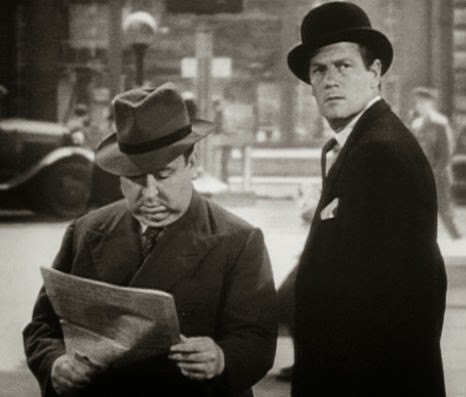
Who is that man reading the paper?
Excellent Support
Besides the other cast members already mentioned, the outstanding supporting players also includes George Sanders (playing a good guy this time), Edmund Gwen, and Robert Benchley, who supposedly wrote his own dialogue.

Have some Joe and Enjoy the Show!
Before the movie, grab a cup of coffee from Overflow Coffee Bar, located within the Daystar Center. You can bring food and beverages into the auditorium; we even have small tables set up next to some of the seats.

Join the Chicago Film club, join the discussion
The Chicago Film Club is for classic movie fans. Once a month we screen a classic film and have a brief discussion afterward. For more information, including how to join (it’s free), click here. To purchase your ticket in advance, click here. The Venue 1550 is easily accessible by the CTA. Please visit Transit Chicago for more information on transportation options.

Wednesday, January 25, 2012

Angela Lansbury: TCM Star of the Month and so much more

An early studio glamor shot of Angela Lansbury
Angela Brigid Lansbury was born October 16, 1925 in Poplar, London. One of the most versatile talents to come out of Hollywood, Lansbury, now in her late 80s, has had a remarkable career that has spanned eight decades. Besides her film work, Lansbury has starred on the stage and was mystery-writing sleuth, Jessica Fletcher on TV’s Murder She Wrote for 12 years.

A Star a 18!
Lansbury’s first movie role came to her at the age of 18. She played saucy maid Nancy Oliver with Ingrid Bergman and Charles Boyer in Gaslight. For her performance, Lansbury received an Academy Award nomination (first of three) for Best Supporting Actress. She didn’t win the award, but her movie career was on its way.

Contract Player
As a contract player at movie studio M-G-M, she was cast in a variety of roles, often in supporting roles or second leads. During the height of the studio system, movie players were often typecast and at M-G-M, Lansbury was typed as a supporting player, never the first choice as glamorous leading lady in spite of her beautiful leading-lady looks.

Stage, Film, and TV Successes
Perhaps not being given the top roles in Hollywood helped Lansbury develop into the wonderful character and stage actress she is today. Had she been a glamorous movie star, say like Lana Turner, her career might not have been as long. Who can forget Lansbury’s turns as disturbed mothers in both The Manchurian Candidate and All Fall Down, both released in 1962? And what about her award-winning stage performances in Mame and Gypsy? In spite of five Tony Award wins (a record she shares with Julie Harris) and numerous other awards, audiences around the world will probably remember Lansbury for her long-running role in TV’s Murder She Wrote. As the mystery writer from Cabot Cove, Maine, Landsbury became an icon of the genre. Not too shabby!

To learn more about Lansbury’s incredible movie career and to purchase some of her films on DVD, check out the Turner Classic Movies online shop. Lansbury is TCM’s January star of the month.


Wednesday, December 14, 2011

Irene Dunne in “The White Cliffs of Dover”


By 1944, Irene Dunne was one of the top female stars in Hollywood. A four-time Academy Award nominee for Best Actress, she was in demand by all the major Hollywood studios. In 1943, Dunne signed on to star in a picture at Metro Goldwyn Mayer. A Guy Named Joe paired the actress with Spencer Tracy and a young newcomer named Van Johnson. During filming Johnson was involved in a serious car accident. Dunne and Tracy didn’t want to replace Johnson, so production was delayed while he recuperated. Since Dunne was already on the lot, M-G-M scooped her up for The White Cliffs of Dover.

Verse Novel Source for Film
The White Cliffs of Dover is based on a verse novel The White Cliffs by Alice Duer Miller published in 1940. The novel was an instant success and sold almost a million copies. Duer Miller was a popular writer and screenwriter. In fact one of her stories was made into the musical Roberta starring Dunne in 1935.


War-Time Romance
Elizabeth Taylor and Roddy McDowell
The White Cliffs of Dover focuses on a young American woman, Susan Dunn, played by Dunne and her father (the irascible Frank Morgan) who are touring London before the outbreak of World War I. She meets a young British aristocrat and army officer, Sir John Asherwood (Alan Marshall). After a whirlwind courtship they marry, but their honeymoon and marriage is cut short. Susan Dunn Asherwood remains in her adopted country and has a son, John Jr.

Serene and Dignified
The film is told in flashback as Dunne’s character recalls her younger days, while serving as a nurse during World War II. At the beginning of the movie, Dunne plays a young girl of 20, which was quite a stretch since she was 46 years old when the film was released. Even though it’s obvious that Dunne isn’t in her 20s, she captures the spirit of a young woman in both her mannerisms and speech. As the older woman, Dunne is serene and dignified. In his May 12, 1944 review of the film, New York Times critic Bosley Crowther said, “Miss Dunne gives to her character a nice glow of American charm...”

Alan Marshall and Dunne
Like Mrs. Miniver (1942), The White Cliffs of Dover was popular with wartime audiences on both sides of the Atlantic. The novel on which it is based, cemented the relationship between the United States and The United Kingdom, during the war years. The movie cost $2,343,000 to produce, earned $4,045,000 in the U.S. and another $2,249,00 in foreign receipts making it a blockbuster hit and a good choice as the M-G-M 20th Anniversary film.

In a famous photograph of M-G-M movie stars, commemorating its 20th anniversary, Dunne, technically not a studio contract player, is seated in the front row two seats to the right of studio chief, Louis B. Mayer. It’s a tribute to Dunne’s popularity (and Mayer’s keen marketing sense) that she was included in this iconic image.

More stars than are in the heavens: M-G -M celebrates 20 years.
Dunne is in the front row fourth from right.
This post corresponds with the class Elegant and Madcap: The Incredible Versatility of Irene Dunne—Class starts November 16, 2011. Meets on Wednesdays from 7p.m. - 10 p.m. for six weeks. Classes are held at Facets Film School on Fullerton Ave. in Chicago, IL.

Thursday, October 21, 2010

The "Wright" Stuff: Teresa Wright Makes Her Mark

Studio portrait of Teresa Wright
"I only ever wanted to be an actress, not a star."
During the early 1940s, few movie actresses made the impact that Teresa Wright did. Wright was Oscar-nominated for the first three movies she appeared in, a record that no other actor or actress has accomplished. Embraced by the public and critics as well, Wright never wanted to be a movie star.

Muriel Teresa Wright was born in 1919 in New York City. After seeing Helen Hayes on the stage, Wright decided she wanted to be an actress. After gaining experience in regional theater, she decided to try her luck on Broadway during the late 1930s.

Early Broadway Success
Almost immediately, Wright found herself playing a small role in Thorton Wilder’s Our Town. During the play’s run, she understudied for Martha Scott, who had the lead role of Emily. When Martha Scott left for Hollywood, Wright stepped into the lead. After her success in Our Town, she was cast as Mary Skinner in an even bigger success, Life With Father. During one performance, a talent scout from the Samuel Goldwyn studios noticed something special about Wright.

Goldwyn was looking for someone to play Bette Davis’s daughter in his production of The Little Foxes, someone who would be able to stand up to the formidable Miss Davis on the big screen. The talent scout thought Wright was up to the task. Before long, she was brought to Hollywood and signed a long-term contract with Goldwyn.

When The Little Foxes was released in 1941, Wright was nominated for Best Supporting Actress, alongside Bette Davis who was nominated for Best Actress. The Goldwyn talent scout’s faith in Wright was validated.

Hot Property
Samuel Goldwyn immediately arranged for Wright to costar in William Wyler’s production of Mrs. Miniver at MGM starring Greer Garson and Walter Pigeon. After she completed that film, she was costarring opposite Gary Cooper in The Pride of the Yankees, directed by Sam Wood. Both Mrs. Miniver and The Pride of the Yankees were released in 1942 and Wright was showered with critical accolades once again.

During that eventful 1942, Wright found herself nominated for both Best Supporting Actress for Mrs. Miniver and Best Actress for The Pride of the Yankees! She lost the Best Actress award to Greer Garson, but won the Best Supporting Actress award for her role as Garson’s daughter-in-law in Mrs. Miniver.

Hitchcock Comes a Calling
When director Alfred Hitchcock was casting Shadow of a Doubt, he considered  Wright for the lead role of Charlotte (Charlie) Newton. He wanted her for her obvious talent, but Hitchcock also wanted her because she was considered a hot property and her appeal would add to the box office. He was correct on both counts. From the start Hitchcock was impressed not only with Wright’s talent, but her professionalism on the set. Wright’s characterization is a tour-de-force. She begins the film as a naive, innocent girl and ends it as a mature worldly-wise young woman.

Wright is top billed in the Hitchcock classic
During its initial release, Shadow of a Doubt  was a critical and popular success. Today it is considered Hitchcock’s first great American film. Unlike his earlier U.S. movies, Shadow of a Doubt was set in a small American town populated with average people living seemingly average lives. The notion that innocence and evil live side by side would become a popular theme that Hitchcock would continue to explore in later films.

Wright starred alongside some of the biggest male stars of the 1940s.
A Major Star
After working with Hitchcock, Wright became a major star, appearing opposite some of Hollywood’s most famous leading men, including Dana Andrews, Robert Mitchum, Ray Milland, and Gary Cooper (after Pride of the Yankees, they starred together again in Casanova Brown). During the late 1940s, Wright lost out on two important film roles that hurt her career.
  
Pursued is considered the first psychological western.

The Roles That Got Away
Wright’s husband, Niven Busch was a screenwriter and popular novelist. He wrote the best-selling novel Duel in the Sun and adapted the screenplay for producer David O. Selznick. Wright was set to star as the half-breed Pearl Chavez. The role was to be a change of pace for the actress. During production, Wright became pregnant and had to drop out. Jennifer Jones, another actress with a girl-next-door image picked up the role and a Best Actress nomination to boot.

The role of Pearl Chavez was written for Wright.

The next role that Teresa Wright lost, again due to pregnancy, was the portrayal of Julia Broughan in The Bishop’s Wife. The role eventually went to Loretta Young, and again, another box office hit slipped through Wright’s fingers.

You're Fired!
In 1948, Wright made a movie for Goldwyn called Enchantment. Goldwyn had high hopes for the film and Wright had one of the key roles. When production wrapped, Wright didn’t particularly like the result. Scheduled to travel to publicize the film, Wright said she was ill and couldn’t participate. Goldwyn didn’t believe Wright and he fired her. Overnight, Wright was a star without a studio. Used to making $5000 a week and $200,000 per picture, Wright was now a freelance artist during a turbulent time in Hollywood. The major studios were losing money because they were forced to give up their theater ownership, which reaped them huge profits.

Wright was Marlon Brando's first leading lady.
In 1950, Wright agreed to star opposite a Hollywood newcomer named Marlon Brando in what would be his very first film, The Men. The film was an independent low-budget production for which Wright accepted a salary of $25,000. Wright said that after she made that film for that low fee, she was rarely given A-list material again. She still had starring roles in movies, but none matched the quality of her early successes.

Wright Finds Work During Television's "Golden Age"
Instead of giving up on acting, Wright started working in TV during its golden age. She was Emmy-nominated for playing Annie Sullivan in a TV production of The Miracle Worker five years before the film version was made. Later she portrayed famed photographer Margaret Bourke-White in a 1960 TV production. In addition to her TV work, Wright went back to Broadway starring in The Country Girl, Bell, Book and Candle, The Heiress, and Death of a Salesman opposite George C. Scott.

During the 1970s, Wright occasionally worked in films and television. During this period she had roles in Roseland and Somewhere in Time. Her last major role was playing Miss Birdie, Matt Damon’s landlady, in John Grisham’s The Rainmaker in 1977.

Teresa Wright died of a heart attack on March 6, 2005. She was 86 years old.

Thursday, August 27, 2009

How The West Was Won: Three-Disc Special Edition

This is hardly breaking news, since How The West Was Won has been out on DVD for several years, but the special three-disc edition is just under a year old. As a huge fan of this film,  I had the DVD version released in 2000. When I heard about the remastered edition released in September 2008,  I had to have it. With today's computer technology, the wizards at Warner Home Video were able to remove the Cinerama three-panel join lines. The print is also beautifully restored and is bright and clear as a bell. By contrast, the 2000 DVD version is grainy and drab.


How The West Was Won is the first movie I remember seeing in the movie theater where I was able to follow the narrative. Seeing the film in the old Cinerama process was an overwhelming experience. I was only six years old when it was released in the United States. Experiencing the Prescott family's perilous trip west was an exciting and emotional adventure for me.

The Cinerama process required three projectors that projected the image on a huge curved screen. The effect was that you felt you were in the movie action somehow, not just an indifferent observer. When the Prescott family rode the rapids you felt like you were on the raft with them (at some theatrical showings, they sprayed the audiences with water). When the buffalo thundered over the settlers and the railroad under construction, you thought they would trample and thunder past you as well.

Three men famous for making memorable westerns, John Ford, Henry Hathaway, and George Marshall directed the different segments. The movie employed just about every major star working in Hollywood in the early 1960s, including Henry Fonda, James Stewart, Gregory Peck, Carroll Baker, Debbie Reynolds, and John Wayne. The supporting cast boasted the likes of Walter Brennan, Agnes Morehead, Thelma Ritter, and Russ Tamblyn.

Discs 1 and 2 contain the road show edition of the classic western, along with commentary by filmmaker David Strohmaier, film historian Rudy Behlmer, Director of Cinerama, Inc., John Sittig, music historian Jon Burlingame, and stuntman Loren James. Disc 3 includes a new documentary Cinerama Adventure, that explains the development of the wide screen process and the unique way Cinerama exhibited its films.


Related Posts Plugin for WordPress, Blogger...