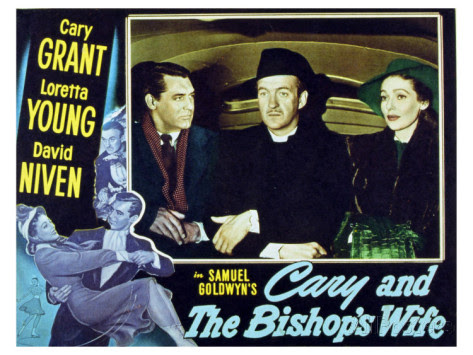
Bishop Henry Brougham (Niven) is preoccupied with the construction of a new cathedral for his congregation that it overwhelms his entire life and alienates him from his wife Julia (Young) and young daughter (Karolyn Grimes). In a desperate moment, the Bishop asks God for help and guidance. Enter an angel named Dudley (Grant) who helps the Bishop organize his life to better serve his church and family. When Dudley begins cheering up a disillusioned Julia, he finds himself falling in love with her. Will his mission to help rekindle the love the Bishop and Julia have for one another be a success or failure?
Henry Koster (1905 - 1988) was a German-born film director. He signed a contract with Universal Pictures in 1936. At the time, he didn't speak English but he convinced the studio to let him make Three Smart Girls (1936), which was Deanna Durbin’s first starring film role. The movie was a huge success and saved Universal from bankruptcy. Koster convinced Universal to sign Abbott and Costello to a film contract. The comedy duo was a box office sensation during the 1940s, making the studio millions. Later in Koster’s career, he directed Harvey (1950), My Cousin Rachel (1952), which was Richard Burton’s American film debut. He directed Burton again the next year in The Robe, which was the first film to be filmed in CinemaScope. Other films include Desiree (1954) with Marlon Brando and Jean Simmons, Flower Drum Song (1960) starring Nancy Kwan, and The Singing Nub (1965) starring Debbie Reynolds.
Cary Grant (1904 – 1986) was an English-born American actor who became one of the most popular leading men in film history. Grant started his career in vaudeville before heading to Hollywood. He became a superstar in the late 1930s in a series of screwball comedies including The Awful Truth (1937) with Irene Dunne. He was a memorable C. K. Dexter Haven in The Philadelphia Story (1940) opposite Katharine Hepburn and James Stewart. He received two Best Actor nominations: Penny Serenade (1941) and None but the Lonely Hearts (1944). Other classic Grant films include Gunga Din (1939), Only Angels Have Wings (1939), and Arsenic and Old Lace (1944). He made four popular films with Alfred Hitchcock: Suspicion (1941), Notorious (1946), To Catch a Thief (1955), and North by Northwest (1959). He was presented with an Honorary Oscar at the 42nd Academy Awards in 1970.
Loretta Young (1913 - 2000) was an American actress who can trace her start to the days of silent films where she performed as a child actress. Young made the transition to talking pictures as an adult with almost immediate success. As an adult starred opposite some of Hollywood’s most popular leading men including James Cagney, Clark Gable, Tyrone Power, Gary Cooper, and Cary Grant. Young made many films during the pre-code era including Platinum Blonde (1931), Taxi! (1932), They Call It Sin (1932), Employee’s Entrance (1933), and Midnight Mary (1933). Darryl Zanuck signed Young to a contract at Twentieth Century-Fox and paired her with Tyrone Power, the studio’s top male star in several hit films including Love is News (1937), Cafe Metopole (1937), and Second Honeymoon (1937). Unsatisfied with the roles Zanuck was providing her with, Young left the studio and became a freelance artist. On her own, Young starred opposite Alan Ladd in two films, starred alongside Gary Cooper in Along Came Jones (1945), The Stranger (1946), The Bishop’s Wife (1947) with Cary Grant and David Niven, and Rachel and the Stranger (1947) top-billed over William Holden and Robert Mitchum. After her film career was winding down, Young became a huge star on television when the medium was in its early stages.
David Niven (1910 - 1983) was a British actor. He won the Academy Award for Best Actor for his performance in Separate Tables (1958). Niven’s film career started in the 1930s with small roles in films like Mutiny on the Bounty (1935). He soon signed a contract with Samuel Goldwyn and his career took off. He had a supporting role in Wuthering Heights (1939). The film was a major success and increased his profile as an actor. He next co-starred with Ginger Rogers in Bachelor Mother (1939), another big hit. He played a safe-cracker in Raffles (1939) co-starring Olivia de Havilland. Niven worked constantly in film throughout the next four decades. Other films he starred in include Enchantment (1948), Soldiers Three (1951), Around the World in 80 Days (1956). Bonjour Tristesse (1958), Please Don’t Eat the Daisies (1960), and The Pink Panther (1963).
The Bishop’s Wife trivia
- When the film was in the development stages, Dana Andrews was set to play the bishop, Teresa Wright was set to play Julia, and David Niven was set to play Dudley.
- Teresa Wright had to drop out due to pregnancy, but Andrews was still attached to the project when Loretta Young was being considered.
- Child actor Karolyn Grimes, who plays Debby, played Zuzu in It’s a Wonderful Life the same year.
- James Gleason, who played Sylvester the cab driver, played a cab driver in Arsenic and Old Lace also starring Cary Grant.
- The film was remade as The Preacher’s Wife with Denzel Washington, Whitney Houston, and Courtney B. Vance some 50 years later.
To watch the film on YouTube, click the link below.
Why watch this film?
It’s one of the great Christmas classics.
It features three great stars: Grant, Young, and Niven
The film has excellent production values, including cinematography by Greg Toland (Citizen Kane, The Best Years of Our Lives)
The supporting cast features Monty Wooley, Elsa Lancaster, and Gladys Cooper.
To join the discussion on December 20, 2021, at 6:30 p.m. Central Time, click here. Once you RSVP, you will receive an invitation and a link to the discussion on Zoom.
Discussion questions:
Where would you rank this film as far as Christmas movies go? Top-ten? A personal favorite?
Do you think David Niven and Loretta Young made a credible couple?
Do you think Dudley really fell in love with Julia?
What do you think is the film’s main theme?
Did the film end the way you wanted it to? Was it satisfying?


 —1944 This musical classic may not be thought of as a Christmas movie, but the story about the trials and tribulations of the Smith family in the year before the 1904 World’s Fair does contain the Christmas classic “Have Yourself a Merry Little Christmas.” As sung by Judy Garland to a young Margaret O’Brien, it became an instant hit and holiday standard. Great music, beautiful color cinematography, and a wonderful ensemble cast make this the perfect movie to watch on a snowy winter’s evening with family and friends.
 —1945 Can anyone make great sentimental films the way Leo McCarey did? McCarey was a master of emotional manipulation, but in a good way. Plus, when you have Ingrid Bergman as your leading lady (even if she’s playing a nun), you can’t really go wrong, can you? Bing Crosby reprises his Oscar-winning performance as Father O’Malley in this sequel to
  , but it’s Bergman’s Sister Benedict that really is the heart and soul of this Christmas classic, in my opinion. And who do we have here? Henry Travers, the great character actor, playing business tycoon-turned-benefactor, Mr. Bogardus, one year before he would be immortalized as the angel Clarence in
  (see below).
 —1945 A big hit when first released, this holiday classic is sometimes overlooked in the lists of great Christmas movies. Made when

 —1947 There have been other versions of this classic, but none come close to matching the warmth and intelligence of the original. It’s amazing to me how well this movie holds up today. Maureen O’Hara is a single working mom trying to balance work while raising her young daughter, Susan, played by Natalie Wood. All the praise went to Edmund Gwen as Kris Kringle, and he’s wonderful (Best Supporting Actor winner), but O’Hara gives a beautifully layered performance as Doris Walker, a conflicted career woman who doesn't want her daughter to believe in fantasies of any kind. John Payne is also excellent as Fred Gailey, as is George Seaton’s crisp and fluid direction.
 —1947 Released the same year as Miracle on 34th Street, the movie boasts two of the most glamorous movie stars in the history of film:
 and
and  were known as much for their classic movie star looks as their acting abilities. Young, a star since the days of silent films, is considered one of the screen’s great beauties. Her big expressive eyes and lovely cheekbones made her a photographer’s dream. Grant’s was the face that the top female stars of the 1930s wanted next to theirs on the big screen.
 (1946). He’s as dapper as, well, Cary Grant. Young on the other hand, plays Julia Brougham, the wife of a Bishop (
 ). Throughout the movie, Young is dressed modestly, but beautifully. Likewise, her hairstyle is pulled back, simply styled, but framing that beautiful, luminous face.
 blocked out a two-shot between Young and Grant, both protested that the blocking did not exploit the best sides of their faces. To appease the two stars, Koster had them look out a window in the same direction. This shot satisfied Young and Grant because their best sides (the left sides of their faces) were photographed.
 saw the dailies (film shot that day), he was critical of Koster’s decision to shoot the scene in such a manner. When Koster asked Young and Grant to explain why the shot was set up and filmed this way, Goldywn let go with one of his famous “Goldwynisms.” He said to both stars “Look, if I'm only getting half a face, you're only getting half a salary!” Young and Grant, both being freelance movie stars and not contracted to a major movie studio were also conscious of workplace politics.


 . During the play’s run, she understudied for Martha Scott, who had the lead role of Emily. When Martha Scott left for Hollywood, Wright stepped into the lead. After her success in Our Town, she was cast as Mary Skinner in an even bigger success,
  . During one performance, a talent scout from the Samuel Goldwyn studios noticed something special about Wright.
 , someone who would be able to stand up to the formidable Miss Davis on the big screen. The talent scout thought Wright was up to the task. Before long, she was brought to Hollywood and signed a long-term contract with Goldwyn.
 at MGM starring Greer Garson and Walter Pigeon. After she completed that film, she was costarring opposite Gary Cooper in
  , directed by Sam Wood. Both Mrs. Miniver and The Pride of the Yankees were released in 1942 and Wright was showered with critical accolades once again.
 , he considered Wright for the lead role of Charlotte (Charlie) Newton. He wanted her for her obvious talent, but Hitchcock also wanted her because she was considered a hot property and her appeal would add to the box office. He was correct on both counts. From the start Hitchcock was impressed not only with Wright’s talent, but her professionalism on the set. Wright’s characterization is a tour-de-force. She begins the film as a naive, innocent girl and ends it as a mature worldly-wise young woman.

 ). During the late 1940s, Wright lost out on two important film roles that hurt her career.
 and adapted the screenplay for producer David O. Selznick. Wright was set to star as the half-breed Pearl Chavez. The role was to be a change of pace for the actress. During production, Wright became pregnant and had to drop out. Jennifer Jones, another actress with a girl-next-door image picked up the role and a Best Actress nomination to boot.
 . Goldwyn had high hopes for the film and Wright had one of the key roles. When production wrapped, Wright didn’t particularly like the result. Scheduled to travel to publicize the film, Wright said she was ill and couldn’t participate. Goldwyn didn’t believe Wright and he fired her. Overnight, Wright was a star without a studio. Used to making $5000 a week and $200,000 per picture, Wright was now a freelance artist during a turbulent time in Hollywood. The major studios were losing money because they were forced to give up their theater ownership, which reaped them huge profits.
 . The film was an independent low-budget production for which Wright accepted a salary of $25,000. Wright said that after she made that film for that low fee, she was rarely given A-list material again. She still had starring roles in movies, but none matched the quality of her early successes.
 five years before the film version was made. Later she portrayed famed photographer
  in a 1960 TV production. In addition to her TV work, Wright went back to Broadway starring in
  ,
,  , The Heiress, and
  opposite George C. Scott.
 and
and  . Her last major role was playing Miss Birdie, Matt Damon’s landlady, in
  in 1977.


