Showing posts with label Clark Gable. Show all posts

Tuesday, July 21, 2026

Bound by Luxury, Broken by Truth: “The Easiest Way”

Directed by Jack Conway, The Easiest Way (1931) is a Pre-Code melodrama starring Constance Bennett, Adolphe Menjou, and Robert Montgomery. The story centers on Laura Murdock (Bennett), a young woman living in a cramped, poverty-stricken tenement with her working-class family. Desperate to escape her difficult circumstances and support her struggling relatives, Laura leaves her job as a department store clerk to work as a commercial model. Her captivating looks quickly catch the eye of her wealthy employer, agency head William Brockton (Menjou).

Attracted to the promise of luxury and financial security, Laura becomes Brockton’s kept mistress, moving into a lavish apartment fully funded by his wealth. While this arrangement elevates her social standing, it strains her relationship with her family, especially her sister Peg (Anita Page) and hard-working brother-in-law Nick (Clark Gable), who reject Laura for compromising her morals. Despite the lavish gifts, Laura remains unfulfilled by her loveless, dependent setup with Brockton.

Everything shifts when Laura travels to Colorado and meets Jack Madison (Montgomery), a charming young journalist. The two fall deeply in love, prompting Laura to abandon Brockton, return his expensive presents, and seek honest employment at Macy’s while Jack takes a months-long assignment in South America. However, left on her own, Laura faces severe financial hardship and is unable to pay her mounting rent bills. Out of sheer desperation, she turns back to Brockton, who agrees to support her again on the condition that she tell Jack the truth about her situation.

When Jack unexpectedly returns from his trip, Brockton reveals the truth of Laura’s return before she can elope with Jack. Devastated by her broken promise of fidelity, Jack abandons her, leaving Laura heartbroken. Rather than remaining with Brockton as his mistress, Laura walks away from his fortune. She eventually returns to her sister and brother-in-law’s humble home, where Nick comforts her and offers a faint glimmer of hope for reconciliation with Jack once tempers cool.


Robert Montgomery and Constance Bennett

Jack Conway (1886 – 1952) was an American film director, producer, and actor who spent much of his prolific career as a dependable contract director for Metro-Goldwyn-Mayer. Born Hugh Ryan Conway in Graceville, Minnesota, he began his entertainment career on the stage before moving to early film acting in 1909 and joining D.W. Griffith’s stock company. Transitioning behind the camera in the 1910s, Conway proved adept at managing large-scale productions, top-tier studio talent, and slick commercial entertainment. Over his long tenure at MGM, he directed classic films such as Viva Villa! (1934), A Tale of Two Cities (1935), Libeled Lady (1936), and Boom Town (1940). Conway retired from filmmaking in 1948 and passed away in Pacific Palisades, California, in 1952.

Constance Campbell Bennett (1904 -1965) was a prominent American stage, film, radio, and television actress who rose to become one of Hollywood's top box-office draws during the late 1920s and 1930s. Born in New York City into a prominent acting dynasty—the daughter of stage star Richard Bennett—she made her initial mark in silent films before taking a temporary hiatus from acting. Upon returning to Hollywood, her sophisticated charm, glamour, and dramatic versatility made her the highest-paid actress in the industry during the early 1930s. Best known for her performances in Pre-Code dramas like The Easiest Way (1931) and What Price Hollywood? (1932), as well as the hit fantasy comedy Topper (1937), Bennett continued acting across various mediums throughout her life until her death from a cerebral hemorrhage in 1965.

Adolphe Jean Menjou (1890 – 1963) was an acclaimed American actor recognized for his suave, debonair persona, impeccable wardrobe, and signature mustache, which established him as a quintessential symbol of Hollywood sophistication. Born in Pittsburgh, Pennsylvania, Menjou transitioned successfully from a prominent silent film career—highlighted by Charlie Chaplin’s A Woman of Paris (1923)—into talkies as a versatile character actor and leading man. He earned an Academy Award nomination for Best Actor for his role in The Front Page (1931). He delivered memorable performances in classics like Little Miss Marker (1934), A Star Is Born (1937), and Stanley Kubrick’s Paths of Glory (1957). Menjou remained active in film and television for four decades until his death from hepatitis in Beverly Hills, California, in 1963.

Robert Montgomery (1904–1981) was a versatile American actor, director, and producer. After launching his career on the Broadway stage, he was signed to Metro-Goldwyn-Mayer, where he quickly established himself as one of the studio's premier and most charismatic leading men. Possessing exceptional artistic range, Montgomery transitioned effortlessly between sophisticated romantic comedies and intense psychological dramas. His acting prowess earned him two Academy Award nominations for Best Actor: first for his chilling portrayal of a psychopathic Irish handyman in Night Must Fall (1937), and later for his whimsical performance as a resurrected boxer in the fantasy-comedy Here Comes Mr. Jordan (1941). During his banner years at MGM, he shared the screen with Hollywood’s most prestigious female stars, including Norma Shearer, Joan Crawford, Ann Harding, and Greta Garbo. Driven by strong civic duty prior to America's official entry into World War II, Montgomery traveled to Europe to join the American Field Service, driving ambulances during the Battle of France. Once the United States formally entered the conflict, he enlisted in the United States Navy, serving with distinction as a lieutenant commander. Following his wartime service, he starred alongside Carole Lombard in Alfred Hitchcock's screwball comedy Mr. & Mrs. Smith (1941), joined John Wayne in John Ford’s naval drama They Were Expendable (1945), and directed as well as starred in two celebrated film noir classics: Lady in the Lake (1947)—famous for its subjective point-of-view camera style—and Ride the Pink Horse (1947). In the 1950s, he successfully transitioned to television, hosting and producing the acclaimed live anthology series Robert Montgomery Presents from 1950 to 1957. His creative talents extended back to the theater as well; in 1955, he won a Tony Award for Best Direction of a Play for staging the original Broadway production of The Desperate Hours. He was also the father of acclaimed television actress Elizabeth Montgomery.


Click HERE to watch the movie online.

Click HERE to join the online discussion on Monday, July 27, 2026, at 6:30 p.m. Central Time. Once you RSVP, you will receive an invitation with a link to join the discussion on Zoom.


The Easiest Way trivia

  • Although Clark Gable played a minor supporting role as Nick, the laundry delivery man, his raw screen presence at test screenings stole the spotlight, sparking widespread studio and audience interest that helped propel him to major stardom at MGM.
  • The movie was adapted from Eugene Walter’s controversial 1909 Broadway play of the same name, which had previously been filmed during the silent era in 1917 starring Clara Kimball Young.
  • The story was initially considered for production at Columbia Pictures a few years earlier, but Hays Office censorship restrictions blocked the studio from making it before MGM ultimately secured the film's production.
  • Constance Bennett made this picture under a test arrangement with MGM executive Louis B. Mayer, who wanted to gauge audience reaction to her before offering her another long-term studio contract.


Montgomery, Bennett, and Adolphe Monjou

Discussion questions

  1. Does the film portray Laura’s choice to become a “kept woman” primarily as a moral failing or as a systemic necessity forced by financial desperation?
  2. How does the character of Nick reflect early 1931 Depression-era attitudes toward working-class pride and traditional moral boundaries compared to Laura’s pragmatic choices?
  3. In what ways does The Easiest Way showcase Pre-Code Hollywood themes through its direct depiction of non-marital relationships and financial dependency?
  4. Does the film’s open-ended conclusion offer a genuine sense of redemption for Laura, or does it serve as an inescapable punishment for violating social standards?
  5.  


Tuesday, June 16, 2026

Echoes of Suspicion: Trust on Trial in “Wife vs. Secretary”

Directed by Clarence Brown, Wife vs. Secretary (1936) is a sophisticated Metro-Goldwyn-Mayer romantic drama that explores the fragile nature of marital trust and the destructive power of societal gossip.

The story centers on Van Stanhope (Clark Gable), a handsome and wildly successful New York magazine publisher who is blissfully married to his devoted wife, Linda (Myrna Loy). Van enjoys an exceptionally close, efficient, and entirely platonic working relationship with his brilliant, fiercely loyal secretary, Helen “Whitey” Wilson (Jean Harlow). While Van and Linda share an enviable, deeply affectionate marriage, the seamless professional shorthand and long hours Van shares with Whitey begin to draw the cynical attention of outside observers, including Van’s status-conscious mother and Whitey’s hardworking boyfriend (James Stewart).

As rumors swirl and societal pressures mount, the film builds a tense psychological conflict centered on whether a marriage built on genuine love can withstand the corrosive effects of unfounded suspicion. The drama reaches its peak when a high-stakes business trip forces Van and Whitey to work around the clock in close quarters, threatening to shatter Linda’s trust completely and forcing all three individuals to confront the delicate boundaries between corporate loyalty and marital devotion.

Loy, Gable, and Harlow in a publicity photo for Wife vs. Secretary

Clarence Brown (1890 – 1987) was an American film director.  Brown was born in Massachusetts but moved to Tennessee when he was 11. After initially working in the automobile industry, Brown was hired by the Peerless (film) Studio in Fort Lee, New Jersey. He became an assistant director working under French director Maurice Tourneur, father of future director Jacques Tourneur (Out of the Past). After serving in World War I, Brown picked up his directing career and secured a contract with Metro-Goldwyn-Mayer in 1924. He remained at M-G-M until the mid-1950s. At M-G-M, Brown directed Joan Crawford six times and Greta Garbo seven. Brown is famous for directing Garbo in her first talking picture, Anna Christie (1930). Brown was nominated six times for Best Director but never won an Oscar. His films were nominated for a total of 38 Academy Awards. Some of Brown’s films include Anna Karenina (1935), Wife vs. Secretary (1936), The Rains Came (1939), The White Cliffs of Dover (1944), National Velvet (1944), and The Yearling (1946).

Clark Gable (1901 – 1960) was an American film actor. Gable was one of the most consistent box-office stars in movie history. He won an Academy Award for Best Actor for his role in the landmark romantic comedy It Happened One Night (1934), directed by Frank Capra. As “The King” of Hollywood, Gable starred alongside some of the biggest female stars of their day, including Joan Crawford, Myrna Loy, Jean Harlow, Lana Turner, Norma Shearer, and Ava Gardner. Gable received two additional Best Actor nominations for Mutiny on the Bounty (1935) and Gone With the Wind (1939), one of the biggest money-makers of all time. Gables third wife was the legendary Carole Lombard. Gable’s marriage to Lombard was in 1939 and ended with her tragic death in a plane crash in 1942. Other Gable films include San Francisco (1937), Test Pilot (1938), Boom Town (1940), Honky Tonk (1941), Command Decision (1948), Teacher’s Pet (1958), It Started in Naples (1960), and The Misfits (1961), his last film before his death at 59.

Jean Harlow (1911–1937), born Harlean Harlow Carpenter, was the definitive screen siren of the 1930s and Hollywood’s original “Blond Bombshell.” After breaking out in Howard Hughes’s aviation epic Hell's Angels (1930), she signed with MGM and quickly became one of the decade's top box office draws by subverting the traditional vamp archetype with a unique blend of street-smart toughness and brilliant comedic timing. Her electric chemistry with Clark Gable solidified them as one of cinema's most celebrated on-screen pairings in hits like Red Dust (1932) and China Seas (1935), while her sharp satirical skills shone brightly in classics like Dinner at Eight (1933) and Bombshell (1933). Tragically, her life and career were cut short at the absolute pinnacle of her fame when she died of kidney failure on June 7, 1937, at the age of 26, leaving behind an enduring legacy as an ultimate icon of classic Hollywood glamour.

Myrna Loy (1905 - 1993) was an American film, television, and stage actress. Loy was a trained dancer but decided to concentrate on acting, appearing in silent films before becoming a major star with the advent of sound. Perhaps Loy is most famous for playing Nora Charles opposite William Powell in The Thin Man (1934) and its subsequent sequels. Loy and Powell were one of the screen’s most popular acting teams; they appeared in 14 films together. Loy starred opposite the top leading men of the day, including Clark Gable, Spencer Tracy, Tyrone Power, and Cary Grant. Some of her films include Wife vs. Secretary (1936), Libeled Lady (1936), The Great Ziegfeld (1936), Test Pilot (1938), Too Hot to Handle (1938), The Rains Came (1939), Love Crazy  (1941), The Bachelor and the Bobby-Soxer (1947), and Mr. Blandings Builds His Dream House (1948).

Gable and Harlow


Wife vs. Secretary trivia

  • By 1936, Jean Harlow was primarily famous for playing brassy, comedic “good-bad girls” or cynical gold-diggers, making her role in this film a highly coveted opportunity to play a sympathetic, elegant, and thoroughly professional working woman that proved her range as a serious dramatic actress.
  • The movie is based on a popular short story of the same name by Faith Baldwin, which was published in Cosmopolitan magazine in May 1934 and became widely read for its sharp look at the dynamics of contemporary American working women.
  • The film represents a peak example of MGM’s famous “more stars than there are in heaven” studio strategy, as booking Clark Gable, Jean Harlow, and Myrna Loy in a single feature practically guaranteed its massive box office profit since all three were reigning top-ten commercial champions at the time.
  • A twenty-seven-year-old James Stewart appears in one of his earliest notable film roles as Whitey’s frustrated fiancĂ©, delivering an earnest performance that caught the eye of studio executives and audiences alike, helping to launch the momentum that would soon lead to his status as a major Hollywood leading man.

Click HERE to join the online discussion on June 22, 2026, at 6:30 p.m. Central Time. Once you RSVP, you will receive an invitation and a link to join the discussion on Zoom.

Click HERE to watch the movie online.


Discussion question

  1. Considering Clarence Brown’s direction and the chemistry of the cast, do you think the film argues that true platonic friendships between men and women are entirely possible in the modern workplace, or does it ultimately suggest that such close relationships will naturally cause friction in domestic life?
  2. In the story, the main characters do absolutely nothing wrong, yet their lives are upended entirely by the perceptions of outsiders, which raises the question of who bears the ultimate responsibility for the near-ruin of the marriage—the meddling family members, the rigidity of 1930s societal expectations, or the wife’s own internal insecurities?
  3. Helen “Whitey” Wilson was brought to life during an era when the role of women in corporate environments was rapidly evolving, so it is worth examining how her character challenges or reinforces the historical Depression-era stereotypes regarding independent working women and secretarial roles.
  4. Given that the narrative builds toward a critical climax regarding fidelity and marital boundaries, why do you think the film structures its conflict around the perceptions of the two female leads, and what does this specific dynamic say about the level of trust and communication between a husband and wife during this period in cinema?

Tuesday, November 28, 2023

Clark Gable and Claudette Colbert in Frank Capra’s “It Happened One Night”

It Happened One Night (1934) is an American romantic comedy directed by Frank Capra and starring Clark Gable and Claudette Colbert. The supporting cast includes Walter Connolly, Roscoe Karns, and Alan Hale. The film was produced by Capra and Columbia Pictures studio head Harry Cohn. The script was written by Robert Riskin. The cinematography was by Joseph Walker (The Awful Truth, It’s a Wonderful Life, Born Yesterday).

Heiress Ellen “Ellie” Andrews (Colbert) has eloped with King Westley (Jameson Thomas), a fortune-hunting pilot, against her rich industrialist father Alexander Andrews’s (Walter Connolly) wishes. Ellie’s father wants to have the wedding annulled but Ellie has other plans. Ellie runs away from her father and takes a bus to New York City to reunite with Wesley. On the bus, Ellie meets Peter Warne (Gable), a newspaper reporter who just lost his job. When he realizes that he’s traveling with the runaway heiress, Warne makes a deal with Ellie that he will keep quiet and not expose her identity if she gives him an exclusive on her love story with Wesley. If she doesn’t, Peter will tell her father where she is.

As the two traveling companions evade her father and his detectives, they fall in love.

Will Peter and Ellie be able to sustain their love, or will Ellie’s father and King Wesley have something to say about it?


Frank Capra (1897 - 1991) was an American film director, producer, and writer. During the 1930s and 1940s, Capra’s films were among the most popular and awarded films. By 1938, Capra has won three Best Director Academy Awards. Born in Italy, Capra immigrated to the United States with his family when he was five years old. By sheer determination and his self-described cockiness, Capra talked his way into the movie business. He found a great home at “Poverty Row” studio, Columbia Pictures. At Columbia he had a major success with It Happened One Night (1934), which swept all the major categories at the Academy Awards that year. This helped turn Columbia Pictures from a Poverty Row studio into a major one. Other Capra successes include You Can’t Take It with You (1938), Mr. Smith Goes to Washington (1939), and It’s a Wonderful Life (1946).

Clark Gable (1901 – 1960) was an American film actor. Gable was one of the most consistent box office stars in the history of movies. He won an Academy Award for Best Actor for his role in the landmark romantic comedy It Happened One Night (1934) directed by Frank Capra. As “The King” of Hollywood, Gable starred alongside some of the biggest female stars of their day including Joan Crawford, Myrna Loy, Jean Harlow, Lana Turner, Norma Shearer, and Ava Gardner. Gable received two additional Best Actor nominations for Mutiny on the Bounty (1935) and Gone With the Wind (1939), one of the biggest money-makers of all time. Gables third wife was the legendary Carole Lombard. Gable married Lombard in 1939 and ended with her tragic death in a plane crash in 1942. Other Gable films include San Francisco (1937), Test Pilot (1938), Boom Town (1940), Honky Tonk (1941), Command Decision (1948), Teacher’s Pet (1958), It Started in Naples (1960), and The Misfits (1961), his last film before his death at 59.

Claudette Colbert (1903 -1996) was an American stage, film, and television actress. She is perhaps best known for her role as Ellie Andrews in Frank Capra’s It Happened One Night (1934). For her role in that film, she won the Academy Award for Best Actress. She was nominated two other times in that category. Colbert got her start in the theater where she played a variety of ingenue roles. In 1928, she signed a contract with Paramount Pictures where she quickly made a succession of movies. Her breakout role came in 1932 in The Sign of the Cross (1932) starring Fredric March and Charles Laughton. In 1934, she made three films that were nominated for the Academy Award for Best Picture: Imitation of Life, Cleopatra, and the eventual winner, It Happened One Night. No one had been able to match that record. Other popular films include I Met Him in Paris (1937), Drums Along the Mohawk (1939), Midnight (1939), The Palm Beach Story (1942), Since You Went Away (1944), and The Egg and I (1947).


It Happened One Night trivia

  • Both Clark Gable and Claudette Colbert didn’t want to make the film. Gable was on loan to Columbia Pictures, which was considered a punishment by the star. Columbia was a minor studio, part of  “poverty row.” Colbert had worked with Frank Capra on a silent film, which wasn’t a pleasant or successful experience.
  • At first, Colbert refused to show her leg in the hitchhiking scene. When she saw the body double’s leg, she changed her mind saying, “That’s not my leg!”
  • It was the first film to win the top five Academy Award categories: Best Picture, Best Director, Best Actor, Best Actress, and Best Screenplay. The other films to win the Oscar “grand slam” are One Flew Over the Cuckoo’s Nest (1975) and The Silence of the Lambs (1991).
  • Constance Bennett and Myrna Loy turned down the script. Colbert only agreed to do the picture because Capra agreed to double her salary and not be required to work for more than four weeks. Bette Davis wanted the role of Ellie, but Warner Bros. wouldn’t loan her to Columbia. Miriam Hopkins, Margaret Sullivan, and Carole Lombard also turned down the role.
  • Robert Montgomery and Fredric March both turned down the role of Peter Warne.                             

Click here to watch the film on YouTube.


Click here to join the discussion on December 4, 2023, at 6:30 p.m. Central Time. Once you RSVP, you will receive an invitation with a link to join the discussion on Zoom.


Discussion questions

  1. Some critics consider the film a screwball comedy. Would you put it in that category?
  2. This film basically wrote the template for all romantic comedy films that came after it. Do you know any modern romantic comedies that owe a debt to It Happened One Night?
  3. What did you think of the chemistry between Gable and Colbert? Was it believable?
  4. Did you have a favorite scene or line of dialogue?
  5. Considered one of the best films ever made, do you think its reputation is well deserved?

Saturday, November 11, 2017

Honor and Remember our Veterans Today and Everyday

(from left to right) Actors Robert Montgomery, Clark Gable, and Robert Taylor served in the
armed forces during World War II.

Thursday, October 5, 2017

10 Things You May Not Know About Deborah Kerr

Deborah Kerr (1921 – 2007) is perhaps best remembered as portraying proper British ladies on the screen, but she had quite a range as an actress. She appeared in comedies, dramas, and musicals with ease.

1. Kerr first trained to be a ballet dancer.

2. Early in her career, she appeared in various walk-on parts in Shakespeare productions in London.

3. At 21 Kerr made her West End debut in Ellie Dunn, stealing the spotlight from established stage stars Edith Evans and Isabel Jeans.

4. Her career in film took off with the Michael Powell and Eric Pressburger production of The Life and Death of Colonel Blimp (1943) in which she played three women.

5. A starring role in another Powell Pressburger production, Black Narcissus (1947) brought Kerr to the attention of Hollywood.

Deborah Kerr with Burt Lancaster in From Here to Eternity, a change of pace
role for the actress

6. Kerr’s first Hollywood role was in the film The Hucksters (1947) costarring Clark Gable with the tagline “Gable’s new star is Deborah Kerr,” in part to introduce American audiences to the pronunciation of Kerr—it rhymes with star!

7. Three times Kerr played a governess in popular films: The King and I (1956), The Innocents (1961), and The Chalk Garden (1964).

8. Kerr was nominated six times for Best Actress Academy Awards, but never won; she was awarded an honorary Oscar in 1994.

9. The actress starred with good friend Robert Mitchum in three films: Heaven Knows, Mr. Allison (1957), The Sundowners and The Grass is Greener (both 1960).

10. Kerr has a star on the Hollywood Walk of Fame at 1709 Vine Street.


Wednesday, November 26, 2014

Book Review: And the Winner Really Is by Ken Grout

Available at Amazon
And the Winner Really Is: The Definitive Ranking of the Greatest Actors and Actresses in Oscar History by Ken Grout. Mixing statistics, motion picture history, and some common sense, Grout has come up with an interesting formula to determine who is the real Oscar champ.

Grout’s book considers all Academy Award winning actors and actresses as well as those nominees who never actually won the award (you see, using Grout’s system, you earn points for each nomination). That’s why Irene Dunne (nominated five times, but never a winner) ranks higher on the list than Clark Gable (nominated 3 times with one win).

To deal with ties, Grout came up with some steps. Here are four that helped crown the champions: Number of Career Wins, Number of Career Nominations, Career Performances in Best Picture Winners, and Career Performances in Best Picture Nominees.

Fan favorites like Cary Grant (two nominations and no wins—honorary Oscars don’t count) and Maureen O’Hara (no nominations, one honorary Oscar) don’t make the list at all. The book also includes the top “Never-Won’s.” According to Grout’s research, “There are twenty-four individuals in Oscar history who have been nominated for at least four competitive acting Oscars,” but haven’t won. Who do you think tops this list? Hint: It’s a man. In fact number two is also a man and a good friend and professional rival of number one.

Sisters Joan Fontaine and Olivia de Havilland have three Best Actress Oscars between them.

Grout charts the dominance of Bette Davis from the late 1940s to the late 1960s. He also adds some fun stats like who are the greatest families in Academy Award history. Spoiler alert: It’s the Fondas: Jane, Henry, and Peter. What Oscar winner is also a champion at the box office?

If you love the Oscars and the movies, you’ll have a ton of fun with And the Winner Really Is. It’s already found a place in my group of movie reference books. I know I’ll be referring to it for years to come.

And the Winner Really Is is available for purchase from Lemonyyellow Books and Amazon.


Sunday, October 5, 2014

Classic Films in Context: Gone With The Wind

I decided to write this post about Gone With The Wind after I read “When It Comes To ‘Gone With The Wind,’ Do Kids Today Give A Damn?” at the NPR Web site. The article suggests that the 1939 Best Picture Winner hasn’t aged well. The author of the piece, Neda Ulaby interviewed 13 students studying film at Georgetown University. Ulaby assures us these students are “serious about movies” to support her thesis.

Not so critical analysis
Apparently the fact that the story took place during a time when it was legal to own slaves makes the film unworthy of any respect or a full viewing according to Georgetown film student Mike Minahan. This is what Minahan has to say about Gone With The Wind: “Everything I’ve seen about it says it, like, glorifies the slave era ... and I dunno, what’s the point of that? I don’t see that as a good time in history. ... like, oh, sweet, a love story of people who own slaves.” Notice the “Everything I’ve seen about it” portion of the quote. Did Minahan watch the film in its entirety? Is he basing his opinion, one that Ulaby says most of his fellow Georgetown film students agree with, on the opinions of others? Shouldn’t a film student be more critical in his analysis? Films are like history; they need to be put into context.

It’s Scarlett's point of view
We see Gone With The Wind through Scarlett O’Hara’s (Vivien Leigh) point of view. If the film were told through Mammy’s (Hattie McDaniel) point of view, for example, we’d have an entirely different film. But it’s Scarlett’s movie and it’s her story warts and all. Is plantation life romanticized in the film? Yes, but then again, it’s pretty typical for the past to be thought of fondly in the face of some pretty stark reality (like the American Civil War); it’s human nature. What Gone With The Wind makes clear is that war is always tragic and that personal relationships (and land if you’re Gerald O’Hara) are all that really matter in life. Unfortunately for Scarlett, she learns that lesson too late.

A well-worn epic
From a technical aspect, I was amazed at how well Gone With The Wind has aged. The fact that a film released in 1939 can hold its own against contemporary epics is in itself remarkable. Ernest “Ernie” Haller’s Oscar-winning cinematography is quite compelling. Who can forget the shot of Scarlett at the Atlanta train station as she walks among the wounded and the dead. At first the camera is close on Scarlett and you only see a few men on the ground. But then the camera pulls back and the number of the wounded and dead on screen is staggering. It’s one of the greatest visuals in all of cinema. And what about the scene of people fleeing Atlanta? How they were able to choreograph the action with star Leigh, not a double, moving against the crowds and running in front of horses and carriages we’ll never know. But on the screen it’s terrific.

Life is troubling
One of the other aspects that the film students find troubling is the scene of marital rape. It is a troubling scene, but put in context it’s true to the marital conventions of the time. The relationship between Rhett Butler (Clark Gable) and Scarlett is indeed a complicated one. I wonder if the same students would refuse to watch Alfred Hitchcock’s Marnie or Clint Eastwood’s High Plains Drifter?

Award-winning performances
The performances in Gone With The Wind are solid. Leigh’s portrayal of Scarlett is fresh, lively, and contemporary. The same can be said for Gable’s portrayal of Rhett. In the hands of Olivia de Havilland (still with us at 97!), Melanie Hamilton is not quite the “mealy mouth ninny” that Scarlett accuses her of being. And who can forget Hattie McDaniel as Mammy? She goes toe-to-toe with Scarlett, always speaks her mind, and is nobody’s fool. When did a black actress get as much screen time as McDaniel did prior to 1939?

Don’t know much about history
My background in educational publishing makes me suspect that today’s film students may be the product of political correctness gone amok. When I worked in school library publishing, we routinely airbrushed cigarettes, cigars, and pipes out of the hands and mouths of historical figures like FDR and pop culture icons like James Dean. We were told that school librarians wouldn’t buy our books if we left these photos intact. This is also the case in contemporary textbook publishing. Instead of explaining that in the not so distant past people didn’t think smoking was a serious health issue and open up a dialogue on the subject, it’s ignored entirely. For many, the history they’ve been taught has been sanitized to the point where it’s not history at all, but instead someone’s fantasy of what history should be. It’s also disturbing the way we in the 21st century look down on people in the past with a superior attitude. As if we would have been any different in our thinking than Scarlett, Rhett, Ashley, and Melanie had we been born during the 19th century.

They’ve got a lot of living to do
What the NPR piece revealed is a group of film students who are unwilling to look at what might be disturbing or upsetting to their worldview. This seems contrary to the whole point of studying film, which is in many ways, studying our history. Perhaps those 13 Georgetown film students need to experience a little more of life to have an appreciation for a classic like Gone With The Wind. And frankly, I do give a damn.

Thursday, July 3, 2014

Hitchcock’s Mr. and Mrs. Smith to screen July 8, 2014 at Daystar Center

When: Tuesday, July 8, 2014 6:30 p.m.
Where: The Venue 1550 at the Daystar Center, 1550 S. State Street

Yes, a Hitchcock Screwball Comedy
In 1940, Alfred Hitchcock’s third American film, Mr. and Mrs. Smith, was a screwball comedy. Yes, that’s right a screwball comedy. And it starred Carole Lombard, who had recently been proclaimed the “Screwball Girl” in a Life magazine profile. Few classic movie fans are familiar with this Hitchcock comedy, even though it was a critical and commercial hit, making its debut at New York’s Radio City Music Hall.

Typically screwball
The plot is typical for a screwball comedy. Ann (Lombard) and David (Robert Montgomery) Smith, discover that through a technicality their marriage isn’t legal. After David admits to his wife that if he had it to do all over again, he wouldn’t get married, Ann decides that she doesn’t want to be married either. What follows is a series of events in which each spouse tries to make the other jealous. Ann starts dating David’s law partner Jeff Custer (Gene Raymond) and David takes a room at his club and starts to hang out with a philandering Chuck Bensen (Jack Carson), which leads to some of the film’s funniest moments.

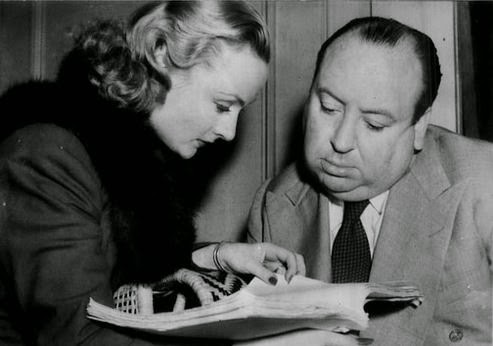
Carole Lombard and Alfred Hitchcock look at the script
His kind of actress
Alfred Hitchcock loved Carole Lombard. She was his type of actress: beautiful, smart, earthy, and blonde. The Hitchcock family rented Lombard’s house after she and Clark Gable were married in 1939. The Hitchcock’s and the Gable’s became fast friends and it was inevitable that the director and actress would work together. Unfortunately, Lombard would make one movie after Mr. and Mrs. Smith, dying tragically in a plane crash the next year, after a successful war bond drive during World War II.


Award-winning script writer
The script written by Oscar winner, Norman Krasna (Hands Across the Table, Bachelor Mother, It Started with Eve, Princess O’Rourke) is quite good and Lombard and Montgomery have great on-screen chemistry and deliver good performances. Raymond is perfect as Montgomery’s strait-laced college chum and partner. The film is peppered with some great character actors like Carson, Lucile Watson, Charles Halton, Esther Dale, and Betty Compson.

Mr. and Mrs. Smith proved that Hitchcock, the master of suspense, could be successful in any genre he put his mind to.

Have some Joe and Enjoy the Show!
Before the movie, grab a cup of coffee from Overflow Coffee Bar, located within the Daystar Center. You can bring food and beverages into the auditorium; we even have small tables set up next to some of the seats.

Join the Chicago Film club, join the discussion
The Chicago Film Club is for classic movie fans. Once a month we screen a classic film and have a brief discussion afterward. For more information, including how to join (it’s free), click here. To purchase your ticket in advance, click here. The Venue 1550 is easily accessible by the CTA. Please visit Transit Chicago for more information on transportation options.

Lombard and Anne Shirley in Vigil in the Night

Backstory: Mr. and Mrs. Smith opened on February 20, 1941 at New York’s Radio City Music Hall. Hitchcock and Lombard had hoped to get Cary Grant to costar, but he was not available. Some Hitchcock critics say that Mr. and Mrs. Smith was a critical and financial flop. This is not true. Audiences were delighted to see Lombard in a comedy after starring in two heavy dramas (Vigil in Night and They Knew What They Wanted). Hitchcock’s first three American films were all solid commercial successes.

Monday, August 5, 2013

Screwball Comedy and the Feminine Mystique—New Film Club series begins in September

Henry Fond and Barbara Stanwyck in The Lady Eve
The 2013-14 Film Club is back at The Venue 1550 at the Daystar Center, 1550 S. State St., Chicago. Hosted by Stephen Reginald, the film club will feature seven classic screwball comedies, including The Awful Truth and The Lady Eve. Movies will be screened at 6:30 p.m. on the second Tuesdays* of the month, starting September 10, 2013. Reginald will introduce each film giving background information before screenings, with discussion afterward. Reginald is a freelance writer/editor and popular instructor at Facets Film School in Chicago. He was also the original host of Meet Me at the Movies.

Screwball Comedy and the Feminine Mystique will feature seven screwball comedies, featuring these icons of the genre: Irene Dunne, Katherine Hepburn, Barbara Stanwyck, Claudette Colbert, and Carole Lombard.

Production Code births the Screwball Comedy
With the enforcement of the Motion Picture Production Code in 1934, movie studios were restricted in their depiction of certain “unacceptable” activities on screen. Prior to the code, the studios produced a string of provocative films that, for the time, were quite sexually explicit.

Life Magazine dubbed Carole Lombard (left) “The Screwball Girl,”
while Clark Gable rarely made comedies
like It Happened One Night.
Once the self-censorship began, the major studios had to come up with clever ways to entertain audiences without going outside the boundaries of the code. Out of these new constraints came the screwball comedy. The use of snappy dialogue filled with double entendres substituted for more straightforward “sex talk,” with the female lead becoming the dominant sex talker, if you will. Professor and film historian, Maria DiBattista calls these women “fast-talking dames.”

This fast-talking by the female protagonist is used not only to get laughs, which it most certainly does, but also to transform the male into a new man of her own creation. This reverse Pygmalion scenario, as noted by DiBattista and others, is at the heart of the screwball comedy and places women in the primary role. This genre produced many familiar female screen icons, including Irene Dunne, Katherine Hepburn, Carole Lombard, and Barbara Stanwyck. This series will examine the screwball comedy, in the context of the female protagonist and her very important place in the canon of American cinema.


Tuesdays* at 6:30 p.m (CST)

September 10 It Happened One Night (1934) When her father threatens to annul her marriage to oily fortune hunter King Westley, heiress Ellie Andrews hops on a cross-country bus to New York. On the trip to meet her new husband, she is befriended by a gruff newspaper reporter named Peter Warne. He agrees to help her on her journey in exchange for exclusive rights to her story. When Ellie and Peter find themselves falling in love, things get complicated, but don’t worry because there are plenty of laughs along the way. Director Frank Capra won the first of his three Oscars for his direction. Stars Clark Gable and Claudette Colbert won Oscars for Best Actor and Actress respectively. It also won awards for Best Picture and Best Writing, making it the first film to sweep all the major Oscar categories, a record it would hold for decades.

October 8 My Man Godfrey (1936) Considered the definitive screwball comedy by many, the plot centers on the actions of the wealthy and eccentric Bullock family. When one of the Bullock daughters (Carole Lombard) hires a “forgotten man” to be their new butler, things get interesting. The film features brilliant performances from Lombard and William Powell as Godfrey. It also features an excellent supporting cast that includes Alice Brady, Eugene Pallette, Gail Patrick, Mischa Auer, and Jean Dixon. My Man Godfrey was the first film to receive Academy Award nominations in all four acting categories. Also nominated for Academy Awards were director Gregory La Cava (Stage Door, Fifth Avenue Girl) and screenwriters Eric Hatch and Morrie Ryskind.

November 19 Theodora Goes Wild* (1936) Irene Dunne plays Theodora Lynn, a small-town girl who has written a racy best-selling novel under the pen name Caroline Adams. Raised by her two maiden aunts, of Lynnfield, Connecticut, Theodora tries to keep Adams’s true identity a secret. On a trip to New York to meet with her publisher, she meets an artist named Michael Grant (Melvyn Douglas) who threatens to expose her real identity. When Theodora discovers that Michael has a few secrets of his own, she turns the tables on him and goes “wild.” Released a few months after My Man Godfrey, Theodora Goes Wild was a huge box office hit. It also revealed that Dunne had a unique gift for comedy. So good was Dunne that she received her second Academy Award nomination for Best Actress—competing against fellow Hoosier, Carole Lombard who was nominated in the same category for My Man Godfrey.

*Theodora Goes Wild will be screened on the third Tuesday in November.

December 10 Christmas in Connecticut* (1945) A big hit when released, this holiday classic is sometimes overlooked in the lists of great Christmas movies. Made when Barbara Stanwyck was at her peak, the story is clever and genuinely funny. Stanwyck is Elizabeth Lane, a writer for Smart Housekeeping magazine, who delights her readers with recipes and homemaking hints. Her character is sort of a 1940s version of Martha Stewart, except, unlike Martha, she has no domestic skills whatsoever. When compelled by her magazine publisher to entertain a war hero, Stanwyck goes into high gear to present herself as the perfect domestic goddess the reading public and her publisher think she is. This holiday charmer fits right in with our screwball comedy series.

*Christmas in Connecticut will be screened on Saturday December 7 at 6:30 p.m.

January 14 The Awful Truth (1937) The first screen pairing of Irene Dunne and Cary Grant is an (Love Affair, Going My Way,) won the Academy Award for his direction.
absolute gem. This Academy Award winning comedy has everything: great acting, dialogue, and a wonderful cast of supporting players. Lucy (Dunne) and Jerry (Grant) Warriner are facing divorce, but do they really want to break up? Lucy finds herself involved with a rich oil tycoon and Jerry starts courting a young woman from a well-heeled aristocratic family. Both try to foil the others’ new romances, while refusing to face the awful truth that they’re still in love with each other. Nominated for five Academy Awards, including a third Best Actress nod for Dunne. Director Leo McCarey

February 11 Bringing Up Baby (1938) Katharine Hepburn is Susan Vance, a rich heiress who becomes infatuated with a mild-mannered paleontologist named David Huxley (Cary Grant). What follows is a roller coaster ride of madcap adventures all initiated by Susan with the weak-willed David along for the ride as her not-so-willing accomplice. And then there’s a dog named George and that leopard named Baby! Director Howard Hawks’s pacing is frenetic. The action and dialogue is nonstop. Don’t be surprised if you’re exhausted after watching this film…but you’ll be smiling, we guarantee it.

March 11 The Lady Eve (1941) Father and daughter con artists (Charles Coburn and Barbara Stanwyck) travel on transatlantic cruise ships swindling rich passengers in card games. When the two spot big fish Charles Poncefort Pike (Henry Fonda), heir to Pike Ale—“The ale that won for Yale”—they decide to take him for all he’s worth. But when the daughter falls in love with their mark, things get complicated and hilarious. Preston Sturges directed his first big-budget hit with amazing results. A critical and financial success, The New York Times declared The Lady Eve the best picture of 1941, above Citizen Kane! Once you see this film you’ll understand why they came to that amazing conclusion.

If you love classic cinema, you should join the Chicago Film Club. It’s free to join. Come share your love of the movies; it’s fun!


Daystar Center located at 1550 S. State St. works through a grassroots network of collaborations and partnerships with individuals and other nonprofit organizations. Through this web, they’re able to provide educational, cultural, and civic activities that enrich and empower their clients, guests, and community members. To learn more about classes and events offered at the Daystar Center, please visit their Web site.

Tuesday, January 1, 2013

Happy New Year from Classic Movie Man

2013: Here’s to another year of classic movie enjoyment!


Carole Lombard and Clark Gable at the Brown Derby

Thursday, August 5, 2010

"It Happened One Night": Still Entertaining Us Almost 80 Years After Its Initial Release


The second week of my class on Claudette Colbert (Down to Earth Sophisticaion: Claudette Colbert in Hollywood) was fun. Last night we screened Frank Capra's 1934 classic It Happened One Night. It's amazing how well this film holds up in the twenty-first century.

Still Fresh
The performances are natural, the chemistry between stars Colbert and Clark Gable is undeniable. The cinematography by Joseph Walker is nearly perfect. The set-ups, the lighting, all contrbute not only to the look of the movie, but to the narrative as well. Almost 80 years later, we still care about Ellie Andrews (Colbert) and Peter Warne (Clark Gable).

The Not So Simple Things
There are many wonderful things to point out in It Happened One Night that have been highlighted by better writers and film historians. But as someone who loves this movie, I can't help but admire the simple things (that technically aren't that simple).

A Walk to Remember
When Colbert leaves the cabin in the auto court and walks to the outdoor showers, it's a thing of beauty. She weaves in and out of adults, children, and auto court workers on her way. It's timed perfectly and it's all done in one beautiful tracking shot. The fact that this movie was shot in four weeks, makes one appreciate the genius of artists like Capra and Walker all the more.

If you've never seen this film, you're missing out not only on a real piece of film history, but also a great feel-good movie that will stay with you forever.

Every Cinderella Has Her Midnight
Midnight (Universal Cinema Classics)Next week it's the Colbert classic Midnight (1939). This great romantic comedy was directed by Michell Leisen and penned by Billy Wilder and Charles Brackett.


Related Posts Plugin for WordPress, Blogger...