Showing posts with label John Wayne. Show all posts

Tuesday, November 11, 2025

Barbara Stanwyck ensnares men with her beautiful “Baby Face”

Baby Face (1933) is an American pre-Code drama directed by Alfred E. Green and starring Barbara Stanwyck and George Brent. The supporting cast includes Theresa Harris, Henry Kolker, Margaret Lindsay, Nat Pendleton, and John Wayne in an early screen performance.

The Ascent of Lily Powers

Set during the Prohibition era and the Great Depression, Baby Face introduces the audience to Lily Powers (Stanwyck), a young woman living a difficult life in a dreary industrial town in Pennsylvania. Forced into dire circumstances by her unscrupulous father, Lily is trapped in a life of exploitation and hardship. Her only source of intellectual and emotional guidance comes from an unlikely friend, an older, philosophical cobbler, who encourages her to reject her current predicament and seize control of her own destiny by embracing a ruthlessly self-serving worldview.

An Ambitious Relocation

Motivated by a fierce desire to escape her past, Lily leaves her small town with her loyal friend, Chico (Harris), heading for the promise of a big city—New York. She quickly sets her sights on the Gotham Trust Company, a towering symbol of wealth and power. Armed with her intelligence, ambition, and striking beauty, Lily makes a calculated decision to use her charm and sexuality as her primary tools for advancement.

Climbing the Corporate Ladder

Lily begins her calculated ascent within the bank, moving systematically from department to department. As she progresses, she encounters a succession of influential men, each of whom she manipulates and seduces to secure promotions and financial gain. Her ruthless ambition leaves a trail of ruined careers and personal scandals in her wake, as the men she uses are unable to resist her influence.

The Height of Power and a New Test

Lily’s relentless climb eventually brings her face-to-face with the bank’s President, a man who is both powerful and intrigued by her unique drive. For the first time, her single-minded focus on material success and power is challenged by a more complex emotional dynamic. As financial disaster threatens the bank and her new life, Lily must face a crucial test of her values, forcing her to decide what truly matters to her and if her carefully constructed world is worth the price she has paid.


Theresa Harris and Barbara Stanwyck

Click HERE to watch the movie on the Internet Archive.

Click HERE to join the online discussion on Monday, November 17, 2025, at 6:30 p.m. Central Time. Once you RSVP, you will receive an invitation and a link to join the discussion on Zoom.

Baby Face trivia

  • Helped Trigger Strict Censorship: Baby Face is widely considered one of the most notorious films of the Pre-Code Hollywood era and was cited as a major catalyst for the strict enforcement of the Motion Picture Production Code (the Hays Code) in 1934. The film’s frank depiction of a woman using sex to advance her career was deemed scandalous by censors and moral reformers.
  • The Censored Ending and Rediscovery: The version initially released to theaters had a heavily censored ending imposed by the Studio Relations Committee (the enforcement arm of the Code), which showed the main character, Lily, reformed and losing her ill-gotten gains. The original, uncensored ending—which was much less punitive and suggested she was rewarded—was presumed lost for decades until a complete pre-release print was discovered in the Library of Congress in 2004.
  • Early John Wayne Role: Look closely at the cast list! A young John Wayne, years before he became a major star, appears in an early, uncredited role as one of the Gotham Trust Company employees—specifically, one of Lily Powers’ initial romantic conquests within the bank.
  • The Power of Philosophy: In the initial, uncensored cut of the film, Lily’s philosophical cobbler friend quotes German philosopher Friedrich Nietzsche, encouraging her to reject traditional morality and become a “master” of her own life. Censors forced this Nietzschean dialogue to be rewritten and dubbed over to remove the immoral suggestion and replace it with a more conventional lesson about taking the “right way” to success.


Discussion questions

  1. Morality and Agency: Lily Powers is often cited as a classic example of a "fallen woman" in film, yet she is also one of the few women in Pre-Code Hollywood to successfully gain and hold power. Do you view Lily as a victim of her circumstances who is simply fighting back, or as a cold manipulator who willfully exploits others? How does the film challenge or reinforce traditional ideas about female morality and agency?
  2. The Role of Men and Institutions: The film portrays the men in Lily's life—from her father to the bank executives—as easily corrupted by their own desires and entitlement. Does Baby Face suggest that these powerful men and the institution (the Gotham Trust Company) are inherently weak or corrupt, and that Lily is merely taking advantage of a pre-existing moral rot?
  3. The Impact of Censorship (Pre-Code vs. Post-Code): Considering that this film was a major reason the Production Code was strictly enforced, how does the Pre-Code version's ending (if you are familiar with it) fundamentally change the film's message compared to the censored version? Does the original ending support a truly anti-moral message, or is it simply a more realistic portrayal of consequences?
  4. Economic and Social Commentary: The film is set against the backdrop of the Great Depression and touches on themes of wealth inequality and the struggle for survival. To what extent is Lily Powers a product of the economic despair of the time, and how does her ruthless pursuit of money reflect a cynical view of the American Dream during this period?
  5. Lily's Relationship with Chico: Lily's only constant, trusted relationship is with her African-American friend and eventual maid, Chico (Theresa Harris). Given the rigid racial and social hierarchies of the 1930s, how is their relationship portrayed differently from Lily’s relationships with the white men in the film? Does their bond offer a commentary on class, race, or female solidarity in a world of male exploitation?
Monday, April 24, 2023

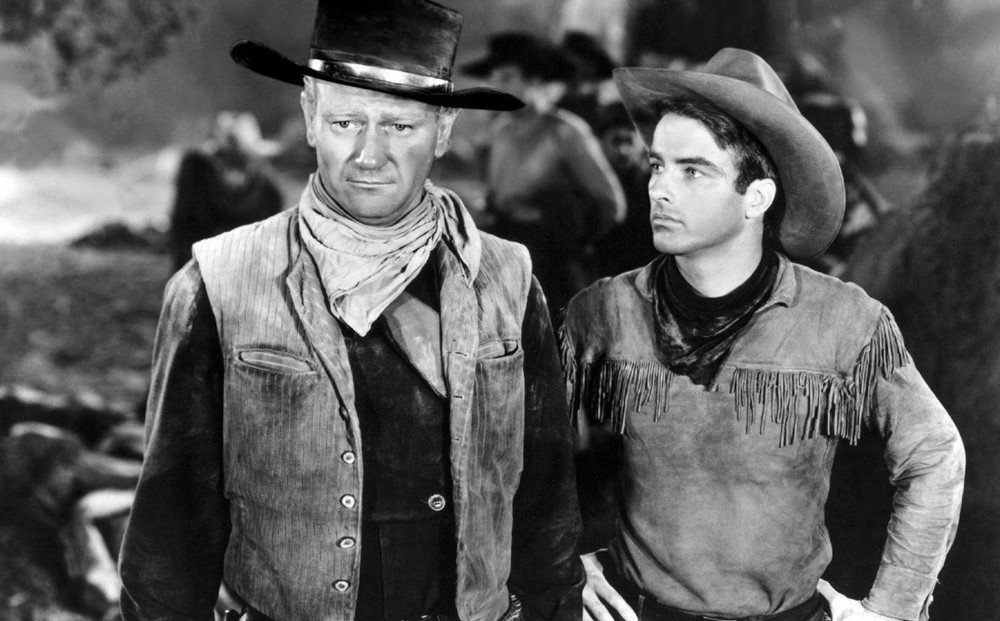
John Wayne and Montgomery Clift clash in Howard Hawks's "Red River"

Red River (1948) is an American western film directed by Howard Hawks and starring John Wayne, Montgomery Clift, Walter Brennan, and Joanne Dru. The movie is based on The Chisholm Trail, first published in The Saturday Evening Post by Borden Chase. Chase co-wrote the screenplay with Charles Schnee. The cinematography was by Russell Harlan (To Kill a Mockingbird) and the music was by Dimitri Tiomkin (Mr. Smith Goes to Washington).

Thomas Dunson (Wayne) wants to start his own cattle drive and establish a ranch in Texas. As he begins his journey, he learns that his girlfriend Fern (Colleen Gray) has been killed in an Indian attack. Dunson convinced Fern to remain with the wagon train to California instead of traveling with him which was her desire.

Dunson and Nadine Groot (Brennan) successfully fend off an Indian attack. Dunson finds his late mother’s bracelet on the writs of one of the Indians. The one he gave to Fern. The next day, they come across a boy named Matthew Garth (Mickey Kuhn) the only survivor of the wagon train, the same wagon that Fern was traveling with. Dunson adopts Matthew and the two work on the cattle drive together.

Time marches on and an older Matthew (Clift) and Dunson don’t always agree with each other and clash over their affection for Tess Millay (Dru).

Will the two men be able to come to terms with their differences and continue to work together raising cattle?

John Wayne and Montgomery Clift


Howard Hawks (1896 - 1977) was an American director, producer, and screenwriter. He is considered one of the great directors from the classic Hollywood era. Hawks excelled in directing films in all genres. His films were famous for featuring strong women characters. These tough-talking “Hawksian women” helped to define the director’s work. Some of Hawks’ popular films include Scarface (1932) Bringing Up Baby (1938), Only Angels Have Wings (1939), His Girl Friday (1940), To Have and Have Not (1944), The Big Sleep (1946), Red River (1948), and Gentlemen Prefer Blondes (1953). Gary Cooper won a Best Actor Academy Award for his performance in Sergeant York (1941) under Hawks’ direction.

John Wayne (1907 - 1979) was an American actor and filmmaker. Nicknamed Duke, Wayne was a pop culture icon and one of the most popular movie stars of all time. During the end of the silent era, Wayne worked on movie sets and played bit parts in movies. He got the chance to play the lead in director Raoul Walsh’s The Big Trail (1930). The Western was an early widescreen epic and a box office disaster, which relegated Wayne to roles in a string of B Westerns. It wasn’t until his role as the Ringo Kid in Stagecoach that he became a star of A films who was now paired with some of the top actresses of the day. Wayne played a variety of roles in the movies but he is most identified with the Western genre and the movies he made with director John Ford. Some of Wayne’s popular films include Red River (1948), The Quiet Man (1952), Rio Bravo (1959), The Searchers (1956), and The Longest Day (1962). Wayne won his one and only Best Actor Academy Award for his role in Tue Grit (1969).

Montgomery Clift (1920 – 1966) was an American actor. He was a four-time Academy Award nominee for Best Actor. Like Marlon Brando and James Dean, Clift was considered one of the original method actors. Clift got his start on the stage as a young man and starred opposite the likes of Tallulah Bankhead, Frederic March, and Alfred Lunt and Lynn Fontanne. Clift’s first movie role was in Howard Hawks’s Red River (1949) starring opposite John Wayne. He went on to co-star with Olivia de Havilland in William Wyler’s The Heiress (1949). He reached superstar status in the role of George Eastman in the George Stevens production of A Place in the Sun (1951) staring opposite Elizabeth Taylor. Clift would later star in Alfred Hitchcock’s I Confess (1953), and Fred Zinnemann’s From Here to Eternity (1953). Other films followed including Raintree County (1956), The Young Lions (1958), Lonelyhearts (1958), Suddenly, Last Summer (1959), and Wild River (1960).

Walter Brennan (1894 – 1974) was an American character actor and three-time Academy Award winner for Best Supporting Actor. Brennan is the only actor male or female to win three awards in the supporting actor category. He got his start as an extra in silent films and eventually made the transition to talking pictures. By the late-1930s, Brennan was one of Hollywood's most sought-after and highest-paid character actors. Some of Brennan’s movies include Three Godfathers (1936), Kentucky (1938), The Westerner (1940), Meet John Doe (1941), The Pride of the Yankees (1942), My Darling Clementine (1946), Rio Bravo (1959), and How the West Was Won (1962).

Joanne Dru (1922 – 1996) was an American film and television actress. She was a popular leading actress in the late-1940s and early 1950s in films like Red River (1949), She Wore a Yellow Ribbon (1949), All the King’s Men, and Wagon Master (1950). Other films include The Pride of St. Louis (1952) and Thunder Bay (1953) opposite James Stewart.


Red River trivia

  • This was Montgomery Clift’s first film role although The Search (1948) was released first. Red River’s release was held up for two years.
  • Upon seeing John Wayne’s performance in this film, director John Ford supposedly said, “I never knew the big son of a bitch could act.” Ford went on to cast Wayne in more complex roles in films like The Searchers (1956).
  • Red River was Howard Hawks’s first western film.


Burt Lancaster was offered the Clift role but had to turn it down because he was committed to star in The Killers (1946).

To watch the film on YouTube, click on the link below.


To join the discussion on May 1, 2023, at 6:30 p.m. Central Time, click here. Once you RSVP, you will receive an email with a link to join the discussion on Zoom.


Discussion questions

  1. This is considered one of the best western ever made. Would you agree? Did you enjoy this western?
  2. What did you think of the performance of John Wayne? Did you think his performance was better than his performance in Stagecoach (1939)?
  3. Did you think that Wayne and Clift worked well together? 
  4. Was there an overall theme to this film? If so, what was it?
  5. What did you think of Joanne Dru’s character? Was she the typical Hawksian heroine?


Wednesday, June 30, 2021

Claire Trevor and John Wayne head the cast of “Stagecoach”

Stagecoach (1939) is an American Western classic directed by John Ford and starring Claire Trevor and John Wayne. The film was produced by Walter Wanger Productions and the cinematography was by Bert Glennon (Young Mr. Lincoln-1939, Our Town-1940, Destination Tokyo-1943).

Considered not only one of the best westerns of all time, but Stagecoach is also considered one of the best pictures of all time. Supposedly, Orson Welles watched the film 40 times in preparation for the making of Citizen Kane (1941). Welles said Stagecoach was the “perfect textbook of film-making.”

When a group of strangers boards a stagecoach in June of 1885, from Tonto, Arizona Territory, to Lordsburg, New Mexico, little do they realize their lives will forever be changed. On that stagecoach is Dallas (Trevor) a prostitute who is run out of town by the all-female Law and Order League, Doc Boone (Thomas Mitchell), an alcoholic, Mrs. Lucy Mallory, (Louise Platt) an officer’s wife, whiskey salesman Samuel Peacock (Donald Meek), and gambler and Southern gentleman Hatfield (John Carradine). Along the way, they pick up dishonest banker Henry Gatewood (Berton Churchill) who has just embezzled money from his bank.

As if the stage wasn’t crowded enough, they meet up with the Ringo King (Wayne) who escaped from jail to avenge the deaths of his father and brother at the hands of Luke Plummer (Tom Tyler).

How these diverse personalities interact along the way is what makes the film so engaging. Will they be at each others’ throats or will they be able to pull together as they ride through dangerous Indian territory?


John Ford (1894 - 1973) was an American film director who won a record four Academy Awards, more than any other director in history. He is perhaps best known for his western films, but ironically the Academy Awards he won weren’t for his classic westerns like Stagecoach (1939) and The Searchers (1956). Ford got his start in silent film, first as an actor, then as a writer-director. He directed many silent films including the epic The Iron Horse (1924). Once the sound era arrived, Ford was one of its first pioneers. He hit his stride in the 1930s with films like The Lost Patrol (1934), The Whole Town’s Talking (1935), and The Informer (1935), which brought Ford his first Academy Award for Best Director. Other popular Ford films include The Hurricane (1937), Wee Willie Winkie (1937), Young Mr. Lincoln (1939), Drums Along the Mohawk (1939), and The Grapes of Wrath (1940) the last three all starring Henry Fonda. He also had a long collaborative relationship with John Wayne. Wayne starred in many classic Ford films including She Wore a Yellow Ribbon (1949), The Quiet Man (1952), The Searchers, and The Man Who Shot Liberty Valance (1962).

Walter Wanger (1894 - 1968) was an American film producer. He was active in films from 1910 until 1963. Wanger attended Dartmouth College and served in the United States Army during World War I. While working for what was to become Paramount Studios, during the early days of talking films, he recruited Broadway performers like Claudette Colbert, Jeanette MacDonald, Fredric March, and Miriam Hopkins to the movies. He also brought directors George Cukor and Rouben Mamoulian to the studio. Some of the films produced by Wanger include Foreign Correspondent (1940), The Long Voyage Home (1940), Scarlet Street (1945), The Reckless Moment (1949), Invasion of the Body Snatchers (1956), I Want to Live! (1958), and Cleapatra (1963). Wanger was married to actress Joan Bennett (1940 - 1965).

The cast of Stagecoach

Claire Trevor (1910 - 2000) was an American actress who appeared in over 60 movies. She received nominations for the Academy Award for Best Supporting Actress for Dead End (1937), and The High and the Mighty (1954). She won the award for her performance in Key Largo (1948). Trevor got her start on the New York stage and made her film debut in 1933. She also appeared on radio with Edward G. Robinson in the popular radio program Big Town. Trevor’s most famous role is probably Dallas in Stagecoach, but she had other memorable roles in Murder, My Sweet (1944), and Born to Kill (1947). Her last film role was in Kiss Me Goodbye (1982) where she played Sally Field’s mother. 

John Wayne (1907 - 1979) was an American actor and filmmaker. Nicknamed Duke, Wayne was a pop culture icon and one of the most popular movie stars of all time. During the end of the silent era, Wayne worked on movie sets and played bit parts in movies. He got the chance to play the lead in director Raoul Walsh’s The Big Trail (1930). The Western was an early widescreen epic and a box office disaster, which relegated Wayne to roles in a string of B Westerns. It wasn’t until his role as the Ringo Kid in Stagecoach that he became a star of A films who was now paired with some of the top actresses of the day. Wayne played a variety of roles in the movies but he is most identified with the Western genre and the movies he made with director John Ford. Some of Wayne’s popular films include Red River (1948), The Quiet Man (1952), Rio Bravo (1959), The Searchers (1956), and The Longest Day (1962). Wayne won his one and only Best Actor Academy Award for his role in Tue Grit (1969).

John Wayne and Claire Trevor

Stagecoach trivia

  • The hat John Wayne wore in the film was his own. He wore it in many westerns but retired it in 1959 after completing Rio Bravo.
  • Local Navajo Indians played Apaches.
  • Stagecoach was one of several big-budget Westerns released in 1939 including Union Pacific, Jesse James, and Dodge City.
  • John Wayne made less money than most of his costars
  • Thomas Mitchell won a Best Supporting Academy Award for this film but was very busy in 1939. Besides Stagecoach, he had important roles in Only Angels Have Wings, Mr. Smith Goes to Washington, The Hunchback of Notre Dame, and Gone with the Wind!


To watch the film on YouTube, click the link below.


To join the discussion on July 5, 2021, at 6:30 p.m. Central Time, click here. Once you RSVP, you will receive an email with an invitation and link to the discussion on Zoom.


Discussion questions:

  1. What did you make of John Wayne’s star-making turn in this film?
  2. Of all the character actors, did one stand out to you?
  3. How much experience with women do you think Wayne’s character had before meeting Dallas?
  4. Why do you think this film is held in such high regard by critics and filmgoers today?
  5. What do you think director John Ford thought of the character of Dallas?
Filming Stagecoach on location


Monday, May 30, 2016

Memorial Day 2016

Remembering those who sacrificed all for our freedom

John Wayne, Donna Reed, and Robert Montgomery in They Were Expendable

Wednesday, March 23, 2016

Great Films of 1939: "Stagecoach" April 16 at the Daystar Center

Great Films of 1939 series: Stagecoach
Where: The Venue 1550 at the Daystar Center, 1550 S. State Street, Chicago, IL
When: April 16, 2016
Time: 6:45 p.m.
Hosted by Stephen Reginald

Stagecoach (1939) changed the western film genre forever. Prior to this film, westerns weren’t taken too seriously and were relegated to low-budget second features or serials. John Ford’s classic also began the fruitful association and partnership with star John Wayne. Before Stagecoach, Wayne was starring in low-budget western second features at poverty row studios. The film boasts a wonderful performance from the female lead, Claire Trevor, who should have, like Wayne, emerged as a major movie star. The supporting cast features many who would become part of the John Ford stock company, including Thomas Mitchell (Academy Award Winner), Andy Devine, Tim Holt, and John Carradine.

Part of the “Great movies of 1939” series. Discover some of the greatest movies from Hollywood’s most famous year.


Backstory: Thomas Mitchell had a great 1939. Besides Stagecoach, Mitchell had major supporting roles in Only Angels Have Wings, Mr. Smith Goes to Washington, The Hunchback of Notre Dame, and Gone with the Wind!

Have some Joe and Enjoy the Show!
Before the movie, grab a cup of coffee from Overflow Coffee Bar, located within the Daystar Center. You can bring food and beverages into the auditorium; we even have small tables set up next to some of the seats. General Admission: $5 Students and Senior Citizens: $3.

Join the Chicago Film club; join the discussion
Twice a month we screen classic films and have a brief discussion afterward. For more information, including how to join (it’s free), click here. The Venue 1550 is easily accessible by the CTA. Please visit Transit Chicago for more information on transportation options.

Stephen Reginald is a freelance writer and editor. He has worked at various positions within the publishing industry for over 25 years. Most recently he was executive editor for McGraw-Hill’s The Learning Group Division. A long-time amateur student of film, Reginald hosts “Chicago Film Club,” a monthly movie event held in the South Loop, for the past two years. Reginald has also taught several adult education film classes at Facets Film School, Chicago.


Daystar Center located at 1550 S. State St. works through a grassroots network of collaborations and partnerships with individuals and other nonprofit organizations. Through this web, they’re able to provide educational, cultural, and civic activities that enrich and empower their clients, guests, and community members. To learn more about classes and events offered at the Daystar Center, please visit their Web site.


Tuesday, October 20, 2015

Book Review: A Real American Character: The Life of Walter Brennan

A Real American Character: The Life of Walter Brennan
University Press of Mississippi, 2015

Walter Brennan (1894 – 1974) was one of the most popular character actors of the twentieth century. Often playing the movie sidekick to stars like John Wayne and Gary Cooper, Brennan was a favorite of directors like Howard Hawks. The winner of three competitive Academy Awards for best supporting actor, he was as popular with movie audiences as some of the top-billed stars he worked with. In the late 1950s, Brennan would become a television icon as Grandpa Amos McCoy on the comedy series The Real McCoys.

Brennan was born in Lynn, Massachusetts toWilliam John Brennan and Margaret Elizabeth Flanagan, both Irish immigrants. He was raised in nearby Swampscott, the second of three children. He had an older brother William Irvin and younger sister who died two days after her birth. Raised as a strict Roman Catholic, Brennan would attribute much of his success to his faith.

As a young man, Brennan thought his family favored his older brother. He was not interested in academics, but he caught the acting bug while in school. By the age of fifteen he was performing in vaudeville. He enlisted in United States Army, serving as a private in France during World War I. After the war with some financial setbacks during the Great Depression, Brennan tried his hand at acting in 1925. He toiled away as an extra and bit part player, mostly uncredited, for years. He was able to survive the advent of talking pictures and hit his stride in the late 1930s. His role as Swan Bostrom in Come and Get It (1936) earned him his first Academy Award and cemented his popularity with the public. As a character actor in Hollywood, Brennan was earning a salary that was comparable to the stars he supported. As a supporting player, he never had to worry about carrying a film and if it bombed, it wasn’t his fault. His notices were almost always good, even in bad pictures.

Walter Brennan and Gary Cooper in The Westerner
Brennan won two more Academy Awards for Kentucky (1938) and The Westerner (1940). He was also nominated for his performance as Pastor Rosier Pile in Sergeant York (1941), losing to Donald Crisp for his performance in How Green Was My Valley.

The list of classic movies that Brennan appeared in seems endless: Northwest Passage (1940), Meet John Doe, Swamp Water (1941), The Pride of Yankees (1942), To Have and Have Not (1944), My Darling Clementine (1946), Red River (1948), Bad Day at Black Rock (1955), Rio Bravo (1959), How the West Was Won (1962), and Support Your Local Sheriff! (1969).

Richard Crenna, Brennan, and Kathleen Nolan
in The Real McCoys
Biographer Carl Rollyson explores Brenann’s life and career with a respect for the performer’s talent and his character as a human being. According to Rollyson, Brennan was a relatively modest man, even when he became highly successful. Always grateful for his good fortune, Brennan was never showy or extravagant. He never forgot his humble beginnings in Swampscott.

Rollyson does an exhaustive review of most of Brennan’s film and television roles. He also offers quotes from the many actors who worked with Brennan, including his Real McCoy costars Richard Crenna and Kathleen Nolan, James Garner, and Angie Dickinson.


Walter Brennan’s career is like a history of the entertainment business. He started out in silent films, made the transition to talkies, and conquered television. Brennan even had several best-selling record albums and singles.

Walter Brennan was truly a real American character.

Monday, November 10, 2014

Maureen O’Hara (Finally) Gets Her Oscar

Maureen O’Hara, the star of such classic films as The Hunchback of Notre Dame, How Green Was My Valley, Sentimental Journey, The Miracle on 34th Street, The Quiet Man, and The Parent Trap, received a special honorary Academy Award. Incredibly, O’Hara, 94, was never nominated for a competitive Oscar in a career that spanned 75 years.

From left to right: John Payne, Edmund Gwenn, Natalie Wood, and O’Hara In Miracle on 34th Street
In her acceptance speech, O’Hara paid tribute to the three men who helped her career: Charles Laughton, John Wayne, and John Ford. Laughton signed O’Hara to her first film contract and costarred with her in The Hunchback of Notre Dame, Jamaica Inn, and This Land Is Mine. O’Hara costarred with Wayne in five films, including Rio Grande, The Quiet Man, McClintock!, and Big Jake. Ford directed O’Hara in How Green Was My Valley, The Quiet Man, and The Long Gray Line.


If you were to award O’Hara for one of her film performances, what would it be?

Sunday, February 2, 2014

John Wayne: The Life and Legend sheds new light on iconic star

Scott Eyman’s new biography, John Wayne: The Life and Legend, follows Victoria Wilson’s recent biography of Barbara Stanwyck. Both biographies attempt to put the lives of their respective subjects in the context of their upbringing, relationships and Hollywood careers.

Marion Robert Morrison was born in 1907 in Winterset, Iowa. When Marion entered pictures, he adopted the name John Wayne, but his friends called him Duke. Wayne’s career as the heroic ideal in western, adventure, and war films sometimes made him appear one dimensional, but in real life he was much more complex. Wayne came from humble means, but was hard working, honest, and had the drive and desire to better himself. He was a good student, as well as an outstanding athlete. His football skills were impressive enough to earn him a scholarship to USC. He had a good relationship with his father, but his mother was remote. She made no attempt to hide her favoritism toward Wayne’s younger brother, Robert.

Stagecoach made John Wayne a star.
Wayne had an early shot at movie stardom in a Fox production called The Big Trail (1930), directed by Raoul Walsh. Walsh offered the lead role to Gary Cooper, but he wasn’t available. Fellow director John Ford recommended John Wayne for the part. The production was huge and it pioneered a new 70mm widescreen process called Grandeur. Wayne received a big buildup from the studio as a major new screen personality. Unfortunately, the film was not a success financially or critically. Most theaters couldn’t afford to upgrade to the new widescreen process, during the depression, with most moviegoers seeing the film in the traditional smaller screen ratio. This box office misfire relegated Wayne to making movies at poverty row studios. It would be nine years before he’d get another chance at stardom.

John Ford’s 1939 production of Stagecoach made Wayne a full-fledged movie star. His performance as the Ringo Kid was widely praised. It was also the beginning of Wayne’s successful association with mentor and friend Ford, a truly complicated relationship, interestingly detailed by Eyman.

Wayne received his one and only Best Actor Oscar
for True Grit in 1970. The award was presented
 by Barbra Streisand (right).
Politically conservative, Wayne never let his politics get in the way of friendships and business (although some of his films had politically conservative points of view). Most of the people who worked with Wayne, fellow actors and technicians alike, adored and respected him. As a movie star, Wayne was very careful about the roles he took and was fairly hands-on in almost every aspect of his films. As he got older, this involvement resulted in forming his own production company, Batjac. During this period, he produced and starred in several successful films, including Island in the Sky, Hondo, and The High and The Mighty.

Wayne’s personal life consisted of three failed marriages to Latina women, whose ups and downs were chronicled in the tabloids, as well as the Hollywood press. There is a funny retelling of Duke’s divorce from his second wife Esperanza “Chata” Bauer. Chata was trying to get a big divorce settlement from Wayne, so she drove to court every day in a beat up old truck, trying to look needy. One day when the divorce proceedings didn’t go Chata’s way she cried and left the courthouse in a Cadillac that somehow replaced the dilapidated pickup truck.

Eyman’s biography is a fair assessment of one of Hollywood’s biggest and most enduring stars. For Wayne fans it’s a must, but for those interested in film history, it’s a fascinating read as well. Publication for this new biography is set for April, 2014, but can be preordered at Amazon. The biography is available in both hardback and Kindle versions.

John Wayne: The Life and Legend
By Scott Eyman
672 pages

Monday, August 9, 2010

Goodbye, Patricia Neal

Patricia Neal, movie star
Academy-Award winning actress Patricia Neal died yesterday at her home in Martha's Vineyard. She was 84 years old and succumbed to lung cancer.

Kentucky Born and Tennessee Raised
Neal was born in Packard, Kentucky in 1926, but raised in Knoxville, Tennessee. As an adult, she studied acting at Northwestern University (B.S. 1947). While still a student, Neal stared on Broadway in Lillian Hellman's Another Part of the Forest. For her role as Regina Hubbard, Neal won a Tony for Best Featured Actress. The Tony Award and rave notices, not to mention her stunning good looks, brought Neal to the attention of Hollywood.

Hollywood Comes a Calling
Gary Cooper and Neal in The Fountainhead
Signed to a contract with Warner Bros., Neal starred opposite future president Ronald Reagan in John Loves Mary (1949). She made another film that year with Reagan (The Hasty Heart), but it was the over-the-top film version of Ayn Rand's bestselling novel, The Fountainhead, that received all the attention. Although not a critical or commercial success, the chemistry between Neal and costar Gary Cooper kept the pages of movie fan magazines burning for several years. In reality, Neal and Cooper had a very torrid love affair that almost destroyed Cooper's marriage and Neal's sanity. When the relationship collapsed, Neal suffered a nervous breakdown and abandoned Hollywood for Broadway. Ironically, she starred in another Helman play, a revival of The Children's Hour. During its run, Hellman introduced Neal to children's author Roald Dahl. The two were married in 1953.

The Play's the Thing
During the late 1950s, Neal devoted herself almost entirely to working on the stage, appearing in only one film: Elia Kazan's A Face in the Crowd (1957), costarring Andy Griffith. Film fans would have to wait until Breakfast at Tiffany's (1961) to see Neal on the big screen again.

Oscar Winner
Neal won a Best Actress Oscar for her role in Hud.
During the early sixties, the leading-lady roles Neal was used to playing all but dried up. After a series of personal tragedies sidelined her from the screen, Neal played a worn-out housekeeper in Martin Ritt's Hud (1963) costarring Paul Newman in the title role. For what many considered a supporting role, Neal won an Oscar as the best actress of the year. Major film roles started coming Neal's way again including Otto Preminger's big-budget World War II classic In Harm's Way (1965). In a cast of many Hollywood notables, Neal received third billing behind John Wayne and Kirk Douglas.

Tragedy and Triumph

Jack Albertson and Neal in The Subject is Roses
Pregnant with her fifth child in 1965, Neal suffered a number of strokes that nearly killed her. After emergency brain surgery and several weeks in a coma, Neal found herself confined to a wheelchair. Neal's husband helped her with her physical therapy and within two years, she had learned to walk and speak again. So remarkable was her recovery that she was offered the role of Mrs. Robinson in The Graduate (1967), but turned it down, thinking it was too soon for her to return to the screen. A year later, she took the lead role in The Subject Was Roses. It was a remarkable comeback; Neal was nominated once again for Best Actress. She lost the award to Barbra Streisand and Katharine Hepburn, who tied that year, but it was a personal and professional triumph for Neal. Although more major film roles didn't come her way, Neal consistently worked in movies and TV, including Flying By released in 2009.

Patricia Neal, star of stage and screen, is survived by four children (daughter Olivia preceded her in death) and seven grandchildren.


Related Posts Plugin for WordPress, Blogger...