Showing posts with label Walter Brennan. Show all posts

Tuesday, October 7, 2025

Robert Mitchum, Barbara Bel Geddes, and Robert Preston star in “Blood on the Moon”

A classic “noir Western,” Blood on the Moon (1948) is an American Western noir directed by Robert Wise and starring Robert Preston, Barbara Bel Geddes, and Robert Preston. The supporting cast includes Walter Brennan, Frank Faylen, and Phyllis Thaxter.

The film centers on Jim Garry (Mitchum), a drifter and a hired hand. He’s called to a remote part of the American West by an old friend, Tate Riling (Preston), who’s involved in a dispute with a local cattle rancher. Initially, Garry agrees to take on a role in what he believes is a straightforward business deal, but he quickly discovers a complex web of deceit, betrayal, and violence.

The film’s plot thickens as Garry becomes entangled in the conflict between the cattleman and a group of homesteaders. The rancher's spirited daughter, Amy Lufton (Bel Geddes), immediately distrusts Garry, suspecting he’s on the side of her family’s enemies. As Garry begins to question his friend’s true intentions and the morality of his own involvement, he finds himself caught between opposing sides, each with their own secrets and hidden agendas. He learns that the stakes are much higher than he first believed and that he’s a pawn in a much larger, more dangerous game.

Torn between loyalty to his past and a growing sense of justice, Garry must navigate a treacherous landscape of shifting allegiances and constant danger. His journey to uncover the truth and choose a side forces him to confront his own cynical nature and determine where his true loyalties lie.


Blood on the Moon trivia

  • After seeing the film, Howard Hughes canceled Barbara Bel Geddes’s contract. He said she wasn’t sexy enough.
  • For the night scenes, director Robert Wise and cinematographer Nicholas Musuraca chose to use infrared film, despite the problems it could cause with the tones of clothes and makeup.
  • According to some pre-production press, James Stewart was set to star in the Mitchum role.
  • Walter Brennan thought Robert Mitchum looked like an authentic cowboy.


Click HERE to watch the film on the Internet Archive.

Click HERE to join the online discussion on Monday October 13, 2025, at 6:30 p.m. Central Time. Once you RSVP, you will receive an invitation with a link to join the discussion on Zoom.

Discussion questions

  1. Noir Western or Traditional Western? Blood on the Moon is often called a “Noir Western.” What elements of film noir does it incorporate? Do you think the film ultimately adheres more to the conventions of film noir or the traditional Western genre?
  2. The Morality of Jim Garry: At the start of the film, Jim Garry is a hired hand, a man for hire with no clear moral compass. How does his character evolve throughout the film? What events or interactions, particularly with Amy Lufton, lead to his shift from a cynical opportunist to a man of principle?
  3. Trust and Betrayal: The film’s plot is driven by a complex web of deceit. Discuss the theme of trust as it applies to the relationships between Jim Garry and Tate Riling, Jim and Amy, and even Amy and her father. In this world, who can be trusted, and why?
  4. Symbolism of the Setting: The film’s desolate, rugged landscapes serve as more than just a backdrop. How does the setting—the canyons, the isolated ranches, the moonlit nights—reflect or enhance the film’s themes of moral ambiguity, isolation, and conflict?
 

Monday, April 24, 2023

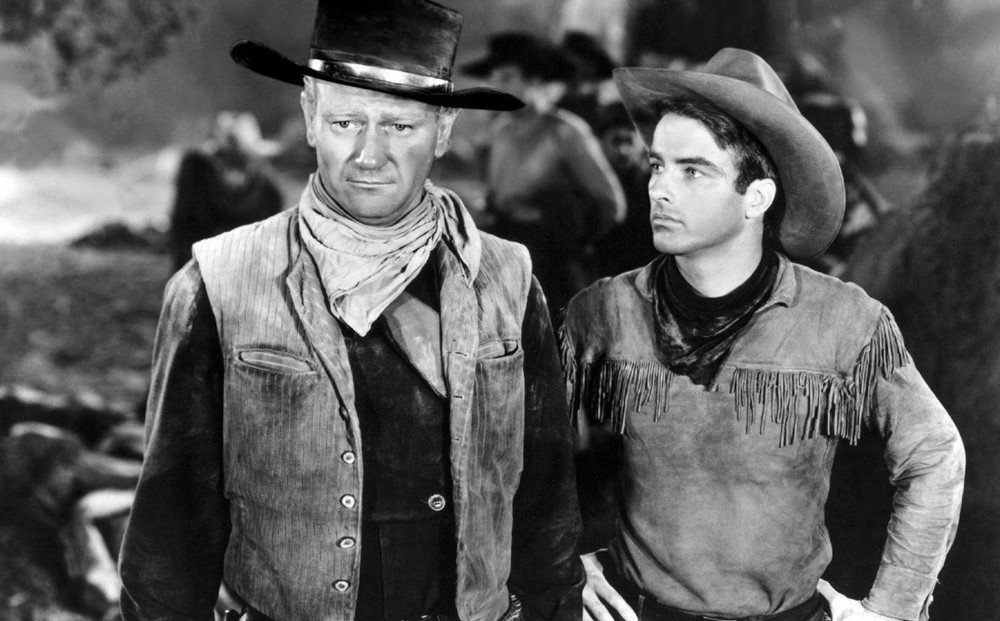
John Wayne and Montgomery Clift clash in Howard Hawks's "Red River"

Red River (1948) is an American western film directed by Howard Hawks and starring John Wayne, Montgomery Clift, Walter Brennan, and Joanne Dru. The movie is based on The Chisholm Trail, first published in The Saturday Evening Post by Borden Chase. Chase co-wrote the screenplay with Charles Schnee. The cinematography was by Russell Harlan (To Kill a Mockingbird) and the music was by Dimitri Tiomkin (Mr. Smith Goes to Washington).

Thomas Dunson (Wayne) wants to start his own cattle drive and establish a ranch in Texas. As he begins his journey, he learns that his girlfriend Fern (Colleen Gray) has been killed in an Indian attack. Dunson convinced Fern to remain with the wagon train to California instead of traveling with him which was her desire.

Dunson and Nadine Groot (Brennan) successfully fend off an Indian attack. Dunson finds his late mother’s bracelet on the writs of one of the Indians. The one he gave to Fern. The next day, they come across a boy named Matthew Garth (Mickey Kuhn) the only survivor of the wagon train, the same wagon that Fern was traveling with. Dunson adopts Matthew and the two work on the cattle drive together.

Time marches on and an older Matthew (Clift) and Dunson don’t always agree with each other and clash over their affection for Tess Millay (Dru).

Will the two men be able to come to terms with their differences and continue to work together raising cattle?

John Wayne and Montgomery Clift


Howard Hawks (1896 - 1977) was an American director, producer, and screenwriter. He is considered one of the great directors from the classic Hollywood era. Hawks excelled in directing films in all genres. His films were famous for featuring strong women characters. These tough-talking “Hawksian women” helped to define the director’s work. Some of Hawks’ popular films include Scarface (1932) Bringing Up Baby (1938), Only Angels Have Wings (1939), His Girl Friday (1940), To Have and Have Not (1944), The Big Sleep (1946), Red River (1948), and Gentlemen Prefer Blondes (1953). Gary Cooper won a Best Actor Academy Award for his performance in Sergeant York (1941) under Hawks’ direction.

John Wayne (1907 - 1979) was an American actor and filmmaker. Nicknamed Duke, Wayne was a pop culture icon and one of the most popular movie stars of all time. During the end of the silent era, Wayne worked on movie sets and played bit parts in movies. He got the chance to play the lead in director Raoul Walsh’s The Big Trail (1930). The Western was an early widescreen epic and a box office disaster, which relegated Wayne to roles in a string of B Westerns. It wasn’t until his role as the Ringo Kid in Stagecoach that he became a star of A films who was now paired with some of the top actresses of the day. Wayne played a variety of roles in the movies but he is most identified with the Western genre and the movies he made with director John Ford. Some of Wayne’s popular films include Red River (1948), The Quiet Man (1952), Rio Bravo (1959), The Searchers (1956), and The Longest Day (1962). Wayne won his one and only Best Actor Academy Award for his role in Tue Grit (1969).

Montgomery Clift (1920 – 1966) was an American actor. He was a four-time Academy Award nominee for Best Actor. Like Marlon Brando and James Dean, Clift was considered one of the original method actors. Clift got his start on the stage as a young man and starred opposite the likes of Tallulah Bankhead, Frederic March, and Alfred Lunt and Lynn Fontanne. Clift’s first movie role was in Howard Hawks’s Red River (1949) starring opposite John Wayne. He went on to co-star with Olivia de Havilland in William Wyler’s The Heiress (1949). He reached superstar status in the role of George Eastman in the George Stevens production of A Place in the Sun (1951) staring opposite Elizabeth Taylor. Clift would later star in Alfred Hitchcock’s I Confess (1953), and Fred Zinnemann’s From Here to Eternity (1953). Other films followed including Raintree County (1956), The Young Lions (1958), Lonelyhearts (1958), Suddenly, Last Summer (1959), and Wild River (1960).

Walter Brennan (1894 – 1974) was an American character actor and three-time Academy Award winner for Best Supporting Actor. Brennan is the only actor male or female to win three awards in the supporting actor category. He got his start as an extra in silent films and eventually made the transition to talking pictures. By the late-1930s, Brennan was one of Hollywood's most sought-after and highest-paid character actors. Some of Brennan’s movies include Three Godfathers (1936), Kentucky (1938), The Westerner (1940), Meet John Doe (1941), The Pride of the Yankees (1942), My Darling Clementine (1946), Rio Bravo (1959), and How the West Was Won (1962).

Joanne Dru (1922 – 1996) was an American film and television actress. She was a popular leading actress in the late-1940s and early 1950s in films like Red River (1949), She Wore a Yellow Ribbon (1949), All the King’s Men, and Wagon Master (1950). Other films include The Pride of St. Louis (1952) and Thunder Bay (1953) opposite James Stewart.


Red River trivia

  • This was Montgomery Clift’s first film role although The Search (1948) was released first. Red River’s release was held up for two years.
  • Upon seeing John Wayne’s performance in this film, director John Ford supposedly said, “I never knew the big son of a bitch could act.” Ford went on to cast Wayne in more complex roles in films like The Searchers (1956).
  • Red River was Howard Hawks’s first western film.


Burt Lancaster was offered the Clift role but had to turn it down because he was committed to star in The Killers (1946).

To watch the film on YouTube, click on the link below.


To join the discussion on May 1, 2023, at 6:30 p.m. Central Time, click here. Once you RSVP, you will receive an email with a link to join the discussion on Zoom.


Discussion questions

  1. This is considered one of the best western ever made. Would you agree? Did you enjoy this western?
  2. What did you think of the performance of John Wayne? Did you think his performance was better than his performance in Stagecoach (1939)?
  3. Did you think that Wayne and Clift worked well together? 
  4. Was there an overall theme to this film? If so, what was it?
  5. What did you think of Joanne Dru’s character? Was she the typical Hawksian heroine?


Wednesday, March 15, 2023

Jean Renoir's "Swamp Water"

Swamp Water (1941) is an American crime drama set in the Okefenokee Swamp, Waycross, Georgia. The film was directed by Jean Renoir and stars Walter Brennan, Walther Huston, Anne Baxter, and Dana Andrews. The strong supporting cast includes Virginia Gilmore, John Carradine, Mary Howard, Eugene Pallette, and Ward Bond.

When Ben Regan (Andrews) goes looking for his dog in the Okefenokee Swamp, he encounters Tom Keefer (Brennan). Keefer is wanted for murdering Deputy Shep Collins. Keefer claims he is innocent. Ben and Keefer form a partnership with Ben selling animals that the two of them trapped. Part of the money that they earn from trapping goes to Julie (Baxter) who is Keefer’s daughter.

Will the actual murderer be revealed? Will Keefer return to normal life as an innocent man?

Anne Baxter and Dana Andrews


Jean Renoir (1894 - 1979) was a French film director, writer, and producer. He directed more than forty films. Renoir worked during the silent era until the end of the 1960s. Two of his films La Grande Illusion (1937) and The Rules of the Game (1939) are considered among the greatest films ever made. Renoir fled to the United States when Germany invaded France in 1940. He came to Hollywood and directed Swamp Water (1941) starring Dana Andrews, This Land is Mine (1943) starring Maureen O’Hara and Charles Laughton. The Southerner is considered Renoir’s best American film. Other films he made in America include Diary of a Chambermaid (1946) and Woman on the Beach (1947). He is the son of the renowned artist, Pierre-Auguste Renoir.

Walter Brennan (1894 – 1974) was an American character actor and three-time Academy Award winner for Best Supporting Actor. Brennan is the only actor male or female to win three awards in the supporting actor category. He got his start as an extra in silent films and eventually made the transition to talking pictures. By the late-1930s, Brennan was one of Hollywood's most sought-after and highest-paid character actors. Some of Brennan’s movies include Three Godfathers (1936), Kentucky (1938), The Westerner (1940), Meet John Doe (1941), The Pride of the Yankees (1942), My Darling Clementine (1946), Rio Bravo (1959), and How the West Was Won (1962).

Walter Huston (1883 - 1950) was a Canadian singer, stage, and film actor. He is also the patriarch of the Huston clan which includes his writer-director son John, and his granddaughter, actress Anjelica. Huston worked in the theater, with roles on Broadway where he debuted in 1924. Once talking pictures began in Hollywood, Huston worked as both a leading man and also a character actor. Some of Huston’s films include The Virginian (1929), Rain (1932), Gabriel Over the White House (1933), The Devil and Daniel Webster (1941), and The Treasure of the Sierra Madre (1948) for which he won the Academy Award for Best Supporting Actor, directed by his son John. Huston’s last film was The Furies (1950) co-starring Barbara Stanwyck and Wendell Corey.

Anne Baxter (1923 – 1985) won a Best Supporting Actress Oscar for her role as Sophie MacDonald in The Razor’s Edge (1946). She was signed to a contract with Twentieth Century-Fox in 1940. In 1948, Baxter starred in four movies, with Yellow Sky being her most prominent role to date. She went on to have a prolific career in film, television, and theater. She is probably best known for her Oscar-nominated performance as Eve Harrington in All About Eve. Frank Lloyd Wright was Baxter’s grandfather.

Dana Andrews (1909 – 1992) was an American stage, film, and television actor. During the 1940s, Andrews was a major star and leading man starring in Laura (1944), State Fair (1945), A Walk in the Sun (1945), The Best Years of Our Lives (1946), Canyon Passage (1946), Boomerang! (1947), and Daisy Kenyon (1947), the latter co-starring Joan Crawford and Henry Fonda. During the 1950s, film roles were harder to come by, but he had success in Elephant Walk (1954) co-starring Elizabeth Taylor and Peter Finch, While the City Sleeps (1956), and Curse of the Demon (1957). In 1958 he replaced Henry Fonda on Broadway in Two for the Seesaw. Andrews worked a lot on television guest-starring on shows like The Twilight ZoneCheckmateThe Barbara Stanwyck ShowBen Casey, The Love BoatIronside, and Falcon Crest. He also starred in the daytime soap opera Bright Promise (1969 - 1971).


Swamp Water trivia

  • Linda Darnell was originally cast as Julie. Gene Tierney was also under consideration for the role.
  • Director Jean Renoir and studio chief Darryl Zanuck butted heads during the film's production with Renoir wanting to shoot on location and Zanuck wanting to shoot on sound stages and the backlot.
  • Lillian Gish was considered for the role of Hannah.
  • Jean Gabin and Henry Fonda were announced for the role of Ben before Dana Andrews was cast.
  • Dana Andrews, Walter Huston, Anne Baxter, and Walter Huston would star in North Star (1943).
  • Dana Andrews was the only actor who actually filmed on location in Georgia.

To join the discussion online on March 20, 2023, at 6:30 p.m., click here. When you RSVP, you will receive an invitation with a link to join the discussion on Zoom. 

To watch the film on YouTube, click the link below.


Discussion questions

  1. The film had an impressive cast; did anyone cast member stand out to you?
  2. Anne Baxter and Dana Andrews were in the early stages of their film careers. Would you have predicted stardom for them both?
  3. Some critics thought Walther Brennan was miscast. What did you thik of his performance?
  4. Did the on-location filming enhance the film?
  5. Did anything about the movie surprise you?


Friday, July 17, 2020

John Ford’s “My Darling Clementine” and myth of the American West

My Darling Clementine (1946) is an American western film directed by John Ford, starring Henry Fonda, Linda Darnell, and Victor Mature. Many critics consider it one of the best westerns ever made.

The movie takes place in 1882, with the Earp brothers Wyatt (Fonda), Morgan (Ward Bond), Virgil (Tim Holt), and James (Don Garner) on a cattle drive to California. On the way, they meet Old Man Clanton (Walter Brennan). Clanton wants to buy the Wyatt cattle, but they refuse to sell. When they learn of the nearby town of Tombstone, the three older brothers ride in, leaving their younger brother James to watch over the herd. When Wyatt, Morgan, and Virgil return to camp, they discover that their cattle have been rustled and James has been murdered.

This is the setup for the famous gunfight at the O.K. Corral.

Some Clementine Trivia
My Darling Clementine was Fonda’s first film role upon returning from service in World War II. Mature had one of his best roles as Doc Holiday, even winning praise from director Ford, which was no easy task. Darnell who was emerging as 20th Century-Fox’s top bombshell is the fiery Chihuahua. Jeanne Crain was originally considered for the role of Clementine Carter, but studio head Darryl F. Zanuck had bigger plans for her. He thought the supporting role was too small for Crain who was being groomed for major stardom. Brennan disliked Ford so much that he never work with him again. Jane Darwell who plays dance hall owner Kate Nelson won a Best Supporting Actress Oscar in Ford’s The Grapes of Wrath (1940) which starred Fonda as Tom Joad.

Linda Darnell and Henry Fonda in an iconic scene from the film

John Ford (1894 – 1946) was an American film director. Best known for his classic westerns. Ironically he won four Best Director Oscars for non-western films, a record that has yet to be equaled. Ford directed more than 140 films going back to the silent era. Orson Welles and Ingmar Bergman are among the many who consider Ford the greatest director of all time.

Henry Fonda (1905 - 1982) was an American stage and film actor. Fonda became a star in his first film role as Dan Harrow in The Farmer Takes a Wife (1935) co-starring established star Janet Gaynor. In 1938, he co-starred in Jezebel with Bette Davis. In 1939 he starred as Frank James along with Tyrone Power in Jesse James (the second biggest hit of the year), Young Mr. Lincoln, and Drums Along the Mohawk, the latter two directed by John Ford. Fonda worked steadily on the stage and on film until a year before his death. He won his one and only Oscar for On Golden Pond (1981).

Linda Darnell (1923 – 1965) was an American film actress. She signed a contract with 20th Century-Fox at age 15 and became a star almost overnight. She was immediately cast opposite Tyrone Power in Day-Time Wife (1939). She made two films with Power in 1940: Brigham Young and The Mark of Zorro. In 1941, she was again paired with Power in Blood and Sand, which also starred an up and coming Rita Hayworth. Darnell’s most famous role was that of Amber St. Clair in Forever Amber (1947), which turned out the be the biggest hit of the year. The role of Amber was the most sought after female role since the casting of Scarlett O’Hara in Gone with the Wind (1939). Other important films she starred in include Unfaithfully Yours (1948), A Letter to Three Wives (1949), and No Way Out (1950). She died tragically at age 41 in a fire while visiting friends in Glenview, Illinois.

Victor Mature (1913 – 1999) was an American stage, film, and television who became a major movie star during the 1940s under contract to 20th Century-Fox. Before his film career took off, Mature starred in Lady in the Dark (1941) on Broadway opposite Gertrude Lawrence. Some of Mature’s notable films include I Wake Up Screaming (1941) with Betty Grable, The Shanghai Gesture (1941) with Gene Tierney. In 1942, he starred opposite Rita Hayworth in the musical My Gal Sal. Other notable films include Kiss of Death (1947), Samson and Delilah (1949), and The Robe (1952), the first film released in the Cinemascope widescreen process.


To watch this film on YouTube, click on the link below. Be sure to use this link because there are several prints of this film on the channel, but this one is the best by far.


After you’ve watched the film, join us for a discussion on Zoom, July 21, 2020. Click on the link below to join the discussion.

Stephen Reginald is inviting you to a scheduled Zoom meeting.

Topic: Discussion of "My Darling Clementine"
Time: Jul 21, 2020, 06:30 PM Central Time (US and Canada)

Join Zoom Meeting

https://us04web.zoom.us/j/75170417977?pwd=eUF5VFdKRmEzK1JWbisxNy9yV3pkZz09

Meeting ID: 751 7041 7977
Passcode: Z5pkxp


Discussion questions:
1. This film is considered one of the great American westerns. How does it rate in your estimation?
2. Henry Fonda was Ford’s first and only choice to play Wyatt Earp. What did you think of Fonda’s performance? Can you see another actor in the role?
3. John Ford was at first unhappy about the casting of Victor Mature (he had wanted James Stewart), but after interviewing the actor, he was convinced he was right for the part. What do you think?
4. Many critics think that Linda Darnell was miscast as Chihuahua. Do you agree with the critics and why or why not?

Tuesday, October 20, 2015

Book Review: A Real American Character: The Life of Walter Brennan

A Real American Character: The Life of Walter Brennan
University Press of Mississippi, 2015

Walter Brennan (1894 – 1974) was one of the most popular character actors of the twentieth century. Often playing the movie sidekick to stars like John Wayne and Gary Cooper, Brennan was a favorite of directors like Howard Hawks. The winner of three competitive Academy Awards for best supporting actor, he was as popular with movie audiences as some of the top-billed stars he worked with. In the late 1950s, Brennan would become a television icon as Grandpa Amos McCoy on the comedy series The Real McCoys.

Brennan was born in Lynn, Massachusetts toWilliam John Brennan and Margaret Elizabeth Flanagan, both Irish immigrants. He was raised in nearby Swampscott, the second of three children. He had an older brother William Irvin and younger sister who died two days after her birth. Raised as a strict Roman Catholic, Brennan would attribute much of his success to his faith.

As a young man, Brennan thought his family favored his older brother. He was not interested in academics, but he caught the acting bug while in school. By the age of fifteen he was performing in vaudeville. He enlisted in United States Army, serving as a private in France during World War I. After the war with some financial setbacks during the Great Depression, Brennan tried his hand at acting in 1925. He toiled away as an extra and bit part player, mostly uncredited, for years. He was able to survive the advent of talking pictures and hit his stride in the late 1930s. His role as Swan Bostrom in Come and Get It (1936) earned him his first Academy Award and cemented his popularity with the public. As a character actor in Hollywood, Brennan was earning a salary that was comparable to the stars he supported. As a supporting player, he never had to worry about carrying a film and if it bombed, it wasn’t his fault. His notices were almost always good, even in bad pictures.

Walter Brennan and Gary Cooper in The Westerner
Brennan won two more Academy Awards for Kentucky (1938) and The Westerner (1940). He was also nominated for his performance as Pastor Rosier Pile in Sergeant York (1941), losing to Donald Crisp for his performance in How Green Was My Valley.

The list of classic movies that Brennan appeared in seems endless: Northwest Passage (1940), Meet John Doe, Swamp Water (1941), The Pride of Yankees (1942), To Have and Have Not (1944), My Darling Clementine (1946), Red River (1948), Bad Day at Black Rock (1955), Rio Bravo (1959), How the West Was Won (1962), and Support Your Local Sheriff! (1969).

Richard Crenna, Brennan, and Kathleen Nolan
in The Real McCoys
Biographer Carl Rollyson explores Brenann’s life and career with a respect for the performer’s talent and his character as a human being. According to Rollyson, Brennan was a relatively modest man, even when he became highly successful. Always grateful for his good fortune, Brennan was never showy or extravagant. He never forgot his humble beginnings in Swampscott.

Rollyson does an exhaustive review of most of Brennan’s film and television roles. He also offers quotes from the many actors who worked with Brennan, including his Real McCoy costars Richard Crenna and Kathleen Nolan, James Garner, and Angie Dickinson.


Walter Brennan’s career is like a history of the entertainment business. He started out in silent films, made the transition to talkies, and conquered television. Brennan even had several best-selling record albums and singles.

Walter Brennan was truly a real American character.


Related Posts Plugin for WordPress, Blogger...