Showing posts with label Robert Mitchum. Show all posts

Tuesday, June 23, 2026

Unlocking the Subconscious: The Nested Secrets of John Brahm’s “The Locket” (1946)

Directed by John Brahm, The Locket (1946) is a psychologically dense film noir that unpeels its narrative mystery through a uniquely complex structure of nested flashbacks. The story begins on the wedding day of the wealthy John Willis, played by Gene Raymond, who is preparing to marry the beautiful and seemingly serene Nancy, portrayed by Laraine Day. The celebratory atmosphere is shattered when an uninvited guest, a psychiatrist named Dr. Blair, played by Brian Aherne, arrives with a shocking warning. Blair claims to be Nancy’s former husband and insists that her elegant facade conceals a deeply fractured, highly dangerous psychological state.

To prove his unsettling allegations, Dr. Blair guides John—and the audience—into the past, recounting how his own marriage to Nancy unraveled. This memory gives way to an even deeper layer of the past when Blair recalls his confrontation with an artist named Norman Clyde, played by Robert Mitchum. Norman, who was Nancy’s passionate lover before Blair, introduces yet another flashback, tracing the roots of Nancy’s behavior all the way back to her childhood. Through this intricate chain of recollections, the film explores how a traumatic childhood accusation involving a priceless diamond locket sparked an obsessive undercurrent of kleptomania and deception.

As the layers of memory converge back onto the wedding day, the film creates a brilliant atmosphere of psychological suspense. The central tension rests on whether Nancy is a genuinely malicious femme fatale orchestrating the ruin of the men around her, or a tragic victim of a deeply buried childhood trauma beyond her control. John Brahm masterfully employs expressionistic shadows and a shifting subjective perspective to keep the audience guessing about the true nature of Nancy’s mind right up until the wedding march begins to play.


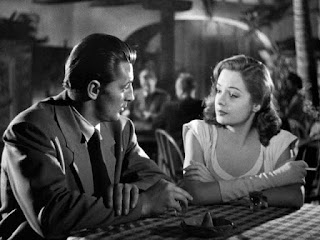
Laraine Day and Robert Mitchum

John Brahm (1893–1982), Born Hans Brahm in Hamburg, Germany, director John Brahm established himself as a master of moody, atmospheric psychological thrillers during the classic Hollywood era. Coming from a prominent theatrical family, he directed stage productions across Europe before fleeing the rise of the Nazi regime in the 1930s. After a brief filmmaking stint in England, Brahm arrived in Hollywood, where his sharp eye for expressionistic lighting and tense, claustrophobic pacing found a perfect home at 20th Century-Fox and RKO. He is celebrated for directing a trio of stylish, macabre melodramas in the mid-1940s—The Lodger (1944), Hangover Square (1945), and The Locket (1946)—before successfully transitioning to television in the 1950s and 1960s, where he directed memorable, atmospheric episodes of The Twilight Zone and Alfred Hitchcock Presents.

Laraine Day (1920 – 2007), born LaRaine Johnson in Roosevelt, Utah, was a versatile leading lady whose wholesome beauty and sharp acting instincts made her a major contract star at MGM and RKO. She first achieved widespread popularity as the dedicated Nurse Mary Lamont in MGM's beloved, long-running Dr. Kildare film series opposite Lew Ayres. Eager to break out of purely ingenue roles, Day delivered standout dramatic performances in Alfred Hitchcock’s Foreign Correspondent (1940) and the psychological noir The Locket (1946), where she brilliantly played against type as a complex, deceptive kleptomaniac. Off-screen, she was famously dubbed the “First Lady of Baseball” during her high-profile marriage to prominent New York Giants manager Leo Durocher, and she remained a beloved Hollywood figure through her extensive television appearances and humanitarian work.

Brian Aherne (1902 – 1986) born William Brian de Lacy Aherne in King's Norton, Worcestershire, England, Brian Aherne brought a dashing, aristocratic charm and impeccable stage diction to classical Hollywood cinema. After establishing himself as a formidable stage actor on the West End and Broadway—frequently starring opposite Katharine Cornell—Aherne transitioned effortlessly into American talkies, often playing refined, honorable gentlemen, romantic leads, and intellectual figures. He earned an Academy Award nomination for Best Supporting Actor for his regal portrayal of Emperor Maximilian in Juarez (1939) and showcased his sophisticated dramatic range as the concerned, analytical psychiatrist Dr. Blair in The Locket (1946). Aherne divided his later career between elegant character roles in Hollywood and a return to the theatrical stage, notably touring extensively in My Fair Lady as Professor Henry Higgins.

Robert Mitchum (1917 – 1997), born in Bridgeport, Connecticut, rose from a rugged, nomadic youth during the Great Depression to become one of Hollywood's most enduring icons and the definitive face of film noir. With his distinctively heavy-lidded eyes, casual swagger, and laconic, deadpan delivery, Mitchum projected a unique brand of cynical, effortless masculinity. He earned his sole Academy Award nomination for The Story of G.I. Joe (1945), which catapulted him into top-tier stardom just before he filmed his vulnerable role as the tragic artist Norman Clyde in The Locket (1946). Mitchum went on to cement his legendary status in timeless noir masterpieces like Out of the Past (1947) and delivered chilling, unforgettable performances as terrifying villains in The Night of the Hunter (1955) and Cape Fear (1962), sustaining a prolific acting career that spanned over five decades.

Gene Raymond (1908 – 1998), born Raymond Guion in New York City, was a charismatic, platinum-blonde actor, director, and producer who enjoyed a multifaceted career across stage, screen, and military service. A prolific child actor on Broadway, Raymond transitioned to Hollywood in the early 1930s, where his athletic build and sunny charm made him a popular romantic lead in glossy musicals and light comedies, famously starring alongside Dolores del Río in Flying Down to Rio (1933). During World War II, he paused his thriving entertainment career to serve as a decorated bomber pilot in the U.S. Army Air Forces, later returning to Hollywood to take on more mature, dramatic roles, such as the wealthy, unsuspecting bridegroom John Willis in The Locket (1946). Raymond, who was married to Hollywood superstar Jeanette MacDonald for nearly three decades, spent his later years directing for television, producing theater, and rising to the rank of Colonel in the Air Force Reserve.


Click HERE to watch the movie online.

Click HERE to join the online discussion on July 1, 2026, at 6:30 p.m. Central Time. Once you RSVP, you will receive an invitation with a link to join the discussion on Zoom. 

The Locket Trivia

  • Screenwriter Sheridan Gibney originally structured the script’s intricate, four-layer-deep flashback sequence as a bold narrative experiment. Still, RKO studio executives initially panicked and feared that mainstream theater audiences in 1946 would find the story completely impossible to follow.
  • Cinematographer Nicholas Musuraca utilized heavily diffused lighting and delicate compositions for Laraine Day’s close-ups to emphasize her character’s outward innocence, deliberately contrasting her angelic appearance with the dark, moody shadows cast over her male co-stars.
  • This film marked one of Robert Mitchum’s final performances before his definitive breakthrough into elite Hollywood stardom later that same year, showcasing an atypical, sensitive vulnerability as the tortured artist Norman Clyde just prior to cementing his cynical, tough-guy noir persona.
  • The striking psychological paintings featured in Norman Clyde’s art studio were actually created by prominent real-life artists hired by RKO to give the production an authentic, sophisticated bohemian aesthetic that reflected the avant-garde art scene of the post-war era.

Discussion Questions

  1. How does the film’s highly unusual nesting-doll flashback structure affect our perception of narrative truth, considering that we are viewing Nancy’s life entirely through a chain of subjective memories recounted by the men who loved her?
  2. In what ways does the film challenge the traditional definition of a film noir femme fatale by framing Nancy’s destructive behavior as a compulsory psychological illness rooted in childhood trauma rather than pure, calculated malice?
  3. Consider the symbolic weight of the locket itself, exploring how a single physical object functions simultaneously as a token of romantic affection, a trigger for childhood shame, and a manifestation of social class envy.
  4. Does the film imply that the men in Nancy’s life are genuinely trying to save her, or are they trapped by their own obsessions with controlling, diagnosing, and capturing her elusive image on canvas and in marriage?

Tuesday, May 19, 2026

Shadow of Suspicion: Out of the Foxhole and Into the Noir Light with “Crossfire”

Directed by Edward Dmytryk, Crossfire (1947) opens in the shadows of a dimly lit Washington, D.C. apartment, where a Jewish civilian named Joseph Samuels is beaten to death. Police Captain Finlay (Robert Young) is assigned to investigate the seemingly motiveless crime and quickly zeroes in on a group of demobilized, world-weary U.S. Army soldiers who were seen drinking with Samuels earlier that evening. Among them is Corporal Keeley (Robert Mitchum), a cynical but level-headed soldier who realizes the prime suspect is his sensitive friend, Mitch Mitchell. Terrified and confused, Mitch has vanished into the city’s neon-lit nightlife, crossing paths with a disillusioned dance hall hostess named Ginny Tremaine (Gloria Grahame) while Keeley desperately tries to find him before the police do.

As Captain Finlay digs deeper, the narrative shifts focus to Montgomery (Robert Ryan), another sergeant in the squad whose outward bravado masks a deeply virulent, simmering anti-Semitism. Through tense interrogations and shifting flashbacks, it becomes clear to both Finlay and Keeley that Montgomery is the true killer, having murdered Samuels out of pure, unadulterated bigotry and subsequently framing the vulnerable Mitch. 

Recognizing that he lacks the hard physical evidence to secure a conviction, Captain Finlay devises a clever psychological trap to expose the killer. Utilizing the assistance of Keeley and a southern soldier named Leroy, Finlay exploits Montgomery's intense hatred and deep-seated paranoia, baiting him into a midnight confrontation where he inadvertently reveals his guilt. Striking for its gritty chiaroscuro cinematography and bold social commentary, Crossfire stands out as a landmark film noir, confronting the poison of domestic prejudice in the immediate aftermath of World War II.


Edward Dmytryk (1908–1999) was a masterful filmmaker whose career embodied both the artistic heights and the political tragedies of mid-century Hollywood. Born in Canada to Ukrainian immigrants and raised in San Francisco, Dmytryk rose through the studio ranks from a teenage messenger boy to a premier director, helping to pioneer the gritty visual style of film noir with classics like Murder, My Sweet (1944) and the Oscar-nominated Crossfire (1947). His momentum was shattered in 1947 when he was jailed as one of the Hollywood Ten for refusing to cooperate with the House Un-American Activities Committee. After a period of exile and blacklisting, Dmytryk made the controversial decision to return and testify as a cooperating witness in 1951—a choice that allowed him to resume his career and direct major post-war successes like The Caine Mutiny (1954), but fractured his relationships within the film community for the rest of his life.

Robert Young (1907–1998) was a remarkably versatile actor whose career seamlessly transitioned from the glamorous studio system of classic Hollywood to the golden age of American television. Born in Chicago, Young signed with MGM in the early 1930s and spent two decades establishing himself as the quintessential, dependable leading man in over one hundred films, expertly navigating light comedies, romances, and occasional dramatic departures like his sharp, steady performance as Captain Finlay in the landmark film noir Crossfire (1947). In the 1950s, he achieved a new level of cultural icon status by pivoting to television, capturing the mid-century American zeitgeist as the patriarchal ideal Jim Anderson in Father Knows Best and later winning a new generation of fans as the compassionate, wise protagonist of Marcus Welby, M.D.—a rare, decades-long trajectory that earned him three Emmy Awards and cemented his legacy as one of the most comforting and enduring faces in entertainment history.

Robert Mitchum (1917–1997) was an iconic, effortlessly magnetic actor whose heavy-lidded gaze and rugged underplay defined the soul of American film noir. Born in Bridgeport, Connecticut, Mitchum lived a transient, rebellious youth during the Great Depression before drifting into acting, capturing an early Oscar nomination for The Story of G.I. Joe (1945) and quickly cementing his star status with a string of brooding, cynical performances in masterpieces like Crossfire (1947) and Out of the Past (1947). Even a highly publicized 1948 marijuana arrest—which would have destroyed a conventional career—only enhanced his authentic, dangerous anti-hero persona, endearing him further to a captivated public. Known for his laconic, self-deprecating attitude toward his craft, Mitchum possessed a vast dramatic range that allowed him to effortlessly transition from playing the laconic hero to embodying pure, bone-chilling villainy in classics like The Night of the Hunter (1955) and Cape Fear (1962), leaving behind a monumental legacy as one of the most uniquely subversive and enduring icons of classic cinema.

Robert Ryan (1909–1973) was a towering, exceptionally gifted actor whose onscreen specialty in playing deeply troubled, volatile, and bigoted characters stood in stark contrast to his real life as a deeply progressive pacifist and civil rights advocate. Born in Chicago, Ryan was an Ivy League boxing champion at Dartmouth before finding his way to Hollywood, where his breakout, Oscar-nominated performance as the fiercely anti-Semitic killer Montgomery in Crossfire (1947) permanently established him as one of the definitive faces of film noir. His imposing physical presence and intense, expressive eyes allowed him to bring profound psychological nuance to complex anti-heroes and menacing villains alike, anchoring masterpieces such as the visceral boxing drama The Set-Up (1949), On Dangerous Ground (1951), and Western classics like The Wild Bunch (1969).


Mitchum, Ryan, and Young

Crossfire trivia

The Dynamics of the Three Roberts

Crossfire features a rare, powerhouse casting trivia note: three of its top-billed stars shared the same first name—Robert Young, Robert Mitchum, and Robert Ryan. While Mitchum and Ryan were already well on their way to becoming definitive icons of the film noir genre, Robert Young’s casting as the sharp, intuitive Captain Finlay was a major departure for him. At the time, audiences were accustomed to seeing Young play light, romantic leading men, making his transition into the cynical, rain-slicked world of postwar noir a pleasant surprise for critics.

A Bold Change from the Source Material

The film was adapted from the 1945 novel The Brick Foxhole, written by Richard Brooks (who would later become a celebrated director himself). In the original book, the murder victim was a homosexual man targeted by a group of soldiers. Because the strict Hollywood Production Code Administration (the Hays Office) absolutely forbade any explicit mention or depiction of homosexuality on screen, producer Adrian Scott and screenwriter John Paxton cleverly pivoted the story's focus to anti-Semitism, managing to keep the book's vital themes of prejudice and systemic hate intact.

A Record-Breaking, Low-Budget Rush

RKO Radio Pictures was working on a shoestring B-movie budget for Crossfire and kept the shooting schedule to a remarkably tight 20 to 22 days. Executive producer Dore Schary rushed the film into production for a very specific strategic reason: he knew that rival studio 20th Century Fox was currently filming Gentleman’s Agreement, another high-profile project tackling anti-Semitism. By cutting corners on the budget and shooting with intense speed, RKO managed to beat Fox to the theaters by several months, securing Crossfire’s place as the first major postwar studio film to directly confront domestic bigotry.

Real-Life Boxing Chops

In the film, Robert Ryan plays the terrifyingly aggressive bully Montgomery, but in real life, his tough physical presence was backed up by legitimate athletic credentials. While attending Dartmouth College in the late 1920s and early 1930s, Ryan was an elite heavyweight boxing champion, holding the school's title for four consecutive years. He would later put those exact real-world boxing skills to brilliant use on screen in another legendary RKO film noir, playing the aging, courageous prize fighter Bill “Stoker” Thompson in The Set-Up (1949).


Click HERE to watch the movie on the Internet Archive.

Click HERE to join the online discussion on May 25, 2026, at 6:30 p.m. Central Time. Once you RSVP, you will receive an invitation and a link to join the discussion on Zoom.


Discussion questions

The Mask of Bigotry and the Three Roberts

Robert Ryan plays the fiercely anti-Semitic Montgomery as an intense, volatile bully, while Robert Mitchum and Robert Young provide a calm, rational, and steady counterweight. How does the film contrast these different masculine archetypes of the postwar era? In what ways does Montgomery’s aggressive bravado reveal his own deep-seated insecurities, and how do Keeley and Finlay represent a different path forward for returning veterans?

Adaptation and the Limitations of the Code

How well does the film pivot to addressing anti-Semitism, and do you feel the dialogue addresses the prejudice directly enough for a 1947 audience?

Noir Aesthetics vs. Social Commentary

Crossfire is highly celebrated for its classic film noir style—featuring deep chiaroscuro shadows, rain-slicked streets, and a cynical, world-weary tone. However, it is also a deliberate message movie aimed at social justice. Do the dark, pessimistic visual tropes of film noir conflict with the movie’s ultimate plea for tolerance and democratic ideals, or does the gritty atmosphere actually make the social commentary feel more grounded and urgent?

The Irony of the Blacklist

The film stands as a bold, cinematic plea for tolerance and systemic justice, yet its release coincided exactly with the rise of the Hollywood blacklist, leading to the direct targeting of its director (Edward Dmytryk) and producer (Adrian Scott) by HUAC. When viewing the film today, how does knowing the real-world political fallout for its creators alter your perception of its themes? Is there a tragic irony in the fact that a film exposing domestic paranoia and persecution was immediately followed by a real-world political witch hunt?


Monday, April 27, 2026

“Not as a Stranger”: The Clinical Arrogance and Human Fallibility of Lucas Marsh

Not as a Stranger (1955), which marked the directorial debut of Stanley Kramer, centers on Lucas Marsh, a brilliant but cold and fiercely ambitious medical student who views the profession of medicine with near-religious fervor. Lacking the funds to finish his schooling, Lucas enters into a calculated, loveless marriage with Kristina Hedvigson, an older, dedicated nurse who has saved enough money to subsidize his education. While Kristina is genuinely devoted to Lucas and his dreams, he views her primarily as a means to an end, remaining emotionally distant and intolerant of any human frailty—both in his personal life and in the medical field.

After graduation, Lucas moves with Kristina to a small town to begin his practice under the mentorship of Dr. Dave Benson. Under Kramer's direction—known for tackling heavy social and ethical themes—the film highlights Lucas's peerless technical skills alongside a non-existent bedside manner; he views his patients as clinical puzzles to be solved rather than human beings to be comforted. His rigid idealism leads to frequent clashes with his colleagues, particularly when he refuses to forgive minor mistakes of others, believing that a doctor must be an infallible figure. This arrogance creates a widening chasm between him and the local medical community, as well as his increasingly alienated wife.

The tension in Lucas’s life reaches a breaking point when he begins a reckless affair with Harriet Lang, a wealthy socialite who represents the luxury he previously lacked. As his marriage to Kristina nears collapse, his professional world begins to crumble. Kramer emphasizes the protagonist's internal struggle as Lucas is forced to confront the reality that he cannot control every variable of life and death, and his obsession with perfection starts to isolate him from the very people who have supported his rise.


Stanley Kramer (1913–2001) was a formidable American filmmaker and producer who became known as Hollywood’s Conscience for his unwavering commitment to “message films” that tackled provocative social and ethical issues. After establishing himself as a successful independent producer with hits like High Noon (1952) and The Caine Mutiny (1954), he transitioned into directing, where he utilized the screen to explore themes of racism, nuclear war, and judicial integrity. His directorial body of work includes landmark classics such as The Defiant Ones (1958), Inherit the Wind (1960), Judgment at Nuremberg (1961), and Guess Who's Coming to Dinner (1967). Over a career that spanned more than three decades, Kramer earned nine Academy Award nominations and received the prestigious Irving G. Thalberg Memorial Award in 1961, leaving behind a legacy as a visionary who prioritized intellectual substance and moral inquiry in mainstream cinema.

Olivia de Havilland (1916–2020) was a legendary Anglo-American actress whose career spanned seven decades and earned her a reputation as one of the last great stars of the Golden Age of Hollywood. Initially rising to fame as the quintessential leading lady opposite Errol Flynn in sweeping adventures like The Adventures of Robin Hood (1938), she achieved cinematic immortality as the gentle Melanie Hamilton in Gone with the Wind (1939). Beyond her on-screen grace, she became a pivotal figure in industry history by successfully challenging the restrictive studio contract system in the landmark “De Havilland Decision,” which granted actors greater professional freedom. This newfound independence allowed her to pursue complex, psychologically demanding roles that showcased her immense range, leading to two Academy Awards for Best Actress for her performances in To Each His Own (1946) and The Heiress (1949). Her legacy is defined by a rare combination of elegant poise and fierce resilience, leaving behind a body of work that remains a cornerstone of classic cinema.

Robert Mitchum (1917–1997) was a towering figure of American cinema whose laconic delivery and sleepy-eyed gaze made him the quintessential anti-hero of the film noir era. Rising to stardom with an Academy Award-nominated performance in The Story of G.I. Joe (1945), he became the definitive face of Noir through cynical, hard-boiled classics such as Out of the Past (1947) and The Night of the Hunter (1955), where he portrayed one of the screen’s most terrifying villains. Despite a rebellious public persona and a highly publicized legal brush with the law, Mitchum’s understated masculinity and effortless screen presence allowed him to transition seamlessly into Westerns and war epics, including The Enemy Below (1957) and The Longest Day (1962). Over a prolific career that spanned five decades, he remained a remarkably versatile performer, ultimately earning his place as a legendary icon whose cool, unbothered exterior masked a profound and enduring technical mastery of his craft.

Frank Sinatra (1915–1998) was an incomparable titan of American entertainment whose dual mastery of song and screen transformed him into a definitive cultural icon of the 20th century. After skyrocketing to fame as a “bobby-soxer” idol in the 1940s, he orchestrated one of the most dramatic career comebacks in Hollywood history, winning an Academy Award for his gritty performance in From Here to Eternity (1953). This resurgence ushered in a period of remarkable cinematic versatility, where he excelled in tense noir thrillers like The Manchurian Candidate (1962), hard-hitting dramas such as The Man with the Golden Arm (1955), and vibrant musicals. Beyond his “Chairman of the Board” persona and legendary status as a recording artist, Sinatra’s naturalistic acting style and magnetic presence allowed him to command the screen with both vulnerability and swagger. Throughout a storied career that spanned over sixty years, he remained a formidable force in the industry, leaving an indelible mark on the Great American Songbook and the annals of classic cinema.


Click HERE to watch the movie on the Internet Archive.

Click HERE to join the online discussion on May 11, 2026, at 6:30 p.m. Central Time. Once you RSVP, you will receive an invitation and a link to join the discussion on Zoom.


Not as a Stranger trivia

A High-Stakes Directorial Debut

Although he was already a powerhouse producer behind classics like High Noon, Not as a Stranger marked the directorial debut of Stanley Kramer. He chose a massive, best-selling medical novel for his first time behind the camera, signaling his intent to move away from purely producing and toward a hands-on role in shaping complex, character-driven narratives.

Clinical Realism and The Heart

In a pursuit of absolute authenticity, Kramer required the cast to observe actual medical procedures. During the filming of the climactic open-heart surgery, the production used footage of a real heart surgery interspersed with shots of the actors. This graphic realism was quite jarring for 1955 audiences and added a visceral intensity to the film's emotional turning point.

Star-Studded Friction

The production was famously tense due to the differing temperaments of its leads. The disciplined and classically trained Olivia de Havilland reportedly found it difficult to work with the more casual, improvisational styles of Robert Mitchum and Frank Sinatra. Sinatra, in particular, was known for his "one-take" preference, which often clashed with the meticulous needs of a first-time director and his more traditional co-stars.

Box Office Triumph

Despite the mixed critical reception regarding its length and heavy-handed tone, the film was a massive financial success. It became one of the highest-grossing films of 1955, proving that the combination of Robert Mitchum's rugged star power and the public's fascination with medical dramas was a winning formula at the domestic box office.


Discussion questions

The Ethics of Ambition

Lucas Marsh enters into a marriage with Kristina primarily to fund his medical education. Does his genuine priesthood of devotion to saving lives justify his cold exploitation of Kristina’s emotions and savings? At what point does professional dedication cross the line into moral bankruptcy?

Infallibility vs. Humanity

Lucas views doctors as god-like figures who must be perfect, leading him to hold his colleagues to impossible standards. How does the film’s climax—where Lucas finally faces his own professional failure—change his definition of what a good doctor is? Is a doctor who acknowledges their own humanity more effective than one who strives for technical perfection?

The Casting Paradox

The film features three of Hollywood’s most magnetic stars: Robert Mitchum, Olivia de Havilland, and Frank Sinatra. Given their established screen personas, how does their casting influence your perception of the characters? For instance, does Mitchum’s natural cool make Lucas more sympathetic, or does it make his clinical detachment feel more calculated?

Directorial Perspective

As Stanley Kramer’s directorial debut, the film emphasizes stark realism, including actual surgical footage. How does this clinical, almost documentary-style approach to the medical scenes contrast with the highly stylized, melodramatic elements of the Harriet Lang affair? Does this contrast help or hinder the film’s overall message?


Tuesday, October 7, 2025

Robert Mitchum, Barbara Bel Geddes, and Robert Preston star in “Blood on the Moon”

A classic “noir Western,” Blood on the Moon (1948) is an American Western noir directed by Robert Wise and starring Robert Preston, Barbara Bel Geddes, and Robert Preston. The supporting cast includes Walter Brennan, Frank Faylen, and Phyllis Thaxter.

The film centers on Jim Garry (Mitchum), a drifter and a hired hand. He’s called to a remote part of the American West by an old friend, Tate Riling (Preston), who’s involved in a dispute with a local cattle rancher. Initially, Garry agrees to take on a role in what he believes is a straightforward business deal, but he quickly discovers a complex web of deceit, betrayal, and violence.

The film’s plot thickens as Garry becomes entangled in the conflict between the cattleman and a group of homesteaders. The rancher's spirited daughter, Amy Lufton (Bel Geddes), immediately distrusts Garry, suspecting he’s on the side of her family’s enemies. As Garry begins to question his friend’s true intentions and the morality of his own involvement, he finds himself caught between opposing sides, each with their own secrets and hidden agendas. He learns that the stakes are much higher than he first believed and that he’s a pawn in a much larger, more dangerous game.

Torn between loyalty to his past and a growing sense of justice, Garry must navigate a treacherous landscape of shifting allegiances and constant danger. His journey to uncover the truth and choose a side forces him to confront his own cynical nature and determine where his true loyalties lie.


Blood on the Moon trivia

  • After seeing the film, Howard Hughes canceled Barbara Bel Geddes’s contract. He said she wasn’t sexy enough.
  • For the night scenes, director Robert Wise and cinematographer Nicholas Musuraca chose to use infrared film, despite the problems it could cause with the tones of clothes and makeup.
  • According to some pre-production press, James Stewart was set to star in the Mitchum role.
  • Walter Brennan thought Robert Mitchum looked like an authentic cowboy.


Click HERE to watch the film on the Internet Archive.

Click HERE to join the online discussion on Monday October 13, 2025, at 6:30 p.m. Central Time. Once you RSVP, you will receive an invitation with a link to join the discussion on Zoom.

Discussion questions

  1. Noir Western or Traditional Western? Blood on the Moon is often called a “Noir Western.” What elements of film noir does it incorporate? Do you think the film ultimately adheres more to the conventions of film noir or the traditional Western genre?
  2. The Morality of Jim Garry: At the start of the film, Jim Garry is a hired hand, a man for hire with no clear moral compass. How does his character evolve throughout the film? What events or interactions, particularly with Amy Lufton, lead to his shift from a cynical opportunist to a man of principle?
  3. Trust and Betrayal: The film’s plot is driven by a complex web of deceit. Discuss the theme of trust as it applies to the relationships between Jim Garry and Tate Riling, Jim and Amy, and even Amy and her father. In this world, who can be trusted, and why?
  4. Symbolism of the Setting: The film’s desolate, rugged landscapes serve as more than just a backdrop. How does the setting—the canyons, the isolated ranches, the moonlit nights—reflect or enhance the film’s themes of moral ambiguity, isolation, and conflict?


Tuesday, May 30, 2023

Robert Mitchum, Shelly Winters, and Lillian Gish star in "The Night of the Hunter"

The Night of the Hunter (1955) is an American thriller directed by Charles Laughton and starring Robert Mitchum, Shelly Winters, and Lillian Gish.
 
The supporting cast includes James Gleason, Evelyn Varden, Billy Chapin, Sally Jane Bruce, and Peter Graves. The screenplay was written by James Agee based on the novel (1953) of the same name by Davis Grub. The cinematography was by Stanley Cortez (The Magnificent Ambersons, Since You Went Away, and The Three Faces of Eve).

The Reverend Harry Powell (Mitchum) is arrested for driving a stolen car. In jail, he shares a cell with Ben Harper (Graves) who killed two men in a bank robbery. He stole $10,000 and made his children never reveal where he hid the money. Harper is hanged for the murders and the secret dies with him.

When Powell is released from jail, he visits Harper’s hometown, where he romances Harper’s widow, Willa (Winters), and marries her, all in an attempt to find the money that Ben had hidden. John Harper (Chapin) is suspicious of Powell from the start and wants nothing to do with him, while his younger sister, Pearl (Bruce) is attracted to him as a replacement for her father.

Will Powell be successful in finding the stolen money? And what will become of the children?


Charles Laughton (1899 – 1962) had a long career on the stage and in Hollywood. He won an Academy Award for Best Actor for his portrayal of Henry VIII in The Private Life of Henry VIII (1933) and was nominated for two other Best Actor Oscars for his performances in Mutiny on the Bounty (1933) and Witness for the Prosecution (1957). His performance in The Suspect is considered one of Laughton’s most natural screen performances, which is credited to director Robert Siodmak, a close personal friend of the actor. The Night of the Hunter is the only film Laughton directed.

Robert Mitchum (1917 - 1997) was an American film actor, director, and singer. His breakthrough came in The Story of G.I. Joe (1945) for which he was nominated for a Best Supporting Actor Academy Award. He later starred in the film noir classic Out of the Past (1947) Crossfire (1947), Rachel and the Stranger (1948), River of No Return (1954) The Night of the Hunter (1955) Heaven Knows, Mr. Allison (1957), Home from the Hill (1960), Cape Fear (1962), and Ryan's Daughter (1970). Mitchum would remain busy until the late nineties. Mitchum is rated number 23 on the American Film Institute's list of the greatest male stars of classic American cinema.

Shelley Winters (1920 - 2006) was an American actress whose career in film began in 1943 and continued into the 2000s. Some of Winters’s film roles include A Double Life (1947), The Great Gatsby (1948), Winchester 73 (1950), and A Place in the Sun (1951) for which she was nominated for a Best Actress Academy Award. Winters was in demand throughout the 1950s having four films in release in 1955 including Night of the Hunter. She won a Best Supporting Actress Academy Award for The Diary of Anne Frank (1959). She won her second Best Supporting Actress Oscar for her performance in A Patch of Blue (1965). Besides her film work, Winters starred on Broadway and was a frequent guest star on popular television series and made-for-TV movies.

Lillian Gish (1893 – 1993) was an American actress; her career spanned 75 years. Gish was a major movie star during the silent film era. She was called the “First Lady of American Cinema” because she is credited with developing film acting techniques when the medium was in its infancy. She had a close professional relationship with director D.W. Griffith who directed her in some of the most famous films from the silent era including The Birth of a Nation (1915), Broken Blossoms (1915), and Orphans of the Storm (1921). With the advent of sound, Gish performed on the stage and occasionally appeared in film roles. Gish’s last film appearance was in The Whales of August (1987) co-starring Bette Davis, Vincent Price, and Ann Sothern.


The Night of the Hunter trivia

  • Later in his career, Robert Mitchum said that Charles Laughton was his favorite director.
  • The novel and film are partially based on the life of serial killer Harry Powers (1893 - 1932).
  • Elsa Lanchester suggested the casting of Lillian Gish in the role of Rachel Cooper.
  • Shelly Winters said of her performance that it was “the most thoughtful and reserved performance I ever gave.”
  • Charles Laughton’s first choices for the film’s male and female leads were Gary Cooper and Betty Grable but both turned it down.


To watch the movie on YouTube, click on the link below.


Discussion questions

  1. I categorized this film as a thriller. Do you agree with that category? How would you classify it?
  2. What did you think of the performances of the child actors? Did their performances seem natural and believable to you?
  3. Robert Mitchum’s character is one of the most diabolical in all of film. What did you think of his performance? Was it Oscar-worthy?
  4. Do you agree with Shelly Winter’s assessment of her performance?
  5. Would you recommend this film to a friend to watch?
  6. Lillian Gish is a legend among film actors. What did you think of her performance?


To join the discussion on June 5, 2023, 6:30 p.m. Central Time, click here. Once you RSVP, you will receive an invitation with a link to join the discussion on Zoom.

Tuesday, February 8, 2022

Lewis Milestones's production of John Steinbeck's "The Red Pony" brought to the screen

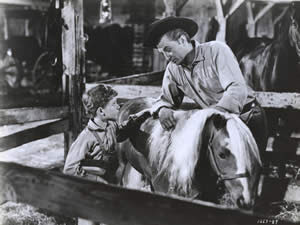
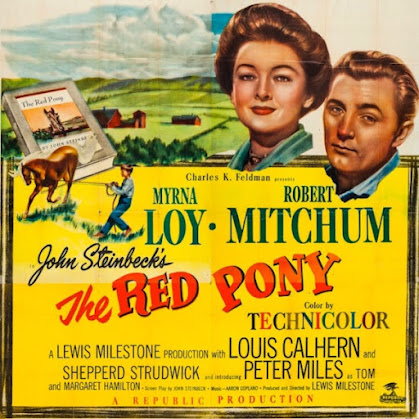
The Red Pony (1949) is a rural drama based on John Steinbeck's short story of the same name. The film was directed by Lewis Milestone and stars Myrna Loy and Robert Mitchum. Others in the cast include Shepperd Strudwick, Louis Calhern, Peter Miles, and Margaret Hamilton. The screenplay was written by Steinbeck with some changes, focusing on the chapters "The Gift" and "The Promise." The cinematography was by Tony Gaudio  (The Adventures of Robin Hood). The film score was written by Aaron Copland.

The plot focuses on Tom Tiflin (Miles) who is given a small pony by his father, Fred Tiflin (Strudwick). Tom learns how to take care of his pony with the help of hired hand Billy Buck (Mitchum), a man that Tom looks up to. They name the pony Gabilan. 

The colorful family also includes Fred's father-in-law (Calhern) who is always telling stories about the old days when he led a wagon train across the country during the pioneer days. Fred finds his stories annoying but his wife, Alice (Loy) finds her father's eccentricities entertaining.

A crisis arises that threatens to destroy Tom's relationship with Billy. Will the two be able to work through the crisis and keep their friendship?

Peter Miles and Robert Mitchum

Lewis Milestone (1895 – 1980) was a Russian-born American film director. He is a two-time Academy Award-winner for Best Director: Two Arabian Knights (1927) and All Quiet on the Western Front (1930). Other notable films directed by Milestone include The Front Page (1931), Of Mice and Men (1939), A Walk in the Sun (1945), Les Miserables (1952), and Ocean’s 11 (1960).

Myrna Loy (1905 - 1993) was an American film, television, and stage actress. Loy was a trained dancer but decided to concentrate on acting, appearing in silent films before becoming a major star with the advent of sound. Perhaps Loy is most famous for playing Nora Charles opposite William Powell in The Thin Man (1934) and its subsequent sequels. Loy and Powell were one of the screen’s most popular acting teams; they appeared in 14 films together. Loy starred opposite the top leading men of the day including Clark Gable, Spencer Tracy, Tyrone Power, and Cary Grant. Some of her films include Wife vs. Secretary (1936), Libeled Lady (1936), The Great Ziegfeld (1936), Test Pilot (1938), Too Hot to Handle (1938), The Rains Came (1939), Love Crazy  (1941), The Bachelor and the Bobby-Soxer (1947), and Mr. Blandings Builds His Dream House (1948). 

Robert Mitchum (1917 - 1997) was an American film actor, director, and singer. His breakthrough came in The Story of G.I. Joe (1945) for which he was nominated for a Best Supporting Actor Academy Award. He later starred in the film noir classic Out of the Past (1947) Crossfire (1947), Rachel and the Stranger (1948), River of No Return (1954) The Night of the Hunter (1955) Heaven Knows, Mr. Allison (1957), Home from the Hill (1960), Cape Fear (1962), and Ryan's Daughter (1970). Mitchum would remain busy until the late-nineties. Mitchum is rated number 23 on the American Film Institute's list of the greatest male stars of classic American cinema.

The Red Pony trivia
  • The film shoot took 81 days, which was the longest and costliest for Republic Pictures.
  • This was the first color film directed by Lewis Milestone.
  • It was made in 1947 before Robert Mitchum became a big star with Out of the Past.
  • Beau Bridges plays a boy named Beau; this was his third film appearance at age 7.

To watch the film on YouTube, click on the link below.


Discussion questions:
  1. What did you think of Tom Tiflin as played by Peter Miles? Was he believable as a farm boy?
  2. Was the relationship between Tom and Billy Buck believable? Why do you think Tom was attracted to Bill?
  3. What did you think of the relationship between Alice and Frank?
  4. Did you like the character of the grandfather?
  5. Was there a theme to this film? If so, what was it?
  6. Did The Red Pony remind you of any other films you've seen?

To join the discussion on February 14, 2022, at 6:30 p.m. Central Time, click here. Once you RSVP, you will receive an invitation and link to join the discussion on Zoom.


Thursday, January 27, 2022

10 Things You May Not Know About Robert Mitchum

Robert Mitchum (1917 - 1997) was the original movie bad boy. When he entered the movies, his easy-going naturalistic acting style kept him starring in movies for five decades. Discover how much, or how little you know about this movie legend.

Studio portrait of Robert Mitchum

1. Mitchum's older sister, Julie, persuaded him to join her at The Players Guild of Long Beach, a local theater guild. He worked as a stagehand and bit player.

2. He worked as a machine operator for Lockheed Aircraft Corporation during World War II. He had to quick due to the damage the loud machinery did to his hearing.

3. Mitchum tried acting again and was cast in the Hopalong Cassidy (1942 - 1943) film series in various minor roles as villains and bad guys.

4. Under contract to RKO, Mitchum starred in B-Westerns based on the novels of Zane Grey. He gained prominence and fame when he was loaned out to United Artists for the film The Story of G. I. Joe (1945). For his performance in that film, he was nominated for the Academy Award for Best Supporting Actor. It would be his only Academy Award nomination.

5. In the mid-1940s, Mitchum began to make his mark in film noir, earning supporting roles in When Strangers Marry (1944),  Undercurrent (1946), and The Locket  (1946). 

Robert Mitchum and Jane Greer in the film noir classic Out of the Past

6. His career got a boost with his co-starring role opposite Teresa Wright in Pursued (1946) directed by Raoul Walsh.  The next year, he became a film noir icon with his role in Out of the Past. 

7. In 1948, Mitchum was arrested with actress Lila Leeds for possession of marijuana. The arrest did not harm his career. In fact, the movies he made after his arrest were box office successes.

8. Mitchum hit his stride in the 1950s with starring roles in The River of No Return (1954), The Night of the Hunter (1955), Not as a Stranger (1955), and Heaven Knows, Mr. Allison (1956).

9. He made three films opposite Deborah Kerr: Heaven Knows, Mr. Allison, The Sundowners (1960), and The Grass is Greener (1960), which also starred Cary Grant and Jean Simmons, an actress who starred in three films with Mitchum.

10. The American Film Institute's 100 Years...100 Stars listed Mitchum as the 23rd-greatest male star from Hollywood's classic period.


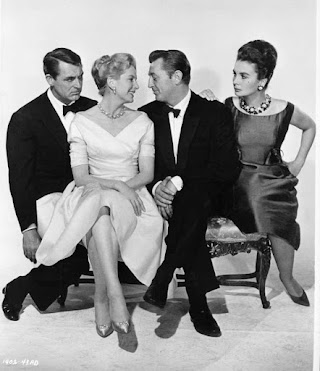
Cary Grant, Deborah Kerr, Mitchum, and Jean Simmons in The Grass is Greener

Tuesday, January 25, 2022

Teresa Wright and Robert Mitchum are "Pursued"

Pursued (1947) Is considered the first noir western, directed by Raoul Walsh and starring Teresa Wright and Robert Mitchum. The cinematography is by the legendary James Wong Howe and music by the equally legendary Max Steiner. Oscar-winning director Martin Scorsese counts Pursued as one of his favorite films.

Mitchum is Jeb Rand, a man haunted by traumatic events from his past that left him an orphan. Mrs. Callum (Judith Anderson) adopts him and raises him as her son with her natural children Adam (John Rodney) and Thorley (Wright). But there is tension in these relationships, and a man he doesn’t even know torments Jeb for reasons he doesn’t understand. 

Others in the cast include Dean Jagger and Alan Hale.

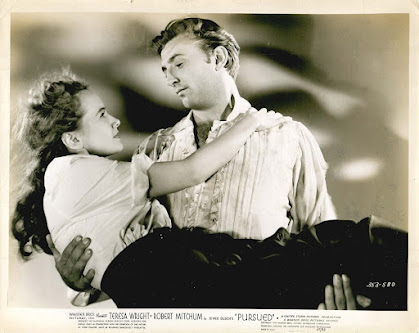
Publicity still of Teresa Wright and Robert Mitchum


Raoul Walsh (1887 - 1980) was an American director, actor, and founding member of The Academy of Motion Picture Arts and Sciences (AMPAS). Walsh got his start acting on the stage in New York. He eventually began acting in silent films and worked as an assistant director alongside D.W. Griffith. He eventually became a director on his own working with major silent-film stars Douglas Fairbanks, Gloria Swanson, and Anna May Wong. He lost his right eye in a freak accident in 1928 and never acted again, instead of focusing exclusively on directing. Some of his notable films include The Roaring Twenties (1939) starring James Cagney and Priscilla Lane, High Sierra (1941) starring Ida Lupino and Humphrey Bogart, The Strawberry Blonde (1941) starring Cagney and Olivia de Havilland, White Heat (1949) starring Cagney and Virginia Mayo, and Captian Horatio Hornblower (1951) starring Gregory Peck and Mayo.

Teresa Wright (1918 - 2005) was an American stage, film, and television actress. She received Academy Award nominations in her first three films, a record that still holds today. In 1942, she was nominated for Best Supporting Actress for Mrs. Miniver and for Best Actress in The Pride of the Yankees. She won the Supporting Oscar for Mrs. Miniver, her co-star, Greer Garson won Best Actress. Today Wright is most famous for playing Lou Gehrig’s wife in The Pride of the Yankees, The Best Years of Our Lives, and Alfred Hitchcock’s Shadow of a Doubt (1943). Wright was a popular star throughout the 1940s starring opposite Robert Mitchum, Ray Milland, Gary Cooper, and David Niven. She starred opposite Marlon Brando in his first film role in The Men (1950). Wright continued working in film, with her last role as Miss Birdie in The Rainmaker (1997). Wright is the only non-baseball player to be honored by the New York Yankees when she passed away at age 86. 

Robert Mitchum (1917 - 1997) was an American film actor, director, and singer. His breakthrough came in The Story of G.I. Joe (1945) for which he was nominated for a Best Supporting Actor Academy Award. He later starred in the film noir classic Out of the Past (1947) Crossfire (1947), Rachel and the Stranger (1948), River of No Return (1954) The Night of the Hunter (1955) Heaven Knows, Mr. Allison (1957), Home from the Hill (1960), Cape Fear (1962), and Ryan's Daughter (1970). Mitchum would remain busy until the late-nineties. Mitchum is rated number 23 on the American Film Institute's list of the greatest male stars of classic American cinema.


Pursued trivia

  • When the film was released, Teresa Wright was #6 at the box office.
  • Charles Bates who plays Adam Callum as an 11-year-old boy played Teresa Wright's younger brother in Alfred Hitchcock's Shadow of a Doubt (1943).
  • The film was filmed in Gallup, New Mexico.
  • The screenplay was written by Niven Busch who was Teresa Wright's husband.
  • Niven Busch also wrote the novel Duel in the Sun which was made into a hit western that was supposed to star Wright. Wright had to drop out due to pregnancy. Pursued was a consolation prize of sorts.
  • Producer Milton Sperling and his United States Pictures production company worked out a distribution deal with Warner Bros. It was a profitable deal for both.

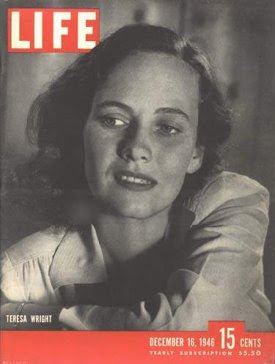
Teresa Wright was on the cover of Life magazine on December 16, 1946.


Why watch this film?

  1. The film features beautiful black and white cinematography by James Wong Howe.
  2. It's an opportunity to see Robert Mitchum in an early lead role.
  3. It's considered the first film noir western, directed by a legend of the Classic Hollywood period.
  4. The film boasts a strong cast including top-billed Teresa Wright, Judith Anderson, and Dean Jagger.


To watch the film on YouTube, click the link below.


Discussion questions:
  1. Do you think a western could be classified as a film noir?
  2. Freud and psychological dramas were all the rage in the 1940s. Does Pursued work as a psychological western?
  3. What did you make of Jeb's relationship with his stepmother, stepbrother, and sister?
  4. Do you think the family dynamics would have been different had Jeb's true origins been known from the beginning?
  5. The scene when Jeb and Adam sing together is a pleasant one and suggests that togetherness and family love was possible or does it?
  6. Was there a performance that stood out to you?
  7. Did anything surprise you?
  8. Do you think the movie had a theme? If so, what do you think it was?
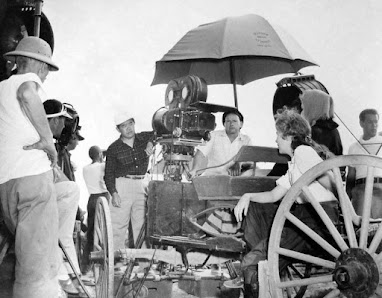
Teresa Wright on location with cinematographer James Wong Howe behind the camera

To join the discussion on January 31, 2022, at 6:30 p.m. Central Time, click here. Once you RSVP, you'll receive an invitation and a link to the discussion on Zoom.


Contemporary reviews for Pursued

Bosley Crowther in The New York Times said this about the film: "...And it is likewise hard to work up any sympathy for the hero, who seems bored by all his woes. That may be because Robert Mitchum, who plays the latter, is a very rigid gent and gives off no more animation than a Frigidaire turned to 'Defrost.'"*

Variety praised the film: "Pursued is potent frontier days Western film fare. Standout in picture is suspense generated by the original script and Raoul Walsh's direction. It builds the western gunman's death walk to high moments of thrill and action. Strong casting also is a decided factor in selling the action wares. Production makes use of natural outdoor backgrounds supplied by New Mexico scenery, lending air of authenticity that is fully captured by the camera."**

*New York Times, Crowther, Bosley, review March 8, 1947
**Variety magazine, Variety staff, review December 31, 1946

Tuesday, October 16, 2018

Screening of “Pursued” at Daystar Center October 29

Pursued (1947)
Where: Daystar Center, 1550 S. State Street, Room 102
When: October 29, 2018
Time: 6:45 p.m
Hosted by Stephen Reginald

Pursued (1947) is considered the first noir western, starring Teresa Wright and Robert Mitchum. Mitchum is Jeb, a man haunted by traumatic events from his past that left him an orphan. Mrs. Callum (Judith Anderson) adopts him and raises him as her son with her natural children Adam (John Rodney) and Thorley (Wright). But there is tension in these relationships, and a man he doesn’t even know torments Jeb for reasons he doesn’t understand.

Robert Mitchum and Teresa Wright
Directed by Raoul Walsh (White Heat), with photography by the legendary James Wong Howe and music by the equally legendary Max Steiner. Oscar-winning director Martin Scorsese counts "Pursued" as one of his favorite films and is responsible for its restoration.

General Admission: $5, Students and Senior Citizens: $3


Have some Joe and Enjoy the Show!
Before the movie, grab a cup of coffee from Overflow Coffee Bar, located within the Daystar Center. You can bring food and beverages into room 102.

Join the Chicago Film club; join the discussion
Twice a month we screen classic films and have a brief discussion afterward. For more information, including how to join (it’s free), click here. The Venue 1550 is easily accessible by the CTA. Please visit Transit Chicago for more information on transportation options.

Stephen Reginald is a freelance writer and editor. He has worked at various positions within the publishing industry for over 25 years. Most recently he was executive editor for McGraw-Hill’s The Learning Group Division. A long-time amateur student of film, Reginald hosts “Chicago Film Club,” a monthly movie event held in the South Loop, for the past two years. Reginald has also taught several adult education film classes at Facets Film School, Chicago.

Saturday, July 6, 2013

“Out of the Past”: 6th and Final Film in “High Heels and Fedoras” series at Daystar Center July 9, 2013

Tuesday, July 9, 2013
6:30 p.m.
The Venue 1550 at the Daystar Center
1550 S. State Street

Out of the Past (1947) is considered one of the best of the 1940s film noirs. In spite of the acclaim the film has received from critics, it’s not as well known as Double Indemnity (1944) or The Postman Always Rings Twice (1946), but it can easily hold its own next to those two classics.

Directed by Jacques Tourneur, Out of the Past showcases the director at the top of his game. Tourneur started out as a unit director working for David O. Selznick where he met fellow Selznick employee Val Lewton. Lewton worked on many of Selznick’s prestige productions including A Tale of Two Cities (1935) and Gone With The Wind (1939). The two became friends and when Lewton was put in charge of the newly formed horror unit at RKO, he convinced Tourneur to join him. Together they crafted some of the most famous and successful horror movies ever produced. Before the term film noir was coined, these horror films incorporated some of the elements that we have come to identify with the genre. In the three horror films Tourneur directed for Lewton, you see wonderful shadows, interesting camera angles, and creative use of sound to create a mood and stir the emotions.

Jane Greer and Robert Mitchum
Out of the Past gave Robert Mitchum one of his first important roles as a leading man. It also helped identify him as a movie tough guy, a reputation that would follow him for the rest of his career. This was also an important film for the leading lady, Jane Greer. Discovered by Howard Hughes, Greer was only 23 when the film was released. As femme fatales go, Greer is at the top of the heap. With her cool sensual beauty, it’s easy to see how she could handle a man like Mitchum.

Like many film noirs, a lot of the story is told in flashback. And like many noir plots, it does get complicated at times. Plot complexities aside, it’s the motivation of the characters that makes this film fascinating. The line between good and evil is a fine one in Out of the Past. As far as the direction goes, New York Times film critic Bosley Crowther noted Tourneur’s “smooth realistic style” in his November 26, 1947 review.

Jacques Tourneur directed the horror classic, Cat People 1942
The plot concerns Mitchum’s character Jeff Bailey, a former private eye trying to escape his questionable past. But the past catches up with him and he’s drawn back into a life he’d like to forget. Greer plays Kathie Moffet, a woman from Jeff’s past who is trying to break free of the clutches of her abusive boyfriend, Whit Sterling, convincingly played by Kirk Douglas in only his second film. Kathie, who earlier had an affair with Jeff, tries to manipulate him into helping her run away from Whit. Jeff, still attracted to Kathie allows himself to be manipulated, thinking he’s smart enough to come out okay. It’s this conceit that is his downfall.

Out of the Past features great performances paired with beautiful cinematography, snappy dialogue, and fluid direction. You’ll enjoy the ride; I guarantee it!

Check out the updated trailer below, featuring “Baby, Please Don’t Leave Me” by Chicago’s own, Buddy Guy.


If you love classic cinema, you should join the Chicago Film Club. It’s free to join. Come share your love of the movies; it’s fun!


The Daystar Center located at 1550 S. State St. works through a grassroots network of collaborations and partnerships with individuals and other nonprofit organizations. Through this web, they’re able to provide educational, cultural, and civic activities that enrich and empower their clients, guests, and community members. To learn more about classes and events offered at the Daystar Center, please visit their Web site.


Related Posts Plugin for WordPress, Blogger...