Showing posts with label RKO. Show all posts

Wednesday, November 18, 2020

Dorothy McGuire descends "The Spiral Staircase"

The Spiral Staircase (1946) is a psychological suspense film directed by Robert Siodmak starring Dorothy McGuire, George Brent, and Ethel Barrymore. Dore Schary produced the film; the screenplay was by Mel Dinelli, the music by Roy Webb, and the cinematography by Nicholas Musuraca.


The setting is a small New England town during the early 20th century terrorized by a serial killer targeting handicapped women. McGuire stars as Helen, a mute since childhood, after she witnessed her parents burn to death in a fire. She is employed by Mrs. Warren (Barrymore), who insists that Helen leave town because she fears she could be the killer’s next victim. Does Mrs. Warren know who the killer is? Mrs. Warren is a widow with two sons: Professor Albert Warren (Brent) and Steven Warren (Gordon Oliver). Albert is Mrs. Warren’s stepson, the son of her husband’s first marriage. Steven is her biological son.

Dorothy McGuire walks home in the dark.

All the action takes place during one day, which adds to the film’s increasing tension. The cast also features Kent Smith, Elsa Lanchester, Sara Allgood, and Rhonda Fleming.

Robert Siodmak (1900 – 1973) had a very successful career in Hollywood and is best known for his thrillers and films noir. He signed a seven-year contract with Universal and directed The Killers (1946), the film that made Ava Gardner a star. He worked with some of the top movie stars during Hollywood’s Golden Age, including Deanna Durbin, Gene Kelly, Burt Lancaster, Dorothy McGuire, Yvonne de Carlo, Olivia de Havilland, and Barbara Stanwyck. Often compared to Hitchcock in his prime, he never got the recognition that the Master of Suspense did, but most of his films hold up remarkably well and are worth watching.

Dore Schary (1905 – 1980) was an American screenwriter, producer, and studio executive. Schary was a journalist and acted in bit parts on Broadway. Schary wrote screenplays for all the major studios before becoming a film executive with David O. Selznick’s Vanguard Films where he oversaw the production of I’ll Be Seeing You (1944), The Farmer’s Daughter (1947), and The Bachelor and the Bobby-Soxer (1947). He moved on to the head of production for RKO where he produced Mr. Blandings Builds His Dream House (1948) and Crossfire (1948). Schary left RKO and went to M-G-M to be vice president in charge of production in 1948 and immediately clashed with studio head Louis B. Meyer. Things came to a head with Meyer resigning and Schary made the head of the studio. After a series of film flops, Schary was fired from M-G-M in 1957. Schary went on to have success writing and producing shows on Broadway including Sunrise at Campobello (1958-59). He went on to write and produce the film version to great success.

Mel Dinelli (1912 – 1991) was an American writer for theater, radio, and film. Dinelli wrote the screenplays for The Window (1949), The Reckless Moment (1949), Cause for Alarm! (1951), Beware, My Lovely (1952), Jeopardy (1953), and Lizzie (1957).

Roy Webb (1888 – 1982) was an American film music composer. Webb was born in New York City and conducted on Broadway before moving to Hollywood in the late 1920s where he became the music director at RKO where he stayed until 1955. He was nominated for seven Academy Awards for his film scores including scores for My Favorite Wife (1940), I Married a Witch (1942), and The Enchanted Cottage (1945). Other famous film scores include Notorious (1946), Out of the Past (1947), I Remember Mama (1948), and Teacher’s Pet (1958). A graduate of Columbia University, Webb wrote the fight song “Roar, Lion Roar” in 1925.

Nicholas Musuraca (1892 – 1975) was a cinematographer best known for his work at RKO where he helped establish their house style. Musuraca filmed producer Val Lewton’s famous horror film Cat People (1942) and the film noir classic Out of the Past (1947), and director George Stevens’s I Remember Mama (1948). Other movies he filmed include Deadline at Dawn (1946), The Locket (1946), and The Bachelor and the Bobby-Soxer (1947).

McGuire at the movies

Dorothy McGuire (1916 – 2001) was an American theater and film actress. McGuire developed an interest in acting at a young age. At 13, she made her stage debut in A Kiss for Cinderella in Omaha, Nebraska, her hometown. Henry Fonda, also from Omaha, was her costar. As an adult, she achieved fame on Broadway in Claudia”(1941 to 1943). In 1943, she starred in the film version with Robert Young that was a huge success. She reunited with Young for The Enchanted Cottage (1945) and replaced Gene Tierney in A Tree Grows in Brooklyn (1945). She was nominated for Best Actress in Gentleman’s Agreement (1947). Some of her other films include Three Coins in the Fountain (1954), Trial (1955), and Friendly Persuasion (1956). McGuire made several popular films for Walt Disney including Old Yeller (1957), Swiss Family Robinson (1960), and Summer Magic (1963).

George Brent (1904 – 1979) was an Irish-American stage, film, and television actor. Brent went to Hollywood in 1930 and appeared in supporting roles in several films. In 1931, he signed with Warner Bros. where he played opposite Barbara Stanwyck in So Big! (1932). That same year he co-starred with Stanwyck again in The Purchase Price. In 1933 he appeared in the musical classic 42nd Street, The Keyhole with Kay Francis and Stanwyck again in Baby Face. He made a string of pictures with Bette Davis: Jezebel (1938), Dark Victory (1939), The Old Maid (1939), The Great Lie (1941), and In This Our Life (1942). Brent continued acting in movies and television till 1978, a year before he died of emphysema.

Ethel Barrymore and McGuire

Ethel Barrymore (1879 – 1959) was an American actress whose career spanned more than six decades. She was the sister of actors John and Lionel Barrymore, the aunt of John Drew Barrymore, and the great-aunt of Drew Barrymore. Barrymore established herself as a major Broadway actress in the 1920s and appeared on the cover of Time magazine in 1924. Barrymore made 15 silent movies and appeared in the early talking picture Rasputin and the Empress (1932) with her brothers John and Lionel. She won an Academy Award for Best Supporting Actress for her role in None but the Lonely Heart (1944) co-starring Cary Grant. She was nominated for three more Best Supporting Actress Oscars for The Spiral Staircase (1946), The Paradine Case (1947), and Pinky (1949).

A cautious McGuire navigates The Spiral Staircase


The Spiral Staircase trivia:

  • Ingrid Bergman was originally considered for the role of Helen.
  • The Killer’s eyes are those of director Robert Siodmak.
  • The silent film being watched by Dorothy McGuire’s character is D.W. Griffith’s The Sands of Time (1922).
  • Included among the American Film Institute’s 2001 list of 400 movies nominated for the top 100 Most Heart-Pounding American Movies.


To watch the film on YouTube, click the link below.


To join us on Zoom for a discussion of the film on November 24, 2020, at 6:30 p.m. Central Time, click on the link to the Chicago Film Club.


Discussion questions:

  1. What genre category do you think this film fits? 
  2. Some have called it a horror film. Is that a fair assessment?
  3. What did you make of the dynamic between the two brothers?
  4. Did you wonder if Mrs. Warren knew who the murderer was?
  5. Was the romance between Helen and Dr. Parry believable?


Friday, April 28, 2017

Book review: “Jimmy and Fay: A Suspense Novel” with a classic movie backdrop

If you enjoy mystery novels and classic movies, Michael Mayo’s Jimmy and Fay may be right up your alley. Set when the 1933 version of King Kong is premiering at Radio City Music Hall, the novel concerns actress Fay Wray and blackmail. Blackmailers have some pictures of a lookalike in some compromising positions and they’re ready to send them to the press if the RKO movie studio doesn’t pay them off.

Enter Jimmy Quinn, the hero of The Jimmy Quinn Mysteries, a tough guy with a limp who operates a speakeasy in New York City. Quinn knows just about every crook and bad guy in the city so of course Wray comes to him for help. Quinn works his contacts to get to the blackmailers, but discovers an underground producer of stag films in Chinatown. Are the blackmailers and the underground filmmakers working together? And then there’s a goat—you have to read the book to understand!

Michael Mayo’s first-person narrative is smooth, easy reading. He has a good ear for authentic, film noir-style dialogue that fits in well with the plot. According the acknowledgments page, Jimmy and Fay is “fiction based on fact.” A year after she starred in King Kong, Wray was the victim of a extortion threat. The kind of threat Wray was subjected to in this novel was probably common during the days of Hollywood’s Golden Age. Fortunately for Wray, the studio was able to mitigate that real situation and successfully kept it out of the press.

Publicity photo of Fay Wray around the time of the release of King Kong

If you enjoy mysteries set against a historical fiction background, Jimmy and Fay may be the book (and series) for you.

Disclosure: I received a review copy of this novel from the publisher.


Series: Jimmy and Fay: A Suspense Novel (The Jimmy Quinn Mysteries)
Paperback: 250 pages
Publisher: MysteriousPress.com/Open Road (October 4, 2016)
Language: English
ISBN-10: 1504036077
ISBN-13: 978-1504036078
Product Dimensions: 5.2 x 0.6 x 8 inches

Wednesday, October 21, 2015

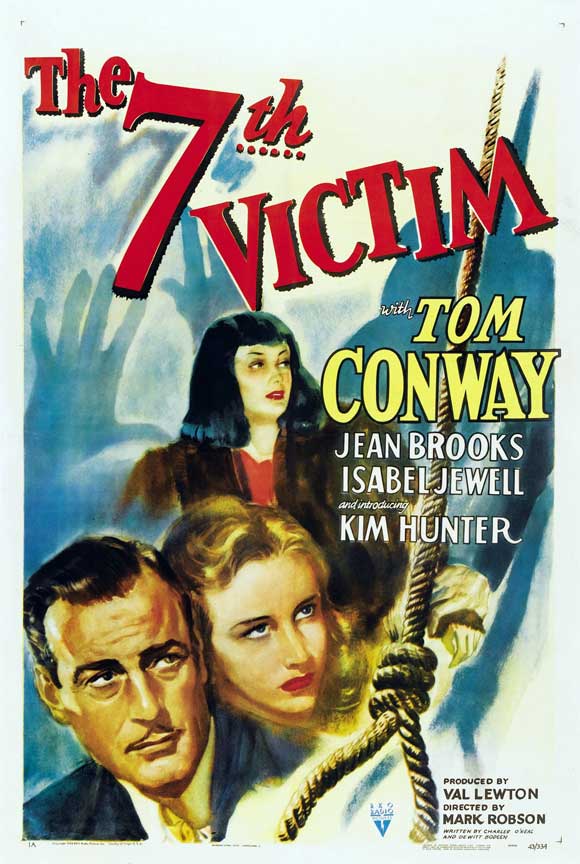
"The Seventh Victim" screens this Saturday, October 24, 2015 at the Daystar Center

Where: The Daystar Center, 1550 S. State St.
When: 6:30 p.m.


The Seventh Victim (1943)—The RKO movie factory was working at full tilt, with producer Val Lewton releasing four films in 1943! The plot of The Seventh Victim surrounds a businesswoman named Jacqueline who aligns herself with a Satanic cult in order to gain success and power. Eventually, she decides that she wants out. The cultist will let her go—if she agrees to commit suicide. Jacqueline tries to escape, but finds the cultists mean business.

Classic scenes: Jacqueline’s younger sister Mary discovers strange activity on a New York City subway and Jacqueline encounters a cultist on a deserted back alley.

The film stars Lewton stock company actors Tom Conway, Jean Brooks, and Isabel Jewell. The Seventh Victim also introduced eventual Academy-Award winner Kim Hunter* to filmgoers. Directors like Alfred Hitchcock (Psycho), Roman Polanski (Rosemary’s Baby), and William Friedkin (The Exorcist) were all influenced by this Lewton horror classic.

Jean Brooks

Before the movie, grab a cup of coffee from Overflow Coffee Bar, located within the Daystar Center. You can bring food and beverages into the auditorium; we even have small tables set up next to some of the seats. General Admission: $5 Students and Senior Citizens: $3. If you would like to RSVP to the movie, click here. Tickets will be available at the door.

Daystar Center located at 1550 S. State St. works through a grassroots network of collaborations and partnerships with individuals and other nonprofit organizations. Through this web, they’re able to provide educational, cultural, and civic activities that enrich and empower their clients, guests, and community members. To learn more about classes and events offered at the Daystar Center, please visit their Web site.

*Hunter won an Academy Award for Best Supporting Actress (1952) for her role as Stella in A Streetcar Named Desire.

Saturday, July 6, 2013

“Out of the Past”: 6th and Final Film in “High Heels and Fedoras” series at Daystar Center July 9, 2013

Tuesday, July 9, 2013
6:30 p.m.
The Venue 1550 at the Daystar Center
1550 S. State Street

Out of the Past (1947) is considered one of the best of the 1940s film noirs. In spite of the acclaim the film has received from critics, it’s not as well known as Double Indemnity (1944) or The Postman Always Rings Twice (1946), but it can easily hold its own next to those two classics.

Directed by Jacques Tourneur, Out of the Past showcases the director at the top of his game. Tourneur started out as a unit director working for David O. Selznick where he met fellow Selznick employee Val Lewton. Lewton worked on many of Selznick’s prestige productions including A Tale of Two Cities (1935) and Gone With The Wind (1939). The two became friends and when Lewton was put in charge of the newly formed horror unit at RKO, he convinced Tourneur to join him. Together they crafted some of the most famous and successful horror movies ever produced. Before the term film noir was coined, these horror films incorporated some of the elements that we have come to identify with the genre. In the three horror films Tourneur directed for Lewton, you see wonderful shadows, interesting camera angles, and creative use of sound to create a mood and stir the emotions.

Jane Greer and Robert Mitchum
Out of the Past gave Robert Mitchum one of his first important roles as a leading man. It also helped identify him as a movie tough guy, a reputation that would follow him for the rest of his career. This was also an important film for the leading lady, Jane Greer. Discovered by Howard Hughes, Greer was only 23 when the film was released. As femme fatales go, Greer is at the top of the heap. With her cool sensual beauty, it’s easy to see how she could handle a man like Mitchum.

Like many film noirs, a lot of the story is told in flashback. And like many noir plots, it does get complicated at times. Plot complexities aside, it’s the motivation of the characters that makes this film fascinating. The line between good and evil is a fine one in Out of the Past. As far as the direction goes, New York Times film critic Bosley Crowther noted Tourneur’s “smooth realistic style” in his November 26, 1947 review.

Jacques Tourneur directed the horror classic, Cat People 1942
The plot concerns Mitchum’s character Jeff Bailey, a former private eye trying to escape his questionable past. But the past catches up with him and he’s drawn back into a life he’d like to forget. Greer plays Kathie Moffet, a woman from Jeff’s past who is trying to break free of the clutches of her abusive boyfriend, Whit Sterling, convincingly played by Kirk Douglas in only his second film. Kathie, who earlier had an affair with Jeff, tries to manipulate him into helping her run away from Whit. Jeff, still attracted to Kathie allows himself to be manipulated, thinking he’s smart enough to come out okay. It’s this conceit that is his downfall.

Out of the Past features great performances paired with beautiful cinematography, snappy dialogue, and fluid direction. You’ll enjoy the ride; I guarantee it!

Check out the updated trailer below, featuring “Baby, Please Don’t Leave Me” by Chicago’s own, Buddy Guy.


If you love classic cinema, you should join the Chicago Film Club. It’s free to join. Come share your love of the movies; it’s fun!


The Daystar Center located at 1550 S. State St. works through a grassroots network of collaborations and partnerships with individuals and other nonprofit organizations. Through this web, they’re able to provide educational, cultural, and civic activities that enrich and empower their clients, guests, and community members. To learn more about classes and events offered at the Daystar Center, please visit their Web site.

Wednesday, September 26, 2012

Val Lewton blogathon coming your way October 31, 2012!

Val Lewton
Horror Film Master
Horrors! Get ready for the Val Lewton blogathon! Kristina of the Speakeasy blog and Stephen aka Classic Movie Man will be cohosting this event.

Lewton, the subject of a documentary produced by none other than Academy Award winning director, Martin Scorsese (Val Lewton: The Man in the Shadows, 2007) was a horror film genius. He didn’t invent the horror film, but elevated it to a new level by commissioning literate scripts, (often written anonymously by himself), carefully casting his main characters, and incorporating film noir techniques. Not a household name, Lewton produced the horror classics Cat People (1942) and I Walked With a Zombie (1943). Often imitated, Lewton influenced legendary directors Scorsese, William Friedkin, and George Romero, to name a few.

The Rules of the Blogathon
Pick a Val Lewton movie or theme that you’d like to explore. Possibly you want to discuss a certain performance, or how Lewton’s films influenced the genre. Then blog your heart out! Since there can be many takes on the same film, duplicate posts will be allowed, but feel free to ask what’s been taken (so far Bedlam, Isle of the DeadI Walked With a Zombie and The Ghost Ship are definites). In the body of your blog post, please mention the blogathon with links, or just cut and paste this handy bit here:

This post is part of the Val Lewton blogathon hosted by Stephen aka Classic Movie Man &  Kristina of the Speakeasy blog  – more here as we both set up landing pages

E-mail Stephen at   sreggie@sbcglobal.net   or   Kristina at   mail.speakeasy@yahoo.com  to let us know which movie you want to do. When corresponding, please include “blogathon” in the subject line of your e-mail. Along with your link, please include your Twitter handle, if you have one. It will help us promote you, your blog, and the blogathon.

Jane Randolph takes a swim in Cat People.

Ready, Set, Boo!
When your post is complete, send the link by end of day October 26, 2012 (Central Time, US). Links to posts will go live on October 31, 2012. Your submissions will be posted to both Classic Movie Man and Kristina’s Speakeasy blogs. The combined posts will include the titles of your blog posts with their respective links to your blog.

Any questions, please contact Stephen or Kristina.

The Blogathon is closed, but please click here to read Val Lewton post from other bloggers.

———————————————

Val’s credits:

COMPLETE FILMOGRAPHY

DIRECTOR (feature film)
Feel free to post this image, courtesy of
Paula Guthat, to your blog.
1. A Tale of Two Cities (1935) as Revolutionary War seq arr by.
WRITER (feature film)
2. The Body Snatcher (1945) as Written for Screen by.
PRODUCER (feature film)
3. Apache Drums (1951) as Producer.
4. Please Believe Me (1950) as Producer.
5. My Own True Love (1949) as Producer.
6. Bedlam (1946) as Producer.
7. Isle of the Dead (1945) as Producer.
8. The Body Snatcher (1945) as Producer.
9. The Curse of the Cat People (1944) as Producer.
10. Youth Runs Wild (1944) as Producer.
11. Mademoiselle Fifi (1944) as Producer.
12. I Walked with a Zombie (1943) as Producer.
13. The Ghost Ship (1943) as Producer.
14. The Seventh Victim (1943) as Producer.
15. The Leopard Man (1943) as Producer.
16. Cat People (1942) as Producer.
EDITING (feature film)
17. A Star Is Born (1937) as Ed asst to David O. Selznick.

The lineup so far (as of October 1, 2012)

Classic Movie Man (this blog) - I WALKED WITH A ZOMBIE @sreggie on twitter

Speakeasy - THE GHOST SHIP @HQofK

Jen Garlen - BEDLAM @garlengirl

Once Upon a Screen - CAT PEOPLE @citizenscreen

Can’t Stop the Movies – BEDLAM @mr_sheldrake

Thrilling days of Yesteryear - THE SEVENTH VICTIM @igsjr

CP’s Classical Gas - ISLE OF THE DEAD

Furious Cinema - ISLE OF THE DEAD @furiouscinema

Laura’s Misc Musings - THE LEOPARD MAN @laurasmiscmovie

Craig of Viking Samurai - The BODY SNATCHER @craigr3521

The Last Drive-in (Monster Girl) – CURSE OF THE CAT PEOPLE & ISLE OF THE DEAD @thelastdrivein

Lasso the Movies - CAT PEOPLE @lassothemovies

Caftan Woman – THE SEVENTH VICTIM @caftanwoman

Cinematically Insane – ??? @willmckinley

Old Movies Nostalgia - VAL LEWTON BIO @moviesnostalgia

The Stop Button - MADEMOISELLE FIFI @thestopbutton

She Blogged by Night - THE BODY SNATCHER

My Love of Old Hollywood - A STAR IS BORN

Journeys in Classic Film – ???

A Shroud of Thoughts - ???

@NitrateDiva - Lewton’s use of Point of View & Voice-Over

50′s Westerns - APACHE DRUMS

Kellee Pratt - Lewton’s Influence on the Horror genre @irishjayhawk66

Classic Becky’s Brain food – I WALKED WITH A ZOMBIE


Ivan of Thrilling Days of Yesteryear created this cool flyer
to promote blogathon.


-Remember, more than one take on a movie is fine, especially if you find a unique angle, so long as there aren’t tons of posts on one movie.

-Someone could do Val’s bio, or the making of a movie or one special performance.

-Do not think you have to be a horror fan to participate? APACHE DRUMS is a technicolor western. Robert Walker was in PLEASE BELIEVE ME as one of the guys romancing heiress Deborah Kerr & Walker was also in the romance MY OWN TRUE LOVE, if you want to write about something different.


Sunday, November 27, 2011

Irene Dunne Goes "Wild" and Reaches New Heights in Comedy Role

A Forgotten Comedy Classic
After almost a decade of starring in popular melodramas, Irene Dunne reluctantly starred in the comedy Theodora Goes Wild (1936). Dunne had established herself as a dramatic actress with great success and she wasn’t inclined toward comedy. When Theodora Goes Wild was released, it was an instant hit with the public and launched a new phase in Dunne’s film career. Overnight she became one of the movie’s top comic actresses, surprising not only the movie-going public, but Dunne herself.

Two-Picture Deal
Theodora Goes Wild was the first of two movies Dunne was committed to making at Columbia Pictures after she left RKO. As an independent movie star, not under exclusive contract to a major studio, she was reluctant to star in a comedy and perhaps risk her standing as a top movie star. So reluctant was Dunne to star in Theodora Goes Wild that she stayed an extra month on a European vacation hoping the executives at Columbia would cast another actress. When Columbia threatened legal action, Dunne relented.

She Sings, She Dances, She Romances
As Theodora Lynn, Dunne gets to utilize all her talents. Before heading to Hollywood, the actress graduated with honors from the Chicago Musical College (now Roosevelt University). As Theodora Lynn, she gets to sing, play the organ and piano, all skills she obtained while studying music.

Small Town Girl
Theodora hails from Lynnfield, Connecticut, and was raised by two maiden aunts who just happen to be the town’s leading citizens. Unbeknownst to her aunts and the town is Theodora’s secret life as bestselling author Caroline Adams. The Lover, written by Theodora is too hot for the town’s Literary Circle, of which Theodora and her aunts are members.

The Artist As A Young Man
Theodora meets artist Michael Grant (Melvin Douglas) who challenges her to break out of her shell and to get out from underneath the town of Lynnfield. Grant has his own problems, however. Stuck in a loveless marriage because of his family’s position and political connections, he’s hardly the person to tell anyone how they should live their life. When Theodora learns about Michael’s predicament, she puts a plan in motion to free him.

Wild Success
Irene Dunne and Melvin Douglas
When released, Theodora Goes Wild was a critical and box office success, propelling Dunne to even greater popularity. The film earned Dunne her second Best Actress Academy Award nomination, five years after her first for Cimarron. Nineteen thirty-six was a very competitive year for screwball comedy films. The classics My Man Godfrey and Mr. Deeds Goes To Town were released that same year to similar acclaim and box office success.

Holds Up Well
Although not as well known as other screwball comedies today, Theodora Goes Wild holds up remarkably well. The more I view it, the more impressed I am. Director Richard Boleslawski, who passed away a year after the film was released, expertly paced Theodora Goes Wild and got great performances out of the more than competent cast. Go “wild” with Theodora. You won’t be disappointed. 


This post corresponds with the class Elegant and Madcap: The Incredible Versatility of Irene Dunne—Class starts November 16, 2011. Meets on Wednesdays from 7p.m. - 10 p.m. for six weeks. Classes are held at Facets Film School on Fullerton Ave. in Chicago, IL.

Tuesday, November 22, 2011

Irene Dunne Comes of "Age" as Edith Wharton's Famous Heroine

The Queen Takes Her Throne
By the mid-1930s, Irene Dunne’s career was in an upward arch. She was one of RKO Studio’s biggest and most dependable players, starring in four pictures per year on average. After her breakout performance in Cimarron (1931), Dunne starred in the classic tearjerker, Back Street (1932), based on the popular best-selling novel by Fannie Hurst. The film was a critical and box office success. Dunne went on to star in a string of popular melodramas, earning the title “Queen of the Weepies” by the motion picture press.

Manhattan Manners
In 1934, Dunne replaced Katherine Hepburn as Countess Ellen Olenska in the first talking-picture adaptation of Edith Wharton’s novel The Age of Innocence published in 1920. The period piece also starred John Boles, Dunne’s costar from Back Street. RKO borrowed Boles from Fox Studios, hoping lighting would strike twice by pairing him once again with Dunne. The film tackles the peculiar manners and mores of upper class New York Society during the latter part of the nineteenth century. It follows Wharton’s narrative fairly closely, but according to the film’s credits, it is also partially based on a play by Margaret Ayer Barnes.

Divorced Lives
First Edition of the novel
The plot concerns Ellen and her attempts to seek a divorce from her European husband with whom she has become estranged. On a visit to see her American relatives, news of her planned divorce is received as well as her unexpected arrival in New York. Ellen’s family will do just about anything to avoid even the hint of scandal so they enlist the aid of lawyer and old family friend, Newland Archer (Boles) to convince the Countess that divorce would be a terrible mistake. Newland sympathizes with Ellen, but gives in to social and family pressures to convince her not to go through with the divorce.

Disengaged Engagement
Newland is engaged to be married to Ellen’s cousin, May Welland (Julia Haydon). Newland knew Ellen growing up, but barely remembers her. At Newland and May’s engagement party, Ellen tells Newland a story from their childhood to jar his memory. Almost at once, Newland is smitten with Ellen and finds himself conflicted in his relationship with May.

Newland encourages May and her family to move up the date of the wedding rather than face his feelings and potential scandal. He marries May, but his love for Ellen grows stronger. Ellen loves Newland, but she too, understands the code of conduct that runs New York society. She also loves her cousin and wouldn’t do anything to purposely hurt her.

John Boles between takes
Wharton’s Ambivalence
Edith Wharton was born into New York society before World War I. When she was 23, she married Edward (Teddy) Robbins Wharton, who was 12 years her senior. He was her equal in the society circles of the day, but they had little else in common. Wharton’s husband suffered from depression that eventually turned into mental illness that was considered incurable. When she divorced him in 1913, Wharton came under heavy criticism. Wharton understood the pressures put on both men and women during the 1870s. Although one may speculate the author’s true feelings about the sanctity of marriage and upper class propriety, Wharton never seems to agree with or condemn Newland or Ellen for their actions (or inaction). The film version does a good job interpreting Wharton’s ambivalence, which makes it rife for discussion.

Modest Success
Although not the blockbuster RKO had hoped for, The Age of Innocence did respectable business and garnered decent reviews. Once again, Dunne’s performance was praised and holds up well today. Film critic Leonard Malton in his review of the film said, “Dunne gives a luminous and touching performance.” Other members of the cast giving good performances are Haydon as May, Laura Hope Crews as May’s mother, Mrs. Welland, and Helen Westley as Granny Mignott.

Boles and Irene Dunne
In 1993, Martin Scorsese filmed a sumptuous interpretation of the Wharton classic starring Daniel Day-Lewis as Newland Archer, Michelle Pfeiffer As Ellen, and Winona Ryder as May.

Gone With the Wind Connection: It’s hard to compare the 1934 version of The Age of Innocence with the Civil War drama, GWTW, but if you take a look at the Age of Innocences film credits, you will see that they do share some remarkable things in common. First the cast: Laura Hope Crews would go on to screen immortality portraying Scarlett’s Aunt Pittypat. The gowns that Irene Dunne wore were designed by Walter Plunkett, the designer of all the costumes for GWTW. And last , but not least, the music was adapted by the legendary Max Steiner, who composed “Tara’s Theme.”

This post corresponds with the class Elegant and Madcap: The Incredible Versatility of Irene Dunne—Class starts November 16, 2011. Meets on Wednesdays from 7p.m. - 10 p.m. for six weeks. Classes are held at Facets Film School on Fullerton Ave. in Chicago, IL.

Sunday, October 16, 2011

Fright School Recap


Lewton’s Legacy
My presentation of I Walked With A Zombie at midnight on October 15, 2011 was well-received by the Facets Fright School attendees. Although many in the audience were familiar with director Jacques Tourneur, most had never heard of producer Val Lewton, or his horror film legacy.

Fright School audience

I enjoy introducing classic films to folks who have never seen them before and last night was no exception. I also enjoyed the reactions and comments from first-time viewers of I Walked With A Zombie.

Literate Audience
The audiences at Facets are generally very literate when it comes to film and last night’s attendees didn't disappoint me. Several made insightful observations and brought to light things I hadn’t noticed, which gives me some more reasons to watch the film again (like I needed any)!

Dee Delights
Frances Dee and Tom Conway in Zombie
Many admired the production and the complexity of the plot for what was supposed to be a horror “programmer” for RKO. One viewer was impressed with Frances Dee’s (1909-2004) performance, which is one of her best in a long film career that started in 1929.

For more information on the rest of the films in the Fright School series, please check the Facets Film School Web site.

Friday, June 11, 2010

Been There Dunne That

Today, Irene Dunne is remembered as one of the top movie actresses from Hollywood’s golden age. She was nominated for five Best Actress Oscars between 1931 and 1949. Although she never won a competitive Oscar, she excelled at both comedy and melodrama. Dunne was known for her professionalism on and off the set. As far as her personal life was concerned, Dunne was never the subject of negative press. And she was married to the same man for 37 years, practically a miracle in Hollywood.

Kentucky-Born, Indiana-Bred
Dunne was born in Kentucky in 1898, but moved to Madison, Indiana, after her father’s death when she was 12. Dunne’s mother encouraged her young daughter to study piano and voice. As an adult, Dunne won a scholarship to Chicago Musical College, now part of Roosevelt University. After she earned her degree, Dunne was determined to sing Opera at New York’s Metropolitan. While performing as Magnolia in the Chicago company of Show Boat, Dunne was discovered and signed to a movie contract with RKO. The studio wanted to groom her to star in movie musicals. The Metropolitan Opera would have to wait.

Slow Start
In the early days of talking pictures, musicals were all the rage. Dunne’s first film was the forgotten musical comedy Leathernecking (1930). Unfortunately for Dunne and RKO, the popularity of movie musicals was in decline and Leathernecking was a flop. The following year would prove to be a game-changer.

An Epic Performance
Dunne’s next role was as Sabra Cravat, the heroine of Edna Ferber’s epic novel Cimarron (1931). Still relatively unknown, it was remarkable that she was given such an important part. The film, costarring Richard Dix, was an immediate critical and financial success. It brought Dunne her first Best Actress Academy Award nomination and it set the course of her career for the next five years.

Queen of the Weepies
Instead of starring in musicals, the career path RKO originally plotted for her, Dunne was cast in a series of successful melodramas. These melodramas included Back Street (1932), This Man is Mine (1934), and Magnificent Obsession (1936). Due to her commercial successes in melodramas, she was dubbed the "Queen of the Weepies," in the trade. Dunne did make two musicals during this period: Roberta (1935) and Show Boat (1936). Both movies were hits, but they didn’t have the world clamoring for more Irene Dunne musicals.

The Reluctant Comedianne
Producers saw something in Dunne’s portrayal of Magnolia, another Edna Ferber character, in Show Boat. It was the ability to let herself go in the musical numbers. There was joy and humor in her performances. The studio suits theorized that Dunne would be perfect for the role of Theodora Lynn in Theodora Goes Wild (1936) on loan-out to Columbia. But Dunne didn’t like comedy. Plus she had an excellent career as a dramatic actress and didn’t want to damage her reputation by giving a poor performance. So adverse was Dunne to playing Theodora that she took an extended vacation in Europe, hoping the studio would assign the role to another actress. After much prodding and pleading, and a few threats from Columbia, Dunne finally relented. What happened would be a major high point in an already successful career.

This Place is Full of Aunts
In Theodora Goes Wild, Dunne plays a small-town girl raised by two maiden aunts. Unbeknownst to them and the rest of the inhabitants of Lynnfield, CT, is the secret that Theodora has written a monster best-selling novel, The Sinner, under the penname, Caroline Adams. On a visit to her publisher in New York City, Theodora meets an unhappily married artist who seems to think Theodora needs to loosen up and live a little. As the movie progresses, Theodora does loosen up, but realizes she’s not the only one whose life could use a shot of excitement. Dunne’s character eventually reveals her true identity and throws caution to the wind, while the rest of Lynnfield is left dumbstruck.

Wild Success
Theodora Goes Wild was an instant hit with film critics and audiences. For her tour de force performance, Dunne received her second Academy Award nomination for Best Actress. As the choir-singing, organ-playing, church soloist, all of Dunne’s talents were on display.

Good Company
Dunne and Theodora were in good company in 1936. Frank Capra’s Mr. Deeds Goes to Town and Gregory La Cava’s My Man Godfrey were also released that year. Dunne’s fellow Hoosier, Carole Lombard, was nominated for Best Actress. Both Dunne and Lombard lost out to Louise Rainer, who had a supporting role, if that, in The Great Ziegfeld, in one of the most controversial Best Actress races of all time.

Comedy Classics
Looking back, it’s hard to understand Dunne’s reluctance to play Theodora. She performs the role so effortlessly and is so believable. It’s a good thing too because if we don’t believe Dunne and her genuine small-town goodness, the movie doesn’t work. Perhaps Dunne realized this when she saw the script and knew if not played just right, it would be an utter failure, a failure laid entirely at her feet. Fortunately for Dunne and film history, she was more than up to the task. If there were no Theodora, chances are there would be no Lucy Warriner in The Awful Truth, no Ellen Arden in My Favorite Wife, and no Nancy Andrews in Unfinished Business. And that would have been a pity. A real pity indeed!

Sources used: Irene Dunne: First Lady of Hollywood, Wes D. Gehring, Scarecrow Press, Inc., Lanham, MD, copyright 2003
Romantic Comedy in Hollywood: From Lubitsch to Sturges, James Harvey, Da Capo Press, New York, NY, copyright 1987

Tuesday, September 1, 2009

Val Lewton: The genius nobody knows

Val Lewton is credited with elevating the horror film to artistic levels during the 1940s. At RKO he set a standard few filmmakers have matched. When other horror films of the period featured creatures and monsters that didn’t exist, Lewton’s movies were populated with ordinary people. The horror did not come from monsters or demons, but from neighbors, coworkers, and those in positions of authority. And Lewton knew that nothing on screen could match the horrors conjured up inside the mind of the viewer. By combining believable characters, literate scripts, film noir-like cinematography, and clever editing, Lewton’s films drummed up more suspense and horror than all the monsters on the Universal lot combined…and that was his goal. Not only were Lewton’s films truly frightening, but they explored unusual (for the times) themes like psychosexual frustration (Cat People) and hints of lesbianism (The Seventh Victim). Alfred Hitchcock would explore these themes further in films like Spellbound, Strangers on a Train, Psycho, and Marni.

Lewton started his movie career working for David O. Selznick as a story editor. While working for Selznick, Lewton had a hand in shaping movie classics like A Tale of Two Cities (1935), A Star is Born (1937), and Rebecca (1940), among others. He’s famous for advising Selznick against buying the rights to Gone with the Wind, calling it “ponderous trash.” Lewton managed to survive that blunder, but he grew tired of working for Selznick.


In 1942, Lewton was named head of the newly formed horror unit at RKO. At the time of his hire, RKO was in financial straits because of their costly relationship with Orson Welles and the failures of Citizen Kane and The Magnificent Ambersons to connect with the public. Lewton’s task was to make horror films that: cost under $150,000 per picture, did not run more than 75 minutes, and used the lurid titles supplied to him by the studio bosses. Starting with Cat People in 1942, Lewton produced a string of successful horror films that helped keep RKO in the black. At RKO, Lewton collaborated with director Jacques Tourneur (Out of the Past, Way of a Gaucho) and gave Robert Wise (The Set Up, The Sound of Music) and Mark Robson (Champion, The Bridges at Toko-Ri) their first assignments as film directors. Although not a household name, Lewton left an indelible mark on the horror film genre and influenced numerous filmmakers, including William Friedkin, Martin Scorsese, George Romero, as well as the aforementioned Alfred Hitchcock to name a few.


Related Posts Plugin for WordPress, Blogger...