Showing posts with label Raoul Walsh. Show all posts

Tuesday, October 1, 2024

Ida Lupino stars in “The Man I Love”

The Man I Love (1947) is a melodramatic film noir directed by Raoul Walsh and starring Ida Lupino, Robert Alda, Andrea King, and Bruce Bennett.

Petey Brown (Lupino) is a lounge singer who is homesick for her family in California. She leaves New York City to visit her two sisters (King and Martha Vickers) and brother (Warren Douglas) on the West Coast. She gets a job at a Long Beach nightclub owned by a local hood, Nicky Toresca (Alda).

While avoiding passes from Toresca, Petey falls in love with a down-on-his-luck ex-jazz pianist, Sam Thomas (Bennett).

Will Petey make a life for herself in California or will she go back to New York City and the jazz clubs where she feels most at home?


Raoul Walsh (1887 - 1980) was an American director, actor, and founding member of The Academy of Motion Picture Arts and Sciences (AMPAS). Walsh got his start acting on the stage in New York. He eventually began acting in silent films and worked as an assistant director alongside D.W. Griffith. Eventually, he became a director working with major silent-film stars Douglas Fairbanks, Gloria Swanson, and Anna May Wong. He lost his right eye in a freak accident in 1928 and never acted again, instead of focusing exclusively on directing. Some of his notable films include The Roaring Twenties (1939) starring James Cagney and Priscilla Lane, High Sierra (1941) starring Ida Lupino and Humphrey Bogart, The Strawberry Blonde (1941) starring Cagney and Olivia de Havilland, White Heat (1949) starring Cagney and Virginia Mayo, and Captian Horatio Hornblower (1951) starring Gregory Peck and Mayo.

Ida Lupino (1918 – 1995) was an English-American actress, director, and producer. She appeared in over 50 films and was one of Warner Bros.’s biggest contract players during the 1940s starring in High Sierra (1941), The Sea Wolf (1941), and The Man I Love (1947). After she left Warner Bros., Lupino formed her own production company, producing, writing, and directing films that tackled subjects the big studios wouldn’t touch. During the 1950s, Lupino was the only female director working in Hollywood. She produced and directed several small independent films but made a name for herself directing for television. Lupino directed episodes of The Twilight Zone (starred in one too), The RiflemanBonanzaGilligan’s IslandIt Takes a ThiefFamily Affair, and Columbo. In 1966, she directed her one-and-only big-budget studio picture, The Trouble with Angels starring Rosalind Russell and Haley Mills.

Ida Lupino and Robert Alda

Robert Alda (1914 – 1986) was an American stage, screen, and television actor. He got his start in vaudeville and after winning a talent contest moved on the burlesque. He toured with Jack Carson and Marion Hutton (Betty Hutton’s sister) supporting Jack Carson’s radio show. Alda’s most famous film roles were as George Gershwin in Rhapsody in Blue (1945) and as the talent agent in Imitation of Life (1959). He created the role of Sky Masterson in Guys and Dolls on Broadway for which he won a Tony Award. He made numerous appearances on television throughout his career and was host of several game shows during the 1950s. He is the father of Alan and Antony Alda.

Andrea King (1919 – 2003) was an American actress of stage, film, and television. King got her start as a child actress and worked on Broadway. Her most famous stage role was as Mark Skinner (replacing Teresa Wright) in Life with Father. In 1944, she signed a contract with Warner Bros. She appeared in several uncredited roles but was eventually elevated to leading lady status in The Beast with Five Fingers (1946) and The Man I Love (1947). King never achieved star status but she continued to work in supporting roles in film and television.

Bruce Bennett (1906 – 2007) was an American actor, college and Olympic athlete. He won a silver medal in the shot put at the 1928 Olympic Games in Amsterdam. Bennett was all set to play Tarzan in 1931 but broke his shoulder filming the football film Touchdown. He was replaced by Johnny Weissmuler. Bennett would eventually play the lead in a Tarzan serial film. His film career was interrupted by World War II, where he served in the United States Navy. Bennett was busy in the 1940s appearing in Mildred Pierce (1945), Nora Prentis (1947), Dark Passage (1947), The Man I Love (1947), and The Treasure of the Sierra Madre (1948).


The Man I Love trivia

  • Ida Lupino’s singing voice was dubbed by Peg La Centra.
  • Lupino became ill during the production and fainted during a scene with Robert Alda. She had to be cut out of her tight-fitting gown.
  • Filmed in mid-1945, it wasn’t released until 1947.
  • The film was originally planned for Ann Sheridan and Humphrey Bogart.
  • Martin Scorcese credited The Man I Love as the inspiration for his film New York, New York.
  • Alan Hale appears with Lupino in The Man I Love. Lupino directed  his son, Alan Hale Jr. in several episodes of Gilligan’s Island


Click HERE to watch the film on YouTube.


Click HERE to join the online discussion on October 7, 2024, at 6:30 p.m. Central Time. Once you RSVP, you will receive an invitation with a link to join the discussion on Zoom.


Discussion questions

  1. Would you consider The Man I Love more of a melodrama or a film noir, or a combination of both.
  2. Did you find the love story between Petey and Sam believable? Why or why not.
  3. Was Robert Alda a convincing small-time hood?
  4. Was Lupino convincing as a nightclub singer?
  5. Was the film’s ending satisfying? Was it realistic? Did it remind you of other films you’ve seen?
 

Tuesday, January 25, 2022

Teresa Wright and Robert Mitchum are "Pursued"

Pursued (1947) Is considered the first noir western, directed by Raoul Walsh and starring Teresa Wright and Robert Mitchum. The cinematography is by the legendary James Wong Howe and music by the equally legendary Max Steiner. Oscar-winning director Martin Scorsese counts Pursued as one of his favorite films.

Mitchum is Jeb Rand, a man haunted by traumatic events from his past that left him an orphan. Mrs. Callum (Judith Anderson) adopts him and raises him as her son with her natural children Adam (John Rodney) and Thorley (Wright). But there is tension in these relationships, and a man he doesn’t even know torments Jeb for reasons he doesn’t understand. 

Others in the cast include Dean Jagger and Alan Hale.

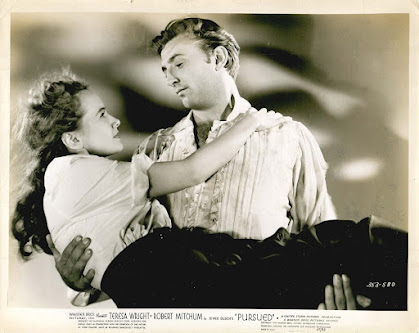
Publicity still of Teresa Wright and Robert Mitchum


Raoul Walsh (1887 - 1980) was an American director, actor, and founding member of The Academy of Motion Picture Arts and Sciences (AMPAS). Walsh got his start acting on the stage in New York. He eventually began acting in silent films and worked as an assistant director alongside D.W. Griffith. He eventually became a director on his own working with major silent-film stars Douglas Fairbanks, Gloria Swanson, and Anna May Wong. He lost his right eye in a freak accident in 1928 and never acted again, instead of focusing exclusively on directing. Some of his notable films include The Roaring Twenties (1939) starring James Cagney and Priscilla Lane, High Sierra (1941) starring Ida Lupino and Humphrey Bogart, The Strawberry Blonde (1941) starring Cagney and Olivia de Havilland, White Heat (1949) starring Cagney and Virginia Mayo, and Captian Horatio Hornblower (1951) starring Gregory Peck and Mayo.

Teresa Wright (1918 - 2005) was an American stage, film, and television actress. She received Academy Award nominations in her first three films, a record that still holds today. In 1942, she was nominated for Best Supporting Actress for Mrs. Miniver and for Best Actress in The Pride of the Yankees. She won the Supporting Oscar for Mrs. Miniver, her co-star, Greer Garson won Best Actress. Today Wright is most famous for playing Lou Gehrig’s wife in The Pride of the YankeesThe Best Years of Our Lives, and Alfred Hitchcock’s Shadow of a Doubt (1943). Wright was a popular star throughout the 1940s starring opposite Robert Mitchum, Ray Milland, Gary Cooper, and David Niven. She starred opposite Marlon Brando in his first film role in The Men (1950). Wright continued working in film, with her last role as Miss Birdie in The Rainmaker (1997). Wright is the only non-baseball player to be honored by the New York Yankees when she passed away at age 86. 

Robert Mitchum (1917 - 1997) was an American film actor, director, and singer. His breakthrough came in The Story of G.I. Joe (1945) for which he was nominated for a Best Supporting Actor Academy Award. He later starred in the film noir classic Out of the Past (1947) Crossfire (1947), Rachel and the Stranger (1948), River of No Return (1954) The Night of the Hunter (1955) Heaven Knows, Mr. Allison (1957), Home from the Hill (1960), Cape Fear (1962), and Ryan's Daughter (1970). Mitchum would remain busy until the late-nineties. Mitchum is rated number 23 on the American Film Institute's list of the greatest male stars of classic American cinema.


Pursued trivia

  • When the film was released, Teresa Wright was #6 at the box office.
  • Charles Bates who plays Adam Callum as an 11-year-old boy played Teresa Wright's younger brother in Alfred Hitchcock's Shadow of a Doubt (1943).
  • The film was filmed in Gallup, New Mexico.
  • The screenplay was written by Niven Busch who was Teresa Wright's husband.
  • Niven Busch also wrote the novel Duel in the Sun which was made into a hit western that was supposed to star Wright. Wright had to drop out due to pregnancy. Pursued was a consolation prize of sorts.
  • Producer Milton Sperling and his United States Pictures production company worked out a distribution deal with Warner Bros. It was a profitable deal for both.

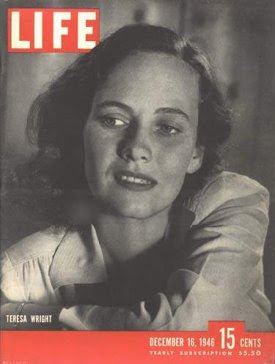
Teresa Wright was on the cover of Life magazine on December 16, 1946.


Why watch this film?

  1. The film features beautiful black and white cinematography by James Wong Howe.
  2. It's an opportunity to see Robert Mitchum in an early lead role.
  3. It's considered the first film noir western, directed by a legend of the Classic Hollywood period.
  4. The film boasts a strong cast including top-billed Teresa Wright, Judith Anderson, and Dean Jagger.


To watch the film on YouTube, click the link below.


Discussion questions:
  1. Do you think a western could be classified as a film noir?
  2. Freud and psychological dramas were all the rage in the 1940s. Does Pursued work as a psychological western?
  3. What did you make of Jeb's relationship with his stepmother, stepbrother, and sister?
  4. Do you think the family dynamics would have been different had Jeb's true origins been known from the beginning?
  5. The scene when Jeb and Adam sing together is a pleasant one and suggests that togetherness and family love was possible or does it?
  6. Was there a performance that stood out to you?
  7. Did anything surprise you?
  8. Do you think the movie had a theme? If so, what do you think it was?
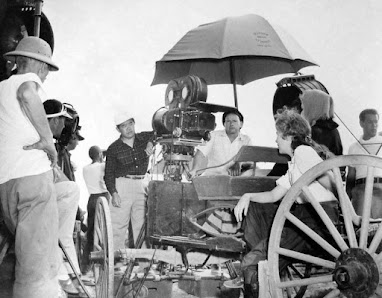
Teresa Wright on location with cinematographer James Wong Howe behind the camera

To join the discussion on January 31, 2022, at 6:30 p.m. Central Time, click here. Once you RSVP, you'll receive an invitation and a link to the discussion on Zoom.


Contemporary reviews for Pursued

Bosley Crowther in The New York Times said this about the film: "...And it is likewise hard to work up any sympathy for the hero, who seems bored by all his woes. That may be because Robert Mitchum, who plays the latter, is a very rigid gent and gives off no more animation than a Frigidaire turned to 'Defrost.'"*

Variety praised the film: "Pursued is potent frontier days Western film fare. Standout in picture is suspense generated by the original script and Raoul Walsh's direction. It builds the western gunman's death walk to high moments of thrill and action. Strong casting also is a decided factor in selling the action wares. Production makes use of natural outdoor backgrounds supplied by New Mexico scenery, lending air of authenticity that is fully captured by the camera."**

*New York Times, Crowther, Bosley, review March 8, 1947
**Variety magazine, Variety staff, review December 31, 1946

Tuesday, October 16, 2018

Screening of “Pursued” at Daystar Center October 29

Pursued (1947)
Where: Daystar Center, 1550 S. State Street, Room 102
When: October 29, 2018
Time: 6:45 p.m
Hosted by Stephen Reginald

Pursued (1947) is considered the first noir western, starring Teresa Wright and Robert Mitchum. Mitchum is Jeb, a man haunted by traumatic events from his past that left him an orphan. Mrs. Callum (Judith Anderson) adopts him and raises him as her son with her natural children Adam (John Rodney) and Thorley (Wright). But there is tension in these relationships, and a man he doesn’t even know torments Jeb for reasons he doesn’t understand.

Robert Mitchum and Teresa Wright
Directed by Raoul Walsh (White Heat), with photography by the legendary James Wong Howe and music by the equally legendary Max Steiner. Oscar-winning director Martin Scorsese counts "Pursued" as one of his favorite films and is responsible for its restoration.

General Admission: $5, Students and Senior Citizens: $3


Have some Joe and Enjoy the Show!
Before the movie, grab a cup of coffee from Overflow Coffee Bar, located within the Daystar Center. You can bring food and beverages into room 102.

Join the Chicago Film club; join the discussion
Twice a month we screen classic films and have a brief discussion afterward. For more information, including how to join (it’s free), click here. The Venue 1550 is easily accessible by the CTA. Please visit Transit Chicago for more information on transportation options.

Stephen Reginald is a freelance writer and editor. He has worked at various positions within the publishing industry for over 25 years. Most recently he was executive editor for McGraw-Hill’s The Learning Group Division. A long-time amateur student of film, Reginald hosts “Chicago Film Club,” a monthly movie event held in the South Loop, for the past two years. Reginald has also taught several adult education film classes at Facets Film School, Chicago.

Tuesday, May 30, 2017

10 Things You May Not Know About Ida Lupino

Ida Lupino (1918 – 1995) was a London-born actress and director; she became an American citizen in 1948. As a contract player at Warner Brothers, Lupino starred opposite some of their top male stars, including Errol Flynn, Humphrey Bogart, and John Garfield. In the late 1940s she embarked on a career as a director and independent filmmaker.

Ida Lupino, Raoul Walsh, and Humphrey Bogart on the set of High Sierra

1. Her parents both had theatrical backgrounds; her father’s family’s theatrical roots date back to the Italian Renaissance.

2. She was signed to a five-year contract with Paramount Pictures in 1933 where she was dubbed “the English Jean Harlow.”

3. Wanting to be more than just a pretty face, Lupino begged director William A. Wellman to test her for the role of Bessie Broke in The Light That Failed (1939).

4. She next played the femme fatale role in They Drive by Night (1940) where she stole the picture from such established stars as George Raft, Ann Sheridan, and Humphrey Bogart.

Beautiful color studio publicity photo of Ida Lupino
5. In 1941 she starred in three movies: The Sea Wolf costarring Edward G. Robinson and John Garfield, Out of the Fog costarring with Garfield again, and Ladies in Retirement costarring with her then husband, Louis Hayward.

6. During her years as a film director, she was a pioneer of product placement to help with financing.

7. She directed dozens of television episodes for popular series, during the 1950s and 1960s, including The Donna Reed Show, 77 Sunset Strip, Alfred Hitchcock Presents, Have Gun Will Travel, Thriller, The Fugitive, Dr. Kildare, The Twilight Zone, and Bewitched. She is the only woman to have directed an episode of the original Twilight Zone and star in one as well.

8. Lupino learned about directing and other behind-the-scenes aspects of filmmaking while she was on suspension at Warner Brothers. When an actor under studio contract turned down a movie role, they were put on suspension. They received no salary during the time the movie they refused to act in was in production. Instead of sitting at home, Lupino visited movie sets and befriended directors like Raoul Walsh and Don Siegel.

Ida Lupino (third from left) on the set of The Trouble With Angels with Rosalind Russell (second from left)

9. She won the National Board of Review award for Best Actress in 1941 (High Sierra and Ladies in Retirement) and 1942 (Moontide) and a New York Film Critics Circle Award in 1943 (The Hard Way), but she was never nominated for an Academy Award.

10. Her last directing job was for the 1966 comedy The Trouble With Angels starring Rosalind Russell and Haley Mills.

Tuesday, August 2, 2011

Ida Lupino: A Lasting Legacy in Hollywood

Ida Lupino was a major movie star during Hollywood’s Golden Age. Born in England to a show business family with roots going back to the Renaissance, she came to Hollywood in 1933 as a bleached blond Jean Harlow look-a-like. After a breakout performance in The Light That Failed (1939), Lupino moved on to starring roles at Warner Brothers as one of their top contract players. When she left the studio in the late 1940s, she began thinking about working behind the scenes as a director. Lupino eventually formed her own production company and directed a series of low-budget melodramas. During the late 1940s and early 1950s, she was the only female director of note working in Hollywood.
The story goes that Lupino was signed on at Warner Brothers to keep the lot’s top female star, Bette Davis in line. The truth behind that tale is open to speculation, but Lupino bolstered it by self-deprecatingly calling herself “the poor man’s Bette Davis.” It’s true that some of the roles Davis turned down went to Lupino, but this type of thing happened regularly during the height of the studio system.
In 1940, Lupino starred in They Drive By Night alongside Warner heavy-hitters George Raft and Ann Sheridan. The film also starred Humphrey Bogart, but he was billed fourth behind Lupino. As Lana Carlsen, the unfaithful wife of Alan Hale, Lupino literally tore up the screen. So compelling was her characterization, that movie audiences supposedly applauded when her character breaks down in front of a packed courtroom. With that performance, Lupino showed she was a talent to be reckoned with.
As one of the hottest new stars in the movies, Lupino was cast next as Marie, a hard luck dame with a soft spot for career criminal, Roy “Mad Dog” Earle (Humphrey Bogart ) in High Sierra (1941). So hot was Lupino that she received top billing over Bogart. The movie is credited with making a major star out of Bogart, but Lupino gives a multi-layered performance that showed she could hold her own opposite anyone. As the film progresses and Marie’s love for Earle grows, Lupino’s characterization becomes more complex. We see her vulnerability, her tenderness. A classic that holds up today, High Sierra’s success owes as much to Lupino’s performance as Bogart’s. And you gotta love her close-up at the end, looking luminous in her grief, tinged with happiness for her love who is free at last in death.
Lupino starred in three other films in 1941: The Sea Wolf, Out of the Fog, and Ladies in Retirement on loan to Columbia. Once again, she proved that she could hold her own against the bigger-than-life Edward G. Robinson and John Garfield in The Sea Wolf and Garfield again in Out of the Fog. And like Davis, she wasn’t afraid to immerse herself into the character she was playing even if it meant downplaying her looks, as she did in Ladies in Retirement. Of her performance in that film, The New York Times wrote, “Give Ida Lupino the largest measure of credit, for her role is the clue to the suspense. Perhaps she is too slight to portray the stolid threat that lay in Flora Robson’s original [stage] performance, but she is none the less the thin ribbon of intensity that makes the film hair-raising.”
In 1942 Lupino was loaned out to Twentieth Century Fox for two films. The first was Moontide, costarring French star Jean Gabin, making his American movie debut. The second, Life Begins at Eight-Thirty, costarring Monty Wooley. Both films featured stronger male than female roles, but Lupino’s presence in both did not go unnoticed. Of her performance in Moontide, The New York Times’s Bosley Crowther had this to say: “Miss Lupino makes a taut and sleazy slattern who is prettily revivified by love.” And as Wooley’s handicapped daughter in Life Begins at Eight-Thirty, Crowther said, in his December 10, 1942 review in the Times, that “Miss Lupino plays the crippled daughter with compassion and simplicity.” In 1943, Lupino would star in a film that would bring her great critical acclaim.
The Hard Way (1943) is a tough tale of two sisters trying to escape their dreary and impoverished existence. Ironically the mining town from which they want to escape is called Green Hill, where there is nothing green or leafy. Under the sharp direction of Vincent Sherman, Lupino gives one of her most complex and nuanced performances as Helen Chernen, Katies (Joan Leslie) pushy success-driven sister. Lupino is Katie’s “stage sister,” exploiting the younger sibling’s talent while vicariously living through her. So compelling was Lupino’s performance that she won the New York Film Critics Circle Award in 1943. For some unknown reason, she was overlooked come Oscar time. (Lupino was never nominated for an Academy Award.) In the hands of a lesser actress, Helen would have been merely a villain. The beauty of Lupino’s performance is that while you don’t necessarily like her actions, you understand them. She isn’t perfect for sure, but neither is her sister or the others in the rough and tumble world of show business that they inhabit.
Now an established star at Warner Brothers, Lupino was not always offered the best roles on the lot. Bette Davis was still the queen of the studio and had first refusal on the choicest scripts. Not one to take just any role, Lupino was often put on suspension by the studio. It was during these periods that she became interested in working behind the scenes. A naturally friendly individual, calling everyone she knew “darling,” Lupino learned from the contract directors, cinematographers, and others about the technical side of filmmaking. It would be a while before Lupino would move behind the camera.
In the mid-to late 1940s, Lupino starred alongside some of the top talent at the studio, including Errol Flynn, Olivia DeHavilland, and Paul Henried. One of her best roles during this period was as Petey Brown in The Man I Love (1947), directed by the legendary Raoul Walsh. As the tough-talking club singer, her Petey is the epitome of independence. As the take-charge career woman, Lupino showed she could carry a picture. The Man I Love was popular enough for Jack Warner to offer the actress a four-year exclusive contract. Lupino decided to try her hand as a freelance artist and turned down Warner’s offer.
Her first role after leaving Warner Brothers was the enjoyable and popular success Road House (1948). Released by Twentieth Century Fox and directed by the underrated Jean Negulesco, the film costarred Cornel Wilde, Celeste Holm, and Richard Widmark at his loony best. Lupino plays Lily Stevens, a torch singer from Chicago, slumming at Jeffty’s road house and bowling alley, owned by Widmark’s character. A predatory Widmark stalks Lupino when he finds out that she favors his “best friend,” Wilde, over him. As interesting as this triangle is, some of the film’s most enjoyable moments are when Lupino sings and plays the piano. Her modest gravely voice has an appealing style that is hard to resist.
As the 1940s came to a close and with good roles harder and harder to come by, Lupino formed her own production company with second husband Collier Young. She produced and directed a series of low budget films utilizing the skills she gleaned from working with the male directors at Warner Brothers. The movies Lupino made during this period were gritty and for the time, groundbreaking. Not Wanted (1949) dealt with unwanted pregnancy and Outrage (1950) told the story of a young woman raped on her way home from work, hardly popular themes at the time. Lupino was now the only working woman director and the second to become a member of the Director’s Guild. When television came on the scene, Lupino hit her stride. She directed numerous episodes of popular TV series, including Alfred Hitchcock Presents, Have Gun Will Travel, The Rifleman, The Untouchables, and Lupino has the distinction of being the only woman to ever direct and star in an episode of The Twilight Zone. Not only did she direct in television, she guest starred on many TV shows herself, staying busy throughout the 1960s and 1970s.
Ida Lupino is the only woman to direct an episode of the classic  TV series.
Ida Lupino’s legacy is a long one. As an actress, she has a body of work that holds up alongside the best of her contemporaries. As a director, she paved the way for future generations of women. It’s amazing that the small fragile-looking Lupino had such a strong and wide-reaching influence that continues today. 
Lupino died of a stroke while being treated for colon cancer on August 3, 1995. She was 77 years old.

Monday, March 29, 2010

Wedding Day for Gable and Lombard

Married March 29, 1939


On March 29, 1939,  Clark Gable and Carole Lombard were married in Kingman, Arizona.

With the help of Gable's press agent and friend, Otto Winkler, Gable and Lombard managed to elope without the press getting wind of it. Gable had a brief break from the filming of Gone With The Wind so he took full advantage of the opportunity to marry Lombard.

The pair would buy a modest (by Hollywood standards) two-story home from director Raoul Walsh. The press comically dubbed it the house of the two Gables.

From all accounts Gable and Lombard were perfectly matched. Both were at the top of the heap as far as fame and popularity were concerned and their personalities, Gable shy and withdrawn, Lombard outgoing and boisterous, complimented each other. They called each other Ma and Pa and settled into life on their "ranch" until the day of Lombard's tragic death in January 1942.


Related Posts Plugin for WordPress, Blogger...