Showing posts with label Ralph Bellamy. Show all posts

Wednesday, November 27, 2024

Irene Dunne and Cary Grant discover “The Awful Truth”

 In 1937, Irene Dunne was at the height of her career. The year before, Dunne received a Best Actress Academy Award nomination for Theodora Goes Wild, a comedy role she was reluctant to take. That picture was a critical success for Dunne and a huge box office hit for Columbia Pictures. So it wasn’t surprising that the next picture she would make for the studio would be another comedy.


From Stage To Screen
The Awful Truth was based on a play by Arthur Richman and brought to the screen with the aid of screenwriter Vina Delmar and Theodora Goes Wild screenwriter, Sidney Buchman, who went uncredited. Teamed with Dunne for the first time was Cary Grant. Grant quickly became a top leading man in Hollywood, but his pairing with Dunne was inspired and their on-screen chemistry delighted movie-going audiences. B.R. Crisler writing in his New York Times review said, “Miss Dunne and Mr. Grant, as the couple...have fun with their roles, and the pleasure seems to be shared, on the whole, by the [Radio City] Music Hall audience.”

What Is The Awful Truth?
The plot revolves around the marital woes of Lucy (Dunne) and Jerry (Grant) Warriner. Each becomes suspicious of the others’ marital fidelity, which eventually leads them to divorce court. After the divorce, Lucy and Jerry are consumed with foiling each other’s new romantic interests. Is the awful truth the fact that Lucy and Jerry are still in love?

Get Me Out Of This Picture
Irene Dunne and Cary Grant
Like Dunne in the previous year’s Theodora Goes Wild, Grant wasn’t too happy working on this film. Director Leo McCarey’s working style didn’t sit well with Grant and he tried to get out of the movie, even going so far as requesting he swap roles with supporting player Ralph Bellamy! McCarey liked to get spontaneous performances out of his cast, which meant a lot of on-set improvising, which Grant found unsettling. Eventually, things worked out for all concerned. Ironically, this is the movie that catapulted Grant to superstar status and is responsible for the Grant movie persona beloved by generations of moviegoers.

Comedy Triumph
For Dunne, The Awful Truth was a delightful experience. She loved working with both McCarey (who became a personal friend) and Grant. Professionally, it was another triumph. Once again, the critics raved about her and the film. And once again she was nominated for Best Actress by the Motion Picture Academy. If there was any doubt about Dunne’s comedy chops, they were all dispelled when the film was first released on October 21, 1937. Dunne and Grant would go on to star in two other popular films: the comedy My Favorite Wife (1940) and the melodrama Penny Serenade (1941).

Award Winner
The Awful Truth was nominated for six Academy Awards, including Best Picture, Best Director, Best Screenplay, and Best Supporting Actor. McCarey won the only Oscar for his direction and ensured his place in motion picture history.

Lasting Legacy
In 2000, the American Film Institute listed The Awful Truth at #68 on its list of 100 Years…100 Laughs. In 2002, the AFI listed it at #77 on the 100 Years…100 Passions list.

Leo McCarey (1898 – 1969) was an American film director, screenwriter, and producer. McCarey is perhaps most famous for his critically acclaimed and commercially popular comedies like Duck Soup (1933), The Ruggles of Red Gap (1935), and The Awful Truth (1937). Other popular films directed by McCarey include Going My Way (1944), The Bells of St. Mary’s (1945), and Good Sam (1948). McCarey won two Best Director Oscars for The Awful Truth and Going My Way.

Irene Dunne (1898 –1990) was an American actress and singer who was one of the most popular movie stars during Hollywood’s Golden Age. She is probably best remembered for her comedic roles, though she first became famous playing in melodramas like Back Street (1932) and Magnificent Obsession (1935). In fact, Dunne was so popular as a star of melodramas that she was dubbed “The Queen of the Weepies” by the press. Her comedic breakout performance was in Theodora Goes Wild (1936), earning her an Academy Award nomination for Best Actress. She would go on to make other comedy classics like The Awful Truth (1937) where she earned another Best Actress nod, and My Favorite Wife (1940). Dunne and Grant were one of the most popular screen teams in movie history. All three of their films were critical and box office successes. Dunne earned five Academy Award nominations for Best Actress but never won a competitive Oscar. The fact that the Motion Picture Academy never awarded her an Honorary Academy Award for her work is a travesty.

Cary Grant (1904 – 1986) was an English-born American actor who became one of film history's most popular leading men. Grant started his career in vaudeville before heading to Hollywood. He became a superstar in the late 1930s in a series of screwball comedies including The Awful Truth (1937) with Irene Dunne. He was a memorable C. K. Dexter Haven in The Philadelphia Story (1940) opposite Katharine Hepburn and James Stewart. He received two Best Actor nominations for Penny Serenade (1941) and None but the Lonely Hearts (1944). Other classic Grant films include Gunga Din (1939), Only Angels Have Wings (1939), and Arsenic and Old Lace (1944). He made four popular films with Alfred Hitchcock: Suspicion (1941), Notorious (1946), To Catch a Thief (1955), and North by Northwest (1959). He was awarded an Honorary Oscar at the 42nd Academy Awards in 1970.

Click HERE to watch the film on the Internet Archive.

Click HERE to join the online discussion on December 9, 2024, at 6:30 p.m. Central Time. Once you RSVP, you will receive an invitation with a like to join the discussion on Zoom.

Discussion questions

  1. Did either character, Jerry or Lucy break their marriage vows?
  2. Do you think there was a serious message about marriage underneath all the comedy?
  3. What did you think of Irene Dunne and Cary Grant together as a team?
  4. Ralph Bellamy made a career out of being the other man. What did you think of his performance?
  5. Did you have a favorite scene or piece of dialogue?

Wednesday, September 8, 2021

Rosalind Russell and Cary Grant in “His Girl Friday”

His Girl Friday (1940) is an American screwball comedy directed by Howard Hawks and starring Cary Grant and Rosalind Russell. Based on the play The Front Page (1928) by Ben Hecht and Charles MacArthur, Hawks decided to turn Hildy Johnson, played by a man in the original, into a woman, changing the dynamics of the story and according to many critics, an improvement. The supporting cast includes Ralph Bellamy, Gene Lockhart, Porter Hall, Roscoe Karns, John Qualen, Helen Mack, and Alma Kruger.

Hildy Johnson (Russell) has left newspaper journalism behind to marry insurance salesman Bruce Baldwin (Bellamy), much to the dismay of her former editor and ex-husband Walter Burns (Grant). Walter does his level best to convince Hildy that she return to her career and to him! What ensues is one of the smartest, fast-talking screwball comedies ever made.


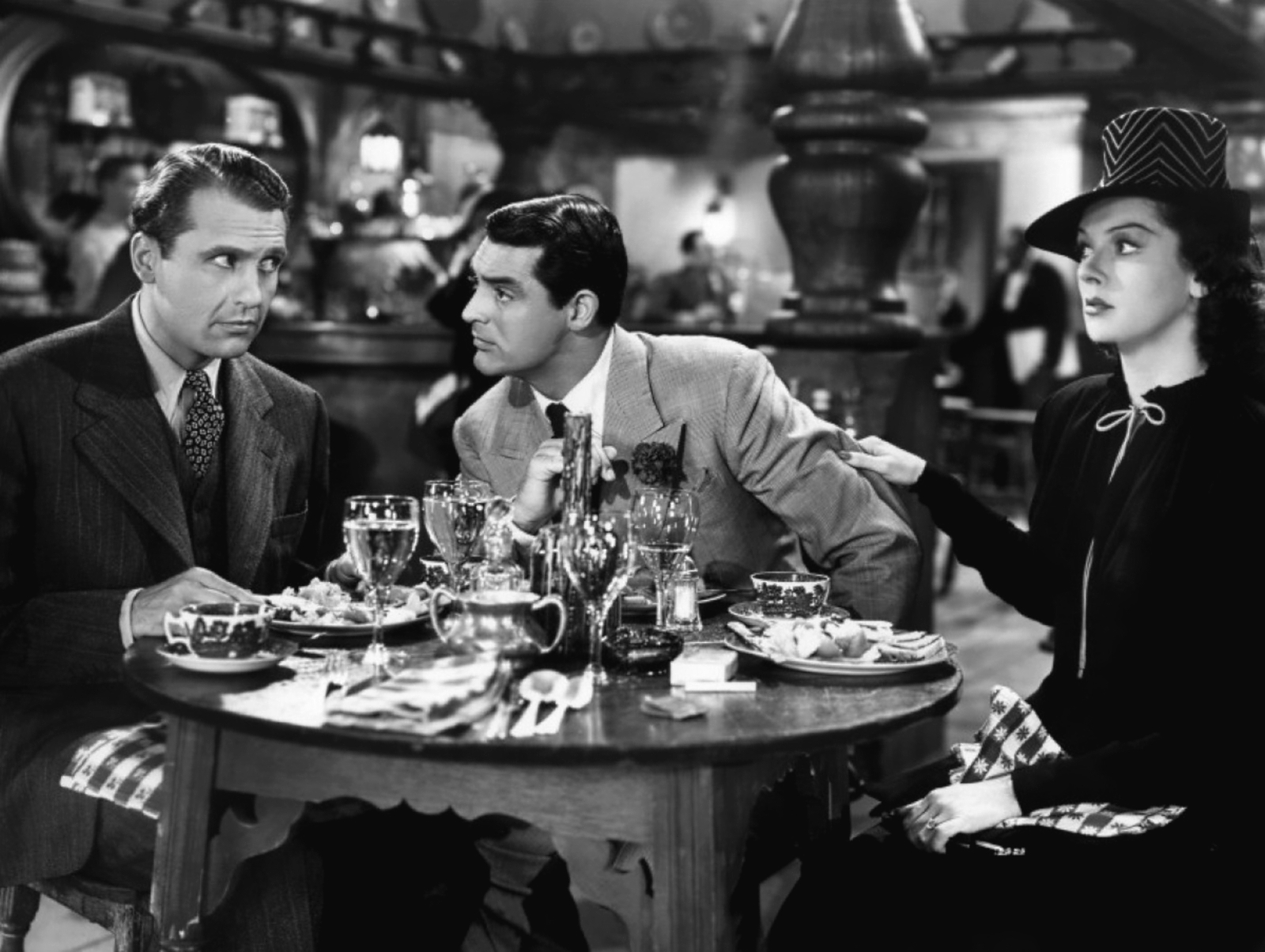
Cary Grant, Ralph Bellamy, and Rosalind Russell


Howard Hawks (1896 - 1977) was an American director, producer, and screenwriter. He is considered one of the great directors from the classic Hollywood era. Hawks excelled in directing films in all genres. His films were famous for featuring strong women characters. These tough-talking “Hawksian women” helped to define the director’s work. Some of Hawks’ popular films include Scarface (1932) Bringing Up Baby (1938), Only Angels Have Wings (1939), His Girl Friday (1940), To Have and Have Not (1944), The Big Sleep (1946), Red River (1948), and Gentlemen Prefer Blondes (1953). Gary Cooper won a Best Actor Academy Award for his performance in Sergeant York (1941) under Hawks’ direction.

Cary Grant (1904 - 1986) was an English-born American actor who became one of the most popular leading men in film history. Grant started his career in vaudeville before heading to Hollywood. He became a superstar in the late 1930s in a series of screwball comedies including The Awful Truth (1937) with Irene Dunne. He was a memorable C. K. Dexter Haven in The Philadelphia Story (1940) opposite Katharine Hepburn and James Stewart. He received two Best Actor nominations for Penny Serenade (1941) and None but the Lonely Hearts (1944). Other classic Grant films include Gunga Din (1939), Only Angels Have Wings (1939), and Arsenic and Old Lace (1944). He made four popular films with Alfred Hitchcock: Suspicion (1941), Notorious (1946), To Catch a Thief (1955), and North by Northwest (1959). He was presented with an Honorary Oscar at the 42nd Academy Awards in 1970.

Rosalind Russell (1907 - 1976) was an American film and stage actress. She was nominated for four Best Actress Academy Awards throughout her career. She won five Golden Globe Awards and a Tony for Best Actress in a Musical for her performance as Ruth in Wonderful Town. Russell was a versatile actress who excelled at both comedy and drama. She was also one of the few actresses of her day to portray lawyers, judges, and psychiatrists. Some of her famous films include The Women (1939), My Sister Eileen (1942), Sister Kenny (1946), Picnic (1955), Auntie Mame (1958), Gypsy (1962), and The Trouble with Angels (1966).


To watch this film on YouTube, click on the link below.


Why watch this film?
  • It is considered one of the best screwball comedies of all time.
  • The overlapping dialogue throughout the film was unique when released and copied ever since.
  • Rosalind Russell had one of the best roles of her career as Hildy Johnson.
  • It showcases Cary Grant’s ease at playing comedy like no one else could.
  • The cast features a supporting cast of some of the best and most popular character actors of the day.

To join the discussion on September 13, 2021, at 6:30 p.m., click here. Once you RSVP, you will receive an invitation and link to the discussion on Zoom.


His Girl Friday trivia
  • Rosalind Russell was literally the last choice to play Hildy Johnson?! Carole Lombard was the director’s first choice but deemed too expensive. Katharine Hepburn, Claudette Colbert, Margaret Sullivan, Ginger Rogers, Jean Arthur, and Irene Dunne were all offered the role but turned it down. Supposedly, even Joan Crawford was considered.
  • Russell hired a writer to help her ad-lib some of her dialog to better compete with Grant who was ad-libbing like crazy.
  • The film contains several inside jokes that audiences in 1940 would have picked up on immediately.
  • Russell was loaned to Columbia from M-G-M where she had just completed The Women (1939).
  • The film was selected for preservation by the Library of Congress in 1993.
  • It premiered at Radio City Music Hall before it went into wide release where it was universally praised by the critics and public.


Discussion questions:
  1. What did you think of the relationship between Walter (Grant) and Hildy (Russell)?
  2. Did the character of Hildy Johnson surprise you in any way?
  3. Did you have a favorite line or interaction between Hildy and Walter?
  4. What about the character actors? Any favorites?
  5. The film moves at break-neck speed; were you able to keep up with it?
  6. Did anything surprise you about the film?
  7. Was the ending satisfying? Was it what you expected?

Saturday, October 20, 2012

Classic screwball comedy “His Girl Friday” coming to “The Venue 1550” November 8


The comedy classic His Girl Friday (1940 ) will be screened at “The Venue 1550” at the Daystar Center, 1550 S. State St., November 8, 2012 at 7 p.m. Tickets are $7 per person and can be purchased at the door or online. This event will be hosted by Stephen Reginald, Classic Movie Man.

His Girl Friday, directed by Howard Hawks and starring Cary Grant and Rosalind Russell is an adaptation of the Ben Hecht and Charles MacArthur classic Broadway smash, The Front Page. Grant plays Walter Burns, a Chicago newspaper managing editor and Russell is Hildy Johnson an ex-reporter for the same paper and Burns’s ex-wife. On the eve of her marriage to a new man, Burns tries to convince Hildy to come back to the paper and him. Considered one of the greatest classic screwball comedies of all time, His Girl Friday is filled with non-stop one liners and the fastest dialogue ever recorded on film.

Backstory
Carole Lombard was first choice
to play Hildy Johnson
Howard Hawks originally planned to do a straight remake of The Front Page. During a read-through of the script during auditions, Hawks had his secretary read Hildy Johnson’s lines. Hawks, always a champion of strong women, liked the sound of Johnson’s lines coming out of the mouth of a female. The script was changed to make Hildy the ex-wife of Walter Burns and many think His Girl Friday is better than the film on which it is based.

Casting Call
Hawks had Cary Grant in mind for Walter Burns from the start, but the casting of Hildy Johnson proved problematic. Hawks originally wanted Carole Lombard, who he directed in Twentieth Century (1934). Lombard, one of the biggest stars in Hollywood, was too expensive. Supposedly the role of Hildy was offered to Katherine Hepburn, Claudette Colbert, Margaret Sullivan, Ginger Rogers, and Irene Dunne. All turned the role down. Joan Crawford, coming off her success in The Women, (1939) was even considered. Hawks finally settled on Rosalind Russell. Hawks encouraged ad-libbing on the set, so Russell hired a writer to punch up her dialogue because she thought Grant had all the good lines.


Ralph Bellamy, Cary Grant, and Rosalind Russell
His Girl Friday was #19 on American Film Institute’s 100 Years…100 Laughs and has been selected for preservation in the United States National Film Registry.


Join the Film Club
Come watch this classic in the comfort of “The Venue 1550.” Overflow Coffee Bar will be open so you can grab a drink or snack to be enjoyed during the movie.


Tuesday, December 6, 2011

The Not So Awful Truth About “The Awful Truth”

In 1937, Irene Dunne was at the height of her career. The year before, Dunne received a Best Actress Academy Award nomination for Theodora Goes Wild, a comedy role she was reluctant to take. Not only was that picture a critical success for Dunne, but a huge box office hit for Columbia Pictures. So it wasn’t a surprise that the next picture she would make for the studio would be another comedy.

From Stage To Screen
The Awful Truth was based on a play by Arthur Richman and brought to the screen with the aid of screenwriter Vina Delmar and Theodora Goes Wild screenwriter, Sidney Buchman, who went uncredited. Teamed with Dunne for the first time was Cary Grant. Grant was quickly becoming a top leading man in Hollywood, but his pairing with Dunne was inspired and their on-screen chemistry delighted movie-going audiences. B.R. Crisler writing in his New York Times review said, “Miss Dunne and Mr. Grant, as the couple...have fun with their roles, and the pleasure seems to be shared, on the whole, by the [Radio City] Music Hall audience.”

What Is The Awful Truth?
The plot revolves around the marital woes of Lucy (Dunne) and Jerry (Grant) Warriner. Each becomes suspicious of the others’ marital fidelity, which eventually leads them to divorce court. After the divorce, Lucy and Jerry are consumed with foiling each others’ new romantic interests. Is the awful truth the fact that Lucy and Jerry are still in love?

Get Me Out Of This Picture
Irene Dunne and Cary Grant
Like Dunne in the previous year’s Theodora Goes Wild, Grant wasn’t too happy working on this film. Director Leo McCarey’s working style didn’t sit well with Grant and he tried to get out of the movie, even going so far as requesting he swap roles with supporting player Ralph Bellamy! McCarey liked to get spontaneous performances out of his cast, which meant a lot of on-set improvising, which Grant found unsettling. Eventually things worked out for all concerned. Ironically, this is the movie that catapulted Grant to superstar status and is responsible for the Grant movie persona beloved by generations of moviegoers.

Comedy Triumph
For Dunne, The Awful Truth was a delightful experience. She loved working with both McCarey (who became a personal friend) and Grant. Professionally, it was another triumph. Once again, the critics raved about her and the film. And once again she was nominated for Best Actress by the Motion Picture Academy. If there was any doubt about Dunne’s comedy chops, they were all dispelled when the film was first released on October 21, 1937. Dunne and Grant would go on to star in two other popular films: the comedy My Favorite Wife (1940) and the melodrama Penny Serenade (1941).

Award Winner
The Awful Truth was nominated for six Academy Awards, including Best Picture, Best Director, Best Screenplay, and Best Supporting Actor. McCarey won the only Oscar for his direction and insured his place in motion picture history.

Lasting Legacy
In 2000, the American Film Institute listed The Awful Truth at #68 on its list of 100 Years…100 Laughs. In 2002, the AFI listed it at #77 on the 100 Years…100 Passions list.


This post corresponds with the class Elegant and Madcap: The Incredible Versatility of Irene Dunne—Class starts November 16, 2011. Meets on Wednesdays from 7p.m. - 10 p.m. for six weeks. Classes are held at Facets Film School on Fullerton Ave. in Chicago, IL.


Saturday, October 24, 2009

Howard Hawks and "His Girl Friday"

Howard Hawks is one of the greatest American movie directors of all time. Adept at all film genres, Hawks excelled at fast-paced screwball comedies like Twentieth Century, Bringing up Baby, and His Girl Friday.

His Girl Friday was a reworking of the Ben Hecht Charles MacArthur classic The Front Page. By making Hildy Johnson a woman and the ex-wife of editor Walter Burns, Hawks thought the dialogue was funnier and added a dimension that The Front Page lacked. This was a pretty risky decision at the time, since The Front Page was considered a classic not to be messed with.

Hawks's risk paid off and the casting of Cary Grant as Walter Burns and Rosalind Russell as Hildy Johnson was inspired. In Grant's capable hands, Walter Burns is a more complex character than he was in the original. In The Front Page, Burns is a total cad. He wants to lure Hildy back to the newspaper business for completely selfish motives. In His Girl Friday, Walter wants Hildy back at the paper because she's a great reporter, but also because he's still in love with her. Russell's Hildy is the perfect Hawksian heroine: self-assured, smart, and independent. It's hard to believe that Russell was the eighth choice to play Hildy Johnson. Jean Arthur, Katherine Hepburn, Claudette Colbert, Irene Dunne, Margaret Sullivan, and Ginger Rogers all turned the role down. Hawks wanted Carole Lombard, who he directed to stardom in Twentieth Century, but she was too expensive, working as an independent actress. Joan Crawford was even considered for the role.

Russell was so put off by being eighth on the list (ninth if you count Crawford) that the first time she met Hawks, she showed up with wet hair. She soon discovered that Hawks wanted her to succeed in the role and after a few rough patches early in the shooting, she quickly gained confidence, going toe-to-toe with the more experienced Grant (His Girl Friday was his third film with Hawks).

As the story goes, Hildy quits the paper to marry dependable, but dull, insurance salesman Bruce Baldwin (Ralph Bellamy). Tired of being a "newspaperman," Hildy says she wants a normal life of domesticity, but Walter suspects she's fooling herself, so he plots to lure her back to the paper and into his arms.

Hawks was never one for depicting domestic married life on the screen, preferring to portray the chase and the buildup to marriage, and no one  showcased the chase better than Hawks. Since Hawks admired smart, funny women, his heroines are never given short shrift on film. From camera angles to screen time, Grant and Russell are treated equally. One of the reasons Hawks's films still seem so fresh and contemporary is due to his strong female characterizations.

Howard Hawks directed some of the greatest films of all time and His Girl Friday is one of his best.

His Girl Friday opened at Radio City Music Hall on January 11, 1940.


Related Posts Plugin for WordPress, Blogger...