Showing posts sorted by relevance for query films of my father. Sort by date Show all posts

Sunday, June 19, 2011

Films From My Father

Child of the Depression
My dad grew up during the Great Depression. Like many kids his age, he went to the movies at least once a week. Back in the late 1930s, a Saturday at the movies might have included several films. The main attraction was generally an A-picture, one with major movie stars, a second feature or B-film with lesser stars, a cartoon, a serial, and a newsreel. If you lived in a relatively large city, you may have experienced some live entertainment. And on some other days, you may have gotten a free gift like Constance Bennett makeup (to give to your mom) or an ice cream cup.


A Love of the Movies is Born
Part of the reason I love the movies, is due to my father’s influence. In the days before cable, old films would routinely show up on television on Saturday and Sunday afternoons. My dad and I often watched movies together. Dad seemed to know every actor in every movie we watched, right down to the character actors who uttered but one line. In those days my favorite movies were the Abbott and Costello comedies, Buck Privates, Keep ‘Em Flying, and Hold That Ghost. My dad enjoyed these films too, but he also had a fondness for two classics released in 1939: Gunga Din and The Four Feathers. Most classic film buffs have seen Gunga Din at least once, but the same cannot be said for The Four Feathers, my father’s favorite film when he was a young man.

June Duprez and John Clements
Third Time is a Charm
The third movie version of the A. E. W. Mason novel is considered the best of the bunch. Produced by Alexander Korda and directed by brother Zoltan, The Four Feathers is an epic production, filmed in Technicolor when the process was still a bit of a novelty. Like Gunga Din, it portrays the British Empire, during the late 19th century, in the best possible light, but we won’t take issue with that here. As an adventure and melodrama, The Four Feathers is hard to beat.

Impeccably British
Starring an impeccable British cast, including John Clements as the conflicted aristocrat Harry Faversham, Ralph Richardson as his commrade and rival John Durrance, and the always enjoyable C. Aubrey Smith as General Burroughs, who constantly reminds everyone how he single-handedly won the Crimean War.

Harry Faversham's Dilema
A publicity still promoting the film
The plot revolves around Harry’s decision not to follow in the family tradition of serving in the army. He very dramatically resigns his post on the eve of his regiment’s journey to the Sudan. Their mission: To recapture Khartoum. Branded a coward by friends —the white feathers given to Harry by his comrades are emblems of cowardice—, and his fiancée played by the lovely June Duprez. As a result, Harry becomes a tormented soul. In an attempt at redemption, he disguises himself as an Arab to rescue his friends, who are imprisoned by Egyptian rebels, and prove that he isn’t a coward. As you might expect, Harry is successful in the end, reclaiming his honor, his friends, and his fiancée. A good story supported by a superior production, The Four Feathers holds up remarkably well. The on-location color cinematography is remarkable. The spectacle of the battle scenes combined with the dazzling red uniforms of the British soldiers still impress today. I remember how awed I was when I saw How The West Was Won, shot in Cinerama, in the theater. I think my dad, then barely 16 years old, must have been similarly impressed by the scope of The Four Feathers upon its initial release.

"Explosively Cinematic"
Many of the scenes shot on location, give the film a polish unmatched by its contemporaries. Osmond Borradaile (I Was a Male War Bride) shot the scenes in the Sudan and Georges Perinal (The Life and Death of Colonel Blimp) shot the rest of the film. What seems remarkable is the almost entire lack of process photography. Even The New York Times film critic was impressed, (no easy task then as now) calling it “explosively cinematic” and overwhelmed by the “sheer weight of size and width of camera field.”

An Overwhelming Year
The Four Feathers had the misfortune of being released in 1939, the year of Wuthering Heights, The Wizard of Oz, Stagecoach, and the Civil War epic, Gone With the Wind, which swept the Oscars that year. Nominated for a single Academy Award (best color cinematography), The Four Feathers was one of many great films vying for attention in 1939, perhaps the most remarkable year in motion picture history.

No matter what its reputation today, The Four Feathers will always hold a special place in my heart because it reminds me of my father and those lazy afternoons of movie watching that we shared.

Tuesday, September 19, 2023

Gregory Peck discovers “The Keys of the Kingdom”

The Keys of the Kingdom (1944) is an American film based on the novel of the same name by A. J. Cronin. The film was directed by John M. Stahl and produced by Joseph L. Mankiewicz. The film stars Gregory Peck, Thomas Mitchell, Rose Stradner, Edmund Gwenn, James Gleason, Sir Cedric Hardwicke, Anne Revere, and Vincent Price. Others in the cast include Roddy McDowall and Peggy Ann Garner.

The plot focuses on Father Francis, (Peck) an old man, who returns to the parish of his youth. Monsignor Sleeth (Hardwicke) believes that it would be best if he retires, which is not what Father Francis desires. The Monsignor gets ready for bed and notices Father Francis’s journal. He begins to read it and learns all about the elderly priest’s life from his youth until today. He reads of Francis’s work in China and the church and school that he helped establish with the help of three missionary nuns.

As Monsignor Sleeth finishes the journal, he has second thoughts about Father Francis.

Gregory Peck and Rose Stradner

John M. Stahl (1886 – 1950) was an American film director and producer who began his career in silent movies in 1913. In 1919 he signed with the film company Louis B. Mayer Pictures, which would eventually become Metro-Goldwyn-Mayer. Stahl made the transition to sound and directed Imitation of Life (1934) starring Claudette Colbert which was nominated for a Best Picture Oscar. In 1935, he directed Magnificent Obsession starring Irene Dunne and Robert Taylor. Other films of note include Back Street (1932) starring Dunne and John Boles, and The Keys of the Kingdom (1944) starring Gregory Peck. Many believe that director Douglas Sirk was influenced by Stahl’s melodramatic style. Sirk remade both Magnificent Obsession (1954) and Imitation of Life (1959).

Gregory Peck (1916 – 2002) was one of the biggest stars in Hollywood. He had three Best Actor nominations early in his career for The Keys to the Kingdom (1944), The Yearling (1946), Gentleman’s Agreement (1947), and Twelve O’Clock High (1949). He had non-exclusive contracts with David O. Selznick and Twentieth Century-Fox, which gave him great flexibility in the roles he chose to play. Other classic Peck film roles include Roman Holiday (1953), The Big Country (1958), and The Guns of Navarone (1961). He finally won a Best Actor Academy Award for his iconic portrayal of Atticus Finch in To Kill a Mockingbird (1962).

Thomas Mitchell (1892 –1962) was an American character actor who had a long career in film and theater. Mitchell was one of the most recognizable character actors in movies during the 1930s and 1940s. In 1939, Mitchell had important roles in five classic films: StagecoachOnly Angles Have WingsMr. Smith Goes to WashingtonGone with the Wind, and The Hunchback of Notre Dame. Mitchell won a Best Supporting Actor Academy Award for his role as Doc Josiah Boone in Stagecoach.

Vincent Price (1911 - 1993) was an American actor who worked on the stage, in film, radio, and television. He was also an art collector and author. Price established himself as a character actor in the 1940s with roles in films like The Song of Bernadette (1943), Laura (1944), The Keys of the Kingdom (1944), and Leave Her to Heaven (1945). In the 1950s, he established himself as a star of horror films including House of Wax (1953), The Fly (1958), and House on Haunted Hill (1959). Toward the end of his career, Price had important roles in The Whales of August (1987) and Tim Burton’s Edward Scissorhands (1990).

Roddy McDowall (1928 - 1998) was a British-born American actor. He started his career as a baby model and then began appearing in films as a young child in England. When he came to Hollywood, he became an in-demand child actor where he appeared in dozens of films including My Friend Flicka (1943), Lassie Come Home (1943), The White Cliffs of Dover (1944), and Thunderhead, Son of Flicka (1945). McDowell was able to successfully transition from child actor to adult actor appearing in lead and supporting roles in films like Midnight Lace (1960), The Longest Day (1962), Cleopatra (1963), and That Darn Cat! (1965). He may be best known as Cornelius, one of the intelligent apes in The Planet of the Apes (1968), its sequels, and short-lived TV series. McDowall also served as a producer of Overboard (1987) as well as co-starring with Goldie Hawn and Kurt Russell.

Peggy Ann Garner (1932 – 1984) was an American child film actress who achieved great fame during the mid-1940s. Garner entered films at age six. By age twelve, she had reached her peak playing the role of Francie Nolan in A Tree Grows in Brooklyn. For her performance in that film, Garner won an Academy Juvenile Award. Garner was memorable as the title character as a young girl in Jane Eyre (1943). After her success in A Tree Grows in Brooklyn, Garner had starring roles in Nob Hill (1945), Junior Miss (1945), and Home Sweet Homicide (1946). Soon thereafter, Garner was relegated to a supporting player, never able to successfully transition to adult roles. In spite of the lack of film roles, Garner had success on Broadway and appeared on popular television shows including Perry MasonCombat!BatmanThe Big Valley, and Lou Grant.

The Keys of the Kingdom trivia

  • This film garnered Peck’s first Academy Award nomination.
  • Joseph Cotten tested for the role of Father Francis. Other actors considered were Spencer Tracy, Orson Welles, Edward G. Robinson, Gene Kelly, Alan Ladd, and Henry Fonda.
  • Ingrid Bergman was considered for the part of Mother Maria Veronica. The role went to Rose Stradner, the wife of producer Joseph L. Mankiwicz. This was her final film.
  • Alfred Hitchcock liked the novel and hoped to direct it.
  • Thomas Mitchell was in his 50s and Peck in his 20s when the film was released which makes it a bit odd that they were cast as best friends from childhood.


To watch the film on YouTube, click on the link.


To join the discussion on Monday, September 25, 2023, at 6:30 Central Time, click here. Once you RSVP, you will receive an invitation and a link to join the discussion on Zoom.


Publicity photo of Gregory Peck and Roddy McDowall reading the novel on set

Discussion questions

  1. This was Gregory Peck’s breakthrough film. What did you think of his performance?
  2. The film is an example of the studio system at its zenith. The depth of the supporting cast is staggering. Of all the great supporting players, did you have a favorite or one that stood out to you?
  3. The movie was filmed entirely on the backlot and the sound stages at 20th Century-Fox. What did you think of the production? Were you convinced the action took place in China?
  4. What do you think the movie had to say about faith and belief?
  5. Did anything about the film surprise you?


Thursday, June 10, 2021

Walter Pidgeon and Maureen O’Hara head the cast in “How Green Was My Valley”

How Green Was My Valley (1941) was an American drama film directed by John Ford and starring Walter Pidgeon, Maureen O’Hara, Donald Crisp, Anna Lee, and Roddy McDowall. It is based on the best-selling novel of the same name by Richard Llewellyn. The novel was published in 1939 and 20th Century-Fox bought the film rights and had originally planned to film in color on location in Wales. Studio chief Darryl F. Zanuck had envisioned an epic like Gone with the Wind, but World War II made that impossible.


The film is told in flashback as Huw Morgan, the McDowall character, now a grown man is leaving the beloved valley home of his youth. He tells the story of a time before the coal dust from the mines hadn't blackened his village and the surrounding area and a time when his father and all his brothers worked in the coal mines. In the beginning, working in the mine was decent, honorable work that the men were proud of. Eventually, things changed and the men decide to unionize with the help and approval of the new minister Mr. Gruffydd (Pidgeon). This disturbs miner Gwilym Morgan (Crisp) and for a time alienates him from his five sons who championed the union. Angharad Morgan (O’Hara) longs for the love of Mr. Gruffydd but will his devotion to the church get in the way of their relationship?


John Ford (1894 - 1973) was an American film director who won a record four Academy Awards, more than any other director in history. He is perhaps best known for his western films, but ironically the Academy Awards he won weren’t for his classic westerns like Stagecoach (1939) and The Searchers (1956). Ford got his start in silent film, first as an actor, then as a writer-director. He directed many silent films including the epic The Iron Horse (1924). Once the sound era arrived, Ford was one of its first pioneers. He hit his stride in the 1930s with films like The Lost Patrol (1934), The Whole Town’s Talking (1935), and The Informer (1935), which brought Ford his first Academy Award for Best Director. Other popular Ford films include The Hurricane (1937), Wee Willie Winkie (1937), Young Mr. Lincoln (1939), Drums Along the Mohawk (1939), and The Grapes of Wrath (1940) the last three all starring Henry Fonda. He also had a long collaborative relationship with John Wayne. Wayne starred in many classic Ford films including She Wore a Yellow Ribbon (1949), The Quiet Man (1952), The Searchers, and The Man Who Shot Liberty Valance (1962).

Maureen O’Hara and Walter Pidgeon

Walter Pidgeon (1897 - 1984) was a Canadian-American actor. During his long career, he was nominated for two Best Actor Academy Awards—Mrs. Miniver (1942) and Madame Curie (1943). Pidgeon worked on the stage before he entered films, making his Broadway debut in 1925. When he starting working in film, he starred in musicals. Once the interest in musicals declined, he began making a name for himself in dramas and comedies during the mid-1930s. His lead role in How Green Was My Valley restored his popularity. He was first paired with Greer Garson in Blossoms in the Dust (1941). They made a total of eight films together, making them one of the screens most popular acting teams. Some of their other films include Mrs. Miniver (1942), Mrs. Parkington (1944), Julia Misbehaves (1948), and That Forsyte Woman (1949). Pidgeon has success on his own in films like Week-End at the Waldorf (1945), The Bad and the Beautiful (1952), and the science fiction classic, Forbidden Planet (1956). One of Pidgeon’s last film roles was Funny Girl (1968) where he portrayed Florenz Ziegfeld.

Maureen O’Hara (1920 - 2015) was an Irish-American actress and singer. In her native Ireland, O’Hara trained with the Abbey Theatre at age 14. She screen-tested for the role of Mary Yellan in Jamaica Inn at age 19. Director Hitchcock wasnt impressed with O’Hara’s test but Laughton persuaded him to cast her. After finishing the film, O’Hara moved to Hollywood where she was signed to contract at RKO. In 1941 she starred in How Green Was My Valley, her first collaboration with director John Ford. She starred alongside Tyrone Power in The Black Swan (1942), The Spanish Main (1945) with Paul Henreid, and Sinbad the Sailor (1947) with Douglas Fairbanks Jr. That same year she starred in the Christmas classic Miracle on 34th Street with John Payne, Edmund Gwenn, and a young Natalie Wood. Other popular films include The Quiet Man (1952), The Parent Trap (1961), and McLintock! (1963). 

Donald Crisp (1882 - 1974) was an English actor, producer, director, and screenwriter whose career began in the silent era into the 1960s. He played Ulysses S. Grant in D. W. Griffith’s silent epic The Birth of a Nation (1915). Crisp worked as an assistant to Griffith where he acquired the desire to be a director himself. He directed The Navigator  (1924) starring Buster Keaton and Don Q, Son of Zorro (1925) starring Douglas Fairbanks. Once the talkies arrived, Crisp devoted himself to acting in supporting roles in films like Mutiny on the Bounty (1935), Wuthering Heights (1939), The Valley of Decision (1945), and National Velvet (1944). His last film role was in Spencer’s Mountain (1963) with former film costars Henry Fonda and Maureen O’Hara.

Roddy McDowall (1928 - 1998) was a British-born American actor. He started his career as a baby model and then began appearing in films as a young child in England. When he came to Hollywood, he became an in-demand child actor where he appeared in dozens of films including My Friend Flicka (1943), Lassie Come Home (1943), The White Cliffs of Dover (1944), and Thunderhead, Son of Flicka (1945). McDowell was able to successfully transition from child actor to adult actor appearing in lead and supporting roles in films like Midnight Lace (1960), The Longest Day (1962), Cleopatra (1963), and That Darn Cat! (1965). He may be best known as Cornelius, one of the intelligent apes in The Planet of the Apes (1968), its sequels, and short-lived TV series. McDowall also served as a producer of Overboard (1987) as well as co-starring with Goldie Hawn and Kurt Russell.


How Green Was My Valley trivia
  • John Ford won his third (out of a total of four) Best Director Academy Award.
  • Wind machines were set up to get Maureen O’Hara’s bridal veil to blow in the wind exactly the way Ford wanted it to.
  • Roddy McDowall was in the United States only two weeks before filming. He evacuated England with his mother and sister to avoid the Blitz.
  • William Wyler was the original director when the film was set to film on location in Wales.
  • The film beat out Citizen Kane for the Best Picture of 1941 and was nominated for a total of 10 Academy Awards; the most nominated film of the year.
  • The Fox production crew turned an 80-acre plot in Brent’s Crags, CA, into a Welsh mining town when World War II prevented them from filming in Wales.


Why watch this film?
  • It’s a Best Picture winner and one of John Ford’s most popular early successes in the sound era.
  • The film marked Roddy McDowall’s introduction to American movie-goers.
  • Marked the first Ford-directed film that Maureen O’Hara starred in.
  • The film features several great character actors including Ana Lee, Sara Allgood, Patric Knowles, Barry Fitzgerald, John Loder, and Rhys Williams.
  • The film was nominated for 10 Academy Awards and won five, including Best Picture.

The Best Picture nominees for 1941
How Green Was My Valley-20the Century-Fox
Blossoms in the Dust-MGM
Citizen Kane-RKO
Here Comes Mr. Jordan-Columbia
Hold Back the Dawn-Paramount
The Little Foxes-RKO
The Maltese Falcon-Warner Bros.
One Foot in Heaven-Warner Bros.
Sergeant York-Warner Bros.
Suspicion-RKO

Interestingly, The New York Times declared Preston Sturges’s The Lady Eve the Best Picture of the Year; it wasn’t even nominated for Best Picture by the Motion Picture Academy.


To watch the film on YouTube, please click the link below.


To join the discussion on Zoom on June 14, 2021, at 6:30 p.m., click the link here. Once you RSVP, you’ll receive an invitation and links to join the discussion.


Discussion questions
  1. Did you like the film narrative (flashback narration)?
  2. Maureen O’Hara was only 21 when the film was released. What did you think of her performance as the only daughter of the Morgan family?
  3. What did you think of the production? Was it convincing to you as a real mining town?
  4. This film helped propel Walter Pidgeon to leading man status; what did you think of his performance?
  5. Why do you think Huw chose to work in the mine rather than furthering in his education?


Monday, February 1, 2016

Mad About Deanna Durbin in "Mad About Music"

This post is part of the 2016 O Canada blogathon hosted by Ruth of Silver Screenings and Kristina of Speakeasy.

Anyone who has visited my blog or follows me on Twitter or read my entry in last year’s O Canada Blogathon, is aware that my love for Deanna Durbin knows no bounds. Besides her beautiful voice, Winnipeg’s Golden Girl had a natural screen presence that made her appealing to just about everyone attending the movies in the late 1930s. Mad About Music (1938) was Durbin’s third feature film. It’s also one of her most enjoyable vehicles, featuring many familiar faces in supporting roles.

Sid Grauman, Gail Patrick, and William Frawley
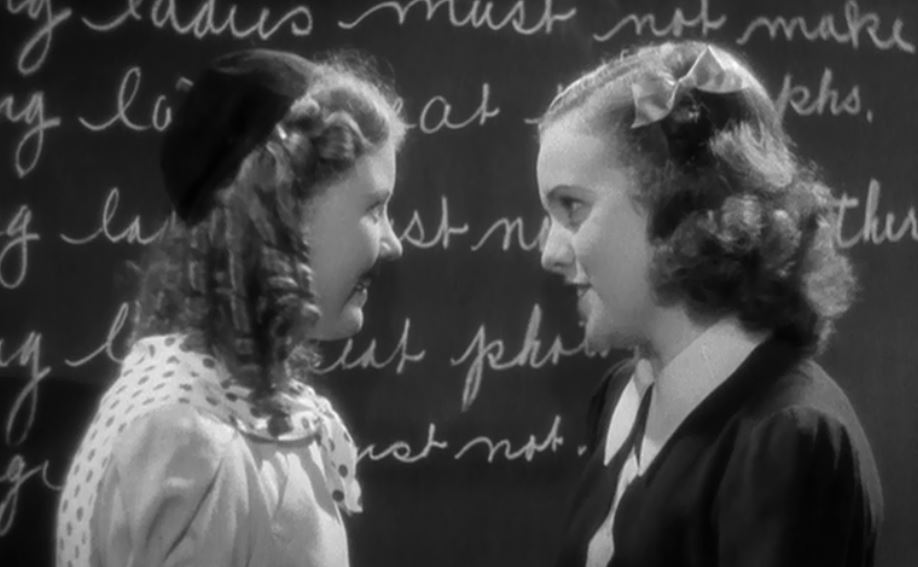
In Mad About Music, Durbin plays Gloria Harkison a student at a girls-only boarding school in Switzerland. Gloria’s mother is the famous movie actress Gwen Taylor (Gail Patrick). On the advice of her manager Dusty Turner (William Frawley), Gwen keeps the fact that she’s a widow with a teenage daughter a secret. Because Gloria can’t reveal her mother’s true identity, she invents a globetrotting explorer father who writes her letters and sends her photographs of his exploits. Of course Gloria writes the letters herself. She reads them out loud to her schoolgirl friends, much to their delight, except for the leader of the mean girls, Felice (Helen Parrish). Felice thinks that Gloria is a fake and that she’s been lying about having a father. Felice makes it her goal to expose Gloria as a liar. Gloria, on the other hand, is desperate to keep the tales of her “father” alive. Her desperation turns to inspiration as she enlists the help of an unsuspecting traveler.

Deanna Durbin reads a letter from her “father.”
Richard Todd (Herbert Marshall) is a composer on vacation in Europe who has planned a five-day stay in Switzerland, traveling with his private secretary and valet (Arthur Treacher). Richard has no idea the turn his life is about to take when he runs into Gloria at the train station. Gloria tells her roommate and best friend Olga (Marsha Mae Jones) that her father is arriving for a visit by train. Gloria asks Olga not to tell anyone, but Olga lets the cat out of the bag and not only is Gloria at the train station meeting her “father,” but all the girls from her school are there, including arch nemesis, Felice. With a bouquet in her arms, Gloria picks Richard out of the train passengers. She tells Richard, that “it’s an old Swiss custom to greet the most distinguished looking visitor on every train.” To keep the ruse alive, while her schoolmates are watching, Gloria insists on taking Richard to his hotel. By escorting Richard into the hotel, right up to the elevator, Gloria convinces her friends that Richard is her father.

Durbin and Jackie Moran
In the midst of Gloria’s subterfuge, she has a puppy-love romance with Tommy, a cadet from a nearby boys academy. While she’s pretending to be Richard’s daughter at the train station, Tommy is waiting for Gloria at a local sweet shop where he asked her out on a date. Gloria arrives late for their date due to meeting Richard at the train station and transporting him to the hotel. Tommy gives Gloria a huge box of chocolates which she brings back to school, telling her pals they’re a gift from her father.

Universal Studios version of a Swiss village on the back lot
When Annette Fusenot (Elisabeth Risdon), one of the instructors/administrators at the boarding school, hears that Gloria’s father is visiting, she and her sister and colleague at the school, Louise (Nana Bryant), invite him to luncheon. When Richard arrives at the school, he is determined to set the record straight and expose Gloria’ big lie. As he enters the school and sees the lineup of Gloria’s classmates to greet him, he changes his mind. Being the sophisticated and debonair man that he is, the girls are enthralled with “Mr. Harkinson’s” tales of adventure. Felice even seems to be coming around due to Richard’s graciousness and charm.

Herbert Marshall and Durbin entertain her schoolmates.

Gloria’s happiness comes to an end when Richard leaves for Paris. After losing her “father,” Gloria is longing to see her mother, who is currently in Paris on a publicity tour. Determined to visit her, Gloria runs away from school, boarding the same Paris-board train that Richard is on. Without a ticket, the train’s conductor locks Gloria in a small room. She tells the conductor that her father is on the train, but he doesn’t believe her. To get Richard’s attention, Gloria starts singing, which draws a crowd and eventually Richard who tells the conductor that she is indeed his daughter. Dusty Taylor tries to keep Gloria away from her mother fearing it will be the end of her career as a movie “glamour girl.” Richard is determined that Gloria gets to visit her mother by barging into the press conference she is having at her hotel. Upon seeing Gloria with Richard, Gwen tells the crowd of reporters that she has a 14-year-old daughter. At first, Gloria doesn’t want to acknowledge this fact, but when she sees that her mother wants it this way, she breaks down in tears and the two embrace.

Patrick, Durbin, and Marshall together as a family
Through all the confusion, it now appears as though the family has been reunited and that includes Richard! So of course, Gwen and Richard become a couple and Gloria not only has her mother back in her life, but a father too.

Summing Up
Mad About Music is an example of the Hollywood studio system at its best. Even with Durbin’s obvious talents, it took the geniuses at Universal to package just the right vehicles for her. Her first producer and mentor, Joeseph Pasternak (he produced 10 of her films, all at Universal) realized that Durbin was a true star and helped develop her God-given talent. It’s no secret that Durbin was unhappy toward the end of her film career, complaining that her roles were awful, even though she was still popular with moviegoers and was one of Hollywood’s highest paid actresses. After retiring, she resisted every attempt to lure her back into the spotlight. When Pasternak moved to MGM, he practically begged Durbin to come with him. She surely would have benefited from the strong musical units at that studio, but she would not be tempted. Instead she lived the rest of her days in relative obscurity in a small town outside of Paris, France.

In their review of Mad About Music, Variety said this about Durbin, “She has acquired more varied technique before the camera, without losing her ingenuous charm nor her luminous screen personality.”

Durbin’s impact on film audiences around the world cannot be understated. She was a favorite of Anne Frank. Durbin’s picture from a movie fan magazine still hangs in her bedroom at the Anne Frank Museum in Amsterdam. Indian filmmaker Satyajit Ray admitted during his Special Oscar acceptance speech: “As a small schoolboy I was terribly interested in the cinema, became a film fan, wrote a letter to Deanna Durbin, got a reply, was delighted: wrote to Ginger Rogers, ah, didn’t get a reply. Then, of course, I got interested in cinema as an art form, and I wrote a twelve-page letter to Billy Wilder after seeing Double Indemnity. He didn’t reply either…Well, there you are.”

Way to go Deanna!

Backstory
Deanna Durbin is known for having a beautiful voice, but her movies aren’t typical musicals, but rather movies with music. Mad About Music is no exception. In between escapades, Durbin sings three new songs: “I Love To Whistle,” “Chapel Bells,” and “A Serenade to the Stars.” She also sings “Ave Maria” with the Vienna Boys Choir, although the boys seen singing on screen were members of Saint Luke’s Church choir of Long Beach, California.

Helen Parrish, Durbin, and Marcia Mae Jones ride (and sing) through the Swiss countryside.

Some of Mad About Music’s Familiar Faces
Herbert Marshall was still considered a leading man in Hollywood at the time of Mad About Music’s release. Ironically, he played the “husband” of Margaret Sullavan in The Good Fairy in 1935. Sullavan’s character picks his name out of the phone book at random and tells a lecherous meat packer, played by Frank Morgan, that Marshall’s character is her husband to avoid his advances.

Durbin celebrates her sweet 16 birthday with Arthur Treacher, Marshall, director Norman Taurog, and producer Joe Pasternak.
Marcia Mae Jones who plays Durbin’s best friend would be the head of the mean girls in the Shirley Temple feature, The Little Princess, the next year.

 Jones and  Durbin
Helen Parrish was to Durbin what Jane Withers was to Shirley Temple. Parrish also played Durbin’s rich, stuck-up cousin in First Love. Parrish could also be a good girl, playing one of Durbin’s older sisters in Three Smart Girls Grow Up. In reality, Durbin and Parrish were the best of friends.

Durbin and Helen Parrish, finally friends in Mad About Music

Arthur Treacher made a career playing butlers in the movies, including this one and several he made with Shirley Temple.

Durbin, Marshall, and Treacher
Jackie Moran, who played Durbin’s romantic interest in Mad About Music was discovered by Mary Pickford. After appearing in Mad About Music, Moran had a small part in Gone With The Wind, playing Doctor and Mrs. Meade’s younger son who wanted to join the Confederate Army so he could “kill all the Yankees” to avenge the death of his older brother. He and Marcia Mae Jones starred in several films for Poverty Row studio Monogram Pictures. In 1944, he exchanged flirtatious glances with Shirley Temple in Since You Went Away.

Jackie Moran and Durbin

William Frawley had a long show business career, that includes classic films like Lady on a Train and Miracle on 34th Street, but is best known today as Fred Mertz in the TV classic I Love Lucy.

Elisabeth Risdon and Nana Bryant who play sisters and teachers Annette and Louise Fusenot, respectively, were in the screwball comedy classic Theodora Goes Wild two years earlier. Risdon played Irene Dunne’s Aunt Mary. Bryant played Ethel Stevenson, the wife of Dunne’s publisher, .

Gail Patrick had played mean women in movies like My Man Godfrey and Stage Door, but gets to play a loving, if conflicted mother in Mad About Music. Rarely a sympathetic character in her early film roles, Patrick shows her versatility with her brief, but warm portrayal.

Mother and child reunion: Patrick and Durbin
Sid Grauman appears as himself in Mad About Music. In the film he says he’s saved a space for Gwen Taylor’s (Gail Patrick) hand and footprints at the Chinese Theater. In reality, it was Durbin who would have her hand and footprints memorialized in cement at the famous theater for Mad About Music’s premier.

Durbin with Grauman getting her footprints in cement at the Chinese Theatre

Monday, February 24, 2025

William Powell and Carole Lombard in “My Man Godfrey”.

My Man Godfrey (1936) is an American screwball comedy directed by Gregory La Cava and starring William Powell and Carole Lombard. The film is based on a short novel, 1101 Park Avenue by Eric S. Hatch. My Man Godfrey is considered one of the best screwball comedies of all time. In 1999, the film was deemed “culturally significant” by the United States Library of Congress and selected for preservation in the National Film Registry.

Carole Lombard and William Powell

During the Great Depression, two socialite sisters, Cornelia and Irene Bullock (Gail Patrick and Carole Lombard respectively) are competing in a charity scavenger hunt and need to find a “forgotten man.” They come across a man living in a New York City dump, but Cornelia gets to him first. She offers Godfrey Smith (William Powell) $5 if he will come play along and help her win the scavenger hunt. Godfrey finds Cornelia’s attitude annoying and backs her up into an ash pile. Irene who has been watching the whole episode ends up speaking with Godfrey who finds her to be kind, but a little bit crazy, and decides to help her. Irene drives the two of them to the Waldorf-Ritz Hotel where she presents Godfrey as her forgotten man. Irene wins the scavenger hunt and is so grateful that she offers Godfrey a job as a butler in her family’s home. Little does Godfrey realize that the Bullock family is quite eccentric and hasn’t been able to keep a butler for more than a few days. 

Gregory La Cava (1892 – 1952) was an American film director best known for several landmark films from the 1930s including My Man Godfrey and Stage Door (1937). La Cava was born in Pennsylvania and studied at the Art Institute of Chicago. La Cava directed many of the top stars during his heyday including Irene Dunne, Helen Hayes, Constance Bennett, Charles Boyer, Claudette Colbert, Joel McCrea, Melvin Douglas, and Katharine Hepburn. LaCava directed Ginger Rogers in three films in three years: Stage DoorFifth Avenue Girl (1939), and Primrose Path (1940).

William Powell (1892 – 1984) was an American actor who was most famous for the Thin Man series in which he co-starred with Myrna Loy. Loy and Powell made 14 films together. Powell was nominated for the Academy Award for Best Actor three times: The Thin Man (1934), My Many Godfrey (1936), and Life With Father (1947). Powell was under contract to Paramount, Warner Bros., and Metro-Goldwyn-Mayer where he had his greatest success. Some of Powell’s popular films include Manhattan Melodrama (1934), The Great Ziegfeld (1936), Libeled Lady (1936), The Last of Mrs. Cheney (1937), Love Crazy (1941), Life with Father (1947), The Senator Was Indiscreet (1947), Dancing in the Dark (1949), How to Marry a Millionaire (1953), and Mister Roberts (1955).

Clark Gable and Carole Lombard on their wedding day

Carole Lombard (1908 – 1942) was an American film actress who gained great fame starring in screwball comedies. So popular was she as a comedic actress that Life magazine dubbed her “The Screwball Girl.” He got her start in silent films as a child and progressed to more important roles when a car accident almost ended her career. Glass from the car’s windshield cut up her face leaving her with a small scar. She eventually hit the big time in 1934 with her breakout performance in Twentieth Century co-starring John Barrymore. The film directed by Howard Hawks (a distant cousin of Lombard’s) lead to better roles and eventually superstardom. In Lombard’s short career, she appeared in several iconic films including My Man GodfreyNothing Sacred (1937), Mr. & Mrs. Smith (1941) directed by Alfred Hitchcock, and To Be or Not to Be (1942). At the height of her career, Lombard died in a plane crash while returning from a bond tour. At the time of her death, she was married to Clark Gable. Together they were one of Hollywood’s original power couples.

The excellent supporting cast includes Alice Brady, Gail Patrick, Jean Dixon, Eugene Pallette, Alan Mowbray, Mischa Auer, and Franklin Pangborn. 

My Man Godfrey trivia:

  • It was the first movie to be nominated in all four acting categories.
  • Marion Davies, Constance Bennett, and Miriam Hopkins were all considered for the role of Irene.
  • William Powell and Carole Lombard were once husband and wife and had been divorced for three years when they made the film.
  • Jane Wyman has an uncredited role standing in the crowd at the Waldorf-Ritz Hotel.
  • Gail Patrick (Cornelia) played Irene’s (Lombard) older sister, but in reality, she was almost three years younger.

Click HERE to watch the film on YouTube.


Click HERE to join the online discussion on March 3, 2025, at 6:30 p.m. Central Time. Once you RSVP, you will receive an email with an invitation and a link to join the discussion on Zoom.

Questions for discussion:

  1. Is there a serious message amidst all the comedy? If yes, what is it?
  2. What do you think motivated Godfrey to get back on his feet?
  3. Did you have a favorite supporting character?
  4. Did Lombard and Powell have believable screen chemistry?
  5. Why do you think the film has remained a classic 85 years after its initial release?

Friday, December 30, 2011

Classic Movie Man’s Top Posts of 2011

The Year in Review
As 2011 comes to a close, I thought it would be fun to revisit the top-ten posts of the year. We lost some classic movie legends, including Elizabeth Taylor and Farley Granger. This year, Classic Movie Man taught another film class at Facets Film School: Elegant and Madcap: The Incredible Versatility of Irene Dunne. It was great fun introducing this remarkable actress and movie star to folks who were not familiar with her body of work.

Below are the top-ten Classic Movie Man posts for 2011. Are any of your favorites on this list?

Number 10Classic Movie Man’s Guilty Pleasure: “Devotion” This fictionalization of the lives of the Brontë sisters was short on the facts (according to critics of the day), but is great melodrama with Ida Lupino as Emily and Olivia de Haviland as Charlotte. Paul Henried, Nancy Coleman, and Arthur Kennedy round out the talented cast. The film score by Erich Wolfgand Korngold is lush and beautiful, as is the movie’s overall production.


Number 9Jeanne Crain: More Than Just a Pretty Face. A personal favorite of mine, Crain was one of the most popular movie stars during the late-1940s to early-1950s. So popular was Crain that when she passed away in 2003, Turner Classic Movies’ Robert Osborn called her “the Julia Roberts of the day.” She appeared in some great films, including A Letter to Three Wives, Apartment for Peggy, and Pinky, the latter earning Crain her only Academy Award nomination for Best Actress.

Fred MacMurray
Number 8Farley Granger, star of Hitchcock’s “Strangers on a Train.” Granger was a product of the Hollywood dream factory. Plucked from obscurity and signed to a movie contract by Samuel Goldwyn, he was featured in some popular films during the mid-1940s like The Purple Heart and The North Star. While under contract to Goldwyn, Granger’s best roles were a result of being loaned out to other studios. Two of his most famous films, Rope and Strangers on a Train both directed by Alfred Hitchcock, were made on loan to Warner Bros.

Number 7Fred MacMurray: Nice-Guy Movie Star. Mostly remembered today for his iconic TV role as Steven Douglas in My Three Sons, MacMurray had a substantial movie career. In fact, MacMurray was the highest paid movie star in the world in 1943.

Number 6Ida Lupino: A Lasting Legacy in Hollywood. Lupino not only was a great movie star, but she was a writer, director, and producer of independent films in the late-1940s and 50s. She was one of the only women directors working in Hollywood, directing classic TV episodes of The Twilight Zone, Alfred Hitchcock Presents, and The Untouchables. In 1966, Lupino finally got a big budget production to direct: The classic comedy The Trouble With Angels starring Rosalind Russell and Halley Mills.

Number 5Classic Movie Man’s Guilty Pleasure: “Elephant Walk.” This action-adventure melodrama starred a very young Elizabeth Taylor, Dana Andrews, and Peter Finch. Released in 1954, the main action takes place on a Ceylon tea plantation run by Finch. Feeling neglected, Taylor turns to overseer Andrews. Some great color cinematography and those stampeding elephants make this a fun movie to watch.

A lovely studio portrait of the very lovely Joan Bennett
Number 4“Jane Eyre”: A Golden Age Classic. One of my favorite classic films, I thought a review was in order when a new version by director Cary Fukunaga released this past spring. Featuring beatuiful black and white cinematography and a wonderful performance from Joan Fontaine as Jane. Orson Welles is a little over-the-top as Rochester, but it doesn’t take anything away from the overall production. It also features a young unbilled Elizabeth Taylor as Jane’s doomed childhood friend Helen.

Number 3Joan Bennett: Almost Scarlet O’Hara, But Always a Star. Bennett almost snagged the role of Scarlet O’Hara, but she got over that disappointment fairly quickly. She starred in musicals, comedies, and dramas, becoming one of the screen’s great femme fatales. Bennett gave terrific performances in three films directed by Fritz Lang: Man Hunt, Scarlet Street, and The Woman in the Window. After her movie glory days were over, she became a pop-culture icon as Elizabeth Collins Stoddard in daytime TV’s Gothic soap opera Dark Shadows. She was also one of the few actresses who could realistically play mother to Elizabeth Taylor (she physically looked as beautiful). She did this twice in Father of the Bride and Father’s Little Dividend.

Elizabeth Taylor
Number 2This Island Earth: 1950s Science Fiction Classic. One of the best flying saucer flicks, the film benefits from a decent script, great special effects, and more than competent performances by the three lead performers: Rex Reason, Faith Domergue, and Jeff Morrow.

Number 1Elizabeth Taylor: Born To Be a Star. With Taylor’s passing, an era passed with her. One of the last great movie stars to come out of the studio system, she epitomized Hollywood style and glamour. Her beautiful looks notwithstanding, Taylor gave some memorable screen performances and won two Best Actress Academy Awards during her long career. As famous for her well-publicized off-screen life, she was the quintessential movie star.

Thanks for reading the Classic Movie Man blog in 2011. I hope you’ll continue to read and follow this blog into 2012 and beyond!

Friday, January 15, 2021

William Powell and Carole Lombard in “My Man Godfrey”

My Man Godfrey (1936) is an American screwball comedy directed by Gregory La Cava and starring William Powell and Carole Lombard. The film is based on a short novel, 1101 Park Avenue by Eric S. Hatch. My Man Godfrey is considered one of the best screwball comedies of all time. In 1999, the film was deemed “culturally significant” by the United States Library of Congress and selected for preservation in the National Film Registry.

Carole Lombard and William Powell

During the Great Depression, two socialite sisters, Cornelia and Irene Bullock (Gail Patrick and Carole Lombard respectively) are competing in a charity scavenger hunt and need to find a “forgotten man.” They come across a man living in a New York City dump, but Cornelia gets to him first. She offers Godfrey Smith (William Powell) $5 if he will come play along and help her win the scavenger hunt. Godfrey finds Cornelia’s attitude annoying and backs her up into an ash pile. Irene who has been watching the whole episode ends up speaking with Godfrey who finds her to be kind, but a little bit crazy, decides to help her. Irene drives the two of them to the Waldorf-Ritz Hotel where she presents Godfrey as her forgotten man. Irene wins the scavenger hunt and is so grateful that she offers Godfrey a job as a butler in her family’s home. Little does Godfrey realize that the Bullock family is quite eccentric and hasn’t been able to keep a butler for more than a few days. 

Myrna Loy and Powell in The Thin Man

Godfrey is a success as a butler impressing the entire family especially Irene who finds herself falling in love with him. But Godfrey has a secret and Cornelia, who has held a grudge since she fell in the ash pile, is determined to expose it.


Gregory La Cava (1892 – 1952) was an American film director best known for several landmark films from the 1930s including My Man Godfrey and Stage Door (1937). La Cava was born in Pennsylvania and studied at the Art Institute of Chicago. La Cava directed many of the top stars during his heyday including Irene Dunne, Helen Hayes, Constance Bennett, Charles Boyer, Claudette Colbert, Joel McCrea, Melvin Douglas, and Katharine Hepburn. LaCava directed Ginger Rogers in three films in three years: Stage Door, Fifth Avenue Girl (1939), and Primrose Path (1940).

William Powell (1892 – 1984) was an American actor who was most famous for the Thin Man series in which he costarred with Myrna Loy. Loy and Powell made 14 films together. Powell was nominated for the Academy Award for Best Actor three times: The Thin Man (1934), My Many Godfrey (1936), and Life With Father (1947). Powell was under contract to Paramount, Warner Bros., and Metro-Goldwyn-Mayer where he had his greatest success. Some of Powell’s popular films include Manhattan Melodrama (1934), The Great Ziegfeld (1936), Libeled Lady (1936), The Last of Mrs. Cheney (1937), Love Crazy (1941), Life with Father (1947), The Senator Was Indiscreet (1947), Dancing in the Dark (1949), How to Marry a Millionare (1953), and Mister Roberts (1955).

Clark Gable and Carole Lombard on their wedding day

Carole Lombard (1908 – 1942) was an American film actress who gained great fame starring in screwball comedies. So popular was she as a comedic actress that Life magazine dubbed her “The Screwball Girl.” He got her start in silent films as a child and progressed to more important roles when a car accident almost ended her career. Glass from the car’s windshield cut up her face leaving her with a small scar. She eventually hit the big time in 1934 with her breakout performance in Twentieth Century co-starring John Barrymore. The film directed by Howard Hawks (a distant cousin of Lombard’s) lead to better roles and eventually superstardom. In Lombard’s short career, she appeared in several iconic films including My Man Godfrey, Nothing Sacred (1937), Mr. & Mrs. Smith (1941) directed by Alfred Hitchcock, and To Be or Not to Be (1942). At the height of her career, Lombard died in a plane crash while returning from a bond tour. At the time of her death, she was married to Clark Gable. Together they were one of Hollywood’s original power couples.

The excellent supporting cast includes Alice Brady, Gail Patrick, Jean Dixon, Eugene Pallette, Alan Mowbray, Mischa Auer, and Franklin Pangborn.


My Man Godfrey trivia:

  • Was the first movie to be nominated in all four acting categories.
  • Marion Davies, Constance Bennett, and Miriam Hopkins were all considered for the role of Irene.
  • William Powell and Carole Lombard were once husband and wife and had been divorced for three years when they made the film.
  • Jane Wyman has an uncredited role standing in the crowd in the Waldorf-Ritz Hotel.
  • Gail Patrick (Cornelia) played Irene’s (Lombard) older sister, but in reality, was almost three years younger.


To watch the film on YouTube, click on the link below.


To join us for a discussion on Zoom on January 19, 2021, at 6 p.m. Central Time, click here. Once you RSVP, you will receive an email with an invitation to the discussion with the appropriate links. 


Questions for discussion:

  1. Is there a serious message amidst all the comedy? If yes, what is it?
  2. What do you think motivated Godfrey to get back on his feet?
  3. Did you have a favorite supporting character?
  4. Did Lombard and Powell have believable screen chemistry?
  5. Why do you think the film has remained a classic 85 years after its initial release?


Tuesday, November 28, 2023

Clark Gable and Claudette Colbert in Frank Capra’s “It Happened One Night”

It Happened One Night (1934) is an American romantic comedy directed by Frank Capra and starring Clark Gable and Claudette Colbert. The supporting cast includes Walter Connolly, Roscoe Karns, and Alan Hale. The film was produced by Capra and Columbia Pictures studio head Harry Cohn. The script was written by Robert Riskin. The cinematography was by Joseph Walker (The Awful Truth, It’s a Wonderful Life, Born Yesterday).

Heiress Ellen “Ellie” Andrews (Colbert) has eloped with King Westley (Jameson Thomas), a fortune-hunting pilot, against her rich industrialist father Alexander Andrews’s (Walter Connolly) wishes. Ellie’s father wants to have the wedding annulled but Ellie has other plans. Ellie runs away from her father and takes a bus to New York City to reunite with Wesley. On the bus, Ellie meets Peter Warne (Gable), a newspaper reporter who just lost his job. When he realizes that he’s traveling with the runaway heiress, Warne makes a deal with Ellie that he will keep quiet and not expose her identity if she gives him an exclusive on her love story with Wesley. If she doesn’t, Peter will tell her father where she is.

As the two traveling companions evade her father and his detectives, they fall in love.

Will Peter and Ellie be able to sustain their love, or will Ellie’s father and King Wesley have something to say about it?


Frank Capra (1897 - 1991) was an American film director, producer, and writer. During the 1930s and 1940s, Capra’s films were among the most popular and awarded films. By 1938, Capra has won three Best Director Academy Awards. Born in Italy, Capra immigrated to the United States with his family when he was five years old. By sheer determination and his self-described cockiness, Capra talked his way into the movie business. He found a great home at “Poverty Row” studio, Columbia Pictures. At Columbia he had a major success with It Happened One Night (1934), which swept all the major categories at the Academy Awards that year. This helped turn Columbia Pictures from a Poverty Row studio into a major one. Other Capra successes include You Can’t Take It with You (1938), Mr. Smith Goes to Washington (1939), and It’s a Wonderful Life (1946).

Clark Gable (1901 – 1960) was an American film actor. Gable was one of the most consistent box office stars in the history of movies. He won an Academy Award for Best Actor for his role in the landmark romantic comedy It Happened One Night (1934) directed by Frank Capra. As “The King” of Hollywood, Gable starred alongside some of the biggest female stars of their day including Joan Crawford, Myrna Loy, Jean Harlow, Lana Turner, Norma Shearer, and Ava Gardner. Gable received two additional Best Actor nominations for Mutiny on the Bounty (1935) and Gone With the Wind (1939), one of the biggest money-makers of all time. Gables third wife was the legendary Carole Lombard. Gable married Lombard in 1939 and ended with her tragic death in a plane crash in 1942. Other Gable films include San Francisco (1937), Test Pilot (1938), Boom Town (1940), Honky Tonk (1941), Command Decision (1948), Teacher’s Pet (1958), It Started in Naples (1960), and The Misfits (1961), his last film before his death at 59.

Claudette Colbert (1903 -1996) was an American stage, film, and television actress. She is perhaps best known for her role as Ellie Andrews in Frank Capra’s It Happened One Night (1934). For her role in that film, she won the Academy Award for Best Actress. She was nominated two other times in that category. Colbert got her start in the theater where she played a variety of ingenue roles. In 1928, she signed a contract with Paramount Pictures where she quickly made a succession of movies. Her breakout role came in 1932 in The Sign of the Cross (1932) starring Fredric March and Charles Laughton. In 1934, she made three films that were nominated for the Academy Award for Best Picture: Imitation of Life, Cleopatra, and the eventual winner, It Happened One Night. No one had been able to match that record. Other popular films include I Met Him in Paris (1937), Drums Along the Mohawk (1939), Midnight (1939), The Palm Beach Story (1942), Since You Went Away (1944), and The Egg and I (1947).


It Happened One Night trivia

  • Both Clark Gable and Claudette Colbert didn’t want to make the film. Gable was on loan to Columbia Pictures, which was considered a punishment by the star. Columbia was a minor studio, part of  “poverty row.” Colbert had worked with Frank Capra on a silent film, which wasn’t a pleasant or successful experience.
  • At first, Colbert refused to show her leg in the hitchhiking scene. When she saw the body double’s leg, she changed her mind saying, “That’s not my leg!”
  • It was the first film to win the top five Academy Award categories: Best Picture, Best Director, Best Actor, Best Actress, and Best Screenplay. The other films to win the Oscar “grand slam” are One Flew Over the Cuckoo’s Nest (1975) and The Silence of the Lambs (1991).
  • Constance Bennett and Myrna Loy turned down the script. Colbert only agreed to do the picture because Capra agreed to double her salary and not be required to work for more than four weeks. Bette Davis wanted the role of Ellie, but Warner Bros. wouldn’t loan her to Columbia. Miriam Hopkins, Margaret Sullivan, and Carole Lombard also turned down the role.
  • Robert Montgomery and Fredric March both turned down the role of Peter Warne.                             

Click here to watch the film on YouTube.


Click here to join the discussion on December 4, 2023, at 6:30 p.m. Central Time. Once you RSVP, you will receive an invitation with a link to join the discussion on Zoom.


Discussion questions

  1. Some critics consider the film a screwball comedy. Would you put it in that category?
  2. This film basically wrote the template for all romantic comedy films that came after it. Do you know any modern romantic comedies that owe a debt to It Happened One Night?
  3. What did you think of the chemistry between Gable and Colbert? Was it believable?
  4. Did you have a favorite scene or line of dialogue?
  5. Considered one of the best films ever made, do you think its reputation is well deserved?


Related Posts Plugin for WordPress, Blogger...